Developing Your
Communicative Competence
Interactive English, Listening,
Speaking and Grammar
Theory of Communicative Competence
• Knowledge about the form or structure of a
language isn’t a guarantee of being able to use it
in actual communication situations.
• No evidence that students who do well on tests
will excel in their careers.
• Castillo: from form and structure of language to
functions of language.
• Language learning needs and communications
situations become the crucial point of teaching.
Theory of Communicative Competence
• Focused on grammar or rules of correct
usage for one’s language structure or form
mastery.
• Basic Principle of a structure-based
language teaching method: Audio-Lingual
method or the Aural-Oral approach (new
key approach to language teaching)
Theory of Communicative Competence
• The advent of a new belief: language is
acquired in the context of natural situations.
• Language Competence is seen as focusing
not on grammar or the structure of
language alone but on its wider SOCIO-
CULTURAL AND EXTRA-LINGUISTIC
CONTEXT.
Theory of Communicative Competence
• Framework of communicative
competence is associated with notions of
language functions. (language functions
– grammatical points)
• Grammatical Competence is mastery of
the linguistic code; the ability to
recognize:
Theory of Communicative Competence
• lexical (spelling),
• morphological (meaning-bearing units of
a language),
• syntactical (meaning),
• and phonological (sounds) features to
form words and sentences.
Theory of Communicative Competence
• Learners in a communicative classroom learn to
use a rule of usage/grammar, not to state as was
the intent of language teaching using the audio-
linguistic method.
• In Communicative Approach, both
form/structure and meaning in language are
emphasized
• Language use and usage are two different
aspects.
Theory of Communicative Competence
4 Dimensions of Communicative Comp.:
• 1. Grammatical Competence – linguistic
competence, mastery of linguistic code,
ability to recognize the lexical (spelling),
morphological (meaning-bearing units of a
language), syntactical (meaning), and
phonological (sounds) features to form
words and sentences demonstrated by the
ability to use a rule, not to state a rule.
Theory of Communicative Competence
4 Dimensions of Communicative Comp.:
• 2. Sociolinguistic Competence –
understanding and knowledge of the social
rules of language. The social context in
which language is used; the roles of
participants; the information they share and
the function of interaction has to do with
the appropriateness of an utterance.
Theory of Communicative Competence
4 Dimensions of Communicative Comp.:
• 3. Discourse Competence – ability to
produce and understand a series of
utterances that form a meaningful whole
• 4. Strategic Competence – ability to
compensate for the communication
breakdown and for imperfect knowledge of
rules; like coping or survival strategies.
Theory of Communicative Competence
• Language Teaching Approach = Rules of
Usage and Rules in Language or CLT
• CLT – Communicative Language Teaching
or CA (Communicative Approach)
Communication Principles
Theory of Communicative Competence
Principles of CLT or CA:
• 1. Communication involves much more than
simply knowledge of forms; depends on the
ability to use forms in appropriate ways.
• Not only knowing the rules of grammar but
also how to use the language skills in socio-
cultural context the learners are exposed to.
Communication Principles
Theory of Communicative Competence
Principles of CLT or CA:
• 2. Communication should result in the
performance of some real and specific
tasks in a foreign language.
• This calls for the ability of the language
learner to use language in actual
situations
Communication Principles
Theory of Communicative Competence
Principles of CLT or CA:
• 3. Communication cannot be easily analyzed into
component features without its nature being
destroyed in the process.
• It’s not enough to be able to decipher or produce
individual elements of the message. What is needed
is the ability to work in the context of the whole.
• The meaning of the message should not be taken
based on individual elements but the whole meaning
of the message.
Communication Principles
Theory of Communicative Competence
Principles of CLT or CA:
• 4. The 3 vital processes of communication are as
follows
• A. Information gap. Communication entails
information transfer in order to connect lapses
interaction.
• B. Choice. Communication involves choosing the
ideas to be expressed at a given moment and
likewise adopting the appropriate linguistic forms to
verbalize such concepts.
Communication Principles
Theory of Communicative Competence
Principles of CLT or CA:
• C. Feedback. Communication must
adequately provide practice in using
language for real purposes that is the
verbalization of the speaker’s aims in
everyday interaction.
Communication Principles
Theory of Communicative Competence
• 5. The aforementioned processes of
communication can be solely
implemented through practicing
communicative activities thus affirming a
cardinal tenet of learning – that is, one
learns to do by doing.
Communication Principles
Theory of Communicative Competence
• 6. Communication is severely hampered
by a number of glaring grammatical and
phonological mistakes
Communication Principles
Theory of Communicative Competence
• Inferred by authorities in the field of
language teaching methodology:
• 1. The emphasis of the communicative
approach lends heavily on teaching
communication competence, socio-
linguistic competence (Canale and Swain:
1980)
Salient Features of the CA
Theory of Communicative Competence
• 2. The communicative approach affords the
second language learners optimum practice
in the use of the target language in as much
as the corresponding repertoire of
communicative techniques and activities
promote greater interaction between
learner and teacher and among learners.
Salient Features of the CA
Theory of Communicative Competence
• 3. The communicative method’s concentration
on aspects of the use of language results in the
commission of mistakes, particularly of grammar;
however, formal accuracy must be sacrificed for
language use.
• Obvious errors in language forms though,
demand the language teacher’s immediate
attention and rectification (correction) (Morrow:
1994)
Salient Features of the CA
Theory of Communicative Competence
• 4. Learning to use the language at the
discourse or above the sentence level offers
the students adequate activities in cohesion
(how we join sentences together to form
grammatical units) and coherence (how we
organize our sentences to form sense units,
a meaningful flow of ideas). (Freeman:
1986)
Salient Features of the CA
Theory of Communicative Competence
Grammatical units
• Morpheme- smallest unit of speech
• word- meaningful unit
• phrase- string of words
• clause- group of words
• Sentence- meaningful linguistic unit
Salient Features of the CA
Theory of Communicative Competence
Grammatical units
E.g.
The man whom you have seen is one of the
best Vietnamese pianists.
Salient Features of the CA
Theory of Communicative Competence
• 5. In communicative-oriented classrooms,
the seating arrangement adopted
concretizes the invariable nature of group
dynamics – that is, chairs are arranged in
small groups, not in regimental rows.
• Such convenient structuring ensures
maximum structuring and maximum
student interaction and participation.
(Morrow: 1993)
Salient Features of the CA
Theory of Communicative Competence
• 6. The teacher facilitates his/her students’
learning by establishing situations likely to
promote communication.
• During the activities, s/he likewise acts as an
advisor – that is, answering students’
questions and monitoring as a co-
communicator and engages in the
communicative activity along with the
students (Morrow: 1993).
Salient Features of the CA
Theory of Communicative Competence
• 1. Speaking. A communicative approach
to speaking emphasizes the use of
language above the level of the sentence.
• 2. Listening. This language skill cannot be
isolated from other language skills.
4 Skills in CLT
Theory of Communicative Competence
• 3. Reading. Reading is carried out for the
purpose. It is done in order to obtain information
which is presented in written form.
• The trend in current practice is towards
developing reading techniques such as scanning
(to locate a known item), search reading (for
information), skimming (to gain an idea of the
organization of the text), receptive reading (to
discover accurately what the writer wishes to
convey), and responsive reading (to reflect upon
what the writer has written). (White: 1993)
4 Skills in CLT
Theory of Communicative Competence
• 1. Role Playing
Highlights
Reduces the artificiality of the classroom
Provides a reason for talking
Allows the learner to talk meaningfully to other
learners.
Enables the students to choose whatever language
he or she pleases
Develops the character of situation as the student
wishes
Procedures & Techniques
Theory of Communicative Competence
Procedures
• Setting of the situation. The teacher
outlines the situation for the students to
understand the nature of the role play.
• Role Preparation. The teacher allows the
students to choose for themselves.
• The Role Play. A role play involve the whole
class but more often the smaller groups
within the class.
Procedures & Techniques
Theory of Communicative Competence
Procedures
• Follow up. A role play can be followed-up
in two ways: a) Corrections – During the
role play, the teacher should have been
making notes of mistakes and the most
serious ones pointed out afterwards;
Procedures & Techniques
Theory of Communicative Competence
Procedures
• b) Conversation and further activity –
Most role plays lend themselves to
discussion. Students can be asked to
write their own role play in the form of
language.
Procedures & Techniques
Theory of Communicative Competence
• 2. Simulations
Highlights
• Invites participation from students.
• Provides opportunities for creativity and
imagination.
• Offers those involved in the simulation a
chance to develop self-confidence and
exercise strategic competence.
Procedures & Techniques
Theory of Communicative Competence
Procedures
• Preparation
• The Simulation
• Follow-Up: Correction and further
activity
Procedures & Techniques
Theory of Communicative Competence
3. Games
Highlights
• Fosters natural, creative, authentic
language behavior
• Involves the use of functional categories
which will have wider applications
Procedures & Techniques
Theory of Communicative Competence
The Technique
• Based on observation and memory
• Based on interpretation
• Based on individual/group interaction
• Board Games, e.g. monopoly
• Card games, e.g. Tarot
• Pencil and paper games
Procedures & Techniques
Sample Activities to Develop CA
Role Playing and Simulations
Example 1
Look at a Road Map (Either duplicated or projected)
A stranger standing at point A asks the way to the bank
1. Excuse me.
2. Yes?
3. Could you tell me how to get to the bank, please?
4. Yes, of course. Go along this road as far as the
traffic lights. Then turn right into Kalaw Street and
its on the left.
5. Is it far?
6. No, not very far.
7. Thank you very much.
8. You’re welcome.
Example 2
Now, get a pair, taking turns to ask for and give
directions to a stranger standing at a certain point
who:
1. Wants to get to the City Hall
2. Wants to get to the post office
3. Wants to get to the church
4. Wants to get to the Fernando’s Supermarket
5. Wants to get to the GSIS
Example 3
Topic: The Miss Universe Pageant to take place in CCP Manila
Bay
• The planning committees work on finance, program, social
activities etc.
• A television newscast with interviews of key personalities
• A scene at the airport where one of the contestants has lost
her luggage, and other similar activities.
• Listening to discussions and interviews of beauty
contestants.
• Reading proposed financial report, agenda items, and
proposal to set the scene.
• Writing of invitations, planned questions for interviews…
Example 4
At the Post Office (Sturtridge: 1993)
A. I’d like to post this __________ please.
B. Put it on the scales. Where to?
A. To________________________.
B. That’ll be________________________.
A.________________________________.
B.________________________________.
Example 5
The Invitation (Sturtridge: 1993)
You meet your friend B at the supermarket. You are having a party
on Saturday and you would like B to come. The party is informal.
Tell B what time to come. Say how glad you are that s/he is coming.
Cues:
- We’re having a party…
- Are you doing anything on Saturday?
- It’s very informal…
- Come as you are.
- That’s great.
- That’ll be lovely
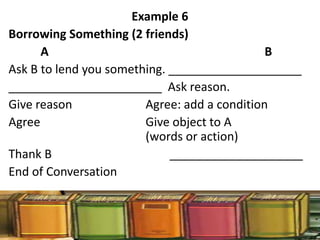
Example 6
Borrowing Something (2 friends)
A B
Ask B to lend you something. ____________________
_______________________ Ask reason.
Give reason Agree: add a condition
Agree Give object to A
(words or action)
Thank B ____________________
End of Conversation

Developing your Communicative Competence

  • 1.
    Developing Your Communicative Competence InteractiveEnglish, Listening, Speaking and Grammar
  • 2.
    Theory of CommunicativeCompetence • Knowledge about the form or structure of a language isn’t a guarantee of being able to use it in actual communication situations. • No evidence that students who do well on tests will excel in their careers. • Castillo: from form and structure of language to functions of language. • Language learning needs and communications situations become the crucial point of teaching. Theory of Communicative Competence
  • 3.
    Theory of CommunicativeCompetence • Focused on grammar or rules of correct usage for one’s language structure or form mastery. • Basic Principle of a structure-based language teaching method: Audio-Lingual method or the Aural-Oral approach (new key approach to language teaching) Theory of Communicative Competence
  • 4.
    Theory of CommunicativeCompetence • The advent of a new belief: language is acquired in the context of natural situations. • Language Competence is seen as focusing not on grammar or the structure of language alone but on its wider SOCIO- CULTURAL AND EXTRA-LINGUISTIC CONTEXT. Theory of Communicative Competence
  • 5.
    Theory of CommunicativeCompetence • Framework of communicative competence is associated with notions of language functions. (language functions – grammatical points) • Grammatical Competence is mastery of the linguistic code; the ability to recognize: Theory of Communicative Competence
  • 6.
    Theory of CommunicativeCompetence • lexical (spelling), • morphological (meaning-bearing units of a language), • syntactical (meaning), • and phonological (sounds) features to form words and sentences. Theory of Communicative Competence
  • 7.
    Theory of CommunicativeCompetence • Learners in a communicative classroom learn to use a rule of usage/grammar, not to state as was the intent of language teaching using the audio- linguistic method. • In Communicative Approach, both form/structure and meaning in language are emphasized • Language use and usage are two different aspects. Theory of Communicative Competence
  • 8.
    Theory of CommunicativeCompetence 4 Dimensions of Communicative Comp.: • 1. Grammatical Competence – linguistic competence, mastery of linguistic code, ability to recognize the lexical (spelling), morphological (meaning-bearing units of a language), syntactical (meaning), and phonological (sounds) features to form words and sentences demonstrated by the ability to use a rule, not to state a rule. Theory of Communicative Competence
  • 9.
    Theory of CommunicativeCompetence 4 Dimensions of Communicative Comp.: • 2. Sociolinguistic Competence – understanding and knowledge of the social rules of language. The social context in which language is used; the roles of participants; the information they share and the function of interaction has to do with the appropriateness of an utterance. Theory of Communicative Competence
  • 10.
    Theory of CommunicativeCompetence 4 Dimensions of Communicative Comp.: • 3. Discourse Competence – ability to produce and understand a series of utterances that form a meaningful whole • 4. Strategic Competence – ability to compensate for the communication breakdown and for imperfect knowledge of rules; like coping or survival strategies. Theory of Communicative Competence
  • 11.
    Theory of CommunicativeCompetence • Language Teaching Approach = Rules of Usage and Rules in Language or CLT • CLT – Communicative Language Teaching or CA (Communicative Approach) Communication Principles
  • 12.
    Theory of CommunicativeCompetence Principles of CLT or CA: • 1. Communication involves much more than simply knowledge of forms; depends on the ability to use forms in appropriate ways. • Not only knowing the rules of grammar but also how to use the language skills in socio- cultural context the learners are exposed to. Communication Principles
  • 13.
    Theory of CommunicativeCompetence Principles of CLT or CA: • 2. Communication should result in the performance of some real and specific tasks in a foreign language. • This calls for the ability of the language learner to use language in actual situations Communication Principles
  • 14.
    Theory of CommunicativeCompetence Principles of CLT or CA: • 3. Communication cannot be easily analyzed into component features without its nature being destroyed in the process. • It’s not enough to be able to decipher or produce individual elements of the message. What is needed is the ability to work in the context of the whole. • The meaning of the message should not be taken based on individual elements but the whole meaning of the message. Communication Principles
  • 15.
    Theory of CommunicativeCompetence Principles of CLT or CA: • 4. The 3 vital processes of communication are as follows • A. Information gap. Communication entails information transfer in order to connect lapses interaction. • B. Choice. Communication involves choosing the ideas to be expressed at a given moment and likewise adopting the appropriate linguistic forms to verbalize such concepts. Communication Principles
  • 16.
    Theory of CommunicativeCompetence Principles of CLT or CA: • C. Feedback. Communication must adequately provide practice in using language for real purposes that is the verbalization of the speaker’s aims in everyday interaction. Communication Principles
  • 17.
    Theory of CommunicativeCompetence • 5. The aforementioned processes of communication can be solely implemented through practicing communicative activities thus affirming a cardinal tenet of learning – that is, one learns to do by doing. Communication Principles
  • 18.
    Theory of CommunicativeCompetence • 6. Communication is severely hampered by a number of glaring grammatical and phonological mistakes Communication Principles
  • 19.
    Theory of CommunicativeCompetence • Inferred by authorities in the field of language teaching methodology: • 1. The emphasis of the communicative approach lends heavily on teaching communication competence, socio- linguistic competence (Canale and Swain: 1980) Salient Features of the CA
  • 20.
    Theory of CommunicativeCompetence • 2. The communicative approach affords the second language learners optimum practice in the use of the target language in as much as the corresponding repertoire of communicative techniques and activities promote greater interaction between learner and teacher and among learners. Salient Features of the CA
  • 21.
    Theory of CommunicativeCompetence • 3. The communicative method’s concentration on aspects of the use of language results in the commission of mistakes, particularly of grammar; however, formal accuracy must be sacrificed for language use. • Obvious errors in language forms though, demand the language teacher’s immediate attention and rectification (correction) (Morrow: 1994) Salient Features of the CA
  • 22.
    Theory of CommunicativeCompetence • 4. Learning to use the language at the discourse or above the sentence level offers the students adequate activities in cohesion (how we join sentences together to form grammatical units) and coherence (how we organize our sentences to form sense units, a meaningful flow of ideas). (Freeman: 1986) Salient Features of the CA
  • 23.
    Theory of CommunicativeCompetence Grammatical units • Morpheme- smallest unit of speech • word- meaningful unit • phrase- string of words • clause- group of words • Sentence- meaningful linguistic unit Salient Features of the CA
  • 24.
    Theory of CommunicativeCompetence Grammatical units E.g. The man whom you have seen is one of the best Vietnamese pianists. Salient Features of the CA
  • 25.
    Theory of CommunicativeCompetence • 5. In communicative-oriented classrooms, the seating arrangement adopted concretizes the invariable nature of group dynamics – that is, chairs are arranged in small groups, not in regimental rows. • Such convenient structuring ensures maximum structuring and maximum student interaction and participation. (Morrow: 1993) Salient Features of the CA
  • 26.
    Theory of CommunicativeCompetence • 6. The teacher facilitates his/her students’ learning by establishing situations likely to promote communication. • During the activities, s/he likewise acts as an advisor – that is, answering students’ questions and monitoring as a co- communicator and engages in the communicative activity along with the students (Morrow: 1993). Salient Features of the CA
  • 27.
    Theory of CommunicativeCompetence • 1. Speaking. A communicative approach to speaking emphasizes the use of language above the level of the sentence. • 2. Listening. This language skill cannot be isolated from other language skills. 4 Skills in CLT
  • 28.
    Theory of CommunicativeCompetence • 3. Reading. Reading is carried out for the purpose. It is done in order to obtain information which is presented in written form. • The trend in current practice is towards developing reading techniques such as scanning (to locate a known item), search reading (for information), skimming (to gain an idea of the organization of the text), receptive reading (to discover accurately what the writer wishes to convey), and responsive reading (to reflect upon what the writer has written). (White: 1993) 4 Skills in CLT
  • 29.
    Theory of CommunicativeCompetence • 1. Role Playing Highlights Reduces the artificiality of the classroom Provides a reason for talking Allows the learner to talk meaningfully to other learners. Enables the students to choose whatever language he or she pleases Develops the character of situation as the student wishes Procedures & Techniques
  • 30.
    Theory of CommunicativeCompetence Procedures • Setting of the situation. The teacher outlines the situation for the students to understand the nature of the role play. • Role Preparation. The teacher allows the students to choose for themselves. • The Role Play. A role play involve the whole class but more often the smaller groups within the class. Procedures & Techniques
  • 31.
    Theory of CommunicativeCompetence Procedures • Follow up. A role play can be followed-up in two ways: a) Corrections – During the role play, the teacher should have been making notes of mistakes and the most serious ones pointed out afterwards; Procedures & Techniques
  • 32.
    Theory of CommunicativeCompetence Procedures • b) Conversation and further activity – Most role plays lend themselves to discussion. Students can be asked to write their own role play in the form of language. Procedures & Techniques
  • 33.
    Theory of CommunicativeCompetence • 2. Simulations Highlights • Invites participation from students. • Provides opportunities for creativity and imagination. • Offers those involved in the simulation a chance to develop self-confidence and exercise strategic competence. Procedures & Techniques
  • 34.
    Theory of CommunicativeCompetence Procedures • Preparation • The Simulation • Follow-Up: Correction and further activity Procedures & Techniques
  • 35.
    Theory of CommunicativeCompetence 3. Games Highlights • Fosters natural, creative, authentic language behavior • Involves the use of functional categories which will have wider applications Procedures & Techniques
  • 36.
    Theory of CommunicativeCompetence The Technique • Based on observation and memory • Based on interpretation • Based on individual/group interaction • Board Games, e.g. monopoly • Card games, e.g. Tarot • Pencil and paper games Procedures & Techniques
  • 37.
    Sample Activities toDevelop CA Role Playing and Simulations Example 1 Look at a Road Map (Either duplicated or projected) A stranger standing at point A asks the way to the bank 1. Excuse me. 2. Yes? 3. Could you tell me how to get to the bank, please?
  • 38.
    4. Yes, ofcourse. Go along this road as far as the traffic lights. Then turn right into Kalaw Street and its on the left. 5. Is it far? 6. No, not very far. 7. Thank you very much. 8. You’re welcome.
  • 39.
    Example 2 Now, geta pair, taking turns to ask for and give directions to a stranger standing at a certain point who: 1. Wants to get to the City Hall 2. Wants to get to the post office 3. Wants to get to the church 4. Wants to get to the Fernando’s Supermarket 5. Wants to get to the GSIS
  • 40.
    Example 3 Topic: TheMiss Universe Pageant to take place in CCP Manila Bay • The planning committees work on finance, program, social activities etc. • A television newscast with interviews of key personalities • A scene at the airport where one of the contestants has lost her luggage, and other similar activities. • Listening to discussions and interviews of beauty contestants. • Reading proposed financial report, agenda items, and proposal to set the scene. • Writing of invitations, planned questions for interviews…
  • 41.
    Example 4 At thePost Office (Sturtridge: 1993) A. I’d like to post this __________ please. B. Put it on the scales. Where to? A. To________________________. B. That’ll be________________________. A.________________________________. B.________________________________.
  • 42.
    Example 5 The Invitation(Sturtridge: 1993) You meet your friend B at the supermarket. You are having a party on Saturday and you would like B to come. The party is informal. Tell B what time to come. Say how glad you are that s/he is coming. Cues: - We’re having a party… - Are you doing anything on Saturday? - It’s very informal… - Come as you are. - That’s great. - That’ll be lovely
  • 43.
    Example 6 Borrowing Something(2 friends) A B Ask B to lend you something. ____________________ _______________________ Ask reason. Give reason Agree: add a condition Agree Give object to A (words or action) Thank B ____________________ End of Conversation