Communicative
Competence
Strategies in Various
Speech Situations`
UNIT II
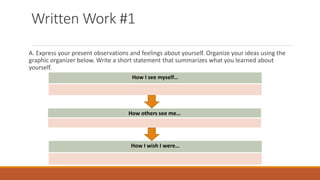
Written Work #1
A. Express your present observations and feelings about yourself. Organize your ideas using the
graphic organizer below. Write a short statement that summarizes what you learned about
yourself.
How I see myself…
How others see me…
How I wish I were…
Speech Context is the situation that brings
people to a conversation or a speaking
event. This involves the particular time and
place of the communication.
This refers to the purpose of the speech
Types of SpeechContextLesson 1
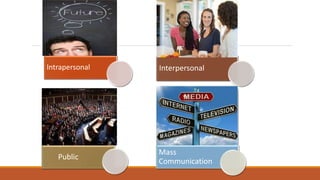
Intrapersonal Interpersonal
Public
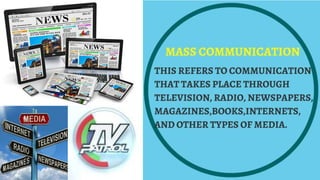
Mass
Communication
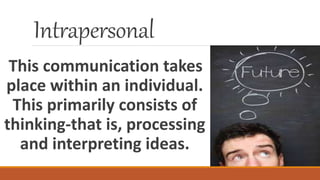
Intrapersonal
This communication takes
place within an individual.
This primarily consists of
thinking-that is, processing
and interpreting ideas.
A girl contemplating about her future plans.
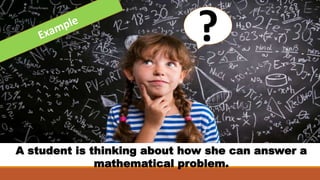
A student is thinking about how she can answer a
mathematical problem.
?
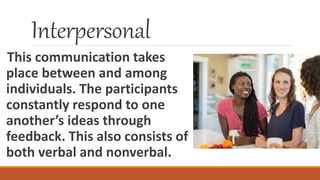
Interpersonal
This communication takes
place between and among
individuals. The participants
constantly respond to one
another’s ideas through
feedback. This also consists of
both verbal and nonverbal.
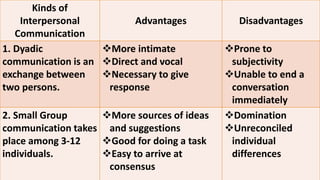
Kinds of
Interpersonal
Communication
Advantages Disadvantages
1. Dyadic
communication is an
exchange between
two persons.
More intimate
Direct and vocal
Necessary to give
response
Prone to
subjectivity
Unable to end a
conversation
immediately
2. Small Group
communication takes
place among 3-12
individuals.
More sources of ideas
and suggestions
Good for doing a task
Easy to arrive at
consensus
Domination
Unreconciled
individual
differences
Effects of Interpersonal Communication
 Learning. Allows people to gather
information about themselves, other people,
past, present or predicted events; beliefs, and
attitudes.
 Helping. Provides people advice, emotional
support, or assistance that can help them
personally or others with a problem.
 Influencing. Allows people to persuade another
person to provide help, share an activity, change an
attitude, counsel a relationship, give permission or
fulfill an obligation.
Relating. Allows people to experience closeness or
distance, agreement or disagreement, equality or
inequality with others.
 Playing. Allows people to experience humor,
camaraderie, celebration or pass time or coordinate
fun activities.
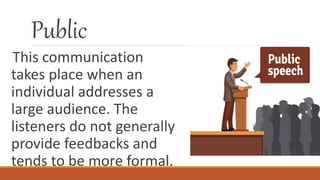
Public
This communication
takes place when an
individual addresses a
large audience. The
listeners do not generally
provide feedbacks and
tends to be more formal.
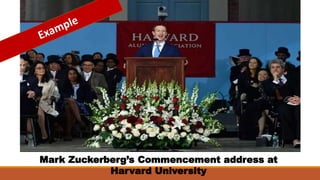
Mark Zuckerberg’s Commencement address at
Harvard University
Oath taking ceremony of a newly elected official.
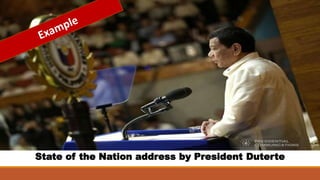
State of the Nation address by President Duterte
Written work #2
Activity 2 Pair Output
B. Ask a partner on how he/she would feel in the following situations:
1. You discover that you best friend, to whom you confided an embarrassing secret,
reveals your story to some who happens to be your arch-critic.
2. You are unable to receive the special gift that your dad promised to buy for you on
your debut simply because he has run short of cash.
3. Your mom says no to your classmates invitation that you attend a night swimming
party with them.
4. During a major exam, you noticed a seatmate cheating openly by using a leakage
without your teacher noticing his demeanour.
5. Your classmate shows you a video of a controversial film and invites you to his
home in order for you to view the whole movie
Activity 3 Group Project
Form a group and discuss the effects of interpersonal
communication through an interview with two successful
professionals in their industry. They could be a lawyer,
doctor, manager, teacher, politician or a celebrity. Ask them
about the humble beginnings of their career and the ladder
they passed to reach their goal. Let your teacher review your
interview questions for grammatical check before you go to
your interview appointment. Record the interview
experience in a video for your visuals in presenting your
answer in the interview worksheet.
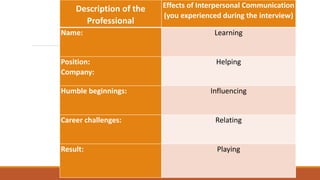
Description of the
Professional
Effects of Interpersonal Communication
(you experienced during the interview)
Name: Learning
Position:
Company:
Helping
Humble beginnings: Influencing
Career challenges: Relating
Result: Playing
Lesson 2
Lesson 2
SPEECH STYLE
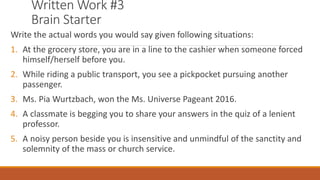
Written Work #3
Brain Starter
Write the actual words you would say given following situations:
1. At the grocery store, you are in a line to the cashier when someone forced
himself/herself before you.
2. While riding a public transport, you see a pickpocket pursuing another
passenger.
3. Ms. Pia Wurtzbach, won the Ms. Universe Pageant 2016.
4. A classmate is begging you to share your answers in the quiz of a lenient
professor.
5. A noisy person beside you is insensitive and unmindful of the sanctity and
solemnity of the mass or church service.
Lesson 2
Lesson 2
SPEECH STYLE
refers to the
distinctive way of
communicating. It consists
of particular pattern of
linguistic, vocal and
nonverbal behaviors.
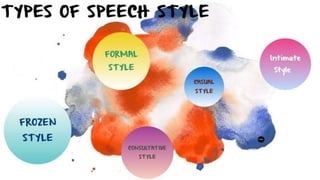
Speech Style
Intimate
Style
Casual Style Consultative
Style
Formal Style Frozen Style
Intimate Style
This style is used in conversations
between people who are very close
and know each other quite well
because having a maximum of shared
background information.
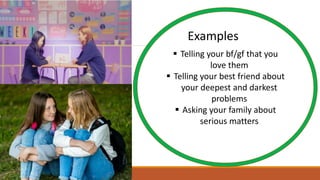
 Telling your bf/gf that you
love them
 Telling your best friend about
your deepest and darkest
problems
 Asking your family about
serious matters
Examples
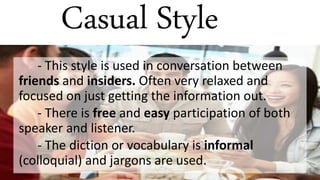
Casual Style
- This style is used in conversation between
friends and insiders. Often very relaxed and
focused on just getting the information out.
- There is free and easy participation of both
speaker and listener.
- The diction or vocabulary is informal
(colloquial) and jargons are used.
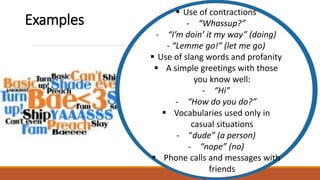
 Use of contractions
- “Whassup?”
- “I’m doin’ it my way” (doing)
- “Lemme go!” (let me go)
 Use of slang words and profanity
 A simple greetings with those
you know well:
- “Hi”
- “How do you do?”
 Vocabularies used only in
casual situations
- “dude” (a person)
- “nope” (no)
 Phone calls and messages with
friends
Examples
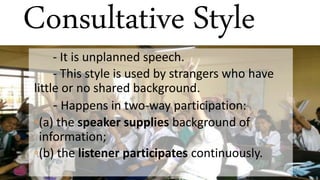
Consultative Style
- It is unplanned speech.
- This style is used by strangers who have
little or no shared background.
- Happens in two-way participation:
◦(a) the speaker supplies background of
information;
◦(b) the listener participates continuously.
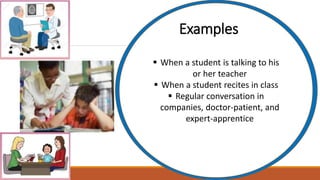
 When a student is talking to his
or her teacher
 When a student recites in class
 Regular conversation in
companies, doctor-patient, and
expert-apprentice
Examples
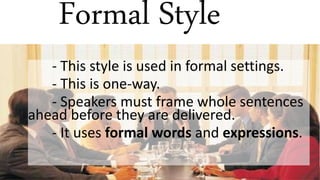
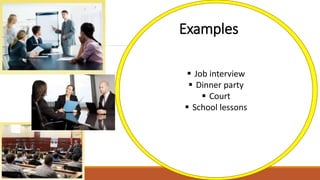
Formal Style
- This style is used in formal settings.
- This is one-way.
- Speakers must frame whole sentences
ahead before they are delivered.
- It uses formal words and expressions.
 Job interview
 Dinner party
 Court
 School lessons
Examples
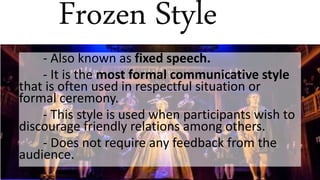
Frozen Style
- Also known as fixed speech.
- It is the most formal communicative style
that is often used in respectful situation or
formal ceremony.
- This style is used when participants wish to
discourage friendly relations among others.
- Does not require any feedback from the
audience.
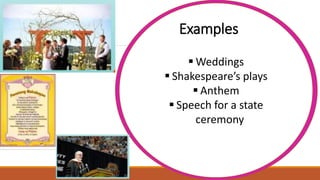
 Weddings
 Shakespeare’s plays
 Anthem
 Speech for a state
ceremony
Examples
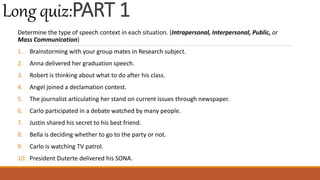
Determine the type of speech context in each situation. (Intrapersonal, Interpersonal, Public, or
Mass Communication)
1. Brainstorming with your group mates in Research subject.
2. Anna delivered her graduation speech.
3. Robert is thinking about what to do after his class.
4. Angel joined a declamation contest.
5. The journalist articulating her stand on current issues through newspaper.
6. Carlo participated in a debate watched by many people.
7. Justin shared his secret to his best friend.
8. Bella is deciding whether to go to the party or not.
9. Carlo is watching TV patrol.
10. President Duterte delivered his SONA.
Long quiz:PART 1
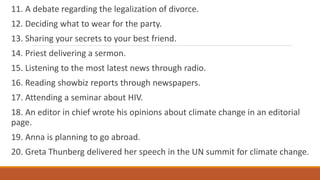
11. A debate regarding the legalization of divorce.
12. Deciding what to wear for the party.
13. Sharing your secrets to your best friend.
14. Priest delivering a sermon.
15. Listening to the most latest news through radio.
16. Reading showbiz reports through newspapers.
17. Attending a seminar about HIV.
18. An editor in chief wrote his opinions about climate change in an editorial
page.
19. Anna is planning to go abroad.
20. Greta Thunberg delivered her speech in the UN summit for climate change.
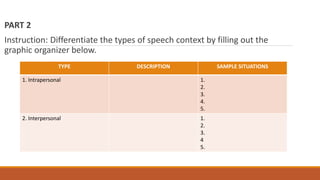
PART 2
Instruction: Differentiate the types of speech context by filling out the
graphic organizer below.
TYPE DESCRIPTION SAMPLE SITUATIONS
1. Intrapersonal 1.
2.
3.
4.
5.
2. Interpersonal 1.
2.
3.
4
5.
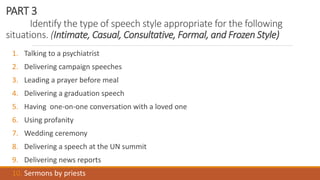
PART 3
Identify the type of speech style appropriate for the following
situations. (Intimate, Casual, Consultative, Formal, and Frozen Style)
1. Talking to a psychiatrist
2. Delivering campaign speeches
3. Leading a prayer before meal
4. Delivering a graduation speech
5. Having one-on-one conversation with a loved one
6. Using profanity
7. Wedding ceremony
8. Delivering a speech at the UN summit
9. Delivering news reports
10. Sermons by priests
Lesson 3
TYPES OF
- first proposed by John Austin in 1962
- was further developed by John Searle
1969
THEORY
What is speech act?
Speech acts are the speaker’s
utterances which convey meaning and
make listeners do specific things (Austin,
1962). According to Austin (1962), when
saying a performative utterance, a
speaker is simultaneously doing
something.
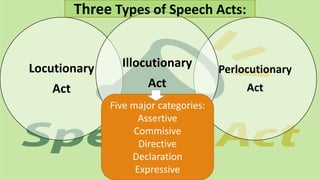
Locutionary
Act
Perlocutionary
Act
Illocutionary
Act
Five major categories:
Assertive
Commisive
Directive
Declaration
Expressive
Three Types of Speech Acts:
Locutionary
This is the literal or semantic meaning of the
message. And the basic act of utterance or
producing a meaningful expression.
For example someone said “it is rain
outside!”, the utterance itself “it is rain outside!”
that is called locutionary act.
ILLOCUTIONARY
This is the intention of the utterance.
It is an utterance with some kind of
function in mind.
1. Assertive
Are utterances that tell how things are in the world. They are
representations of reality. These are in the form of
statements, description, explanation, classification and
conclusion.
Example : I am a great singer.
Bill was an accountant.
Five major categories of Illocutionary act:
2. Commisives
Commit a speaker to some future action. These are in the
form of vows, promises, threats, and contracts.
Example: I am going to leave you.
I’ll call you tonight.
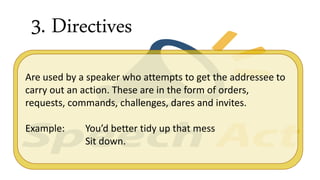
3. Directives
Are used by a speaker who attempts to get the addressee to
carry out an action. These are in the form of orders,
requests, commands, challenges, dares and invites.
Example: You’d better tidy up that mess
Sit down.
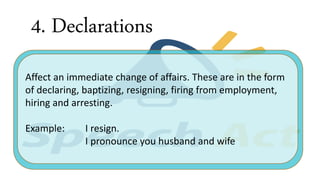
4. Declarations
Affect an immediate change of affairs. These are in the form
of declaring, baptizing, resigning, firing from employment,
hiring and arresting.
Example: I resign.
I pronounce you husband and wife
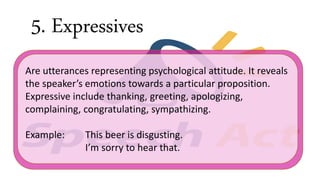
5. Expressives
Are utterances representing psychological attitude. It reveals
the speaker’s emotions towards a particular proposition.
Expressive include thanking, greeting, apologizing,
complaining, congratulating, sympathizing.
Example: This beer is disgusting.
I’m sorry to hear that.
PERLOCUTIONARY
This how the message was perceived
by the listener or the effect of the
utterance to the hearer.
Example 1
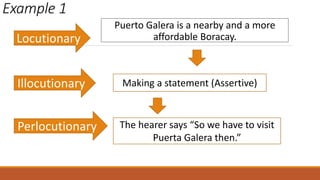
Puerto Galera is a nearby and a more
affordable Boracay.
Making a statement (Assertive)
The hearer says “So we have to visit
Puerta Galera then.”
Locutionary
Illocutionary
Perlocutionary
Example 2
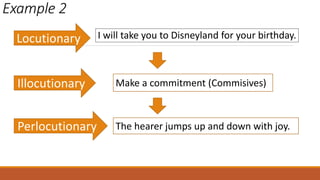
I will take you to Disneyland for your birthday.
Make a commitment (Commisives)
The hearer jumps up and down with joy.
Locutionary
Illocutionary
Perlocutionary
Example 3
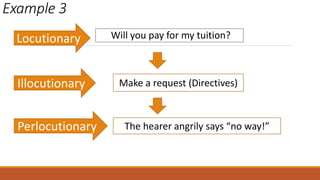
Will you pay for my tuition?
Make a request (Directives)
The hearer angrily says “no way!”
Locutionary
Illocutionary
Perlocutionary
Example 4
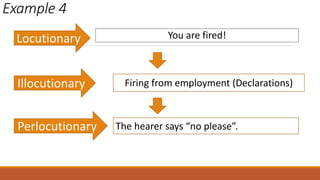
You are fired!
Firing from employment (Declarations)
The hearer says “no please”.
Locutionary
Illocutionary
Perlocutionary
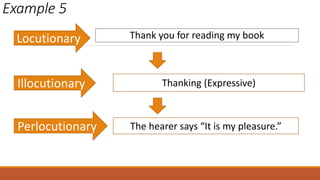
Example 5
Thank you for reading my book
Thanking (Expressive)
The hearer says “It is my pleasure.”
Locutionary
Illocutionary
Perlocutionary
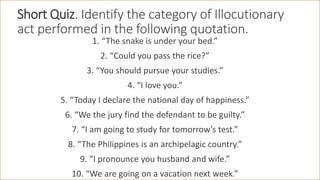
Short Quiz. Identify the category of Illocutionary
act performed in the following quotation.
1. “The snake is under your bed.”
2. “Could you pass the rice?”
3. “You should pursue your studies.”
4. “I love you.”
5. “Today I declare the national day of happiness.”
6. “We the jury find the defendant to be guilty.”
7. “I am going to study for tomorrow’s test.”
8. “The Philippines is an archipelagic country.”
9. “I pronounce you husband and wife.”
10. “We are going on a vacation next week.”
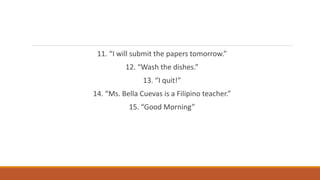
11. “I will submit the papers tomorrow.”
12. “Wash the dishes.”
13. “I quit!”
14. “Ms. Bella Cuevas is a Filipino teacher.”
15. “Good Morning”
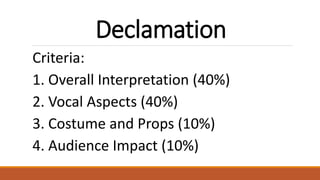
Declamation
Criteria:
1. Overall Interpretation (40%)
2. Vocal Aspects (40%)
3. Costume and Props (10%)
4. Audience Impact (10%)
Oratorical
Criteria:
1. Content (30%)
2. Delivery (30%)
3. Stage presence and personality (30%)
4. Audience impact (10%)
PUBLIC
SPEAKING

Oral communication Unit 2

  • 1.
  • 2.
    Written Work #1 A.Express your present observations and feelings about yourself. Organize your ideas using the graphic organizer below. Write a short statement that summarizes what you learned about yourself. How I see myself… How others see me… How I wish I were…
  • 3.
    Speech Context isthe situation that brings people to a conversation or a speaking event. This involves the particular time and place of the communication. This refers to the purpose of the speech Types of SpeechContextLesson 1
  • 4.
  • 5.
    Intrapersonal This communication takes placewithin an individual. This primarily consists of thinking-that is, processing and interpreting ideas.
  • 6.
    A girl contemplatingabout her future plans.
  • 7.
    A student isthinking about how she can answer a mathematical problem. ?
  • 8.
    Interpersonal This communication takes placebetween and among individuals. The participants constantly respond to one another’s ideas through feedback. This also consists of both verbal and nonverbal.
  • 9.
    Kinds of Interpersonal Communication Advantages Disadvantages 1.Dyadic communication is an exchange between two persons. More intimate Direct and vocal Necessary to give response Prone to subjectivity Unable to end a conversation immediately 2. Small Group communication takes place among 3-12 individuals. More sources of ideas and suggestions Good for doing a task Easy to arrive at consensus Domination Unreconciled individual differences
  • 10.
    Effects of InterpersonalCommunication  Learning. Allows people to gather information about themselves, other people, past, present or predicted events; beliefs, and attitudes.  Helping. Provides people advice, emotional support, or assistance that can help them personally or others with a problem.
  • 11.
     Influencing. Allowspeople to persuade another person to provide help, share an activity, change an attitude, counsel a relationship, give permission or fulfill an obligation. Relating. Allows people to experience closeness or distance, agreement or disagreement, equality or inequality with others.  Playing. Allows people to experience humor, camaraderie, celebration or pass time or coordinate fun activities.
  • 12.
    Public This communication takes placewhen an individual addresses a large audience. The listeners do not generally provide feedbacks and tends to be more formal.
  • 13.
    Mark Zuckerberg’s Commencementaddress at Harvard University
  • 14.
    Oath taking ceremonyof a newly elected official.
  • 15.
    State of theNation address by President Duterte
  • 17.
    Written work #2 Activity2 Pair Output B. Ask a partner on how he/she would feel in the following situations: 1. You discover that you best friend, to whom you confided an embarrassing secret, reveals your story to some who happens to be your arch-critic. 2. You are unable to receive the special gift that your dad promised to buy for you on your debut simply because he has run short of cash. 3. Your mom says no to your classmates invitation that you attend a night swimming party with them. 4. During a major exam, you noticed a seatmate cheating openly by using a leakage without your teacher noticing his demeanour. 5. Your classmate shows you a video of a controversial film and invites you to his home in order for you to view the whole movie
  • 18.
    Activity 3 GroupProject Form a group and discuss the effects of interpersonal communication through an interview with two successful professionals in their industry. They could be a lawyer, doctor, manager, teacher, politician or a celebrity. Ask them about the humble beginnings of their career and the ladder they passed to reach their goal. Let your teacher review your interview questions for grammatical check before you go to your interview appointment. Record the interview experience in a video for your visuals in presenting your answer in the interview worksheet.
  • 19.
    Description of the Professional Effectsof Interpersonal Communication (you experienced during the interview) Name: Learning Position: Company: Helping Humble beginnings: Influencing Career challenges: Relating Result: Playing
  • 20.
  • 21.
    Written Work #3 BrainStarter Write the actual words you would say given following situations: 1. At the grocery store, you are in a line to the cashier when someone forced himself/herself before you. 2. While riding a public transport, you see a pickpocket pursuing another passenger. 3. Ms. Pia Wurtzbach, won the Ms. Universe Pageant 2016. 4. A classmate is begging you to share your answers in the quiz of a lenient professor. 5. A noisy person beside you is insensitive and unmindful of the sanctity and solemnity of the mass or church service.
  • 22.
  • 29.
    refers to the distinctiveway of communicating. It consists of particular pattern of linguistic, vocal and nonverbal behaviors. Speech Style
  • 30.
  • 31.
    Intimate Style This styleis used in conversations between people who are very close and know each other quite well because having a maximum of shared background information.
  • 32.
     Telling yourbf/gf that you love them  Telling your best friend about your deepest and darkest problems  Asking your family about serious matters Examples
  • 33.
    Casual Style - Thisstyle is used in conversation between friends and insiders. Often very relaxed and focused on just getting the information out. - There is free and easy participation of both speaker and listener. - The diction or vocabulary is informal (colloquial) and jargons are used.
  • 34.
     Use ofcontractions - “Whassup?” - “I’m doin’ it my way” (doing) - “Lemme go!” (let me go)  Use of slang words and profanity  A simple greetings with those you know well: - “Hi” - “How do you do?”  Vocabularies used only in casual situations - “dude” (a person) - “nope” (no)  Phone calls and messages with friends Examples
  • 35.
    Consultative Style - Itis unplanned speech. - This style is used by strangers who have little or no shared background. - Happens in two-way participation: ◦(a) the speaker supplies background of information; ◦(b) the listener participates continuously.
  • 36.
     When astudent is talking to his or her teacher  When a student recites in class  Regular conversation in companies, doctor-patient, and expert-apprentice Examples
  • 37.
    Formal Style - Thisstyle is used in formal settings. - This is one-way. - Speakers must frame whole sentences ahead before they are delivered. - It uses formal words and expressions.
  • 38.
     Job interview Dinner party  Court  School lessons Examples
  • 39.
    Frozen Style - Alsoknown as fixed speech. - It is the most formal communicative style that is often used in respectful situation or formal ceremony. - This style is used when participants wish to discourage friendly relations among others. - Does not require any feedback from the audience.
  • 40.
     Weddings  Shakespeare’splays  Anthem  Speech for a state ceremony Examples
  • 41.
    Determine the typeof speech context in each situation. (Intrapersonal, Interpersonal, Public, or Mass Communication) 1. Brainstorming with your group mates in Research subject. 2. Anna delivered her graduation speech. 3. Robert is thinking about what to do after his class. 4. Angel joined a declamation contest. 5. The journalist articulating her stand on current issues through newspaper. 6. Carlo participated in a debate watched by many people. 7. Justin shared his secret to his best friend. 8. Bella is deciding whether to go to the party or not. 9. Carlo is watching TV patrol. 10. President Duterte delivered his SONA. Long quiz:PART 1
  • 42.
    11. A debateregarding the legalization of divorce. 12. Deciding what to wear for the party. 13. Sharing your secrets to your best friend. 14. Priest delivering a sermon. 15. Listening to the most latest news through radio. 16. Reading showbiz reports through newspapers. 17. Attending a seminar about HIV. 18. An editor in chief wrote his opinions about climate change in an editorial page. 19. Anna is planning to go abroad. 20. Greta Thunberg delivered her speech in the UN summit for climate change.
  • 43.
    PART 2 Instruction: Differentiatethe types of speech context by filling out the graphic organizer below. TYPE DESCRIPTION SAMPLE SITUATIONS 1. Intrapersonal 1. 2. 3. 4. 5. 2. Interpersonal 1. 2. 3. 4 5.
  • 44.
    PART 3 Identify thetype of speech style appropriate for the following situations. (Intimate, Casual, Consultative, Formal, and Frozen Style) 1. Talking to a psychiatrist 2. Delivering campaign speeches 3. Leading a prayer before meal 4. Delivering a graduation speech 5. Having one-on-one conversation with a loved one 6. Using profanity 7. Wedding ceremony 8. Delivering a speech at the UN summit 9. Delivering news reports 10. Sermons by priests
  • 45.
  • 46.
    - first proposedby John Austin in 1962 - was further developed by John Searle 1969 THEORY
  • 47.
    What is speechact? Speech acts are the speaker’s utterances which convey meaning and make listeners do specific things (Austin, 1962). According to Austin (1962), when saying a performative utterance, a speaker is simultaneously doing something.
  • 48.
  • 49.
    Locutionary This is theliteral or semantic meaning of the message. And the basic act of utterance or producing a meaningful expression. For example someone said “it is rain outside!”, the utterance itself “it is rain outside!” that is called locutionary act.
  • 50.
    ILLOCUTIONARY This is theintention of the utterance. It is an utterance with some kind of function in mind.
  • 51.
    1. Assertive Are utterancesthat tell how things are in the world. They are representations of reality. These are in the form of statements, description, explanation, classification and conclusion. Example : I am a great singer. Bill was an accountant. Five major categories of Illocutionary act:
  • 52.
    2. Commisives Commit aspeaker to some future action. These are in the form of vows, promises, threats, and contracts. Example: I am going to leave you. I’ll call you tonight.
  • 53.
    3. Directives Are usedby a speaker who attempts to get the addressee to carry out an action. These are in the form of orders, requests, commands, challenges, dares and invites. Example: You’d better tidy up that mess Sit down.
  • 54.
    4. Declarations Affect animmediate change of affairs. These are in the form of declaring, baptizing, resigning, firing from employment, hiring and arresting. Example: I resign. I pronounce you husband and wife
  • 55.
    5. Expressives Are utterancesrepresenting psychological attitude. It reveals the speaker’s emotions towards a particular proposition. Expressive include thanking, greeting, apologizing, complaining, congratulating, sympathizing. Example: This beer is disgusting. I’m sorry to hear that.
  • 56.
    PERLOCUTIONARY This how themessage was perceived by the listener or the effect of the utterance to the hearer.
  • 57.
    Example 1 Puerto Galerais a nearby and a more affordable Boracay. Making a statement (Assertive) The hearer says “So we have to visit Puerta Galera then.” Locutionary Illocutionary Perlocutionary
  • 58.
    Example 2 I willtake you to Disneyland for your birthday. Make a commitment (Commisives) The hearer jumps up and down with joy. Locutionary Illocutionary Perlocutionary
  • 59.
    Example 3 Will youpay for my tuition? Make a request (Directives) The hearer angrily says “no way!” Locutionary Illocutionary Perlocutionary
  • 60.
    Example 4 You arefired! Firing from employment (Declarations) The hearer says “no please”. Locutionary Illocutionary Perlocutionary
  • 61.
    Example 5 Thank youfor reading my book Thanking (Expressive) The hearer says “It is my pleasure.” Locutionary Illocutionary Perlocutionary
  • 62.
    Short Quiz. Identifythe category of Illocutionary act performed in the following quotation. 1. “The snake is under your bed.” 2. “Could you pass the rice?” 3. “You should pursue your studies.” 4. “I love you.” 5. “Today I declare the national day of happiness.” 6. “We the jury find the defendant to be guilty.” 7. “I am going to study for tomorrow’s test.” 8. “The Philippines is an archipelagic country.” 9. “I pronounce you husband and wife.” 10. “We are going on a vacation next week.”
  • 63.
    11. “I willsubmit the papers tomorrow.” 12. “Wash the dishes.” 13. “I quit!” 14. “Ms. Bella Cuevas is a Filipino teacher.” 15. “Good Morning”
  • 64.
    Declamation Criteria: 1. Overall Interpretation(40%) 2. Vocal Aspects (40%) 3. Costume and Props (10%) 4. Audience Impact (10%)
  • 65.
    Oratorical Criteria: 1. Content (30%) 2.Delivery (30%) 3. Stage presence and personality (30%) 4. Audience impact (10%)
  • 66.