

WHAT IS A SHOT?
• a series of frames, that runs for an
uninterrupted period of time
• the moment that the camera starts
rolling until the moment it stops.
• an essential aspect of a movie where
angles, transitions and cuts are used to
further express emotion, ideas and
movement
THE RULE OF THIRDS
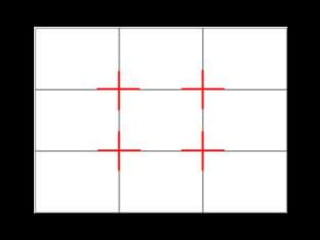
• an image should be imagined as divided
into nine equal parts by two equally
spaced horizontal lines and two equally
spaced vertical lines
• important compositional elements
should be placed along these lines or
their intersections
THE RULE OF THIRDS
• Aligning a subject with these points
creates more tension, energy and
interest in the composition than simply
centering the subject.
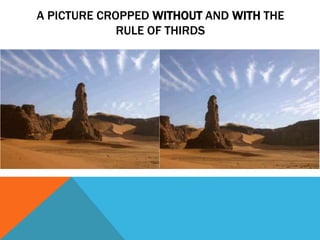
A PICTURE CROPPED WITHOUT AND WITH THE
RULE OF THIRDS
EWS (EXTREME WIDE SHOT)
• The view is so far from the subject that he
isn't even visible.
• Contains a large amount of landscape.
• Often used at the beginning of a scene or a
film to establish general location (setting).
• Also known as an establishing shot.
EWS (EXTREME WIDE SHOT)
VWS (VERY WIDE SHOT)
• The subject is visible (barely), but the
emphasis is still on placing him in his
environment.
• allows the viewer to understand the
relationship between the characters and
their environment.
VWS (VERY WIDE SHOT)
WS (WIDE SHOT)
• The subject takes up the full frame, or at
least as much as comfortably possible.
WS (WIDE SHOT)
MS (MID SHOT)
• Shows some part of the subject in more
detail while still giving an impression of the
whole subject.
MS (MID SHOT)
MCU (MEDIUM CLOSE UP)
• Half way between a Mid Shot and a Close Up.
• shows the face more clearly, without getting
uncomfortably close.
MCU (MEDIUM CLOSE UP)
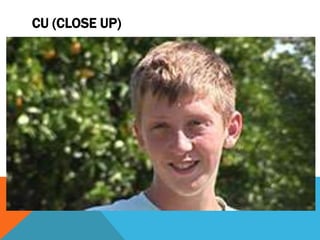
CU (CLOSE UP)
• A certain feature or part of the subject takes
up the whole frame.
• useful for showing detail
• A close-up of a person emphasizes their
emotional state. But a mid-shot or wide-shot
is more appropriate for delivering facts and
general information.
CU (CLOSE UP)
ECU (EXTREME CLOSE UP)
• The ECU gets right in and shows extreme
detail.
• to show general reactions or emotion
ECU (EXTREME CLOSE UP)
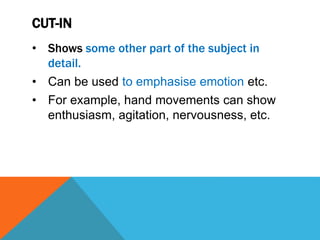
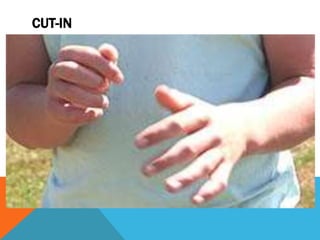
CUT-IN
• Shows some other part of the subject in
detail.
• Can be used to emphasise emotion etc.
• For example, hand movements can show
enthusiasm, agitation, nervousness, etc.
CUT-IN
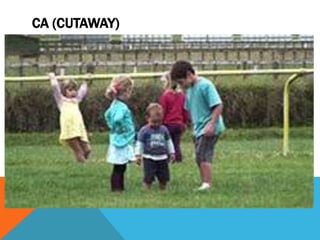
CA (CUTAWAY)
• A shot of something other than the subject.
• used as a "buffer" between shots (to help the
editing process), or to add interesting
information.
CA (CUTAWAY)
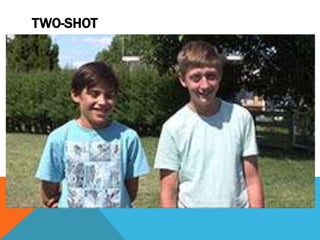
TWO-SHOT
• A shot of two people, framed similarly to a
mid shot.
• Often used in interviews, or when two
presenters are hosting a show.
• to follow the interaction between two people
without getting distracted by their
surroundings.
• good for establishing a relationship between
subjects.
TWO-SHOT
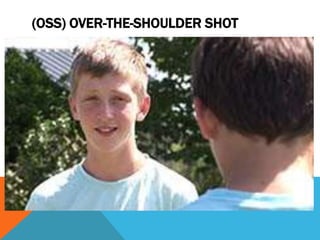
(OSS) OVER-THE-SHOULDER SHOT
• Looking from behind a person at the subject.
• helps to establish the position of each
person, and get the feel of looking at one
person from the other's point of view.
• The person facing the subject should usually
occupy about 1/3 of the frame.
(OSS) OVER-THE-SHOULDER SHOT
NODDY SHOT
• Usually refers to a shot of the interviewer
listening and reacting to the subject.
NODDY SHOT
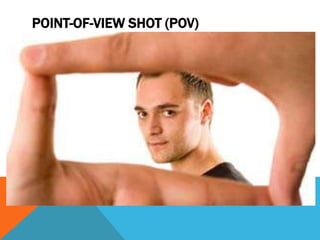
POINT-OF-VIEW SHOT (POV)
• Shows a view from the subject's perspective.
POINT-OF-VIEW SHOT (POV)
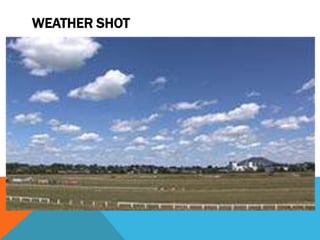
WEATHER SHOT
• The subject is the weather.
• Can be used to show the background for
graphics.
WEATHER SHOT
THANK YOU

Shots in Films

  • 2.
    WHAT IS ASHOT? • a series of frames, that runs for an uninterrupted period of time • the moment that the camera starts rolling until the moment it stops. • an essential aspect of a movie where angles, transitions and cuts are used to further express emotion, ideas and movement
  • 3.
    THE RULE OFTHIRDS • an image should be imagined as divided into nine equal parts by two equally spaced horizontal lines and two equally spaced vertical lines • important compositional elements should be placed along these lines or their intersections
  • 5.
    THE RULE OFTHIRDS • Aligning a subject with these points creates more tension, energy and interest in the composition than simply centering the subject.
  • 8.
    A PICTURE CROPPEDWITHOUT AND WITH THE RULE OF THIRDS
  • 11.
    EWS (EXTREME WIDESHOT) • The view is so far from the subject that he isn't even visible. • Contains a large amount of landscape. • Often used at the beginning of a scene or a film to establish general location (setting). • Also known as an establishing shot.
  • 12.
  • 13.
    VWS (VERY WIDESHOT) • The subject is visible (barely), but the emphasis is still on placing him in his environment. • allows the viewer to understand the relationship between the characters and their environment.
  • 14.
  • 15.
    WS (WIDE SHOT) •The subject takes up the full frame, or at least as much as comfortably possible.
  • 16.
  • 17.
    MS (MID SHOT) •Shows some part of the subject in more detail while still giving an impression of the whole subject.
  • 18.
  • 19.
    MCU (MEDIUM CLOSEUP) • Half way between a Mid Shot and a Close Up. • shows the face more clearly, without getting uncomfortably close.
  • 20.
  • 21.
    CU (CLOSE UP) •A certain feature or part of the subject takes up the whole frame. • useful for showing detail • A close-up of a person emphasizes their emotional state. But a mid-shot or wide-shot is more appropriate for delivering facts and general information.
  • 22.
  • 23.
    ECU (EXTREME CLOSEUP) • The ECU gets right in and shows extreme detail. • to show general reactions or emotion
  • 24.
  • 25.
    CUT-IN • Shows someother part of the subject in detail. • Can be used to emphasise emotion etc. • For example, hand movements can show enthusiasm, agitation, nervousness, etc.
  • 26.
  • 27.
    CA (CUTAWAY) • Ashot of something other than the subject. • used as a "buffer" between shots (to help the editing process), or to add interesting information.
  • 28.
  • 29.
    TWO-SHOT • A shotof two people, framed similarly to a mid shot. • Often used in interviews, or when two presenters are hosting a show. • to follow the interaction between two people without getting distracted by their surroundings. • good for establishing a relationship between subjects.
  • 30.
  • 31.
    (OSS) OVER-THE-SHOULDER SHOT •Looking from behind a person at the subject. • helps to establish the position of each person, and get the feel of looking at one person from the other's point of view. • The person facing the subject should usually occupy about 1/3 of the frame.
  • 32.
  • 33.
    NODDY SHOT • Usuallyrefers to a shot of the interviewer listening and reacting to the subject.
  • 34.
  • 35.
    POINT-OF-VIEW SHOT (POV) •Shows a view from the subject's perspective.
  • 36.
  • 37.
  • 38.
  • 39.
  • 40.
    WEATHER SHOT • Thesubject is the weather. • Can be used to show the background for graphics.
  • 41.
  • 42.