Listening in Interpersonal Communication Presented By: Muhammad Husnain  (8389) Zarmeen Karimi  (10202) Syed Arif Ali Shah  (7922) Waqas Zahid  (7112) Presented To: Zehra Shah
Listening  : the process of receiving, constructing meaning from, and responding to spoken and/or nonverbal messages; to hear something with thoughtful attention  Effective communication is 2-way depends on speaking  and  listening What is Listening?
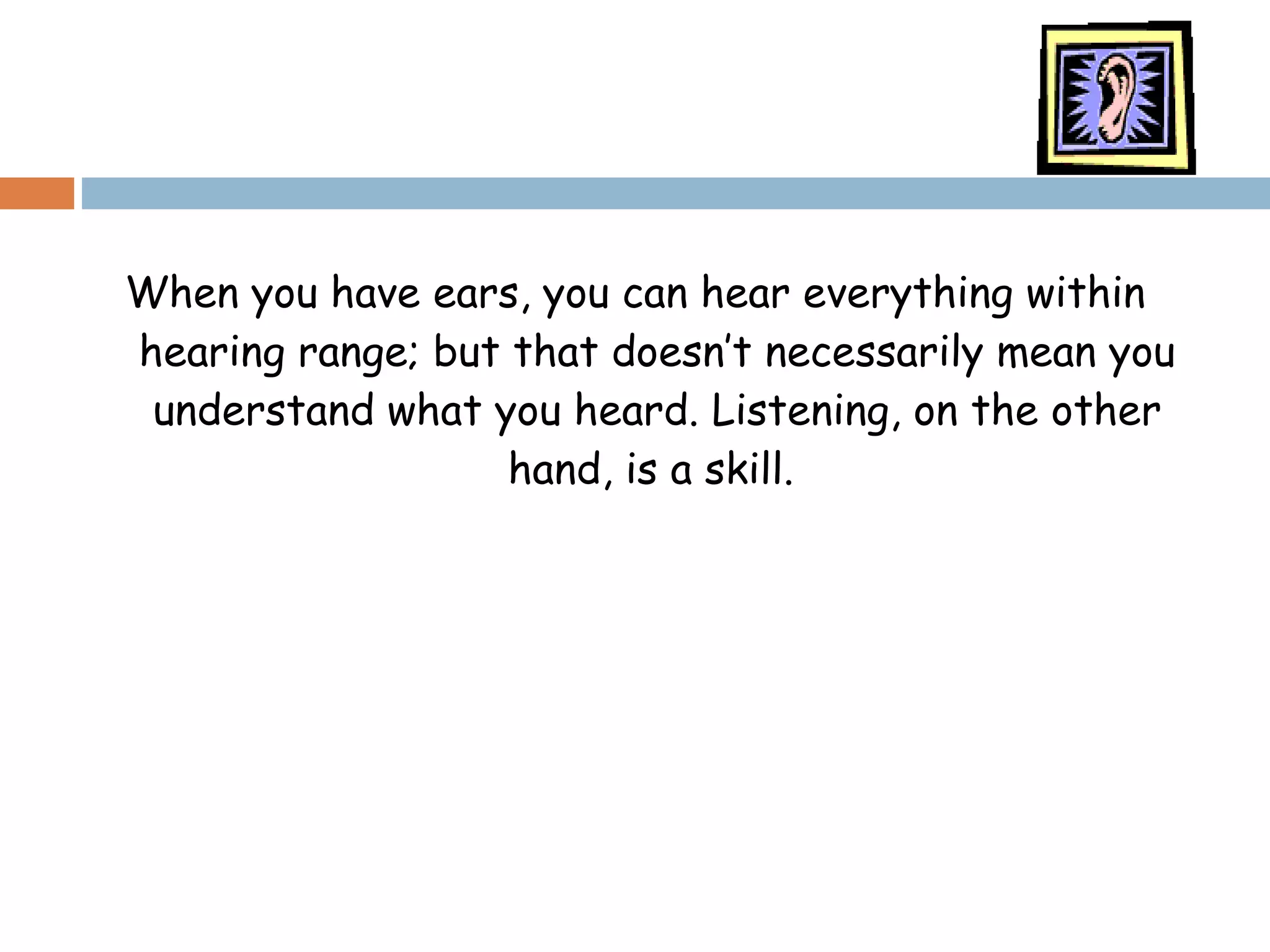
When you have ears, you can hear everything within hearing range; but that doesn’t necessarily mean you understand what you heard. Listening, on the other hand, is a skill.
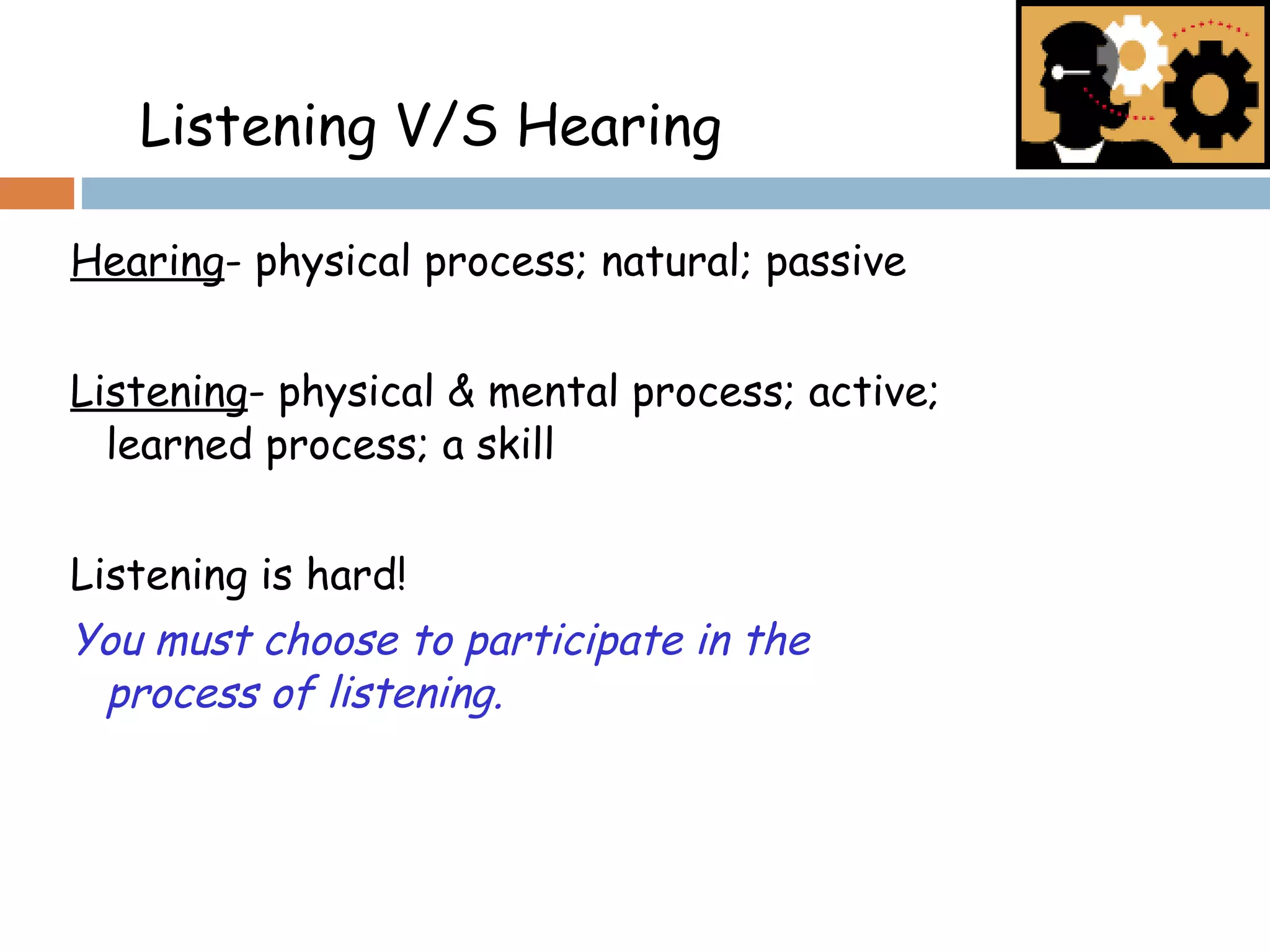
Hearing - physical process; natural; passive Listening - physical & mental process; active; learned process; a skill Listening is hard! You must choose to participate in the process of listening.  Listening V/S Hearing
Listening…. the psychological process of receiving, attending to, constructing meaning from, and responding to spoken or nonverbal messages Hearing = physiological  Listening = psychological  What is listening?
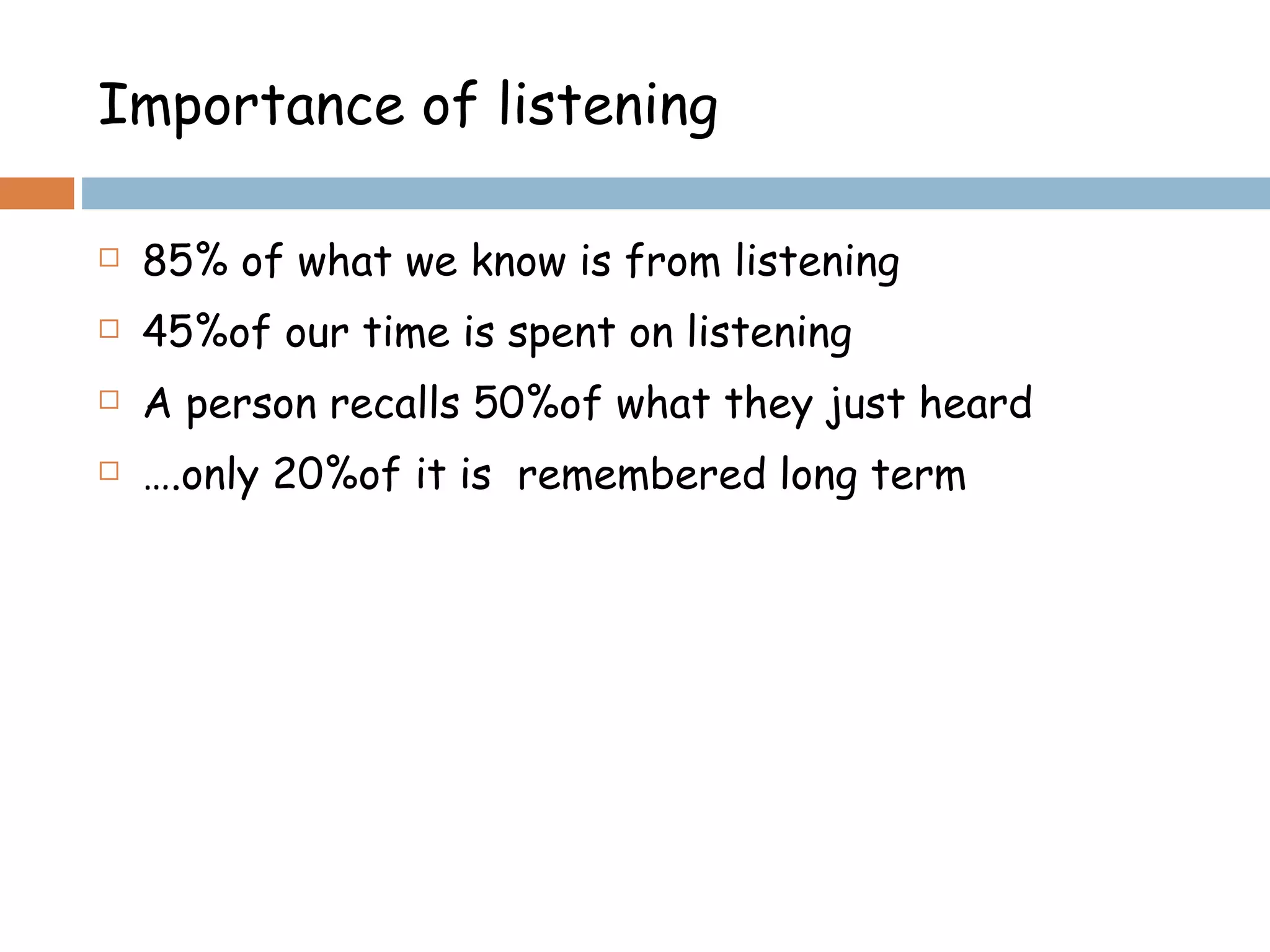
85% of what we know is from listening 45%of our time is spent on listening  A person recalls 50%of what they just heard  … .only 20%of it is  remembered long term  Importance of listening
To be  recognized  and  remembered To feel  valued To feel  appreciated To feel  respected To feel  understood To feel  comfortable  about a want or need Why Be A Good Listener?
Listening is the most powerful form of acknowledgment …a way of saying, “You are  important.”
Listening promotes being heard ‘Seek first to understand, then be understood’  - Stephen Covey
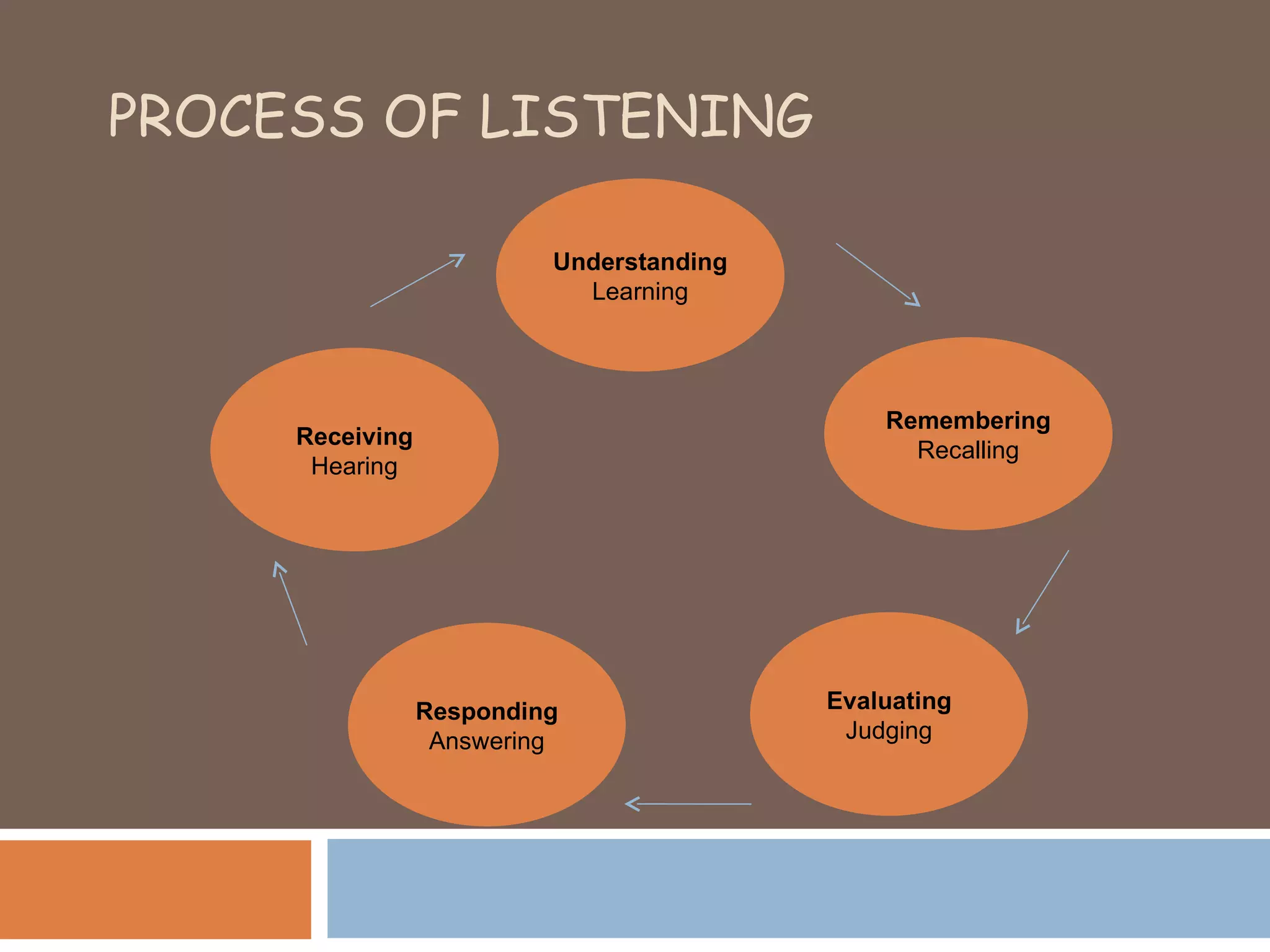
PROCESS OF LISTENING Understanding Learning Remembering Recalling Evaluating Judging Receiving Hearing Responding Answering
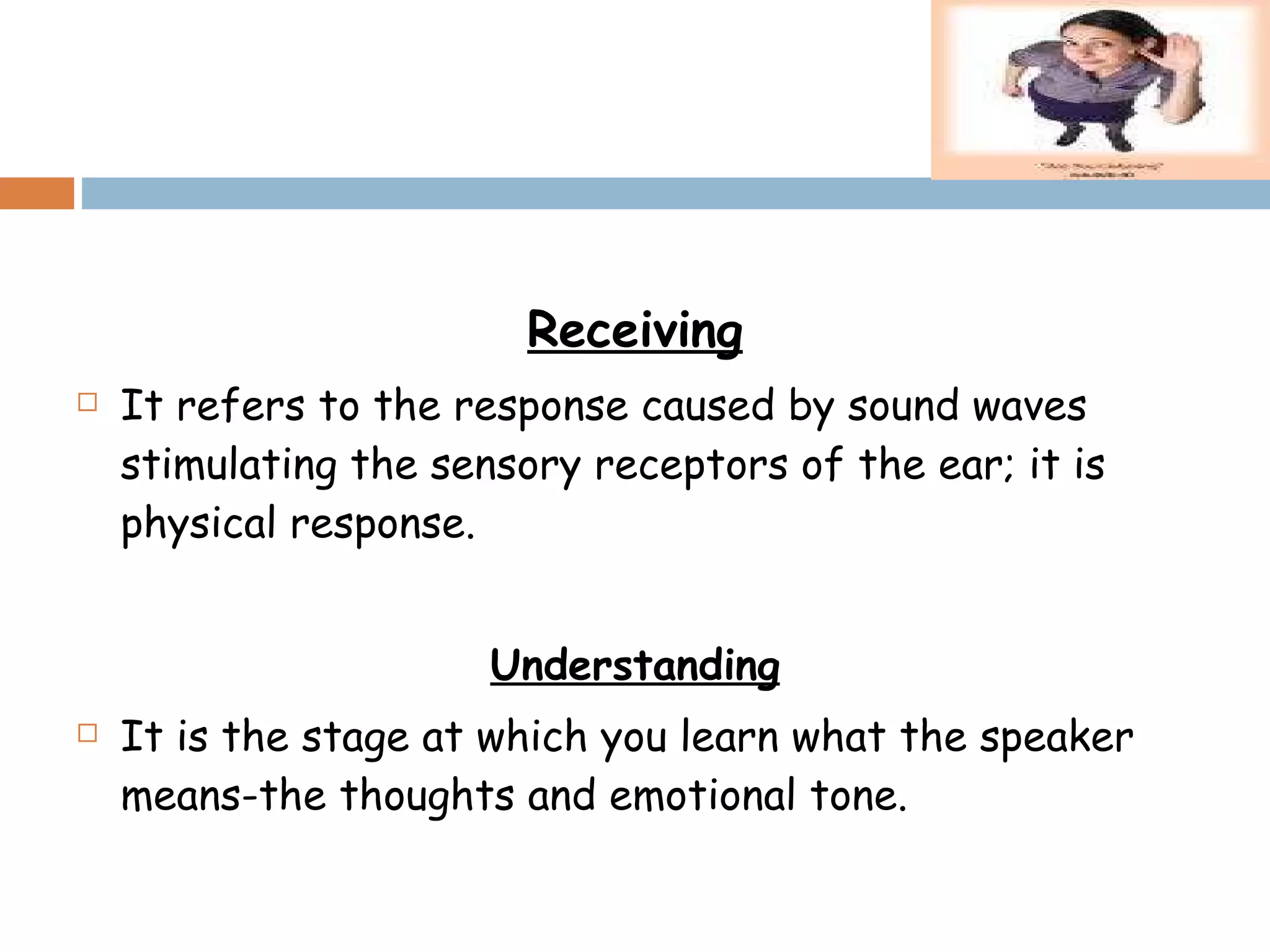
Receiving It refers to the response caused by sound waves stimulating the sensory receptors of the ear; it is physical response. Understanding It is the stage at which you learn what the speaker means-the thoughts and emotional tone.
Remembering It is important listening process because it means that an individual has not only received and interpreted a message but has also added it to the mind's storage bank. But just as our attention is selective, so too is our memory- what is remembered may be quite different from what was originally seen or heard.
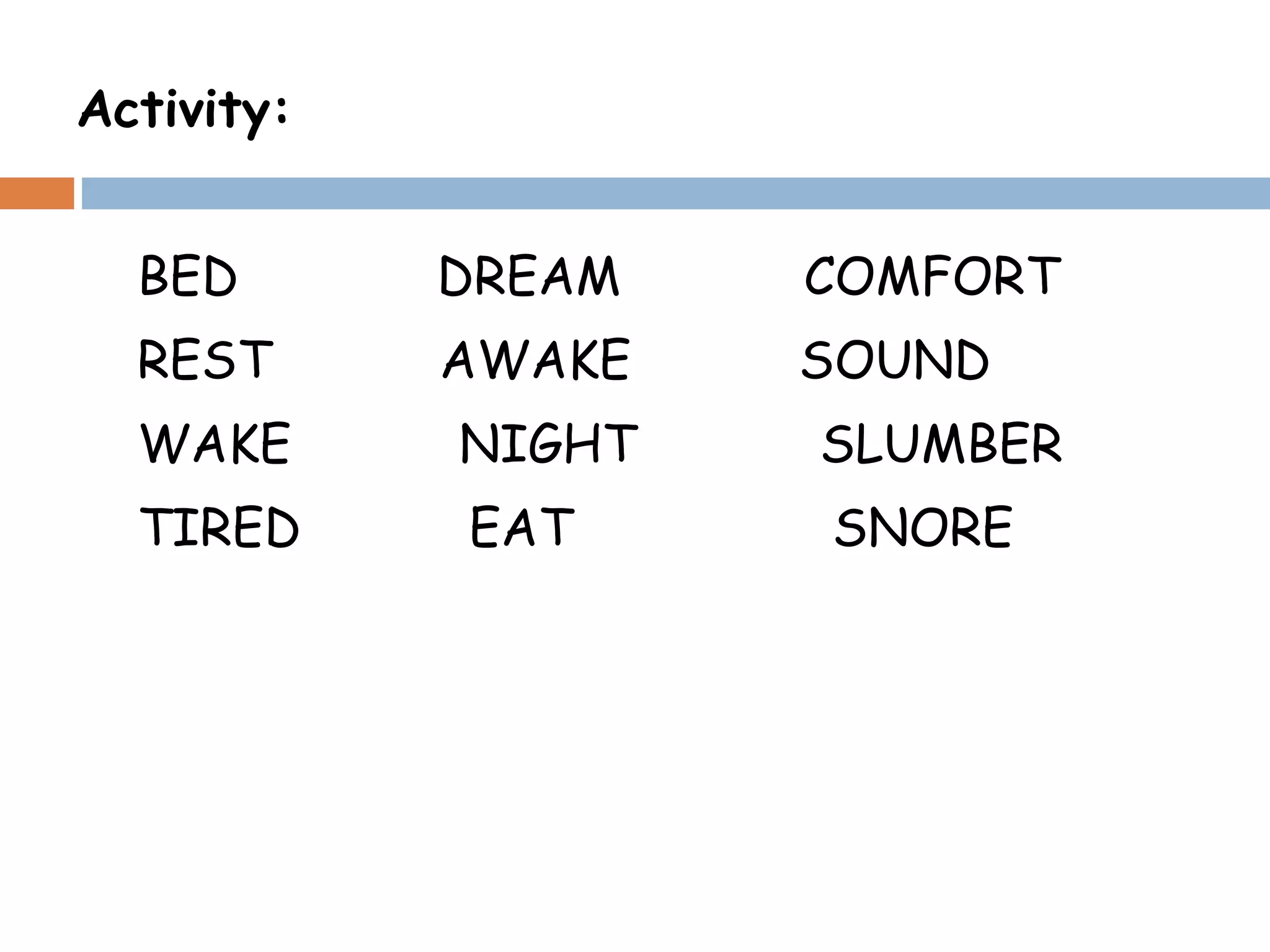
Activity: BED  DREAM  COMFORT REST  AWAKE  SOUND WAKE  NIGHT  SLUMBER TIRED  EAT  SNORE
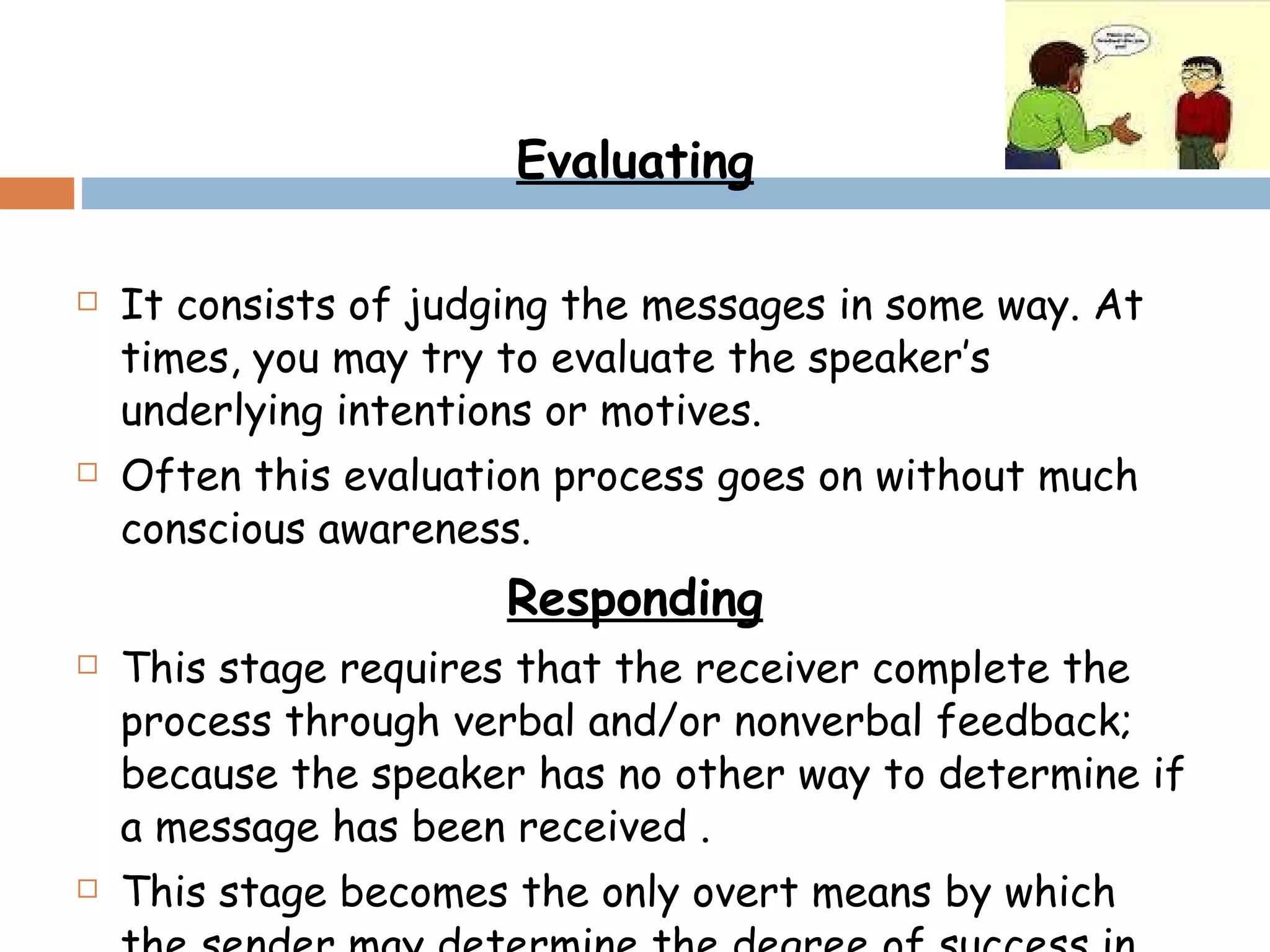
Evaluating It consists of judging the messages in some way. At times, you may try to evaluate the speaker’s underlying intentions or motives. Often this evaluation process goes on without much conscious awareness.  Responding This stage requires that the receiver complete the process through verbal and/or nonverbal feedback; because the speaker has no other way to determine if a message has been received . This stage becomes the only overt means by which the sender may determine the degree of success in transmitting the message.
STYLES OF EFFECTIVE LISTENING Syed Arif Ali Shah (7922)
NO ONE  WOULD  TALK MUCH IN SOCIETY IF THEY KNEW HOW OFTEN THEY MISUNDERSTOOD OTHERS. (GOETHE)
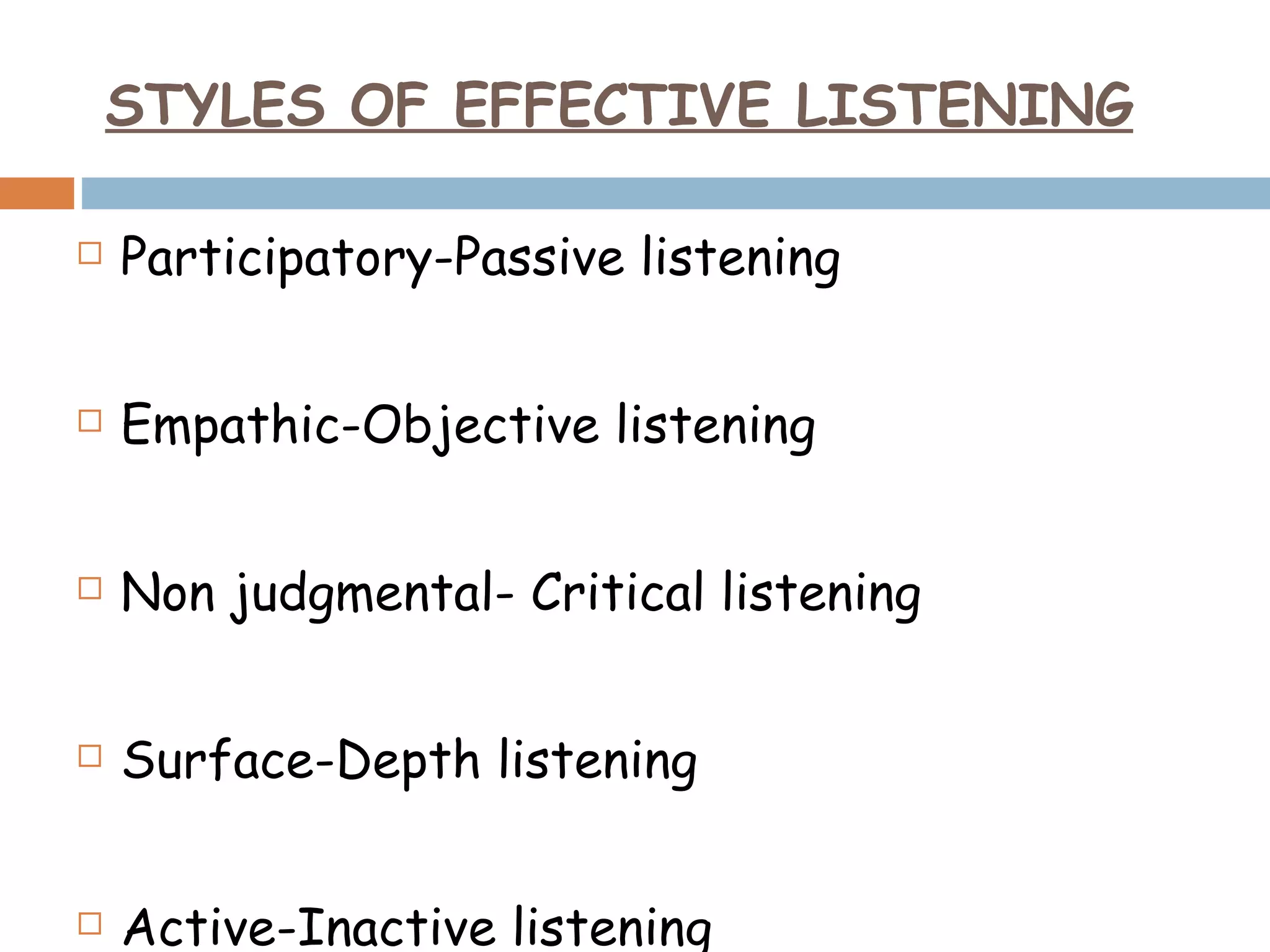
Participatory-Passive listening Empathic-Objective listening Non judgmental- Critical listening Surface-Depth listening Active-Inactive listening STYLES OF EFFECTIVE LISTENING
Participatory -Passive   listening Active participation Physically & mentally engage in the sharing of meaning Elements   Non-Verbal:  Eye contact, facial expressions  Verbal : questions, back channeling cues such as “I see” “yes” “uh-huh” etc


Participatory- Passive listening Listening without talking Powerful means of communicating acceptance Passive listener: suspends judgment and just listens Who accepts, not evaluate. Who supports, not intrude
 
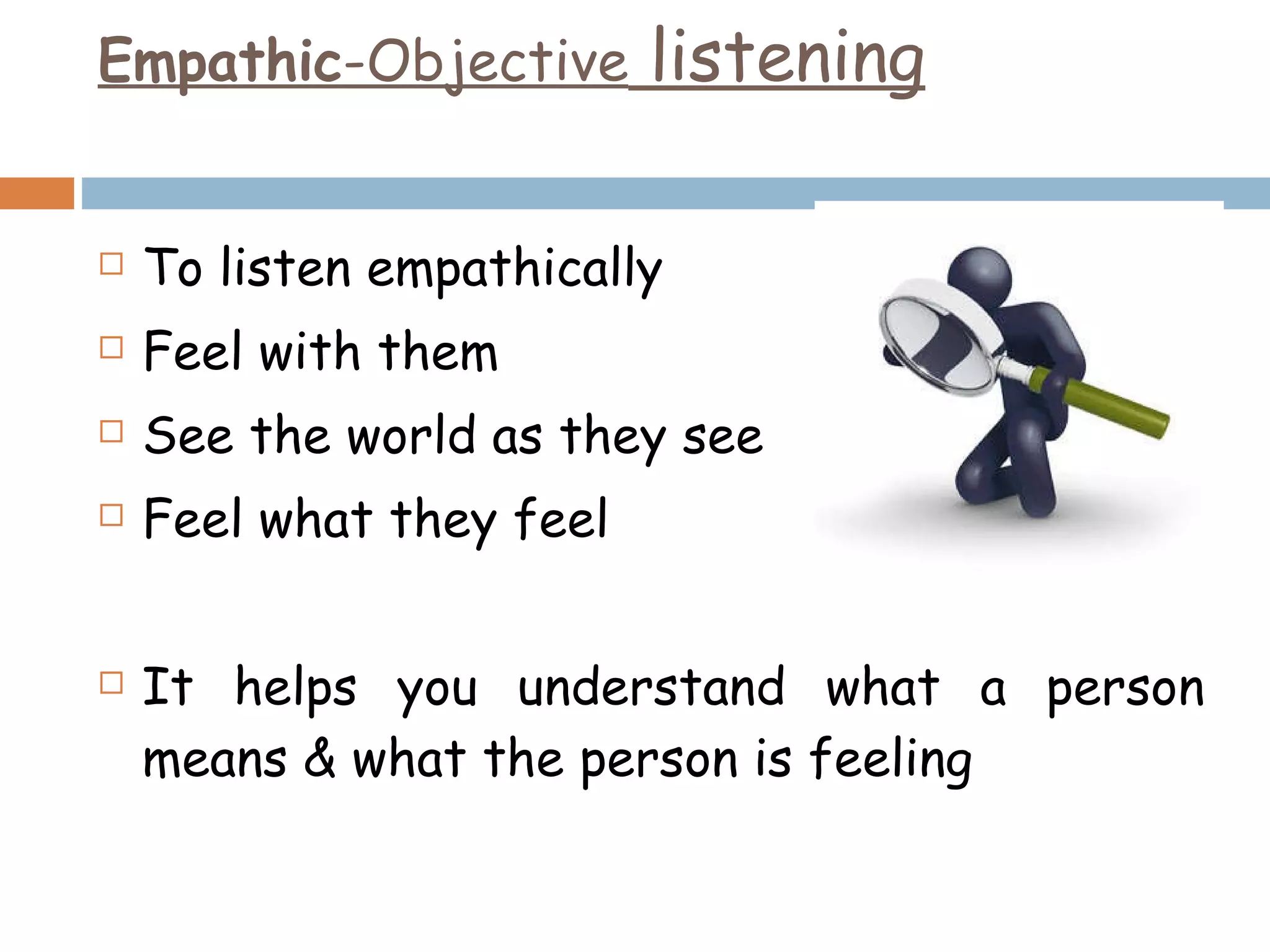
Empathic -Objective  listening To listen empathically Feel with them See the world as they see Feel what they feel It helps you understand what a person means & what the person is feeling
Empathic- Objective  listening Listen with objectivity and detachment See beyond other person sees Example:  A teacher & student (Empathic) (1+1 = 11) (Objective) (1+1 =  2)
 
Non judgmental - Critical listening Listen with open mind Avoid distorting messages Avoid filtering out unpleasant or undesirable message Recognize your own ethnic, national, or religious biases, (it may increase or minimize importance because it confirms or contradicts your biases)
Non  judgmental-  C ritical listening Name calling-  involves giving an idea e.g.  (“atheist” “neo-Nazi” “cult”) to make you accept things you value high, like (“democracy” “free speech” “academic freedom”) Testimonial-  use image associated to with person to gain approval, (if you respect the person) to gain rejection (if you disrespect the person) e.g.  advertisement: use person dressed like doctors, use phrase “dentists advice” Bandwagon-  used to persuade to accept or reject an idea because “everybody is doing it” e.g.  “draw Mohammad day” & “switch to Pakbuk”
 
Surface -Depth  listening Obvious/surface/literal meaning (Surface level communication) What they are saying?
Surface- Depth  listening Hidden, deep meaning (In depth communication) Why they are saying? E.g.: “The patient is very serious”
 
Purpose of Active listening “ Active, effective listening is a habit, as well as the foundation of effective communication.”
ACTIVE LIETENING “ Active listening is the process of sending back the speaker what the listener thinks the speaker meant.” It is a process of putting into some meaningful whole your understanding of the speaker’s total message
Continued… Example: ESMAIL:  that creep gave me a c on the paper!! I really worked on that project and all I get is a lousy C! AYESHA:  that’s not so bad; most people got around the same grade. I got a C too. FAISAL:  So what? This is your last semester. Who cares about grades anyway? SAAD:  You got a C on the paper you were working for the last three weeks? You sound really angry and hurt.
Active listening serves a number of important purposes: It shows that you are listening. Check how accurately you have understood what the speaker said and meant. Express acceptance of speaker’s feelings. To prompt the speaker to further explore his or her feelings or thoughts. Purpose:
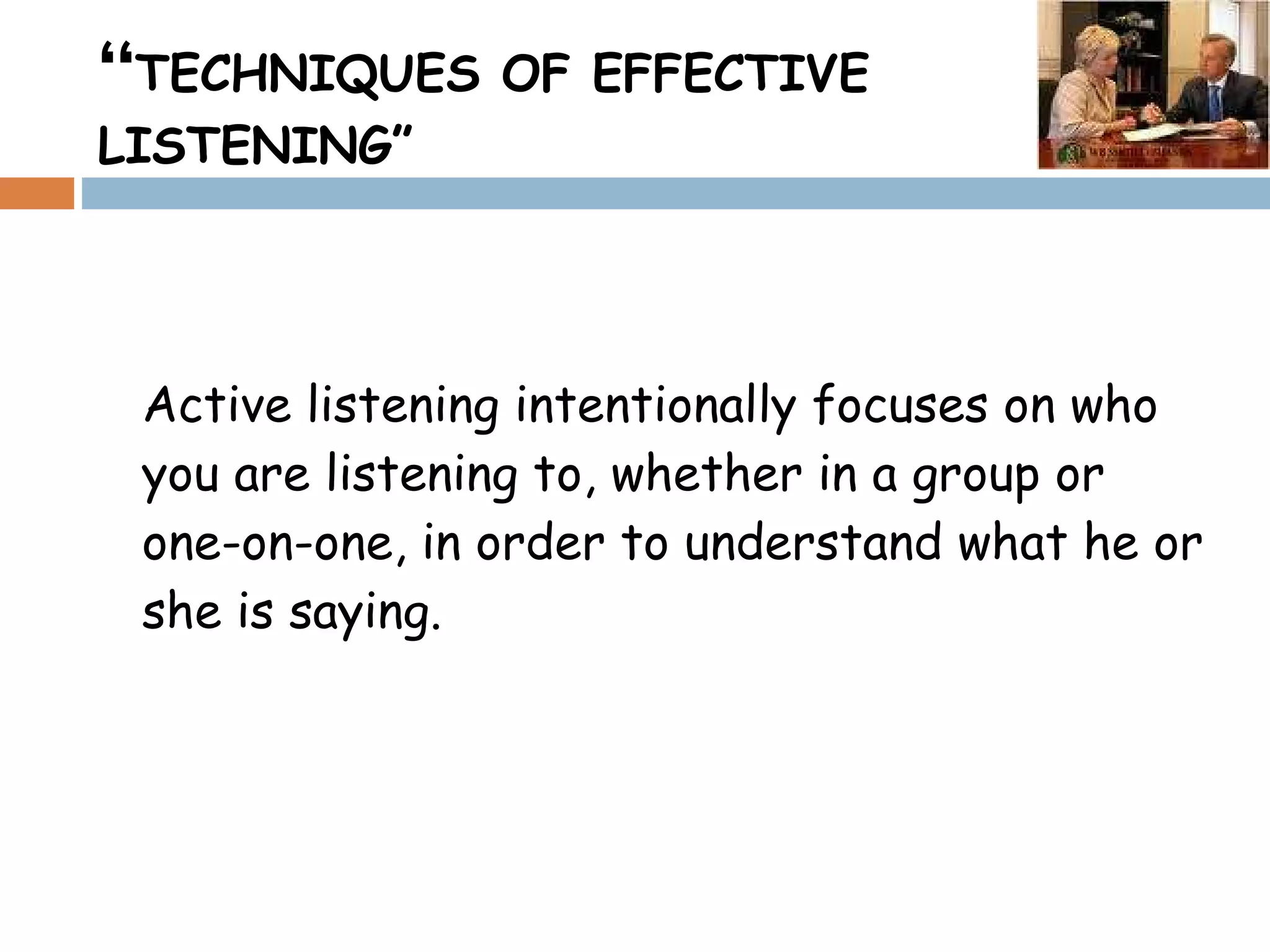
“ TECHNIQUES OF EFFECTIVE LISTENING” Active listening intentionally focuses on who you are listening to, whether in a group or one-on-one, in order to understand what he or she is saying. 
Techniques: Paraphrase the speaker’s meaning. Express understanding of the speaker’s feeling. Ask questions to ensure that you are on a right track. Focus your attention on the subject  Avoid distractions  Set aside your prejudices, your opinions. When interacting with the speaker, keep an eye contact and do not argue.
Quick flashback Listening and hearing are two different entities. The listening process requires five pre-requisites if it has to be listening. Cultural differences and gender differences play an important role in the listening process. The general key to effective listening in interpersonal situations is ‘’ Active participation”.
Contd.. We need to listen empathically to make sure that we understand what the speaker is actually going through. Effective listening involves listening non-judgmentally to help you understand and help you critically.
That completes our agenda for the day. Hope you have enjoyed . 
THANK-YOU

Process of listening

  • 1.
    Listening in InterpersonalCommunication Presented By: Muhammad Husnain (8389) Zarmeen Karimi (10202) Syed Arif Ali Shah (7922) Waqas Zahid (7112) Presented To: Zehra Shah
  • 2.
    Listening :the process of receiving, constructing meaning from, and responding to spoken and/or nonverbal messages; to hear something with thoughtful attention Effective communication is 2-way depends on speaking and listening What is Listening?
  • 3.
    When you haveears, you can hear everything within hearing range; but that doesn’t necessarily mean you understand what you heard. Listening, on the other hand, is a skill.
  • 4.
    Hearing - physicalprocess; natural; passive Listening - physical & mental process; active; learned process; a skill Listening is hard! You must choose to participate in the process of listening. Listening V/S Hearing
  • 5.
    Listening…. the psychologicalprocess of receiving, attending to, constructing meaning from, and responding to spoken or nonverbal messages Hearing = physiological Listening = psychological What is listening?
  • 6.
    85% of whatwe know is from listening 45%of our time is spent on listening A person recalls 50%of what they just heard … .only 20%of it is remembered long term Importance of listening
  • 7.
    To be recognized and remembered To feel valued To feel appreciated To feel respected To feel understood To feel comfortable about a want or need Why Be A Good Listener?
  • 8.
    Listening is themost powerful form of acknowledgment …a way of saying, “You are important.”
  • 9.
    Listening promotes beingheard ‘Seek first to understand, then be understood’ - Stephen Covey
  • 10.
    PROCESS OF LISTENINGUnderstanding Learning Remembering Recalling Evaluating Judging Receiving Hearing Responding Answering
  • 11.
    Receiving It refersto the response caused by sound waves stimulating the sensory receptors of the ear; it is physical response. Understanding It is the stage at which you learn what the speaker means-the thoughts and emotional tone.
  • 12.
    Remembering It isimportant listening process because it means that an individual has not only received and interpreted a message but has also added it to the mind's storage bank. But just as our attention is selective, so too is our memory- what is remembered may be quite different from what was originally seen or heard.
  • 13.
    Activity: BED DREAM COMFORT REST AWAKE SOUND WAKE NIGHT SLUMBER TIRED EAT SNORE
  • 14.
    Evaluating It consistsof judging the messages in some way. At times, you may try to evaluate the speaker’s underlying intentions or motives. Often this evaluation process goes on without much conscious awareness. Responding This stage requires that the receiver complete the process through verbal and/or nonverbal feedback; because the speaker has no other way to determine if a message has been received . This stage becomes the only overt means by which the sender may determine the degree of success in transmitting the message.
  • 15.
    STYLES OF EFFECTIVELISTENING Syed Arif Ali Shah (7922)
  • 16.
    NO ONE WOULD TALK MUCH IN SOCIETY IF THEY KNEW HOW OFTEN THEY MISUNDERSTOOD OTHERS. (GOETHE)
  • 17.
    Participatory-Passive listening Empathic-Objectivelistening Non judgmental- Critical listening Surface-Depth listening Active-Inactive listening STYLES OF EFFECTIVE LISTENING
  • 18.
    Participatory -Passive listening Active participation Physically & mentally engage in the sharing of meaning Elements Non-Verbal: Eye contact, facial expressions Verbal : questions, back channeling cues such as “I see” “yes” “uh-huh” etc
  • 19.
    Participatory- Passive listeningListening without talking Powerful means of communicating acceptance Passive listener: suspends judgment and just listens Who accepts, not evaluate. Who supports, not intrude
  • 20.
  • 21.
    Empathic -Objective listening To listen empathically Feel with them See the world as they see Feel what they feel It helps you understand what a person means & what the person is feeling
  • 22.
    Empathic- Objective listening Listen with objectivity and detachment See beyond other person sees Example: A teacher & student (Empathic) (1+1 = 11) (Objective) (1+1 = 2)
  • 23.
  • 24.
    Non judgmental -Critical listening Listen with open mind Avoid distorting messages Avoid filtering out unpleasant or undesirable message Recognize your own ethnic, national, or religious biases, (it may increase or minimize importance because it confirms or contradicts your biases)
  • 25.
    Non judgmental- C ritical listening Name calling- involves giving an idea e.g. (“atheist” “neo-Nazi” “cult”) to make you accept things you value high, like (“democracy” “free speech” “academic freedom”) Testimonial- use image associated to with person to gain approval, (if you respect the person) to gain rejection (if you disrespect the person) e.g. advertisement: use person dressed like doctors, use phrase “dentists advice” Bandwagon- used to persuade to accept or reject an idea because “everybody is doing it” e.g. “draw Mohammad day” & “switch to Pakbuk”
  • 26.
  • 27.
    Surface -Depth listening Obvious/surface/literal meaning (Surface level communication) What they are saying?
  • 28.
    Surface- Depth listening Hidden, deep meaning (In depth communication) Why they are saying? E.g.: “The patient is very serious”
  • 29.
  • 30.
    Purpose of Activelistening “ Active, effective listening is a habit, as well as the foundation of effective communication.”
  • 31.
    ACTIVE LIETENING “Active listening is the process of sending back the speaker what the listener thinks the speaker meant.” It is a process of putting into some meaningful whole your understanding of the speaker’s total message
  • 32.
    Continued… Example: ESMAIL: that creep gave me a c on the paper!! I really worked on that project and all I get is a lousy C! AYESHA: that’s not so bad; most people got around the same grade. I got a C too. FAISAL: So what? This is your last semester. Who cares about grades anyway? SAAD: You got a C on the paper you were working for the last three weeks? You sound really angry and hurt.
  • 33.
    Active listening servesa number of important purposes: It shows that you are listening. Check how accurately you have understood what the speaker said and meant. Express acceptance of speaker’s feelings. To prompt the speaker to further explore his or her feelings or thoughts. Purpose:
  • 34.
    “ TECHNIQUES OFEFFECTIVE LISTENING” Active listening intentionally focuses on who you are listening to, whether in a group or one-on-one, in order to understand what he or she is saying. 
  • 35.
    Techniques: Paraphrase thespeaker’s meaning. Express understanding of the speaker’s feeling. Ask questions to ensure that you are on a right track. Focus your attention on the subject Avoid distractions Set aside your prejudices, your opinions. When interacting with the speaker, keep an eye contact and do not argue.
  • 36.
    Quick flashback Listeningand hearing are two different entities. The listening process requires five pre-requisites if it has to be listening. Cultural differences and gender differences play an important role in the listening process. The general key to effective listening in interpersonal situations is ‘’ Active participation”.
  • 37.
    Contd.. We needto listen empathically to make sure that we understand what the speaker is actually going through. Effective listening involves listening non-judgmentally to help you understand and help you critically.
  • 38.
    That completes ouragenda for the day. Hope you have enjoyed . 
  • 39.