By Xavier Pradheep Singh M. S.
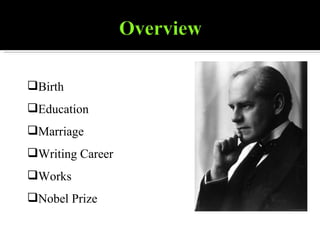
Birth Education Marriage Writing Career Works Nobel Prize
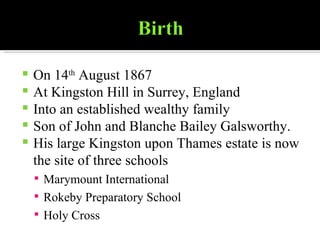
On 14 th  August 1867 At Kingston Hill in Surrey, England Into an established wealthy family Son of John and Blanche Bailey Galsworthy. His large Kingston upon Thames estate is now the site of three schools Marymount International Rokeby Preparatory School Holy Cross
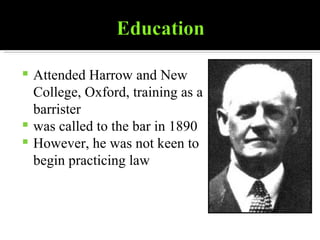
Attended Harrow and New College, Oxford, training as a barrister was called to the bar in 1890 However, he was not keen to begin practicing law
travelled abroad to look after the family's shipping business interests During these travels he met Joseph Conrad, then the first mate of a sailing-ship moored in the harbour of Adelaide, Australia the two future novelists became close friends
In 1895 Galsworthy began an affair with Ada Nemesis Pearson Cooper, the wife of Maj. Arthur Galsworthy, one of his cousins. After her divorce ten years later, the pair married on 23 rd  September 1905 and stayed together until his death in 1933.
From the Four Winds , a collection of short stories, was Galsworthy's first published work in 1897. These, and several subsequent works, were published under the pen name John Sinjohn In 1904 he began publishing under his own name, probably owing to the death of his father.
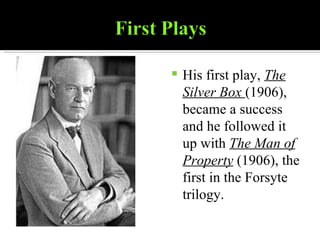
His first play,  The Silver Box   (1906), became a success and he followed it up with  The Man of Property  (1906), the first in the Forsyte trilogy.
Although he continued writing both plays and novels it was as a playwright that he was mainly appreciated for at the time.
He is known for  The Forsyte Saga , the first of three trilogies of novels about the eponymous family and connected lives. These works dealt with class, and in particular upper-middle class lives. Although sympathetic to his characters he highlights their insular, snobbish and acquisitive attitudes and their suffocating moral codes.
Along with George Bernard Shaw, his plays addressed the class system and social issues,  Two best known plays are  Strife  (1909) and  The Skin Game  (1920).
He is one of the first writers of the Edwardian era. Challenged some of the ideals of society depicted in the preceding literature of Victorian England in his works.
The depiction of a woman in an unhappy marriage furnishes another recurring theme in his work. The character of Irene in  The Forsyte Saga  is drawn from Ada Pearson even though her previous marriage was not as miserable as Irene's.
His work is often less convincing when it deals with the changing face of wider British society and how it affects people of the lower social classes. Through his writings he campaigned for a variety of causes including prison reform, women's rights, animal welfare and the opposition of censorship.
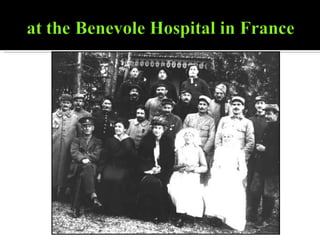
During the First World War Galsworthy was 47 years old. He worked in France at the Benevole Hospital for disabled soldiers. He also signed over his family house as a rest home for members of the British Army recovering from war injuries.
 
Elected as the first president of the International PEN literary club in 1921 Appointed to the Order of Merit in 1929 Turned down a knighthood
Awarded the Nobel Prize in 1932. He was too ill to attend the Nobel awards ceremony Died six weeks later.
John Galsworthy lived for the final seven years of his life at Bury in West Sussex. He died from a brain tumour on 31 st  January 1933 at his London home, Grove Lodge, Hampstead. In accordance with his will he was cremated at Woking and his ashes scattered over the South Downs from an aero plane.
 
The popularity of his fiction waned quickly after his death but the hugely successful adaptation of  The Forsyte Saga  in 1967 renewed interest in his work.
The Forsyte Saga  has been filmed several times: That Forsyte Woman  (1949), dir. by Compton Bennett  BBC television drama (1967), dir. by James Cellan Jones, David Giles 26 parts  Granada television drama (2002), dir. by Christopher Menaul, 13 parts.
The Skin Game  was adapted and directed by Alfred Hitchcock in 1931. Escape  was filmed in 1930 and 1948 directed by Joseph L. Mankiewicz. One More River  directed by James Whale in 1934. The First and the Last , a short play, was adapted as  21 Days .
From The Four Winds , 1897 (as John Sinjohn)  Jocelyn , 1898 (as John Sinjohn)  Villa Rubein , 1900 (as John Sinjohn)  A Man Of Devon , 1901 (as John Sinjohn)
The Silver Box , 1906 (his first play)  The Forsyte Saga , 1906-21, 1922  The Man Of Property , 1906  (interlude) Indian Summer of a Forsyte , 1918  In Chancery , 1920  (interlude) Awakening , 1920  To Let , 1921
The Country House , 1907  A Commentary , 1908  Strife , 1909  Fraternity , 1909  Joy , 1909 Justice , 1910  The Little Dream , 1911 The Eldest Son , 1912
The Fugitive , 1913  The Little Man , 1915  A Bit's Love , 1915  Saint's Progress , 1919  Addresses In America , 1912 Loyalties , 1922  Escape , 1926
A Modern Comedy , 1924-1928, 1929  The White Monkey , 1924  (Interlude) a Silent Wooing , 1927  The Silver Spoon , 1926  (Interlude) Passers By , 1927  Swan Song , 1928  Two Forsyte Interludes , 1927  The Manaton Edition , 1923-26 (collection, 30 vols.)  Exiled , 1929  The Roof , 1929  On Forsyte Change , 1930  Two Essays On Conrad , 1930  Soames And The Flag , 1930
His plays often took up specific social grievances. The double standard of justice as applied to the upper and lower classes in  The Silver Box . The confrontation of capital and labour in  Strife . Justice ,  his most famous play, led to a prison reform in England. Galsworthy's reaction to the First World War found its expression in  The Mob  (1914), in which the voice of a statesman is drowned in the madness of the war-hungry masses
 

John Galsworthy

  • 1.
    By Xavier PradheepSingh M. S.
  • 2.
    Birth Education MarriageWriting Career Works Nobel Prize
  • 3.
    On 14 th August 1867 At Kingston Hill in Surrey, England Into an established wealthy family Son of John and Blanche Bailey Galsworthy. His large Kingston upon Thames estate is now the site of three schools Marymount International Rokeby Preparatory School Holy Cross
  • 4.
    Attended Harrow andNew College, Oxford, training as a barrister was called to the bar in 1890 However, he was not keen to begin practicing law
  • 5.
    travelled abroad tolook after the family's shipping business interests During these travels he met Joseph Conrad, then the first mate of a sailing-ship moored in the harbour of Adelaide, Australia the two future novelists became close friends
  • 6.
    In 1895 Galsworthybegan an affair with Ada Nemesis Pearson Cooper, the wife of Maj. Arthur Galsworthy, one of his cousins. After her divorce ten years later, the pair married on 23 rd September 1905 and stayed together until his death in 1933.
  • 7.
    From the FourWinds , a collection of short stories, was Galsworthy's first published work in 1897. These, and several subsequent works, were published under the pen name John Sinjohn In 1904 he began publishing under his own name, probably owing to the death of his father.
  • 8.
    His first play, The Silver Box (1906), became a success and he followed it up with The Man of Property (1906), the first in the Forsyte trilogy.
  • 9.
    Although he continuedwriting both plays and novels it was as a playwright that he was mainly appreciated for at the time.
  • 10.
    He is knownfor The Forsyte Saga , the first of three trilogies of novels about the eponymous family and connected lives. These works dealt with class, and in particular upper-middle class lives. Although sympathetic to his characters he highlights their insular, snobbish and acquisitive attitudes and their suffocating moral codes.
  • 11.
    Along with GeorgeBernard Shaw, his plays addressed the class system and social issues, Two best known plays are Strife (1909) and The Skin Game (1920).
  • 12.
    He is oneof the first writers of the Edwardian era. Challenged some of the ideals of society depicted in the preceding literature of Victorian England in his works.
  • 13.
    The depiction ofa woman in an unhappy marriage furnishes another recurring theme in his work. The character of Irene in The Forsyte Saga is drawn from Ada Pearson even though her previous marriage was not as miserable as Irene's.
  • 14.
    His work isoften less convincing when it deals with the changing face of wider British society and how it affects people of the lower social classes. Through his writings he campaigned for a variety of causes including prison reform, women's rights, animal welfare and the opposition of censorship.
  • 15.
    During the FirstWorld War Galsworthy was 47 years old. He worked in France at the Benevole Hospital for disabled soldiers. He also signed over his family house as a rest home for members of the British Army recovering from war injuries.
  • 16.
  • 17.
    Elected as thefirst president of the International PEN literary club in 1921 Appointed to the Order of Merit in 1929 Turned down a knighthood
  • 18.
    Awarded the NobelPrize in 1932. He was too ill to attend the Nobel awards ceremony Died six weeks later.
  • 19.
    John Galsworthy livedfor the final seven years of his life at Bury in West Sussex. He died from a brain tumour on 31 st January 1933 at his London home, Grove Lodge, Hampstead. In accordance with his will he was cremated at Woking and his ashes scattered over the South Downs from an aero plane.
  • 20.
  • 21.
    The popularity ofhis fiction waned quickly after his death but the hugely successful adaptation of The Forsyte Saga in 1967 renewed interest in his work.
  • 22.
    The Forsyte Saga has been filmed several times: That Forsyte Woman (1949), dir. by Compton Bennett BBC television drama (1967), dir. by James Cellan Jones, David Giles 26 parts Granada television drama (2002), dir. by Christopher Menaul, 13 parts.
  • 23.
    The Skin Game was adapted and directed by Alfred Hitchcock in 1931. Escape was filmed in 1930 and 1948 directed by Joseph L. Mankiewicz. One More River directed by James Whale in 1934. The First and the Last , a short play, was adapted as 21 Days .
  • 24.
    From The FourWinds , 1897 (as John Sinjohn) Jocelyn , 1898 (as John Sinjohn) Villa Rubein , 1900 (as John Sinjohn) A Man Of Devon , 1901 (as John Sinjohn)
  • 25.
    The Silver Box, 1906 (his first play) The Forsyte Saga , 1906-21, 1922 The Man Of Property , 1906 (interlude) Indian Summer of a Forsyte , 1918 In Chancery , 1920 (interlude) Awakening , 1920 To Let , 1921
  • 26.
    The Country House, 1907 A Commentary , 1908 Strife , 1909 Fraternity , 1909 Joy , 1909 Justice , 1910 The Little Dream , 1911 The Eldest Son , 1912
  • 27.
    The Fugitive ,1913 The Little Man , 1915 A Bit's Love , 1915 Saint's Progress , 1919 Addresses In America , 1912 Loyalties , 1922 Escape , 1926
  • 28.
    A Modern Comedy, 1924-1928, 1929 The White Monkey , 1924 (Interlude) a Silent Wooing , 1927 The Silver Spoon , 1926 (Interlude) Passers By , 1927 Swan Song , 1928 Two Forsyte Interludes , 1927 The Manaton Edition , 1923-26 (collection, 30 vols.) Exiled , 1929 The Roof , 1929 On Forsyte Change , 1930 Two Essays On Conrad , 1930 Soames And The Flag , 1930
  • 29.
    His plays oftentook up specific social grievances. The double standard of justice as applied to the upper and lower classes in The Silver Box . The confrontation of capital and labour in Strife . Justice , his most famous play, led to a prison reform in England. Galsworthy's reaction to the First World War found its expression in The Mob (1914), in which the voice of a statesman is drowned in the madness of the war-hungry masses
  • 30.