
WRITING PROJECT REPORTS
M.S. Xavier Pradheep Singh
Email: pradheepxing@gmail.com
Project Report
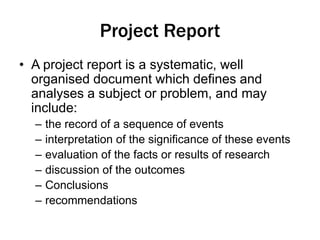
• A project report is a systematic, well
organised document which defines and
analyses a subject or problem, and may
include:
– the record of a sequence of events
– interpretation of the significance of these events
– evaluation of the facts or results of research
– discussion of the outcomes
– Conclusions
– recommendations
• A good project report has a structure and a
proper style.
– Structure of Project Report
– Academic style of writing
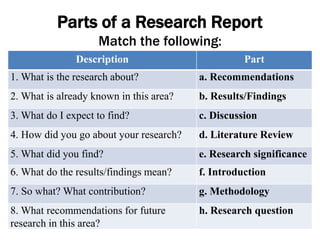
Parts of a Research Report
Match the following:
Description Part
1. What is the research about? a. Recommendations
2. What is already known in this area? b. Results/Findings
3. What do I expect to find? c. Discussion
4. How did you go about your research? d. Literature Review
5. What did you find? e. Research significance
6. What do the results/findings mean? f. Introduction
7. So what? What contribution? g. Methodology
8. What recommendations for future
research in this area?
h. Research question
Parts of a Research Report
Description Part
1. What is the research about? f. Introduction
2. What is already known in this area? d. Literature Review
3. What do I expect to find? h. Research question
4. How did you go about your
research?
g. Methodology
5. What did you find? b. Results/Findings
6. What do the results/findings mean? c. Discussion
7. So what? What contribution? e. Research
significance
8. What recommendations for future a. Recommendations
Structure of a Research Report
• Title
• Abstract
• Table of Contents
• Introduction
• Literature Review
• Methodology
• Findings
• Discussion
• Conclusions
• Recommendation
• References
• Appendices
Abstract
• This should be a very brief overview of
the entire report covering 4 main
areas:
–What you did (the topic)
–How you did it (methodology)
–What you found out (results – major
only)
–What was the significance
(conclusion/recommendations)
Introduction
• Provide contextual information to the
problem/questions, identifying the
gap of research in this area
• ƒIntroduce the objectives
• ƒIdentify the specific research
questions
• Indicate the structure of
• the rest of the report
Literature Review
• Review previous work relating to research
problem/questions
• Show the gap that the present research
will be filling.
– Should be structured thematically
– May have a number of sub-sections to
identify themes
– Research should be integrated and
combined highlighting areas of similarity
and difference
Methodology
• Discuss your theoretical
• perspectives (this may depend on your area of
research)
• Use the literature (theory) to help you justify why
you chose this methodology
• Explore the scope and limitations of your chosen
methodology
• ƒExplain how data was collected/generated
• ƒExplain how data was analysed
• ƒExplain any methodological problems
• and their solutions or effects
ƒResults
• Present the results (using
graphs, tables, etc where
appropriate)
Discussion
• Interpret and discuss the results
• ƒCompare with results of previous
research (link to the Literature
Review)
• ƒDiscuss the effects of methods used
on data obtained.
• ƒDiscuss the shortcomings of the
research, or the research
methodology?
Conclusions
• Return to the research questions and
suggest whether they've been
answered or "solved".
• ƒReturn to the objectives and whether
thy have been achieved?
• ƒIndicate what has been learnt from
the study and how it can be applied
• ƒIndicate improvements for the
research and future possibilities
Recommendations
• Things you wanted to do but
couldn’t
• Why should you do them?
• Why didn’t you?
• What you would do in a
different way & why?
Style of a Research Report
• Academic style of writing usually includes
the following features:
– Subject specific words
– References
– Formal tone/language
– Examples of writing in the third person
Example 1
• Gender has been an issue throughout history
for example women didn’t fight in WW2. This
is because people thought that they should
stay at home and look after the kids, but I
think they could have fought in the wars
because some women are stronger than
men.
– Subject specific words Y/N
– Formal Tone/Language Y/N
– Writing in the third person Y/N
– References Y/N
Example 1
• Includes subject specific words.
• However, this is a poor example of
academic writing as it:
–Includes contractions such as didn’t
–Uses informal English such as kids
–Should not be written in the first
person; I think
–Should include evidence to support
points; people thought
Example 2
• Referring to Payne (2000), one of the indicators of
social divisions is unequal access to resources
and thus different chances and life styles. Such
unequal access is most clearly seen by a person’s
ability to acquire goods and services for his or her
own personal needs. This is primarily influenced
by people’s employment access to income and
amount of income.
– Subject specific words Y/N
– Formal Tone/Language Y/N
– Writing in the third person Y/N
– References Y/N
Example 2
• Includes subject specific words,
references, formal tone and language
and examples of writing in the third
person:
– References and evidence to support points;
Payne (2000).
– Subject specific terminology, such as social
divisions
– Use of the third person; a person’s ability.
Example 3
• With classification of ownership and form of leases
required for financial statements, the UK has been
using the substance over form method, SSAP 21
for operating leases and finance leases. This
requires the total expenses be charged as an
expense in the profit and loss account, being
detailed in a note structure for operating leases.
– Subject specific words Y/N
– Formal Tone/Language Y/N
– Writing in the third person Y/N
– References Y/N
Example 3
• Includes subject specific words
and formal tone and language:
–Subject specific words, such as
operating leases
Example 4
• It can be seen that selected art galleries
around London, often offer members of the
public the opportunity to engage with art for
free. This can allow members of society who
may be jobless, struggling to find work or in
between jobs the chance to still experience
the developing culture of the art world.
– Subject specific words Y/N
– Formal Tone/Language Y/N
– Writing in the third person Y/N
– References Y/N
Example 4
• Includes examples of writing in the
third person; however, this is a poor
example as the writing:
–Is not concise; in this example there
are a lot of unnecessary words.
–Does not include references; which
galleries?
–Uses informal colloquial words; jobless
Academic Vs Non-academic Styles
Academic Non-academic
Reader Academicians Family and friends
Content Serious thought Conversational
Style (Sentence
Construction)
Complex sentences
showing considerable
variety in construction
Mostly simple and
compound sentences
joined by constructions
such as and or but.
Organisation Clear and well-planned Less likely to be clear
and organised
Grammar Likely to be error free May not always use
complete sentences
Vocabulary Technical and academic
language used
accurately
Use short forms, idioms
and slang.
Academic Words
• Formal words are
– longer than informal words
– single words not multi-words
– of French/Latin origin rather than their
informal equivalents which are of Anglo-
Saxon origin
• Example: "depart" is from French/Latin but
"go" is Anglo-Saxon
Formal / Academic
Words
Informal / Non-Academic
Words
Climb
Help
Cease
Commence
Use
Decrease
Demonstrate
Want
Enquire
End
Tell
Obtain
Preserve
Reject
Free
Mend
Require
Formal / Academic
Words
Informal / Non-Academic
Words
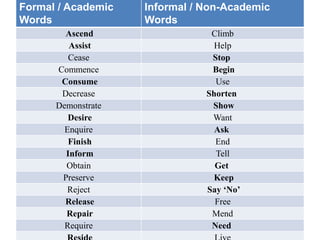
Ascend Climb
Assist Help
Cease Stop
Commence Begin
Consume Use
Decrease Shorten
Demonstrate Show
Desire Want
Enquire Ask
Finish End
Inform Tell
Obtain Get
Preserve Keep
Reject Say ‘No’
Release Free
Repair Mend
Require Need

Writing project reports

  • 1.
    WRITING PROJECT REPORTS M.S.Xavier Pradheep Singh Email: pradheepxing@gmail.com
  • 2.
    Project Report • Aproject report is a systematic, well organised document which defines and analyses a subject or problem, and may include: – the record of a sequence of events – interpretation of the significance of these events – evaluation of the facts or results of research – discussion of the outcomes – Conclusions – recommendations
  • 3.
    • A goodproject report has a structure and a proper style. – Structure of Project Report – Academic style of writing
  • 4.
    Parts of aResearch Report Match the following: Description Part 1. What is the research about? a. Recommendations 2. What is already known in this area? b. Results/Findings 3. What do I expect to find? c. Discussion 4. How did you go about your research? d. Literature Review 5. What did you find? e. Research significance 6. What do the results/findings mean? f. Introduction 7. So what? What contribution? g. Methodology 8. What recommendations for future research in this area? h. Research question
  • 5.
    Parts of aResearch Report Description Part 1. What is the research about? f. Introduction 2. What is already known in this area? d. Literature Review 3. What do I expect to find? h. Research question 4. How did you go about your research? g. Methodology 5. What did you find? b. Results/Findings 6. What do the results/findings mean? c. Discussion 7. So what? What contribution? e. Research significance 8. What recommendations for future a. Recommendations
  • 6.
    Structure of aResearch Report • Title • Abstract • Table of Contents • Introduction • Literature Review • Methodology • Findings • Discussion • Conclusions • Recommendation • References • Appendices
  • 7.
    Abstract • This shouldbe a very brief overview of the entire report covering 4 main areas: –What you did (the topic) –How you did it (methodology) –What you found out (results – major only) –What was the significance (conclusion/recommendations)
  • 8.
    Introduction • Provide contextualinformation to the problem/questions, identifying the gap of research in this area • ƒIntroduce the objectives • ƒIdentify the specific research questions • Indicate the structure of • the rest of the report
  • 9.
    Literature Review • Reviewprevious work relating to research problem/questions • Show the gap that the present research will be filling. – Should be structured thematically – May have a number of sub-sections to identify themes – Research should be integrated and combined highlighting areas of similarity and difference
  • 10.
    Methodology • Discuss yourtheoretical • perspectives (this may depend on your area of research) • Use the literature (theory) to help you justify why you chose this methodology • Explore the scope and limitations of your chosen methodology • ƒExplain how data was collected/generated • ƒExplain how data was analysed • ƒExplain any methodological problems • and their solutions or effects
  • 11.
    ƒResults • Present theresults (using graphs, tables, etc where appropriate)
  • 12.
    Discussion • Interpret anddiscuss the results • ƒCompare with results of previous research (link to the Literature Review) • ƒDiscuss the effects of methods used on data obtained. • ƒDiscuss the shortcomings of the research, or the research methodology?
  • 13.
    Conclusions • Return tothe research questions and suggest whether they've been answered or "solved". • ƒReturn to the objectives and whether thy have been achieved? • ƒIndicate what has been learnt from the study and how it can be applied • ƒIndicate improvements for the research and future possibilities
  • 14.
    Recommendations • Things youwanted to do but couldn’t • Why should you do them? • Why didn’t you? • What you would do in a different way & why?
  • 15.
    Style of aResearch Report • Academic style of writing usually includes the following features: – Subject specific words – References – Formal tone/language – Examples of writing in the third person
  • 16.
    Example 1 • Genderhas been an issue throughout history for example women didn’t fight in WW2. This is because people thought that they should stay at home and look after the kids, but I think they could have fought in the wars because some women are stronger than men. – Subject specific words Y/N – Formal Tone/Language Y/N – Writing in the third person Y/N – References Y/N
  • 17.
    Example 1 • Includessubject specific words. • However, this is a poor example of academic writing as it: –Includes contractions such as didn’t –Uses informal English such as kids –Should not be written in the first person; I think –Should include evidence to support points; people thought
  • 18.
    Example 2 • Referringto Payne (2000), one of the indicators of social divisions is unequal access to resources and thus different chances and life styles. Such unequal access is most clearly seen by a person’s ability to acquire goods and services for his or her own personal needs. This is primarily influenced by people’s employment access to income and amount of income. – Subject specific words Y/N – Formal Tone/Language Y/N – Writing in the third person Y/N – References Y/N
  • 19.
    Example 2 • Includessubject specific words, references, formal tone and language and examples of writing in the third person: – References and evidence to support points; Payne (2000). – Subject specific terminology, such as social divisions – Use of the third person; a person’s ability.
  • 20.
    Example 3 • Withclassification of ownership and form of leases required for financial statements, the UK has been using the substance over form method, SSAP 21 for operating leases and finance leases. This requires the total expenses be charged as an expense in the profit and loss account, being detailed in a note structure for operating leases. – Subject specific words Y/N – Formal Tone/Language Y/N – Writing in the third person Y/N – References Y/N
  • 21.
    Example 3 • Includessubject specific words and formal tone and language: –Subject specific words, such as operating leases
  • 22.
    Example 4 • Itcan be seen that selected art galleries around London, often offer members of the public the opportunity to engage with art for free. This can allow members of society who may be jobless, struggling to find work or in between jobs the chance to still experience the developing culture of the art world. – Subject specific words Y/N – Formal Tone/Language Y/N – Writing in the third person Y/N – References Y/N
  • 23.
    Example 4 • Includesexamples of writing in the third person; however, this is a poor example as the writing: –Is not concise; in this example there are a lot of unnecessary words. –Does not include references; which galleries? –Uses informal colloquial words; jobless
  • 24.
    Academic Vs Non-academicStyles Academic Non-academic Reader Academicians Family and friends Content Serious thought Conversational Style (Sentence Construction) Complex sentences showing considerable variety in construction Mostly simple and compound sentences joined by constructions such as and or but. Organisation Clear and well-planned Less likely to be clear and organised Grammar Likely to be error free May not always use complete sentences Vocabulary Technical and academic language used accurately Use short forms, idioms and slang.
  • 25.
    Academic Words • Formalwords are – longer than informal words – single words not multi-words – of French/Latin origin rather than their informal equivalents which are of Anglo- Saxon origin • Example: "depart" is from French/Latin but "go" is Anglo-Saxon
  • 26.
    Formal / Academic Words Informal/ Non-Academic Words Climb Help Cease Commence Use Decrease Demonstrate Want Enquire End Tell Obtain Preserve Reject Free Mend Require
  • 27.
    Formal / Academic Words Informal/ Non-Academic Words Ascend Climb Assist Help Cease Stop Commence Begin Consume Use Decrease Shorten Demonstrate Show Desire Want Enquire Ask Finish End Inform Tell Obtain Get Preserve Keep Reject Say ‘No’ Release Free Repair Mend Require Need