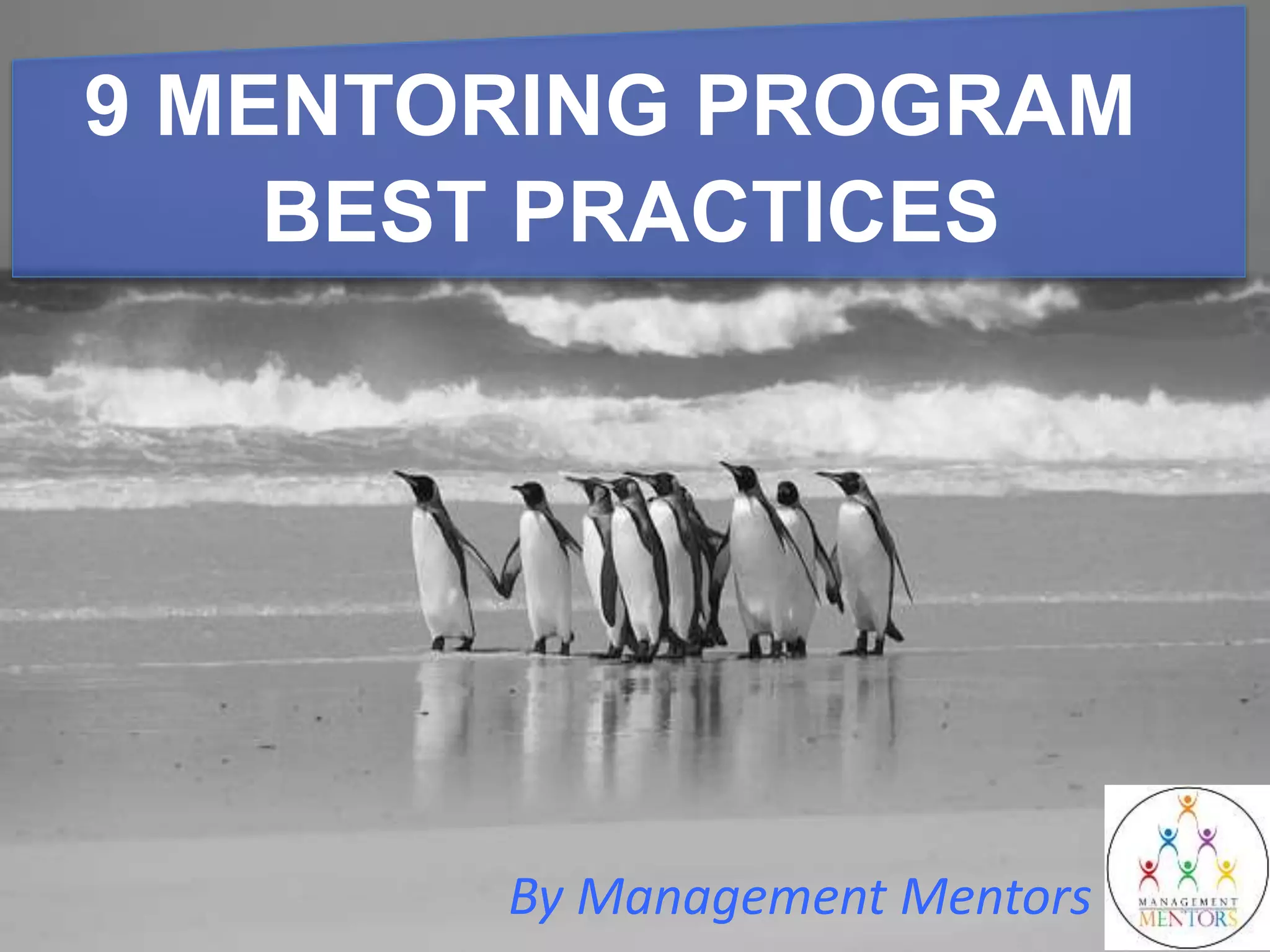
9 MENTORING PROGRAM
BEST PRACTICES
By Management Mentors
When developing formal mentoring programs,
there are nine best practices companies should
embrace. Let’s dig in!
IDENTIFY A STRATEGIC
PURPOSE
1
 Every mentoring program should
have a strategic purpose.
Image Credit: flickr.com/photos/evoo73/
1
 Every mentoring program should
have a strategic purpose.
 This provides the mentors and mentorees
a foundation upon which they can
build their relationships.
1
 Every mentoring program should
have a strategic purpose.
 This provides the mentors and mentorees
a foundation upon which they can
build their relationships.
 For example, if the purpose of your
program is to support leadership initiatives,
your mentors and mentorees will know that
this subject should be a main topic of
discussion throughout their nine to twelve
months together.
1
 Every mentoring program should
have a strategic purpose.
 This provides the mentors and mentorees
a foundation upon which they can
build their relationships.
 For example, if the purpose of your
program is to support leadership initiatives,
your mentors and mentorees will know that
this subject should be a main topic of
discussion throughout their nine to twelve
months together.
 No it doesn’t need to be the only topic.
Of course, other topics will evolve
naturally from this one.
1
Image Credit: flickr.com/photos/wwarby/
TRAIN A PROGRAM
MANAGER
2
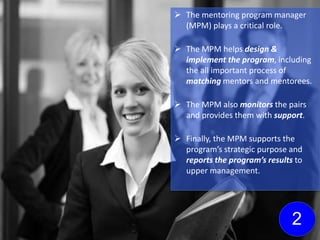
 The mentoring program manager
(MPM) plays a critical role.
2
 The mentoring program manager
(MPM) plays a critical role.
 The MPM helps design &
implement the program, including
the all important process of
matching mentors and mentorees.
2
 The mentoring program manager
(MPM) plays a critical role.
 The MPM helps design &
implement the program, including
the all important process of
matching mentors and mentorees.
 The MPM also monitors the pairs
and provides them with support.
2
 The mentoring program manager
(MPM) plays a critical role.
 The MPM helps design &
implement the program, including
the all important process of
matching mentors and mentorees.
 The MPM also monitors the pairs
and provides them with support.
 Finally, the MPM supports the
program’s strategic purpose and
reports the program’s results to
upper management.
2
Image Credit: flickr.com/photos/untitlism/
NEVER PAIR MENTOREES
WITH THEIR DIRECT
MANAGERS
3
3
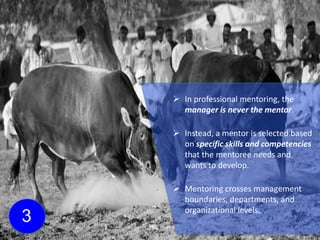
 In professional mentoring, the
manager is never the mentor.
3
 In professional mentoring, the
manager is never the mentor.
 Instead, a mentor is selected based
on specific skills and competencies
that the mentoree needs and
wants to develop.
3
 In professional mentoring, the
manager is never the mentor.
 Instead, a mentor is selected based
on specific skills and competencies
that the mentoree needs and
wants to develop.
 Mentoring crosses management
boundaries, departments, and
organizational levels.
Image Credit: flickr.com/photos/34316967@N04/
DIFFERENTIATE BETWEEN
COACHING & MENTORING
4
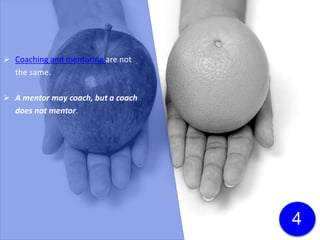
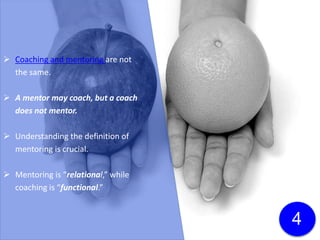
 Coaching and mentoring are not
the same.
Click here to download a free
white paper on the differences
between coaching and
mentoring!
4
 Coaching and mentoring are not
the same.
 A mentor may coach, but a coach
does not mentor.
4
Click here to download a free
white paper on the differences
between coaching and
mentoring!
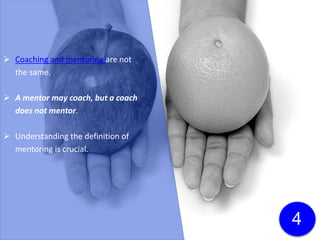
 Coaching and mentoring are not
the same.
 A mentor may coach, but a coach
does not mentor.
 Understanding the definition of
mentoring is crucial.
4
Click here to download a free
white paper on the differences
between coaching and
mentoring!
 Coaching and mentoring are not
the same.
 A mentor may coach, but a coach
does not mentor.
 Understanding the definition of
mentoring is crucial.
 Mentoring is “relational,” while
coaching is “functional.”
4
Click here to download a free
white paper on the differences
between coaching and
mentoring!
Image credit flickr.com/photos/kkleinrn/
PROVIDE TRAINING TO NEW
MENTORS & MENTOREES
5
 It’s easy to think there’s not much to mentoring.
Image Credit: flickr.com/photos/benoit-dufait/
5
 It’s easy to think there’s not much to mentoring.
 After all, it’s just two people getting together to
discuss stuff, right?
5
 It’s easy to think there’s not much to mentoring.
 After all, it’s just two people getting together to
discuss stuff, right?
 WRONG.
5
 It’s easy to think there’s not much to mentoring.
 After all, it’s just two people getting together to
discuss stuff, right?
 WRONG.
 It’s easy for mentorees and especially mentors to
think they don’t need any guidance as they head
into a mentoring program, but that couldn’t be
further from the truth.
5
 It’s easy to think there’s not much to mentoring.
 After all, it’s just two people getting together to
discuss stuff, right?
 WRONG.
 It’s easy for mentorees and especially mentors to
think they don’t need any guidance as they head
into a mentoring program, but that couldn’t be
further from the truth.
 Your program should offer some sort training and
guidelines to new mentors and mentorees who are
about to enter a mentoring relationship.
5
Click here to learn more about
mentoring training and
e-learning!
FOSTER A SAFE
MENTORING
ENVIRONMENT
6
 Mentoring is a developmental
relationship, one where feelings
thoughts, & emotions come into play.
Image Credit: flickr.com/photos/paperpariah/
6
 Mentoring is a developmental
relationship, one where feelings
thoughts, & emotions come into play.
 In order for honest discussions to take
place, both the mentor and mentoree
must feel safe—safe with one another
and safe in the overall environment.
6
 Mentoring is a developmental
relationship, one where feelings
thoughts, & emotions come into play.
 In order for honest discussions to take
place, both the mentor and mentoree
must feel safe—safe with one another
and safe in the overall environment.
 The MPM should encourage the mentor
and mentoree to jointly create an
environment whereby both can share
the “real” issues and the “real”
obstacles they have or are
encountering.
6
 Mentoring is a developmental
relationship, one where feelings
thoughts, & emotions come into play.
 In order for honest discussions to take
place, both the mentor and mentoree
must feel safe—safe with one another
and safe in the overall environment.
 The MPM should encourage the mentor
and mentoree to jointly create an
environment whereby both can share
the “real” issues and the “real”
obstacles they have or are
encountering.
 When mentors and mentorees feel safe
and trust one another to share these
sorts of thoughts and experiences, true
transformation can take place—for
both of them.
6
Image credit flickr.com/photos/kkleinrn/
PROVIDE EASY ACCESS TO
MENTORING RESOURCES
7
 You can easily create your own library of mentoring resources and share it with
mentors and mentorees as they enter the program.
7
Click here for FREE
mentoring resources
to get your library
started!
 You can easily create your own library of mentoring resources and share it with
mentors and mentorees as they enter the program.
 In addition, we recommend that the MPM send out regular communication to
mentors and mentorees (once a month, ideally) highlighting a specific, relevant
resource.
7
Click here for FREE
mentoring resources
to get your library
started!
 You can easily create your own library of mentoring resources and share it with
mentors and mentorees as they enter the program.
 In addition, we recommend that the MPM send out regular communication to
mentors and mentorees (once a month, ideally) highlighting a specific, relevant
resource.
 For example, during the first month, the MPM might send an article on three easy
communication tips, since the mentors and mentorees will be getting to know one
another.
7
Click here for FREE
mentoring resources
to get your library
started!
 You can easily create your own library of mentoring resources and share it with
mentors and mentorees as they enter the program.
 In addition, we recommend that the MPM send out regular communication to
mentors and mentorees (once a month, ideally) highlighting a specific, relevant
resource.
 For example, during the first month, the MPM might send an article on three easy
communication tips, since the mentors and mentorees will be getting to know one
another.
 During the halfway point, the MPM might send out a mentoring program success
story as motivation to keep going.
7
Click here for FREE
mentoring resources
to get your library
started!
8
EVALUATE RESULTS
 At the end of each mentoring
program, an evaluation should be
made with a focus on what worked,
what didn’t, and why.
8
 At the end of each mentoring
program, an evaluation should be
made with a focus on what worked,
what didn’t, and why.
 You can then make adjustments
accordingly before your next program
begins.
8
 At the end of each mentoring
program, an evaluation should be
made with a focus on what worked,
what didn’t, and why.
 You can then make adjustments
accordingly before your next program
begins.
 The mentoring program manager will
likely be the one performing the
evaluation, but it’s always a good idea
to bring in an objective 3rd party at some
point so you can gain fresh perspectives.
8
 At the end of each mentoring
program, an evaluation should be
made with a focus on what worked,
what didn’t, and why.
 You can then make adjustments
accordingly before your next program
begins.
 The mentoring program manager will
likely be the one performing the
evaluation, but it’s always a good idea
to bring in an objective 3rd party at some
point so you can gain fresh perspectives.
 A seasoned mentoring consultant can fairly
evaluate your program and offer practical
suggestions for improvement.
8
Image Credit: flickr.com/photos/50144889@N08/
KEEP IT DYNAMIC9
 Your mentoring program needs to evolve along with your organization and the
world at large.
9
 Your mentoring program needs to evolve along with your organization and the
world at large.
 Technology can play a huge role in business mentoring thanks to email, smart phones, and video
conferencing.
9
 Your mentoring program needs to evolve along with your organization and the
world at large.
 Technology can play a huge role in business mentoring thanks to email, smart phones, and video
conferencing.
 Be open to experimentation, especially if it’s at the request of your mentors and mentorees.
9
 Your mentoring program needs to evolve along with your organization and the
world at large.
 Technology can play a huge role in business mentoring thanks to email, smart phones, and video
conferencing.
 Be open to experimentation, especially if it’s at the request of your mentors and mentorees.
 Be open to new tools, new ideas, and new ways to make your program even better such as
e-mentoring software, which can provide a streamlined approaching to to filling out forms, keeping
track of time, and providing updates to the MPM.
9
Click here for more
information about e-
mentoring software.
 Your mentoring program needs to evolve along with your organization and the
world at large.
 Technology can play a huge role in business mentoring thanks to email, smart phones, and video
conferencing.
 Be open to experimentation, especially if it’s at the request of your mentors and mentorees.
 Be open to new tools, new ideas, and new ways to make your program even better such as
e-mentoring software, which can provide a streamlined approaching to to filling out forms, keeping
track of time, and providing updates to the MPM.
 Technology should never replace the one-to-one face time that’s critical to mentoring, but it can
certainly support your overall program.
9
Click here for more
information about e-
mentoring software.
We’ve been helping organizations
worldwide implement successful
corporate mentoring programs for over
25 years. Decades of experience;
innovative e-mentoring software.
P.O. Box 67291
Chestnut Hill, MA 02167
617-789-4622
Email
CONNECT WITH US
Blog
Twitter
LinkedIn
Facebook
Google +

9 Mentoring Best Practices

  • 1.
    9 MENTORING PROGRAM BESTPRACTICES By Management Mentors
  • 2.
    When developing formalmentoring programs, there are nine best practices companies should embrace. Let’s dig in!
  • 3.
  • 4.
     Every mentoringprogram should have a strategic purpose. Image Credit: flickr.com/photos/evoo73/ 1
  • 5.
     Every mentoringprogram should have a strategic purpose.  This provides the mentors and mentorees a foundation upon which they can build their relationships. 1
  • 6.
     Every mentoringprogram should have a strategic purpose.  This provides the mentors and mentorees a foundation upon which they can build their relationships.  For example, if the purpose of your program is to support leadership initiatives, your mentors and mentorees will know that this subject should be a main topic of discussion throughout their nine to twelve months together. 1
  • 7.
     Every mentoringprogram should have a strategic purpose.  This provides the mentors and mentorees a foundation upon which they can build their relationships.  For example, if the purpose of your program is to support leadership initiatives, your mentors and mentorees will know that this subject should be a main topic of discussion throughout their nine to twelve months together.  No it doesn’t need to be the only topic. Of course, other topics will evolve naturally from this one. 1
  • 8.
  • 9.
     The mentoringprogram manager (MPM) plays a critical role. 2
  • 10.
     The mentoringprogram manager (MPM) plays a critical role.  The MPM helps design & implement the program, including the all important process of matching mentors and mentorees. 2
  • 11.
     The mentoringprogram manager (MPM) plays a critical role.  The MPM helps design & implement the program, including the all important process of matching mentors and mentorees.  The MPM also monitors the pairs and provides them with support. 2
  • 12.
     The mentoringprogram manager (MPM) plays a critical role.  The MPM helps design & implement the program, including the all important process of matching mentors and mentorees.  The MPM also monitors the pairs and provides them with support.  Finally, the MPM supports the program’s strategic purpose and reports the program’s results to upper management. 2
  • 13.
    Image Credit: flickr.com/photos/untitlism/ NEVERPAIR MENTOREES WITH THEIR DIRECT MANAGERS 3
  • 14.
    3  In professionalmentoring, the manager is never the mentor.
  • 15.
    3  In professionalmentoring, the manager is never the mentor.  Instead, a mentor is selected based on specific skills and competencies that the mentoree needs and wants to develop.
  • 16.
    3  In professionalmentoring, the manager is never the mentor.  Instead, a mentor is selected based on specific skills and competencies that the mentoree needs and wants to develop.  Mentoring crosses management boundaries, departments, and organizational levels.
  • 17.
  • 18.
     Coaching andmentoring are not the same. Click here to download a free white paper on the differences between coaching and mentoring! 4
  • 19.
     Coaching andmentoring are not the same.  A mentor may coach, but a coach does not mentor. 4 Click here to download a free white paper on the differences between coaching and mentoring!
  • 20.
     Coaching andmentoring are not the same.  A mentor may coach, but a coach does not mentor.  Understanding the definition of mentoring is crucial. 4 Click here to download a free white paper on the differences between coaching and mentoring!
  • 21.
     Coaching andmentoring are not the same.  A mentor may coach, but a coach does not mentor.  Understanding the definition of mentoring is crucial.  Mentoring is “relational,” while coaching is “functional.” 4 Click here to download a free white paper on the differences between coaching and mentoring!
  • 22.
    Image credit flickr.com/photos/kkleinrn/ PROVIDETRAINING TO NEW MENTORS & MENTOREES 5
  • 23.
     It’s easyto think there’s not much to mentoring. Image Credit: flickr.com/photos/benoit-dufait/ 5
  • 24.
     It’s easyto think there’s not much to mentoring.  After all, it’s just two people getting together to discuss stuff, right? 5
  • 25.
     It’s easyto think there’s not much to mentoring.  After all, it’s just two people getting together to discuss stuff, right?  WRONG. 5
  • 26.
     It’s easyto think there’s not much to mentoring.  After all, it’s just two people getting together to discuss stuff, right?  WRONG.  It’s easy for mentorees and especially mentors to think they don’t need any guidance as they head into a mentoring program, but that couldn’t be further from the truth. 5
  • 27.
     It’s easyto think there’s not much to mentoring.  After all, it’s just two people getting together to discuss stuff, right?  WRONG.  It’s easy for mentorees and especially mentors to think they don’t need any guidance as they head into a mentoring program, but that couldn’t be further from the truth.  Your program should offer some sort training and guidelines to new mentors and mentorees who are about to enter a mentoring relationship. 5 Click here to learn more about mentoring training and e-learning!
  • 28.
  • 29.
     Mentoring isa developmental relationship, one where feelings thoughts, & emotions come into play. Image Credit: flickr.com/photos/paperpariah/ 6
  • 30.
     Mentoring isa developmental relationship, one where feelings thoughts, & emotions come into play.  In order for honest discussions to take place, both the mentor and mentoree must feel safe—safe with one another and safe in the overall environment. 6
  • 31.
     Mentoring isa developmental relationship, one where feelings thoughts, & emotions come into play.  In order for honest discussions to take place, both the mentor and mentoree must feel safe—safe with one another and safe in the overall environment.  The MPM should encourage the mentor and mentoree to jointly create an environment whereby both can share the “real” issues and the “real” obstacles they have or are encountering. 6
  • 32.
     Mentoring isa developmental relationship, one where feelings thoughts, & emotions come into play.  In order for honest discussions to take place, both the mentor and mentoree must feel safe—safe with one another and safe in the overall environment.  The MPM should encourage the mentor and mentoree to jointly create an environment whereby both can share the “real” issues and the “real” obstacles they have or are encountering.  When mentors and mentorees feel safe and trust one another to share these sorts of thoughts and experiences, true transformation can take place—for both of them. 6
  • 33.
    Image credit flickr.com/photos/kkleinrn/ PROVIDEEASY ACCESS TO MENTORING RESOURCES 7
  • 34.
     You caneasily create your own library of mentoring resources and share it with mentors and mentorees as they enter the program. 7 Click here for FREE mentoring resources to get your library started!
  • 35.
     You caneasily create your own library of mentoring resources and share it with mentors and mentorees as they enter the program.  In addition, we recommend that the MPM send out regular communication to mentors and mentorees (once a month, ideally) highlighting a specific, relevant resource. 7 Click here for FREE mentoring resources to get your library started!
  • 36.
     You caneasily create your own library of mentoring resources and share it with mentors and mentorees as they enter the program.  In addition, we recommend that the MPM send out regular communication to mentors and mentorees (once a month, ideally) highlighting a specific, relevant resource.  For example, during the first month, the MPM might send an article on three easy communication tips, since the mentors and mentorees will be getting to know one another. 7 Click here for FREE mentoring resources to get your library started!
  • 37.
     You caneasily create your own library of mentoring resources and share it with mentors and mentorees as they enter the program.  In addition, we recommend that the MPM send out regular communication to mentors and mentorees (once a month, ideally) highlighting a specific, relevant resource.  For example, during the first month, the MPM might send an article on three easy communication tips, since the mentors and mentorees will be getting to know one another.  During the halfway point, the MPM might send out a mentoring program success story as motivation to keep going. 7 Click here for FREE mentoring resources to get your library started!
  • 38.
  • 39.
     At theend of each mentoring program, an evaluation should be made with a focus on what worked, what didn’t, and why. 8
  • 40.
     At theend of each mentoring program, an evaluation should be made with a focus on what worked, what didn’t, and why.  You can then make adjustments accordingly before your next program begins. 8
  • 41.
     At theend of each mentoring program, an evaluation should be made with a focus on what worked, what didn’t, and why.  You can then make adjustments accordingly before your next program begins.  The mentoring program manager will likely be the one performing the evaluation, but it’s always a good idea to bring in an objective 3rd party at some point so you can gain fresh perspectives. 8
  • 42.
     At theend of each mentoring program, an evaluation should be made with a focus on what worked, what didn’t, and why.  You can then make adjustments accordingly before your next program begins.  The mentoring program manager will likely be the one performing the evaluation, but it’s always a good idea to bring in an objective 3rd party at some point so you can gain fresh perspectives.  A seasoned mentoring consultant can fairly evaluate your program and offer practical suggestions for improvement. 8
  • 43.
  • 44.
     Your mentoringprogram needs to evolve along with your organization and the world at large. 9
  • 45.
     Your mentoringprogram needs to evolve along with your organization and the world at large.  Technology can play a huge role in business mentoring thanks to email, smart phones, and video conferencing. 9
  • 46.
     Your mentoringprogram needs to evolve along with your organization and the world at large.  Technology can play a huge role in business mentoring thanks to email, smart phones, and video conferencing.  Be open to experimentation, especially if it’s at the request of your mentors and mentorees. 9
  • 47.
     Your mentoringprogram needs to evolve along with your organization and the world at large.  Technology can play a huge role in business mentoring thanks to email, smart phones, and video conferencing.  Be open to experimentation, especially if it’s at the request of your mentors and mentorees.  Be open to new tools, new ideas, and new ways to make your program even better such as e-mentoring software, which can provide a streamlined approaching to to filling out forms, keeping track of time, and providing updates to the MPM. 9 Click here for more information about e- mentoring software.
  • 48.
     Your mentoringprogram needs to evolve along with your organization and the world at large.  Technology can play a huge role in business mentoring thanks to email, smart phones, and video conferencing.  Be open to experimentation, especially if it’s at the request of your mentors and mentorees.  Be open to new tools, new ideas, and new ways to make your program even better such as e-mentoring software, which can provide a streamlined approaching to to filling out forms, keeping track of time, and providing updates to the MPM.  Technology should never replace the one-to-one face time that’s critical to mentoring, but it can certainly support your overall program. 9 Click here for more information about e- mentoring software.
  • 49.
    We’ve been helpingorganizations worldwide implement successful corporate mentoring programs for over 25 years. Decades of experience; innovative e-mentoring software. P.O. Box 67291 Chestnut Hill, MA 02167 617-789-4622 Email CONNECT WITH US Blog Twitter LinkedIn Facebook Google +