Communication SkillsCommunication Skills
By –By – N.G.PalitN.G.Palit
What is Communication?What is Communication?
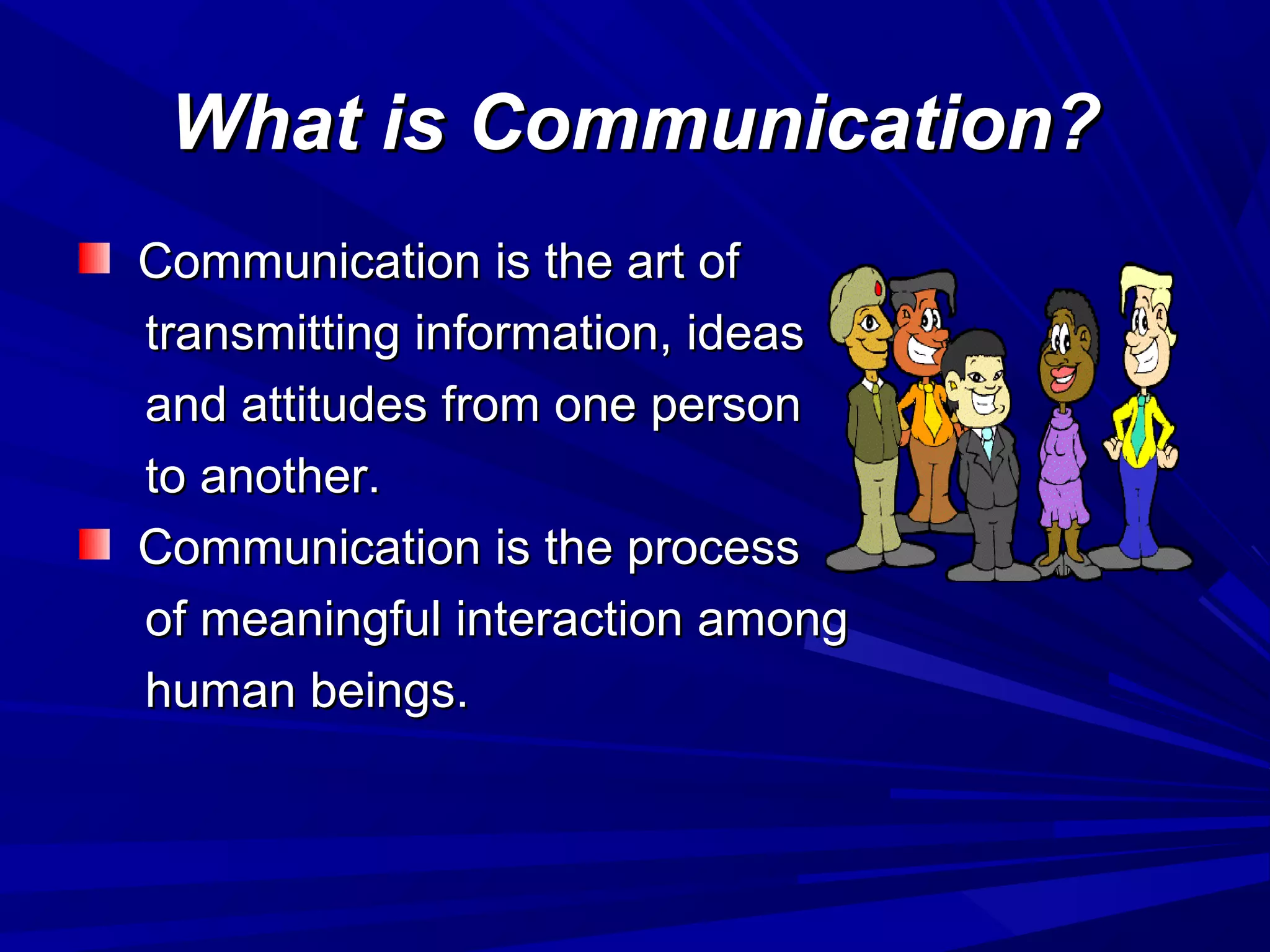
Communication is the art ofCommunication is the art of
transmitting information, ideastransmitting information, ideas
and attitudes from one personand attitudes from one person
to another.to another.
Communication is the processCommunication is the process
of meaningful interaction amongof meaningful interaction among
human beings.human beings.
What is Communication?What is Communication?
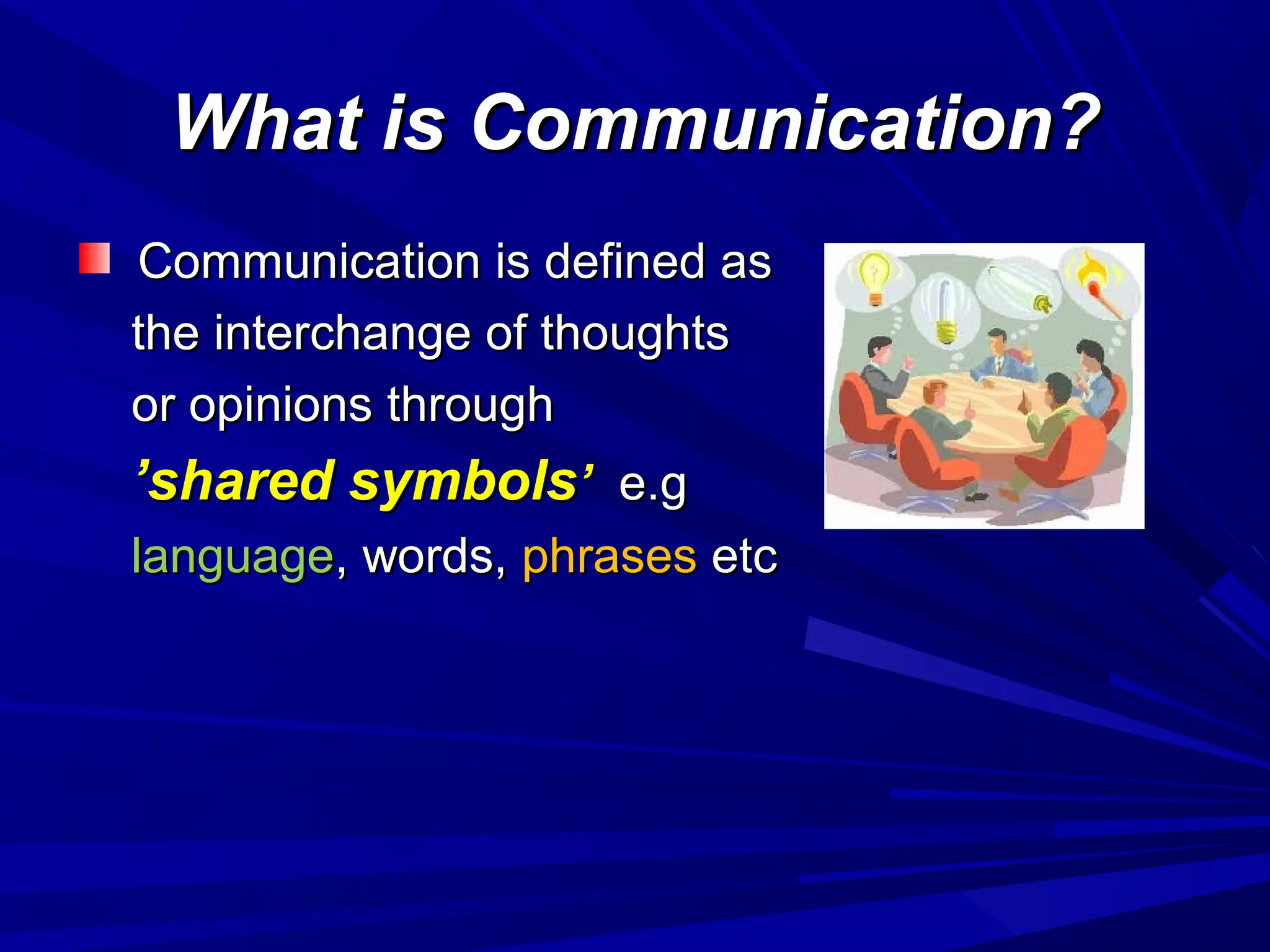
Communication is defined asCommunication is defined as
the interchange of thoughtsthe interchange of thoughts
or opinions throughor opinions through
’’shared symbolsshared symbols’’ e.ge.g
languagelanguage, words,, words, phrasesphrases etcetc
What is Effective Communication?What is Effective Communication?
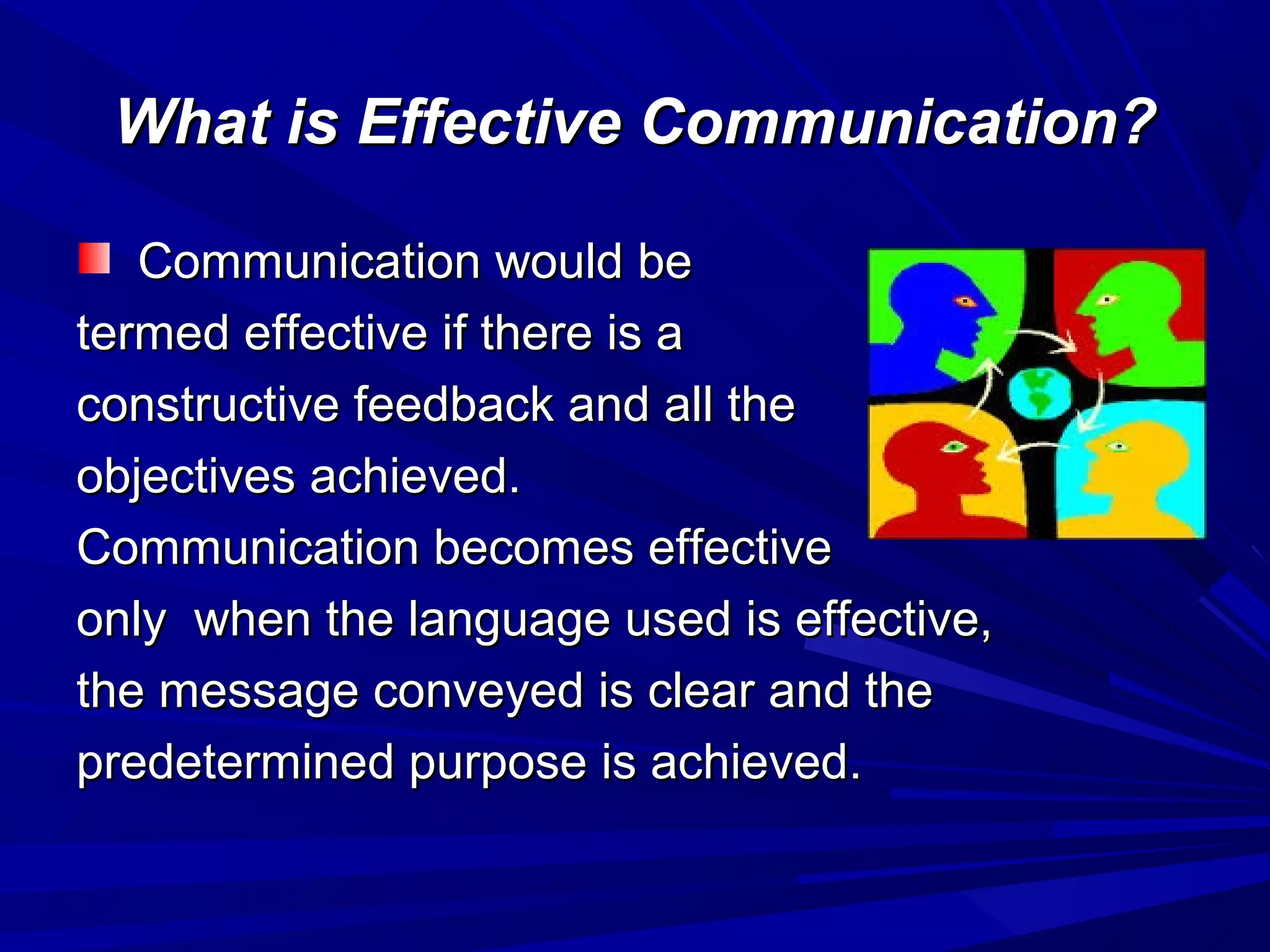
Communication would beCommunication would be
termed effective if there is atermed effective if there is a
constructive feedback and all theconstructive feedback and all the
objectives achieved.objectives achieved.
Communication becomes effectiveCommunication becomes effective
only when the language used is effective,only when the language used is effective,
the message conveyed is clear and thethe message conveyed is clear and the
predetermined purpose is achieved.predetermined purpose is achieved.
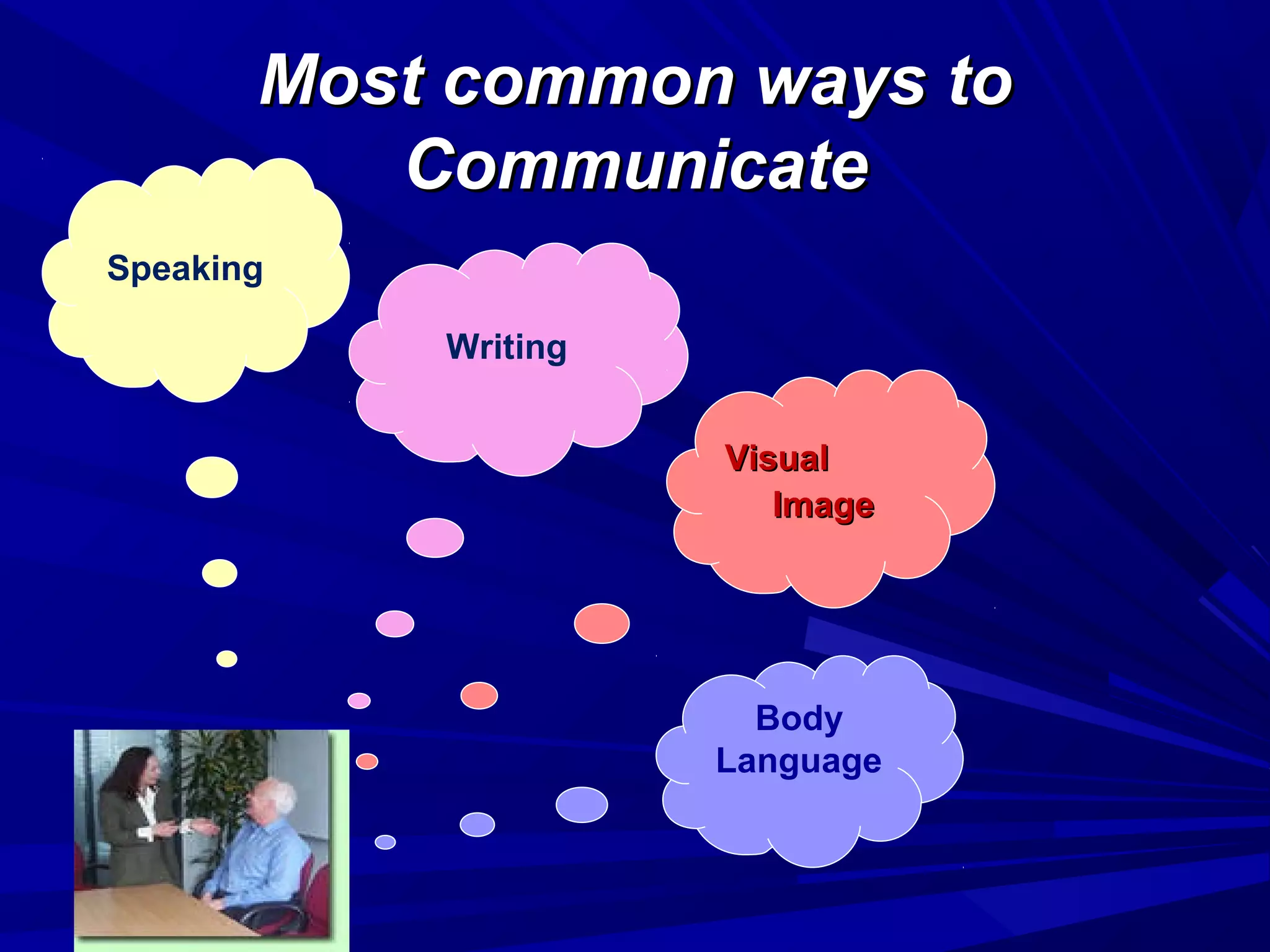
Most common ways toMost common ways to
CommunicateCommunicate
Speaking
Writing
VisualVisual
ImageImage
Body
Language
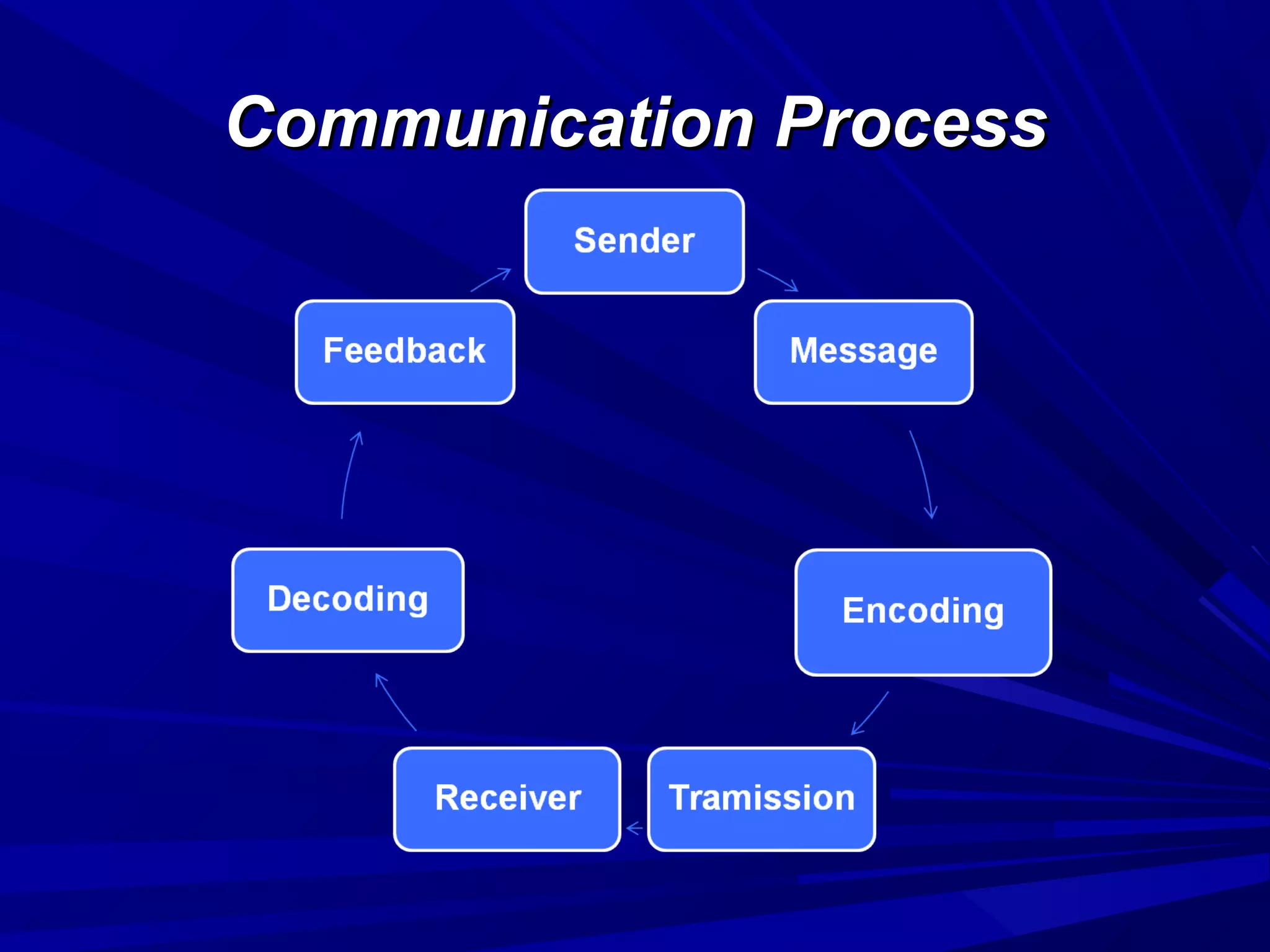
Communication ProcessCommunication Process
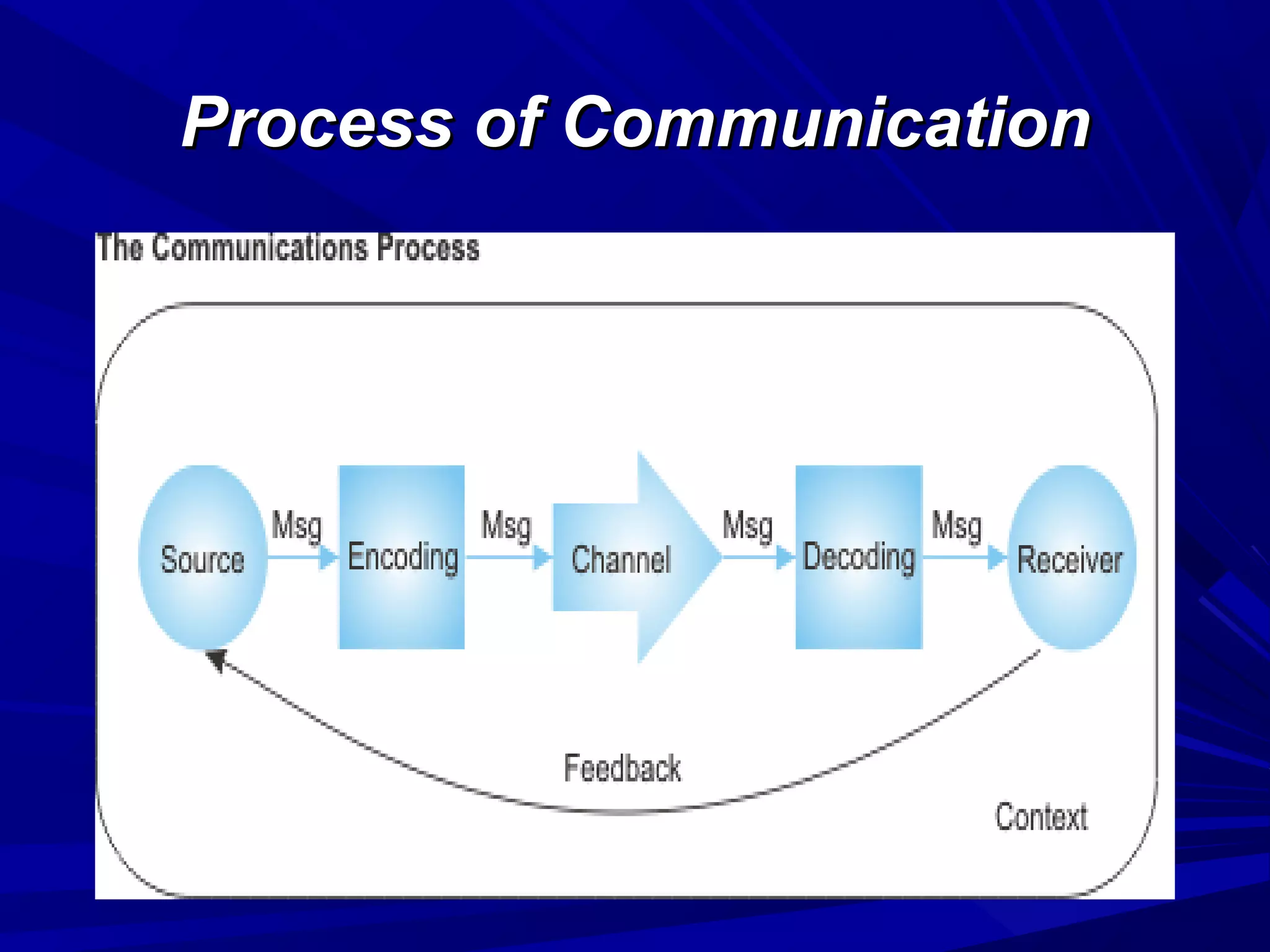
Process of CommunicationProcess of Communication
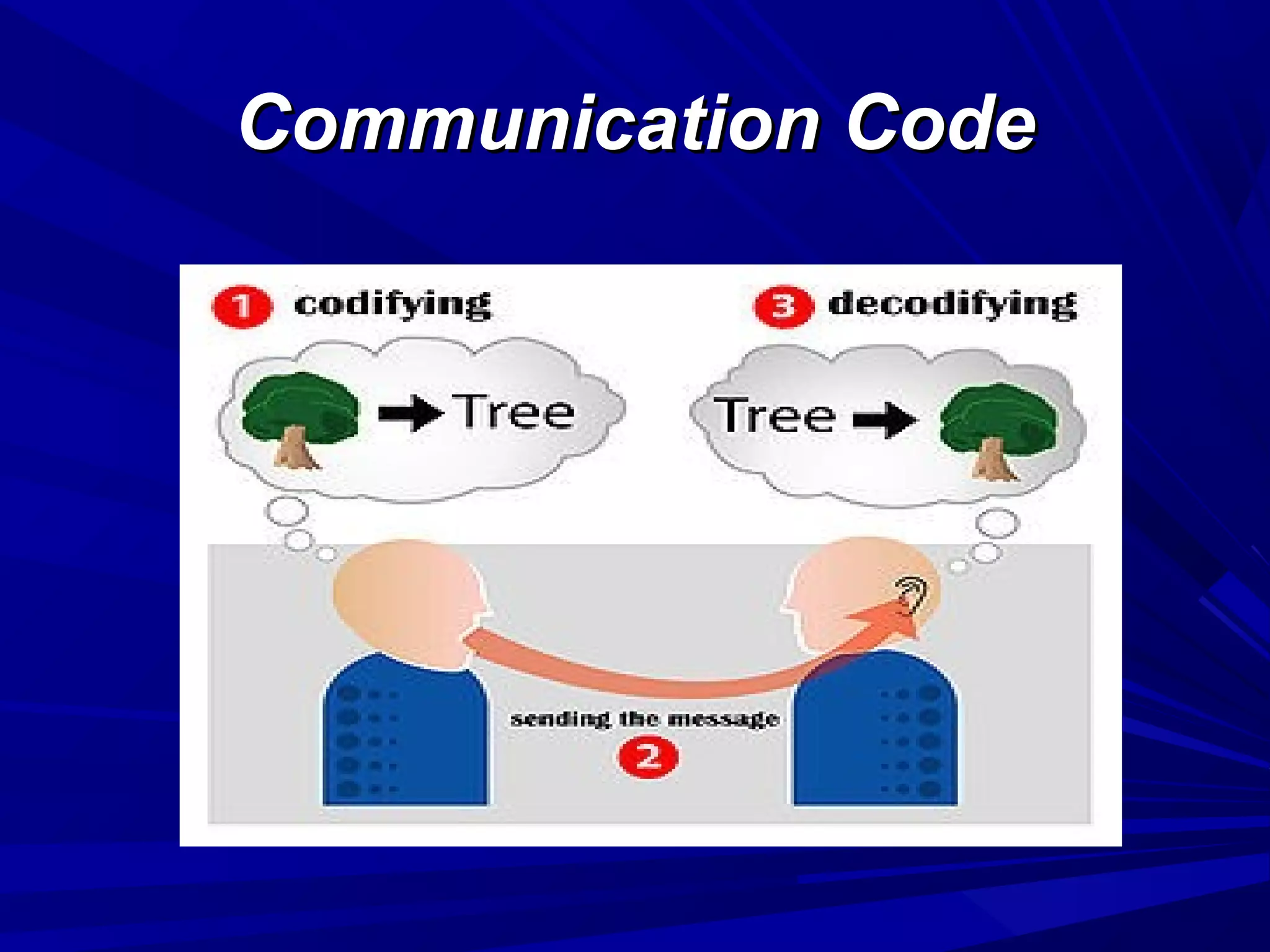
Communication CodeCommunication Code
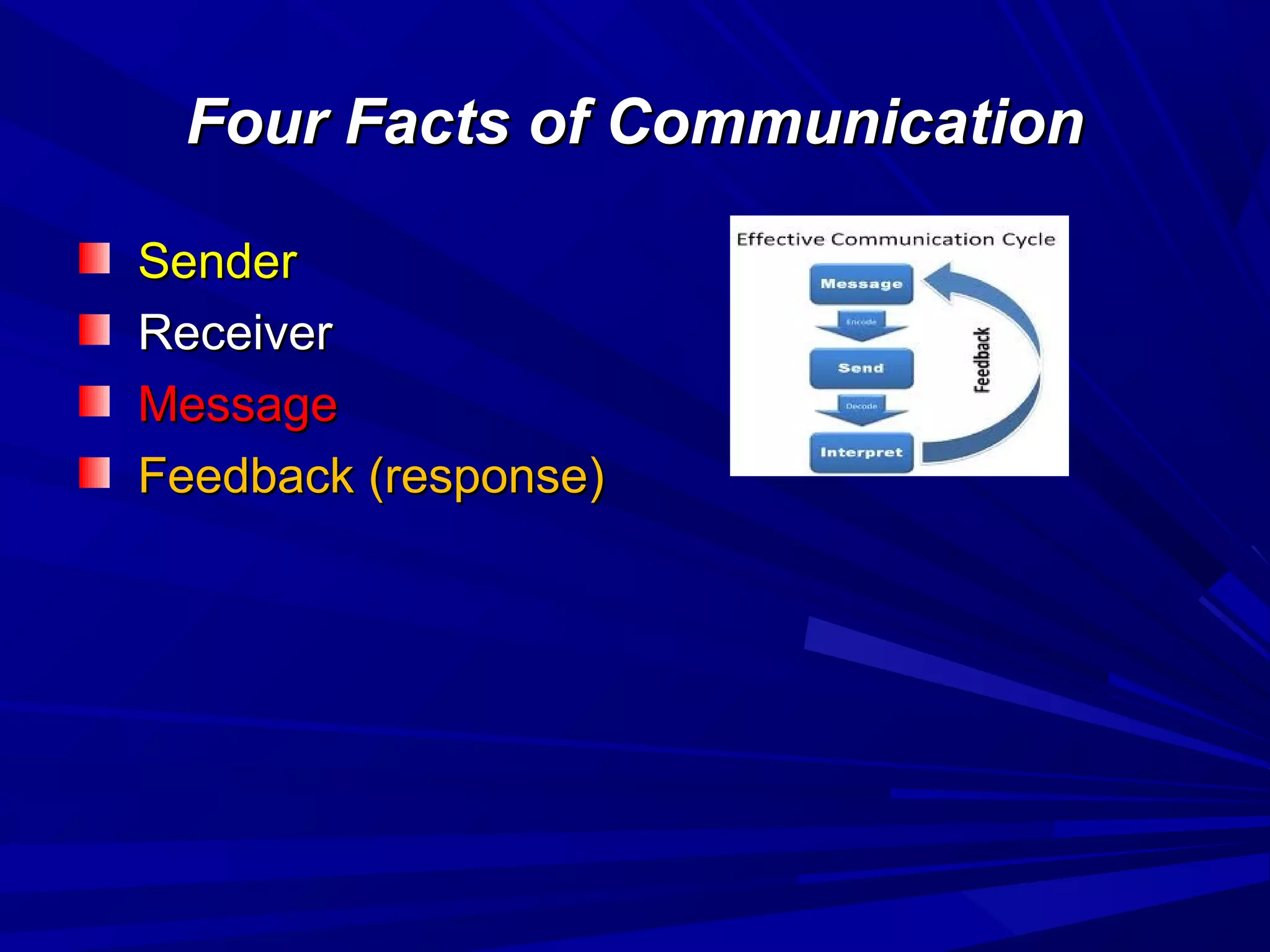
Four Facts of CommunicationFour Facts of Communication
SenderSender
ReceiverReceiver
MessageMessage
Feedback (response)Feedback (response)
Four Facets of CommunicatioFour Facets of Communicationn
In any communication:In any communication:
TheThe ’Sender’Sender’’ is the person who trying tois the person who trying to
communicate a message.communicate a message.
TheThe ’Receiver’Receiver’ is the person to whom the’ is the person to whom the
message is directed.message is directed.
A message is sent to conveyA message is sent to convey ’’information’.information’.
Information is meant to changeInformation is meant to change ’behaviour’.’behaviour’.
Communication mechanismCommunication mechanism
The message:The message:
The source of message is the sender. The sender mustThe source of message is the sender. The sender must
know why the communication is necessary & what resultknow why the communication is necessary & what result
is needed.is needed.
Encoding:Encoding:
Encoding is the process of taking your message andEncoding is the process of taking your message and
transferring it into the proper format for sharing it with thetransferring it into the proper format for sharing it with the
audience.audience.
Channel:Channel:
Channel is the method of communication that youChannel is the method of communication that you
choose, such as face-to-face, by telephone or via e-mail.choose, such as face-to-face, by telephone or via e-mail.
Communication mechanismCommunication mechanism
Decoding:Decoding:
It is the process of receiving the message accurately,It is the process of receiving the message accurately,
and understand the information.and understand the information.
Feedback:Feedback:
It is the response from the receiver.It is the response from the receiver.
Feedback lets you know if your communication wasFeedback lets you know if your communication was
successful or not.successful or not.
Feedback can be Verbal & Non-verbal Reactions.Feedback can be Verbal & Non-verbal Reactions.
It can be Positive feedback and Negative feedbackIt can be Positive feedback and Negative feedback
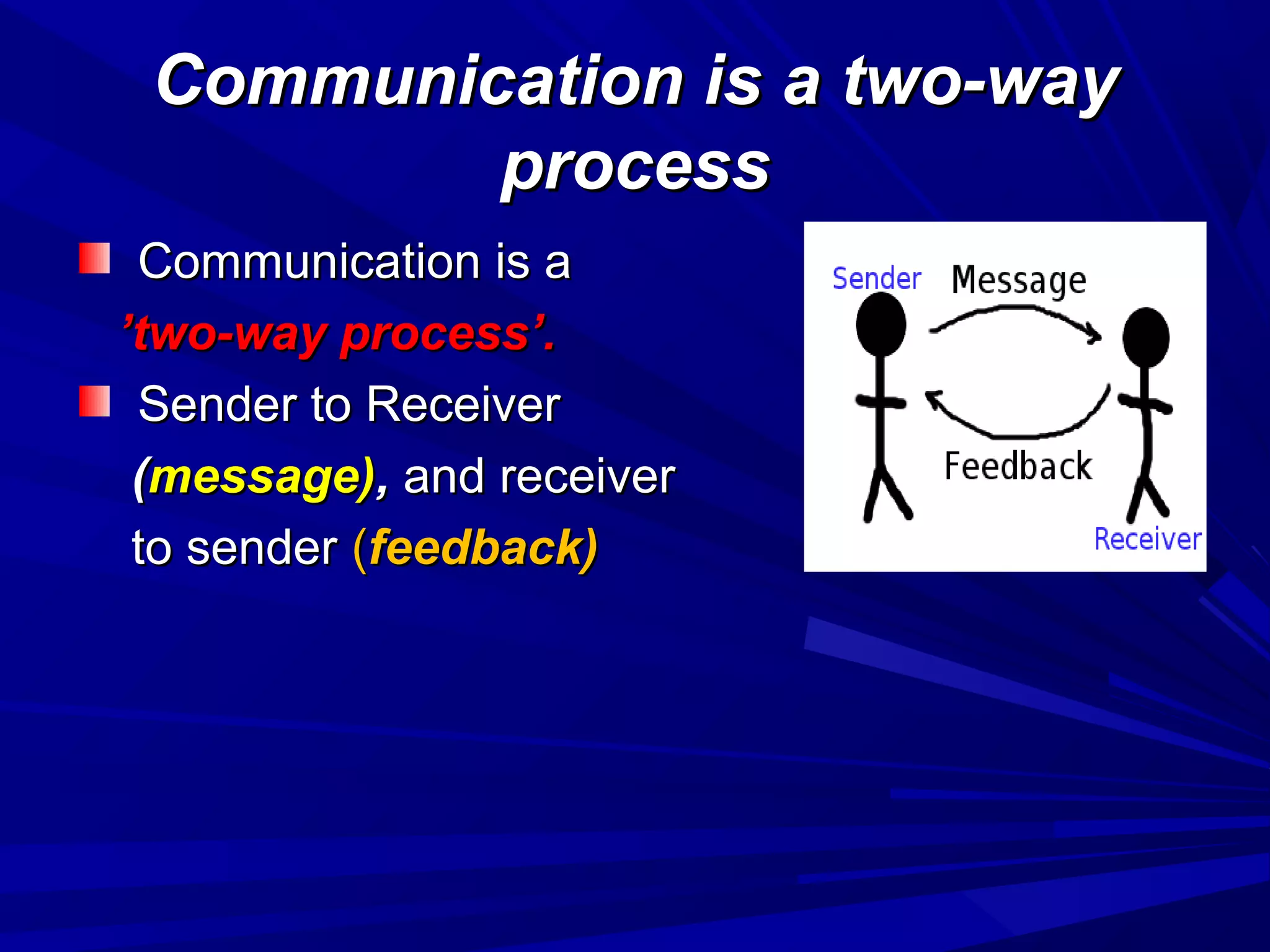
Communication is a two-wayCommunication is a two-way
processprocess
Communication is aCommunication is a
’’two-way process’.two-way process’.
Sender to ReceiverSender to Receiver
((message)message),, and receiverand receiver
to senderto sender ((feedback)feedback)
Nature of communicationNature of communication
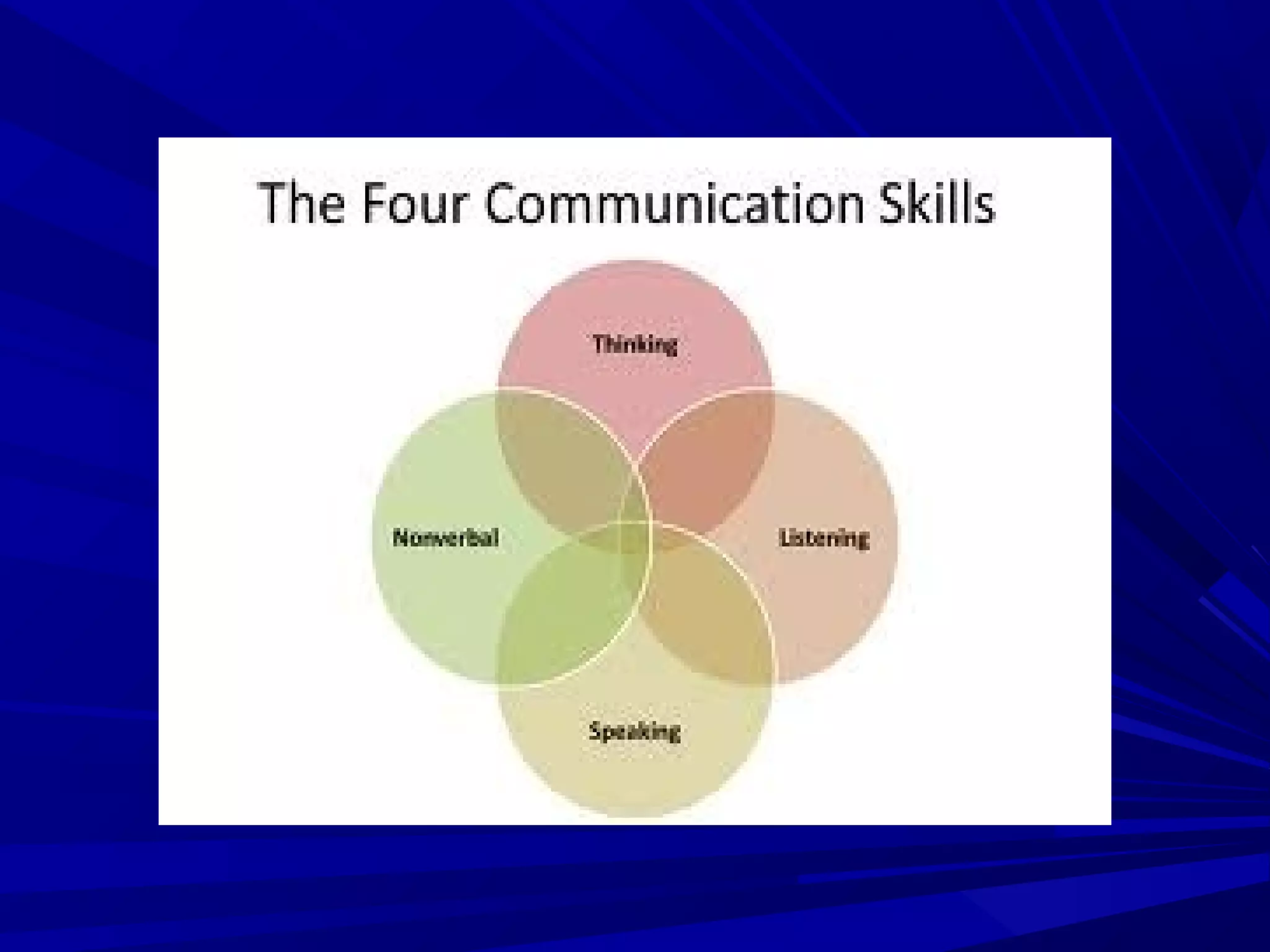
It has four specific skills:It has four specific skills:
1. Reading1. Reading
2. Writing2. Writing
3. Speaking3. Speaking
4. Listening4. Listening
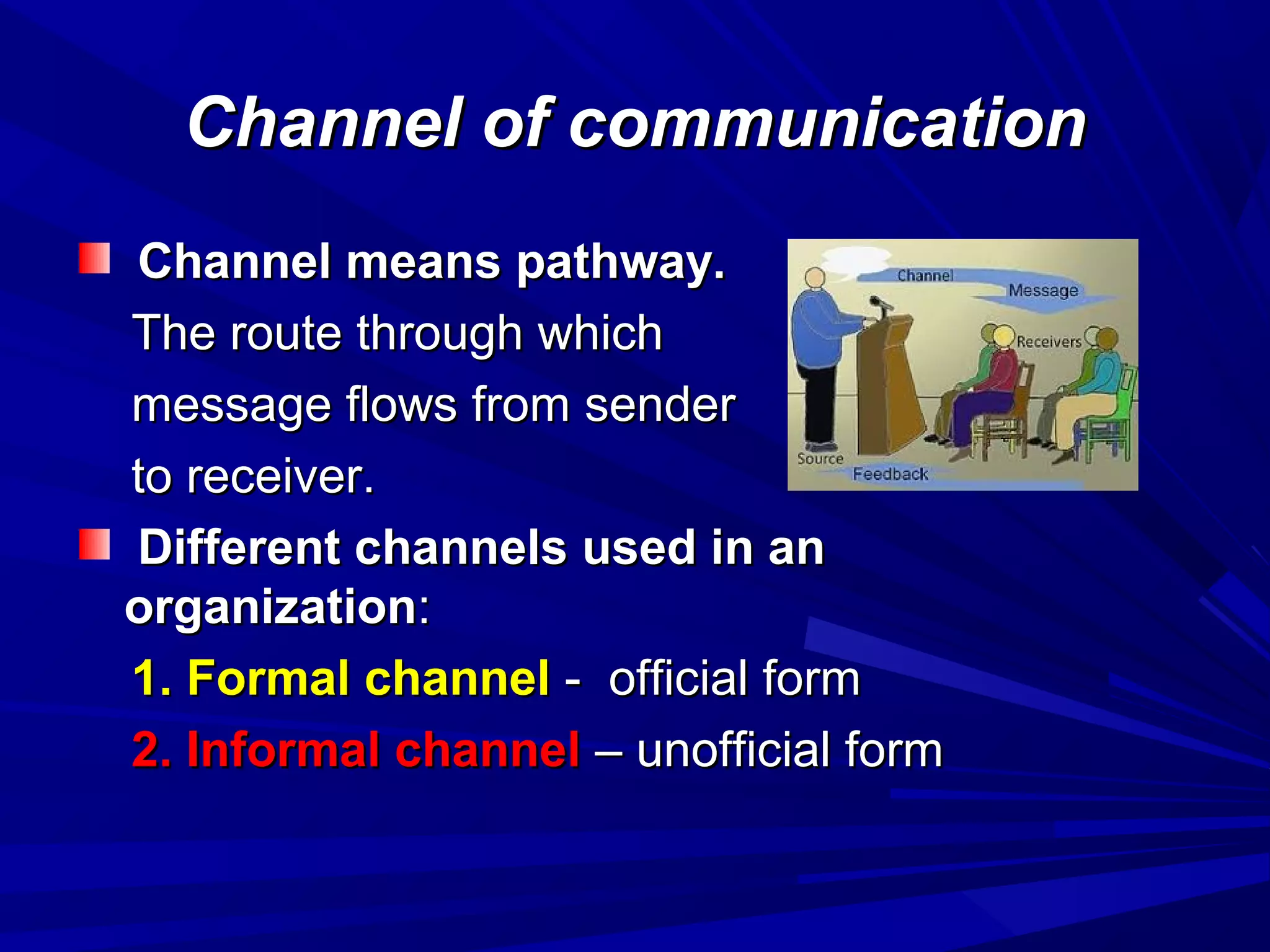
Channel of communicationChannel of communication
Channel means pathway.Channel means pathway.
The route through whichThe route through which
message flows from sendermessage flows from sender
to receiver.to receiver.
Different channels used in anDifferent channels used in an
organizationorganization::
1. Formal channel1. Formal channel - official form- official form
2. Informal channel2. Informal channel – unofficial form– unofficial form
Types of CommunicationTypes of Communication
On the basis of organizational relationship:On the basis of organizational relationship:
1.1. FormalFormal
2. Informal2. Informal
On the basis of flow:On the basis of flow:
1. Vertical1. Vertical
2. Diagonal / crosswise2. Diagonal / crosswise
3. Horizontal3. Horizontal
Informal communicationInformal communication
’Grapevine’’Grapevine’
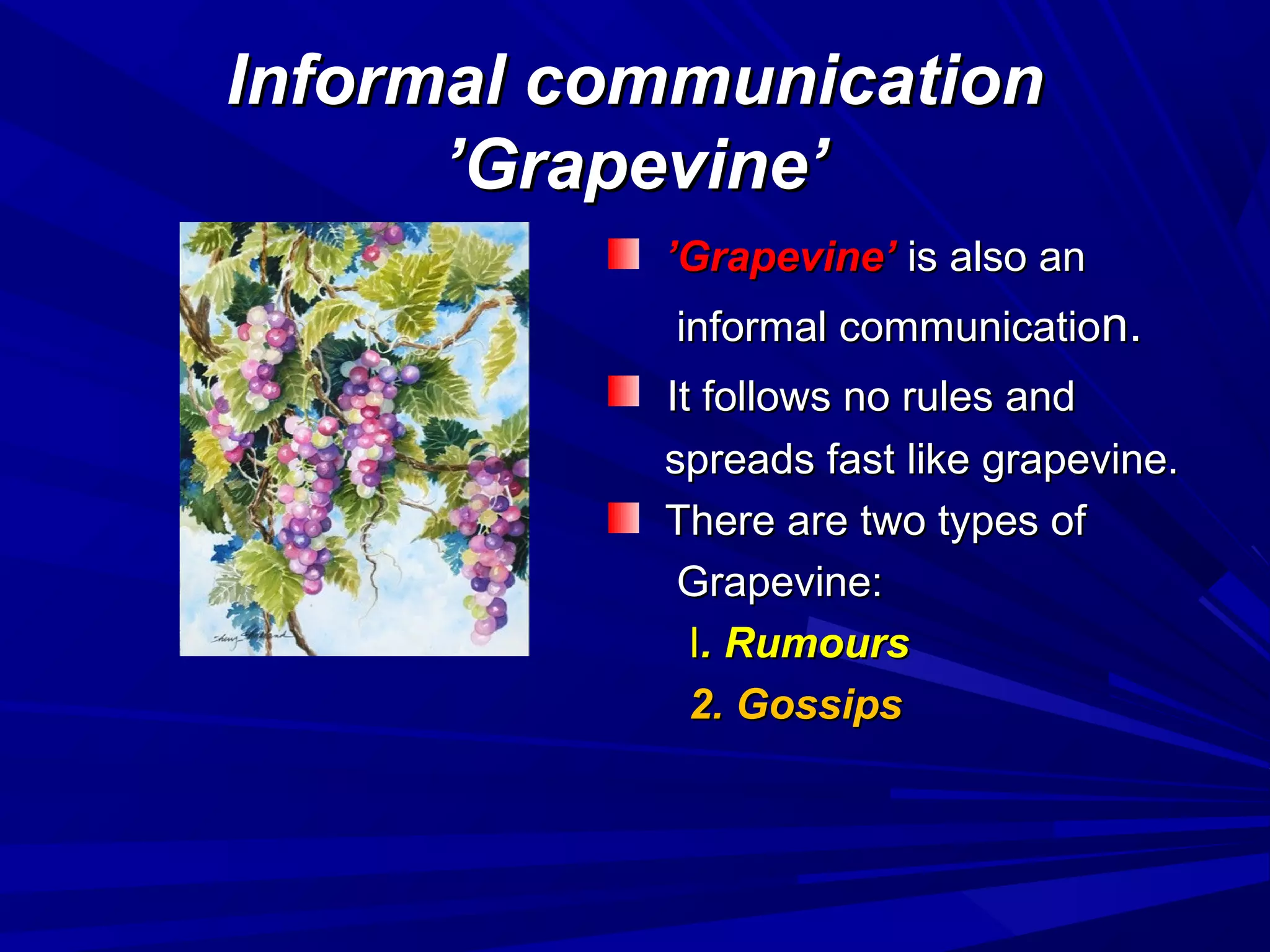
’’Grapevine’Grapevine’ is also anis also an
informal communicatioinformal communication.n.
It follows no rules andIt follows no rules and
spreads fast like grapevine.spreads fast like grapevine.
There are two types ofThere are two types of
Grapevine:Grapevine:
II. Rumours. Rumours
2. Gossips2. Gossips
Types of CommunicationTypes of Communication
On the basis of Expression:On the basis of Expression:
1. Oral1. Oral
2. Written2. Written
3. Gesture3. Gesture
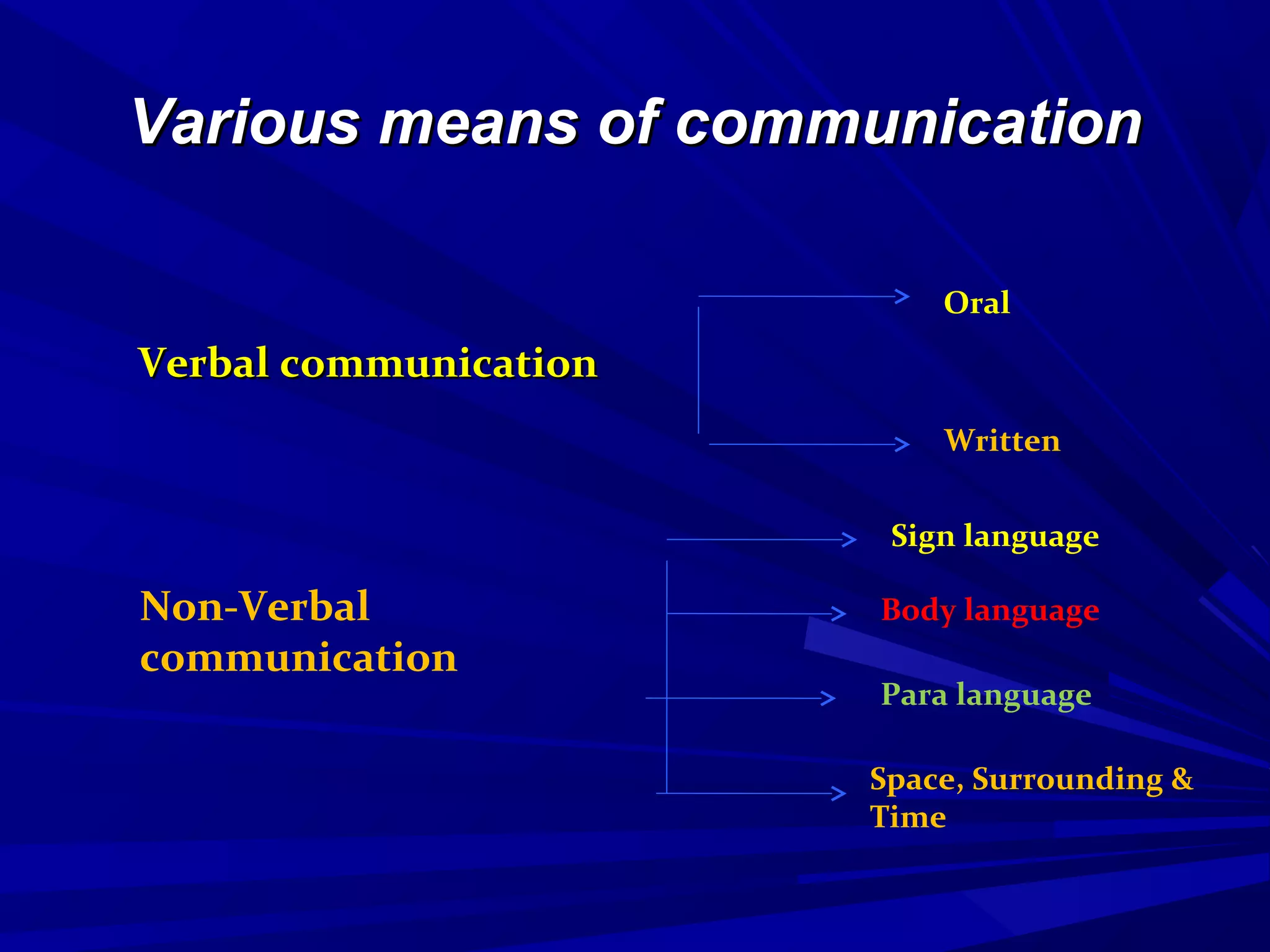
Various means of communicationVarious means of communication
Verbal communicationVerbal communication
Oral
Written
Non-Verbal
communication
Sign language
Body language
Para language
Space, Surrounding &
Time
Verbal & non-verbalVerbal & non-verbal
communicationcommunication
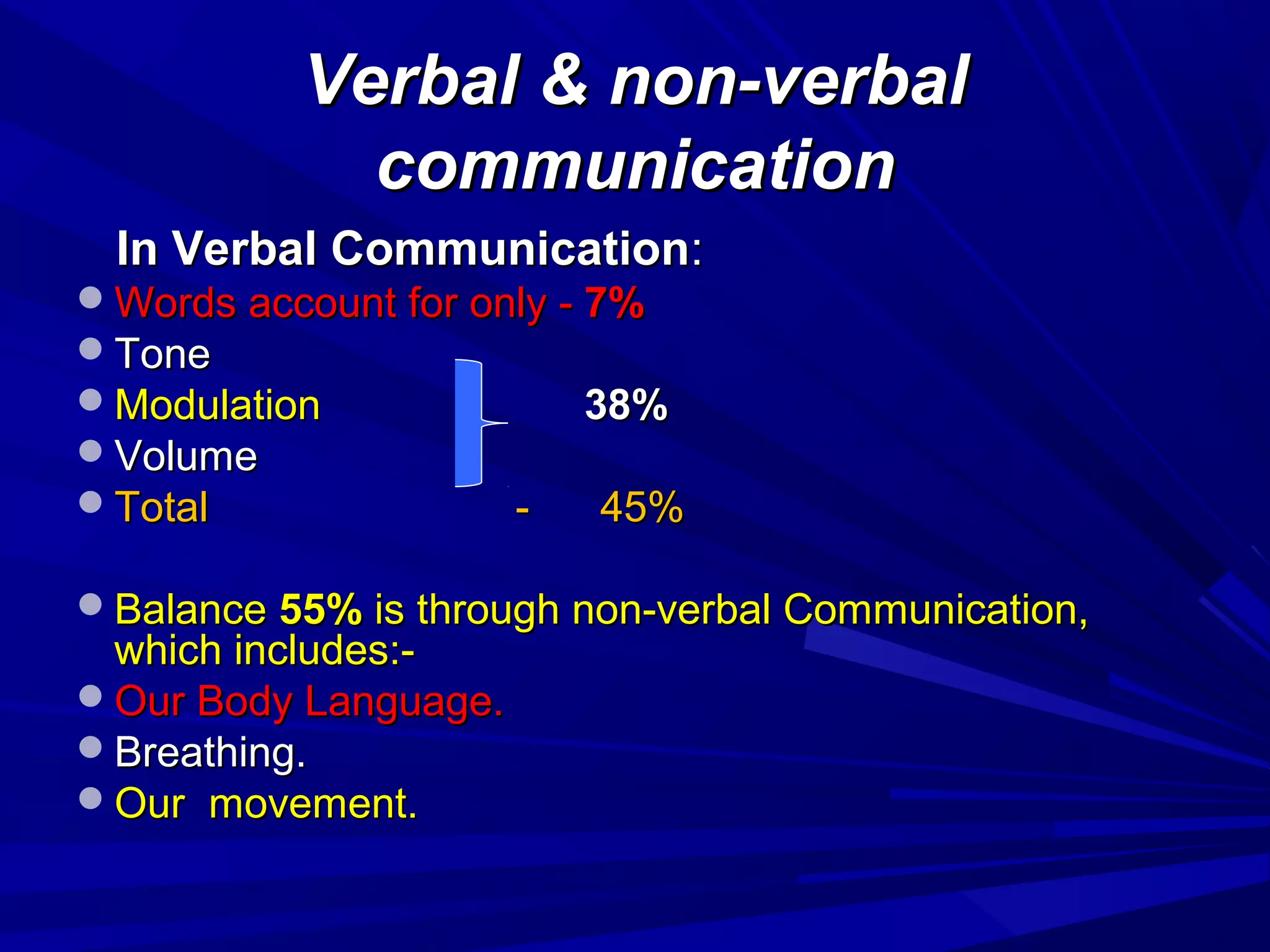
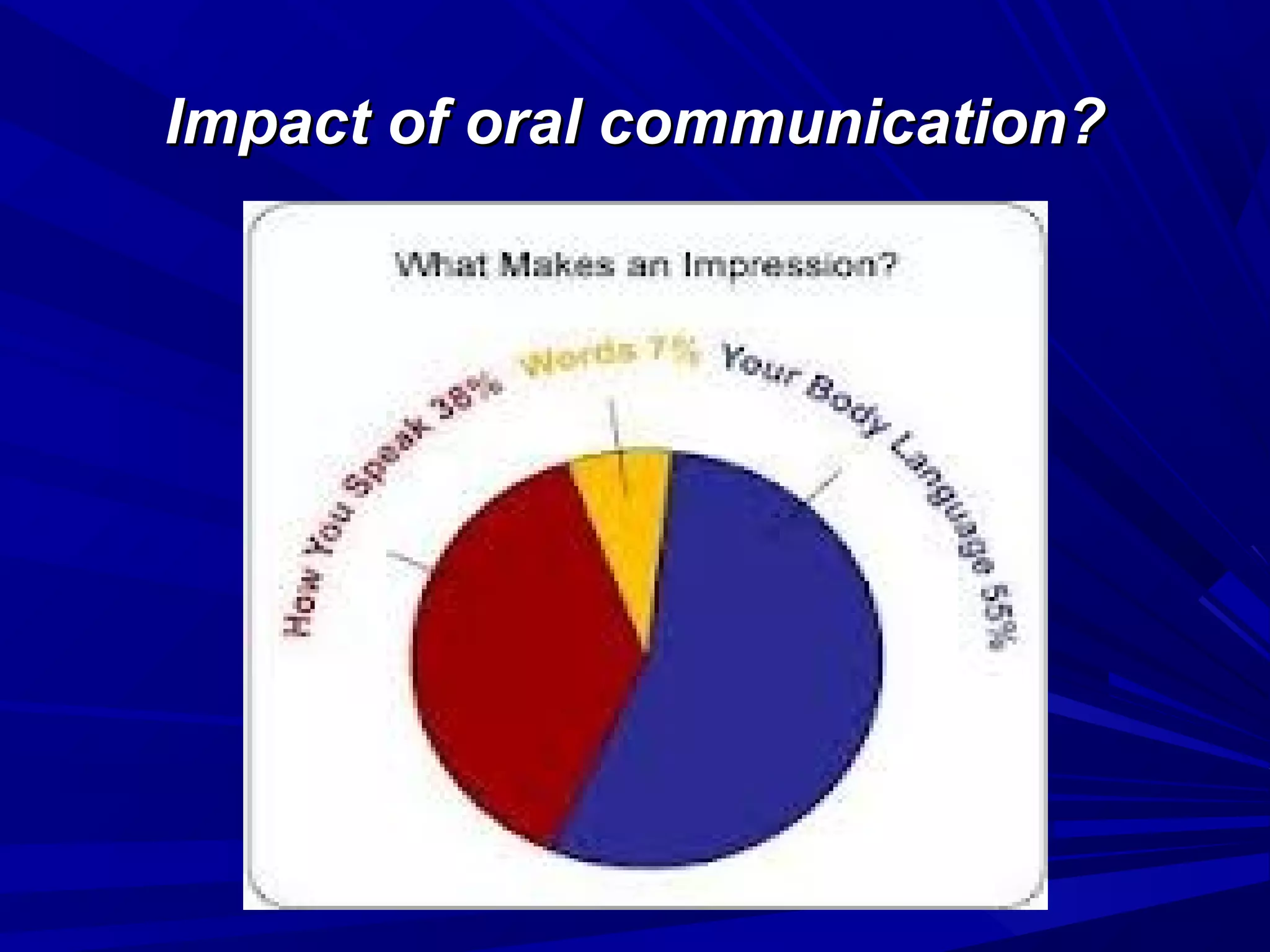
In Verbal CommunicationIn Verbal Communication::
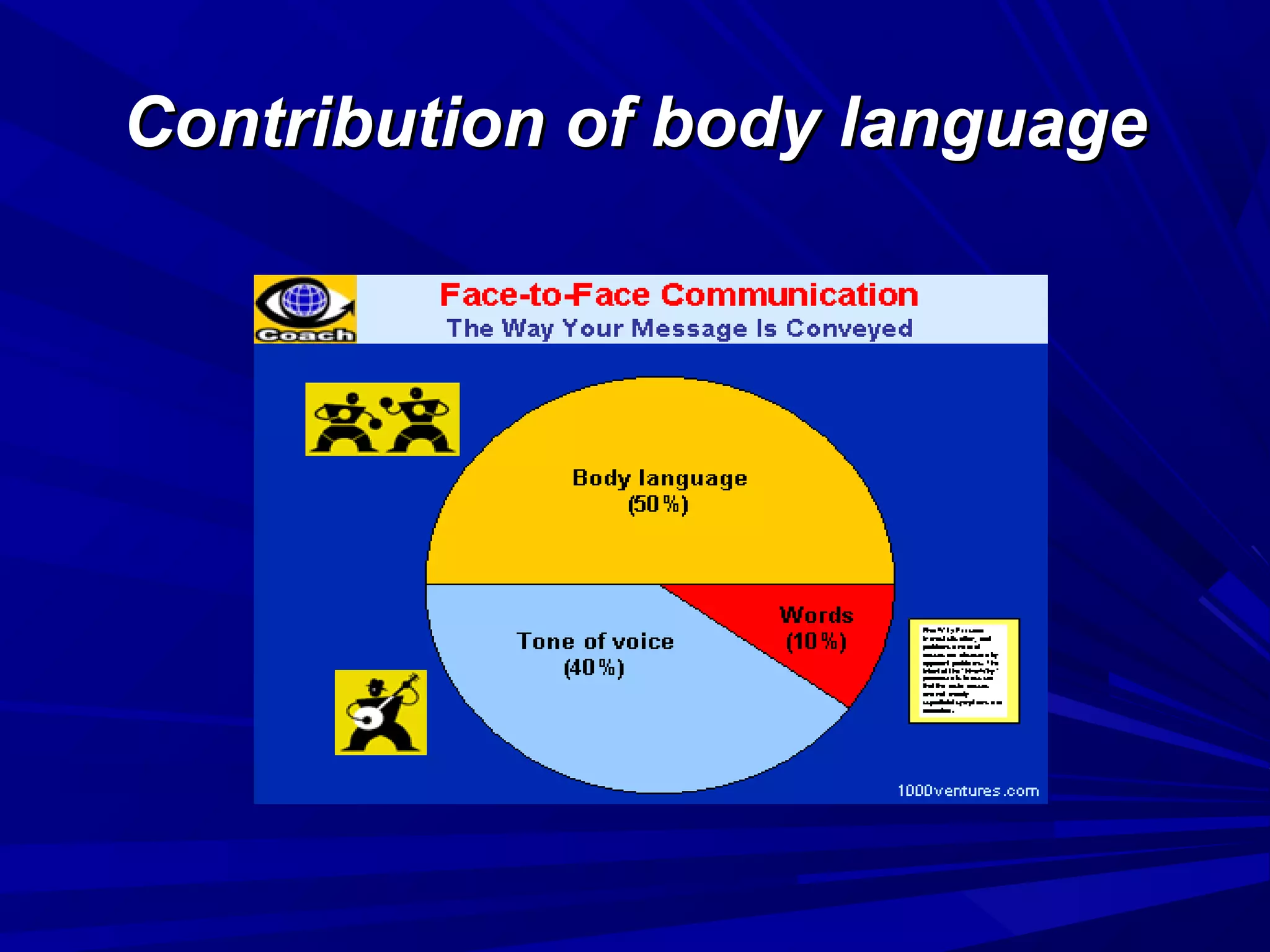
Words account for only -Words account for only - 7%7%
ToneTone
ModulationModulation 38%38%
VolumeVolume
Total - 45%Total - 45%
BalanceBalance 55%55% is through non-verbal Communication,is through non-verbal Communication,
which includes:-which includes:-
Our Body Language.Our Body Language.
Breathing.Breathing.
Our movement.Our movement.
Verbal languageVerbal language
** Like: Arabic, English,Like: Arabic, English,
French,…etcFrench,…etc
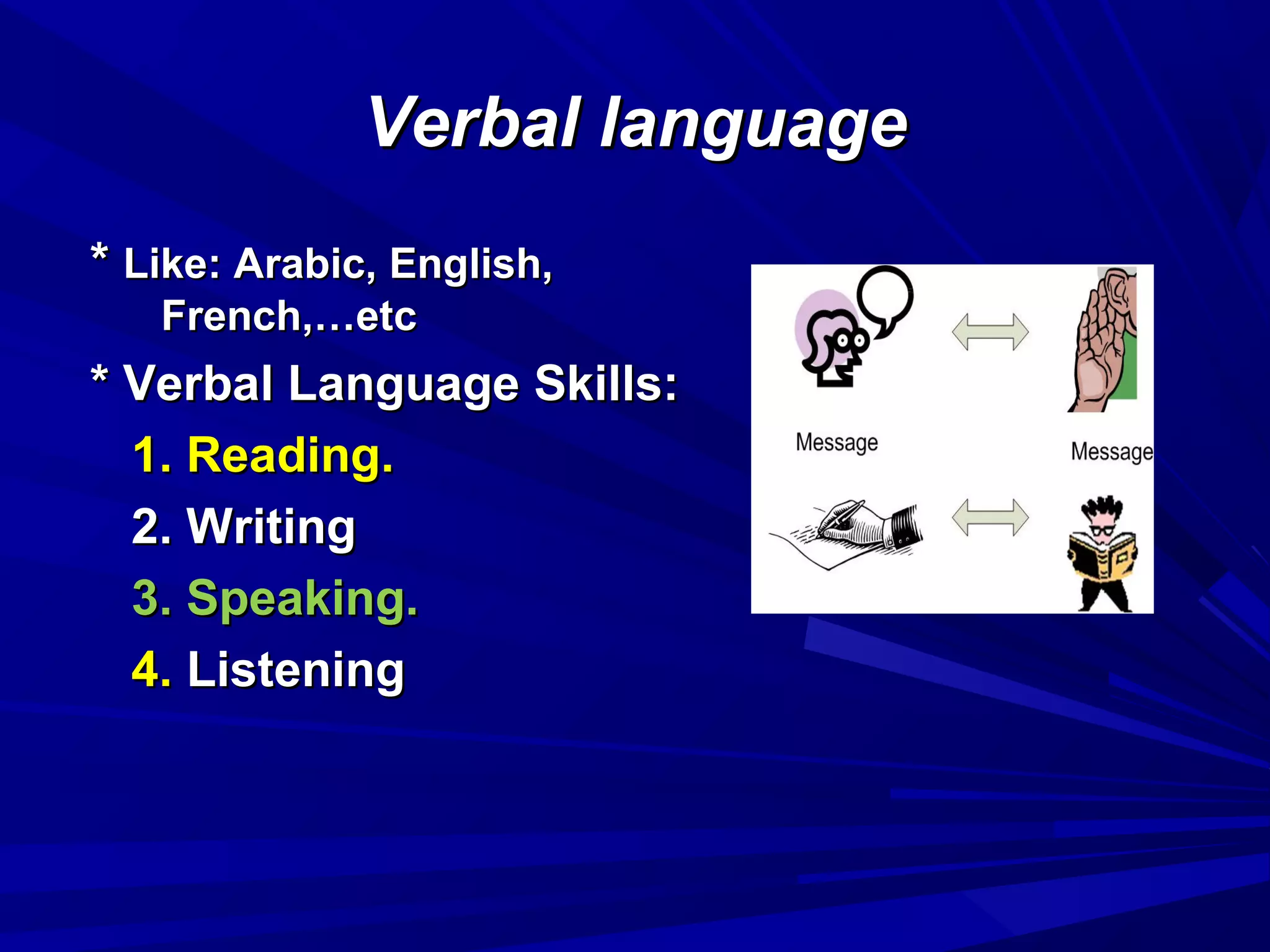
* Verbal Language Skills:* Verbal Language Skills:
1. Reading.1. Reading.
2. Writing2. Writing
3. Speaking.3. Speaking.
4.4. ListeningListening
What is Verbal Communication?What is Verbal Communication?
Verbal means use of words. So, verbalVerbal means use of words. So, verbal
communication may becommunication may be either oral or written.either oral or written.
1. Oral Communication:1. Oral Communication:
This is communication through spoken words.This is communication through spoken words.
2. Written Communication:2. Written Communication:
Communication through written words, like:Communication through written words, like:
letters, memos, circulars, manuals etcletters, memos, circulars, manuals etc
Impact of oral communication?Impact of oral communication?
Non-verbal CommunicationNon-verbal Communication
Contribution of body languageContribution of body language
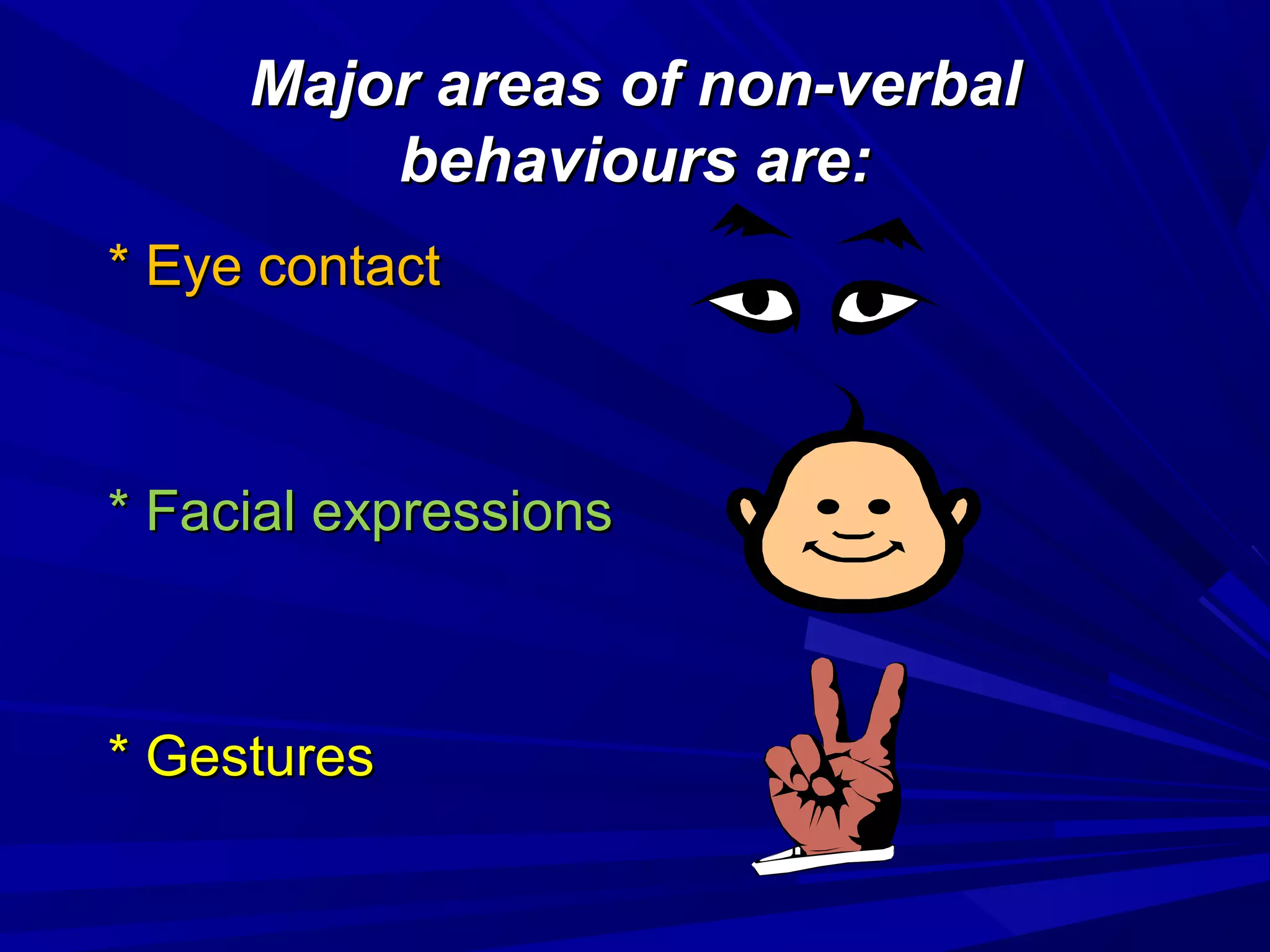
Major areas of non-verbalMajor areas of non-verbal
behaviours are:behaviours are:
* Eye contact* Eye contact
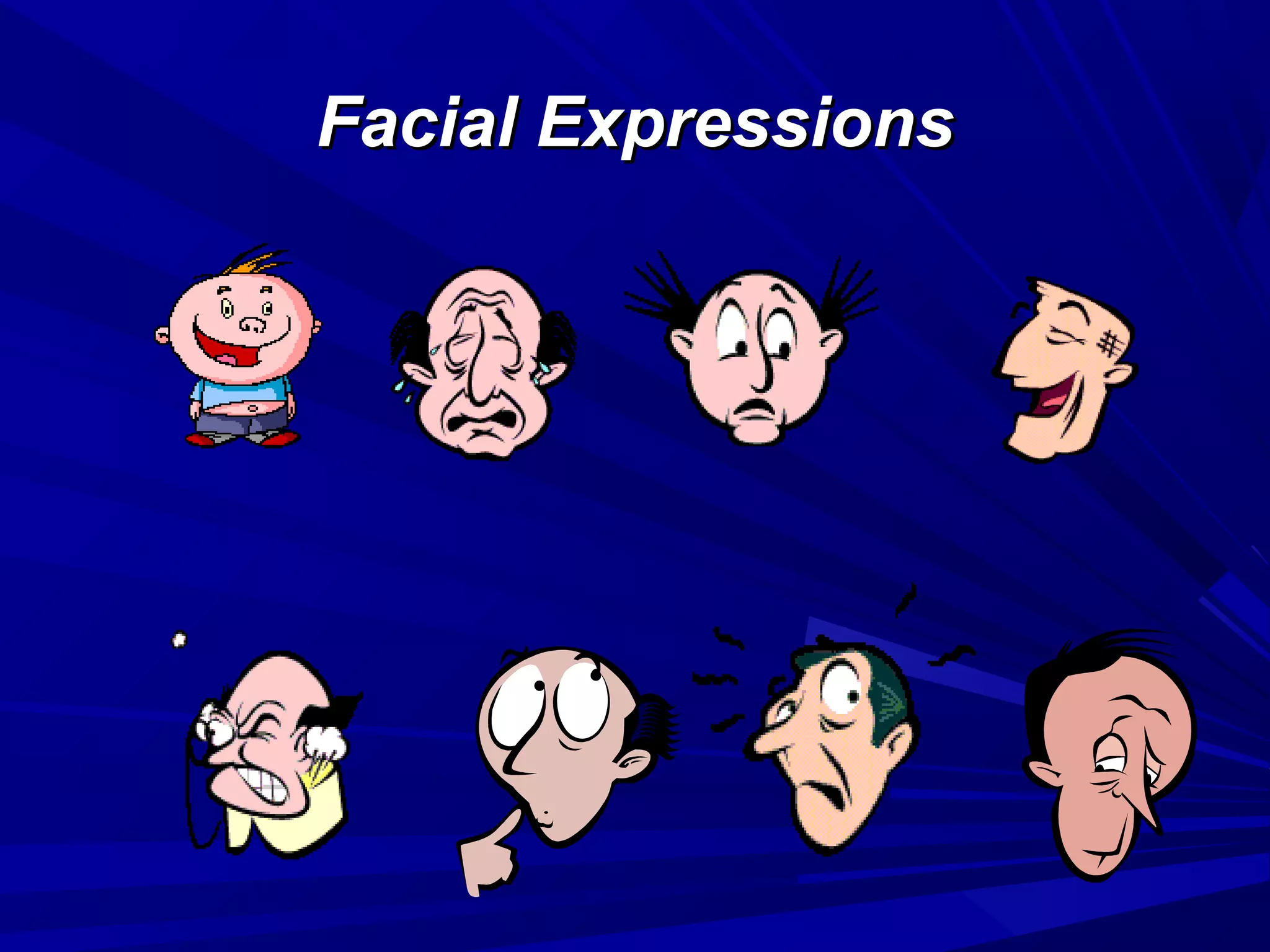
* Facial expressions* Facial expressions
* Gestures* Gestures
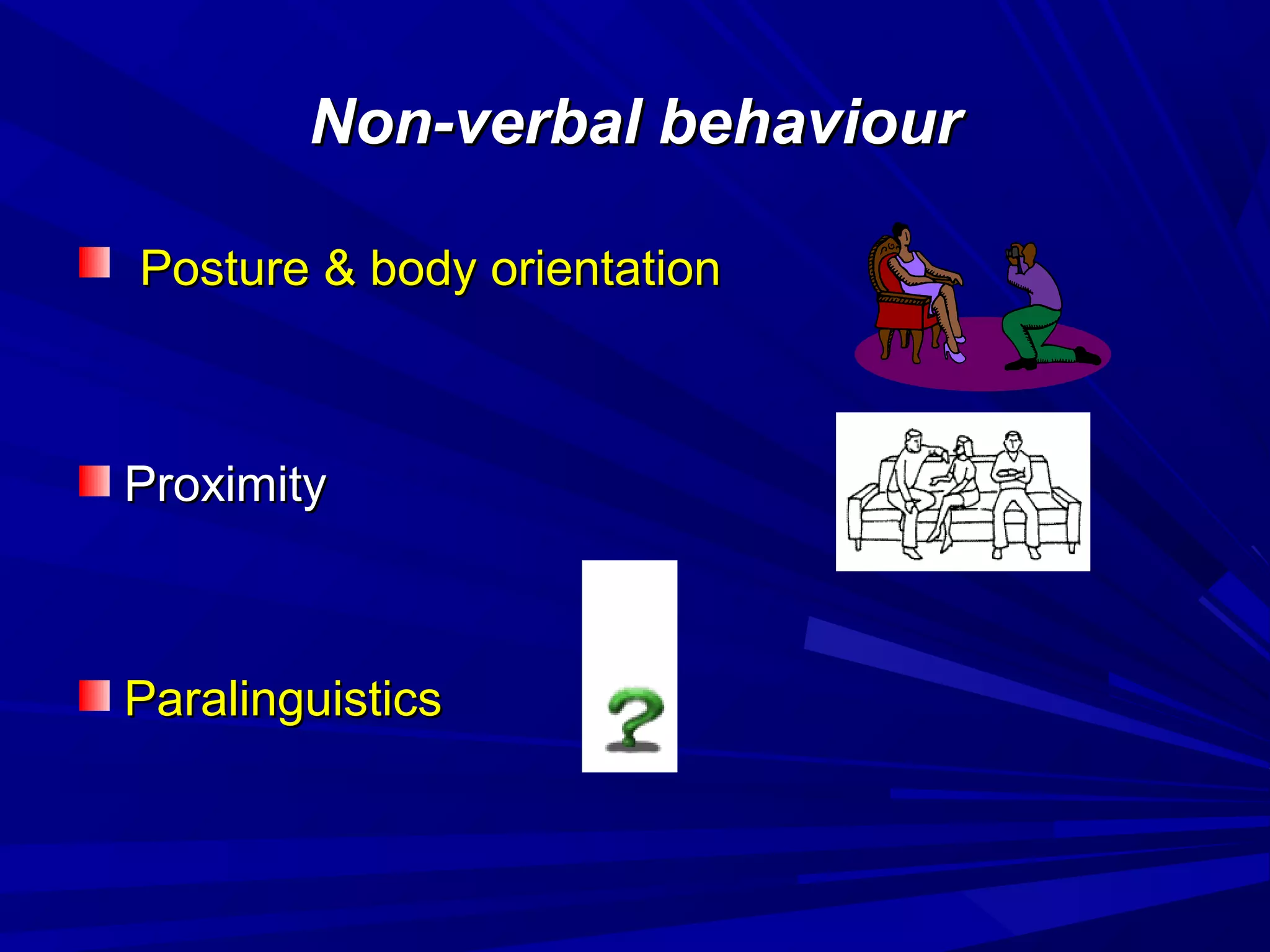
Non-verbal behaviourNon-verbal behaviour
Posture & body orientationPosture & body orientation
ProximityProximity
ParalinguisticsParalinguistics
Facial ExpressionsFacial Expressions
GesturesGestures
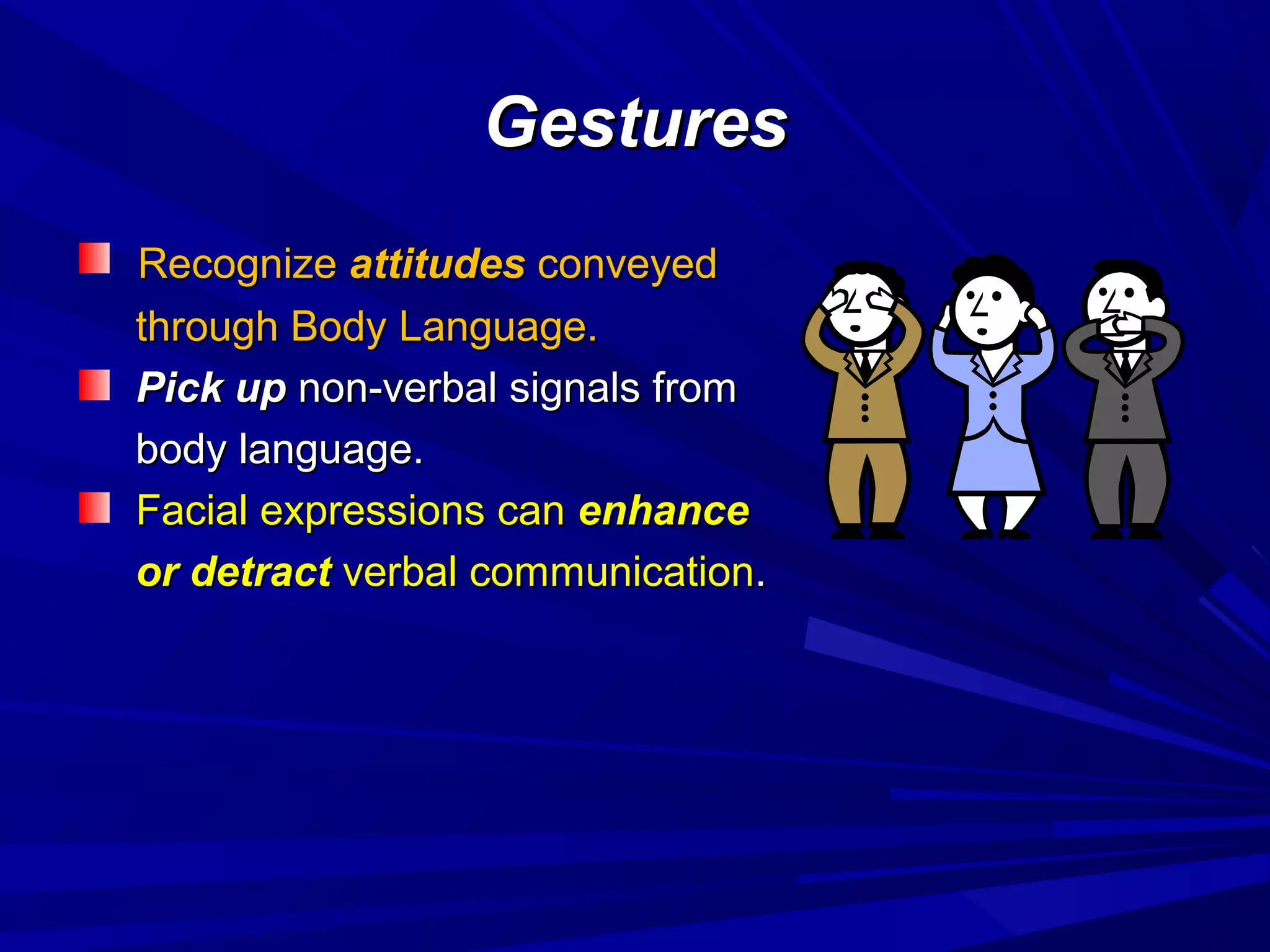
RecognizeRecognize attitudesattitudes conveyedconveyed
through Body Language.through Body Language.
Pick upPick up non-verbal signals fromnon-verbal signals from
body language.body language.
Facial expressions canFacial expressions can enhanceenhance
or detractor detract verbal communicationverbal communication..
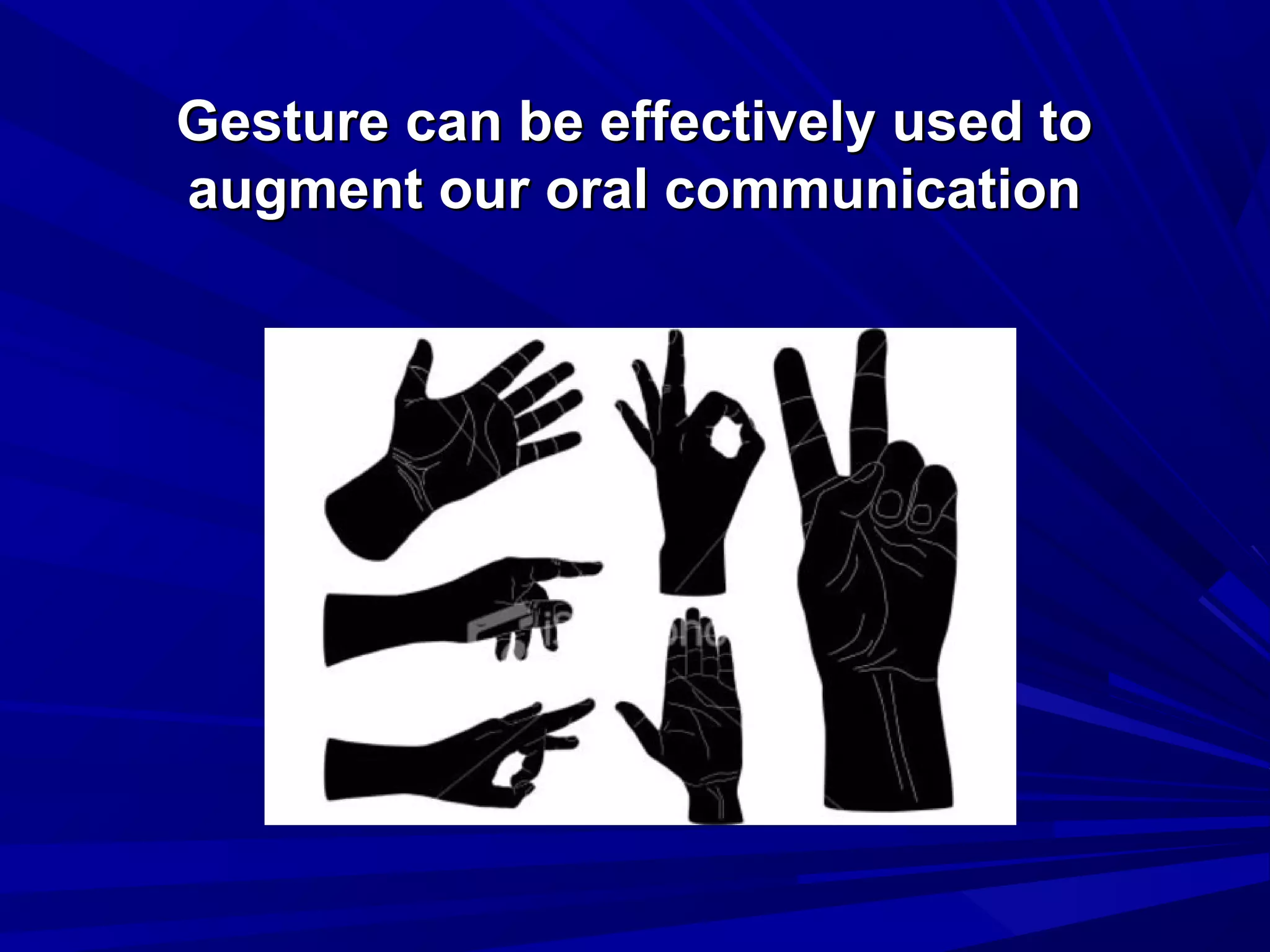
Gesture can be effectively used toGesture can be effectively used to
augment our oral communicationaugment our oral communication
Para linguisticsPara linguistics
Components ofComponents of Para linguisticsPara linguistics are:are:
Rate of speedRate of speed
When a speaker speaks too fast, he is seen asWhen a speaker speaks too fast, he is seen as
more competentmore competent..
PitchPitch
Pich should be changed according to thePich should be changed according to the
context of the spoken words.context of the spoken words.
VolumeVolume
LoudLoud people are considered as agressive.people are considered as agressive.
Soft spokenSoft spoken voices are perceived as timid or polite.voices are perceived as timid or polite.
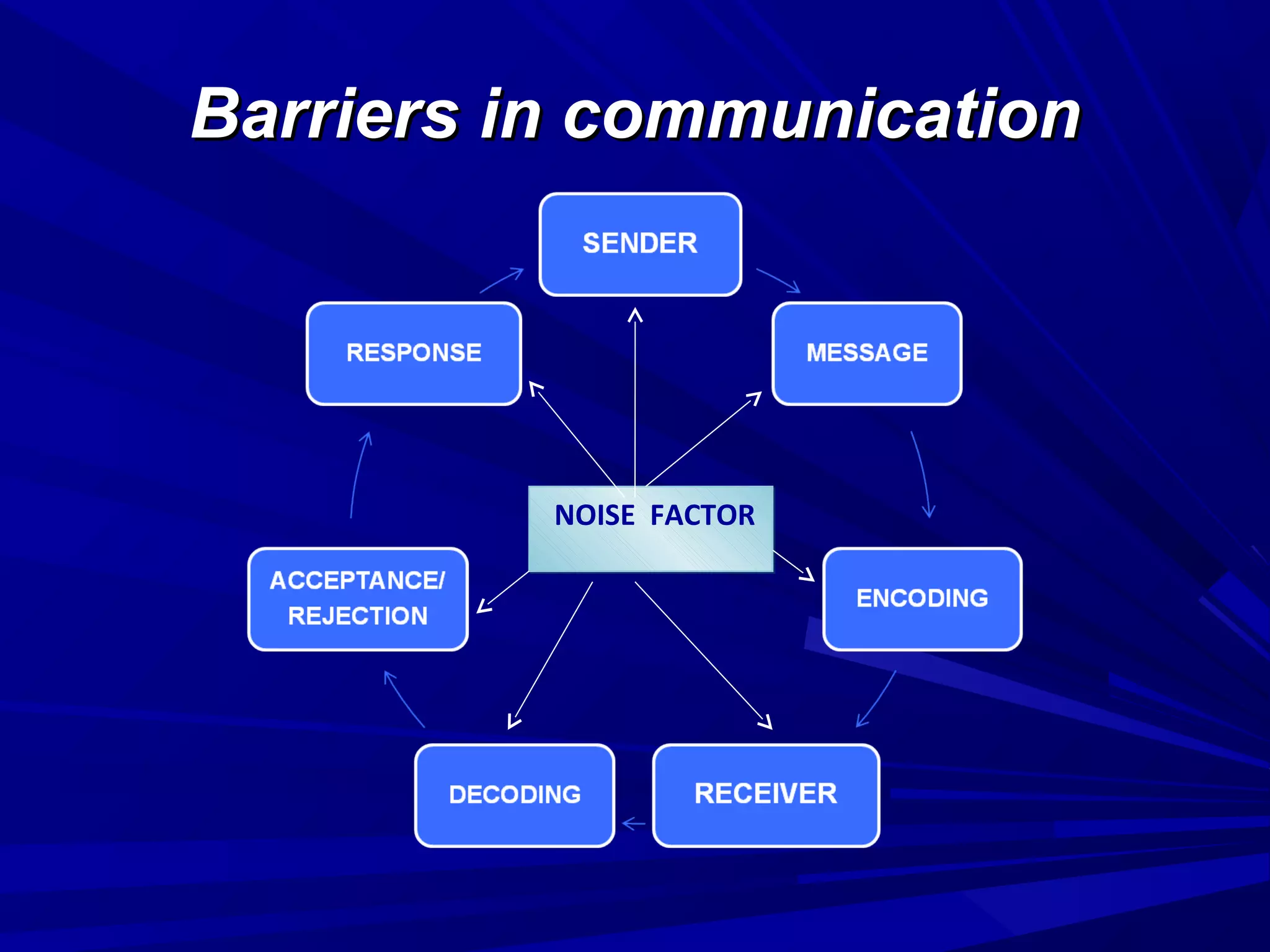
Barriers in communicationBarriers in communication
NOISE FACTORNOISE FACTOR
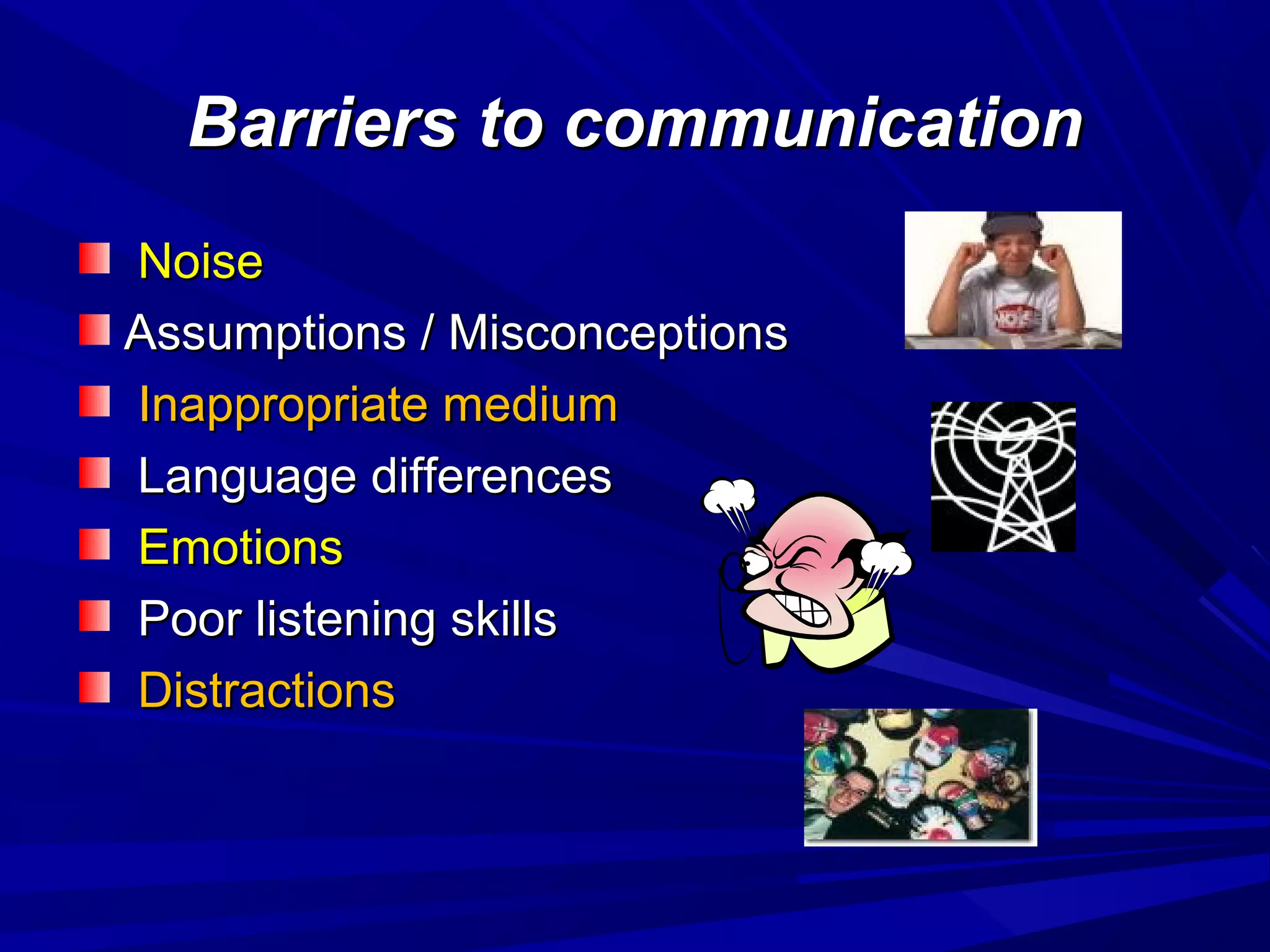
Barriers to communicationBarriers to communication
NoiseNoise
Assumptions / MisconceptionsAssumptions / Misconceptions
Inappropriate mediumInappropriate medium
Language differencesLanguage differences
EmotionsEmotions
Poor listening skillsPoor listening skills
DistractionsDistractions
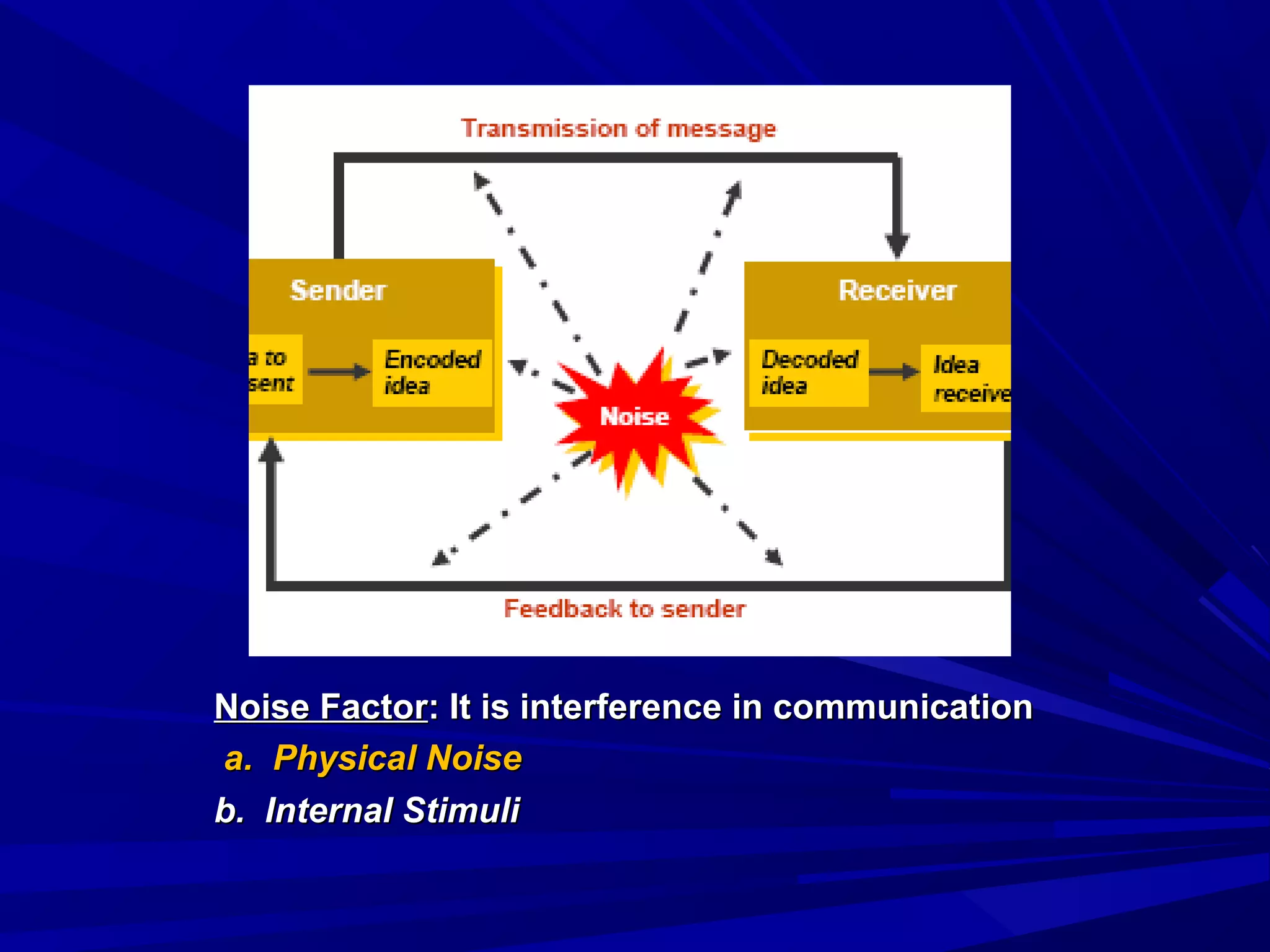
b. Internal Stimulib. Internal Stimuli
Noise FactorNoise Factor: It is interference in communication: It is interference in communication
a. Physical Noisea. Physical Noise
Barriers in communicationBarriers in communication
1.1. Semantic BarrierSemantic Barrier::
a.a. SymbolsSymbols with different meaningwith different meaning
b. Badly expressed message or use ofb. Badly expressed message or use of
Jargons(specialist’s language).Jargons(specialist’s language).
c. Unclarified assumptionsc. Unclarified assumptions
d. The same words can haved. The same words can have
different meanings, depending ondifferent meanings, depending on
how we interpret them. Example:how we interpret them. Example:
””A woman without her manA woman without her man,, is nothing”is nothing”
””A woman,A woman, wthout her man is nothing”wthout her man is nothing”
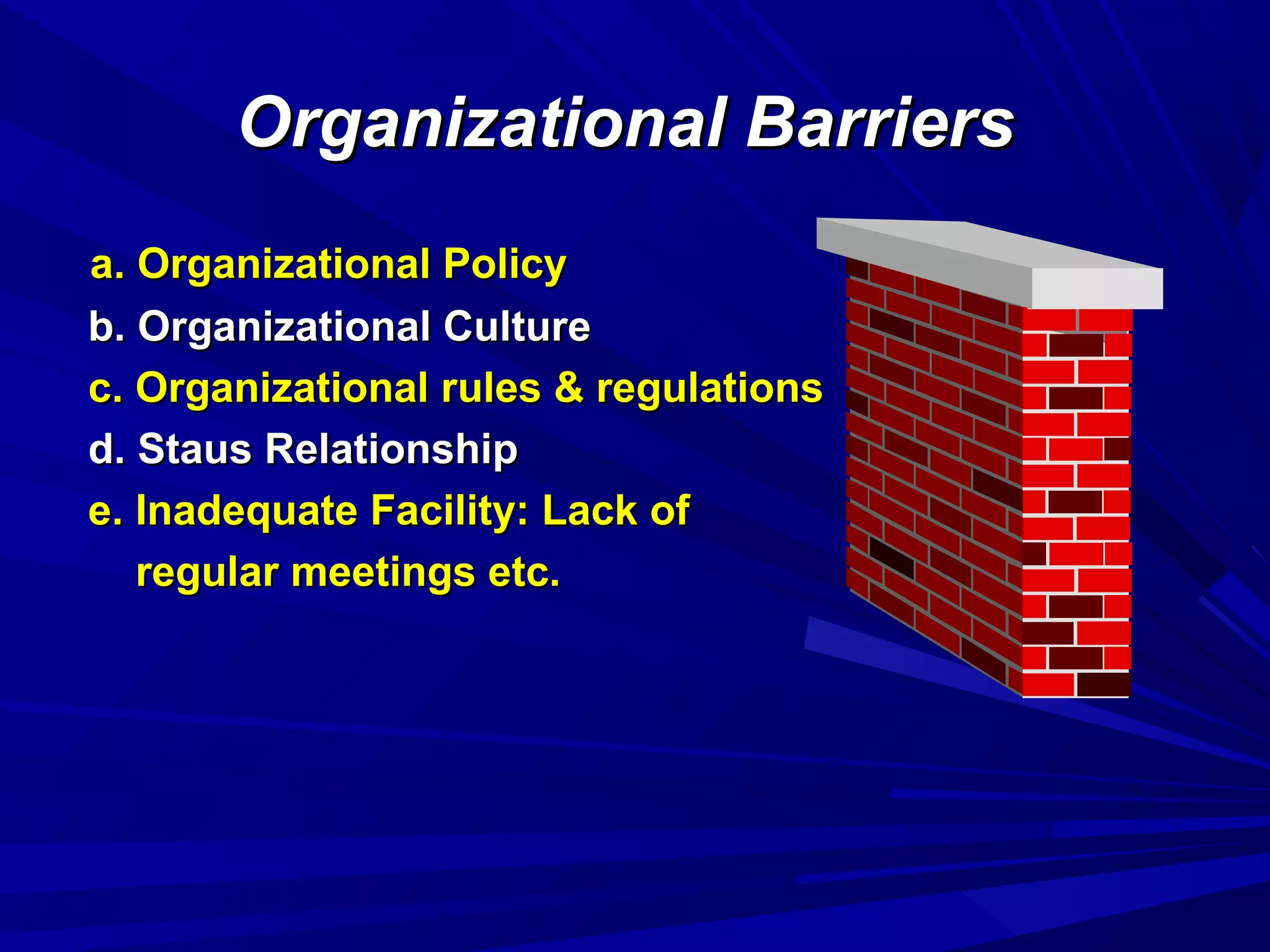
Organizational BarriersOrganizational Barriers
a. Organizational Policya. Organizational Policy
b. Organizational Cultureb. Organizational Culture
c. Organizational rules & regulationsc. Organizational rules & regulations
d. Staus Relationshipd. Staus Relationship
e. Inadequate Facility: Lack ofe. Inadequate Facility: Lack of
regular meetings etc.regular meetings etc.
Psychological or Emotional BarrierPsychological or Emotional Barrier
aa. Lack of attention. Lack of attention
b. Premature evaluationb. Premature evaluation
c. Loss of transmission & poor retaintionc. Loss of transmission & poor retaintion
d.d. Distrust of communication.Distrust of communication.
e. Failure to communicate properly.e. Failure to communicate properly.
..
Communication involves threeCommunication involves three
componentscomponents
1. Verbal Messages:1. Verbal Messages:
The words we choose.The words we choose.
2. Paraverbal Messages:2. Paraverbal Messages:
What we transmit through tone, pitch etc.What we transmit through tone, pitch etc.
It is not what you say,It is not what you say, it is how you sit is how you say it, thatay it, that
matters.matters.
3. Non-verbal Messages:3. Non-verbal Messages:
Mainly our bodylanguage.Mainly our bodylanguage.
These three components are used:These three components are used:
** To send clear & concise messagesTo send clear & concise messages
* Receive & correctly understand messages sent to us.* Receive & correctly understand messages sent to us.
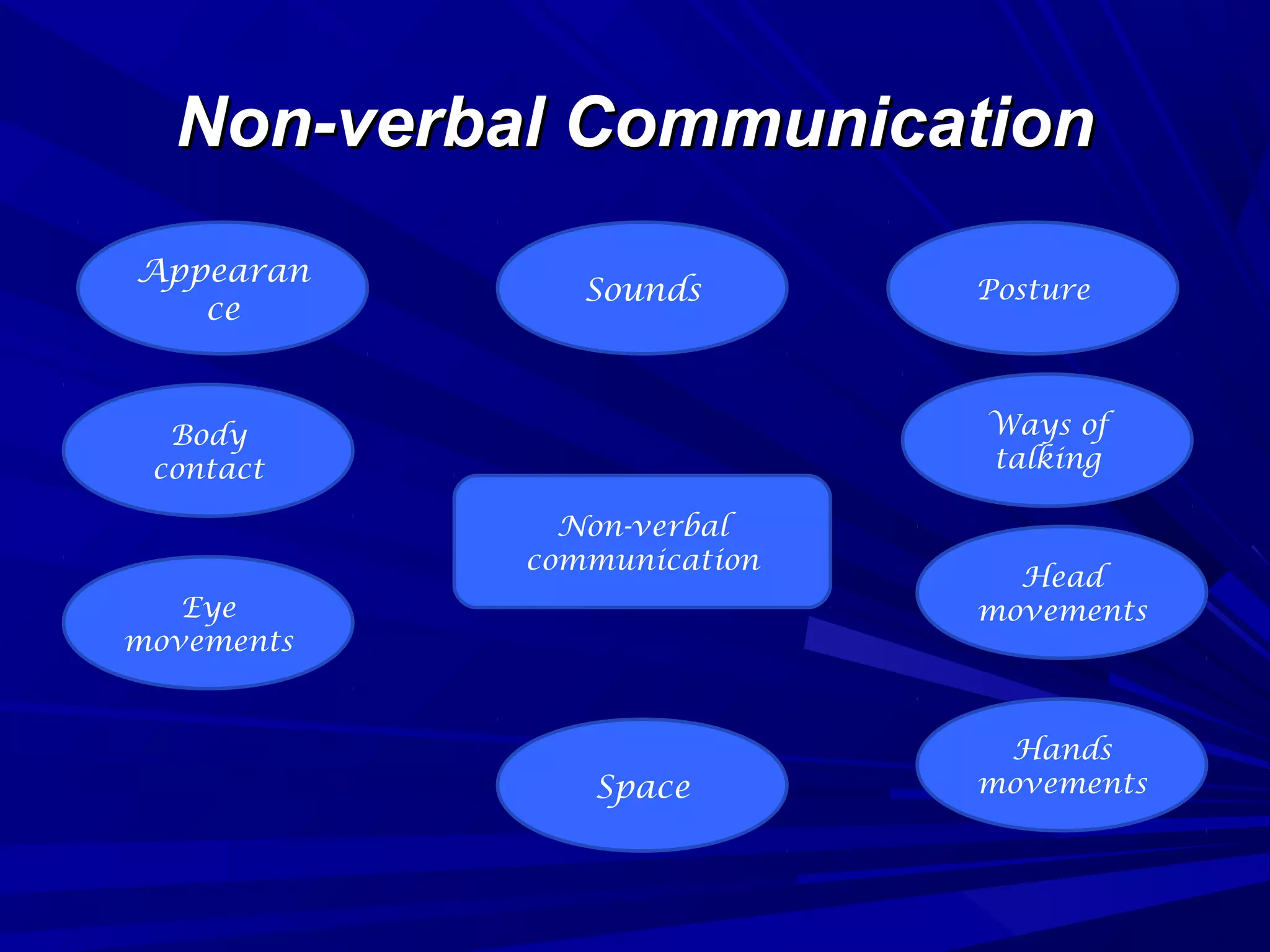
Non-verbal CommunicationNon-verbal Communication
Non-verbal
communication
Ways of
talking
Sounds Posture
Head
movements
Space
Body
contact
Appearan
ce
Hands
movements
Eye
movements
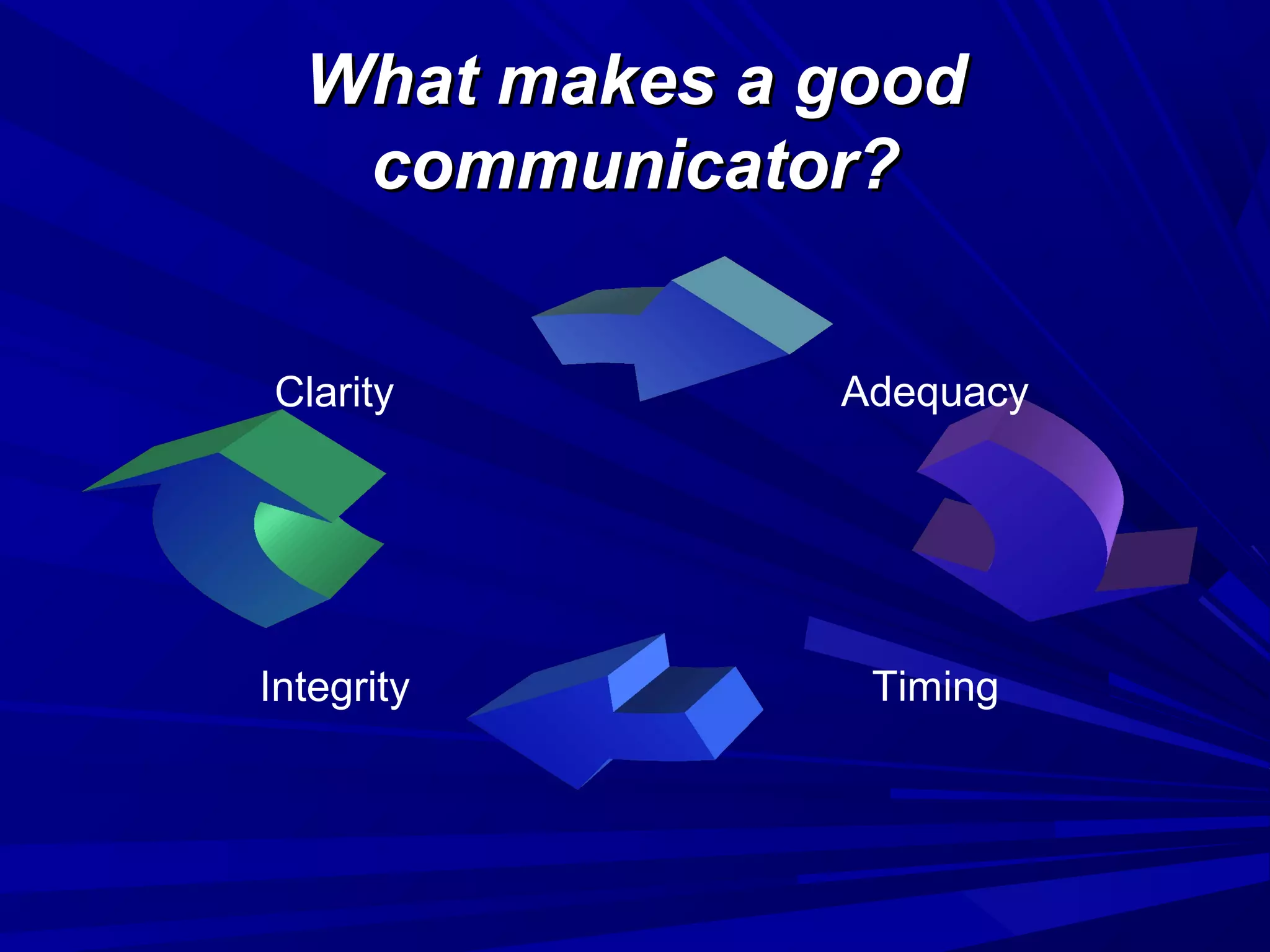
What makes a goodWhat makes a good
communicator?communicator?
Clarity
Integrity Timing
Adequacy
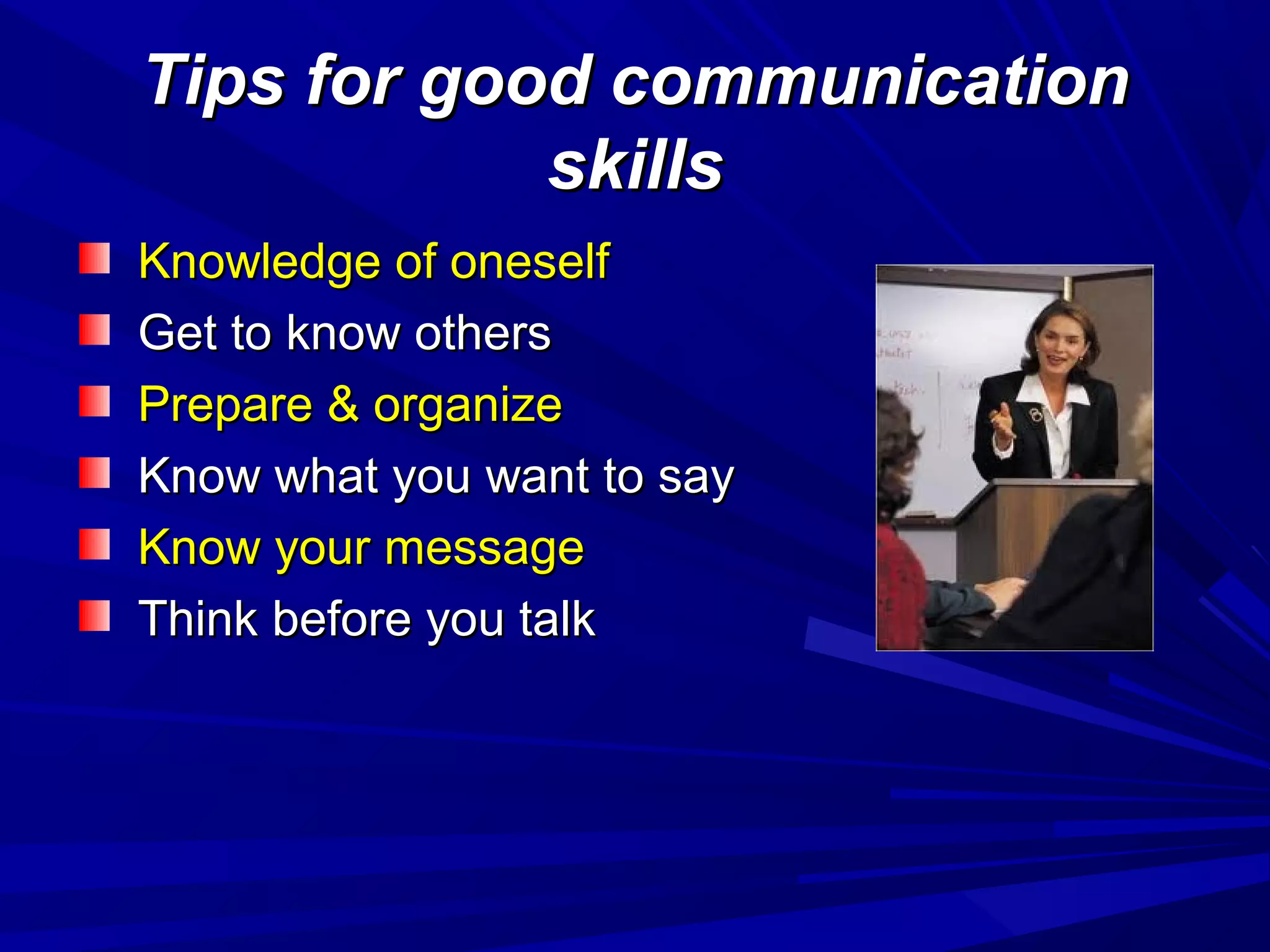
Tips for good communicationTips for good communication
skillsskills
Knowledge of oneselfKnowledge of oneself
Get to know othersGet to know others
Prepare & organizePrepare & organize
Know what you want to sayKnow what you want to say
Know your messageKnow your message
Think before you talkThink before you talk
Tips for good PresentationTips for good Presentation
PracticePractice the power of persuationthe power of persuation
Know about the audienceKnow about the audience
Use theUse the ’KISS’KISS’ method’ method
Use simple termsUse simple terms for better clarityfor better clarity
Choose correct wordsChoose correct words
Avoid technical jargonsAvoid technical jargons
Speak audience’s languageSpeak audience’s language
Tips for good PresentationTips for good Presentation
Factors important for goodFactors important for good
communicationcommunication
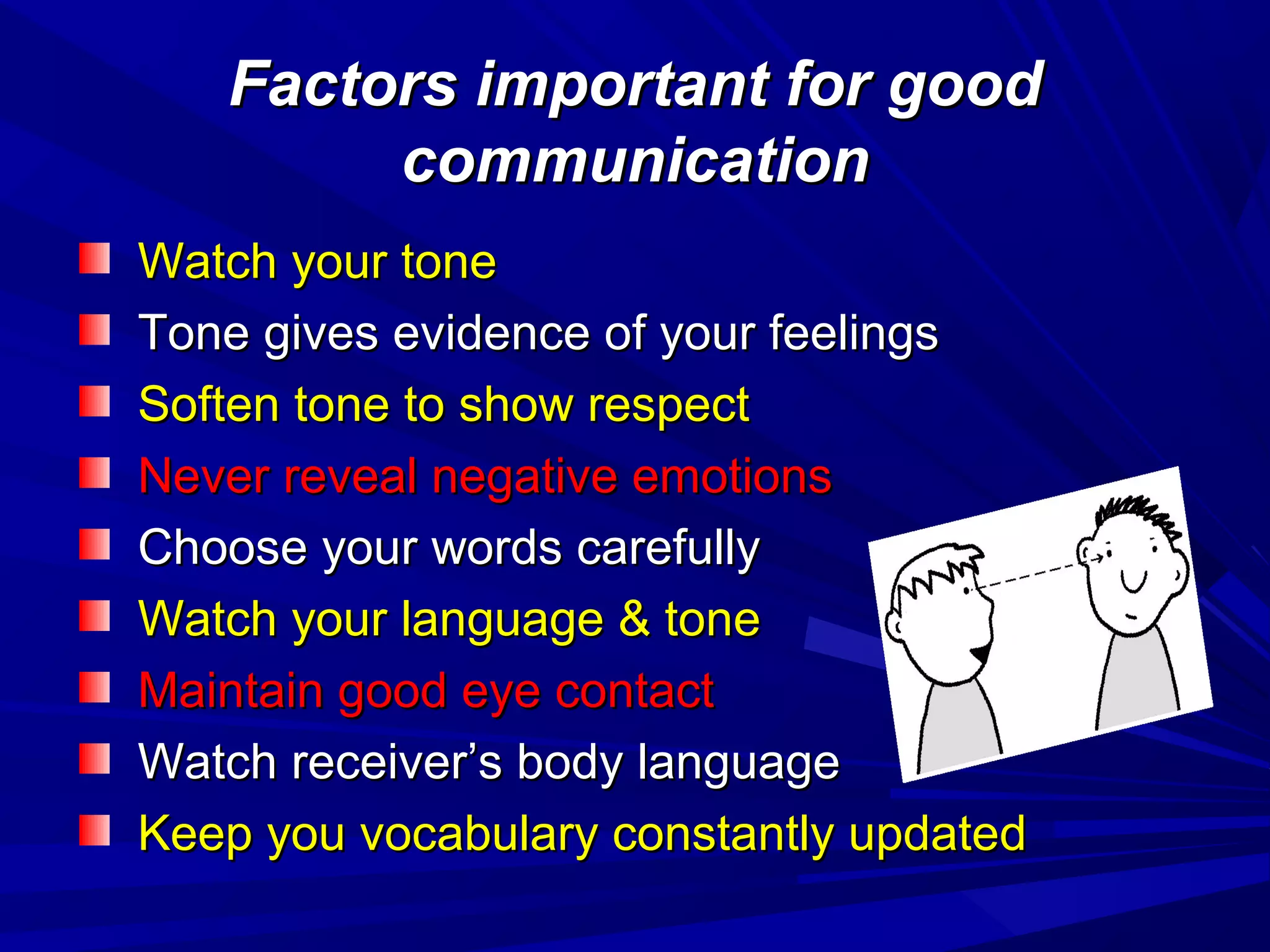
Watch your toneWatch your tone
Tone gives evidence of your feelingsTone gives evidence of your feelings
Soften tone to show respectSoften tone to show respect
Never reveal negative emotionsNever reveal negative emotions
Choose your words carefullyChoose your words carefully
Watch your language & toneWatch your language & tone
Maintain good eye contactMaintain good eye contact
Watch receiver’s body languageWatch receiver’s body language
Keep you vocabulary constantly updatedKeep you vocabulary constantly updated
Factors important for goodFactors important for good
communicationcommunication
Speak from the heartSpeak from the heart
Use suitable pausesUse suitable pauses
Stop talkingStop talking
Think what to say nextThink what to say next
Emphasize a point by pausingEmphasize a point by pausing
Pause gives listeners time to thinkPause gives listeners time to think
Factors important for goodFactors important for good
communicationcommunication
Vary your rate of speechVary your rate of speech
Screen your distractionsScreen your distractions
Develop the art of listeningDevelop the art of listening
Aim for open, timely and two-wayAim for open, timely and two-way
communicationcommunication
Follow up on communicationFollow up on communication
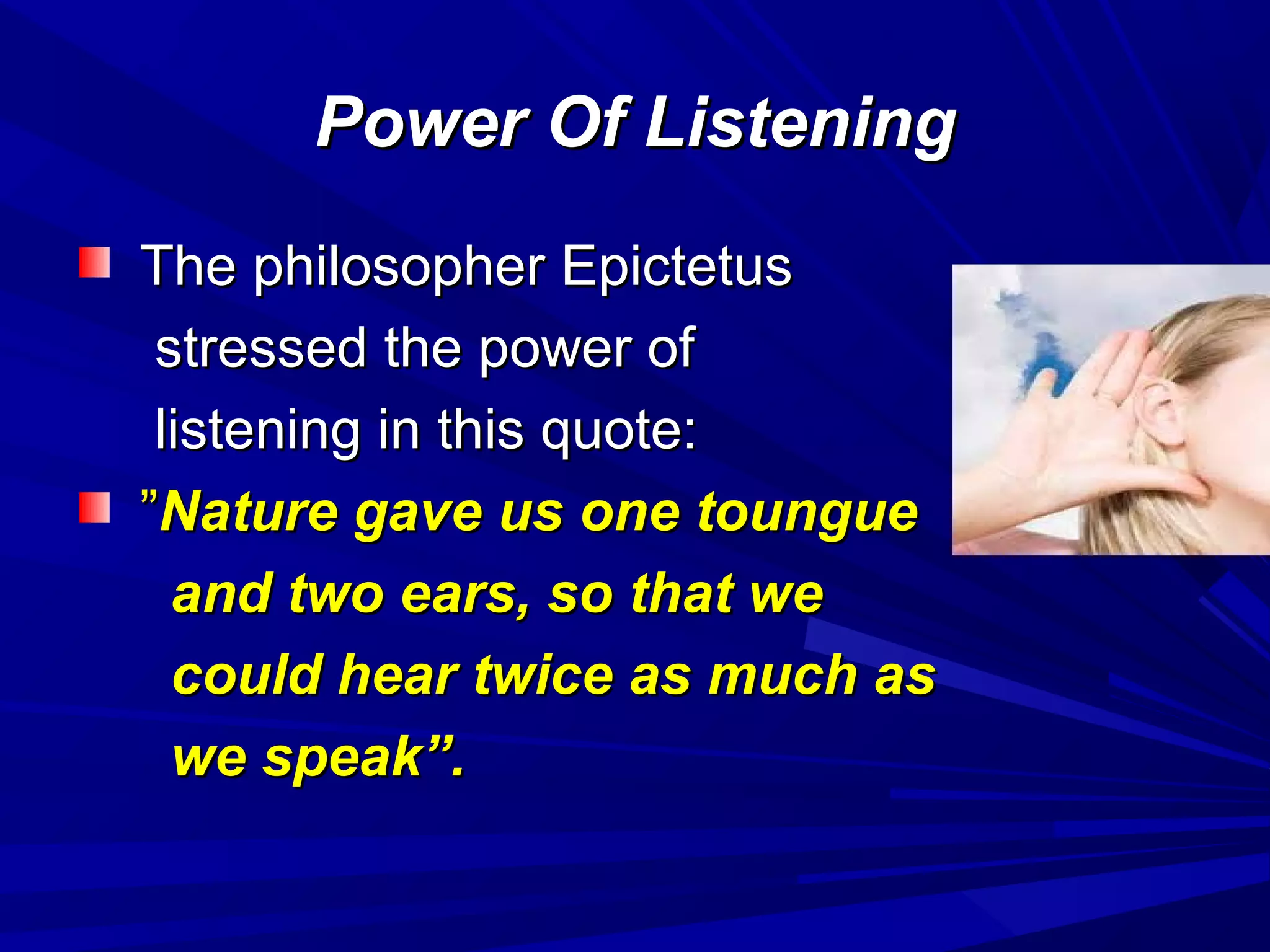
Power Of ListeningPower Of Listening
The philosopher EpictetusThe philosopher Epictetus
stressed the power ofstressed the power of
listening in this quote:listening in this quote:
””Nature gave us one toungueNature gave us one toungue
and two ears, so that weand two ears, so that we
could hear twice as much ascould hear twice as much as
we speak”.we speak”.
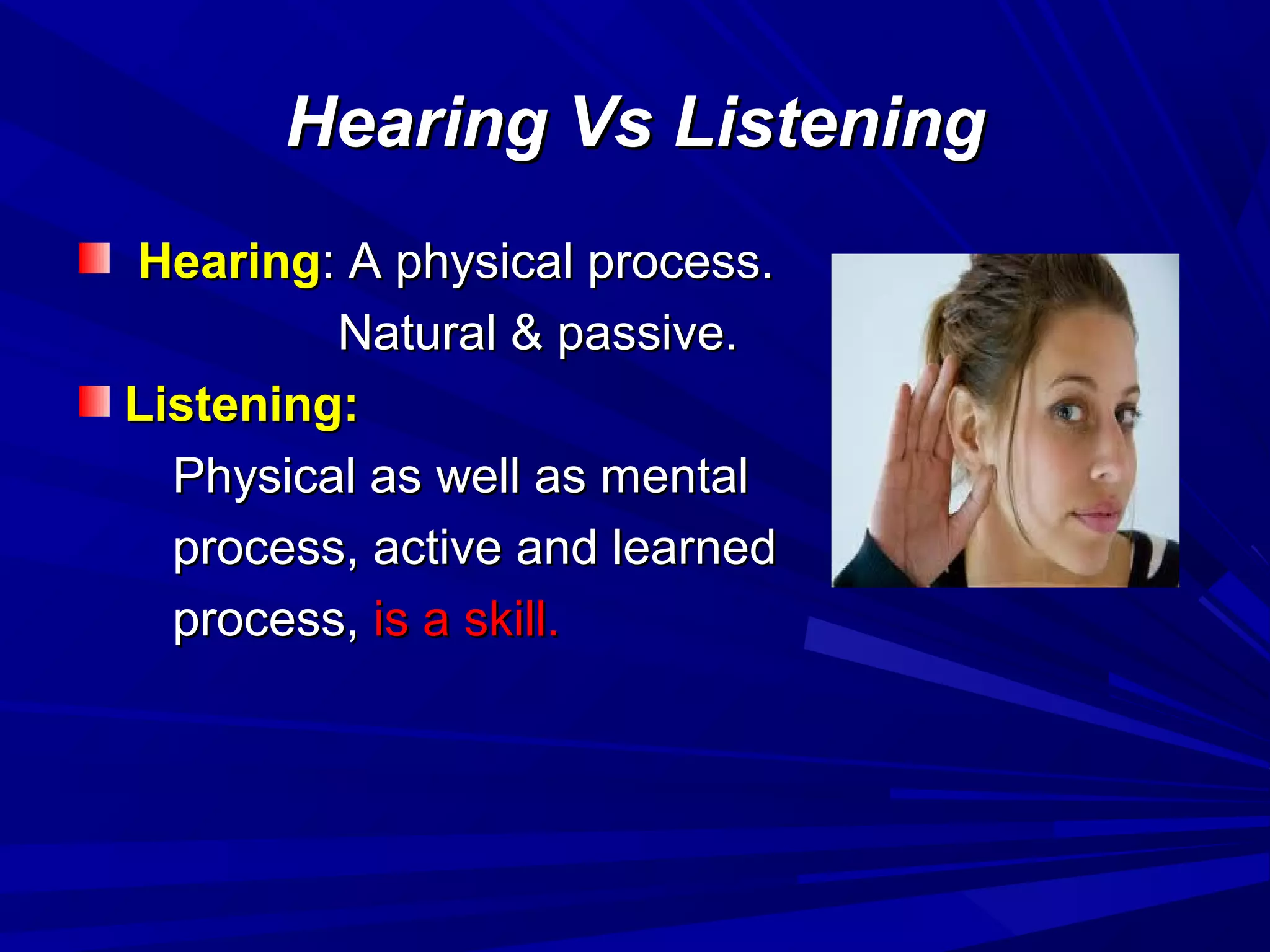
Hearing Vs ListeningHearing Vs Listening
HearingHearing: A physical process.: A physical process.
Natural & passive.Natural & passive.
Listening:Listening:
Physical as well as mentalPhysical as well as mental
process, active and learnedprocess, active and learned
process,process, is a skill.is a skill.
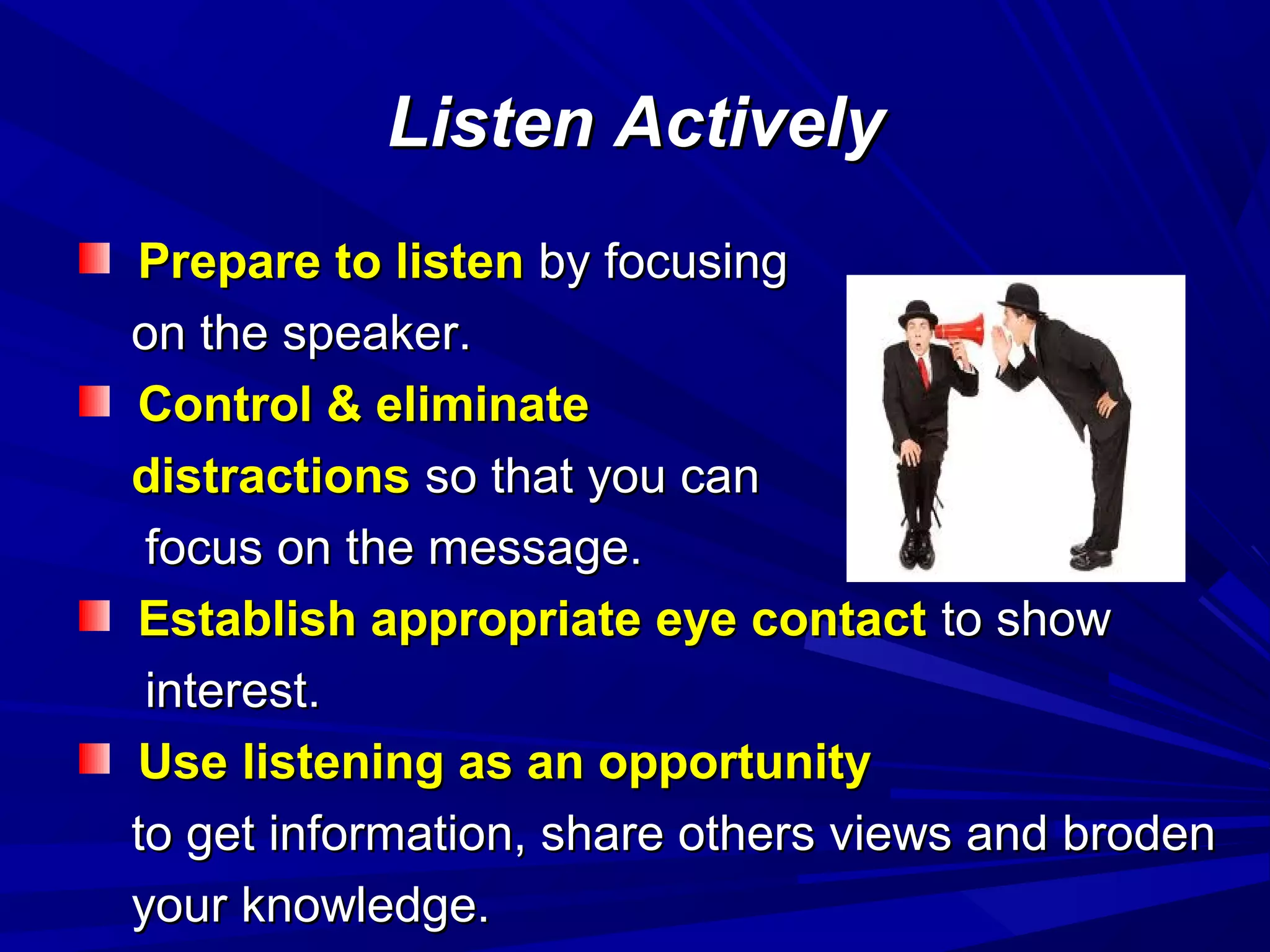
Listen ActivelyListen Actively
Prepare to listenPrepare to listen by focusingby focusing
on the speaker.on the speaker.
Control & eliminateControl & eliminate
distractionsdistractions so that you canso that you can
focus on the message.focus on the message.
Establish appropriate eye contactEstablish appropriate eye contact to showto show
interest.interest.
Use listening as an opportunityUse listening as an opportunity
to get information, share others views and brodento get information, share others views and broden
your knowledge.your knowledge.
Listen ActivelyListen Actively
Non.verbal:Non.verbal:
Be aware of the speaker’sBe aware of the speaker’s
non-verbal messages.non-verbal messages.
Verbal:Verbal:
Pay attention to the wordsPay attention to the words
and feelings that are beingand feelings that are being
expressed.expressed.
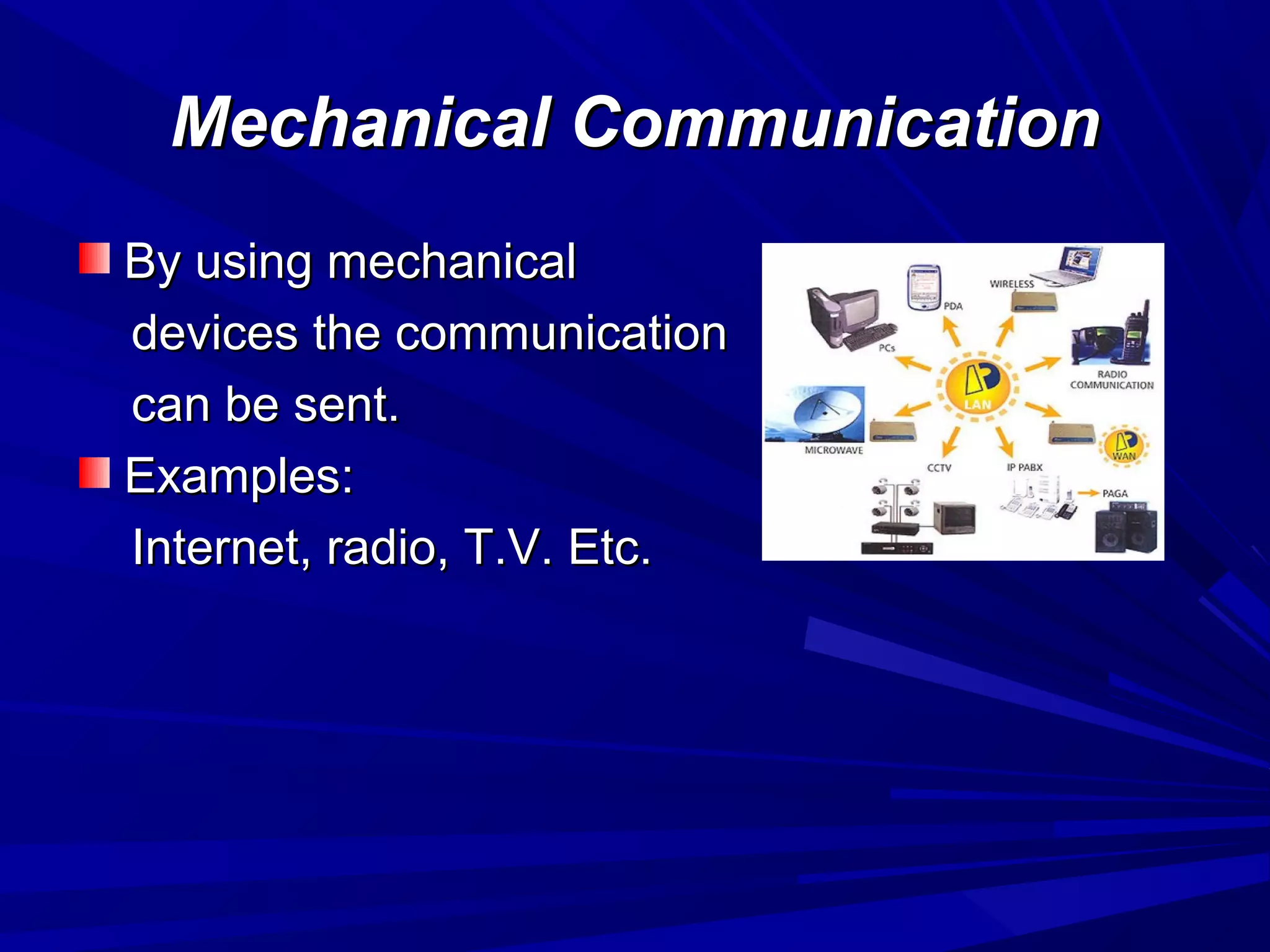
Mechanical CommunicationMechanical Communication
By using mechanicalBy using mechanical
devices the communicationdevices the communication
can be sent.can be sent.
Examples:Examples:
Internet, radio, T.V. Etc.Internet, radio, T.V. Etc.
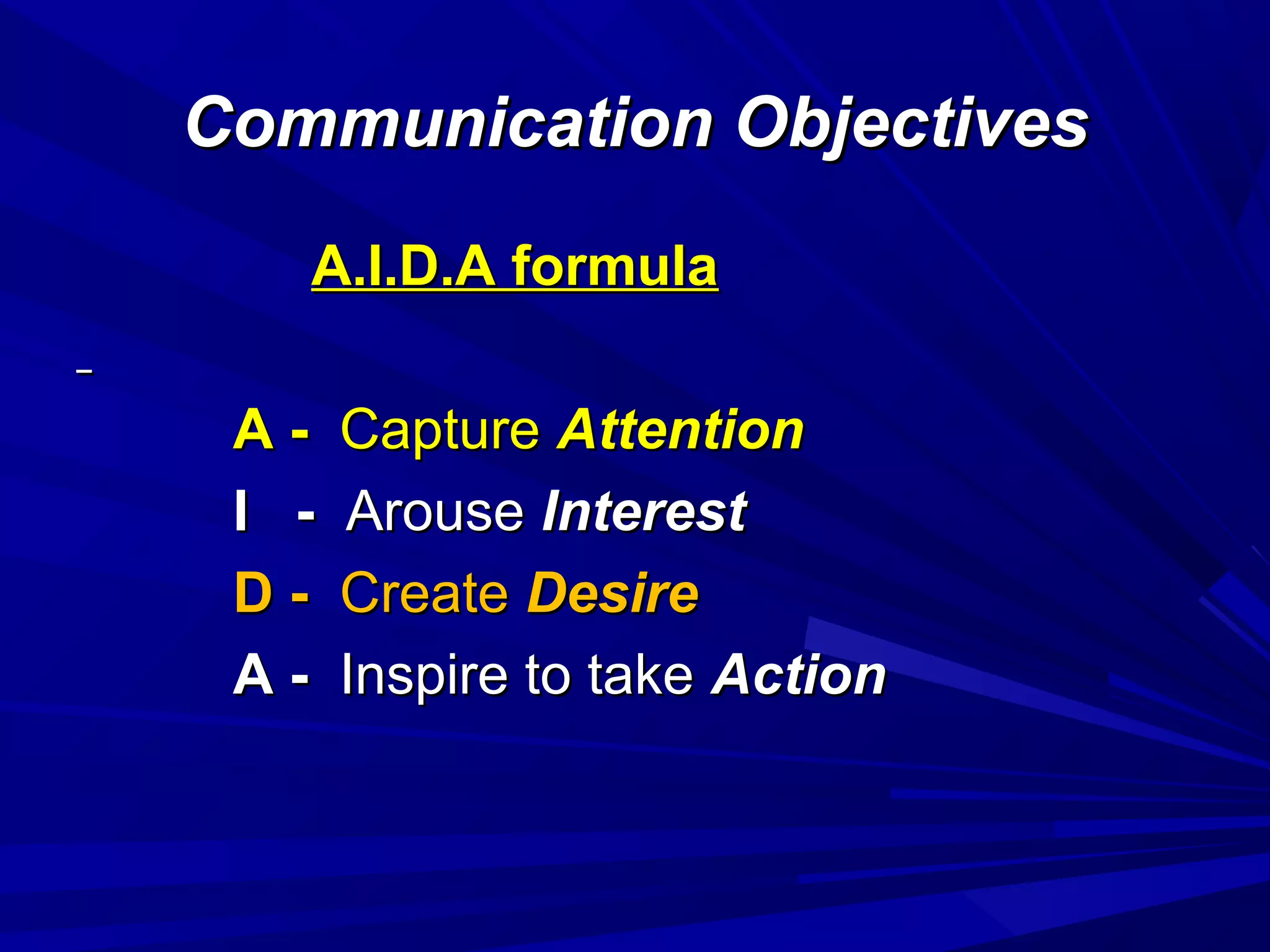
Communication ObjectivesCommunication Objectives
A.I.D.A formulaA.I.D.A formula
A -A - CaptureCapture AttentionAttention
I -I - ArouseArouse InterestInterest
D -D - CreateCreate DesireDesire
A -A - Inspire to takeInspire to take ActionAction
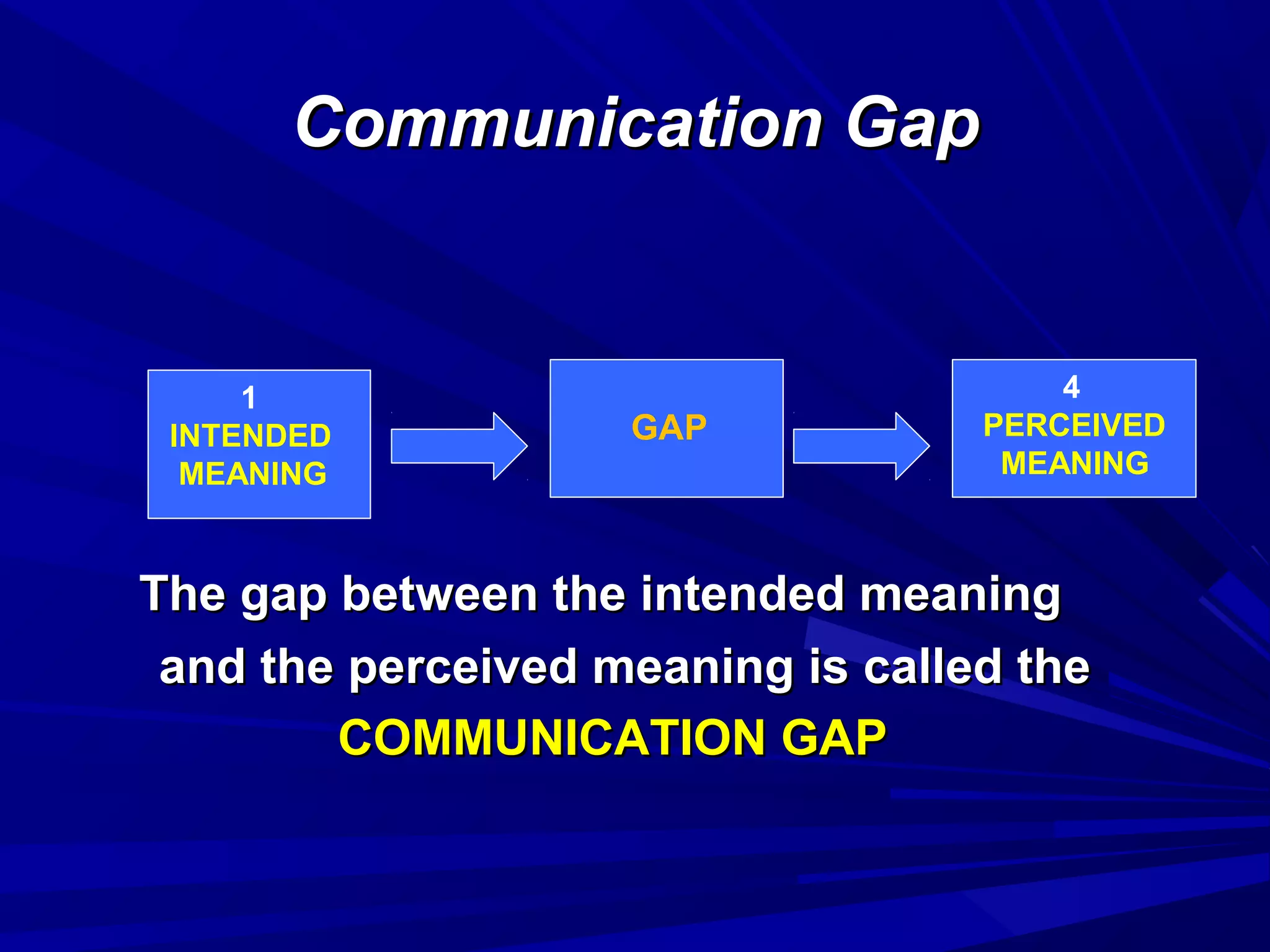
Communication GapCommunication Gap
The gap between the intended meaningThe gap between the intended meaning
and the perceived meaning is called theand the perceived meaning is called the
COMMUNICATION GAPCOMMUNICATION GAP
GAP
1
INTENDED
MEANING
4
PERCEIVED
MEANING
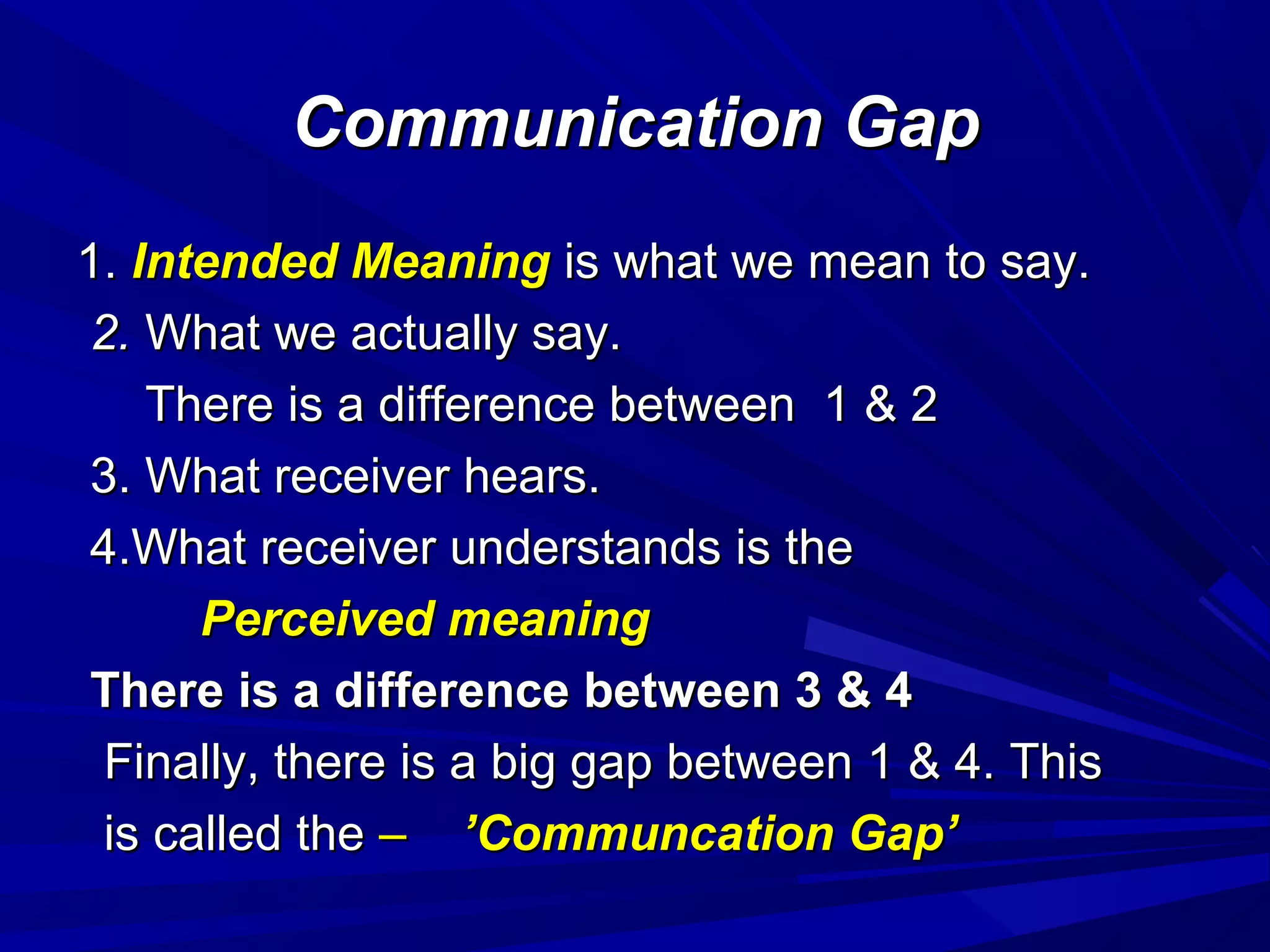
Communication GapCommunication Gap
1.1. Intended MeaningIntended Meaning is what we mean to say.is what we mean to say.
2.2. What we actually say.What we actually say.
There is a difference between 1 & 2There is a difference between 1 & 2
3. What receiver hears.3. What receiver hears.
4.What receiver understands is the4.What receiver understands is the
Perceived meaningPerceived meaning
There is a difference between 3 & 4There is a difference between 3 & 4
Finally, there is a big gap between 1 & 4. ThisFinally, there is a big gap between 1 & 4. This
is called theis called the –– ’Communcation Gap’’Communcation Gap’
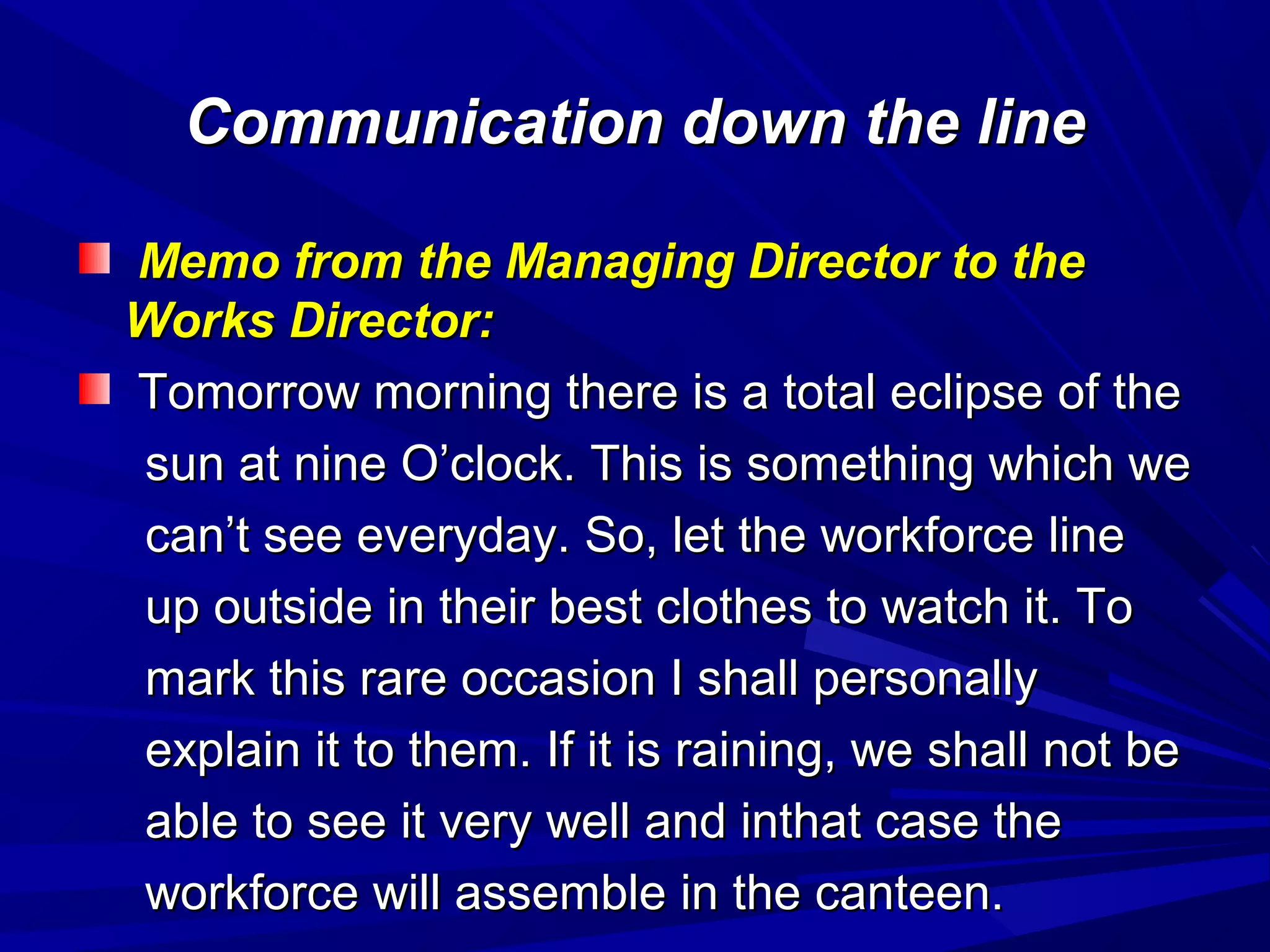
Communication down the lineCommunication down the line
Memo from the Managing Director to theMemo from the Managing Director to the
Works Director:Works Director:
Tomorrow morning there is a total eclipse of theTomorrow morning there is a total eclipse of the
sun at nine O’clock. This is something which wesun at nine O’clock. This is something which we
can’t see everyday. So, let the workforce linecan’t see everyday. So, let the workforce line
up outside in their best clothes to watch it. Toup outside in their best clothes to watch it. To
mark this rare occasion I shall personallymark this rare occasion I shall personally
explain it to them. If it is raining, we shall not beexplain it to them. If it is raining, we shall not be
able to see it very well and inthat case theable to see it very well and inthat case the
workforce will assemble in the canteen.workforce will assemble in the canteen.
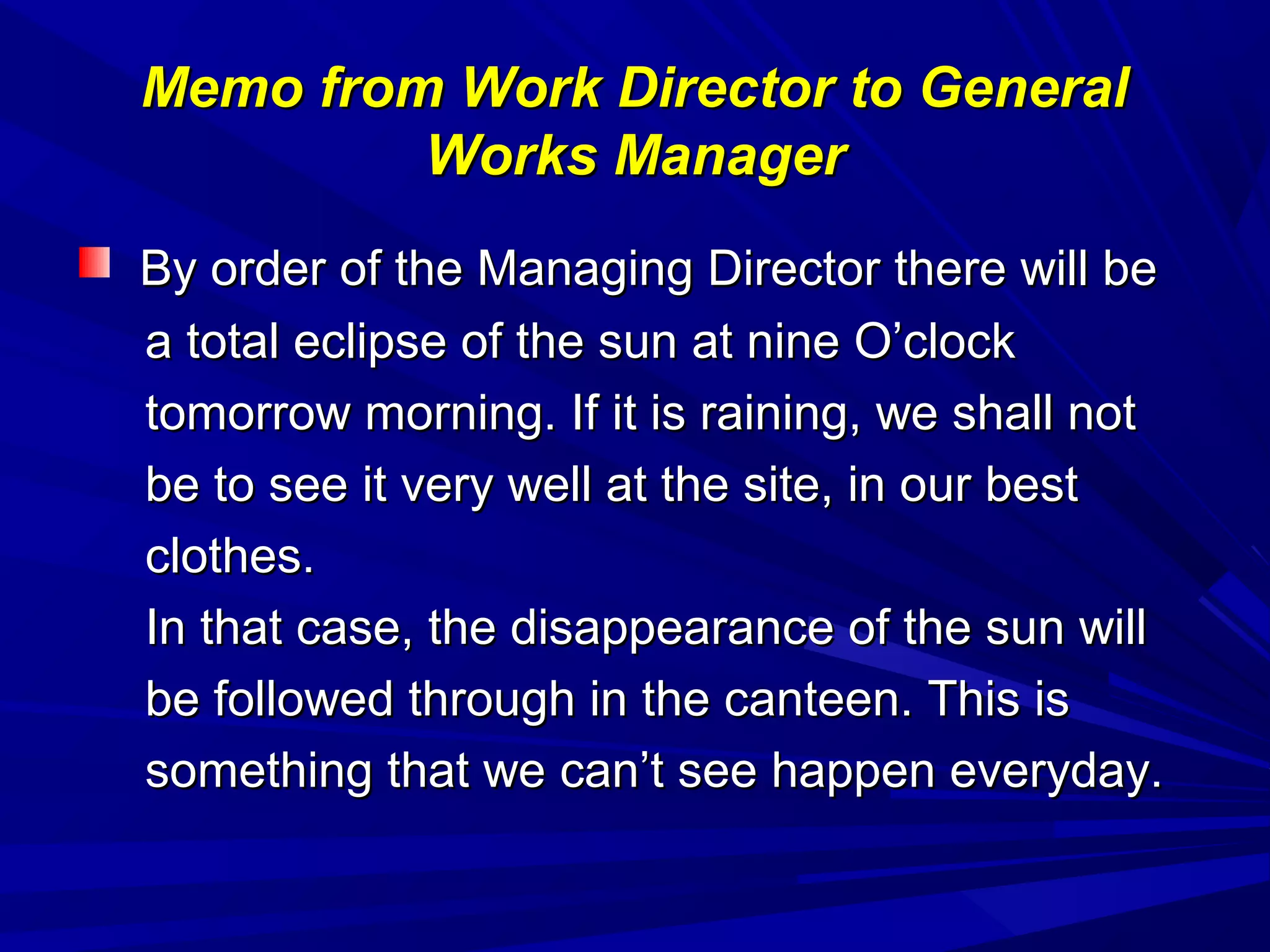
Memo from Work Director to GeneralMemo from Work Director to General
Works ManagerWorks Manager
By order of the Managing Director there will beBy order of the Managing Director there will be
a total eclipse of the sun at nine O’clocka total eclipse of the sun at nine O’clock
tomorrow morning. If it is raining, we shall nottomorrow morning. If it is raining, we shall not
be to see it very well at the site, in our bestbe to see it very well at the site, in our best
clothes.clothes.
In that case, the disappearance of the sun willIn that case, the disappearance of the sun will
be followed through in the canteen. This isbe followed through in the canteen. This is
something that we can’t see happen everyday.something that we can’t see happen everyday.
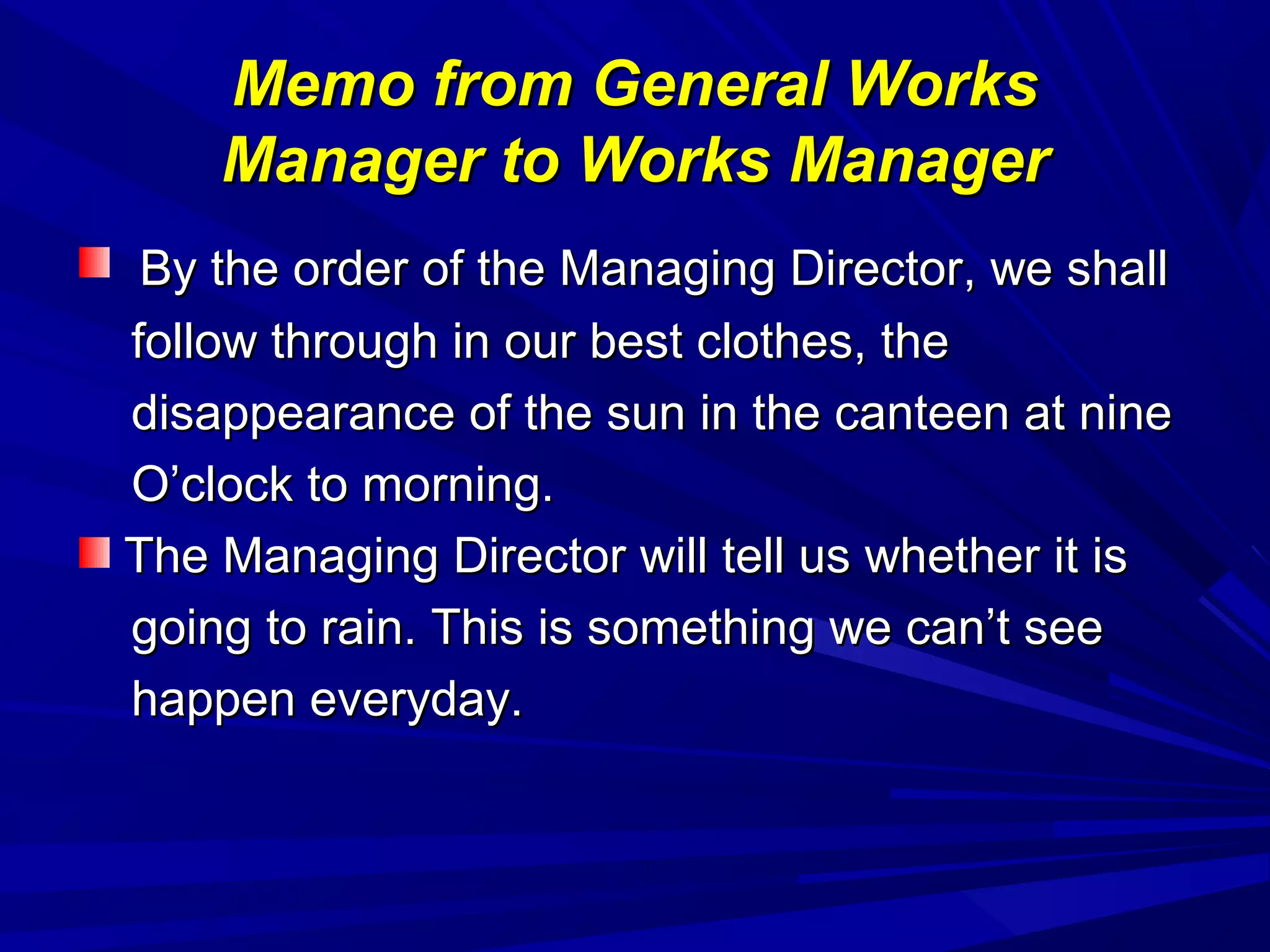
Memo from General WorksMemo from General Works
Manager to Works ManagerManager to Works Manager
By the order of the Managing Director, we shallBy the order of the Managing Director, we shall
follow through in our best clothes, thefollow through in our best clothes, the
disappearance of the sun in the canteen at ninedisappearance of the sun in the canteen at nine
O’clock to morning.O’clock to morning.
The Managing Director will tell us whether it isThe Managing Director will tell us whether it is
going to rain. This is something we can’t seegoing to rain. This is something we can’t see
happen everyday.happen everyday.
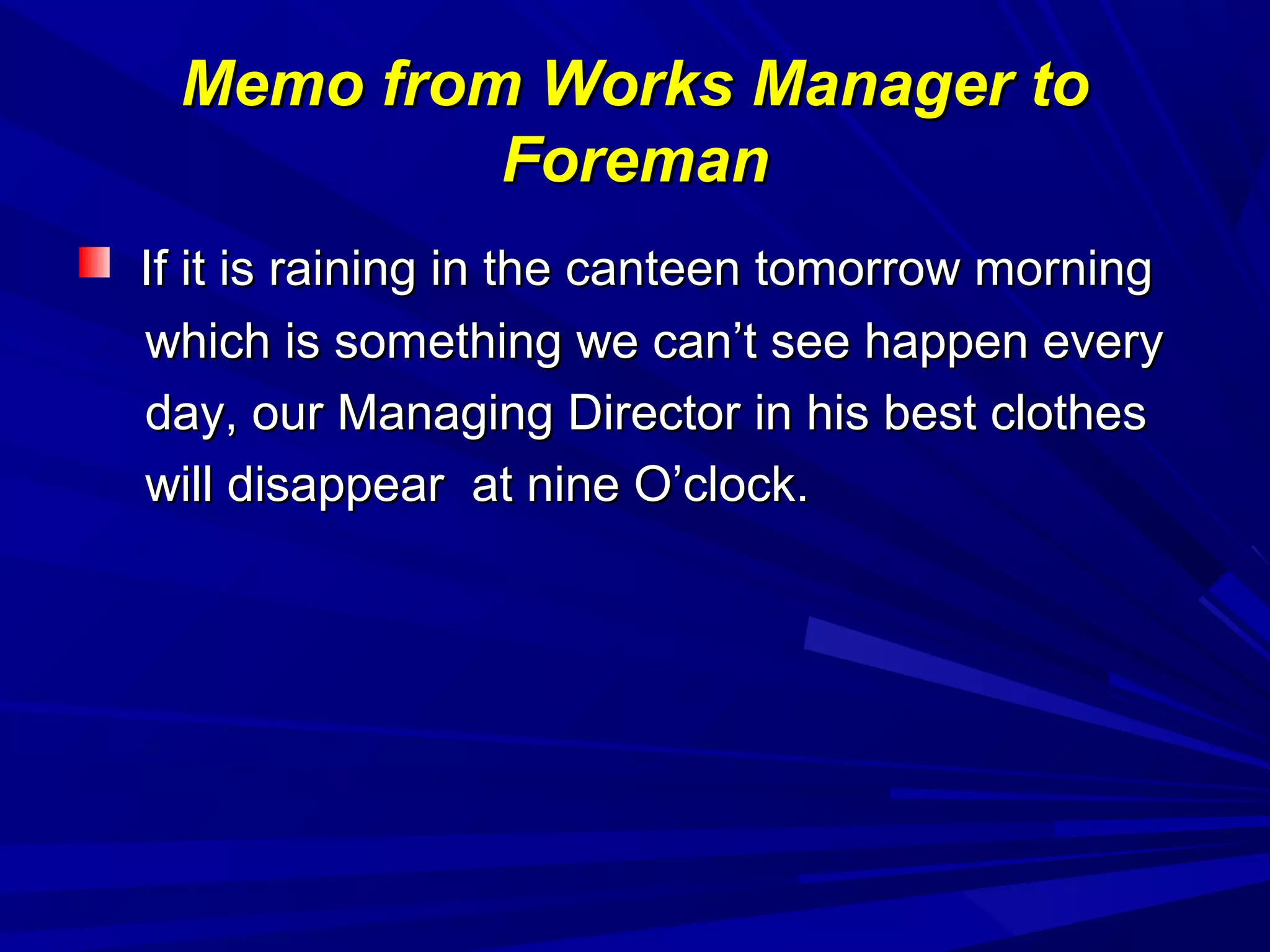
Memo from Works Manager toMemo from Works Manager to
ForemanForeman
If it is raining in the canteen tomorrow morningIf it is raining in the canteen tomorrow morning
which is something we can’t see happen everywhich is something we can’t see happen every
day, our Managing Director in his best clothesday, our Managing Director in his best clothes
will disappear at nine O’clock.will disappear at nine O’clock.
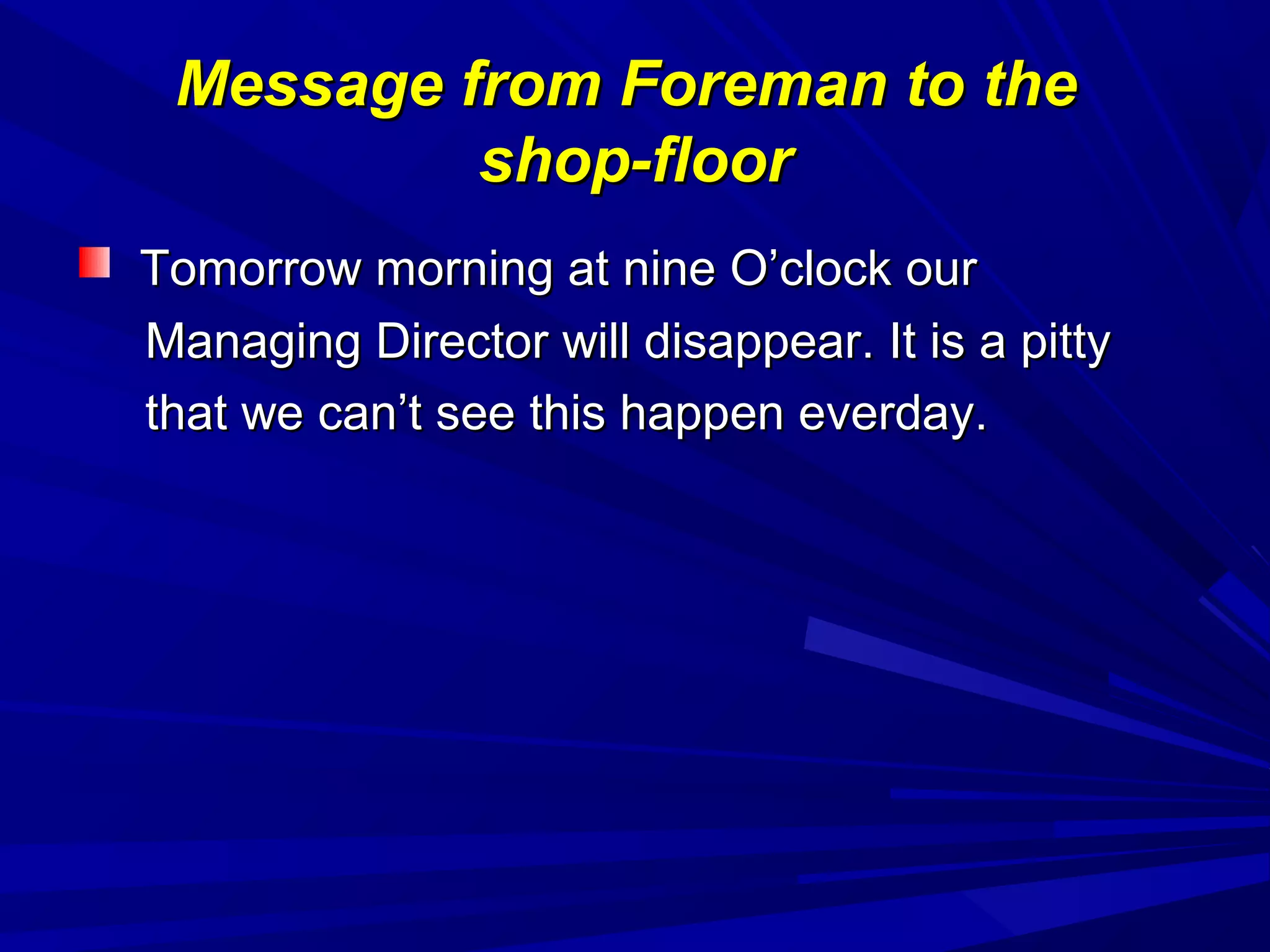
Message from Foreman to theMessage from Foreman to the
shop-floorshop-floor
Tomorrow morning at nine O’clock ourTomorrow morning at nine O’clock our
Managing Director will disappear. It is a pittyManaging Director will disappear. It is a pitty
that we can’t see this happen everday.that we can’t see this happen everday.
Poor vocabulary problemPoor vocabulary problem
Once, a man with poor EnglishOnce, a man with poor English
vocabulary went to a British lady-doctor tovocabulary went to a British lady-doctor to
consult about his wife, because theyconsult about his wife, because they
were not blessed with any child even afterwere not blessed with any child even after
several years of marriage.several years of marriage.
When the doctor asked about his wife’sWhen the doctor asked about his wife’s
problem, he explained the problem in thisproblem, he explained the problem in this
way:way:
Poor vocabularyPoor vocabulary
””Here is my wife Rita. Her problem is thatHere is my wife Rita. Her problem is that
she isshe is ’’ unbearableunbearable’’ (can’t bear a child),(can’t bear a child),
no, no she isno, no she is ’inconceiveable’’inconceiveable’ ((can’tcan’t
conceive), no, no, I am sorry, she isconceive), no, no, I am sorry, she is
’’impregnableimpregnable’’ (can’t become pregnant).(can’t become pregnant).
So, improve your vocabulary to avoidSo, improve your vocabulary to avoid
this type of situation.this type of situation.
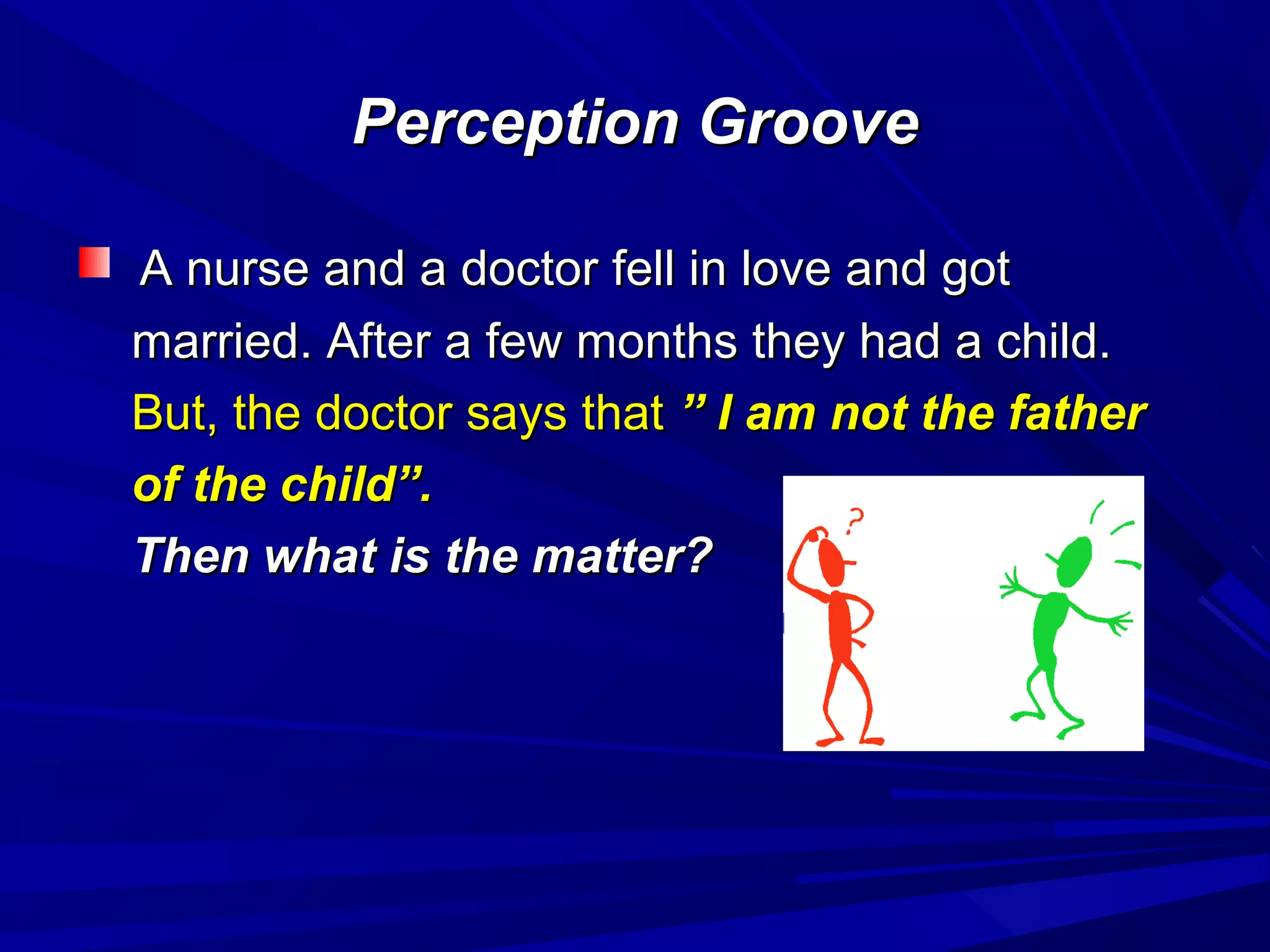
Perception GroovePerception Groove
A nurse and a doctor fell in love and gotA nurse and a doctor fell in love and got
married. After a few months they had a child.married. After a few months they had a child.
But, the doctor says thatBut, the doctor says that ” I am not the father” I am not the father
of the child”.of the child”.
Then what is the matter?Then what is the matter?
Any Question?Any Question?
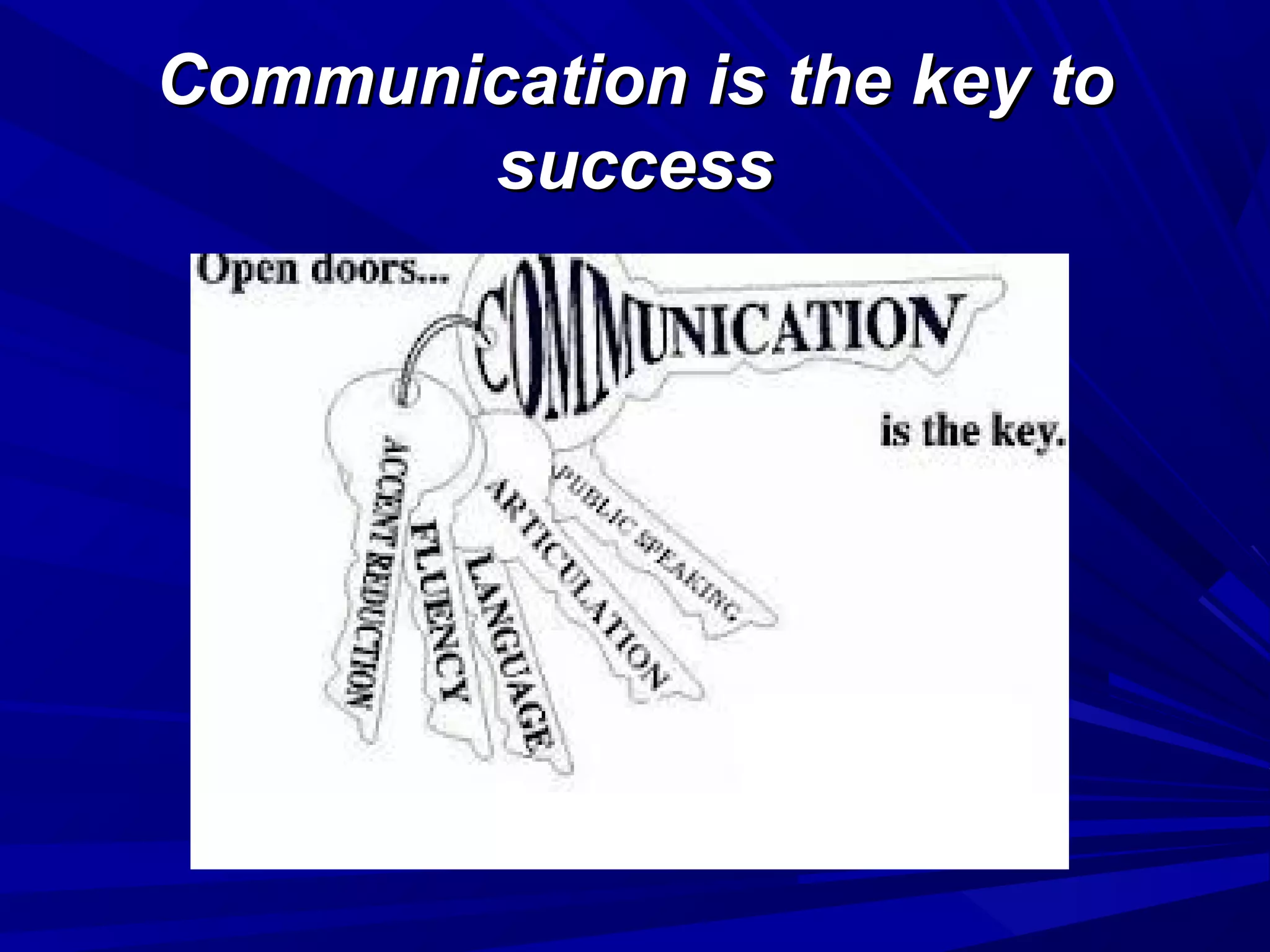
Communication is the key toCommunication is the key to
successsuccess
Nature’s CommunicationNature’s Communication
The EndThe End
By – N.G.PalitBy – N.G.Palit

Communication skills

  • 1.
    Communication SkillsCommunication Skills By–By – N.G.PalitN.G.Palit
  • 2.
    What is Communication?Whatis Communication? Communication is the art ofCommunication is the art of transmitting information, ideastransmitting information, ideas and attitudes from one personand attitudes from one person to another.to another. Communication is the processCommunication is the process of meaningful interaction amongof meaningful interaction among human beings.human beings.
  • 3.
    What is Communication?Whatis Communication? Communication is defined asCommunication is defined as the interchange of thoughtsthe interchange of thoughts or opinions throughor opinions through ’’shared symbolsshared symbols’’ e.ge.g languagelanguage, words,, words, phrasesphrases etcetc
  • 4.
    What is EffectiveCommunication?What is Effective Communication? Communication would beCommunication would be termed effective if there is atermed effective if there is a constructive feedback and all theconstructive feedback and all the objectives achieved.objectives achieved. Communication becomes effectiveCommunication becomes effective only when the language used is effective,only when the language used is effective, the message conveyed is clear and thethe message conveyed is clear and the predetermined purpose is achieved.predetermined purpose is achieved.
  • 5.
    Most common waystoMost common ways to CommunicateCommunicate Speaking Writing VisualVisual ImageImage Body Language
  • 6.
  • 7.
  • 8.
  • 9.
    Four Facts ofCommunicationFour Facts of Communication SenderSender ReceiverReceiver MessageMessage Feedback (response)Feedback (response)
  • 10.
    Four Facets ofCommunicatioFour Facets of Communicationn In any communication:In any communication: TheThe ’Sender’Sender’’ is the person who trying tois the person who trying to communicate a message.communicate a message. TheThe ’Receiver’Receiver’ is the person to whom the’ is the person to whom the message is directed.message is directed. A message is sent to conveyA message is sent to convey ’’information’.information’. Information is meant to changeInformation is meant to change ’behaviour’.’behaviour’.
  • 11.
    Communication mechanismCommunication mechanism Themessage:The message: The source of message is the sender. The sender mustThe source of message is the sender. The sender must know why the communication is necessary & what resultknow why the communication is necessary & what result is needed.is needed. Encoding:Encoding: Encoding is the process of taking your message andEncoding is the process of taking your message and transferring it into the proper format for sharing it with thetransferring it into the proper format for sharing it with the audience.audience. Channel:Channel: Channel is the method of communication that youChannel is the method of communication that you choose, such as face-to-face, by telephone or via e-mail.choose, such as face-to-face, by telephone or via e-mail.
  • 12.
    Communication mechanismCommunication mechanism Decoding:Decoding: Itis the process of receiving the message accurately,It is the process of receiving the message accurately, and understand the information.and understand the information. Feedback:Feedback: It is the response from the receiver.It is the response from the receiver. Feedback lets you know if your communication wasFeedback lets you know if your communication was successful or not.successful or not. Feedback can be Verbal & Non-verbal Reactions.Feedback can be Verbal & Non-verbal Reactions. It can be Positive feedback and Negative feedbackIt can be Positive feedback and Negative feedback
  • 13.
    Communication is atwo-wayCommunication is a two-way processprocess Communication is aCommunication is a ’’two-way process’.two-way process’. Sender to ReceiverSender to Receiver ((message)message),, and receiverand receiver to senderto sender ((feedback)feedback)
  • 14.
    Nature of communicationNatureof communication It has four specific skills:It has four specific skills: 1. Reading1. Reading 2. Writing2. Writing 3. Speaking3. Speaking 4. Listening4. Listening
  • 15.
    Channel of communicationChannelof communication Channel means pathway.Channel means pathway. The route through whichThe route through which message flows from sendermessage flows from sender to receiver.to receiver. Different channels used in anDifferent channels used in an organizationorganization:: 1. Formal channel1. Formal channel - official form- official form 2. Informal channel2. Informal channel – unofficial form– unofficial form
  • 16.
    Types of CommunicationTypesof Communication On the basis of organizational relationship:On the basis of organizational relationship: 1.1. FormalFormal 2. Informal2. Informal On the basis of flow:On the basis of flow: 1. Vertical1. Vertical 2. Diagonal / crosswise2. Diagonal / crosswise 3. Horizontal3. Horizontal
  • 17.
    Informal communicationInformal communication ’Grapevine’’Grapevine’ ’’Grapevine’Grapevine’is also anis also an informal communicatioinformal communication.n. It follows no rules andIt follows no rules and spreads fast like grapevine.spreads fast like grapevine. There are two types ofThere are two types of Grapevine:Grapevine: II. Rumours. Rumours 2. Gossips2. Gossips
  • 18.
    Types of CommunicationTypesof Communication On the basis of Expression:On the basis of Expression: 1. Oral1. Oral 2. Written2. Written 3. Gesture3. Gesture
  • 19.
    Various means ofcommunicationVarious means of communication Verbal communicationVerbal communication Oral Written Non-Verbal communication Sign language Body language Para language Space, Surrounding & Time
  • 21.
    Verbal & non-verbalVerbal& non-verbal communicationcommunication In Verbal CommunicationIn Verbal Communication:: Words account for only -Words account for only - 7%7% ToneTone ModulationModulation 38%38% VolumeVolume Total - 45%Total - 45% BalanceBalance 55%55% is through non-verbal Communication,is through non-verbal Communication, which includes:-which includes:- Our Body Language.Our Body Language. Breathing.Breathing. Our movement.Our movement.
  • 22.
    Verbal languageVerbal language **Like: Arabic, English,Like: Arabic, English, French,…etcFrench,…etc * Verbal Language Skills:* Verbal Language Skills: 1. Reading.1. Reading. 2. Writing2. Writing 3. Speaking.3. Speaking. 4.4. ListeningListening
  • 23.
    What is VerbalCommunication?What is Verbal Communication? Verbal means use of words. So, verbalVerbal means use of words. So, verbal communication may becommunication may be either oral or written.either oral or written. 1. Oral Communication:1. Oral Communication: This is communication through spoken words.This is communication through spoken words. 2. Written Communication:2. Written Communication: Communication through written words, like:Communication through written words, like: letters, memos, circulars, manuals etcletters, memos, circulars, manuals etc
  • 24.
    Impact of oralcommunication?Impact of oral communication?
  • 25.
  • 26.
    Contribution of bodylanguageContribution of body language
  • 27.
    Major areas ofnon-verbalMajor areas of non-verbal behaviours are:behaviours are: * Eye contact* Eye contact * Facial expressions* Facial expressions * Gestures* Gestures
  • 28.
    Non-verbal behaviourNon-verbal behaviour Posture& body orientationPosture & body orientation ProximityProximity ParalinguisticsParalinguistics
  • 29.
  • 30.
    GesturesGestures RecognizeRecognize attitudesattitudes conveyedconveyed throughBody Language.through Body Language. Pick upPick up non-verbal signals fromnon-verbal signals from body language.body language. Facial expressions canFacial expressions can enhanceenhance or detractor detract verbal communicationverbal communication..
  • 31.
    Gesture can beeffectively used toGesture can be effectively used to augment our oral communicationaugment our oral communication
  • 32.
    Para linguisticsPara linguistics ComponentsofComponents of Para linguisticsPara linguistics are:are: Rate of speedRate of speed When a speaker speaks too fast, he is seen asWhen a speaker speaks too fast, he is seen as more competentmore competent.. PitchPitch Pich should be changed according to thePich should be changed according to the context of the spoken words.context of the spoken words. VolumeVolume LoudLoud people are considered as agressive.people are considered as agressive. Soft spokenSoft spoken voices are perceived as timid or polite.voices are perceived as timid or polite.
  • 33.
    Barriers in communicationBarriersin communication NOISE FACTORNOISE FACTOR
  • 34.
    Barriers to communicationBarriersto communication NoiseNoise Assumptions / MisconceptionsAssumptions / Misconceptions Inappropriate mediumInappropriate medium Language differencesLanguage differences EmotionsEmotions Poor listening skillsPoor listening skills DistractionsDistractions
  • 35.
    b. Internal Stimulib.Internal Stimuli Noise FactorNoise Factor: It is interference in communication: It is interference in communication a. Physical Noisea. Physical Noise
  • 36.
    Barriers in communicationBarriersin communication 1.1. Semantic BarrierSemantic Barrier:: a.a. SymbolsSymbols with different meaningwith different meaning b. Badly expressed message or use ofb. Badly expressed message or use of Jargons(specialist’s language).Jargons(specialist’s language). c. Unclarified assumptionsc. Unclarified assumptions d. The same words can haved. The same words can have different meanings, depending ondifferent meanings, depending on how we interpret them. Example:how we interpret them. Example: ””A woman without her manA woman without her man,, is nothing”is nothing” ””A woman,A woman, wthout her man is nothing”wthout her man is nothing”
  • 37.
    Organizational BarriersOrganizational Barriers a.Organizational Policya. Organizational Policy b. Organizational Cultureb. Organizational Culture c. Organizational rules & regulationsc. Organizational rules & regulations d. Staus Relationshipd. Staus Relationship e. Inadequate Facility: Lack ofe. Inadequate Facility: Lack of regular meetings etc.regular meetings etc.
  • 38.
    Psychological or EmotionalBarrierPsychological or Emotional Barrier aa. Lack of attention. Lack of attention b. Premature evaluationb. Premature evaluation c. Loss of transmission & poor retaintionc. Loss of transmission & poor retaintion d.d. Distrust of communication.Distrust of communication. e. Failure to communicate properly.e. Failure to communicate properly. ..
  • 39.
    Communication involves threeCommunicationinvolves three componentscomponents 1. Verbal Messages:1. Verbal Messages: The words we choose.The words we choose. 2. Paraverbal Messages:2. Paraverbal Messages: What we transmit through tone, pitch etc.What we transmit through tone, pitch etc. It is not what you say,It is not what you say, it is how you sit is how you say it, thatay it, that matters.matters. 3. Non-verbal Messages:3. Non-verbal Messages: Mainly our bodylanguage.Mainly our bodylanguage. These three components are used:These three components are used: ** To send clear & concise messagesTo send clear & concise messages * Receive & correctly understand messages sent to us.* Receive & correctly understand messages sent to us.
  • 40.
    Non-verbal CommunicationNon-verbal Communication Non-verbal communication Waysof talking Sounds Posture Head movements Space Body contact Appearan ce Hands movements Eye movements
  • 41.
    What makes agoodWhat makes a good communicator?communicator? Clarity Integrity Timing Adequacy
  • 42.
    Tips for goodcommunicationTips for good communication skillsskills Knowledge of oneselfKnowledge of oneself Get to know othersGet to know others Prepare & organizePrepare & organize Know what you want to sayKnow what you want to say Know your messageKnow your message Think before you talkThink before you talk
  • 43.
    Tips for goodPresentationTips for good Presentation PracticePractice the power of persuationthe power of persuation Know about the audienceKnow about the audience Use theUse the ’KISS’KISS’ method’ method Use simple termsUse simple terms for better clarityfor better clarity Choose correct wordsChoose correct words Avoid technical jargonsAvoid technical jargons Speak audience’s languageSpeak audience’s language
  • 44.
    Tips for goodPresentationTips for good Presentation
  • 45.
    Factors important forgoodFactors important for good communicationcommunication Watch your toneWatch your tone Tone gives evidence of your feelingsTone gives evidence of your feelings Soften tone to show respectSoften tone to show respect Never reveal negative emotionsNever reveal negative emotions Choose your words carefullyChoose your words carefully Watch your language & toneWatch your language & tone Maintain good eye contactMaintain good eye contact Watch receiver’s body languageWatch receiver’s body language Keep you vocabulary constantly updatedKeep you vocabulary constantly updated
  • 46.
    Factors important forgoodFactors important for good communicationcommunication Speak from the heartSpeak from the heart Use suitable pausesUse suitable pauses Stop talkingStop talking Think what to say nextThink what to say next Emphasize a point by pausingEmphasize a point by pausing Pause gives listeners time to thinkPause gives listeners time to think
  • 47.
    Factors important forgoodFactors important for good communicationcommunication Vary your rate of speechVary your rate of speech Screen your distractionsScreen your distractions Develop the art of listeningDevelop the art of listening Aim for open, timely and two-wayAim for open, timely and two-way communicationcommunication Follow up on communicationFollow up on communication
  • 48.
    Power Of ListeningPowerOf Listening The philosopher EpictetusThe philosopher Epictetus stressed the power ofstressed the power of listening in this quote:listening in this quote: ””Nature gave us one toungueNature gave us one toungue and two ears, so that weand two ears, so that we could hear twice as much ascould hear twice as much as we speak”.we speak”.
  • 49.
    Hearing Vs ListeningHearingVs Listening HearingHearing: A physical process.: A physical process. Natural & passive.Natural & passive. Listening:Listening: Physical as well as mentalPhysical as well as mental process, active and learnedprocess, active and learned process,process, is a skill.is a skill.
  • 50.
    Listen ActivelyListen Actively Prepareto listenPrepare to listen by focusingby focusing on the speaker.on the speaker. Control & eliminateControl & eliminate distractionsdistractions so that you canso that you can focus on the message.focus on the message. Establish appropriate eye contactEstablish appropriate eye contact to showto show interest.interest. Use listening as an opportunityUse listening as an opportunity to get information, share others views and brodento get information, share others views and broden your knowledge.your knowledge.
  • 51.
    Listen ActivelyListen Actively Non.verbal:Non.verbal: Beaware of the speaker’sBe aware of the speaker’s non-verbal messages.non-verbal messages. Verbal:Verbal: Pay attention to the wordsPay attention to the words and feelings that are beingand feelings that are being expressed.expressed.
  • 52.
    Mechanical CommunicationMechanical Communication Byusing mechanicalBy using mechanical devices the communicationdevices the communication can be sent.can be sent. Examples:Examples: Internet, radio, T.V. Etc.Internet, radio, T.V. Etc.
  • 53.
    Communication ObjectivesCommunication Objectives A.I.D.AformulaA.I.D.A formula A -A - CaptureCapture AttentionAttention I -I - ArouseArouse InterestInterest D -D - CreateCreate DesireDesire A -A - Inspire to takeInspire to take ActionAction
  • 54.
    Communication GapCommunication Gap Thegap between the intended meaningThe gap between the intended meaning and the perceived meaning is called theand the perceived meaning is called the COMMUNICATION GAPCOMMUNICATION GAP GAP 1 INTENDED MEANING 4 PERCEIVED MEANING
  • 55.
    Communication GapCommunication Gap 1.1.Intended MeaningIntended Meaning is what we mean to say.is what we mean to say. 2.2. What we actually say.What we actually say. There is a difference between 1 & 2There is a difference between 1 & 2 3. What receiver hears.3. What receiver hears. 4.What receiver understands is the4.What receiver understands is the Perceived meaningPerceived meaning There is a difference between 3 & 4There is a difference between 3 & 4 Finally, there is a big gap between 1 & 4. ThisFinally, there is a big gap between 1 & 4. This is called theis called the –– ’Communcation Gap’’Communcation Gap’
  • 56.
    Communication down thelineCommunication down the line Memo from the Managing Director to theMemo from the Managing Director to the Works Director:Works Director: Tomorrow morning there is a total eclipse of theTomorrow morning there is a total eclipse of the sun at nine O’clock. This is something which wesun at nine O’clock. This is something which we can’t see everyday. So, let the workforce linecan’t see everyday. So, let the workforce line up outside in their best clothes to watch it. Toup outside in their best clothes to watch it. To mark this rare occasion I shall personallymark this rare occasion I shall personally explain it to them. If it is raining, we shall not beexplain it to them. If it is raining, we shall not be able to see it very well and inthat case theable to see it very well and inthat case the workforce will assemble in the canteen.workforce will assemble in the canteen.
  • 57.
    Memo from WorkDirector to GeneralMemo from Work Director to General Works ManagerWorks Manager By order of the Managing Director there will beBy order of the Managing Director there will be a total eclipse of the sun at nine O’clocka total eclipse of the sun at nine O’clock tomorrow morning. If it is raining, we shall nottomorrow morning. If it is raining, we shall not be to see it very well at the site, in our bestbe to see it very well at the site, in our best clothes.clothes. In that case, the disappearance of the sun willIn that case, the disappearance of the sun will be followed through in the canteen. This isbe followed through in the canteen. This is something that we can’t see happen everyday.something that we can’t see happen everyday.
  • 58.
    Memo from GeneralWorksMemo from General Works Manager to Works ManagerManager to Works Manager By the order of the Managing Director, we shallBy the order of the Managing Director, we shall follow through in our best clothes, thefollow through in our best clothes, the disappearance of the sun in the canteen at ninedisappearance of the sun in the canteen at nine O’clock to morning.O’clock to morning. The Managing Director will tell us whether it isThe Managing Director will tell us whether it is going to rain. This is something we can’t seegoing to rain. This is something we can’t see happen everyday.happen everyday.
  • 59.
    Memo from WorksManager toMemo from Works Manager to ForemanForeman If it is raining in the canteen tomorrow morningIf it is raining in the canteen tomorrow morning which is something we can’t see happen everywhich is something we can’t see happen every day, our Managing Director in his best clothesday, our Managing Director in his best clothes will disappear at nine O’clock.will disappear at nine O’clock.
  • 60.
    Message from Foremanto theMessage from Foreman to the shop-floorshop-floor Tomorrow morning at nine O’clock ourTomorrow morning at nine O’clock our Managing Director will disappear. It is a pittyManaging Director will disappear. It is a pitty that we can’t see this happen everday.that we can’t see this happen everday.
  • 61.
    Poor vocabulary problemPoorvocabulary problem Once, a man with poor EnglishOnce, a man with poor English vocabulary went to a British lady-doctor tovocabulary went to a British lady-doctor to consult about his wife, because theyconsult about his wife, because they were not blessed with any child even afterwere not blessed with any child even after several years of marriage.several years of marriage. When the doctor asked about his wife’sWhen the doctor asked about his wife’s problem, he explained the problem in thisproblem, he explained the problem in this way:way:
  • 62.
    Poor vocabularyPoor vocabulary ””Hereis my wife Rita. Her problem is thatHere is my wife Rita. Her problem is that she isshe is ’’ unbearableunbearable’’ (can’t bear a child),(can’t bear a child), no, no she isno, no she is ’inconceiveable’’inconceiveable’ ((can’tcan’t conceive), no, no, I am sorry, she isconceive), no, no, I am sorry, she is ’’impregnableimpregnable’’ (can’t become pregnant).(can’t become pregnant). So, improve your vocabulary to avoidSo, improve your vocabulary to avoid this type of situation.this type of situation.
  • 63.
    Perception GroovePerception Groove Anurse and a doctor fell in love and gotA nurse and a doctor fell in love and got married. After a few months they had a child.married. After a few months they had a child. But, the doctor says thatBut, the doctor says that ” I am not the father” I am not the father of the child”.of the child”. Then what is the matter?Then what is the matter?
  • 64.
  • 65.
    Communication is thekey toCommunication is the key to successsuccess
  • 66.
  • 67.
    The EndThe End By– N.G.PalitBy – N.G.Palit