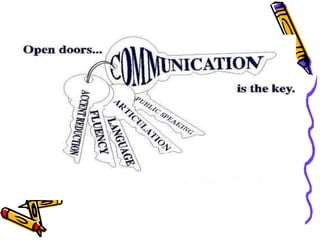
COMMUNICATION
SKILLS
Never be stuck for words again
About training:
o The purpose of the training is to develop and
explore better ways of expressing ourselves.
o The training is meant to leave our hesitation and
fear of speaking in public.
o We all are here to learn something from others
and teach something to others
o Due to the above reasons the training is going to
be a very interactive session with your active
participation.
o Extempore, group discussions and games are
going to be a part of every session.
o You are very much free to share your views and
knowledge with the rest of the class.
Introduce your friend
Make group of two and take five
minutes to know your partner. After
5 minutes everyone will introduce
his/her partner.
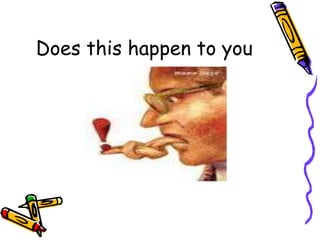
Does this happen to you
Examples of wrong communication
Cover letter: "I would be prepared to
meet with you at your earliest
convenience to discuss what I can do to
your company."
Resume: "It is my professional objective
to obtain a position which allows me to
make use of my commuter skills."
Weaknesses: "Suffer from prickly heat in
summer."
Cover letter: "Enclosed is my resume for
your viewing pleasure."
Cover letter: "You are privileged to receive
my resume."
Experience: "10 years of experience in
financail budgiting and transactions
rigistering."
Cover letter: "Please overlook my resume."
Cover letter: "I'm submitting the attached
copy of my resume for your consumption."
Skills: "Grate communication skills."
Yes, but can you talk and chop at the same
time?
Experience: "Responsibilities included
recruiting, screening, interviewing and
executing final candidates."
• Cover letter: "Salary demanded - $65,000."
We are living in the age where the
economy is based on the exchange of
information. This is the information
age where we operate our business
through communication of various
kind of information.
WHAT IS
COMMUNICATION???
Express your views about the training/
communication!
The word communication is derived
from Latin word
“Communis or “Communicare” which
means to make common.
Communication in simple terms can be
understood as the exchange of
information.
The word “communication” has been
defined differently by different
persons of repute in management.
These are
Koontz and Donell’s :-
“Communication is the transfer of
information from one person to other
whether or not it elicits confidence.”
Louis A. Allen
“Communication is the sum of all things
which a person does when he wants to
create an understanding in the mind of
another. It involves a systematic and
continuous process of telling, listening and
understanding.”
George Terry
“Communication is an exchange of
facts, ideas, opinion or emotions by
two or more persons.”
Why communication is
being discussed
o Coordination
o Planning
o Controlling
o Organizing
o Knowledge management
o Emotional Expression
o Motivation
Sources of
Communication
• There have been various mediums
through which we communicate with
each other.
• From pigeons to emails.
Can you name some
sources?
• Face to face
• Telephonic
• SMS
• E-mails
• Social networking sites
• Postal( letter, document, telegram,
greeting cards)
• Newspaper
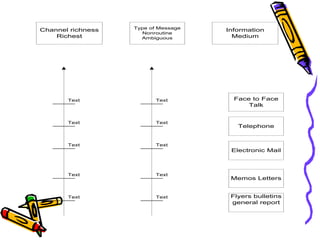
Choice of communication channel
The channels of communication are
considered rich or poor based on-
o handle multiple cues simultaneously,
o facilitate rapid feedback,
o be very personal.
Game of diagram:
• All of you have to form teams of two
each and one out two will be assigned
a diagram. He has to tell his team
member the diagram through symbols
without saying any word.
Text
Text
Text
Text
Text
Text
Text
Text
Text
Text
Channel richness
Richest
Type of Message
Nonroutine
Ambiguous
Information
Medium
Face to Face
Talk
Telephone
Electronic Mail
Memos Letters
Flyers bulletins
general report
Types of Communication
(based on Communication Channels)
It could be broadly divided in two
categories
o Verbal Communication
o Non-verbal Communication
Verbal Communication
Verbal communication is further divided into
oral and written communication.
The oral communication refers to the spoken
words in the communication process. Oral
communication can either be face-to-face
communication or a conversation over the
phone or on the voice chat over the
Internet.
The other type of verbal communication is
Written communication.
Written communication can be either via
mail, or email. The effectiveness of written
communication depends on the style of
writing, vocabulary used, grammar, clarity
and precision of language.
Non verbal Communication
Non -Verbal Communication is the
message or response not expressed or
sent in words –but in form of hints ,
suggestions , indications.
Activity or inactivity, words or silence, all
have message value: they influence others
and these others, in turn, respond to these
communications.”
Non-verbal communication includes
facial expressions, eye contact, tone
of voice, body posture and motions,
and positioning within groups. It may
also include the way we wear our
clothes or the silence we keep.
If a person’s words say one thing and
their nonverbal communication says
another, you will pay attention to the
nonverbal communication – and that is
usually the correct decision.
Types of Communication
(based on style and purpose)
Based on the style of communication,
there can be two broad categories of
communication:-
o Formal Communication
o Informal Communication
Formal Communication
Formal communication includes all the
instances where communication has
to occur in a set formal format.
Typically this can include all sorts of
business communication or corporate
communication
Examples
• Official conferences.
• Meetings.
• Written memos.
• Corporate letters.
Informal Communication
Informal communication includes
instances of free unrestrained
communication between people who
share a casual rapport with each
other. Informal communication
requires two people to have a similar
wavelength and hence occurs
between friends and family.
Types of Communication
(Based on number of people )
o Intrapersonal communication
o Interpersonal communication
o Group communication
o Mass Communication
Intrapersonal
Communication
Communicating within yourself. When you think,
daydream, solve problems, and image, you are
in the realm of intrapersonal communication.
Transcendental meditation, for instance, is an
example of such communication.
Interpersonal
Communication
This form of communication
describes the interactions of two or
more people.
Example Face-to face communication
between two persons is an example of
such communication.
Group communication
Group communication shares all these
qualities, though in a much less measure.
Group communication requires the
following conditions: leadership, equal
sharing of ideas, peer pressure, roles and
norms, and focuses on a common goal.
Mass Communication
Mass communication powerfully affects
our attitudes and beliefs, as well as our
perspective on social life.
Some Examples of if may be media -print
newspapers or magazines, electrical radio,
TV or video, or even electronic.
Elements of
Communication
o Sender
o Receiver
o Channel/medium of communication
Process of
Communication
The communication process is made up
of four key components
o Encoding
o Transmitting process
o Decoding
o Feedback
Encoding process
In order to convey meaning, the sender
must begin encoding, which means
translating information into a
message in the form of symbols that
represent ideas or concepts.
Transmitting process
To begin transmitting the message,
the sender uses some kind of channel
(also called a medium). The channel is
the means used to convey the
message.
Decoding process
Once the message is received and
examined, the stimulus is sent to the
brain for interpreting, in order to
assign some type of meaning to it. It
is this processing stage that
constitutes decoding.
Feedback
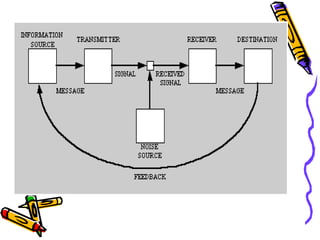
After receiving a message, the
receiver responds in some way and
signals that response to the sender.
Feedback is a key component in the
communication process because it
allows the sender to evaluate the
effectiveness of the message.
Barriers to
communication
o The external/internal forces may
affect the effectiveness of
communication by acting upon any or
all of the basic elements of
communication act/process and the
sender and receiver channel.
General barriers
o Noise
o Wrong/unclarified assumptions
o Cultural barriers
o Socio-psychological barriers
o Emotions
o Selective perception
General Barriers
o Filtering
o Information overload
o Loss by transmission
o Poor retention
o Poor listening
o Goal conflicts
General Barriers
o Offensive style
o Time and distance
o Abstraction
o Slanting
o Inferring
Barriers from sender’s side
o Lack of planning
o Vagueness about the purpose of
communication
o Objectives to be achieved
o Choice of wrong language resulting in
badly encoded message
o Unshared and unclarified assumptions
o Different perceptions of reality
o Wrong choice of the channel
Barriers from receiver's
side
o Poor listening
o Inattention
o Mistrust
o Lack of interest
o Premature evaluation
o Semantic difficulties
o Bias
o Different perception of reality
o Lack of trust
o Attitudinal clash with the sender
o Not in a fit physical state
Socio-psychological
barriers-
o Status
o Perception and reality
Characteristics of
successful communication
o Candidness
o Clarity
o Completeness
o Conciseness
o Concreteness
o Correctness
o Courtesy
Communication Styles
Good communication skills require a
high level of self-awareness.
Understanding your personal style of
communicating will go a long way
toward helping you to create good
and lasting impressions on others.
Communication Styles: A
Self-Assessment Exercise
There are basically four styles of
communication
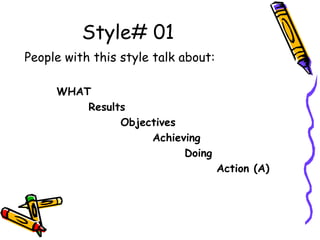
Style# 01
People with this style talk about:
WHAT
Results
Objectives
Achieving
Doing
Action (A)
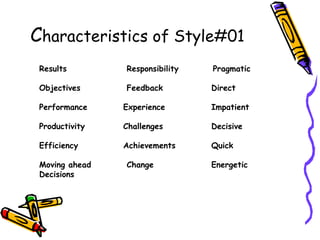
Characteristics of Style#01
Results Responsibility Pragmatic
Objectives Feedback Direct
Performance Experience Impatient
Productivity Challenges Decisive
Efficiency Achievements Quick
Moving ahead Change Energetic
Decisions
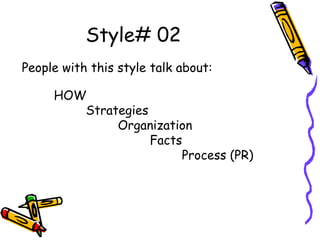
Style# 02
People with this style talk about:
HOW
Strategies
Organization
Facts
Process (PR)
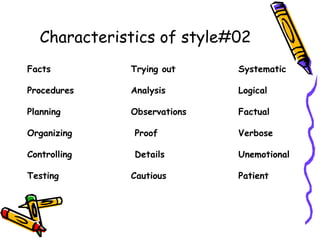
Characteristics of style#02
Facts Trying out Systematic
Procedures Analysis Logical
Planning Observations Factual
Organizing Proof Verbose
Controlling Details Unemotional
Testing Cautious Patient
Style# 03
People with this style talk about:
WHO
Communication
Relationships
Teamwork
People (PE)
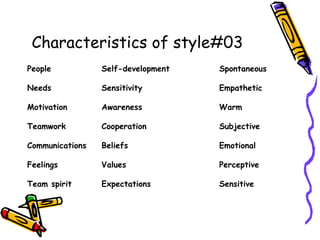
Characteristics of style#03
People Self-development Spontaneous
Needs Sensitivity Empathetic
Motivation Awareness Warm
Teamwork Cooperation Subjective
Communications Beliefs Emotional
Feelings Values Perceptive
Team spirit Expectations Sensitive
Style#04
People with this style talk about:
WHY
Concepts
Theories
Innovation
Ideas (I)
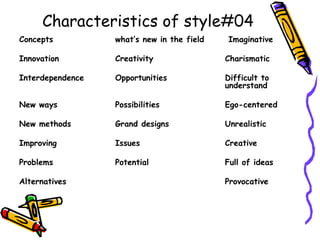
Characteristics of style#04
Concepts what’s new in the field Imaginative
Innovation Creativity Charismatic
Interdependence Opportunities Difficult to
understand
New ways Possibilities Ego-centered
New methods Grand designs Unrealistic
Improving Issues Creative
Problems Potential Full of ideas
Alternatives Provocative
Adjusting to
Other’s
Communication Styles
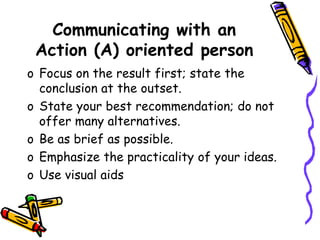
Communicating with an
Action (A) oriented person
o Focus on the result first; state the
conclusion at the outset.
o State your best recommendation; do not
offer many alternatives.
o Be as brief as possible.
o Emphasize the practicality of your ideas.
o Use visual aids
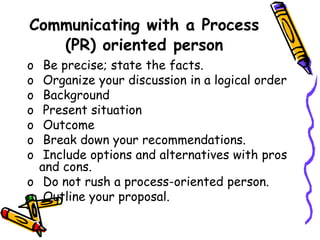
Communicating with a Process
(PR) oriented person
o Be precise; state the facts.
o Organize your discussion in a logical order
o Background
o Present situation
o Outcome
o Break down your recommendations.
o Include options and alternatives with pros
and cons.
o Do not rush a process-oriented person.
o Outline your proposal.
Communicating with a People
(PE) oriented person
o Allow for small talk; do not start the
discussion right away.
o Stress the relationship between your
proposal and the people concerned.
o Show how the idea worked well in the past.
o Indicate support from well-respected
people.
o Use an informal writing style.
Communicating with an Idea (I)
oriented person
o Allow enough time for discussion.
o Do not get impatient when he or she goes off
on tangents.
o Try to relate the discussed topic to a broader
concept or idea
o Stress the uniqueness of the idea or topic at
hand.
o Emphasize future value or relate the impact
of the idea to the future.
o If writing, try to stress the key concepts
that underlie your recommendation at the
outset.
Improving your style of
communication
o Be aware of your own communication
style.
o Study the style of those around you.
o Adjust to the other styles of
communication.
o To build rapport, during a
conversation try and match the other
person’s movements, posture and
verbal style.
o Change your style of communication
suit the different setting.
o Don’t criticize others for
communicating differently.
Figuring out what to say and the
best way to say it
o In order to make interesting
conversation, you must be keeping
yourself informed on current events,
staying involved in activities, and
keeping a mental list of good topics of
discussion are excellent ways to break
the ice.
o Instead of focusing on how
uncomfortable you feel, prepare
yourself by thinking of the issues
that interest you most a little
preparation will go a long way in
enabling you to easily converse with
others. Don't be afraid to ask
questions.
o Make an effort to be a good listener
when starting a conversation. Balance
is the key in any conversation.
Alternate between talking and
listening to what the other person is
saying and make additional comments
as appropriate.
o Even if you find it extremely
difficult, always greet those you
encounter with a smile and look them
directly in the eye.
o Try to remember small details about
co-workers and acquaintances. Show
genuine interest in those around you.
Ego Management
“Being flexible without compromising
your identity”
Test of dominant ego state
EGO
In simple terms, ego is that part of
our minds that Constantly thinks in
terms of “I” , “me”, and “Mine”. This
can result in our being taken off-
course from our desired path of
effective personal development or
self improvement and onto a road of
frustration.
Ego Management
o Controlling or managing ego without
becoming doormats.
o Manage your thoughts rather than
your thoughts managing you.
o Personal development-knowing more
about yourself
Listening Skills
We were given two ears but only one
mouth.
This is because God knew that listening
was twice as hard as talking.
What is listening?
Listening means absorption of meaning of the
words and sentences by the brain. It is the
proper matching of the mental faculties of
the sender and the receiver.
Listening is completely different from the
word Hearing. It requires concentration
which is focusing of your thoughts upon one
particular problem
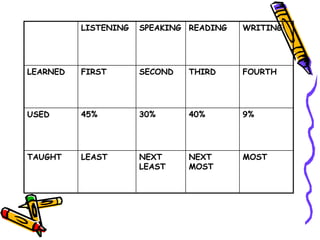
LISTENING SPEAKING READING WRITING
LEARNED FIRST SECOND THIRD FOURTH
USED 45% 30% 40% 9%
TAUGHT LEAST NEXT
LEAST
NEXT
MOST
MOST
Triple –A listening
Good listening is built on three basic
factors:
o Attitude
o Attention
o Adjustment
Fallacies of listening
skills
o Listening is not my problem!
o Listening and hearing are the same
o Good readers are good listeners
o Smarter people are better listeners
o Listening improves with age
Steps for active Listening
Hearing
Understanding
Evaluating
Hearing
o In this step of listening, the listener
just hear the speaker.
o Hearing means that listener only just
catch up the points of the speaker.
o In this step no understanding or
evaluation is required by the listener.
Understanding.
o This is the secondary step of Listening
process.
o In this step the listener take up the point
he has heard and try to understand or
create a meaning about it.
o Thus we can say that Listening leads to
the understanding of the facts and ideas.
Evaluating
o This is the final step of listening.
o After listener is sure about his
understanding, the listener now
thinks whether it makes any sense or
not.
o The process of evaluation is going on
in his mind.
o After that he provides feedback to
the sender.
Barriers in Listening
o Lack of Interest
o Ego
o Preconsumed ideas
o Mismatch of perception
o Language difference
o Disability of hearing
Tips for being a good
listener
• Give your full attention on the person
who is speaking
• If you feel your mind wandering,
change the position of your body and
try to concentrate on the speaker's
words.
• Let the speaker finish before you
begin to talk.
• You can't really listen if you are
busy thinking about what you
want say next.
• Listen for main ideas
• Ask questions
• Give feedback.
Understanding Nonverbal
Communication
Recognize that people communicate on many levels.
Watch their facial expressions, eye contact,
posture, hand and feet movements, body movement
and placement, and appearance and passage as they
walk toward you. Every gesture is communicating
something if you listen with your eyes. Become
accustomed to watching nonverbal communication
and your ability to read nonverbal communication will
grow with practice.
"The bearing with which one presents
oneself proclaims one's position in life.”
Nancy Henly, author of Body Politics
o 93% of communication is nonverbal
o 55% through facial expression,
posture, gesture
o 38% through tone of voice
Functions of non-verbal
communication
o Express emotions
o Express interpersonal attitudes
o To accompany speech in managing the cues
of interaction between speakers and
listeners
o Self-presentation of one’s personality
o Rituals (greetings)
Nonverbal messages can
interact with verbal messages
in six ways
o Repeating
o Conflicting
o Complementing
o Substituting
o Regulating
o Accenting/Moderating
Knowledge of non-verbal
communication is important
managers
o To function effectively as a team
leader.
o The team members project attitudes
and feelings through non-verbal
communication.
Types of Nonverbal
Communication
o Paralanguage- Voice, Articulation,
Modulation, Pronunciation and Pauses
o Kinesics- Body Language
o Proxemics- Space distancing
o Chronemics- Touch
o Artifacts-Saying words with clarity and
forcefulness so they are individually
audible and discernible,
Paralanguage
• Rate-speed-When a speaker uses a
faster rate they may be seen as more
competent.
• Pitch-We associate low pitch voices
with strength, attractiveness and
maturity. We associate high pitches
voices with tenseness, helplessness,
& nervousness.
• Volume-Loud people are perceived as
aggressive or overbearing. Soft
stolen voices are perceived as timid
or polite.
• Vocal Fillers-Fillers can destroy your
presentation, hurt your credibility,
and annoy your audience (um, uh, ah).
• Treat your pauses like gold.
• Quality- Made up of tempo,
resonance, rhythm, and articulation.
Infants cannot understand words so
they rely on nonverbal cues for
information. Children from ages 6-12
use words to make sense of
messages. This is why kids don't
understand sarcasm.
Kinesics -Body Movements
Kinesics are divided into 5 categories
o Emblems-body movements that have direct
translation to words: OK
o Illustrator- Accent emphasizes or reinforces
words: Fish was this big!
o Regulators- Control the back and forth flow of
speaking and listening.
o Display of feelings- Feelings are shown through
face and body motions
o Adaptor-Way of adjusting to communication
situation: Twist hair, tap pen
Occulesics -Eye behavior
Occulesics deals with eye behavior as an
element of communication. Some aspects
of occulesics deal with a static or fixed
gaze versus dynamic eye movement.
In the West, direct eye contact (looking into
the eyes of the other person) is common
about 40 percent of the time while talking
and 70 percent while listening. In Japan, it is
more common to look at the throat of the
other person. In China and Indonesia, the
practice is to lower the eyes because direct
eye contact is considered bad manners, and
in Hispanic culture direct eye contact is
form of challenge and disrespect.
Appearance/Artifacts
o Clothing
o Uniforms
o Occupational dress
o Leisure clothes
o Costumes
o Color
Proxemics
o It is the nonverbal study of space
and distance
o The amount of distance we need and
the amount of space we perceive as
belonging to us is influenced by a
number of factors including social
norms, situational factors,
personality characteristics, and level
of familiarity.
Distance Zones
1. Intimate distance-no more than 18 inches
apart mom and baby.
2. Personal Distance-18 inches to 4 feet
Casual and personal conversations.
3. Social distance-4-12 feet impersonal,
business, social gatherings.
4. Public distance-More than 12 feet Public
speaking
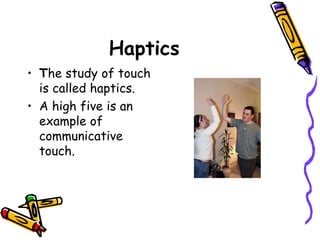
Haptics
• The study of touch
is called haptics.
• A high five is an
example of
communicative
touch.
Examples of haptics
• Touches that can be defined as
communication include handshakes,
holding hands, kissing (cheek, lips,
hand), back slapping, high fives, a pat
on the shoulder, and brushing an arm.
Touching of oneself during
communication may include licking,
picking, holding, and scratching.
Types of haptics:
1. Functional/professional
2. Social/polite
3. Friendship/warmth
4. Love/intimacy
Olfactics
o Olfactics is the study of smell in relation
to human communication
o Smells are also powerful at triggering our
memory, with certain smells being tied to
different emotions, people, or events.
o Loud smells most of the time give a
negative image to people around. So it is
always advised wear light perfumes. People
with loud perfumes are considered ill-
mannered and aggressive.
Chronomics
o Nonverbal communication study of
time.
o The reaction time tells a lot about
the person. The people have delayed
reaction are considered Type B
mostly( keeping the other variables
constant). Similarly people who give
prompt reactions are considered as
type A.
Facial Expressions
• You have 80 muscles in your face
that can create more than 7,000
facial expressions.
Six main types of facial
expressions found in all
cultures
o Happiness- round eyes, smiles, raised
cheeks
o Disgust-wrinkled nose, lowered
eyelids and eyebrow, raised upper lip
o Fear- around eyes, open mouth
o Angry- lower eyebrow and stare
intensely.
o Surprise-raised eyebrow, wide open
eyes, open mouth
o Sadness- Area around mouth and
eyes
Letter Writing
Letter writing is an art. A well-
written letter is a always a pleasure
to read. Writing a letter is about
conveying a message.
The context can be casual or formal.
The flow of thoughts has to be
continual.
Techniques of letter
writing
o Write the date in an indexed form.
o Formal letters require a subject line
that has to be brief
e.g. Sub: EMI of my loan account or
Sub: Disconnection of my internet.
o Keep the salutation very formal.
o First names generally do not feature
here. Sincerely is more preferred to
‘yours faithfully’ in formal letters.
o Make the Letter Clear and simple -
Use short words. Avoid jargon or
vague words which may confuse the
letter reader.
o Use only one side of the paper.
o Make your letter Short. Be as brief
as possible.
o Make your letter come Alive - Try to
address the letter directly to the
reader.
o Make it correct - Avoid spelling, poor
grammar, and mistakes in your letter.
If you can prepare your letter on a
computer, it will be neater.
Tips for writing effective letter
Interest of the reader
A letter should be written in such a
way that it catches the interest of
the reader
Objective
Before you start writing, ask
yourself the reason and the purpose
of writing the letter. Then drive the
content of the letter toward the
goals you want to achieve.
Lead
Your opening sentence and headline
should be such that they attract the
attention of the reader and retain
interest until the very end. Use
simple language, yet captivating
content.
Informal Dialog
Write using a conversational tone so
that the letter flows like a natural
conversation between you and the
reader. Focus on grammar, spelling
and the message that you want to
convey.
Writing Format
It is always better to use tried and
tested writing formulas that have
worked in the past. This way, you not
only reduce your chances of failing
but also greatly increase your
chances of writing a business letter
that gets results.
Emphasize
If you want to draw the attention of
the reader to certain key parts of
the letter, you can do so by using
bold letters or highlighting to
emphasize.
Advantages for the
Reader
Rather than focusing your writing on how
great your product or service is, you
should elaborate on the various ways the
product or service will be beneficial to the
reader. Place more emphasis on how the
product or service will be useful to the
reader by relating the different ways it
will save money, time, solve a problem or
yield more profit.
Avoid Jargon
Write in simple language. Using plain
vocabulary is recommended since it is
easier for the reader to comprehend
the sales content. Avoid using
industry jargon unless it would
properly fit the audience.
Testimonials
You can include testimonials and
references with your letters; this
works to create a favorable
impression about your business and
thus enhances your credibility.
Cater To All Readers
Your letter should be able to capture
the attention of readers who read
through the entire letter as well as
those who merely glance through the
letter. Bulleting and using headlines
are great ways to give the reader a
brief idea of the entire content of
the sales letter.
Types of letter
o Acknowledgement Letter
Purpose:
Letting someone know you have
received something sent to you.
Format:
Short, polite note mentioning
when the item arrived and express
thanks.
Purpose:
Response to a complaint letter
Adjustment letter
Format:
o Open with whatever you believe the reader will
consider good news.
o Explain what caused the problem.
o Explain specifically how you intend to make the
adjustment.
o Express appreciation to the customer for calling
your attention to the situation.
o Point out any steps you may be taking to prevent
a recurrence.
o Close pleasantly. Avoid recalling the problem in
your closing.
Points to remember
o Tone is critical
o Emphasize what you are doing to
correct it.
o Know company's policies.
o Avoid law admissible, condemning
terms.
Application letter
Purpose:
A sales letter, marketing your
skills, abilities and knowledge.
Format:
o Identify an employment area or state a
specific job title.
o Point out your source of information about
the job.
o Summarize your qualifications for the job,
tailored to job requirements
o Refer the reader to your resume.
o Ask for an interview, stating where you
can be reached and when you will be
available for an interview.
Points to remember
o Catch the reader's favorable
attention.
o Convince the reader you are
qualified.
o Be sincere and honest.
o Don't duplicate the resume.
o Request an interview.
Complaint Letter
Purpose:
Customers asking that certain
situations be corrected.
Format:
o The opening includes all identifying
data.
o The body explains logically and
clearly what happened..
o Conclusion should be friendly and
request action.
Points to remember
o Be sure of your facts
o Include copies of any support
information
o Avoid overtones of accusations
Inquiry Letters
Purpose:
To request assistance,
information, or merchandise
Format:
o Keep questions concise but specific and clear
o Phrase questions so that the reader will know
immediately what type of information you are
seeking, why you are seeking it, and how you will
use it.
o If possible, present your questions in a
numbered list.
o Keep questions to a minimum
o Offer inducement for the reader to respond
o Promise to keep responses confidential (where
appropriate)
o Express appreciation
Points to remember
o Include the address to which the
material is to be sent
o Improve response by enclosing a
stamped, self addressed return
envelope.
Reference Letter
Purpose:
Recommending someone for
employment .
Format:
o Identify yourself: name, title or position,
employer and address
o State how long you have known the applicant and
the circumstances of your acquaintance.
o Address specifically the applicant's skills,
abilities, knowledge and personal characteristics
in relation to the requested objective.
o Conclude with a statement of recommendation
and a brief summary of the applicant's
qualifications
Points to remember
o Be familiar with the applicant's
abilities to offer an evaluation
o Truthfully communicate that
evaluation to the inquirer
Refusal Letter
Purpose:
Refuse some kind of request
Format:
o A buffer beginning.
o A review of the facts.
o The bad news, based on the facts.
o A positive and pleasant closing.
Point to remember
Place yourself in the reader's
position.
Tips for writing a
business letter
o Use 8 ½" by 11" unlined paper
o Use 1" margins on all four sides
o Use a serif font such as Times Roman
(12 point) or Georgia (11 point).
o A business letter should be single-
spaced and should be typed
Format of business letter
o Return address of the letter writer.
o The date of the letter.
o Complete name, title, and address of the
recipient.
o Salutation with a colon
o Body of the letter.
o Closing.
o Enclosure.
Return address of the
letter writer:
For example,
16 Main Street
M.G Road, Kolkatta 12345
The date of the letter:
This is usually typed in one of two
ways:
(Begin with the day, no comma)
15 January 2008
OR
(Begin with the month; use a comma)
December 1, 2007
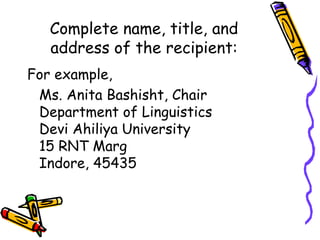
Complete name, title, and
address of the recipient:
For example,
Ms. Anita Bashisht, Chair
Department of Linguistics
Devi Ahiliya University
15 RNT Marg
Indore, 45435
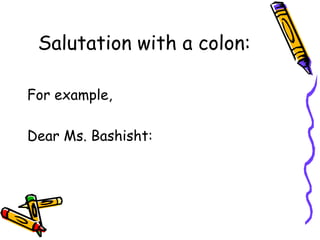
Salutation with a colon:
For example,
Dear Ms. Bashisht:
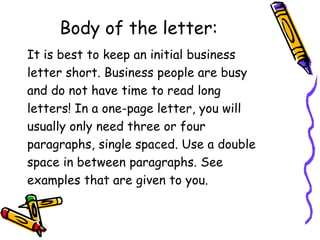
Body of the letter:
It is best to keep an initial business
letter short. Business people are busy
and do not have time to read long
letters! In a one-page letter, you will
usually only need three or four
paragraphs, single spaced. Use a double
space in between paragraphs. See
examples that are given to you.
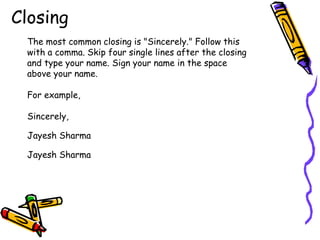
Closing
The most common closing is "Sincerely." Follow this
with a comma. Skip four single lines after the closing
and type your name. Sign your name in the space
above your name.
For example,
Sincerely,
Jayesh Sharma
Jayesh Sharma
Enclosure
If you are enclosing additional
information with your letter such as
address proof skip two single lines
after your typed name and type
"Enclosure" or "Enclosures." If you
use the plural, you have the option of
stating the number of enclosures in
parentheses.
Enclosures (2)
Emails
When, on May 24th, 1844, Samuel B. Morse sent
the first telegraph message, it stated simply
“What hath God wrought!” and was a profound
moment in the history of human communications.
Fully 160 years later, we have email, which speeds
messages, documents, and images at the speed of
light to all corners of the Earth (and even space.)
Even though it has become ubiquitous in business,
many messages are sent without thought as to the
impression they’re making on the receiving end.
Most of these problems are easy to address with
simple procedural changes.
Understanding E-mail
What do cc: and bcc: mean
There is a certain etiquette with
email, especially in the use of the
carbon copy (cc :) and blind carbon
copy (bcc :) fields.
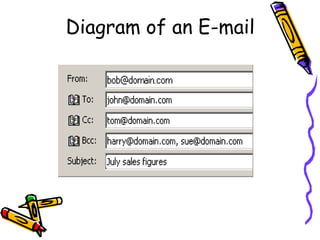
Diagram of an E-mail
Carbon Copy (CC:)
It is courteous to add addresses to
the 'cc:' field if those people need
to know about the subject but are
not required to act on the contents.
Blind Carbon Copy
The 'bcc:' field is useful where
discretion is required. People in this
field are concealed from other
recipients in the 'To', 'cc:' and 'bcc:'
fields. They can themselves see
others in the 'To' and 'cc:' fields but
not the 'bcc:' fields.
Plain text email
Plain text email means that only the
words are transmitted to the
recipient, without any formatting
information. So your subscriber can
control the format of the email in
their email reader, using the size and
font that best suits their eyesight.
HTML email
HTML email allows you to add
formatting to your text as well as
images or links using HTML code.
Many online newsletters are written
in this format as they provide a more
visual medium and are pleasing to look
at.
Signature File
Signature files can be attached to
every outgoing message you send,
usually containing contact details and
other relevant information.
• Uses for an email signature include:
• Confidentiality statements
• Drawing attention to web site
addresses
• Promoting a newsletter
Tips for writing e-mail
Email is meant for quick, simple communication.
As a general guide that means roughly 4 or 5
paragraphs at most. Due to the limitations of
formatting and layout, anything much longer than
that is probably best sent as a separate
attachment such as a Word file. Most people have
a limited attention span with email - if they are
receiving a lot of mail you want to get the main
message explained in the shortest possible space.
Important points to remember
while writing email
o Email is much less formal than a
written letter. Emails are usually
short and concise.
o If you are writing to someone you
don't know, a simple "Hello" is
adequate.
o When writing to someone you know
well, feel free to write as if you are
speaking to the person.
o Use abbreviated verb forms (He's,
We're, He'd, etc.)
o Include a telephone number to the
signature of the email. This will give
the recipient the chance to telephone
if necessary.
o It is not necessary to include your
email address as the recipient can
just reply to the email.
o When replying eliminate all the
information that is not necessary.
Only leave the sections of text that
are related to your reply. This will
save your reader time when reading
your email.
Mistakes to Avoid When Writing
Email
o Thinking e-mail is good for
everything
o Not writing e-mail from the reader's
perspective
o Forgetting about the importance of
etiquette
o CCing the world.
o Believing that an erased e-mail is
gone forever.
o Viewing instant messages as less
'formal' than e-mail.
o Assuming people have time to read
your entire message
o Mismatching the sender's tone
o Lack of a clear request
o Not re-reading before you hit 'send'
Telephone Etiquettes
Telephone Etiquette is more
important than ever in today’s
business environment. Most of our
business communications takes place
on the phone. Proper phone technique
can make or break deals or
relationships
Tips to follow while answering your
own professional calls or handling calls
for others
o Avoid using Slang’s.
o Make use of phrases such as "May I help
You", "You are welcome", and "Thank You",
etc.
o Put the receiver down gently. Never slam
the phone.
o Always speak clearly so that the other
person can understand what you are saying.
o When picking up the phone, it is good
practice to identify your Company and
yourself to the caller.
o When transferring calls, make sure that you are
well versed with the procedure for call
transfers. It is good practice to use the name
of the person you are transferring the call to.
o Always adopt a pleasant tone of voice and be
attentive.
o When placing a call on hold, inform the caller of
the same.
o Don't interrupt the caller when speaking.
o When initiating a call, spend a few moments to
mentally prepare yourself so that you know what
need to be said / discussed.
Do's and don'ts
o Don't type or shuffle papers while you're
on the phone - it suggests that you're not
listening to the caller.
o If you have to put the phone down, do it
gently to spare your caller's ear.
o Rid your mouth of food, gum, cough drops,
or candy before talking on the phone - the
receiver amplifies your noshing.
o If you have to sneeze or cough, turn your
head and cover your mouth - and the
receiver.
o Speak directly into the receiver - don't
bury it in your shoulder or neck.
o If you dial the wrong number, explain
yourself and verify the phone number so
you don't repeat the call. Don't hang up;
that's just rude.
o Cut down on the background noise when
taking or making a call. Radios, televisions,
and even computer bings and bleeps can be
distracting over the phone.
Taking Message
o Record the time and date the call came in.
o Verify the caller's name, company name,
and phone number.
o Initialize the message, so if the person
who received the message has any
questions, he or she can contact you.
o Get a short statement about the caller's
intent.
Presentation Skills
Ideas, concepts or issues talked about
or spoken to a group or audience
Skills required to give a good
presentation can be developed.
Preparation is the Key
o Preparation/ Planning is the first step on
the ladder to success
o Aspects in the development of a good
presentation
Subject Centered (Material)
Audience Centered (Audience)
Self Centered (Self)
“I want (who) to (what) (where, when and
how) because (why)”
Who is your audience?
What do you want to present (content)?
Why do you want to present (purpose)?
Where will you be presenting (place)?
How do you want to present (words to be
used or not, slides to be used)
Before preparation: Ask these
questions
o What is the audience interested in
o What does the audience want
o What does the audience already know
and needs to know
o What are their needs, expectations
from this presentation
o How will the audience benefit from
this presentation
Preparation: Audience Analysis
Frame the content keeping in
mind following points-
• Structure the content in line with the
audience’s needs
• What do you want to tell the audience?
• What is your objective?
• Prepare keeping in mind the time allotted
• Anticipate the questions and prepare
• Collect material from a variety of sources
• Arrange points logically and sequentially
• Prepare handouts as well
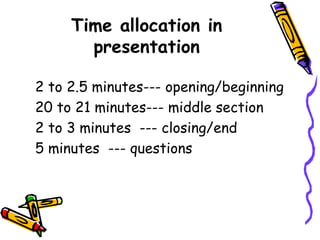
Time allocation in
presentation
2 to 2.5 minutes--- opening/beginning
20 to 21 minutes--- middle section
2 to 3 minutes --- closing/end
5 minutes --- questions
The Beginning
o Should be carefully designed
o Get attention
shock, humor, question, story, facts &
figures ,well rehearsed yet natural
o Motivate audience to listen
Structure of Preparation
o Sequence should be logical &
understandable
o Interim summaries- Recaps
o Value of visual aids-flip charts, handouts
etc.
o Use the 4 Ps
Position Possibilities
Problem Proposals
Designing the Climax
o Last 2 to 2.5 minutes are as critical
as the first five minutes for a
successful presentation
o Summarize- highlight important
points
o Suggest action- what to do and when,
where and how to do it
Key issue: Stage Fright
o Everyone has it to some degree
o Can be used constructively
o Key issue is not elimination of fear
o Instead channel the energy it
generates for an effective
presentation
For Effective Delivery
o Be active - move
o Be purposeful - controlled gestures
o Variations – vocal (pitch, volume,
rate)
o Be natural
o Be direct – don’t just talk in front of
the audience talk to them
Sensitivity to the audience
o “See” the audience
o Take non-verbal feedback
congruent and incongruent body
language
o Modify to meet audience needs
o Don’t just make it as a presentation
Handling Questions
o Do not get confused
o You are not supposed to know
everything
o Anticipate and keep answers ready
o Sometime questions themselves give
you a lead to highlight your point of
view
Appearance
Physical Appearance
o Dress neatly and tidily - first
impressions are important.
o Carry yourself in a confident and
professional manner.
Eye Contact
Keep eye contact with the audience.
This will:
o Keep them alert.
o Make them feel that they are being
directly spoken to.
o Make them feel part of the class.
o Give them confidence in you as the
instructor/presenter.
Do not:
o Stare (intimidate).
o Move your eyes from side to side
(distraction).
o Look out the window or at the clock
(indicates boredom).
o Look only at the training aids or chalk
board (this can be perceived as impolite).
o Look at your feet or at the ceiling
(indication of nervousness or timidity).
Body Movements
o Be natural - don't move around too much
or too little.
o Move forward for emphasis (e.g. when
standing at a podium).
o Relax when talking from behind a desk -
this creates some intimacy with a group.
o Slowly and on occasion move from side to
side to engage all parts of the class.
Do not:
o Stand rigid.
o March.
o Slouch (stoop)
Gestures
o Use meaningful and appropriate
gestures to make a point.
Do not or at least avoid:
o Play with keys or coins in your pocket.
o Use your hands too much, touching your
nose or ears and excessive coughing.
o Use gestures that indicate you are washing
your hand of a situation or wringing your
hands because of frustration.
o Use a praying gesture as some may find
this offensive or foot tap as this may be
perceived as patronizing.
o Use a pointer, pen, pencil or chalk to point
at an individual may be perceived as
offensive.
Voice
Volume
o Speak loudly enough to be heard.
Pitch
o Use effectively to convey meaning.
Rate
o Speak more quickly to convey enthusiasm.
o Speak more slowly to emphasize key points
or issues.
Do not:
o Speak so quickly that no one can
understand.
o Speak so quickly that materials are
glossed over rather than well explained so
that they are understood.
o Speak so slowly that people become bored
or drowsy.
o Articulation
o Speak clearly, pronouncing words carefully
-don't mumble. Control your lips, teeth and
tongue to assist you.
Language
o Avoid "pet" expressions
(E.g."O.K.","Like", "You know").
o Do not use profanity (bad language,
oath, pledge)
Humor
o Use humor but only appropriately
Methods to plan impromptu
(unplanned) talks
METHOD I - PREP
o P = Point
o R = Reason
o E = Example
o P = Point
Point
o Personal viewpoint.
o Something strong.
o Attention getter
Reason
o Explain why you feel this way.
Example
o Real life examples which clearly illustrate your
viewpoint.
o Support material. 1
Point
o Go back and re-state the point.
METHOD II - PAST /
PRESENT / FUTURE
o Past - What happened in past?
o Present - What is present situation?
o Future - Where are we going in the
future?
METHOD III - RELATED
INCIDENT METHOD
o Use the subject as a reminder of a
previous incident.
o Relate the incident or an experience using
lots of detail. (E.g. asked to speak on
safety, tell story of your first accident or
first investigation of fatality and the
effects it had on you.)
METHOD IV - 5 "W's" AND ONE "H"
What
• What happened?
• What was the cause?
Who
• Whom did it happen to?
• Who is involved?
Where
• Where did it happen?
When
• When did it happen?
Why
• Why did it happen?
• Why are you involved?
How
• How did it happen?
• Are you involved?
So to conclude :
o Always prepare
o Channelize you fear
o Interact with your
audience

COMMUNICATION SKILLS.ppt

  • 1.
  • 2.
    About training: o Thepurpose of the training is to develop and explore better ways of expressing ourselves. o The training is meant to leave our hesitation and fear of speaking in public. o We all are here to learn something from others and teach something to others o Due to the above reasons the training is going to be a very interactive session with your active participation. o Extempore, group discussions and games are going to be a part of every session. o You are very much free to share your views and knowledge with the rest of the class.
  • 3.
    Introduce your friend Makegroup of two and take five minutes to know your partner. After 5 minutes everyone will introduce his/her partner.
  • 4.
  • 6.
    Examples of wrongcommunication Cover letter: "I would be prepared to meet with you at your earliest convenience to discuss what I can do to your company." Resume: "It is my professional objective to obtain a position which allows me to make use of my commuter skills."
  • 7.
    Weaknesses: "Suffer fromprickly heat in summer." Cover letter: "Enclosed is my resume for your viewing pleasure." Cover letter: "You are privileged to receive my resume." Experience: "10 years of experience in financail budgiting and transactions rigistering."
  • 8.
    Cover letter: "Pleaseoverlook my resume." Cover letter: "I'm submitting the attached copy of my resume for your consumption." Skills: "Grate communication skills." Yes, but can you talk and chop at the same time? Experience: "Responsibilities included recruiting, screening, interviewing and executing final candidates." • Cover letter: "Salary demanded - $65,000."
  • 9.
    We are livingin the age where the economy is based on the exchange of information. This is the information age where we operate our business through communication of various kind of information.
  • 10.
    WHAT IS COMMUNICATION??? Express yourviews about the training/ communication!
  • 11.
    The word communicationis derived from Latin word “Communis or “Communicare” which means to make common. Communication in simple terms can be understood as the exchange of information.
  • 12.
    The word “communication”has been defined differently by different persons of repute in management. These are
  • 13.
    Koontz and Donell’s:- “Communication is the transfer of information from one person to other whether or not it elicits confidence.”
  • 14.
    Louis A. Allen “Communicationis the sum of all things which a person does when he wants to create an understanding in the mind of another. It involves a systematic and continuous process of telling, listening and understanding.”
  • 15.
    George Terry “Communication isan exchange of facts, ideas, opinion or emotions by two or more persons.”
  • 16.
    Why communication is beingdiscussed o Coordination o Planning o Controlling o Organizing o Knowledge management o Emotional Expression o Motivation
  • 17.
    Sources of Communication • Therehave been various mediums through which we communicate with each other. • From pigeons to emails.
  • 18.
    Can you namesome sources? • Face to face • Telephonic • SMS • E-mails • Social networking sites • Postal( letter, document, telegram, greeting cards) • Newspaper
  • 19.
    Choice of communicationchannel The channels of communication are considered rich or poor based on- o handle multiple cues simultaneously, o facilitate rapid feedback, o be very personal.
  • 20.
    Game of diagram: •All of you have to form teams of two each and one out two will be assigned a diagram. He has to tell his team member the diagram through symbols without saying any word.
  • 21.
    Text Text Text Text Text Text Text Text Text Text Channel richness Richest Type ofMessage Nonroutine Ambiguous Information Medium Face to Face Talk Telephone Electronic Mail Memos Letters Flyers bulletins general report
  • 22.
    Types of Communication (basedon Communication Channels) It could be broadly divided in two categories o Verbal Communication o Non-verbal Communication
  • 23.
    Verbal Communication Verbal communicationis further divided into oral and written communication. The oral communication refers to the spoken words in the communication process. Oral communication can either be face-to-face communication or a conversation over the phone or on the voice chat over the Internet.
  • 24.
    The other typeof verbal communication is Written communication. Written communication can be either via mail, or email. The effectiveness of written communication depends on the style of writing, vocabulary used, grammar, clarity and precision of language.
  • 25.
    Non verbal Communication Non-Verbal Communication is the message or response not expressed or sent in words –but in form of hints , suggestions , indications. Activity or inactivity, words or silence, all have message value: they influence others and these others, in turn, respond to these communications.”
  • 26.
    Non-verbal communication includes facialexpressions, eye contact, tone of voice, body posture and motions, and positioning within groups. It may also include the way we wear our clothes or the silence we keep.
  • 27.
    If a person’swords say one thing and their nonverbal communication says another, you will pay attention to the nonverbal communication – and that is usually the correct decision.
  • 28.
    Types of Communication (basedon style and purpose) Based on the style of communication, there can be two broad categories of communication:- o Formal Communication o Informal Communication
  • 29.
    Formal Communication Formal communicationincludes all the instances where communication has to occur in a set formal format. Typically this can include all sorts of business communication or corporate communication
  • 30.
    Examples • Official conferences. •Meetings. • Written memos. • Corporate letters.
  • 31.
    Informal Communication Informal communicationincludes instances of free unrestrained communication between people who share a casual rapport with each other. Informal communication requires two people to have a similar wavelength and hence occurs between friends and family.
  • 32.
    Types of Communication (Basedon number of people ) o Intrapersonal communication o Interpersonal communication o Group communication o Mass Communication
  • 33.
    Intrapersonal Communication Communicating within yourself.When you think, daydream, solve problems, and image, you are in the realm of intrapersonal communication. Transcendental meditation, for instance, is an example of such communication.
  • 34.
    Interpersonal Communication This form ofcommunication describes the interactions of two or more people. Example Face-to face communication between two persons is an example of such communication.
  • 35.
    Group communication Group communicationshares all these qualities, though in a much less measure. Group communication requires the following conditions: leadership, equal sharing of ideas, peer pressure, roles and norms, and focuses on a common goal.
  • 36.
    Mass Communication Mass communicationpowerfully affects our attitudes and beliefs, as well as our perspective on social life. Some Examples of if may be media -print newspapers or magazines, electrical radio, TV or video, or even electronic.
  • 37.
    Elements of Communication o Sender oReceiver o Channel/medium of communication
  • 38.
    Process of Communication The communicationprocess is made up of four key components o Encoding o Transmitting process o Decoding o Feedback
  • 39.
    Encoding process In orderto convey meaning, the sender must begin encoding, which means translating information into a message in the form of symbols that represent ideas or concepts.
  • 40.
    Transmitting process To begintransmitting the message, the sender uses some kind of channel (also called a medium). The channel is the means used to convey the message.
  • 41.
    Decoding process Once themessage is received and examined, the stimulus is sent to the brain for interpreting, in order to assign some type of meaning to it. It is this processing stage that constitutes decoding.
  • 42.
    Feedback After receiving amessage, the receiver responds in some way and signals that response to the sender. Feedback is a key component in the communication process because it allows the sender to evaluate the effectiveness of the message.
  • 44.
    Barriers to communication o Theexternal/internal forces may affect the effectiveness of communication by acting upon any or all of the basic elements of communication act/process and the sender and receiver channel.
  • 45.
    General barriers o Noise oWrong/unclarified assumptions o Cultural barriers o Socio-psychological barriers o Emotions o Selective perception
  • 46.
    General Barriers o Filtering oInformation overload o Loss by transmission o Poor retention o Poor listening o Goal conflicts
  • 47.
    General Barriers o Offensivestyle o Time and distance o Abstraction o Slanting o Inferring
  • 48.
    Barriers from sender’sside o Lack of planning o Vagueness about the purpose of communication o Objectives to be achieved o Choice of wrong language resulting in badly encoded message o Unshared and unclarified assumptions o Different perceptions of reality o Wrong choice of the channel
  • 49.
    Barriers from receiver's side oPoor listening o Inattention o Mistrust o Lack of interest o Premature evaluation o Semantic difficulties o Bias o Different perception of reality o Lack of trust o Attitudinal clash with the sender o Not in a fit physical state
  • 50.
  • 51.
    Characteristics of successful communication oCandidness o Clarity o Completeness o Conciseness o Concreteness o Correctness o Courtesy
  • 52.
    Communication Styles Good communicationskills require a high level of self-awareness. Understanding your personal style of communicating will go a long way toward helping you to create good and lasting impressions on others.
  • 53.
  • 54.
    There are basicallyfour styles of communication
  • 55.
    Style# 01 People withthis style talk about: WHAT Results Objectives Achieving Doing Action (A)
  • 56.
    Characteristics of Style#01 ResultsResponsibility Pragmatic Objectives Feedback Direct Performance Experience Impatient Productivity Challenges Decisive Efficiency Achievements Quick Moving ahead Change Energetic Decisions
  • 57.
    Style# 02 People withthis style talk about: HOW Strategies Organization Facts Process (PR)
  • 58.
    Characteristics of style#02 FactsTrying out Systematic Procedures Analysis Logical Planning Observations Factual Organizing Proof Verbose Controlling Details Unemotional Testing Cautious Patient
  • 59.
    Style# 03 People withthis style talk about: WHO Communication Relationships Teamwork People (PE)
  • 60.
    Characteristics of style#03 PeopleSelf-development Spontaneous Needs Sensitivity Empathetic Motivation Awareness Warm Teamwork Cooperation Subjective Communications Beliefs Emotional Feelings Values Perceptive Team spirit Expectations Sensitive
  • 61.
    Style#04 People with thisstyle talk about: WHY Concepts Theories Innovation Ideas (I)
  • 62.
    Characteristics of style#04 Conceptswhat’s new in the field Imaginative Innovation Creativity Charismatic Interdependence Opportunities Difficult to understand New ways Possibilities Ego-centered New methods Grand designs Unrealistic Improving Issues Creative Problems Potential Full of ideas Alternatives Provocative
  • 63.
  • 64.
    Communicating with an Action(A) oriented person o Focus on the result first; state the conclusion at the outset. o State your best recommendation; do not offer many alternatives. o Be as brief as possible. o Emphasize the practicality of your ideas. o Use visual aids
  • 65.
    Communicating with aProcess (PR) oriented person o Be precise; state the facts. o Organize your discussion in a logical order o Background o Present situation o Outcome o Break down your recommendations. o Include options and alternatives with pros and cons. o Do not rush a process-oriented person. o Outline your proposal.
  • 66.
    Communicating with aPeople (PE) oriented person o Allow for small talk; do not start the discussion right away. o Stress the relationship between your proposal and the people concerned. o Show how the idea worked well in the past. o Indicate support from well-respected people. o Use an informal writing style.
  • 67.
    Communicating with anIdea (I) oriented person o Allow enough time for discussion. o Do not get impatient when he or she goes off on tangents. o Try to relate the discussed topic to a broader concept or idea o Stress the uniqueness of the idea or topic at hand. o Emphasize future value or relate the impact of the idea to the future. o If writing, try to stress the key concepts that underlie your recommendation at the outset.
  • 68.
    Improving your styleof communication
  • 69.
    o Be awareof your own communication style. o Study the style of those around you. o Adjust to the other styles of communication.
  • 70.
    o To buildrapport, during a conversation try and match the other person’s movements, posture and verbal style. o Change your style of communication suit the different setting. o Don’t criticize others for communicating differently.
  • 71.
    Figuring out whatto say and the best way to say it
  • 72.
    o In orderto make interesting conversation, you must be keeping yourself informed on current events, staying involved in activities, and keeping a mental list of good topics of discussion are excellent ways to break the ice.
  • 73.
    o Instead offocusing on how uncomfortable you feel, prepare yourself by thinking of the issues that interest you most a little preparation will go a long way in enabling you to easily converse with others. Don't be afraid to ask questions.
  • 74.
    o Make aneffort to be a good listener when starting a conversation. Balance is the key in any conversation. Alternate between talking and listening to what the other person is saying and make additional comments as appropriate.
  • 75.
    o Even ifyou find it extremely difficult, always greet those you encounter with a smile and look them directly in the eye.
  • 76.
    o Try toremember small details about co-workers and acquaintances. Show genuine interest in those around you.
  • 77.
    Ego Management “Being flexiblewithout compromising your identity”
  • 78.
  • 79.
    EGO In simple terms,ego is that part of our minds that Constantly thinks in terms of “I” , “me”, and “Mine”. This can result in our being taken off- course from our desired path of effective personal development or self improvement and onto a road of frustration.
  • 80.
    Ego Management o Controllingor managing ego without becoming doormats. o Manage your thoughts rather than your thoughts managing you. o Personal development-knowing more about yourself
  • 81.
    Listening Skills We weregiven two ears but only one mouth. This is because God knew that listening was twice as hard as talking.
  • 82.
    What is listening? Listeningmeans absorption of meaning of the words and sentences by the brain. It is the proper matching of the mental faculties of the sender and the receiver. Listening is completely different from the word Hearing. It requires concentration which is focusing of your thoughts upon one particular problem
  • 83.
    LISTENING SPEAKING READINGWRITING LEARNED FIRST SECOND THIRD FOURTH USED 45% 30% 40% 9% TAUGHT LEAST NEXT LEAST NEXT MOST MOST
  • 84.
    Triple –A listening Goodlistening is built on three basic factors: o Attitude o Attention o Adjustment
  • 85.
    Fallacies of listening skills oListening is not my problem! o Listening and hearing are the same o Good readers are good listeners o Smarter people are better listeners o Listening improves with age
  • 86.
    Steps for activeListening Hearing Understanding Evaluating
  • 87.
    Hearing o In thisstep of listening, the listener just hear the speaker. o Hearing means that listener only just catch up the points of the speaker. o In this step no understanding or evaluation is required by the listener.
  • 88.
    Understanding. o This isthe secondary step of Listening process. o In this step the listener take up the point he has heard and try to understand or create a meaning about it. o Thus we can say that Listening leads to the understanding of the facts and ideas.
  • 89.
    Evaluating o This isthe final step of listening. o After listener is sure about his understanding, the listener now thinks whether it makes any sense or not. o The process of evaluation is going on in his mind. o After that he provides feedback to the sender.
  • 90.
    Barriers in Listening oLack of Interest o Ego o Preconsumed ideas o Mismatch of perception o Language difference o Disability of hearing
  • 91.
    Tips for beinga good listener • Give your full attention on the person who is speaking • If you feel your mind wandering, change the position of your body and try to concentrate on the speaker's words. • Let the speaker finish before you begin to talk.
  • 92.
    • You can'treally listen if you are busy thinking about what you want say next. • Listen for main ideas • Ask questions • Give feedback.
  • 93.
    Understanding Nonverbal Communication Recognize thatpeople communicate on many levels. Watch their facial expressions, eye contact, posture, hand and feet movements, body movement and placement, and appearance and passage as they walk toward you. Every gesture is communicating something if you listen with your eyes. Become accustomed to watching nonverbal communication and your ability to read nonverbal communication will grow with practice.
  • 94.
    "The bearing withwhich one presents oneself proclaims one's position in life.” Nancy Henly, author of Body Politics o 93% of communication is nonverbal o 55% through facial expression, posture, gesture o 38% through tone of voice
  • 95.
    Functions of non-verbal communication oExpress emotions o Express interpersonal attitudes o To accompany speech in managing the cues of interaction between speakers and listeners o Self-presentation of one’s personality o Rituals (greetings)
  • 96.
    Nonverbal messages can interactwith verbal messages in six ways o Repeating o Conflicting o Complementing o Substituting o Regulating o Accenting/Moderating
  • 97.
    Knowledge of non-verbal communicationis important managers o To function effectively as a team leader. o The team members project attitudes and feelings through non-verbal communication.
  • 98.
    Types of Nonverbal Communication oParalanguage- Voice, Articulation, Modulation, Pronunciation and Pauses o Kinesics- Body Language o Proxemics- Space distancing o Chronemics- Touch o Artifacts-Saying words with clarity and forcefulness so they are individually audible and discernible,
  • 99.
    Paralanguage • Rate-speed-When aspeaker uses a faster rate they may be seen as more competent. • Pitch-We associate low pitch voices with strength, attractiveness and maturity. We associate high pitches voices with tenseness, helplessness, & nervousness.
  • 100.
    • Volume-Loud peopleare perceived as aggressive or overbearing. Soft stolen voices are perceived as timid or polite. • Vocal Fillers-Fillers can destroy your presentation, hurt your credibility, and annoy your audience (um, uh, ah). • Treat your pauses like gold.
  • 101.
    • Quality- Madeup of tempo, resonance, rhythm, and articulation. Infants cannot understand words so they rely on nonverbal cues for information. Children from ages 6-12 use words to make sense of messages. This is why kids don't understand sarcasm.
  • 102.
    Kinesics -Body Movements Kinesicsare divided into 5 categories o Emblems-body movements that have direct translation to words: OK o Illustrator- Accent emphasizes or reinforces words: Fish was this big! o Regulators- Control the back and forth flow of speaking and listening. o Display of feelings- Feelings are shown through face and body motions o Adaptor-Way of adjusting to communication situation: Twist hair, tap pen
  • 103.
    Occulesics -Eye behavior Occulesicsdeals with eye behavior as an element of communication. Some aspects of occulesics deal with a static or fixed gaze versus dynamic eye movement.
  • 104.
    In the West,direct eye contact (looking into the eyes of the other person) is common about 40 percent of the time while talking and 70 percent while listening. In Japan, it is more common to look at the throat of the other person. In China and Indonesia, the practice is to lower the eyes because direct eye contact is considered bad manners, and in Hispanic culture direct eye contact is form of challenge and disrespect.
  • 105.
    Appearance/Artifacts o Clothing o Uniforms oOccupational dress o Leisure clothes o Costumes o Color
  • 106.
    Proxemics o It isthe nonverbal study of space and distance o The amount of distance we need and the amount of space we perceive as belonging to us is influenced by a number of factors including social norms, situational factors, personality characteristics, and level of familiarity.
  • 107.
    Distance Zones 1. Intimatedistance-no more than 18 inches apart mom and baby. 2. Personal Distance-18 inches to 4 feet Casual and personal conversations. 3. Social distance-4-12 feet impersonal, business, social gatherings. 4. Public distance-More than 12 feet Public speaking
  • 108.
    Haptics • The studyof touch is called haptics. • A high five is an example of communicative touch.
  • 109.
    Examples of haptics •Touches that can be defined as communication include handshakes, holding hands, kissing (cheek, lips, hand), back slapping, high fives, a pat on the shoulder, and brushing an arm. Touching of oneself during communication may include licking, picking, holding, and scratching.
  • 110.
    Types of haptics: 1.Functional/professional 2. Social/polite 3. Friendship/warmth 4. Love/intimacy
  • 111.
    Olfactics o Olfactics isthe study of smell in relation to human communication o Smells are also powerful at triggering our memory, with certain smells being tied to different emotions, people, or events. o Loud smells most of the time give a negative image to people around. So it is always advised wear light perfumes. People with loud perfumes are considered ill- mannered and aggressive.
  • 112.
    Chronomics o Nonverbal communicationstudy of time. o The reaction time tells a lot about the person. The people have delayed reaction are considered Type B mostly( keeping the other variables constant). Similarly people who give prompt reactions are considered as type A.
  • 113.
    Facial Expressions • Youhave 80 muscles in your face that can create more than 7,000 facial expressions.
  • 114.
    Six main typesof facial expressions found in all cultures o Happiness- round eyes, smiles, raised cheeks o Disgust-wrinkled nose, lowered eyelids and eyebrow, raised upper lip
  • 115.
    o Fear- aroundeyes, open mouth o Angry- lower eyebrow and stare intensely. o Surprise-raised eyebrow, wide open eyes, open mouth o Sadness- Area around mouth and eyes
  • 116.
  • 117.
    Letter writing isan art. A well- written letter is a always a pleasure to read. Writing a letter is about conveying a message. The context can be casual or formal. The flow of thoughts has to be continual.
  • 118.
    Techniques of letter writing oWrite the date in an indexed form. o Formal letters require a subject line that has to be brief e.g. Sub: EMI of my loan account or Sub: Disconnection of my internet. o Keep the salutation very formal. o First names generally do not feature here. Sincerely is more preferred to ‘yours faithfully’ in formal letters.
  • 119.
    o Make theLetter Clear and simple - Use short words. Avoid jargon or vague words which may confuse the letter reader. o Use only one side of the paper. o Make your letter Short. Be as brief as possible. o Make your letter come Alive - Try to address the letter directly to the reader. o Make it correct - Avoid spelling, poor grammar, and mistakes in your letter. If you can prepare your letter on a computer, it will be neater.
  • 120.
    Tips for writingeffective letter
  • 121.
    Interest of thereader A letter should be written in such a way that it catches the interest of the reader
  • 122.
    Objective Before you startwriting, ask yourself the reason and the purpose of writing the letter. Then drive the content of the letter toward the goals you want to achieve.
  • 123.
    Lead Your opening sentenceand headline should be such that they attract the attention of the reader and retain interest until the very end. Use simple language, yet captivating content.
  • 124.
    Informal Dialog Write usinga conversational tone so that the letter flows like a natural conversation between you and the reader. Focus on grammar, spelling and the message that you want to convey.
  • 125.
    Writing Format It isalways better to use tried and tested writing formulas that have worked in the past. This way, you not only reduce your chances of failing but also greatly increase your chances of writing a business letter that gets results.
  • 126.
    Emphasize If you wantto draw the attention of the reader to certain key parts of the letter, you can do so by using bold letters or highlighting to emphasize.
  • 127.
    Advantages for the Reader Ratherthan focusing your writing on how great your product or service is, you should elaborate on the various ways the product or service will be beneficial to the reader. Place more emphasis on how the product or service will be useful to the reader by relating the different ways it will save money, time, solve a problem or yield more profit.
  • 128.
    Avoid Jargon Write insimple language. Using plain vocabulary is recommended since it is easier for the reader to comprehend the sales content. Avoid using industry jargon unless it would properly fit the audience.
  • 129.
    Testimonials You can includetestimonials and references with your letters; this works to create a favorable impression about your business and thus enhances your credibility.
  • 130.
    Cater To AllReaders Your letter should be able to capture the attention of readers who read through the entire letter as well as those who merely glance through the letter. Bulleting and using headlines are great ways to give the reader a brief idea of the entire content of the sales letter.
  • 131.
    Types of letter oAcknowledgement Letter Purpose: Letting someone know you have received something sent to you. Format: Short, polite note mentioning when the item arrived and express thanks.
  • 132.
    Purpose: Response to acomplaint letter Adjustment letter
  • 133.
    Format: o Open withwhatever you believe the reader will consider good news. o Explain what caused the problem. o Explain specifically how you intend to make the adjustment. o Express appreciation to the customer for calling your attention to the situation. o Point out any steps you may be taking to prevent a recurrence. o Close pleasantly. Avoid recalling the problem in your closing.
  • 134.
    Points to remember oTone is critical o Emphasize what you are doing to correct it. o Know company's policies. o Avoid law admissible, condemning terms.
  • 135.
    Application letter Purpose: A salesletter, marketing your skills, abilities and knowledge.
  • 136.
    Format: o Identify anemployment area or state a specific job title. o Point out your source of information about the job. o Summarize your qualifications for the job, tailored to job requirements o Refer the reader to your resume. o Ask for an interview, stating where you can be reached and when you will be available for an interview.
  • 137.
    Points to remember oCatch the reader's favorable attention. o Convince the reader you are qualified. o Be sincere and honest. o Don't duplicate the resume. o Request an interview.
  • 138.
    Complaint Letter Purpose: Customers askingthat certain situations be corrected.
  • 139.
    Format: o The openingincludes all identifying data. o The body explains logically and clearly what happened.. o Conclusion should be friendly and request action.
  • 140.
    Points to remember oBe sure of your facts o Include copies of any support information o Avoid overtones of accusations
  • 141.
    Inquiry Letters Purpose: To requestassistance, information, or merchandise
  • 142.
    Format: o Keep questionsconcise but specific and clear o Phrase questions so that the reader will know immediately what type of information you are seeking, why you are seeking it, and how you will use it. o If possible, present your questions in a numbered list. o Keep questions to a minimum o Offer inducement for the reader to respond o Promise to keep responses confidential (where appropriate) o Express appreciation
  • 143.
    Points to remember oInclude the address to which the material is to be sent o Improve response by enclosing a stamped, self addressed return envelope.
  • 144.
  • 145.
    Format: o Identify yourself:name, title or position, employer and address o State how long you have known the applicant and the circumstances of your acquaintance. o Address specifically the applicant's skills, abilities, knowledge and personal characteristics in relation to the requested objective. o Conclude with a statement of recommendation and a brief summary of the applicant's qualifications
  • 146.
    Points to remember oBe familiar with the applicant's abilities to offer an evaluation o Truthfully communicate that evaluation to the inquirer
  • 147.
  • 148.
    Format: o A bufferbeginning. o A review of the facts. o The bad news, based on the facts. o A positive and pleasant closing.
  • 149.
    Point to remember Placeyourself in the reader's position.
  • 150.
    Tips for writinga business letter o Use 8 ½" by 11" unlined paper o Use 1" margins on all four sides o Use a serif font such as Times Roman (12 point) or Georgia (11 point). o A business letter should be single- spaced and should be typed
  • 151.
    Format of businessletter o Return address of the letter writer. o The date of the letter. o Complete name, title, and address of the recipient. o Salutation with a colon o Body of the letter. o Closing. o Enclosure.
  • 152.
    Return address ofthe letter writer: For example, 16 Main Street M.G Road, Kolkatta 12345
  • 153.
    The date ofthe letter: This is usually typed in one of two ways: (Begin with the day, no comma) 15 January 2008 OR (Begin with the month; use a comma) December 1, 2007
  • 154.
    Complete name, title,and address of the recipient: For example, Ms. Anita Bashisht, Chair Department of Linguistics Devi Ahiliya University 15 RNT Marg Indore, 45435
  • 155.
    Salutation with acolon: For example, Dear Ms. Bashisht:
  • 156.
    Body of theletter: It is best to keep an initial business letter short. Business people are busy and do not have time to read long letters! In a one-page letter, you will usually only need three or four paragraphs, single spaced. Use a double space in between paragraphs. See examples that are given to you.
  • 157.
    Closing The most commonclosing is "Sincerely." Follow this with a comma. Skip four single lines after the closing and type your name. Sign your name in the space above your name. For example, Sincerely, Jayesh Sharma Jayesh Sharma
  • 158.
    Enclosure If you areenclosing additional information with your letter such as address proof skip two single lines after your typed name and type "Enclosure" or "Enclosures." If you use the plural, you have the option of stating the number of enclosures in parentheses. Enclosures (2)
  • 159.
    Emails When, on May24th, 1844, Samuel B. Morse sent the first telegraph message, it stated simply “What hath God wrought!” and was a profound moment in the history of human communications. Fully 160 years later, we have email, which speeds messages, documents, and images at the speed of light to all corners of the Earth (and even space.) Even though it has become ubiquitous in business, many messages are sent without thought as to the impression they’re making on the receiving end. Most of these problems are easy to address with simple procedural changes.
  • 160.
    Understanding E-mail What docc: and bcc: mean There is a certain etiquette with email, especially in the use of the carbon copy (cc :) and blind carbon copy (bcc :) fields.
  • 161.
  • 162.
    Carbon Copy (CC:) Itis courteous to add addresses to the 'cc:' field if those people need to know about the subject but are not required to act on the contents.
  • 163.
    Blind Carbon Copy The'bcc:' field is useful where discretion is required. People in this field are concealed from other recipients in the 'To', 'cc:' and 'bcc:' fields. They can themselves see others in the 'To' and 'cc:' fields but not the 'bcc:' fields.
  • 164.
    Plain text email Plaintext email means that only the words are transmitted to the recipient, without any formatting information. So your subscriber can control the format of the email in their email reader, using the size and font that best suits their eyesight.
  • 165.
    HTML email HTML emailallows you to add formatting to your text as well as images or links using HTML code. Many online newsletters are written in this format as they provide a more visual medium and are pleasing to look at.
  • 166.
    Signature File Signature filescan be attached to every outgoing message you send, usually containing contact details and other relevant information.
  • 167.
    • Uses foran email signature include: • Confidentiality statements • Drawing attention to web site addresses • Promoting a newsletter
  • 168.
    Tips for writinge-mail Email is meant for quick, simple communication. As a general guide that means roughly 4 or 5 paragraphs at most. Due to the limitations of formatting and layout, anything much longer than that is probably best sent as a separate attachment such as a Word file. Most people have a limited attention span with email - if they are receiving a lot of mail you want to get the main message explained in the shortest possible space.
  • 169.
    Important points toremember while writing email o Email is much less formal than a written letter. Emails are usually short and concise. o If you are writing to someone you don't know, a simple "Hello" is adequate.
  • 170.
    o When writingto someone you know well, feel free to write as if you are speaking to the person. o Use abbreviated verb forms (He's, We're, He'd, etc.)
  • 171.
    o Include atelephone number to the signature of the email. This will give the recipient the chance to telephone if necessary. o It is not necessary to include your email address as the recipient can just reply to the email.
  • 172.
    o When replyingeliminate all the information that is not necessary. Only leave the sections of text that are related to your reply. This will save your reader time when reading your email.
  • 173.
    Mistakes to AvoidWhen Writing Email o Thinking e-mail is good for everything o Not writing e-mail from the reader's perspective o Forgetting about the importance of etiquette
  • 174.
    o CCing theworld. o Believing that an erased e-mail is gone forever. o Viewing instant messages as less 'formal' than e-mail. o Assuming people have time to read your entire message
  • 175.
    o Mismatching thesender's tone o Lack of a clear request o Not re-reading before you hit 'send'
  • 176.
    Telephone Etiquettes Telephone Etiquetteis more important than ever in today’s business environment. Most of our business communications takes place on the phone. Proper phone technique can make or break deals or relationships
  • 177.
    Tips to followwhile answering your own professional calls or handling calls for others o Avoid using Slang’s. o Make use of phrases such as "May I help You", "You are welcome", and "Thank You", etc. o Put the receiver down gently. Never slam the phone. o Always speak clearly so that the other person can understand what you are saying. o When picking up the phone, it is good practice to identify your Company and yourself to the caller.
  • 178.
    o When transferringcalls, make sure that you are well versed with the procedure for call transfers. It is good practice to use the name of the person you are transferring the call to. o Always adopt a pleasant tone of voice and be attentive. o When placing a call on hold, inform the caller of the same. o Don't interrupt the caller when speaking. o When initiating a call, spend a few moments to mentally prepare yourself so that you know what need to be said / discussed.
  • 179.
    Do's and don'ts oDon't type or shuffle papers while you're on the phone - it suggests that you're not listening to the caller. o If you have to put the phone down, do it gently to spare your caller's ear. o Rid your mouth of food, gum, cough drops, or candy before talking on the phone - the receiver amplifies your noshing.
  • 180.
    o If youhave to sneeze or cough, turn your head and cover your mouth - and the receiver. o Speak directly into the receiver - don't bury it in your shoulder or neck. o If you dial the wrong number, explain yourself and verify the phone number so you don't repeat the call. Don't hang up; that's just rude. o Cut down on the background noise when taking or making a call. Radios, televisions, and even computer bings and bleeps can be distracting over the phone.
  • 181.
    Taking Message o Recordthe time and date the call came in. o Verify the caller's name, company name, and phone number. o Initialize the message, so if the person who received the message has any questions, he or she can contact you. o Get a short statement about the caller's intent.
  • 182.
    Presentation Skills Ideas, conceptsor issues talked about or spoken to a group or audience Skills required to give a good presentation can be developed. Preparation is the Key
  • 183.
    o Preparation/ Planningis the first step on the ladder to success o Aspects in the development of a good presentation Subject Centered (Material) Audience Centered (Audience) Self Centered (Self) “I want (who) to (what) (where, when and how) because (why)”
  • 184.
    Who is youraudience? What do you want to present (content)? Why do you want to present (purpose)? Where will you be presenting (place)? How do you want to present (words to be used or not, slides to be used) Before preparation: Ask these questions
  • 185.
    o What isthe audience interested in o What does the audience want o What does the audience already know and needs to know o What are their needs, expectations from this presentation o How will the audience benefit from this presentation Preparation: Audience Analysis
  • 186.
    Frame the contentkeeping in mind following points- • Structure the content in line with the audience’s needs • What do you want to tell the audience? • What is your objective? • Prepare keeping in mind the time allotted • Anticipate the questions and prepare • Collect material from a variety of sources • Arrange points logically and sequentially • Prepare handouts as well
  • 187.
    Time allocation in presentation 2to 2.5 minutes--- opening/beginning 20 to 21 minutes--- middle section 2 to 3 minutes --- closing/end 5 minutes --- questions
  • 188.
    The Beginning o Shouldbe carefully designed o Get attention shock, humor, question, story, facts & figures ,well rehearsed yet natural o Motivate audience to listen
  • 189.
    Structure of Preparation oSequence should be logical & understandable o Interim summaries- Recaps o Value of visual aids-flip charts, handouts etc. o Use the 4 Ps Position Possibilities Problem Proposals
  • 190.
    Designing the Climax oLast 2 to 2.5 minutes are as critical as the first five minutes for a successful presentation o Summarize- highlight important points o Suggest action- what to do and when, where and how to do it
  • 191.
    Key issue: StageFright o Everyone has it to some degree o Can be used constructively o Key issue is not elimination of fear o Instead channel the energy it generates for an effective presentation
  • 192.
    For Effective Delivery oBe active - move o Be purposeful - controlled gestures o Variations – vocal (pitch, volume, rate) o Be natural o Be direct – don’t just talk in front of the audience talk to them
  • 193.
    Sensitivity to theaudience o “See” the audience o Take non-verbal feedback congruent and incongruent body language o Modify to meet audience needs o Don’t just make it as a presentation
  • 194.
    Handling Questions o Donot get confused o You are not supposed to know everything o Anticipate and keep answers ready o Sometime questions themselves give you a lead to highlight your point of view
  • 195.
    Appearance Physical Appearance o Dressneatly and tidily - first impressions are important. o Carry yourself in a confident and professional manner.
  • 196.
    Eye Contact Keep eyecontact with the audience. This will: o Keep them alert. o Make them feel that they are being directly spoken to. o Make them feel part of the class. o Give them confidence in you as the instructor/presenter.
  • 197.
    Do not: o Stare(intimidate). o Move your eyes from side to side (distraction). o Look out the window or at the clock (indicates boredom). o Look only at the training aids or chalk board (this can be perceived as impolite). o Look at your feet or at the ceiling (indication of nervousness or timidity).
  • 198.
    Body Movements o Benatural - don't move around too much or too little. o Move forward for emphasis (e.g. when standing at a podium). o Relax when talking from behind a desk - this creates some intimacy with a group. o Slowly and on occasion move from side to side to engage all parts of the class.
  • 199.
    Do not: o Standrigid. o March. o Slouch (stoop)
  • 200.
    Gestures o Use meaningfuland appropriate gestures to make a point.
  • 201.
    Do not orat least avoid: o Play with keys or coins in your pocket. o Use your hands too much, touching your nose or ears and excessive coughing. o Use gestures that indicate you are washing your hand of a situation or wringing your hands because of frustration. o Use a praying gesture as some may find this offensive or foot tap as this may be perceived as patronizing. o Use a pointer, pen, pencil or chalk to point at an individual may be perceived as offensive.
  • 202.
    Voice Volume o Speak loudlyenough to be heard. Pitch o Use effectively to convey meaning. Rate o Speak more quickly to convey enthusiasm. o Speak more slowly to emphasize key points or issues.
  • 203.
    Do not: o Speakso quickly that no one can understand. o Speak so quickly that materials are glossed over rather than well explained so that they are understood. o Speak so slowly that people become bored or drowsy. o Articulation o Speak clearly, pronouncing words carefully -don't mumble. Control your lips, teeth and tongue to assist you.
  • 204.
    Language o Avoid "pet"expressions (E.g."O.K.","Like", "You know"). o Do not use profanity (bad language, oath, pledge)
  • 205.
    Humor o Use humorbut only appropriately
  • 206.
    Methods to planimpromptu (unplanned) talks
  • 207.
    METHOD I -PREP o P = Point o R = Reason o E = Example o P = Point
  • 208.
    Point o Personal viewpoint. oSomething strong. o Attention getter Reason o Explain why you feel this way. Example o Real life examples which clearly illustrate your viewpoint. o Support material. 1 Point o Go back and re-state the point.
  • 209.
    METHOD II -PAST / PRESENT / FUTURE o Past - What happened in past? o Present - What is present situation? o Future - Where are we going in the future?
  • 210.
    METHOD III -RELATED INCIDENT METHOD o Use the subject as a reminder of a previous incident. o Relate the incident or an experience using lots of detail. (E.g. asked to speak on safety, tell story of your first accident or first investigation of fatality and the effects it had on you.)
  • 211.
    METHOD IV -5 "W's" AND ONE "H" What • What happened? • What was the cause? Who • Whom did it happen to? • Who is involved? Where • Where did it happen?
  • 212.
    When • When didit happen? Why • Why did it happen? • Why are you involved? How • How did it happen? • Are you involved?
  • 213.
    So to conclude: o Always prepare o Channelize you fear o Interact with your audience