CommuniCation
SkillSSkillS
Outlines
Communication skillsCommunication skills
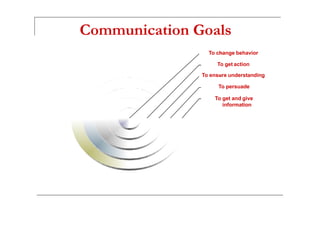
CommunicationCommunication GoalsGoals
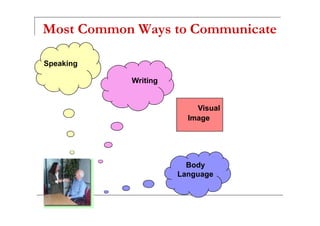
MostMost CommonCommon Ways toWays to CommunicateCommunicate
Types ofTypes of CommunicationCommunication
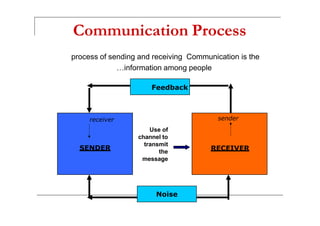
CommunicationCommunication ProcessProcessCommunicationCommunication ProcessProcess
CommunicationCommunication BarriersBarriers
CommunicationCommunication ComponentsComponents
ListeningListening SkillsSkills
TipsTips to goodto good communicationcommunication skillsskills
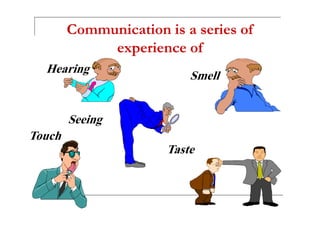
Communication is a series of
experience of
Hearing
Smell
SeeingSeeing
Touch
Taste
Communication Skills
Communication skills is the ability to use language
)receptive) and express )expressive) information.
Effective communication skills are a critical element inEffective communication skills are a critical element in
your career and personal lives.
Communication Goals
To change behavior
To get action
To ensure understanding
To persuade
To get and give
information
Most Common Ways to Communicate
Speaking
Writing
Visual
Image
Body
Language
Types of Communication
On the basis of organization relationship
Formal
Informal
On the basis of Flow
VerticalVertical
Crosswise/Diagonal
Horizontal
On the basis of Expression
Oral
Written
Gesture
Communication Process
Communication is theprocess of sending and receiving
information among people…
Feedback
REIVECRE
receiver
SENDER
sender
Noise
Use of
channel to
transmit
the
message
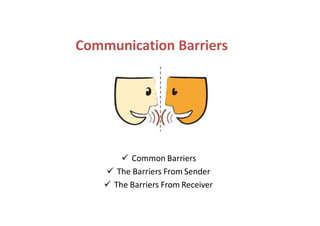
Communication Barriers
Common Barriers
The Barriers From Sender
The Barriers From Receiver
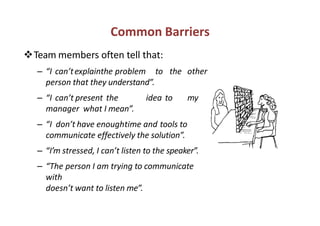
Common Barriers
Team members often tell that:
– “I can’texplainthe problem to the other
person that they understand .”
– “I can’t present the idea to my
manager what I mean .”manager what I mean .”
– “I don’t have enoughtime and tools to
communicate effectively the solution .”
– “I’m stressed, I can’t listen to the speaker .”
– “The person I am trying to communicate
with
doesn’t want to listen me .”
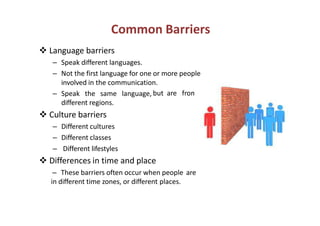
Common Barriers
Language barriers
– Speak different languages.
– Not the first language for one or more people
involved in the communication.
but are from– Speak the same language,
different regions.
Culture barriersCulture barriers
– Different cultures
– Different classes
– Different lifestyles
Differences in time and place
– These barriers often occur when people are
in different time zones, or different places.
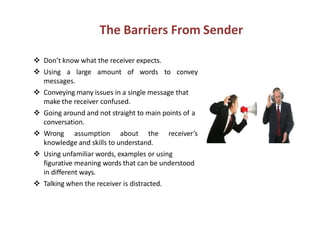
The Barriers From Sender
Don’t know what the receiver expects.
Using a large amount of words to convey
messages.
Conveying many issues in a single message that
make the receiver confused.
Going around and not straight to main points of aGoing around and not straight to main points of a
conversation.
Wrong assumption about the receiver’s
knowledge and skills to understand.
Using unfamiliar words, examples or using
figurative meaning words that can be understood
in different ways.
Talking when the receiver is distracted.
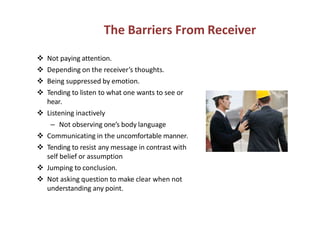
The Barriers From Receiver
Not paying attention.
Depending on the receiver’s thoughts.
Being suppressed by emotion.
Tending to listen to what one wants to see or
hear.
Listening inactivelyListening inactively
– Not observing one’s body language
Communicating in the uncomfortable manner.
Tending to resist any message in contrast with
self belief or assumption
Jumping to conclusion.
Not asking question to make clear when not
understanding any point.
Communication Involves Three
Components
Verbal Messages -the words we choose
Paraverbal Messages -how we say the
words
Nonverbal Messages -our body languageNonverbal Messages -our body language
These Three Components Are Used To
Send Clear, Concise Messages
Receive and Correctly Understand Messages
Sent to Us
Effective Verbal Messages
Are brief, succinct, and organized
Are free of jargonAre free of jargon
Do not create resistance in the listener
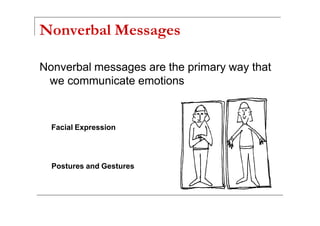
Nonverbal Messages
Nonverbal messages are the primary way that
we communicate emotions
Facial Expression
Postures and Gestures
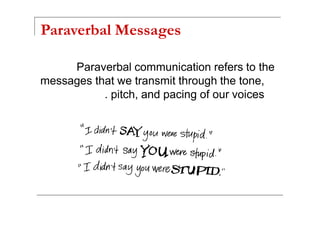
Paraverbal Messages
Paraverbal communication refers to the
messages that we transmit through the tone,
pitch, and pacing of our voices.
RECEIVING MESSAGES
Listening:
Requires concentration and energy
Involves a psychological connection with the
speakerspeaker
Includes a desire and willingness to try and
see things from another's perspective
Requires that we suspend judgment and
evaluation
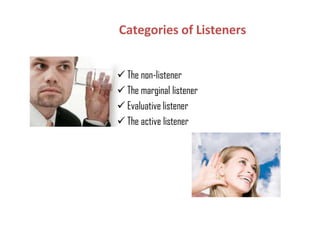
Categories of Listeners
The non-listener
The marginal listener
Evaluative listener
The active listener
Nonverbal
Giving full physical attention to the speaker;
Being aware of the speaker's nonverbal
messages;
Key Listening Skills
messages;
Verbal
Paying attention to the words and feelings
that are being expressed
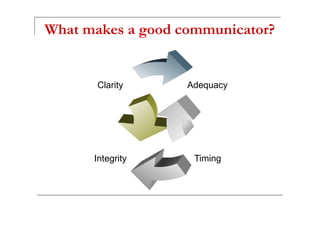
What makes a good communicator?
Clarity Adequacy
Integrity Timing
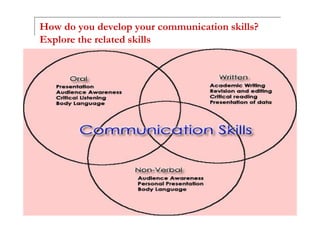
How do you develop your communication skills?
Explore the related skills
Tips to good communication skills
1. Maintain eye contact with the audience1. Maintain eye contact with the audience
2. Body awareness
3. Gestures and expressions
4. Convey one's thoughts
5. Practice effective communication skills
Effective Communication . . .
It is two way.
It involves active listening.
It reflects the accountability of speaker and
Listener.Listener.
It utilizes feedback.
It is free of stress.
It is clear.
ThanksThanks

Communication skills at work

  • 1.
  • 2.
    Outlines Communication skillsCommunication skills CommunicationCommunicationGoalsGoals MostMost CommonCommon Ways toWays to CommunicateCommunicate Types ofTypes of CommunicationCommunication CommunicationCommunication ProcessProcessCommunicationCommunication ProcessProcess CommunicationCommunication BarriersBarriers CommunicationCommunication ComponentsComponents ListeningListening SkillsSkills TipsTips to goodto good communicationcommunication skillsskills
  • 3.
    Communication is aseries of experience of Hearing Smell SeeingSeeing Touch Taste
  • 4.
    Communication Skills Communication skillsis the ability to use language )receptive) and express )expressive) information. Effective communication skills are a critical element inEffective communication skills are a critical element in your career and personal lives.
  • 5.
    Communication Goals To changebehavior To get action To ensure understanding To persuade To get and give information
  • 6.
    Most Common Waysto Communicate Speaking Writing Visual Image Body Language
  • 7.
    Types of Communication Onthe basis of organization relationship Formal Informal On the basis of Flow VerticalVertical Crosswise/Diagonal Horizontal On the basis of Expression Oral Written Gesture
  • 8.
    Communication Process Communication istheprocess of sending and receiving information among people… Feedback REIVECRE receiver SENDER sender Noise Use of channel to transmit the message
  • 9.
    Communication Barriers Common Barriers TheBarriers From Sender The Barriers From Receiver
  • 10.
    Common Barriers Team membersoften tell that: – “I can’texplainthe problem to the other person that they understand .” – “I can’t present the idea to my manager what I mean .”manager what I mean .” – “I don’t have enoughtime and tools to communicate effectively the solution .” – “I’m stressed, I can’t listen to the speaker .” – “The person I am trying to communicate with doesn’t want to listen me .”
  • 11.
    Common Barriers Language barriers –Speak different languages. – Not the first language for one or more people involved in the communication. but are from– Speak the same language, different regions. Culture barriersCulture barriers – Different cultures – Different classes – Different lifestyles Differences in time and place – These barriers often occur when people are in different time zones, or different places.
  • 12.
    The Barriers FromSender Don’t know what the receiver expects. Using a large amount of words to convey messages. Conveying many issues in a single message that make the receiver confused. Going around and not straight to main points of aGoing around and not straight to main points of a conversation. Wrong assumption about the receiver’s knowledge and skills to understand. Using unfamiliar words, examples or using figurative meaning words that can be understood in different ways. Talking when the receiver is distracted.
  • 13.
    The Barriers FromReceiver Not paying attention. Depending on the receiver’s thoughts. Being suppressed by emotion. Tending to listen to what one wants to see or hear. Listening inactivelyListening inactively – Not observing one’s body language Communicating in the uncomfortable manner. Tending to resist any message in contrast with self belief or assumption Jumping to conclusion. Not asking question to make clear when not understanding any point.
  • 14.
    Communication Involves Three Components VerbalMessages -the words we choose Paraverbal Messages -how we say the words Nonverbal Messages -our body languageNonverbal Messages -our body language These Three Components Are Used To Send Clear, Concise Messages Receive and Correctly Understand Messages Sent to Us
  • 15.
    Effective Verbal Messages Arebrief, succinct, and organized Are free of jargonAre free of jargon Do not create resistance in the listener
  • 16.
    Nonverbal Messages Nonverbal messagesare the primary way that we communicate emotions Facial Expression Postures and Gestures
  • 17.
    Paraverbal Messages Paraverbal communicationrefers to the messages that we transmit through the tone, pitch, and pacing of our voices.
  • 18.
    RECEIVING MESSAGES Listening: Requires concentrationand energy Involves a psychological connection with the speakerspeaker Includes a desire and willingness to try and see things from another's perspective Requires that we suspend judgment and evaluation
  • 19.
    Categories of Listeners Thenon-listener The marginal listener Evaluative listener The active listener
  • 20.
    Nonverbal Giving full physicalattention to the speaker; Being aware of the speaker's nonverbal messages; Key Listening Skills messages; Verbal Paying attention to the words and feelings that are being expressed
  • 21.
    What makes agood communicator? Clarity Adequacy Integrity Timing
  • 22.
    How do youdevelop your communication skills? Explore the related skills
  • 23.
    Tips to goodcommunication skills 1. Maintain eye contact with the audience1. Maintain eye contact with the audience 2. Body awareness 3. Gestures and expressions 4. Convey one's thoughts 5. Practice effective communication skills
  • 24.
    Effective Communication .. . It is two way. It involves active listening. It reflects the accountability of speaker and Listener.Listener. It utilizes feedback. It is free of stress. It is clear.
  • 25.