BUSINESS STUDIES96
Notes
7
OBJECTIVES
COMMUNICATION SERVICES
All of us know that man is a social animal. He cannot survive in isolation. As
a member of the society he is dependent on others. For most of the things he
has to take help from others. But the question is, how does one know what the
other wants? One has to convey his feelings, thoughts, ideas, requirements,
experiences, etc. to another in such a way that the latter understands those
correctly. The same thing happens with business also. It provides information
to the customers, government, owners, and employees. etc. and at the same
time receives information from them. In this lesson let us know, how people
convey their feelings, thoughts, ideas, messages, etc.
After studying this lesson, you will be able to :
• define communication;
• state the elements of the communication process;
• explain the importance of communication in business;
• identify the types of communication;
• describe different means of communication; and
• explain barriers of communication.
7.1 MEANING OF COMMUNICATION
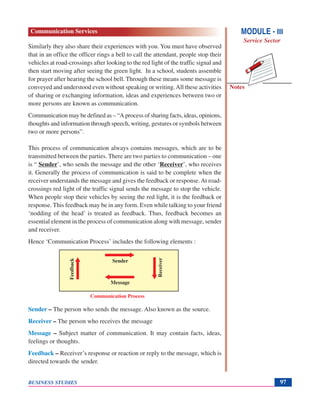
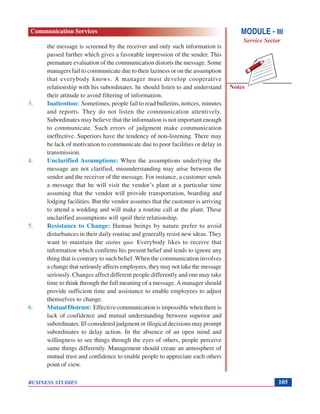
Every day you talk to the members
of your family, friends and relatives
on various matters. You receive
letters from your friends and
relatives on different occasions.You
also reply to their letters. Sometimes
to convey urgent message you send
telegrams or make telephone calls.
In this process you are able to share
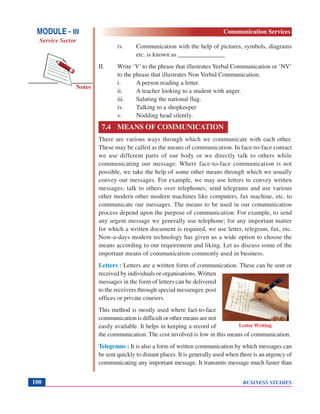
the information with others. Picture Showing Communication
MODULE - III
Service Sector
Communication Services
Notes
BUSINESS STUDIES 97
Similarly they also share their experiences with you. You must have observed
that in an office the officer rings a bell to call the attendant, people stop their
vehicles at road-crossings after looking to the red light of the traffic signal and
then start moving after seeing the green light. In a school, students assemble
for prayer after hearing the school bell. Through these means some message is
conveyed and understood even without speaking or writing.All these activities
of sharing or exchanging information, ideas and experiences between two or
more persons are known as communication.
Communication may be defined as – “A process of sharing facts, ideas, opinions,
thoughts and information through speech, writing, gestures or symbols between
two or more persons”.
This process of communication always contains messages, which are to be
transmitted between the parties. There are two parties to communication – one
is “ Sender’, who sends the message and the other ‘Receiver’, who receives
it. Generally the process of communication is said to be complete when the
receiver understands the message and gives the feedback or response.At road-
crossings red light of the traffic signal sends the message to stop the vehicle.
When people stop their vehicles by seeing the red light, it is the feedback or
response. This feedback may be in any form. Even while talking to your friend
‘nodding of the head’ is treated as feedback. Thus, feedback becomes an
essential element in the process of communication along with message, sender
and receiver.
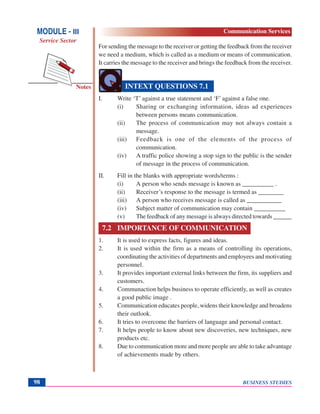
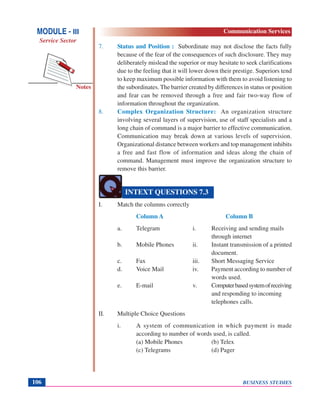
Hence ‘Communication Process’ includes the following elements :
Sender – The person who sends the message. Also known as the source.
Receiver – The person who receives the message
Message – Subject matter of communication. It may contain facts, ideas,
feelings or thoughts.
Feedback – Receiver’s response or reaction or reply to the message, which is
directed towards the sender.
Sender
Message
Feedback
Receiver
Communication Process
MODULE - III
Service Sector
Communication Services
BUSINESS STUDIES98
Notes INTEXT QUESTIONS 7.1
For sending the message to the receiver or getting the feedback from the receiver
we need a medium, which is called as a medium or means of communication.
It carries the message to the receiver and brings the feedback from the receiver.
I. Write ‘T’ against a true statement and ‘F’ against a false one.
(i) Sharing or exchanging information, ideas ad experiences
between persons means communication.
(ii) The process of communication may not always contain a
message.
(iii) Feedback is one of the elements of the process of
communication.
(iv) A traffic police showing a stop sign to the public is the sender
of message in the process of communication.
II. Fill in the blanks with appropriate words/terms :
(i) A person who sends message is known as __________ .
(ii) Receiver’s response to the message is termed as ________
(iii) A person who receives message is called as ___________
(iv) Subject matter of communication may contain __________
(v) The feedback of any message is always directed towards ______
7.2 IMPORTANCE OF COMMUNICATION
1. It is used to express facts, figures and ideas.
2. It is used within the firm as a means of controlling its operations,
coordinating the activities of departments and employees and motivating
personnel.
3. It provides important external links between the firm, its suppliers and
customers.
4. Communaction helps business to operate efficiently, as well as creates
a good public image .
5. Communication educates people, widens their knowledge and broadens
their outlook.
6. It tries to overcome the barriers of language and personal contact.
7. It helps people to know about new discoveries, new techniques, new
products etc.
8. Due to communication more and more people are able to take advantage
of achievements made by others.
MODULE - III
Service Sector
Communication Services
Notes
BUSINESS STUDIES 99
7.3 TYPES OF COMMUNICATION
When we talk to others or write to them, communication takes place between us.
But for such a communication, language is essential. Communication with the
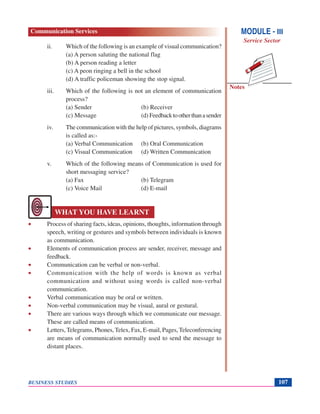
help of words known as Oral/Verbal communication is made through words
spoken. Communication through spoken works is known as oral communication,
which may be in the form of lectures, meetings, group discussions, conferences,
telephonic conversations, radio message etc. In written communication, message
istransmittedthroughwrittenwordsintheformofletters,memos,circulars,notices,
reports, manuals, magazines, handbooks, etc.
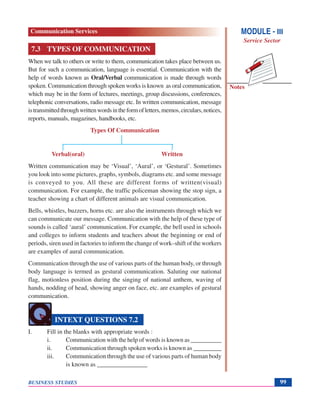
Types Of Communication
Verbal(oral) Written
Written communication may be ‘Visual’, ‘Aural’, or ‘Gestural’. Sometimes
you look into some pictures, graphs, symbols, diagrams etc. and some message
is conveyed to you. All these are different forms of written(visual)
communication. For example, the traffic policeman showing the stop sign, a
teacher showing a chart of different animals are visual communication.
Bells, whistles, buzzers, horns etc. are also the instruments through which we
can communicate our message. Communication with the help of these type of
sounds is called ‘aural’ communication. For example, the bell used in schools
and colleges to inform students and teachers about the beginning or end of
periods, siren used in factories to inform the change of work–shift of the workers
are examples of aural communication.
Communication through the use of various parts of the human body, or through
body language is termed as gestural communication. Saluting our national
flag, motionless position during the singing of national anthem, waving of
hands, nodding of head, showing anger on face, etc. are examples of gestural
communication.
I. Fill in the blanks with appropriate words :
i. Communication with the help of words is known as __________
ii. Communication through spoken works is known as _________
iii. Communication through the use of various parts of human body
is known as ________________
INTEXT QUESTIONS 7.2
MODULE - III
Service Sector
Communication Services
BUSINESS STUDIES100
Notes
iv. Communication with the help of pictures, symbols, diagrams
etc. is known as _______________
II. Write ‘V’to the phrase that illustrates Verbal Communication or ‘NV’
to the phrase that illustrates Non Verbal Communication.
i. A person reading a letter.
ii. A teacher looking to a student with anger.
iii. Saluting the national flag.
iv. Talking to a shopkeeper
v. Nodding head silently.
7.4 MEANS OF COMMUNICATION
There are various ways through which we communicate with each other.
These may be called as the means of communication. In face-to-face contact
we use different parts of our body or we directly talk to others while
communicating our message. Where face-to-face communication is not
possible, we take the help of some other means through which we usually
convey our messages. For example, we may use letters to convey written
messages; talk to others over telephones; send telegrams and use various
other modern other modern machines like computers, fax machine, etc. to
communicate our messages. The means to be used in our communication
process depend upon the purpose of communication. For example, to send
any urgent message we generally use telephone; for any important matter
for which a written document is required, we use letter, telegram, fax, etc.
Now-a-days modern technology has given us a wide option to choose the
means according to our requirement and liking. Let us discuss some of the
important means of communication commonly used in business.
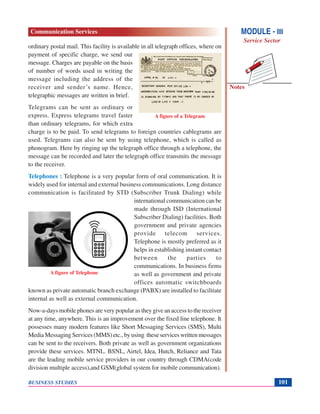
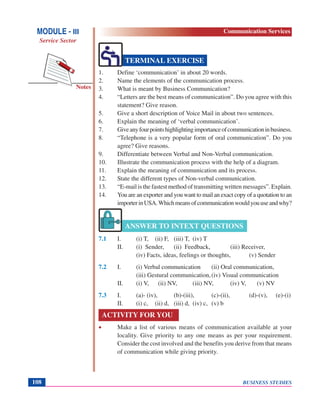
Letters : Letters are a written form of communication. These can be sent or
received by individuals or organisations. Written
messages in the form of letters can be delivered
to the receivers through special messenger, post
offices or private couriers.
This method is mostly used where fact-to-face
communication is difficult or other means are not
easily available. It helps in keeping a record of
the communication. The cost involved is low in this means of communication.
Telegrams : It is also a form of written communication by which messages can
be sent quickly to distant places. It is generally used when there is an urgency of
communicating any important message. It transmits message much faster than
Letter Writing
MODULE - III
Service Sector
Communication Services
Notes
BUSINESS STUDIES 101
ordinary postal mail. This facility is available in all telegraph offices, where on
payment of specific charge, we send our
message. Charges are payable on the basis
of number of words used in writing the
message including the address of the
receiver and sender’s name. Hence,
telegraphic messages are written in brief.
Telegrams can be sent as ordinary or
express. Express telegrams travel faster
than ordinary telegrams, for which extra
charge is to be paid. To send telegrams to foreign countries cablegrams are
used. Telegrams can also be sent by using telephone, which is called as
phonogram. Here by ringing up the telegraph office through a telephone, the
message can be recorded and later the telegraph office transmits the message
to the receiver.
Telephones : Telephone is a very popular form of oral communication. It is
widely used for internal and external business communications. Long distance
communication is facilitated by STD (Subscriber Trunk Dialing) while
international communication can be
made through ISD (International
Subscriber Dialing) facilities. Both
government and private agencies
provide telecom services.
Telephone is mostly preferred as it
helps in establishing instant contact
between the parties to
communications. In business firms
as well as government and private
offices automatic switchboards
known as private automatic branch exchange (PABX) are installed to facilitate
internal as well as external communication.
Now-a-days mobile phones are very popular as they give an access to the receiver
at any time, anywhere. This is an improvement over the fixed line telephone. It
possesses many modern features like Short Messaging Services (SMS), Multi
Media Messaging Services (MMS) etc., by using these services written messages
can be sent to the receivers. Both private as well as government organizations
provide these services. MTNL. BSNL, Airtel, Idea, Hutch, Reliance and Tata
are the leading mobile service providers in our country through CDMA(code
division multiple access),and GSM(global system for mobile communication).
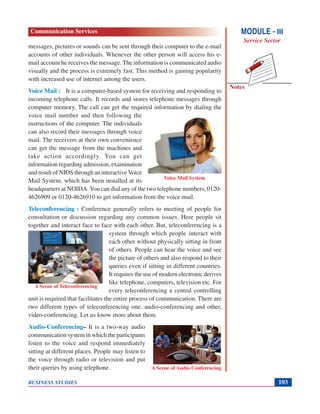
A figure of a Telegram
A figure of Telephone
MODULE - III
Service Sector
Communication Services
BUSINESS STUDIES102
Notes
Telex : Telex provides a means of printed
communication using Teleprinter.
Teleprinters consist of machines installed
at different places which are connected to
a central exchange through cable. In each
machine a standard keyboard is fitted.Any
message typed by using those keyboards
at one end is automatically typed at the
other end. Hence instant transmission is possible.
Fax : Fax or facsimile is an electronic device that enables instant transmission
of any matter, which may be handwritten or printed like letters, diagrams,
graphs, sketches, etc. By using telephone lines this machine sends the exact
copy of the document to another fax
machine at the receiving end. Far
sending any message, the documents on
which message, diagram or drawing is
typed or drawn has to be put in the fax
machineandthefaxnumber(atelephone
number) of the other party has to be
dialed. Then the fax machine at the
receiving end will instantly produce the
replica of the matter. This is the most
commonly used means of written communication in business. The main
advantagesofFaxsystemareeasyoperation,instanttransmissionofhandwritten
or printed matters, over any distance Telephone machine also records each
transaction of communication. The only limitation is that fax machine accepts
document up to a standard size. Again, as a usual practice, a copy of the same
documentissenttothereceiverthroughpostfortheirrecord.Telephone receiver
at the other end also makes a photocopy of the document immediately after
receiving the message through fax machine, because there may be chances that
the ink used by the machine may fade away after some time.
E-mail : Electronic mail, popularly known
as e-mail is a modern means of
communication. The system makes use of
electronic methods of transmitting and
receiving information. In this case
individuals, through the internet, open an
e-mail account in their name from any ISP
(Internet Service Provider). Then letters,
Telex Machine
Fax Machine
E-mail Communication
MODULE - III
Service Sector
Communication Services
Notes
BUSINESS STUDIES 103
messages, pictures or sounds can be sent through their computer to the e-mail
accounts of other individuals. Whenever the other person will access his e-
mail account he receives the message. The information is communicated audio
visually and the process is extremely fast. This method is gaining popularity
with increased use of internet among the users.
Voice Mail : It is a computer-based system for receiving and responding to
incoming telephone calls. It records and stores telephone messages through
computer memory. The call can get the required information by dialing the
voice mail number and then following the
instructions of the computer. The individuals
can also record their messages through voice
mail. The receivers at their own convenience
can get the message from the machines and
take action accordingly. You can get
information regarding admission, examination
and result of NIOS through an interactiveVoice
Mail System, which has been installed at its
headquarters at NOIDA.You can dial any of the two telephone numbers, 0120-
4626909 or 0120-4626910 to get information from the voice mail.
Teleconferencing : Conference generally refers to meeting of people for
consultation or discussion regarding any common issues. Here people sit
together and interact face to face with each other. But, teleconferencing is a
system through which people interact with
each other without physically sitting in front
of others. People can hear the voice and see
the picture of others and also respond to their
queries even if sitting in different countries.
It requires the use of modern electronic derives
like telephone, computers, television etc. For
every teleconferencing a central controlling
unit is required that facilitates the entire process of communication. There are
two different types of teleconferencing one, audio-conferencing and other,
video-conferencing. Let us know more about them.
Audio-Conferencing– It is a two-way audio
communication system in which the participants
listen to the voice and respond immediately
sitting at different places. People may listen to
the voice through radio or television and put
their queries by using telephone.
Voice Mail System
A Scene of Teleconferencing
A Scene of Audio Conferencing
MODULE - III
Service Sector
Communication Services
BUSINESS STUDIES104
Notes
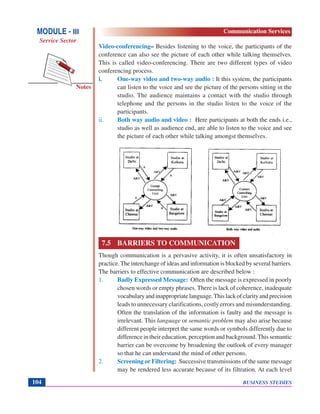
Video-conferencing– Besides listening to the voice, the participants of the
conference can also see the picture of each other while talking themselves.
This is called video-conferencing. There are two different types of video
conferencing process.
i. One-way video and two-way audio : It this system, the participants
can listen to the voice and see the picture of the persons sitting in the
studio. The audience maintains a contact with the studio through
telephone and the persons in the studio listen to the voice of the
participants.
ii. Both way audio and video : Here participants at both the ends i.e.,
studio as well as audience end, are able to listen to the voice and see
the picture of each other while talking amongst themselves.
7.5 BARRIERS TO COMMUNICATION
Though communication is a pervasive activity, it is often unsatisfactory in
practice.The interchange of ideas and information is blocked by several barriers.
The barriers to effective communication are described below :
1. Badly Expressed Message: Often the message is expressed in poorly
chosen words or empty phrases. There is lack of coherence, inadequate
vocabularyandinappropriatelanguage.Thislackofclarityandprecision
leads to unnecessary clarifications, costly errors and misunderstanding.
Often the translation of the information is faulty and the message is
irrelevant. This language or semantic problem may also arise because
different people interpret the same words or symbols differently due to
difference in their education, perception and background.This semantic
barrier can be overcome by broadening the outlook of every manager
so that he can understand the mind of other persons.
2. Screening or Filtering: Successive transmissions of the same message
may be rendered less accurate because of its filtration. At each level
MODULE - III
Service Sector
Communication Services
Notes
BUSINESS STUDIES 105
the message is screened by the receiver and only such information is
passed further which gives a favorable impression of the sender. This
premature evaluation of the communication distorts the message. Some
managers fail to communicate due to their laziness or on the assumption
that everybody knows. A manager must develop cooperative
relationship with his subordinates. he should listen to and understand
their attitude to avoid filtering of information.
3. Inattention: Sometimes, people fail to read bulletins, notices, minutes
and reports. They do not listen the communication attentively.
Subordinates may believe that the information is not important enough
to communicate. Such errors of judgment make communication
ineffective. Superiors have the tendency of non-listening. There may
be lack of motivation to communicate due to poor facilities or delay in
transmission.
4. Unclarified Assumptions: When the assumptions underlying the
message are not clarified, misunderstanding may arise between the
sender and the receiver of the message. For instance, a customer sends
a message that he will visit the vendor’s plant at a particular time
assuming that the vendor will provide transportation, boarding and
lodging facilities. But the vendor assumes that the customer is arriving
to attend a wedding and will make a routine call at the plant. These
unclarified assumptions will spoil their relationship.
5. Resistance to Change: Human beings by nature prefer to avoid
disturbances in their daily routine and generally resist new ideas. They
want to maintain the status quo. Everybody likes to receive that
information which confirms his present belief and tends to ignore any
thing that is contrary to such belief. When the communication involves
a change that seriously affects employees, they may not take the message
seriously. Changes affect different people differently and one may take
time to think through the full meaning of a message.Amanager should
provide sufficient time and assistance to enable employees to adjust
themselves to change.
6. Mutual Distrust: Effective communication is impossible when there is
lack of confidence and mutual understanding between superior and
subordinates. Ill-consideredjudgmentorillogicaldecisionsmayprompt
subordinates to delay action. In the absence of an open mind and
willingness to see things through the eyes of others, people perceive
same things differently. Management should create an atmosphere of
mutual trust and confidence to enable people to appreciate each others
point of view.
MODULE - III
Service Sector
Communication Services
BUSINESS STUDIES106
Notes
7. Status and Position : Subordinate may not disclose the facts fully
because of the fear of the consequences of such disclosure. They may
deliberately mislead the superior or may hesitate to seek clarifications
due to the feeling that it will lower down their prestige. Superiors tend
to keep maximum possible information with them to avoid listening to
the subordinates. The barrier created by differences in status or position
and fear can be removed through a free and fair two-way flow of
information throughout the organization.
8. Complex Organization Structure: An organization structure
involving several layers of supervision, use of staff specialists and a
long chain of command is a major barrier to effective communication.
Communication may break down at various levels of supervision.
Organizational distance between workers and top management inhibits
a free and fast flow of information and ideas along the chain of
command. Management must improve the organization structure to
remove this barrier.
I. Match the columns correctly
Column A Column B
a. Telegram i. Receiving and sending mails
through internet
b. Mobile Phones ii. Instant transmission of a printed
document.
c. Fax iii. Short Messaging Service
d. Voice Mail iv. Payment according to number of
words used.
e. E-mail v. Computerbasedsystemofreceiving
and responding to incoming
telephones calls.
II. Multiple Choice Questions
i. A system of communication in which payment is made
according to number of words used, is called.
(a) Mobile Phones (b) Telex
(c) Telegrams (d) Pager
INTEXT QUESTIONS 7.3
MODULE - III
Service Sector
Communication Services
Notes
BUSINESS STUDIES 107
ii. Which of the following is an example of visual communication?
(a) A person saluting the national flag
(b) A person reading a letter
(c) A peon ringing a bell in the school
(d) A traffic policeman showing the stop signal.
iii. Which of the following is not an element of communication
process?
(a) Sender (b) Receiver
(c) Message (d) Feedbacktootherthanasender
iv. The communication with the help of pictures, symbols, diagrams
is called as:-
(a) Verbal Communication (b) Oral Communication
(c) Visual Communication (d) Written Communication
v. Which of the following means of Communication is used for
short messaging service?
(a) Fax (b) Telegram
(c) Voice Mail (d) E-mail
• Process of sharing facts, ideas, opinions, thoughts, information through
speech, writing or gestures and symbols between individuals is known
as communication.
• Elements of communication process are sender, receiver, message and
feedback.
• Communication can be verbal or non-verbal.
• Communication with the help of words is known as verbal
communication and without using words is called non-verbal
communication.
• Verbal communication may be oral or written.
• Non-verbal communication may be visual, aural or gestural.
• There are various ways through which we communicate our message.
These are called means of communication.
• Letters, Telegrams, Phones, Telex, Fax, E-mail, Pages,Teleconferencing
are means of communication normally used to send the message to
distant places.
WHAT YOU HAVE LEARNT
MODULE - III
Service Sector
Communication Services
BUSINESS STUDIES108
Notes
1. Define ‘communication’ in about 20 words.
2. Name the elements of the communication process.
3. What is meant by Business Communication?
4. “Letters are the best means of communication”. Do you agree with this
statement? Give reason.
5. Give a short description of Voice Mail in about two sentences.
6. Explain the meaning of ‘verbal communication’.
7. Giveanyfourpointshighlightingimportanceofcommunicationinbusiness.
8. “Telephone is a very popular form of oral communication”. Do you
agree? Give reasons.
9. Differentiate between Verbal and Non-Verbal communication.
10. Illustrate the communication process with the help of a diagram.
11. Explain the meaning of communication and its process.
12. State the different types of Non-verbal communication.
13. “E-mail is the fastest method of transmitting written messages”. Explain.
14. You are an exporter and you want to mail an exact copy of a quotation to an
importerinUSA.Whichmeansofcommunicationwouldyouuseandwhy?
7.1 I. (i) T, (ii) F, (iii) T, (iv) T
II. (i) Sender, (ii) Feedback, (iii) Receiver,
(iv) Facts, ideas, feelings or thoughts, (v) Sender
7.2 I. (i) Verbal communication (ii) Oral communication,
(iii) Gestural communication,(iv) Visual communication
II. (i) V, (ii) NV, (iii) NV, (iv) V, (v) NV
7.3 I. (a)- (iv), (b)-(iii), (c)-(ii), (d)-(v), (e)-(i)
II. (i) c, (ii) d, (iii) d, (iv) c, (v) b
ACTIVITY FOR YOU
• Make a list of various means of communication available at your
locality. Give priority to any one means as per your requirement.
Consider the cost involved and the benefits you derive from that means
of communication while giving priority.
TERMINAL EXERCISE
ANSWER TO INTEXT QUESTIONS
MODULE - III
Service Sector
Communication Services

Communication services

  • 1.
    BUSINESS STUDIES96 Notes 7 OBJECTIVES COMMUNICATION SERVICES Allof us know that man is a social animal. He cannot survive in isolation. As a member of the society he is dependent on others. For most of the things he has to take help from others. But the question is, how does one know what the other wants? One has to convey his feelings, thoughts, ideas, requirements, experiences, etc. to another in such a way that the latter understands those correctly. The same thing happens with business also. It provides information to the customers, government, owners, and employees. etc. and at the same time receives information from them. In this lesson let us know, how people convey their feelings, thoughts, ideas, messages, etc. After studying this lesson, you will be able to : • define communication; • state the elements of the communication process; • explain the importance of communication in business; • identify the types of communication; • describe different means of communication; and • explain barriers of communication. 7.1 MEANING OF COMMUNICATION Every day you talk to the members of your family, friends and relatives on various matters. You receive letters from your friends and relatives on different occasions.You also reply to their letters. Sometimes to convey urgent message you send telegrams or make telephone calls. In this process you are able to share the information with others. Picture Showing Communication MODULE - III Service Sector Communication Services
  • 2.
    Notes BUSINESS STUDIES 97 Similarlythey also share their experiences with you. You must have observed that in an office the officer rings a bell to call the attendant, people stop their vehicles at road-crossings after looking to the red light of the traffic signal and then start moving after seeing the green light. In a school, students assemble for prayer after hearing the school bell. Through these means some message is conveyed and understood even without speaking or writing.All these activities of sharing or exchanging information, ideas and experiences between two or more persons are known as communication. Communication may be defined as – “A process of sharing facts, ideas, opinions, thoughts and information through speech, writing, gestures or symbols between two or more persons”. This process of communication always contains messages, which are to be transmitted between the parties. There are two parties to communication – one is “ Sender’, who sends the message and the other ‘Receiver’, who receives it. Generally the process of communication is said to be complete when the receiver understands the message and gives the feedback or response.At road- crossings red light of the traffic signal sends the message to stop the vehicle. When people stop their vehicles by seeing the red light, it is the feedback or response. This feedback may be in any form. Even while talking to your friend ‘nodding of the head’ is treated as feedback. Thus, feedback becomes an essential element in the process of communication along with message, sender and receiver. Hence ‘Communication Process’ includes the following elements : Sender – The person who sends the message. Also known as the source. Receiver – The person who receives the message Message – Subject matter of communication. It may contain facts, ideas, feelings or thoughts. Feedback – Receiver’s response or reaction or reply to the message, which is directed towards the sender. Sender Message Feedback Receiver Communication Process MODULE - III Service Sector Communication Services
  • 3.
    BUSINESS STUDIES98 Notes INTEXTQUESTIONS 7.1 For sending the message to the receiver or getting the feedback from the receiver we need a medium, which is called as a medium or means of communication. It carries the message to the receiver and brings the feedback from the receiver. I. Write ‘T’ against a true statement and ‘F’ against a false one. (i) Sharing or exchanging information, ideas ad experiences between persons means communication. (ii) The process of communication may not always contain a message. (iii) Feedback is one of the elements of the process of communication. (iv) A traffic police showing a stop sign to the public is the sender of message in the process of communication. II. Fill in the blanks with appropriate words/terms : (i) A person who sends message is known as __________ . (ii) Receiver’s response to the message is termed as ________ (iii) A person who receives message is called as ___________ (iv) Subject matter of communication may contain __________ (v) The feedback of any message is always directed towards ______ 7.2 IMPORTANCE OF COMMUNICATION 1. It is used to express facts, figures and ideas. 2. It is used within the firm as a means of controlling its operations, coordinating the activities of departments and employees and motivating personnel. 3. It provides important external links between the firm, its suppliers and customers. 4. Communaction helps business to operate efficiently, as well as creates a good public image . 5. Communication educates people, widens their knowledge and broadens their outlook. 6. It tries to overcome the barriers of language and personal contact. 7. It helps people to know about new discoveries, new techniques, new products etc. 8. Due to communication more and more people are able to take advantage of achievements made by others. MODULE - III Service Sector Communication Services
  • 4.
    Notes BUSINESS STUDIES 99 7.3TYPES OF COMMUNICATION When we talk to others or write to them, communication takes place between us. But for such a communication, language is essential. Communication with the help of words known as Oral/Verbal communication is made through words spoken. Communication through spoken works is known as oral communication, which may be in the form of lectures, meetings, group discussions, conferences, telephonic conversations, radio message etc. In written communication, message istransmittedthroughwrittenwordsintheformofletters,memos,circulars,notices, reports, manuals, magazines, handbooks, etc. Types Of Communication Verbal(oral) Written Written communication may be ‘Visual’, ‘Aural’, or ‘Gestural’. Sometimes you look into some pictures, graphs, symbols, diagrams etc. and some message is conveyed to you. All these are different forms of written(visual) communication. For example, the traffic policeman showing the stop sign, a teacher showing a chart of different animals are visual communication. Bells, whistles, buzzers, horns etc. are also the instruments through which we can communicate our message. Communication with the help of these type of sounds is called ‘aural’ communication. For example, the bell used in schools and colleges to inform students and teachers about the beginning or end of periods, siren used in factories to inform the change of work–shift of the workers are examples of aural communication. Communication through the use of various parts of the human body, or through body language is termed as gestural communication. Saluting our national flag, motionless position during the singing of national anthem, waving of hands, nodding of head, showing anger on face, etc. are examples of gestural communication. I. Fill in the blanks with appropriate words : i. Communication with the help of words is known as __________ ii. Communication through spoken works is known as _________ iii. Communication through the use of various parts of human body is known as ________________ INTEXT QUESTIONS 7.2 MODULE - III Service Sector Communication Services
  • 5.
    BUSINESS STUDIES100 Notes iv. Communicationwith the help of pictures, symbols, diagrams etc. is known as _______________ II. Write ‘V’to the phrase that illustrates Verbal Communication or ‘NV’ to the phrase that illustrates Non Verbal Communication. i. A person reading a letter. ii. A teacher looking to a student with anger. iii. Saluting the national flag. iv. Talking to a shopkeeper v. Nodding head silently. 7.4 MEANS OF COMMUNICATION There are various ways through which we communicate with each other. These may be called as the means of communication. In face-to-face contact we use different parts of our body or we directly talk to others while communicating our message. Where face-to-face communication is not possible, we take the help of some other means through which we usually convey our messages. For example, we may use letters to convey written messages; talk to others over telephones; send telegrams and use various other modern other modern machines like computers, fax machine, etc. to communicate our messages. The means to be used in our communication process depend upon the purpose of communication. For example, to send any urgent message we generally use telephone; for any important matter for which a written document is required, we use letter, telegram, fax, etc. Now-a-days modern technology has given us a wide option to choose the means according to our requirement and liking. Let us discuss some of the important means of communication commonly used in business. Letters : Letters are a written form of communication. These can be sent or received by individuals or organisations. Written messages in the form of letters can be delivered to the receivers through special messenger, post offices or private couriers. This method is mostly used where fact-to-face communication is difficult or other means are not easily available. It helps in keeping a record of the communication. The cost involved is low in this means of communication. Telegrams : It is also a form of written communication by which messages can be sent quickly to distant places. It is generally used when there is an urgency of communicating any important message. It transmits message much faster than Letter Writing MODULE - III Service Sector Communication Services
  • 6.
    Notes BUSINESS STUDIES 101 ordinarypostal mail. This facility is available in all telegraph offices, where on payment of specific charge, we send our message. Charges are payable on the basis of number of words used in writing the message including the address of the receiver and sender’s name. Hence, telegraphic messages are written in brief. Telegrams can be sent as ordinary or express. Express telegrams travel faster than ordinary telegrams, for which extra charge is to be paid. To send telegrams to foreign countries cablegrams are used. Telegrams can also be sent by using telephone, which is called as phonogram. Here by ringing up the telegraph office through a telephone, the message can be recorded and later the telegraph office transmits the message to the receiver. Telephones : Telephone is a very popular form of oral communication. It is widely used for internal and external business communications. Long distance communication is facilitated by STD (Subscriber Trunk Dialing) while international communication can be made through ISD (International Subscriber Dialing) facilities. Both government and private agencies provide telecom services. Telephone is mostly preferred as it helps in establishing instant contact between the parties to communications. In business firms as well as government and private offices automatic switchboards known as private automatic branch exchange (PABX) are installed to facilitate internal as well as external communication. Now-a-days mobile phones are very popular as they give an access to the receiver at any time, anywhere. This is an improvement over the fixed line telephone. It possesses many modern features like Short Messaging Services (SMS), Multi Media Messaging Services (MMS) etc., by using these services written messages can be sent to the receivers. Both private as well as government organizations provide these services. MTNL. BSNL, Airtel, Idea, Hutch, Reliance and Tata are the leading mobile service providers in our country through CDMA(code division multiple access),and GSM(global system for mobile communication). A figure of a Telegram A figure of Telephone MODULE - III Service Sector Communication Services
  • 7.
    BUSINESS STUDIES102 Notes Telex :Telex provides a means of printed communication using Teleprinter. Teleprinters consist of machines installed at different places which are connected to a central exchange through cable. In each machine a standard keyboard is fitted.Any message typed by using those keyboards at one end is automatically typed at the other end. Hence instant transmission is possible. Fax : Fax or facsimile is an electronic device that enables instant transmission of any matter, which may be handwritten or printed like letters, diagrams, graphs, sketches, etc. By using telephone lines this machine sends the exact copy of the document to another fax machine at the receiving end. Far sending any message, the documents on which message, diagram or drawing is typed or drawn has to be put in the fax machineandthefaxnumber(atelephone number) of the other party has to be dialed. Then the fax machine at the receiving end will instantly produce the replica of the matter. This is the most commonly used means of written communication in business. The main advantagesofFaxsystemareeasyoperation,instanttransmissionofhandwritten or printed matters, over any distance Telephone machine also records each transaction of communication. The only limitation is that fax machine accepts document up to a standard size. Again, as a usual practice, a copy of the same documentissenttothereceiverthroughpostfortheirrecord.Telephone receiver at the other end also makes a photocopy of the document immediately after receiving the message through fax machine, because there may be chances that the ink used by the machine may fade away after some time. E-mail : Electronic mail, popularly known as e-mail is a modern means of communication. The system makes use of electronic methods of transmitting and receiving information. In this case individuals, through the internet, open an e-mail account in their name from any ISP (Internet Service Provider). Then letters, Telex Machine Fax Machine E-mail Communication MODULE - III Service Sector Communication Services
  • 8.
    Notes BUSINESS STUDIES 103 messages,pictures or sounds can be sent through their computer to the e-mail accounts of other individuals. Whenever the other person will access his e- mail account he receives the message. The information is communicated audio visually and the process is extremely fast. This method is gaining popularity with increased use of internet among the users. Voice Mail : It is a computer-based system for receiving and responding to incoming telephone calls. It records and stores telephone messages through computer memory. The call can get the required information by dialing the voice mail number and then following the instructions of the computer. The individuals can also record their messages through voice mail. The receivers at their own convenience can get the message from the machines and take action accordingly. You can get information regarding admission, examination and result of NIOS through an interactiveVoice Mail System, which has been installed at its headquarters at NOIDA.You can dial any of the two telephone numbers, 0120- 4626909 or 0120-4626910 to get information from the voice mail. Teleconferencing : Conference generally refers to meeting of people for consultation or discussion regarding any common issues. Here people sit together and interact face to face with each other. But, teleconferencing is a system through which people interact with each other without physically sitting in front of others. People can hear the voice and see the picture of others and also respond to their queries even if sitting in different countries. It requires the use of modern electronic derives like telephone, computers, television etc. For every teleconferencing a central controlling unit is required that facilitates the entire process of communication. There are two different types of teleconferencing one, audio-conferencing and other, video-conferencing. Let us know more about them. Audio-Conferencing– It is a two-way audio communication system in which the participants listen to the voice and respond immediately sitting at different places. People may listen to the voice through radio or television and put their queries by using telephone. Voice Mail System A Scene of Teleconferencing A Scene of Audio Conferencing MODULE - III Service Sector Communication Services
  • 9.
    BUSINESS STUDIES104 Notes Video-conferencing– Besideslistening to the voice, the participants of the conference can also see the picture of each other while talking themselves. This is called video-conferencing. There are two different types of video conferencing process. i. One-way video and two-way audio : It this system, the participants can listen to the voice and see the picture of the persons sitting in the studio. The audience maintains a contact with the studio through telephone and the persons in the studio listen to the voice of the participants. ii. Both way audio and video : Here participants at both the ends i.e., studio as well as audience end, are able to listen to the voice and see the picture of each other while talking amongst themselves. 7.5 BARRIERS TO COMMUNICATION Though communication is a pervasive activity, it is often unsatisfactory in practice.The interchange of ideas and information is blocked by several barriers. The barriers to effective communication are described below : 1. Badly Expressed Message: Often the message is expressed in poorly chosen words or empty phrases. There is lack of coherence, inadequate vocabularyandinappropriatelanguage.Thislackofclarityandprecision leads to unnecessary clarifications, costly errors and misunderstanding. Often the translation of the information is faulty and the message is irrelevant. This language or semantic problem may also arise because different people interpret the same words or symbols differently due to difference in their education, perception and background.This semantic barrier can be overcome by broadening the outlook of every manager so that he can understand the mind of other persons. 2. Screening or Filtering: Successive transmissions of the same message may be rendered less accurate because of its filtration. At each level MODULE - III Service Sector Communication Services
  • 10.
    Notes BUSINESS STUDIES 105 themessage is screened by the receiver and only such information is passed further which gives a favorable impression of the sender. This premature evaluation of the communication distorts the message. Some managers fail to communicate due to their laziness or on the assumption that everybody knows. A manager must develop cooperative relationship with his subordinates. he should listen to and understand their attitude to avoid filtering of information. 3. Inattention: Sometimes, people fail to read bulletins, notices, minutes and reports. They do not listen the communication attentively. Subordinates may believe that the information is not important enough to communicate. Such errors of judgment make communication ineffective. Superiors have the tendency of non-listening. There may be lack of motivation to communicate due to poor facilities or delay in transmission. 4. Unclarified Assumptions: When the assumptions underlying the message are not clarified, misunderstanding may arise between the sender and the receiver of the message. For instance, a customer sends a message that he will visit the vendor’s plant at a particular time assuming that the vendor will provide transportation, boarding and lodging facilities. But the vendor assumes that the customer is arriving to attend a wedding and will make a routine call at the plant. These unclarified assumptions will spoil their relationship. 5. Resistance to Change: Human beings by nature prefer to avoid disturbances in their daily routine and generally resist new ideas. They want to maintain the status quo. Everybody likes to receive that information which confirms his present belief and tends to ignore any thing that is contrary to such belief. When the communication involves a change that seriously affects employees, they may not take the message seriously. Changes affect different people differently and one may take time to think through the full meaning of a message.Amanager should provide sufficient time and assistance to enable employees to adjust themselves to change. 6. Mutual Distrust: Effective communication is impossible when there is lack of confidence and mutual understanding between superior and subordinates. Ill-consideredjudgmentorillogicaldecisionsmayprompt subordinates to delay action. In the absence of an open mind and willingness to see things through the eyes of others, people perceive same things differently. Management should create an atmosphere of mutual trust and confidence to enable people to appreciate each others point of view. MODULE - III Service Sector Communication Services
  • 11.
    BUSINESS STUDIES106 Notes 7. Statusand Position : Subordinate may not disclose the facts fully because of the fear of the consequences of such disclosure. They may deliberately mislead the superior or may hesitate to seek clarifications due to the feeling that it will lower down their prestige. Superiors tend to keep maximum possible information with them to avoid listening to the subordinates. The barrier created by differences in status or position and fear can be removed through a free and fair two-way flow of information throughout the organization. 8. Complex Organization Structure: An organization structure involving several layers of supervision, use of staff specialists and a long chain of command is a major barrier to effective communication. Communication may break down at various levels of supervision. Organizational distance between workers and top management inhibits a free and fast flow of information and ideas along the chain of command. Management must improve the organization structure to remove this barrier. I. Match the columns correctly Column A Column B a. Telegram i. Receiving and sending mails through internet b. Mobile Phones ii. Instant transmission of a printed document. c. Fax iii. Short Messaging Service d. Voice Mail iv. Payment according to number of words used. e. E-mail v. Computerbasedsystemofreceiving and responding to incoming telephones calls. II. Multiple Choice Questions i. A system of communication in which payment is made according to number of words used, is called. (a) Mobile Phones (b) Telex (c) Telegrams (d) Pager INTEXT QUESTIONS 7.3 MODULE - III Service Sector Communication Services
  • 12.
    Notes BUSINESS STUDIES 107 ii.Which of the following is an example of visual communication? (a) A person saluting the national flag (b) A person reading a letter (c) A peon ringing a bell in the school (d) A traffic policeman showing the stop signal. iii. Which of the following is not an element of communication process? (a) Sender (b) Receiver (c) Message (d) Feedbacktootherthanasender iv. The communication with the help of pictures, symbols, diagrams is called as:- (a) Verbal Communication (b) Oral Communication (c) Visual Communication (d) Written Communication v. Which of the following means of Communication is used for short messaging service? (a) Fax (b) Telegram (c) Voice Mail (d) E-mail • Process of sharing facts, ideas, opinions, thoughts, information through speech, writing or gestures and symbols between individuals is known as communication. • Elements of communication process are sender, receiver, message and feedback. • Communication can be verbal or non-verbal. • Communication with the help of words is known as verbal communication and without using words is called non-verbal communication. • Verbal communication may be oral or written. • Non-verbal communication may be visual, aural or gestural. • There are various ways through which we communicate our message. These are called means of communication. • Letters, Telegrams, Phones, Telex, Fax, E-mail, Pages,Teleconferencing are means of communication normally used to send the message to distant places. WHAT YOU HAVE LEARNT MODULE - III Service Sector Communication Services
  • 13.
    BUSINESS STUDIES108 Notes 1. Define‘communication’ in about 20 words. 2. Name the elements of the communication process. 3. What is meant by Business Communication? 4. “Letters are the best means of communication”. Do you agree with this statement? Give reason. 5. Give a short description of Voice Mail in about two sentences. 6. Explain the meaning of ‘verbal communication’. 7. Giveanyfourpointshighlightingimportanceofcommunicationinbusiness. 8. “Telephone is a very popular form of oral communication”. Do you agree? Give reasons. 9. Differentiate between Verbal and Non-Verbal communication. 10. Illustrate the communication process with the help of a diagram. 11. Explain the meaning of communication and its process. 12. State the different types of Non-verbal communication. 13. “E-mail is the fastest method of transmitting written messages”. Explain. 14. You are an exporter and you want to mail an exact copy of a quotation to an importerinUSA.Whichmeansofcommunicationwouldyouuseandwhy? 7.1 I. (i) T, (ii) F, (iii) T, (iv) T II. (i) Sender, (ii) Feedback, (iii) Receiver, (iv) Facts, ideas, feelings or thoughts, (v) Sender 7.2 I. (i) Verbal communication (ii) Oral communication, (iii) Gestural communication,(iv) Visual communication II. (i) V, (ii) NV, (iii) NV, (iv) V, (v) NV 7.3 I. (a)- (iv), (b)-(iii), (c)-(ii), (d)-(v), (e)-(i) II. (i) c, (ii) d, (iii) d, (iv) c, (v) b ACTIVITY FOR YOU • Make a list of various means of communication available at your locality. Give priority to any one means as per your requirement. Consider the cost involved and the benefits you derive from that means of communication while giving priority. TERMINAL EXERCISE ANSWER TO INTEXT QUESTIONS MODULE - III Service Sector Communication Services