MODULE - VII
Yoga : A Way of
Life
Psychology Secondary Course
Notes
PSYCHOLOGY SECONDARY COURSE142
Nurturing the Whole Being:An Indian Perspective
26
NURTURING THE WHOLE BEING: AN
INDIAN PERSPECTIVE
‘Every one has in him something divine, something his own, a chance of perfection
and strength in however small a sphere which God offers him to take or refuse.
The task is to find it, develop it and use it. The chief aim of education should be
to help the growing soul, to draw out that in itself is the best and make it perfect
for a noble use.’
– Sri Aurobindo
Everybodyisattractedtowardsanimpressive"personality".Beingapositiveandeffective
personisconsideredtobethebestassetanindividualcanhave.Hencepersonalityandits
developmentconstituteamajorconcernforpsychology.While"personality"isuniversally
acceptedinpopularcircles,theconceptofpersonalityhasbeenapproachedbypsychologists
indifferentways.Also,personalitydoesnotrefertothewholeofourexistencethephysical,
social and spiritual. This issue has received attention from the Indian sages from ancient
times.BhagvadGitaprovidescomprehensivemodelsofhighlydevelopedhumanpotential.
ItemphasizesTriGunaviewwhereasUpanishadslaiddownpanchkoshatheory.Similar
topanchkoshatheoryoftheUpnishadsSriAurobindohasgivenacomprehensivesystem
ofone’sbeingbasedonhisstudiesonconsciousness.Inthislessonwewillintroduceyou
tosomeaspectsofpersonalitydevelopmentfromthesewholisticIndianperspectives.
OBJECTIVES
Afterstudyingthislesson,youwillbeableto:
• definepersonalityinviewofthewholisticIndianperspective;
• tofamiliarizewiththeconceptsoftrigunasandpanchkoshas;and
• to understand the ways in which the different aspects of existential life can be
enhanced.
MODULE - VII
Yoga : A Way of
Life
Notes
143PSYCHOLOGY SECONDARY COURSE
Nurturing the Whole Being:An Indian Perspective
26.1 WHOLISTIC PERSONALITY: AN INDIAN VIEW
Thetermpersonalitygenerallyreferstothekindofpersonanindividualis.Itcomesfrom
the Latin word ‘persona’ a mask worn in Greek and Roman theaters by actors to enable
each actor to play several roles. It also means that the external appearance of a person
comprising the characteristics that are accessible to other persons.
TheIndianthinkersvisualizedhumanexistenceintermsofanintegratedstructurehaving
spiritualaswellasmaterialaspects.InUpanishadstheself,theatmanortheconsciousness
is considered as the real core of personality. Consciousness is the eternal and immutable
aspect of existence. Thus personality can not be taken as physical appearance (body)
only. It extends to the different levels of existence incorporating the physical, social and
spirituallevels.Letustrytolearnaboutthismodelofpersonalityinsomedetail.
INTEXT QUESTIONS 26.1
1. Describe the Indian concept of personality.
_______________________________________________________________
26.2 THEORY OF TRIGUNAS
This theory proposes that entire existence in nature is made up of combination of three
Gunas namely Sattwa, Rajas and Tamas. Sattwa represents light, Rajas represents
dynamism andTamas represents lethargy or inertia. Human beings too are mixtures or
combinations of these three qualities. Geeta describes how different people under the
influence of different Gunas behave in diverse ways. Human development is examined
withreferencetomovementfromTamastoRajasandthentoSattwa.Thehigheststageis
astateofbeingabovethesethreegunas.LetusstudyaboutthreeGunasandpersonalities
related to them .
Sattwik: This kind of person functions moderately in eating, sleeping and performing
variousactivities.Heorshemeditatesregularly,anddoesallhisorherworkasworshipof
the Lord. People love this person and this person also loves and helps people. He or she
radiates the light of knowledge. Guru Nanak Dev, Hazrat Nizamuddin, Kabir, Meera,
Purandar Das, and Thyagaraj are some of the examples of such evolved persons.
Rajasik: This type of person is very active, dynamic and addicted to work. If he or she
does not have work to do, he or she will feel restless. This kind of a person likes to eat
spicyfood.Heorsheisfondofentertainment,sittingatoneplaceandobservingsilenceis
difficultforhimorher.Suchpersonsareoftenfoundinthebusinessworld.
MODULE - VII
Yoga : A Way of
Life
Psychology Secondary Course
Notes
PSYCHOLOGY SECONDARY COURSE144
Nurturing the Whole Being:An Indian Perspective
Tamasik:Thistypeofpersondoesnotliketowork.Heorshegetsuplateinthemorning.
Theyarefailuresintheirlives.Nobodylikesthembecausetheyaredirty,idleandlethargic.
Peopleusuallykeepthemselvesawayfromsuchpersons.
The three qualities mentioned above are not exclusive. Each and every person is a
combinationofthesethreegunasindifferentdegrees.Insome,Sattwikispredominant,in
some Rajasik is and in some Tamasik. However all the three are present in each of us to
someextent.Personalitydevelopmentinvolvesachievingandmaintainingtherightproportion
of these three qualities. It should be noted that Rajasik is necessary to some extent but
Tamasik should be tried to be kept at the minimum.
Now we come to another way of looking at our existence which sees human beings
consisting of five levels. Let us examine them in detail and also the ways in which life
developsalongwiththem.
26.3 THEORY OF PANCH KOSHAS (FIVE SHEATHS OF
HUMAN EXISTENCE)
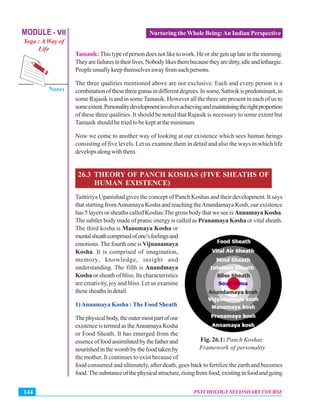
Taittiriya Upanishad gives the concept of Panch Koshas and their development. It says
that starting fromAnnamaya Kosha and reaching theAnandamaya Kosh, our existence
has 5 layers or sheaths called Koshas.The gross body that we see is Annamaya Kosha.
The subtler body made of pranic energy is called as Pranamaya Kosha or vital sheath.
The third kosha is Manomaya Kosha or
mentalsheathcomprisedofone’sfeelingsand
emotions. The fourth one is Vijnanamaya
Kosha. It is comprised of imagination,
memory, knowledge, insight and
understanding. The fifth is Anandmaya
Kosha or sheath of bliss. Its characteristics
are creativity, joy and bliss. Let us examine
thesesheathsindetail.
1)Annamaya Kosha : The Food Sheath
Thephysicalbody,theoutermostpartofour
existenceistermedastheAnnamayaKosha
or Food Sheath. It has emerged from the
essenceoffoodassimilatedbythefatherand
nourishedinthewombbythefoodtakenby
the mother. It continues to exist because of
food consumed and ultimately, after death, goes back to fertilize the earth and becomes
food.Thesubstanceofthephysicalstructure,risingfromfood,existinginfoodandgoing
Fig. 26.1: Panch Koshas:
Framework of personality
MODULE - VII
Yoga : A Way of
Life
Notes
145PSYCHOLOGY SECONDARY COURSE
Nurturing the Whole Being:An Indian Perspective
back to become food, is naturally and most appropriately termed the food sheath.
The food we eat gets transformed into muscles, veins, nerves, blood and bones. If proper
exerciseandproperdietisgiventheAnnamayaKoshadevelopswell.Thesignsofhealthy
development are fitness, agility, stamina and endurance.Aperson having these qualities
can easily master motor skills and has good eye hand co-ordination. Food taken is
transformedintovariousnutritouselementsandmakesusgrowphysically.
2) Pranamaya Kosha: The Vital Sheath
ThePancha-Pranas,whicharecorrespondingtothefivephysiologicalsystemsdescribed
inAyurveda, represent the Vital Sheath. These activities which support the body take
place as a result of the air that we breath in. Hence it is termed theVital Sheath.The five
Pranascomprisingthissheathincludethefollowing:
i) Prana (The Faculty of Perception): It controls the perceptions of the five fold
stimulireceivedfromtheexternalenvironmentthroughthefivesenseorgans.
ii) Apana(TheFacultyofExcretion):Allthingsthrownoutofbodyorrejectedbythe
body such as septum, perspiration, urine, faeces, etc. are expressions ofApana.
iii) Samana (The Faculty of Digestion): Digests the food collected in the stomach.
iv) Vyana (The Faculty of Circulation): The power by which the nutrients resulting
fromthedigestedfoodareproperlycoveyedtothevariouslimbsofthebodythrough
the blood stream.
v) Udana(TheFacultyofThinking):Thecapacityinanindividualtoraisehisthoughts
fromtheirpresentlevelsoastoconceiveapossibilityoforappreciateanewprinciple
or idea-the capacity of self-education.
Thesefivefacultiesgraduallyweakenaspeopleadvanceinage.
The Vital Sheath controls and regulates the Food Sheath. When the pranas do not
functionproperly,thephysicalbodyisaffected.Thesignsofhealthydevelopmentof
PranamayaKoshaareenthusiasm,abilitytousevoiceeffectively,supplenessofbody,
perserverance,leadership,discipline,honestyandnobility.
3) Manomaya Kosha: The Mental Sheath
ThemindregulatesthePranamayaKoshaorVitalSheath.Forexample,whenthemindis
upsetduetosomeshock,thefunctionsofpranasandthebodyareaffected.Mindinterprets
theimpressionsofsenseorgans.Itstoresgoodandbadmemoriesofthepast.Itispossible
to increase the strength of mind by regular prayer, making resolutions and keeping them
up.There is a deep relationship between mind, intellect and body.
MODULE - VII
Yoga : A Way of
Life
Psychology Secondary Course
Notes
PSYCHOLOGY SECONDARY COURSE146
Nurturing the Whole Being:An Indian Perspective
4) Vijnanmaya Kosha:The Intellectual Sheath
The mind (Manas) is that which receives the external stimuli through sense organs and
communicatestheresponsestotheorgansofaction.Thoughthestimulireceivedthrough
thefivesenseorgansaredistinctanddifferentfromoneanother,anintegratedexperience
of them is brought about by the mind. The intellect (Buddhi) is the discriminating and
discerningprocesswhichexaminesandjudgesthestimulireceived.Italsocommunicates
to the mind its decision about the type of responses to be executed. The mind associates
the impressions with pleasantness or unpleasantness based on memory. The intellect
however,withitscapacitytothink,takesarationaldecisionwhichmaynotbelikedbythe
mindbutisultimatelybeneficialtotheperson.
Themindisthestorehouseofallmemoriesandknowledge.Thisstorehouseofexperience
is the guiding factor in man’s actions. The mind can also be described as the seat of
emotionsandtheintellectistoexaminetheareasinwhichtheyoperate.Themindhasthe
capacity to travel only to the ‘realms known’ but the intellect, besides remaining in the
realmsknown,canfurtherpenetrateintothe‘realmsunknown’toinvestigate,contemplate
and comprehend new discoveries.
5)Anandamaya Kosha: The Blissful sheath
This is the innermost of the five sheaths and consists ofVasanas or desires.They exist in
thesubconscious,thewayweexistduringthestateofdeep-sleep.Itisconsideredblissful,
because,whateverbetheconditioninwhichweareinourwakinganddreamstates,once
we reach, all of us experience relatively the same undisturbed peace and bliss due to the
cessation of agitation experienced by us when we are awake or dreaming. The Bliss
SheathcontrolstheintellectualSheath,sincetheintellectfunctionsunderthecontroland
guidance of one’s vasanas.
WhenalltheotherKoshasarewelldevelopedweexperienceharmonybetweentheinner
self and the outer world. This harmony gives us a sense of joy and bliss. The five sheaths
arelikethelayersofclotheswornbyapersonwhicharetotallydifferentfromthewearer.
So too, theAtman or the real self is distinct and separate from the five outer layers.
INTEXT QUESTIONS 26.2
1. What is the concept of panch koshas?
_______________________________________________________________
2. What are the three gunas?
_______________________________________________________________
MODULE - VII
Yoga : A Way of
Life
Notes
147PSYCHOLOGY SECONDARY COURSE
Nurturing the Whole Being:An Indian Perspective
26.4 DEVELOPMENT OF KOSHAS
Personalitydevelopmentmovesfromannamayakoshatothepureconsciousnessgradually
removingallthefivecoversthatmaskit.Regulareatinghabits,rightkindoffood,alltypes
ofexercisesandgames,jogging,running,walkingandAsanasfacilitatethedevelopmentof
AnnamayaKosha.PranayamandbreathingexercisesimprovethequalityofPranamaya
Kosha.ForthedevelopmentofManomayaKoshastudyofgoodliteratureincludingpoems,
novels,essaysandarticlesisuseful.Alltheactivitiesthatchallengeone’sintellectdevelop
VijnanamayaKosha.Theseactivitiesincludedebates,problem-solving,study-techniques,
small research projects, evaluation and appreciation of books and interviewing eminent
persons.Alltheseactivitiesmakeyougobeyondyourtinyselfandgiveyouanopportunity
toidenfitywithyourfellowbeings-yourcommunitymembers,yourcountryandthewhole
world.ThisfacilitatesthedevelopmentofAnandamayaKosha.Eveninyourcontemplation
you can extend your consciousness to reach the earth, the sun, the stars, the galaxies and
theuniverse.Thiswaywegraduallybuildtherelationshipbetweenindividualselforindividual
consciousnessanduniversalselforuniversalconsiousness.
26.5 SRI AUROBINDO ON LEVELS OF CONSCIOUSNESS
SriAurobindo says that two systems are simultaneously active in the organization of the
beinganditsparts:aconcentricsystemandaverticalsystem.Theconcentricsystemislike
a series of rings or sheaths. The outer most circle is comprised of awareness of physical
body, awareness of vital (pranic) body or sheath and awareness of mental sheath. They
areinterconnected.Theinnercircleiscomposedofinnermindwhichisintouchwiththe
universalmindorSupremeEnergy.TheinnermostcoreiscalledPsychicbeingwhichisa
sparkoftheDivine(SupremeEnergy)presentinallofusandineverything.Itisalsocalled
Atman.
Theverticalsystemislikeastaircaseconsistingofvariouslevels,planesofconsciousness
rangingfromthelowest–theinconscienttothehighest–SatChitAnand.Insimplewords,
fromunicellularbeing,humanshaveclimbedinnumerablerungsoftheladderofevolution.
Wehaveanevolvedbodyandmind.Butourevolutionisnotcomplete.Ourconsciousness
hastoclimbseveralrungstoreachstillhigherlevelsandthehighestlevelofconsciousness
whichisendowedwithamazingexperienceofgoodness,freedomandknowledge.
INTEXT QUESTIONS 26.3
1. How can we facilitate the development ofAnandamaya Kosha?
_______________________________________________________________
MODULE - VII
Yoga : A Way of
Life
Psychology Secondary Course
Notes
PSYCHOLOGY SECONDARY COURSE148
Nurturing the Whole Being:An Indian Perspective
2. AccordingtoSriAurobindo,whatistheinnermostcircleofconsciousnesscalled?
_______________________________________________________________
WHAT YOU HAVE LEARNT
• Humanexistenceanditsdevelopmentisamajorconcernofpsychology.
• Bhagwad Gita and Upanishads give us profiles of highly developed life ways.
Upanishadsalsogiveastheconstituentsofhumanpotential.TheyarecalledKoshas.
• Atman,thedivinesparkoflife,livesinthehumanbodywithfivecoveringsonit.The
coverings or sheaths are called Koshas. Annamaya, Pranamaya, Manomaya,
VijananmayaandAnandmayaarethefiveKoshas.
• The food we eat gets transformed into muscles, veins, nerves, blood and bones. If
proper exercise and proper diet is given theAnnamaya Kosha develops well. The
signs of healthy development are fitness, agility, stamina and endurance.Aperson
havingthesequalitiescaneasilymastermotorskillsandhasgoodeyehandcoordination.
Wiring,fitting,welding,knittingaremotorskillsthatinvolveeyehandco-ordination.
Indian psychology says that the body is an effective instrument in the worship of
God. Our duty and work itself is the worship and one is supposed to do it with total
devotion.
• SriAurobindo’s perspective gives us a concentric and a vertical model of our being.
ThedevelopmentaccordingtothisismoreorlesssimilartothedevelopmentofPanch
Koshas.
TERMINAL QUESTIONS
1. Explain any one Kosha in detail.
2. Describe the ways for development of the five Koshas.
ANSWER TO INTEXT QUESTIONS
26.1
1. Personalityisnotmereexternalappearance.Itincludesthewholeexistencethatincludes
physical,socialandspiritualpartsoflife.Anindividual’strueselfornatureisconsidered
as pure consciousness orAtman.
MODULE - VII
Yoga : A Way of
Life
Notes
149PSYCHOLOGY SECONDARY COURSE
Nurturing the Whole Being:An Indian Perspective
26.2
1. PanchKoshasincludethefollowing:Annamayakosha,PranamayaKosha,Manomaya
Kosha,Vigarammaya Kosha,Anandmaya Kosha.
2. Sativik,Passik,Tamsik
26.3
1. Regulareatinghabits,exercise,nightfoodandYoga
2. PsychicbeingorAtman.
Hints forTerminal Questions
1. Refer to section 26.3
2. Refer to section 26.4

Nurturing the whole being an indian perspective

  • 1.
    MODULE - VII Yoga: A Way of Life Psychology Secondary Course Notes PSYCHOLOGY SECONDARY COURSE142 Nurturing the Whole Being:An Indian Perspective 26 NURTURING THE WHOLE BEING: AN INDIAN PERSPECTIVE ‘Every one has in him something divine, something his own, a chance of perfection and strength in however small a sphere which God offers him to take or refuse. The task is to find it, develop it and use it. The chief aim of education should be to help the growing soul, to draw out that in itself is the best and make it perfect for a noble use.’ – Sri Aurobindo Everybodyisattractedtowardsanimpressive"personality".Beingapositiveandeffective personisconsideredtobethebestassetanindividualcanhave.Hencepersonalityandits developmentconstituteamajorconcernforpsychology.While"personality"isuniversally acceptedinpopularcircles,theconceptofpersonalityhasbeenapproachedbypsychologists indifferentways.Also,personalitydoesnotrefertothewholeofourexistencethephysical, social and spiritual. This issue has received attention from the Indian sages from ancient times.BhagvadGitaprovidescomprehensivemodelsofhighlydevelopedhumanpotential. ItemphasizesTriGunaviewwhereasUpanishadslaiddownpanchkoshatheory.Similar topanchkoshatheoryoftheUpnishadsSriAurobindohasgivenacomprehensivesystem ofone’sbeingbasedonhisstudiesonconsciousness.Inthislessonwewillintroduceyou tosomeaspectsofpersonalitydevelopmentfromthesewholisticIndianperspectives. OBJECTIVES Afterstudyingthislesson,youwillbeableto: • definepersonalityinviewofthewholisticIndianperspective; • tofamiliarizewiththeconceptsoftrigunasandpanchkoshas;and • to understand the ways in which the different aspects of existential life can be enhanced.
  • 2.
    MODULE - VII Yoga: A Way of Life Notes 143PSYCHOLOGY SECONDARY COURSE Nurturing the Whole Being:An Indian Perspective 26.1 WHOLISTIC PERSONALITY: AN INDIAN VIEW Thetermpersonalitygenerallyreferstothekindofpersonanindividualis.Itcomesfrom the Latin word ‘persona’ a mask worn in Greek and Roman theaters by actors to enable each actor to play several roles. It also means that the external appearance of a person comprising the characteristics that are accessible to other persons. TheIndianthinkersvisualizedhumanexistenceintermsofanintegratedstructurehaving spiritualaswellasmaterialaspects.InUpanishadstheself,theatmanortheconsciousness is considered as the real core of personality. Consciousness is the eternal and immutable aspect of existence. Thus personality can not be taken as physical appearance (body) only. It extends to the different levels of existence incorporating the physical, social and spirituallevels.Letustrytolearnaboutthismodelofpersonalityinsomedetail. INTEXT QUESTIONS 26.1 1. Describe the Indian concept of personality. _______________________________________________________________ 26.2 THEORY OF TRIGUNAS This theory proposes that entire existence in nature is made up of combination of three Gunas namely Sattwa, Rajas and Tamas. Sattwa represents light, Rajas represents dynamism andTamas represents lethargy or inertia. Human beings too are mixtures or combinations of these three qualities. Geeta describes how different people under the influence of different Gunas behave in diverse ways. Human development is examined withreferencetomovementfromTamastoRajasandthentoSattwa.Thehigheststageis astateofbeingabovethesethreegunas.LetusstudyaboutthreeGunasandpersonalities related to them . Sattwik: This kind of person functions moderately in eating, sleeping and performing variousactivities.Heorshemeditatesregularly,anddoesallhisorherworkasworshipof the Lord. People love this person and this person also loves and helps people. He or she radiates the light of knowledge. Guru Nanak Dev, Hazrat Nizamuddin, Kabir, Meera, Purandar Das, and Thyagaraj are some of the examples of such evolved persons. Rajasik: This type of person is very active, dynamic and addicted to work. If he or she does not have work to do, he or she will feel restless. This kind of a person likes to eat spicyfood.Heorsheisfondofentertainment,sittingatoneplaceandobservingsilenceis difficultforhimorher.Suchpersonsareoftenfoundinthebusinessworld.
  • 3.
    MODULE - VII Yoga: A Way of Life Psychology Secondary Course Notes PSYCHOLOGY SECONDARY COURSE144 Nurturing the Whole Being:An Indian Perspective Tamasik:Thistypeofpersondoesnotliketowork.Heorshegetsuplateinthemorning. Theyarefailuresintheirlives.Nobodylikesthembecausetheyaredirty,idleandlethargic. Peopleusuallykeepthemselvesawayfromsuchpersons. The three qualities mentioned above are not exclusive. Each and every person is a combinationofthesethreegunasindifferentdegrees.Insome,Sattwikispredominant,in some Rajasik is and in some Tamasik. However all the three are present in each of us to someextent.Personalitydevelopmentinvolvesachievingandmaintainingtherightproportion of these three qualities. It should be noted that Rajasik is necessary to some extent but Tamasik should be tried to be kept at the minimum. Now we come to another way of looking at our existence which sees human beings consisting of five levels. Let us examine them in detail and also the ways in which life developsalongwiththem. 26.3 THEORY OF PANCH KOSHAS (FIVE SHEATHS OF HUMAN EXISTENCE) Taittiriya Upanishad gives the concept of Panch Koshas and their development. It says that starting fromAnnamaya Kosha and reaching theAnandamaya Kosh, our existence has 5 layers or sheaths called Koshas.The gross body that we see is Annamaya Kosha. The subtler body made of pranic energy is called as Pranamaya Kosha or vital sheath. The third kosha is Manomaya Kosha or mentalsheathcomprisedofone’sfeelingsand emotions. The fourth one is Vijnanamaya Kosha. It is comprised of imagination, memory, knowledge, insight and understanding. The fifth is Anandmaya Kosha or sheath of bliss. Its characteristics are creativity, joy and bliss. Let us examine thesesheathsindetail. 1)Annamaya Kosha : The Food Sheath Thephysicalbody,theoutermostpartofour existenceistermedastheAnnamayaKosha or Food Sheath. It has emerged from the essenceoffoodassimilatedbythefatherand nourishedinthewombbythefoodtakenby the mother. It continues to exist because of food consumed and ultimately, after death, goes back to fertilize the earth and becomes food.Thesubstanceofthephysicalstructure,risingfromfood,existinginfoodandgoing Fig. 26.1: Panch Koshas: Framework of personality
  • 4.
    MODULE - VII Yoga: A Way of Life Notes 145PSYCHOLOGY SECONDARY COURSE Nurturing the Whole Being:An Indian Perspective back to become food, is naturally and most appropriately termed the food sheath. The food we eat gets transformed into muscles, veins, nerves, blood and bones. If proper exerciseandproperdietisgiventheAnnamayaKoshadevelopswell.Thesignsofhealthy development are fitness, agility, stamina and endurance.Aperson having these qualities can easily master motor skills and has good eye hand co-ordination. Food taken is transformedintovariousnutritouselementsandmakesusgrowphysically. 2) Pranamaya Kosha: The Vital Sheath ThePancha-Pranas,whicharecorrespondingtothefivephysiologicalsystemsdescribed inAyurveda, represent the Vital Sheath. These activities which support the body take place as a result of the air that we breath in. Hence it is termed theVital Sheath.The five Pranascomprisingthissheathincludethefollowing: i) Prana (The Faculty of Perception): It controls the perceptions of the five fold stimulireceivedfromtheexternalenvironmentthroughthefivesenseorgans. ii) Apana(TheFacultyofExcretion):Allthingsthrownoutofbodyorrejectedbythe body such as septum, perspiration, urine, faeces, etc. are expressions ofApana. iii) Samana (The Faculty of Digestion): Digests the food collected in the stomach. iv) Vyana (The Faculty of Circulation): The power by which the nutrients resulting fromthedigestedfoodareproperlycoveyedtothevariouslimbsofthebodythrough the blood stream. v) Udana(TheFacultyofThinking):Thecapacityinanindividualtoraisehisthoughts fromtheirpresentlevelsoastoconceiveapossibilityoforappreciateanewprinciple or idea-the capacity of self-education. Thesefivefacultiesgraduallyweakenaspeopleadvanceinage. The Vital Sheath controls and regulates the Food Sheath. When the pranas do not functionproperly,thephysicalbodyisaffected.Thesignsofhealthydevelopmentof PranamayaKoshaareenthusiasm,abilitytousevoiceeffectively,supplenessofbody, perserverance,leadership,discipline,honestyandnobility. 3) Manomaya Kosha: The Mental Sheath ThemindregulatesthePranamayaKoshaorVitalSheath.Forexample,whenthemindis upsetduetosomeshock,thefunctionsofpranasandthebodyareaffected.Mindinterprets theimpressionsofsenseorgans.Itstoresgoodandbadmemoriesofthepast.Itispossible to increase the strength of mind by regular prayer, making resolutions and keeping them up.There is a deep relationship between mind, intellect and body.
  • 5.
    MODULE - VII Yoga: A Way of Life Psychology Secondary Course Notes PSYCHOLOGY SECONDARY COURSE146 Nurturing the Whole Being:An Indian Perspective 4) Vijnanmaya Kosha:The Intellectual Sheath The mind (Manas) is that which receives the external stimuli through sense organs and communicatestheresponsestotheorgansofaction.Thoughthestimulireceivedthrough thefivesenseorgansaredistinctanddifferentfromoneanother,anintegratedexperience of them is brought about by the mind. The intellect (Buddhi) is the discriminating and discerningprocesswhichexaminesandjudgesthestimulireceived.Italsocommunicates to the mind its decision about the type of responses to be executed. The mind associates the impressions with pleasantness or unpleasantness based on memory. The intellect however,withitscapacitytothink,takesarationaldecisionwhichmaynotbelikedbythe mindbutisultimatelybeneficialtotheperson. Themindisthestorehouseofallmemoriesandknowledge.Thisstorehouseofexperience is the guiding factor in man’s actions. The mind can also be described as the seat of emotionsandtheintellectistoexaminetheareasinwhichtheyoperate.Themindhasthe capacity to travel only to the ‘realms known’ but the intellect, besides remaining in the realmsknown,canfurtherpenetrateintothe‘realmsunknown’toinvestigate,contemplate and comprehend new discoveries. 5)Anandamaya Kosha: The Blissful sheath This is the innermost of the five sheaths and consists ofVasanas or desires.They exist in thesubconscious,thewayweexistduringthestateofdeep-sleep.Itisconsideredblissful, because,whateverbetheconditioninwhichweareinourwakinganddreamstates,once we reach, all of us experience relatively the same undisturbed peace and bliss due to the cessation of agitation experienced by us when we are awake or dreaming. The Bliss SheathcontrolstheintellectualSheath,sincetheintellectfunctionsunderthecontroland guidance of one’s vasanas. WhenalltheotherKoshasarewelldevelopedweexperienceharmonybetweentheinner self and the outer world. This harmony gives us a sense of joy and bliss. The five sheaths arelikethelayersofclotheswornbyapersonwhicharetotallydifferentfromthewearer. So too, theAtman or the real self is distinct and separate from the five outer layers. INTEXT QUESTIONS 26.2 1. What is the concept of panch koshas? _______________________________________________________________ 2. What are the three gunas? _______________________________________________________________
  • 6.
    MODULE - VII Yoga: A Way of Life Notes 147PSYCHOLOGY SECONDARY COURSE Nurturing the Whole Being:An Indian Perspective 26.4 DEVELOPMENT OF KOSHAS Personalitydevelopmentmovesfromannamayakoshatothepureconsciousnessgradually removingallthefivecoversthatmaskit.Regulareatinghabits,rightkindoffood,alltypes ofexercisesandgames,jogging,running,walkingandAsanasfacilitatethedevelopmentof AnnamayaKosha.PranayamandbreathingexercisesimprovethequalityofPranamaya Kosha.ForthedevelopmentofManomayaKoshastudyofgoodliteratureincludingpoems, novels,essaysandarticlesisuseful.Alltheactivitiesthatchallengeone’sintellectdevelop VijnanamayaKosha.Theseactivitiesincludedebates,problem-solving,study-techniques, small research projects, evaluation and appreciation of books and interviewing eminent persons.Alltheseactivitiesmakeyougobeyondyourtinyselfandgiveyouanopportunity toidenfitywithyourfellowbeings-yourcommunitymembers,yourcountryandthewhole world.ThisfacilitatesthedevelopmentofAnandamayaKosha.Eveninyourcontemplation you can extend your consciousness to reach the earth, the sun, the stars, the galaxies and theuniverse.Thiswaywegraduallybuildtherelationshipbetweenindividualselforindividual consciousnessanduniversalselforuniversalconsiousness. 26.5 SRI AUROBINDO ON LEVELS OF CONSCIOUSNESS SriAurobindo says that two systems are simultaneously active in the organization of the beinganditsparts:aconcentricsystemandaverticalsystem.Theconcentricsystemislike a series of rings or sheaths. The outer most circle is comprised of awareness of physical body, awareness of vital (pranic) body or sheath and awareness of mental sheath. They areinterconnected.Theinnercircleiscomposedofinnermindwhichisintouchwiththe universalmindorSupremeEnergy.TheinnermostcoreiscalledPsychicbeingwhichisa sparkoftheDivine(SupremeEnergy)presentinallofusandineverything.Itisalsocalled Atman. Theverticalsystemislikeastaircaseconsistingofvariouslevels,planesofconsciousness rangingfromthelowest–theinconscienttothehighest–SatChitAnand.Insimplewords, fromunicellularbeing,humanshaveclimbedinnumerablerungsoftheladderofevolution. Wehaveanevolvedbodyandmind.Butourevolutionisnotcomplete.Ourconsciousness hastoclimbseveralrungstoreachstillhigherlevelsandthehighestlevelofconsciousness whichisendowedwithamazingexperienceofgoodness,freedomandknowledge. INTEXT QUESTIONS 26.3 1. How can we facilitate the development ofAnandamaya Kosha? _______________________________________________________________
  • 7.
    MODULE - VII Yoga: A Way of Life Psychology Secondary Course Notes PSYCHOLOGY SECONDARY COURSE148 Nurturing the Whole Being:An Indian Perspective 2. AccordingtoSriAurobindo,whatistheinnermostcircleofconsciousnesscalled? _______________________________________________________________ WHAT YOU HAVE LEARNT • Humanexistenceanditsdevelopmentisamajorconcernofpsychology. • Bhagwad Gita and Upanishads give us profiles of highly developed life ways. Upanishadsalsogiveastheconstituentsofhumanpotential.TheyarecalledKoshas. • Atman,thedivinesparkoflife,livesinthehumanbodywithfivecoveringsonit.The coverings or sheaths are called Koshas. Annamaya, Pranamaya, Manomaya, VijananmayaandAnandmayaarethefiveKoshas. • The food we eat gets transformed into muscles, veins, nerves, blood and bones. If proper exercise and proper diet is given theAnnamaya Kosha develops well. The signs of healthy development are fitness, agility, stamina and endurance.Aperson havingthesequalitiescaneasilymastermotorskillsandhasgoodeyehandcoordination. Wiring,fitting,welding,knittingaremotorskillsthatinvolveeyehandco-ordination. Indian psychology says that the body is an effective instrument in the worship of God. Our duty and work itself is the worship and one is supposed to do it with total devotion. • SriAurobindo’s perspective gives us a concentric and a vertical model of our being. ThedevelopmentaccordingtothisismoreorlesssimilartothedevelopmentofPanch Koshas. TERMINAL QUESTIONS 1. Explain any one Kosha in detail. 2. Describe the ways for development of the five Koshas. ANSWER TO INTEXT QUESTIONS 26.1 1. Personalityisnotmereexternalappearance.Itincludesthewholeexistencethatincludes physical,socialandspiritualpartsoflife.Anindividual’strueselfornatureisconsidered as pure consciousness orAtman.
  • 8.
    MODULE - VII Yoga: A Way of Life Notes 149PSYCHOLOGY SECONDARY COURSE Nurturing the Whole Being:An Indian Perspective 26.2 1. PanchKoshasincludethefollowing:Annamayakosha,PranamayaKosha,Manomaya Kosha,Vigarammaya Kosha,Anandmaya Kosha. 2. Sativik,Passik,Tamsik 26.3 1. Regulareatinghabits,exercise,nightfoodandYoga 2. PsychicbeingorAtman. Hints forTerminal Questions 1. Refer to section 26.3 2. Refer to section 26.4