MODULE - IV
Social
Psychological
Processes
Notes
PSYCHOLOGY SECONDARY COURSE36
Social and Educational Problems
16
SOCIAL AND EDUCATIONAL
PROBLEMS
Socialproblemsrefertothesituationsfacedbythepeopleinwhichachievementofgenuine
goals of a community or group are not achieved due to difficulties at the level of system.
Peoplegetharassed,liveunderdisadvantagedconditions,donotgetgoodeducation,and
are subjected to discrimination and prejudice. These are examples of social problems.
Theseproblemshavemanyaspectsincludingsocial,economicpsychologicalandhistorical
andothersolutionrequireseffortsfrommanyangles.Indiansocietyisundergoingsocio-
economic transformation.Also it has a very rich and old cultural heritage. India is also
aspiring to be a strong country at a global level. all these pressures are causing problems
andotherkindsofdevelopment.Someproblemslikeilliteracy,socialtensionandgender
discrimination are well known. Educational problems refer to issues of school dropout,
stagnationandwastage.Theyarealsosocialproblems.Thislessonwillhelpyouunderstand
the psychological aspects of some important social problems faced in the society.
OBJECTIVES
Afterstudyingthislesson,youwillbeableto:
• explainimportantpsychologicalaspectsofsocialproblems:poverty,drugaddiction,
and dowry;
• reflect upon the ways to solve these problems; and
• discuss the extent of school dropout, stagnation and wastage.
16.1 POVERTY
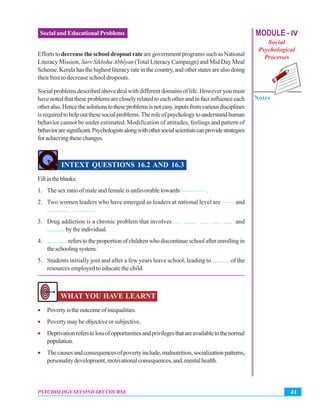
Inourcountry,therearemanypeoplelivinginpoverty.Povertydeniesindividualsandtheir
family of basic rights such as equality, justice, dignity, health, basic comforts and
personal security. Poverty is basically an outcome of inequalities. Poverty is usually
MODULE - IV
Social
Psychological
Processes
Notes
37PSYCHOLOGY SECONDARY COURSE
Social and Educational Problems
definedintermsof objectivepoverty,whichislack ofmaterialbelongingsthatis,lack
of economic resources such as it is difficult to achieve an adequate level of living. Hence
wecansaythatpovertydividesthepopulationbetweenthosewhohaveanadequatelevel
oflivingandthosewhodonot.Subjectivepovertyreferstotheperceptionandexperience
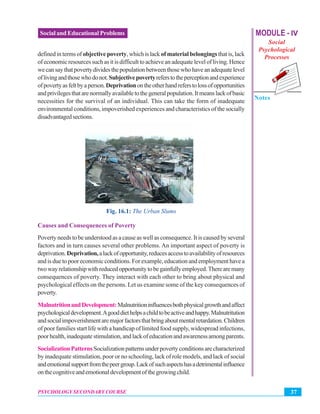
ofpovertyasfeltbyaperson.Deprivationontheotherhandreferstolossofopportunities
andprivilegesthatarenormallyavailabletothegeneralpopulation.Itmeanslackofbasic
necessities for the survival of an individual. This can take the form of inadequate
environmental conditions, impoverished experiences and characteristics of the socially
disadvantagedsections.
Fig. 16.1: The Urban Slums
Causes and Consequences of Poverty
Poverty needs to be understood as a cause as well as consequence. It is caused by several
factors and in turn causes several other problems. An important aspect of poverty is
deprivation.Deprivation,alackofopportunity,reducesaccesstoavailabilityofresources
andisduetopooreconomicconditions.Forexample,educationandemploymenthavea
twowayrelationshipwithreducedopportunitytobegainfullyemployed.Therearemany
consequences of poverty. They interact with each other to bring about physical and
psychological effects on the persons. Let us examine some of the key consequences of
poverty.
MalnutritionandDevelopment:Malnutritioninfluencesbothphysicalgrowthandaffect
psychologicaldevelopment.Agooddiethelpsachildtobeactiveandhappy.Malnutritution
andsocialimpoverishmentaremajorfactorsthatbringaboutmentalretardation.Children
of poor families start life with a handicap of limited food supply, widespread infections,
poorhealth,inadequatestimulation,andlackofeducationandawarenessamongparents.
SocializationPatternsSocializationpatternsunderpovertyconditionsarecharacterized
by inadequate stimulation, poor or no schooling, lack of role models, and lack of social
andemotionalsupportfromthepeergroup.Lackofsuchaspectshasadetrimentalinfluence
onthecognitiveandemotionaldevelopmentofthegrowingchild.
MODULE - IV
Social
Psychological
Processes
Notes
PSYCHOLOGY SECONDARY COURSE38
Social and Educational Problems
PersonalityDevelopment:Differentpersonalitypatternsaresuggestedforthedeprived
and non-deprived groups. Highly deprived children are likely to be high on neuroticism
andintroversion,andlowonextraversionthannon-deprivedchildren.Deprivationisalso
relatedtosocialmaladjustment,immaturity,andwithdrawal.Italsopredisposeschildren
todelinquency,andpronenesstomoreexternalandchanceorientationthannon-deprived
youngadults.
Activity 1
Understanding the concept of poverty.
Talk to people belonging to different backgrounds - friends, family, neighbours,
students,emplyedunemployed,slumdwellers,amongstothers.Askeachpersonto
definepovertyandlistthefivemostimportantreasonsfortheoccurenceofpoverty
inIndia.Addyourownanswerandtabulatethedta.Youcancalculatethefrequency
ofeachcausestatedbythepeople.Discussyourfindingswithyourfamily.
MotivationalConsequences:Theexperiencesofrewardsandpunishmentshelpsinthe
formation of one’s motivational orientation, poverty condition leads to low need for
achievement, low extension need, and a high need for dependence.
Mentalhealth:Thereisincreasingevidenceofastrongassociationbetweenpoormental
healthandtheexperienceofpovertyandderivation.Thetypeandextentofmentalhealth
problemsrangefromhealthproblems,adjustmentishigheriftheindividualisamigrantand
comesfromalowsocio-economicstatus.Althoughmentalillnessoccursinallages,gender
and backgrounds, the risk is higher among the poor and homeless, unemployed, and
withloweducation.
Psychological Interventions:There are many causes and consequences of poverty. It
affects the individual, group and society. Psychologists work with the idea that human
developmentisshapedbytheexperiencesfacedbytheindividual.Theaimtowardshelping
the person then is to train the individual by building up and increasing support to the
deprivedpersonintermsofcognitive,motivationalandbehavioralskills.Suchguidance
willincreasethecompetencylevelsforeffectivefunctioninginsociety.
Psychological interventions do help the deprived and disadvantaged. However we must
keep the following aspects in mind. First, continuous help may lead to psychological
dependency and reliance on others. Under such conditions the deprived will not take
responsibility for their actions and not become self-sufficient. Second, psychological
interventionsshouldbeoperableatallthreelevels:theindividual,communityandsocietal.
Forexample,simultaneouschangesofeducationalpractices,socialpolicyandeconomic
inputwillhavefarreachingimpact.Communityinvolvementbringsaboutcommitmentand
the desire to achieve success in the programmes.
MODULE - IV
Social
Psychological
Processes
Notes
39PSYCHOLOGY SECONDARY COURSE
Social and Educational Problems
INTEXT QUESTIONS 16.1
1.Completethefollowingstatements:
1. Poverty is defined in terms of ————— and —————poverty.
2. Objective poverty is the lack of —————— ——————.
3. Subjective poverty refers to the ——— and ————— felt by the person.
4. ———————————— refers to loss of opportunities and privileges that
arenormallyavailabletothegeneralpopulation.
5. Deprived person must be trained in terms of ——————————, ———
———, and ———————— skills.
6. Psychological interventions for poverty must operate at the ——————, —
—————, and —————————— levels.
2. Explain the causes and consequences of poverty.
16.2 SOME OTHER SOCIAL PROBLEMS
DrugAddiction. Drug addiction is a chronic problem that involves compulsive drug
seekinganddependenceonitdespitethefactthatithasharmfuleffectsontheindividual.
It is often difficult to understand as to why some people become addicted to drugs. It
couldbeduetoacombinationof riskfactorssuchasindividualbiology,socioeconomic
status,peerpressure,stress,qualityofparenting,rolemodels,andagearesomeimportant
aspects. Genetic and environmental factors interact with developmental and maturity
stages in a person’s life.The earlier a person takes to consuming drugs the more serious
the addiction. It is a common problem and a challenge during adolescence, when peer
pressure to experiment with new things is present. Drug addiction is closely related to
crimeandHIV/AIDS.Theeffectsonphysicalandmentalhealtharealsowelldocumented.
Treatment is available to help people counter their addiction; however prevention of
drugaddictionisabetterapproach.Involvingfamilies,schools,colleges,communityand
media are effective ways of countering addiction. Public figures and youth icons can
participateinanti-drugcampaigns.
Dowry. Dowry refers to the cash, gifts, property and material goods the man receives
fromthewife’sfamilyatthetimeofmarriage.Dowrywasearlierawayofhelpingwiththe
marriageexpensesbutnowithasbecomeawayofpayingthegroom’sfamilyfortakingon
the burden of a woman. Due to this aspect the birth of a girl in a family is considered as
an expense, and if the family is poor it puts more strain on the family. There are many
MODULE - IV
Social
Psychological
Processes
Notes
PSYCHOLOGY SECONDARY COURSE40
Social and Educational Problems
reasons for dowry giving and taking.The concern by the girl’s parents to provide a good
andhappylifetotheirdaughterforcesthemtopaylargeamountsasdowrymuchbeyond
theirmeans.Borrowingmoneyathighinterestratestopaydowryoftenputsthefamilyin
perennialdebt.Dowryisasocialcustom,practicedforgenerations.Changingsuchcustoms
is very difficult. This custom puts the young woman at very high risks. The woman who
bringsinlittledowryisatthemercyofthehusband’sfamily,astheymayilltreather,harass
her and indulge in violence and torture. It is sad to note that even in the presence of the
DowryProhibitionAct,1961,dowrydeaths,arebecomingmoreprevalent,andindicating
thatmerelawsdonothelpintheeradicationofthissocialevil.Effectiveimplementation,
active involvement and cooperation of society in removing of this evil must be sought.
Boys and girls must be educated, taught to respect each other, and refusals of dowry are
somewaysoferadicatingthissocialevil.
16.3 SCHOOL DROPOUT, STAGNATION AND WASTAGE
The right to educationis a fundamental right.Yet we note that children who join school
often drop out of schooling. Dropout rate is defined as the proportion of children who
discontinueschoolafterenrollingintheschoolingsystem.Thirtypercentofchildrenleave
schoolbeforecompletingfiveyearsofschoolingand50percentleavebeforecompleting
8yearsofschooling.
Two additional concepts of stagnation and wastage are important in the educational
setting.Educationisnecessaryforthedevelopmentofthepersonandeffectivecontribution
of the person towards society.When the education received is of little or no help to the
person then it is termed as wastage of education. It is important for the growing child to
usetheknowledgeheorshehasgainedfromeducation,initsabsencethereiswastageof
the resources. In addition the educational system needs to keep pace with demands and
needsofthecontextandbringaboutchangesinthecurriculumandknowledgecontentof
differenteducationalfields.Ifitcannotdosotheneducationalstagnationtakesplace.Thus
attheprimaryschoollevelstudentsinitiallyjoinandafterafewyearsleaveschool,leading
to wastage of the resources employed to educate the child. It becomes essential to retain
the child back in school to complete his/her education. Often children are retained in the
same class due to unsatisfactory progress. This further demotivates the child to continue
studyinginschool.
There are various reasons for school dropout, stagnation and wastage. These reasons fall
intothreecategories,namely,socio-economic,psychologicalandeducational.Theabsence
of schooling activities in the vicinity, lack of awareness of necessary education among
parents, poverty, lack of interest in education, absence of educational environment,
examination failure and, the need for children to work for economic reasons are major
reasons for leaving school. In addition, poor systemic support in terms of rules and
procedures of the schooling system, curriculum that is alien to the needs of the students,
poorqualityofeducation,andpoorequipmentalsoplayaroleinincreasingschooldropouts.
MODULE - IV
Social
Psychological
Processes
Notes
41PSYCHOLOGY SECONDARY COURSE
Social and Educational Problems
Efforts todecrease the school dropout rate are government programs such as National
Literacy Mission, Sarv SikhshaAbhïyan (Total Literacy Campaign) and Mid Day Meal
Scheme.Keralahasthehighestliteracyrateinthecountry,andotherstatesarealsodoing
their best to decrease school dropouts.
Social problems described above deal with different domains of life. However you must
havenotedthattheseproblemsarecloselyrelatedtoeachotherandinfactinfluenceeach
otheralso.Hencethesolutionstotheseproblemsisnoteasy,inputsfromvariousdisciplines
isrequiredtohelpoutthesesocialproblems.Theroleofpsychologytounderstandhuman
behavior cannot be under estimated. Modification of attitudes, feelings and pattern of
behavioraresignificant.Psychologistsalongwithothersocialscientistscanprovidestrategies
forachievingthesechanges.
INTEXT QUESTIONS 16.2 AND 16.3
Fillintheblanks:
1. The sex ratio of male and female is unfavorable towards ———— .
2. Two women leaders who have emerged as leaders at national level are —— and
.............. ...............
3. Drug addiction is a chronic problem that involves ..... ........ ...... ..... ...... and
............ by the individual.
4. ..............referstotheproportionofchildrenwhodiscontinueschoolafterenrollingin
theschoolingsystem.
5. Students initially join and after a few years leave school, leading to ........... of the
resources employed to educate the child.
WHAT YOU HAVE LEARNT
• Povertyistheoutcomeofinequalities.
• Poverty may be objective or subjective.
• Deprivationreferstolossofopportunitiesandprivilegesthatareavailabletothenormal
population.
• Thecausesandconsequencesofpovertyinclude,malnutrition,socializationpatterns,
personalitydevelopment,motivationalconsequences,and,mentalhealth.
MODULE - IV
Social
Psychological
Processes
Notes
PSYCHOLOGY SECONDARY COURSE42
Social and Educational Problems
• Psychologicalinterventionsaimtotrainthepersontobuildupandprovidesupportin
termsofcognitive,behaviouralandmotivationalskills.
• Drug addition and dowry seeking are other social problems.
• Intheeducationalsettingthedropoutrateofstudentsfromschoolishigh.Theissues
of stagnation and wastage are relatd to school dropout.
• There are various reasons for school dropout, wastagae and stagnation - socio
economic,psychologicalandeducational.
TERMINAL QUESTIONS
1. Define poverty. Explain the causes and consequences of poverty.
2. Write short notes on :
a. Drugaddiction
b. Dowry
3. Explain the terms ‘stagnation’and ‘Wastage’in the educational setting.What eforts
are being made to reduce school droup outs.
ANSWERS TO INTEXT QUESTIONS
16.1
1. Objective,subjective
2. Materialbelongings
3. Perception,experience
4. Deprivation
5. Cognitive,motivationalandbehavioral
6. Individual,communityandsocietal
2. Deprivation, malnutrition, socialization patterns, personality motivation and mental
health.
16.2
1. Women
2. SarojiniNaiduandIndiraGandhi
3. Dropout
MODULE - IV
Social
Psychological
Processes
Notes
43PSYCHOLOGY SECONDARY COURSE
Social and Educational Problems
4. Wastage
5. Compulsivedrugseeking,dependence
Hints forTerminal Questions
1. Refer to section 16.1
2. Refer to section 16.2
3. Refer to section 16.3

Social and educational problems

  • 1.
    MODULE - IV Social Psychological Processes Notes PSYCHOLOGYSECONDARY COURSE36 Social and Educational Problems 16 SOCIAL AND EDUCATIONAL PROBLEMS Socialproblemsrefertothesituationsfacedbythepeopleinwhichachievementofgenuine goals of a community or group are not achieved due to difficulties at the level of system. Peoplegetharassed,liveunderdisadvantagedconditions,donotgetgoodeducation,and are subjected to discrimination and prejudice. These are examples of social problems. Theseproblemshavemanyaspectsincludingsocial,economicpsychologicalandhistorical andothersolutionrequireseffortsfrommanyangles.Indiansocietyisundergoingsocio- economic transformation.Also it has a very rich and old cultural heritage. India is also aspiring to be a strong country at a global level. all these pressures are causing problems andotherkindsofdevelopment.Someproblemslikeilliteracy,socialtensionandgender discrimination are well known. Educational problems refer to issues of school dropout, stagnationandwastage.Theyarealsosocialproblems.Thislessonwillhelpyouunderstand the psychological aspects of some important social problems faced in the society. OBJECTIVES Afterstudyingthislesson,youwillbeableto: • explainimportantpsychologicalaspectsofsocialproblems:poverty,drugaddiction, and dowry; • reflect upon the ways to solve these problems; and • discuss the extent of school dropout, stagnation and wastage. 16.1 POVERTY Inourcountry,therearemanypeoplelivinginpoverty.Povertydeniesindividualsandtheir family of basic rights such as equality, justice, dignity, health, basic comforts and personal security. Poverty is basically an outcome of inequalities. Poverty is usually
  • 2.
    MODULE - IV Social Psychological Processes Notes 37PSYCHOLOGYSECONDARY COURSE Social and Educational Problems definedintermsof objectivepoverty,whichislack ofmaterialbelongingsthatis,lack of economic resources such as it is difficult to achieve an adequate level of living. Hence wecansaythatpovertydividesthepopulationbetweenthosewhohaveanadequatelevel oflivingandthosewhodonot.Subjectivepovertyreferstotheperceptionandexperience ofpovertyasfeltbyaperson.Deprivationontheotherhandreferstolossofopportunities andprivilegesthatarenormallyavailabletothegeneralpopulation.Itmeanslackofbasic necessities for the survival of an individual. This can take the form of inadequate environmental conditions, impoverished experiences and characteristics of the socially disadvantagedsections. Fig. 16.1: The Urban Slums Causes and Consequences of Poverty Poverty needs to be understood as a cause as well as consequence. It is caused by several factors and in turn causes several other problems. An important aspect of poverty is deprivation.Deprivation,alackofopportunity,reducesaccesstoavailabilityofresources andisduetopooreconomicconditions.Forexample,educationandemploymenthavea twowayrelationshipwithreducedopportunitytobegainfullyemployed.Therearemany consequences of poverty. They interact with each other to bring about physical and psychological effects on the persons. Let us examine some of the key consequences of poverty. MalnutritionandDevelopment:Malnutritioninfluencesbothphysicalgrowthandaffect psychologicaldevelopment.Agooddiethelpsachildtobeactiveandhappy.Malnutritution andsocialimpoverishmentaremajorfactorsthatbringaboutmentalretardation.Children of poor families start life with a handicap of limited food supply, widespread infections, poorhealth,inadequatestimulation,andlackofeducationandawarenessamongparents. SocializationPatternsSocializationpatternsunderpovertyconditionsarecharacterized by inadequate stimulation, poor or no schooling, lack of role models, and lack of social andemotionalsupportfromthepeergroup.Lackofsuchaspectshasadetrimentalinfluence onthecognitiveandemotionaldevelopmentofthegrowingchild.
  • 3.
    MODULE - IV Social Psychological Processes Notes PSYCHOLOGYSECONDARY COURSE38 Social and Educational Problems PersonalityDevelopment:Differentpersonalitypatternsaresuggestedforthedeprived and non-deprived groups. Highly deprived children are likely to be high on neuroticism andintroversion,andlowonextraversionthannon-deprivedchildren.Deprivationisalso relatedtosocialmaladjustment,immaturity,andwithdrawal.Italsopredisposeschildren todelinquency,andpronenesstomoreexternalandchanceorientationthannon-deprived youngadults. Activity 1 Understanding the concept of poverty. Talk to people belonging to different backgrounds - friends, family, neighbours, students,emplyedunemployed,slumdwellers,amongstothers.Askeachpersonto definepovertyandlistthefivemostimportantreasonsfortheoccurenceofpoverty inIndia.Addyourownanswerandtabulatethedta.Youcancalculatethefrequency ofeachcausestatedbythepeople.Discussyourfindingswithyourfamily. MotivationalConsequences:Theexperiencesofrewardsandpunishmentshelpsinthe formation of one’s motivational orientation, poverty condition leads to low need for achievement, low extension need, and a high need for dependence. Mentalhealth:Thereisincreasingevidenceofastrongassociationbetweenpoormental healthandtheexperienceofpovertyandderivation.Thetypeandextentofmentalhealth problemsrangefromhealthproblems,adjustmentishigheriftheindividualisamigrantand comesfromalowsocio-economicstatus.Althoughmentalillnessoccursinallages,gender and backgrounds, the risk is higher among the poor and homeless, unemployed, and withloweducation. Psychological Interventions:There are many causes and consequences of poverty. It affects the individual, group and society. Psychologists work with the idea that human developmentisshapedbytheexperiencesfacedbytheindividual.Theaimtowardshelping the person then is to train the individual by building up and increasing support to the deprivedpersonintermsofcognitive,motivationalandbehavioralskills.Suchguidance willincreasethecompetencylevelsforeffectivefunctioninginsociety. Psychological interventions do help the deprived and disadvantaged. However we must keep the following aspects in mind. First, continuous help may lead to psychological dependency and reliance on others. Under such conditions the deprived will not take responsibility for their actions and not become self-sufficient. Second, psychological interventionsshouldbeoperableatallthreelevels:theindividual,communityandsocietal. Forexample,simultaneouschangesofeducationalpractices,socialpolicyandeconomic inputwillhavefarreachingimpact.Communityinvolvementbringsaboutcommitmentand the desire to achieve success in the programmes.
  • 4.
    MODULE - IV Social Psychological Processes Notes 39PSYCHOLOGYSECONDARY COURSE Social and Educational Problems INTEXT QUESTIONS 16.1 1.Completethefollowingstatements: 1. Poverty is defined in terms of ————— and —————poverty. 2. Objective poverty is the lack of —————— ——————. 3. Subjective poverty refers to the ——— and ————— felt by the person. 4. ———————————— refers to loss of opportunities and privileges that arenormallyavailabletothegeneralpopulation. 5. Deprived person must be trained in terms of ——————————, ——— ———, and ———————— skills. 6. Psychological interventions for poverty must operate at the ——————, — —————, and —————————— levels. 2. Explain the causes and consequences of poverty. 16.2 SOME OTHER SOCIAL PROBLEMS DrugAddiction. Drug addiction is a chronic problem that involves compulsive drug seekinganddependenceonitdespitethefactthatithasharmfuleffectsontheindividual. It is often difficult to understand as to why some people become addicted to drugs. It couldbeduetoacombinationof riskfactorssuchasindividualbiology,socioeconomic status,peerpressure,stress,qualityofparenting,rolemodels,andagearesomeimportant aspects. Genetic and environmental factors interact with developmental and maturity stages in a person’s life.The earlier a person takes to consuming drugs the more serious the addiction. It is a common problem and a challenge during adolescence, when peer pressure to experiment with new things is present. Drug addiction is closely related to crimeandHIV/AIDS.Theeffectsonphysicalandmentalhealtharealsowelldocumented. Treatment is available to help people counter their addiction; however prevention of drugaddictionisabetterapproach.Involvingfamilies,schools,colleges,communityand media are effective ways of countering addiction. Public figures and youth icons can participateinanti-drugcampaigns. Dowry. Dowry refers to the cash, gifts, property and material goods the man receives fromthewife’sfamilyatthetimeofmarriage.Dowrywasearlierawayofhelpingwiththe marriageexpensesbutnowithasbecomeawayofpayingthegroom’sfamilyfortakingon the burden of a woman. Due to this aspect the birth of a girl in a family is considered as an expense, and if the family is poor it puts more strain on the family. There are many
  • 5.
    MODULE - IV Social Psychological Processes Notes PSYCHOLOGYSECONDARY COURSE40 Social and Educational Problems reasons for dowry giving and taking.The concern by the girl’s parents to provide a good andhappylifetotheirdaughterforcesthemtopaylargeamountsasdowrymuchbeyond theirmeans.Borrowingmoneyathighinterestratestopaydowryoftenputsthefamilyin perennialdebt.Dowryisasocialcustom,practicedforgenerations.Changingsuchcustoms is very difficult. This custom puts the young woman at very high risks. The woman who bringsinlittledowryisatthemercyofthehusband’sfamily,astheymayilltreather,harass her and indulge in violence and torture. It is sad to note that even in the presence of the DowryProhibitionAct,1961,dowrydeaths,arebecomingmoreprevalent,andindicating thatmerelawsdonothelpintheeradicationofthissocialevil.Effectiveimplementation, active involvement and cooperation of society in removing of this evil must be sought. Boys and girls must be educated, taught to respect each other, and refusals of dowry are somewaysoferadicatingthissocialevil. 16.3 SCHOOL DROPOUT, STAGNATION AND WASTAGE The right to educationis a fundamental right.Yet we note that children who join school often drop out of schooling. Dropout rate is defined as the proportion of children who discontinueschoolafterenrollingintheschoolingsystem.Thirtypercentofchildrenleave schoolbeforecompletingfiveyearsofschoolingand50percentleavebeforecompleting 8yearsofschooling. Two additional concepts of stagnation and wastage are important in the educational setting.Educationisnecessaryforthedevelopmentofthepersonandeffectivecontribution of the person towards society.When the education received is of little or no help to the person then it is termed as wastage of education. It is important for the growing child to usetheknowledgeheorshehasgainedfromeducation,initsabsencethereiswastageof the resources. In addition the educational system needs to keep pace with demands and needsofthecontextandbringaboutchangesinthecurriculumandknowledgecontentof differenteducationalfields.Ifitcannotdosotheneducationalstagnationtakesplace.Thus attheprimaryschoollevelstudentsinitiallyjoinandafterafewyearsleaveschool,leading to wastage of the resources employed to educate the child. It becomes essential to retain the child back in school to complete his/her education. Often children are retained in the same class due to unsatisfactory progress. This further demotivates the child to continue studyinginschool. There are various reasons for school dropout, stagnation and wastage. These reasons fall intothreecategories,namely,socio-economic,psychologicalandeducational.Theabsence of schooling activities in the vicinity, lack of awareness of necessary education among parents, poverty, lack of interest in education, absence of educational environment, examination failure and, the need for children to work for economic reasons are major reasons for leaving school. In addition, poor systemic support in terms of rules and procedures of the schooling system, curriculum that is alien to the needs of the students, poorqualityofeducation,andpoorequipmentalsoplayaroleinincreasingschooldropouts.
  • 6.
    MODULE - IV Social Psychological Processes Notes 41PSYCHOLOGYSECONDARY COURSE Social and Educational Problems Efforts todecrease the school dropout rate are government programs such as National Literacy Mission, Sarv SikhshaAbhïyan (Total Literacy Campaign) and Mid Day Meal Scheme.Keralahasthehighestliteracyrateinthecountry,andotherstatesarealsodoing their best to decrease school dropouts. Social problems described above deal with different domains of life. However you must havenotedthattheseproblemsarecloselyrelatedtoeachotherandinfactinfluenceeach otheralso.Hencethesolutionstotheseproblemsisnoteasy,inputsfromvariousdisciplines isrequiredtohelpoutthesesocialproblems.Theroleofpsychologytounderstandhuman behavior cannot be under estimated. Modification of attitudes, feelings and pattern of behavioraresignificant.Psychologistsalongwithothersocialscientistscanprovidestrategies forachievingthesechanges. INTEXT QUESTIONS 16.2 AND 16.3 Fillintheblanks: 1. The sex ratio of male and female is unfavorable towards ———— . 2. Two women leaders who have emerged as leaders at national level are —— and .............. ............... 3. Drug addiction is a chronic problem that involves ..... ........ ...... ..... ...... and ............ by the individual. 4. ..............referstotheproportionofchildrenwhodiscontinueschoolafterenrollingin theschoolingsystem. 5. Students initially join and after a few years leave school, leading to ........... of the resources employed to educate the child. WHAT YOU HAVE LEARNT • Povertyistheoutcomeofinequalities. • Poverty may be objective or subjective. • Deprivationreferstolossofopportunitiesandprivilegesthatareavailabletothenormal population. • Thecausesandconsequencesofpovertyinclude,malnutrition,socializationpatterns, personalitydevelopment,motivationalconsequences,and,mentalhealth.
  • 7.
    MODULE - IV Social Psychological Processes Notes PSYCHOLOGYSECONDARY COURSE42 Social and Educational Problems • Psychologicalinterventionsaimtotrainthepersontobuildupandprovidesupportin termsofcognitive,behaviouralandmotivationalskills. • Drug addition and dowry seeking are other social problems. • Intheeducationalsettingthedropoutrateofstudentsfromschoolishigh.Theissues of stagnation and wastage are relatd to school dropout. • There are various reasons for school dropout, wastagae and stagnation - socio economic,psychologicalandeducational. TERMINAL QUESTIONS 1. Define poverty. Explain the causes and consequences of poverty. 2. Write short notes on : a. Drugaddiction b. Dowry 3. Explain the terms ‘stagnation’and ‘Wastage’in the educational setting.What eforts are being made to reduce school droup outs. ANSWERS TO INTEXT QUESTIONS 16.1 1. Objective,subjective 2. Materialbelongings 3. Perception,experience 4. Deprivation 5. Cognitive,motivationalandbehavioral 6. Individual,communityandsocietal 2. Deprivation, malnutrition, socialization patterns, personality motivation and mental health. 16.2 1. Women 2. SarojiniNaiduandIndiraGandhi 3. Dropout
  • 8.
    MODULE - IV Social Psychological Processes Notes 43PSYCHOLOGYSECONDARY COURSE Social and Educational Problems 4. Wastage 5. Compulsivedrugseeking,dependence Hints forTerminal Questions 1. Refer to section 16.1 2. Refer to section 16.2 3. Refer to section 16.3