MODULE - VI
Work Life and
Environmental
Concerns
Notes
PSYCHOLOGY SECONDARY COURSE94
TheWorld of Organizations
22
THE WORLD OF ORGANIZATION
In today’s world an individual alone can not achieve all the desired goals because any
activity requires contributions from many persons. Therefore, people often get together
andworktoachieveacommongoal.Forthispurposecoordinationandsystematicapproach
is needed. Such a group of people is called an ‘association’.You must have seen in your
localitywheretwoormorepeoplegettogetherandstartabusinessoftheirown.Thisisan
exampleofasmallorganizationwhereaslargefactorieswiththousandsofemployeesare
examplesoflargeorganizations.Everyorganizationhasitsownnormsbecauseitworksas
a system. This lesson will help you to know about the key features of organizations’ and
familiarizeyouwiththeworldoforganizations.
OBJECTIVES
Afterstudyingthislesson,youwillbeableto:
• describeorganizationasasystem;
• explainorganizationalclimate;and
• analyzefactorsinfluencingproductivityandexcellenceatwork.
22.1 ORGANIZATION AS A SYSTEM
An organization is a social unit which is created with a specific purpose.We can have a
better understanding of an organization if we view it as a system. The systems approach
recognizesthatorganizationshaveuniqueproperties,capabilitiesanditscomponentshold
mutual relationships.Asystem may be either closed or open.Aclosed system does not
haveanyinteractionwiththeexternalenvironment.Modernorganizationsaremoreorless
opensystems.
MODULE - VI
Work Life and
Environmental
Concerns
Notes
95PSYCHOLOGY SECONDARY COURSE
TheWorld of Organizations
An open system is in constant interaction with the environment. It is characterized by a
continuingprocessofinput,transformation,andoutput.Theorganizationsgetinputsfrom
theenvironmentandtransformthemintooutputswhichcanbesuppliedtotheenvironment.
Theorganizationgetsfeedbackfromtheenvironmentandtakessuitablestepstomeetthe
challengesandexpectationsoftheenvironment.Letusunderstandthesetermsindetail.
Inputs:Eachsystemtakescertainkindsofinputsfromitsenvironment.Thesemaybein
theformofHumanResource(HR),Capital,Technology,Material,andInformation.The
inputsreceivedfromtheenvironmentareprocessedwithintheorganizationtoproducethe
desired output.
Outputs: Outputs may be both intended as well as unintended. Intended outputs are
usually called objectives. For instance high productivity is an intended objective.An
unintendedobjectivemaybeinformalrelationsamongthegroupmembers.Itmayhowever,
be stated that all unintended consequences are not undesirable.
Environment: An organization is called an open system because it is influenced by and
also influences the environment. The suppliers of inputs, customers and many other
organizationsconstitutetheenvironmentofasystem.Throughtheprocessoffeedbackthe
systemgetsconnectedwiththeenvironment.
Activity 1
LearningAboutOrganization
Identifyanorganizationintheregionwhereyoustayanddescribetheinputs,outputs
andtypeofenvironmentinconnectionwiththatorganization.
Thus it is clear that organizations do not exist in a vacuum. They are social institutions
operatinginthelargersocietyofwhichtheyareapart.Theorganizationandtheindividual
bothshareareciprocalrelationship.Forexamplethenatureoforganizationsandtechnology
have all changed society. We are becoming used to modern amenities like computers,
internet,mobileandotherelectricalappliances.Thusmoderntechnologyhastransformed
thelifestyleinmanyways.Indiahasbeenprimarilyanagrariansocietyinthepast,butwith
alltheadvancementitismovingtowardanindustrialmodeoflife.Thisshifthasbrought
with it a change in the attitudes and values of the people. Competition and consumerism
arebecomingimportantinthecontextofgrowingmarketeconomy.
Sub Systems of an Organization
Organizations usually have a number of parts or sub systems. The key sub systems are
describedbelow:
i) GoalSubsystem:Itcomprisesoftheoverallgoalsandobjectivesoftheorganization
andalsothespecificgoalsofdifferentdepartmentsandindividualsintheorganization.
MODULE - VI
Work Life and
Environmental
Concerns
Notes
PSYCHOLOGY SECONDARY COURSE96
TheWorld of Organizations
ii) Technical Subsystem : This subsystem refers to the use of knowledge, facilities
equipmentandtechnologybythepeoplewhoworkintheorganization.
iii) Managerial Subsystem : This involves planning and co-ordination of the activities
undertakenintheorganization.
iv) Structural Subsystem : People work together on well defined tasks and integrated
activitiesindifferentunits(likeproduction,marketing,HR)ordepartments.Theymake
upthestructuralsubsystems.
v) PsychologicalSubsystem:Peopleliveinsocialrelationshipswithinanorganization.
Thismustnotbeviewedsimplyintermsofpeopleandtechnologybutalsointermsof
coordinationorstructureofworktasksbasedonfollowingcertainrules,regulations,
norms,andvalues.
Itmayberememberedthateachofthesubsystemshasitsspecificsignificance.Forexample
thegoalsubsystemdetermineswhatwork,task,andactivitiesshouldbeundertaken.Itis
importantthatthesegoalsandobjectivesareinagreementwiththegoalsofthesocietyat
large.
22.2 ORGANIZATIONAL CLIMATE
Climate is the atmosphere of an organization, a relatively enduring quality of its internal
environment, which is experienced by the members and influences their performance. It
conveys the impression people have about the internal environment within which they
work.Itmayalsobeviewedasthedegreetowhichorganizationalrulesarereinforcedby
theadministrativecomponent.Italsorepresentstheattitudesoftheorganizationalmembers
towardtheorganizationitself.
Thusorganizationalclimateoftendistinguishesoneorganizationfromanother.Itisrelatively
enduring over a period of time, and influences the behaviour of the members of an
organization. It may be noted that there may be differences in the climate of different
departments like HR, production, research and development.
Inunderstandingorganizationalclimateitisnecessarytoknowhoworganizationmembers
communicate and relate to each other, the amount of cooperation between the level of
satisfactionandsoforth.Allthesefactorsdeterminetheeffectivenessofanorganization.
Anorganizationislikelytobemoreeffectiveifthereistwo–waycommunication;employees
arecooperativeandhaveapositiveviewoftheorganization.Suchemployeeshavehigher
job satisfaction and commitment. Their productivity will also be higher. A positive
organizationalclimateresultsinmakingemployeesmoresatisfiedandproductive.
Determinants of Climate
Manyfactorsdeterminetheclimateofanorganization.Atleastfouroftheseseemespecially
relevant.Theseare:
MODULE - VI
Work Life and
Environmental
Concerns
Notes
97PSYCHOLOGY SECONDARY COURSE
TheWorld of Organizations
i) OrganizationalStructure:Itistheframeworkofauthority–responsibilityrelationship
in an organization. It clarifies who is to supervise whom and who is responsible to
whom. It serves as the basis of interpersonal relationships between supervisors,
subordinates and coworkers. For example if the top management feels the need to
givegreateremphasistothesubordinates,itwillfollowadecentralizedstructure.This
meanstherewillbefewerlayersinthehierarchyandemployeeswouldbeencouraged
to participate in decision making. But if top management likes to maintain greater
consistencyindecisionmaking,itwouldfollowacentralizedstructure.
ii) Technology:The nature of technology employed by an organization also influences
theorganizationalclimate.Forexampleroutinetechnologieslikeassemblylinestend
to create rules, leading to a rigid climate where trust and creativity are low. More
dynamicandchangingtechnologiese.g.aerospaceengineeringseemtoleadtogreater
trustandpersonalresponsibilityfortaskaccomplishment.
iii) ExternalEnvironment:Externaleventsorfactorsthathaverelevanceforemployees
may also affect the climate. For example when economic conditions are severe,
organizations are forced to cut down the number of employees. Those who remain
wouldprobablyperceivetheclimateasthreateningwithlittlewarmth,supportandlow
motivation.
iv) Management Policies and Practices: Managers who provide their subordinates
withmoreautonomyandfeedbackcontributesignificantlytothecreationofachievement
orientedclimateleadingtogreaterproductivity.
INTEXT QUESTIONS 22.1
1. Whatisanorganization?
_______________________________________________________________
2. Givetwoexamplesofinputfromtheenvironmentinanorganization.
_______________________________________________________________
3. Nameanythreesubsystemsofanorganization.
_______________________________________________________________
22.3 INTERPERSONAL RELATIONSHIPS AT WORK
Performing a task in an organization often involves contributions by many people. It is a
socialactivity.Virtuallyanykindofworkrequiressocialinteractionwithseveralindividuals.
Thesalesmaninteractswithhiscustomers,thedoctorwithhispatients,thesupervisorwith
MODULE - VI
Work Life and
Environmental
Concerns
Notes
PSYCHOLOGY SECONDARY COURSE98
TheWorld of Organizations
hissubordinatesandtheteacherwithstudents.Further,mostworkersaremembersofone
ormoreworkgroupswithwhomtheymayinteractmorefrequently.
Interpersonalrelationsmaybeseentoformcontracts.Thesecontractsinvolveagreements
tointeractinparticularways.Wemayinteractwithmanypeoplebutmaynotnecessarily
enter into a relationship.Arelationship comes into existence only when we have certain
expectations about appropriate ways of behaving.
In the work context employees build different kinds of relationships with others. These
maybearesultofboththeformalworkroleandthepositionintheorganizationalhierarchy.
People have to interact with the boss, with coworkers and the peer group.
Superior-SubordinateRelationship
Everyemployeehastobuildarelationshipwiththebosstoseekinstructionsandguidance.
Itisthebosswhoallows(ordisallows)thesubordinatetoparticipateindecisionmaking,
gives assignments, evaluates performance, determines pay increments and decides who
hastobepromoted.Thekindofrelationshipthatanemployeeshareswiththebossdepends
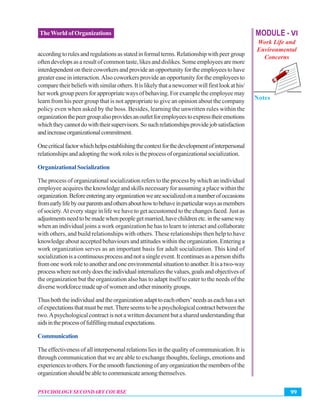
upon the leadership style adopted by the boss. These are described in Box 22.2.
Leadership Style Nature of Relationships with Workers
Authoritarian: Management directs and uses threats and punishment to
enfore orders and get the work done by subordinates.
Involvesonewaydownwardcommunication.
Paternalistic: Basically authoritative but permits some participation to
subordinates.Involvestwo-waycommunicationbetween
bossandsubordinates.Rewardsandthreatsareemployed
to enforce the orders.
Consultative: Orders are issued and goals set after consultation with the
employees.Team work is encouraged to some extent.
Participative: Employeesarefullyinvolvedinsettingthegoalsandtwo-
waycommunicationbecomesthenorm.
Generally the more the boss takes into consideration the needs and judgments of the
subordinatesandthemoreparticipativehisstyleoffunctioningthegreatertheproductivity
and satisfaction of the employees and the less the absenteeism and employee turnover.
Relationship with Co-workers and Peer Group
We spend more time with our colleagues than with anyone else.The work group context
affects our experiences at the work place. Relationship with coworkers does not develop
MODULE - VI
Work Life and
Environmental
Concerns
Notes
99PSYCHOLOGY SECONDARY COURSE
TheWorld of Organizations
accordingtorulesandregulationsasstatedinformalterms.Relationshipwithpeergroup
oftendevelopsasaresultofcommontaste,likesanddislikes.Someemployeesaremore
interdependentontheircoworkersandprovideanopportunityfortheemployeestohave
greater ease in interaction.Also coworkers provide an opportunity for the employees to
comparetheirbeliefswithsimilarothers.Itislikelythatanewcomerwillfirstlookathis/
her work group peers for appropriate ways of behaving. For example the employee may
learn from his peer group that is not appropriate to give an opinion about the company
policy even when asked by the boss. Besides, learning the unwritten rules within the
organizationthepeergroupalsoprovidesanoutletforemployeestoexpresstheiremotions
whichtheycannotdowiththeirsupervisors.Sosuchrelationshipsprovidejobsatisfaction
andincreaseorganizationalcommitment.
Onecriticalfactorwhichhelpsestablishingthecontextforthedevelopmentofinterpersonal
relationshipsandadoptingtheworkrolesistheprocessoforganizationalsocialization.
OrganizationalSocialization
The process of organizational socialization refers to the process by which an individual
employee acquires the knowledge and skills necessary for assuming a place within the
organization.Beforeenteringanyorganizationwearesocializedonanumberofoccasions
fromearlylifebyourparentsandothersabouthowtobehaveinparticularwaysasmembers
of society.At every stage in life we have to get accustomed to the changes faced. Just as
adjustmentsneedtobemadewhenpeoplegetmarried,havechildrenetc.inthesameway
when an individual joins a work organization he has to learn to interact and collaborate
with others, and build relationships with others. These relationships then help to have
knowledge about accepted behaviours and attitudes within the organization. Entering a
work organization serves as an important basis for adult socialization. This kind of
socializationisacontinuousprocessandnotasingleevent.Itcontinuesasapersonshifts
fromoneworkroletoanotherandoneenvironmentalsituationtoanother.Itisatwo-way
processwherenotonlydoestheindividualinternalizesthevalues,goalsandobjectivesof
the organization but the organization also has to adapt itself to cater to the needs of the
diverse workforce made up of women and other minority groups.
Thusboththeindividualandtheorganizationadapttoeachothers’needsaseachhasaset
ofexpectationsthatmustbemet.Thereseemstobeapsychologicalcontractbetweenthe
two.Apsychological contract is not a written document but a shared understanding that
aidsintheprocessoffulfillingmutualexpectations.
Communication
The effectiveness of all interpersonal relations lies in the quality of communication. It is
through communication that we are able to exchange thoughts, feelings, emotions and
experiencestoothers.Forthesmoothfunctioningofanyorganizationthemembersofthe
organizationshouldbeabletocommunicateamongthemselves.
MODULE - VI
Work Life and
Environmental
Concerns
Notes
PSYCHOLOGY SECONDARY COURSE100
TheWorld of Organizations
Meaning:Communicationentailsthetransferofmeaningbetweenasenderandreceiver.
Itestablishesacommonframeofreferenceforunderstandingamongindividuals.Although
somebasicformofcommunicationoccursbetweenalllivingorganisimsnonetheless,only
humanbeingshavetheuniquecapacitytotransmitinformationwiththehelpofsymbols.
Symbolscouldrefertosimpleobjectsinthephysicalworldliketables,chairs,booksetc,
or they may refer to activities like eating, reading, sleeping and so forth.At an abstract
levelsymbolsmaybeusedtorefertoconceptslikeintelligence,truth,worthiness,etc.The
useoflanguagebyhumansrepresentsthemostevolveduseofsymbols.Communication
may be spoken or written. It may take place between (a) two individuals, (b) in a group,
(c)intheentireorganization,and(d)withmasses.
Organizational communication may entail the use of computers. Thus from the point of
viewoforganizationbothmechanicalandhumancommunicationbecomeimportant.The
generalcommunicationprocessisdiscussedindetailinlesson20.
22.4 PRODUCTIVITY AND EXCELLENCE AT WORK
When organizations meet the expectations of the people every one benefits i.e. owners,
employees, customers and local communities in which they operate. Then they are
consideredeffective.However,whentheyexceedtheminimumstandardsofeffectiveness
theymaybeconsideredtohaveachievedexcellence.Overtimeexcellencebringsreputation
– that is when an organization is regarded and recognized for superior performance. To
achieveexcellenceanorganizationmustbeproductiveandbeabletotransforminputsinto
outputsatminimumcost.Individualbehaviourinorganizationsisjointlydeterminedbytwo
factors – the characteristics of the perceived environment and the characteristics of the
individual.Theperceivedenvironmentorclimatehasbeenexaminedinsomedetailearlier.
Letusexaminetheroleofindividualcharacteristicsandthewaytheyinfluenceproductivity
andexcellenceatwork,andultimatelythesuccessorfailureofanorganization.
When questions about organizational output and productivity are analyzed from the
standpoint of individual employees the importance of good job performance becomes
apparent.Without superior performance at all levels of the organization, the objective of
attaininggoalsandtherebyachievingproductivitybecomesverydifficult.Anyorganization
willbeabletosuccessfullymeetitsobjectives,onlywhenindividualemployeesareableto
meet their personal goals. Thus, it becomes important to identify the factors responsible
for individual performance which has repercussions for organizational productivity and
excellenceinthelongrun.
Factors Influencing Productivity and Excellence
Theimportantfactorswhichinfluenceanindividual’sperformanceandtherebyproductivity
are as follows.
MODULE - VI
Work Life and
Environmental
Concerns
Notes
101PSYCHOLOGY SECONDARY COURSE
TheWorld of Organizations
i)Abilities,Aptitudes and Interests
Ability,aptitudeandinterestrepresentthoseindividualcharacteristicsthatlargelydetermine
an employees capacity to contribute to an organization. These attributes are relatively
stableovertime,thoughsomechangesarepossiblethroughtraining.Concernhereisnot
somuchwithadetailedexaminationoftherangeofhumanattributesandtheirmeasurement
butratherwiththeimplicationsofvariationsinsuchattributesastheyaffectproductivity
andexcellenceinorganizationalsettings.Thesehavebeendiscussedindetailinlesson20.
Employee’sabilitiescanaffectproductivityandperformanceinmanyways.Forinstance
managerial success has been shown to be closely related to the level of one’s intellectual
capacities (for e.g. verbal comprehension, reasoning ability and memory). In fact, it has
beensuggestedthatathigherlevelsintheorganizationalhierarchyintellectualabilitiesare
importantformanagerialperformance.Thiswouldentailselectingandrecruitingemployees
with appropriate abilities and offering jobs which are sufficiently challenging. Hiring
employees of superior intellectual capacities and then placing them on a dull and routine
job would shift their performance and have an impact on productivity. Additionally
productivityisalsodependentontheappropriatematchofthepersonalitytraitsandinterests
of a person with the right job profile.
ii) Role Clarity
Thedegreetowhichanindividualunderstandsthejobrequirementsandworkobjectives
themoreenergywillbeatthedisposalofgoaldirectedactivities.Moreover,roleclarityis
related to increased goal commitment, involvement and productivity.These are two role
relatedproblemswhichcanservetodiminishproductivity.Inthelongruntheyare(a)role
ambiguityand(b)roleconflict.Roleambiguityexistswhereindividualisconfrontedwith
two sets of role demands that are incompatible. For instance an employee’s supervisor
mayasktoincreasethenumberofgoodsproduced,butthecoworkersmaybeemphasizing
the need to maintain the number of items produced at the current level. This has a direct
impactonorganizationalproductivitytotheextentthatthegoalrelatedroleprescriptions
oftheemployeecomeinconflictwithotherdemands.Thusorganizationswhichattemptto
integratepersonalorgroupgoalswithorganizationalobjectiveshelptosatisfybothsetsof
demandsandalleviateconflicts.
iii) The Performance Environment
In order to increase productivity at work it is important for managers to understand the
natureoftheperformanceenvironmentwheregoaldirectedactivitiestakeplace,andtobe
able to modify this environment where needed. This would ensure a more suitable
atmosphereforemployeeeffort,performanceandultimatelyproductivityandexcellence.
MODULE - VI
Work Life and
Environmental
Concerns
Notes
PSYCHOLOGY SECONDARY COURSE102
TheWorld of Organizations
22.5 STRATEGIES FOR DEVELOPING PRODUCTIVITY
AT WORK
Fourprincipalstrategiesexistfordevelopingandenhancingproductivityandexcellenceat
work:(1)employeeselectionandplacement;(2)traininganddevelopment(3)taskdesign
and (4) performance appraisal and rewards. Together, such activities can contribute
substantiallytoimprovingproductivityatworkwhichultimatelyisakeyfactorincontributing
toorganizationalexcellence.Theseareexplainedbelow.
i) Employee Selection and Placement
Byselectingonlythosewithhighabilityandskilllevels,highinitialmotivationallevelsand
thenplacingthemonsuitablejobs–organizationscanimprovetheinitialqualityofatleast
someofthehumaninputswhichgoontodetermineexcellenceatwork.Recruitmentand
selectionmayalsosubstituteforemployeesocializationandtraining.Ifdesirableemployees
can be secured through a combination of recruitment and socialization, it would ensure
organizationalsuccess.
ii)Training and Development
Training can serve to develop the capabilities not only in the present job but also future
jobs.Infacttrainingisaninvestmentinemployees(atalentbank)thatcanbedrawnupon
in the future. Employee training programmes may take a variety of forms including
informationpresentationtechniques(suchaslectures),casestudies,roleplayandsoforth.
iii) Task Design
Theeffectsoftaskdesignonproductivityandexcellencearetwo-fold.Ingeneralincreasing
theamountofvariety,autonomy,responsibility,feedbackandtaskidentity(orcompleteness
of task) can improve performance. The important thing then for both individuals and
organizationsistounderstandtheneed-strengthandgoalsforredesigningthejobs.
iv) PerformanceAppraisal and Rewards
Finally,avarietyofmethodsareavailabletoguide,directandrewardemployee-behaviour.
Formal performance appraisal and appropriate use of reward system represent two such
methods.
INTEXT QUESTIONS 22.2
State whether the following statements areTrue or False :
1. Work is a social activity.
2. Allworksrequiresocialinteraction.
MODULE - VI
Work Life and
Environmental
Concerns
Notes
103PSYCHOLOGY SECONDARY COURSE
TheWorld of Organizations
3. Inauthoritarianrelationshipemployeesarefullyinvolvedinsettinggoals.
4. Theprocessoforganizationalsocializationisafactorindeterminingthedevelopment
ofinterpersonalrelationshipsatwork.
5. Roleclarityinfluencesproductivityatwork.
WHAT HAVE YOU LEARNT
• Anorganizationisasocialunitwhichisformedwithaspecificpurpose.
• As an open system an organization gets feedback from the environment and takes
suitablestepstomeetthechallengesandexpectationsoftheenvironment.
• Organizations have a number of parts or sub systems such as Goal Subsystems,
Technical Subsystem, Managerial Subsystem, Structural Subsystem, Psychological
Subsystem.
• The organizational climate may be defined as a set a characteristics that describe an
organizationandthatdistinguishoneorganizationfromanother.Thesecharacteristics
arerelativelyenduringoveraperiodoftime,andinfluencethebehaviourofthemembers
ofanorganization.
• Manyfactorsdeterminethenatureofclimateprevalentinanorganization.Theseinclude
organizationalstructure,technology,externalenvironmentandmanagementpolicies
and practices.
• Theeffectivenessofallinterpersonalrelationshipsrestsoncommunication.
• To achieve excellence an organization must be productive and be able to transform
inputsintooutputsatminimumcost.
• Factorsinfluencingproductivityandexcellenceincludeabilities,aptitudeandinterests;
roleclarityandperformanceenvironment.
• Strategiesfordevelopingproductivityatworkareemployeeselectionandplacement,
traininganddevelopment,taskdesign,performanceappraisalandwork.
TERMINAL EXERCISE
1. Describeanytwosubsystemsofanorganization.
2. Listthedeterminantsoforganizationalclimateandexplainanytwodeterminants.
3. Writeshortnoteonanytwoofthefollowing:
i. Relationshipwithco-workers.
MODULE - VI
Work Life and
Environmental
Concerns
Notes
PSYCHOLOGY SECONDARY COURSE104
TheWorld of Organizations
ii. Productivityandexcellenceatwork.
iii. Strategiesfordevelopingproductivityatwork.
ANSWERS TO INTEXT QUESTIONS
22.1
1. Anorganizationisasocialunitwhichisformedwithaspecificpurpose.
2. HumanResource,CapitalTechnology,Material,Information (anytwo)
3. Goalsubstem,Technicalsubsystem,Managerialsubsystem,structuralsubsystem,
(anythree)
22.2
1) True
2) True
3) False
4) True
5) True
Hints forTerminal Questions
1. Refer to section 22.1
2. Refer to section 22.2
3. i) Refer to section 22.3
ii) Refer to section 22.4
iii) Refer to section 22.5

The world of organization

  • 1.
    MODULE - VI WorkLife and Environmental Concerns Notes PSYCHOLOGY SECONDARY COURSE94 TheWorld of Organizations 22 THE WORLD OF ORGANIZATION In today’s world an individual alone can not achieve all the desired goals because any activity requires contributions from many persons. Therefore, people often get together andworktoachieveacommongoal.Forthispurposecoordinationandsystematicapproach is needed. Such a group of people is called an ‘association’.You must have seen in your localitywheretwoormorepeoplegettogetherandstartabusinessoftheirown.Thisisan exampleofasmallorganizationwhereaslargefactorieswiththousandsofemployeesare examplesoflargeorganizations.Everyorganizationhasitsownnormsbecauseitworksas a system. This lesson will help you to know about the key features of organizations’ and familiarizeyouwiththeworldoforganizations. OBJECTIVES Afterstudyingthislesson,youwillbeableto: • describeorganizationasasystem; • explainorganizationalclimate;and • analyzefactorsinfluencingproductivityandexcellenceatwork. 22.1 ORGANIZATION AS A SYSTEM An organization is a social unit which is created with a specific purpose.We can have a better understanding of an organization if we view it as a system. The systems approach recognizesthatorganizationshaveuniqueproperties,capabilitiesanditscomponentshold mutual relationships.Asystem may be either closed or open.Aclosed system does not haveanyinteractionwiththeexternalenvironment.Modernorganizationsaremoreorless opensystems.
  • 2.
    MODULE - VI WorkLife and Environmental Concerns Notes 95PSYCHOLOGY SECONDARY COURSE TheWorld of Organizations An open system is in constant interaction with the environment. It is characterized by a continuingprocessofinput,transformation,andoutput.Theorganizationsgetinputsfrom theenvironmentandtransformthemintooutputswhichcanbesuppliedtotheenvironment. Theorganizationgetsfeedbackfromtheenvironmentandtakessuitablestepstomeetthe challengesandexpectationsoftheenvironment.Letusunderstandthesetermsindetail. Inputs:Eachsystemtakescertainkindsofinputsfromitsenvironment.Thesemaybein theformofHumanResource(HR),Capital,Technology,Material,andInformation.The inputsreceivedfromtheenvironmentareprocessedwithintheorganizationtoproducethe desired output. Outputs: Outputs may be both intended as well as unintended. Intended outputs are usually called objectives. For instance high productivity is an intended objective.An unintendedobjectivemaybeinformalrelationsamongthegroupmembers.Itmayhowever, be stated that all unintended consequences are not undesirable. Environment: An organization is called an open system because it is influenced by and also influences the environment. The suppliers of inputs, customers and many other organizationsconstitutetheenvironmentofasystem.Throughtheprocessoffeedbackthe systemgetsconnectedwiththeenvironment. Activity 1 LearningAboutOrganization Identifyanorganizationintheregionwhereyoustayanddescribetheinputs,outputs andtypeofenvironmentinconnectionwiththatorganization. Thus it is clear that organizations do not exist in a vacuum. They are social institutions operatinginthelargersocietyofwhichtheyareapart.Theorganizationandtheindividual bothshareareciprocalrelationship.Forexamplethenatureoforganizationsandtechnology have all changed society. We are becoming used to modern amenities like computers, internet,mobileandotherelectricalappliances.Thusmoderntechnologyhastransformed thelifestyleinmanyways.Indiahasbeenprimarilyanagrariansocietyinthepast,butwith alltheadvancementitismovingtowardanindustrialmodeoflife.Thisshifthasbrought with it a change in the attitudes and values of the people. Competition and consumerism arebecomingimportantinthecontextofgrowingmarketeconomy. Sub Systems of an Organization Organizations usually have a number of parts or sub systems. The key sub systems are describedbelow: i) GoalSubsystem:Itcomprisesoftheoverallgoalsandobjectivesoftheorganization andalsothespecificgoalsofdifferentdepartmentsandindividualsintheorganization.
  • 3.
    MODULE - VI WorkLife and Environmental Concerns Notes PSYCHOLOGY SECONDARY COURSE96 TheWorld of Organizations ii) Technical Subsystem : This subsystem refers to the use of knowledge, facilities equipmentandtechnologybythepeoplewhoworkintheorganization. iii) Managerial Subsystem : This involves planning and co-ordination of the activities undertakenintheorganization. iv) Structural Subsystem : People work together on well defined tasks and integrated activitiesindifferentunits(likeproduction,marketing,HR)ordepartments.Theymake upthestructuralsubsystems. v) PsychologicalSubsystem:Peopleliveinsocialrelationshipswithinanorganization. Thismustnotbeviewedsimplyintermsofpeopleandtechnologybutalsointermsof coordinationorstructureofworktasksbasedonfollowingcertainrules,regulations, norms,andvalues. Itmayberememberedthateachofthesubsystemshasitsspecificsignificance.Forexample thegoalsubsystemdetermineswhatwork,task,andactivitiesshouldbeundertaken.Itis importantthatthesegoalsandobjectivesareinagreementwiththegoalsofthesocietyat large. 22.2 ORGANIZATIONAL CLIMATE Climate is the atmosphere of an organization, a relatively enduring quality of its internal environment, which is experienced by the members and influences their performance. It conveys the impression people have about the internal environment within which they work.Itmayalsobeviewedasthedegreetowhichorganizationalrulesarereinforcedby theadministrativecomponent.Italsorepresentstheattitudesoftheorganizationalmembers towardtheorganizationitself. Thusorganizationalclimateoftendistinguishesoneorganizationfromanother.Itisrelatively enduring over a period of time, and influences the behaviour of the members of an organization. It may be noted that there may be differences in the climate of different departments like HR, production, research and development. Inunderstandingorganizationalclimateitisnecessarytoknowhoworganizationmembers communicate and relate to each other, the amount of cooperation between the level of satisfactionandsoforth.Allthesefactorsdeterminetheeffectivenessofanorganization. Anorganizationislikelytobemoreeffectiveifthereistwo–waycommunication;employees arecooperativeandhaveapositiveviewoftheorganization.Suchemployeeshavehigher job satisfaction and commitment. Their productivity will also be higher. A positive organizationalclimateresultsinmakingemployeesmoresatisfiedandproductive. Determinants of Climate Manyfactorsdeterminetheclimateofanorganization.Atleastfouroftheseseemespecially relevant.Theseare:
  • 4.
    MODULE - VI WorkLife and Environmental Concerns Notes 97PSYCHOLOGY SECONDARY COURSE TheWorld of Organizations i) OrganizationalStructure:Itistheframeworkofauthority–responsibilityrelationship in an organization. It clarifies who is to supervise whom and who is responsible to whom. It serves as the basis of interpersonal relationships between supervisors, subordinates and coworkers. For example if the top management feels the need to givegreateremphasistothesubordinates,itwillfollowadecentralizedstructure.This meanstherewillbefewerlayersinthehierarchyandemployeeswouldbeencouraged to participate in decision making. But if top management likes to maintain greater consistencyindecisionmaking,itwouldfollowacentralizedstructure. ii) Technology:The nature of technology employed by an organization also influences theorganizationalclimate.Forexampleroutinetechnologieslikeassemblylinestend to create rules, leading to a rigid climate where trust and creativity are low. More dynamicandchangingtechnologiese.g.aerospaceengineeringseemtoleadtogreater trustandpersonalresponsibilityfortaskaccomplishment. iii) ExternalEnvironment:Externaleventsorfactorsthathaverelevanceforemployees may also affect the climate. For example when economic conditions are severe, organizations are forced to cut down the number of employees. Those who remain wouldprobablyperceivetheclimateasthreateningwithlittlewarmth,supportandlow motivation. iv) Management Policies and Practices: Managers who provide their subordinates withmoreautonomyandfeedbackcontributesignificantlytothecreationofachievement orientedclimateleadingtogreaterproductivity. INTEXT QUESTIONS 22.1 1. Whatisanorganization? _______________________________________________________________ 2. Givetwoexamplesofinputfromtheenvironmentinanorganization. _______________________________________________________________ 3. Nameanythreesubsystemsofanorganization. _______________________________________________________________ 22.3 INTERPERSONAL RELATIONSHIPS AT WORK Performing a task in an organization often involves contributions by many people. It is a socialactivity.Virtuallyanykindofworkrequiressocialinteractionwithseveralindividuals. Thesalesmaninteractswithhiscustomers,thedoctorwithhispatients,thesupervisorwith
  • 5.
    MODULE - VI WorkLife and Environmental Concerns Notes PSYCHOLOGY SECONDARY COURSE98 TheWorld of Organizations hissubordinatesandtheteacherwithstudents.Further,mostworkersaremembersofone ormoreworkgroupswithwhomtheymayinteractmorefrequently. Interpersonalrelationsmaybeseentoformcontracts.Thesecontractsinvolveagreements tointeractinparticularways.Wemayinteractwithmanypeoplebutmaynotnecessarily enter into a relationship.Arelationship comes into existence only when we have certain expectations about appropriate ways of behaving. In the work context employees build different kinds of relationships with others. These maybearesultofboththeformalworkroleandthepositionintheorganizationalhierarchy. People have to interact with the boss, with coworkers and the peer group. Superior-SubordinateRelationship Everyemployeehastobuildarelationshipwiththebosstoseekinstructionsandguidance. Itisthebosswhoallows(ordisallows)thesubordinatetoparticipateindecisionmaking, gives assignments, evaluates performance, determines pay increments and decides who hastobepromoted.Thekindofrelationshipthatanemployeeshareswiththebossdepends upon the leadership style adopted by the boss. These are described in Box 22.2. Leadership Style Nature of Relationships with Workers Authoritarian: Management directs and uses threats and punishment to enfore orders and get the work done by subordinates. Involvesonewaydownwardcommunication. Paternalistic: Basically authoritative but permits some participation to subordinates.Involvestwo-waycommunicationbetween bossandsubordinates.Rewardsandthreatsareemployed to enforce the orders. Consultative: Orders are issued and goals set after consultation with the employees.Team work is encouraged to some extent. Participative: Employeesarefullyinvolvedinsettingthegoalsandtwo- waycommunicationbecomesthenorm. Generally the more the boss takes into consideration the needs and judgments of the subordinatesandthemoreparticipativehisstyleoffunctioningthegreatertheproductivity and satisfaction of the employees and the less the absenteeism and employee turnover. Relationship with Co-workers and Peer Group We spend more time with our colleagues than with anyone else.The work group context affects our experiences at the work place. Relationship with coworkers does not develop
  • 6.
    MODULE - VI WorkLife and Environmental Concerns Notes 99PSYCHOLOGY SECONDARY COURSE TheWorld of Organizations accordingtorulesandregulationsasstatedinformalterms.Relationshipwithpeergroup oftendevelopsasaresultofcommontaste,likesanddislikes.Someemployeesaremore interdependentontheircoworkersandprovideanopportunityfortheemployeestohave greater ease in interaction.Also coworkers provide an opportunity for the employees to comparetheirbeliefswithsimilarothers.Itislikelythatanewcomerwillfirstlookathis/ her work group peers for appropriate ways of behaving. For example the employee may learn from his peer group that is not appropriate to give an opinion about the company policy even when asked by the boss. Besides, learning the unwritten rules within the organizationthepeergroupalsoprovidesanoutletforemployeestoexpresstheiremotions whichtheycannotdowiththeirsupervisors.Sosuchrelationshipsprovidejobsatisfaction andincreaseorganizationalcommitment. Onecriticalfactorwhichhelpsestablishingthecontextforthedevelopmentofinterpersonal relationshipsandadoptingtheworkrolesistheprocessoforganizationalsocialization. OrganizationalSocialization The process of organizational socialization refers to the process by which an individual employee acquires the knowledge and skills necessary for assuming a place within the organization.Beforeenteringanyorganizationwearesocializedonanumberofoccasions fromearlylifebyourparentsandothersabouthowtobehaveinparticularwaysasmembers of society.At every stage in life we have to get accustomed to the changes faced. Just as adjustmentsneedtobemadewhenpeoplegetmarried,havechildrenetc.inthesameway when an individual joins a work organization he has to learn to interact and collaborate with others, and build relationships with others. These relationships then help to have knowledge about accepted behaviours and attitudes within the organization. Entering a work organization serves as an important basis for adult socialization. This kind of socializationisacontinuousprocessandnotasingleevent.Itcontinuesasapersonshifts fromoneworkroletoanotherandoneenvironmentalsituationtoanother.Itisatwo-way processwherenotonlydoestheindividualinternalizesthevalues,goalsandobjectivesof the organization but the organization also has to adapt itself to cater to the needs of the diverse workforce made up of women and other minority groups. Thusboththeindividualandtheorganizationadapttoeachothers’needsaseachhasaset ofexpectationsthatmustbemet.Thereseemstobeapsychologicalcontractbetweenthe two.Apsychological contract is not a written document but a shared understanding that aidsintheprocessoffulfillingmutualexpectations. Communication The effectiveness of all interpersonal relations lies in the quality of communication. It is through communication that we are able to exchange thoughts, feelings, emotions and experiencestoothers.Forthesmoothfunctioningofanyorganizationthemembersofthe organizationshouldbeabletocommunicateamongthemselves.
  • 7.
    MODULE - VI WorkLife and Environmental Concerns Notes PSYCHOLOGY SECONDARY COURSE100 TheWorld of Organizations Meaning:Communicationentailsthetransferofmeaningbetweenasenderandreceiver. Itestablishesacommonframeofreferenceforunderstandingamongindividuals.Although somebasicformofcommunicationoccursbetweenalllivingorganisimsnonetheless,only humanbeingshavetheuniquecapacitytotransmitinformationwiththehelpofsymbols. Symbolscouldrefertosimpleobjectsinthephysicalworldliketables,chairs,booksetc, or they may refer to activities like eating, reading, sleeping and so forth.At an abstract levelsymbolsmaybeusedtorefertoconceptslikeintelligence,truth,worthiness,etc.The useoflanguagebyhumansrepresentsthemostevolveduseofsymbols.Communication may be spoken or written. It may take place between (a) two individuals, (b) in a group, (c)intheentireorganization,and(d)withmasses. Organizational communication may entail the use of computers. Thus from the point of viewoforganizationbothmechanicalandhumancommunicationbecomeimportant.The generalcommunicationprocessisdiscussedindetailinlesson20. 22.4 PRODUCTIVITY AND EXCELLENCE AT WORK When organizations meet the expectations of the people every one benefits i.e. owners, employees, customers and local communities in which they operate. Then they are consideredeffective.However,whentheyexceedtheminimumstandardsofeffectiveness theymaybeconsideredtohaveachievedexcellence.Overtimeexcellencebringsreputation – that is when an organization is regarded and recognized for superior performance. To achieveexcellenceanorganizationmustbeproductiveandbeabletotransforminputsinto outputsatminimumcost.Individualbehaviourinorganizationsisjointlydeterminedbytwo factors – the characteristics of the perceived environment and the characteristics of the individual.Theperceivedenvironmentorclimatehasbeenexaminedinsomedetailearlier. Letusexaminetheroleofindividualcharacteristicsandthewaytheyinfluenceproductivity andexcellenceatwork,andultimatelythesuccessorfailureofanorganization. When questions about organizational output and productivity are analyzed from the standpoint of individual employees the importance of good job performance becomes apparent.Without superior performance at all levels of the organization, the objective of attaininggoalsandtherebyachievingproductivitybecomesverydifficult.Anyorganization willbeabletosuccessfullymeetitsobjectives,onlywhenindividualemployeesareableto meet their personal goals. Thus, it becomes important to identify the factors responsible for individual performance which has repercussions for organizational productivity and excellenceinthelongrun. Factors Influencing Productivity and Excellence Theimportantfactorswhichinfluenceanindividual’sperformanceandtherebyproductivity are as follows.
  • 8.
    MODULE - VI WorkLife and Environmental Concerns Notes 101PSYCHOLOGY SECONDARY COURSE TheWorld of Organizations i)Abilities,Aptitudes and Interests Ability,aptitudeandinterestrepresentthoseindividualcharacteristicsthatlargelydetermine an employees capacity to contribute to an organization. These attributes are relatively stableovertime,thoughsomechangesarepossiblethroughtraining.Concernhereisnot somuchwithadetailedexaminationoftherangeofhumanattributesandtheirmeasurement butratherwiththeimplicationsofvariationsinsuchattributesastheyaffectproductivity andexcellenceinorganizationalsettings.Thesehavebeendiscussedindetailinlesson20. Employee’sabilitiescanaffectproductivityandperformanceinmanyways.Forinstance managerial success has been shown to be closely related to the level of one’s intellectual capacities (for e.g. verbal comprehension, reasoning ability and memory). In fact, it has beensuggestedthatathigherlevelsintheorganizationalhierarchyintellectualabilitiesare importantformanagerialperformance.Thiswouldentailselectingandrecruitingemployees with appropriate abilities and offering jobs which are sufficiently challenging. Hiring employees of superior intellectual capacities and then placing them on a dull and routine job would shift their performance and have an impact on productivity. Additionally productivityisalsodependentontheappropriatematchofthepersonalitytraitsandinterests of a person with the right job profile. ii) Role Clarity Thedegreetowhichanindividualunderstandsthejobrequirementsandworkobjectives themoreenergywillbeatthedisposalofgoaldirectedactivities.Moreover,roleclarityis related to increased goal commitment, involvement and productivity.These are two role relatedproblemswhichcanservetodiminishproductivity.Inthelongruntheyare(a)role ambiguityand(b)roleconflict.Roleambiguityexistswhereindividualisconfrontedwith two sets of role demands that are incompatible. For instance an employee’s supervisor mayasktoincreasethenumberofgoodsproduced,butthecoworkersmaybeemphasizing the need to maintain the number of items produced at the current level. This has a direct impactonorganizationalproductivitytotheextentthatthegoalrelatedroleprescriptions oftheemployeecomeinconflictwithotherdemands.Thusorganizationswhichattemptto integratepersonalorgroupgoalswithorganizationalobjectiveshelptosatisfybothsetsof demandsandalleviateconflicts. iii) The Performance Environment In order to increase productivity at work it is important for managers to understand the natureoftheperformanceenvironmentwheregoaldirectedactivitiestakeplace,andtobe able to modify this environment where needed. This would ensure a more suitable atmosphereforemployeeeffort,performanceandultimatelyproductivityandexcellence.
  • 9.
    MODULE - VI WorkLife and Environmental Concerns Notes PSYCHOLOGY SECONDARY COURSE102 TheWorld of Organizations 22.5 STRATEGIES FOR DEVELOPING PRODUCTIVITY AT WORK Fourprincipalstrategiesexistfordevelopingandenhancingproductivityandexcellenceat work:(1)employeeselectionandplacement;(2)traininganddevelopment(3)taskdesign and (4) performance appraisal and rewards. Together, such activities can contribute substantiallytoimprovingproductivityatworkwhichultimatelyisakeyfactorincontributing toorganizationalexcellence.Theseareexplainedbelow. i) Employee Selection and Placement Byselectingonlythosewithhighabilityandskilllevels,highinitialmotivationallevelsand thenplacingthemonsuitablejobs–organizationscanimprovetheinitialqualityofatleast someofthehumaninputswhichgoontodetermineexcellenceatwork.Recruitmentand selectionmayalsosubstituteforemployeesocializationandtraining.Ifdesirableemployees can be secured through a combination of recruitment and socialization, it would ensure organizationalsuccess. ii)Training and Development Training can serve to develop the capabilities not only in the present job but also future jobs.Infacttrainingisaninvestmentinemployees(atalentbank)thatcanbedrawnupon in the future. Employee training programmes may take a variety of forms including informationpresentationtechniques(suchaslectures),casestudies,roleplayandsoforth. iii) Task Design Theeffectsoftaskdesignonproductivityandexcellencearetwo-fold.Ingeneralincreasing theamountofvariety,autonomy,responsibility,feedbackandtaskidentity(orcompleteness of task) can improve performance. The important thing then for both individuals and organizationsistounderstandtheneed-strengthandgoalsforredesigningthejobs. iv) PerformanceAppraisal and Rewards Finally,avarietyofmethodsareavailabletoguide,directandrewardemployee-behaviour. Formal performance appraisal and appropriate use of reward system represent two such methods. INTEXT QUESTIONS 22.2 State whether the following statements areTrue or False : 1. Work is a social activity. 2. Allworksrequiresocialinteraction.
  • 10.
    MODULE - VI WorkLife and Environmental Concerns Notes 103PSYCHOLOGY SECONDARY COURSE TheWorld of Organizations 3. Inauthoritarianrelationshipemployeesarefullyinvolvedinsettinggoals. 4. Theprocessoforganizationalsocializationisafactorindeterminingthedevelopment ofinterpersonalrelationshipsatwork. 5. Roleclarityinfluencesproductivityatwork. WHAT HAVE YOU LEARNT • Anorganizationisasocialunitwhichisformedwithaspecificpurpose. • As an open system an organization gets feedback from the environment and takes suitablestepstomeetthechallengesandexpectationsoftheenvironment. • Organizations have a number of parts or sub systems such as Goal Subsystems, Technical Subsystem, Managerial Subsystem, Structural Subsystem, Psychological Subsystem. • The organizational climate may be defined as a set a characteristics that describe an organizationandthatdistinguishoneorganizationfromanother.Thesecharacteristics arerelativelyenduringoveraperiodoftime,andinfluencethebehaviourofthemembers ofanorganization. • Manyfactorsdeterminethenatureofclimateprevalentinanorganization.Theseinclude organizationalstructure,technology,externalenvironmentandmanagementpolicies and practices. • Theeffectivenessofallinterpersonalrelationshipsrestsoncommunication. • To achieve excellence an organization must be productive and be able to transform inputsintooutputsatminimumcost. • Factorsinfluencingproductivityandexcellenceincludeabilities,aptitudeandinterests; roleclarityandperformanceenvironment. • Strategiesfordevelopingproductivityatworkareemployeeselectionandplacement, traininganddevelopment,taskdesign,performanceappraisalandwork. TERMINAL EXERCISE 1. Describeanytwosubsystemsofanorganization. 2. Listthedeterminantsoforganizationalclimateandexplainanytwodeterminants. 3. Writeshortnoteonanytwoofthefollowing: i. Relationshipwithco-workers.
  • 11.
    MODULE - VI WorkLife and Environmental Concerns Notes PSYCHOLOGY SECONDARY COURSE104 TheWorld of Organizations ii. Productivityandexcellenceatwork. iii. Strategiesfordevelopingproductivityatwork. ANSWERS TO INTEXT QUESTIONS 22.1 1. Anorganizationisasocialunitwhichisformedwithaspecificpurpose. 2. HumanResource,CapitalTechnology,Material,Information (anytwo) 3. Goalsubstem,Technicalsubsystem,Managerialsubsystem,structuralsubsystem, (anythree) 22.2 1) True 2) True 3) False 4) True 5) True Hints forTerminal Questions 1. Refer to section 22.1 2. Refer to section 22.2 3. i) Refer to section 22.3 ii) Refer to section 22.4 iii) Refer to section 22.5