Non-verbal communication
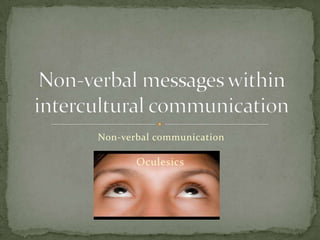
 Oculesics is a technical term for eye contact.
 How & how much do we look at others when

communicating.
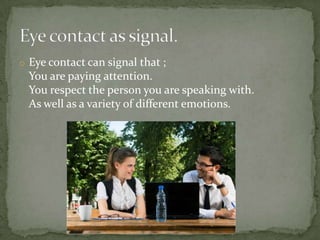
o Eye contact can signal that ;

You are paying attention.
You respect the person you are speaking with.
As well as a variety of different emotions.
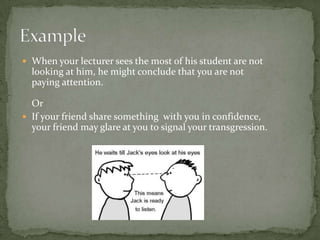
 When your lecturer sees the most of his student are not

looking at him, he might conclude that you are not
paying attention.

Or
 If your friend share something with you in confidence,
your friend may glare at you to signal your transgression.
 Intense of eye contact may also be an attempt to

dominate ( Pearson, West, & Turner, 1995)
 That’s why we sometimes say things like “if looks could
kill” when we saw someone glare at someone else.
Studies show that in Western cultures, talkers hold eye
contact about 40% of the time and listeners nearly 70%
of the time (Knapp & Hall,2006)
 In western culture people also maintain more eye
contact when discussing topic their comfortable with.
 If the topic is uncomfortable to discuss, they tend to
avoid eye contact.
 A majority of people in the U.S & other Western

culture expect those with whom they are
communicating to “look them in the eyes.” But, direct
eye contact is not universally considered appropriate
(samovar, Porter, & McDaniel, 2009)
 Japan for instance, prolonged eye contact considered
rude, disrespectful, and threatening. Similarly in
China and Indonesia too much of direct eye is a sign of
bad manners.
 Middle Eastern countries, people tend to use

continuous and direct eye contact with others to show
keen interest.
 Native Americans tend to avoid eye contact with
superiors as a sign of respect for their authority.
 Woman tend to use more eye contact during
conversations then men do (wood, 2007)
 THANK YOU

Oculesics

  • 1.
  • 2.
     Oculesics isa technical term for eye contact.  How & how much do we look at others when communicating.
  • 3.
    o Eye contactcan signal that ; You are paying attention. You respect the person you are speaking with. As well as a variety of different emotions.
  • 4.
     When yourlecturer sees the most of his student are not looking at him, he might conclude that you are not paying attention. Or  If your friend share something with you in confidence, your friend may glare at you to signal your transgression.
  • 5.
     Intense ofeye contact may also be an attempt to dominate ( Pearson, West, & Turner, 1995)  That’s why we sometimes say things like “if looks could kill” when we saw someone glare at someone else.
  • 6.
    Studies show thatin Western cultures, talkers hold eye contact about 40% of the time and listeners nearly 70% of the time (Knapp & Hall,2006)  In western culture people also maintain more eye contact when discussing topic their comfortable with.  If the topic is uncomfortable to discuss, they tend to avoid eye contact.
  • 7.
     A majorityof people in the U.S & other Western culture expect those with whom they are communicating to “look them in the eyes.” But, direct eye contact is not universally considered appropriate (samovar, Porter, & McDaniel, 2009)  Japan for instance, prolonged eye contact considered rude, disrespectful, and threatening. Similarly in China and Indonesia too much of direct eye is a sign of bad manners.
  • 8.
     Middle Easterncountries, people tend to use continuous and direct eye contact with others to show keen interest.  Native Americans tend to avoid eye contact with superiors as a sign of respect for their authority.  Woman tend to use more eye contact during conversations then men do (wood, 2007)
  • 9.