Definition…
 Communication is the process of exchanging
information and ideas.
 An active process, it involves encoding,
transmitting, and decoding intended messages
Why Communications Skills Are
So Important ?
 The purpose of communication is to get your message across
to others. This is a process that involves both the sender of
the message and the receiver. This process leaves room for
error, with messages often misinterpreted by one or more of
the parties involved. This causes unnecessary confusion and
counter productivity.
 In fact, a message is successful only when both the sender
and the receiver perceive it in the same way.
Communication
Is Affected By :
• Personal Factors
• mood
• energy level / fatigue
• body language
• Environment
• noise
• temperature
• other distractions
• Whether we use old technology or new, effective
communication includes active listening, choosing our
words carefully and matching them with our body
language.
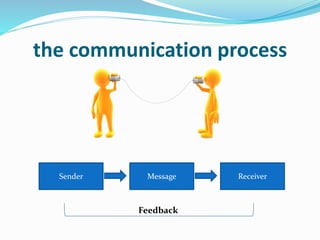
the communication process
Sender Message Receiver
Feedback
Types of Communication
• People communicate with each other in a number
of ways that depend upon the message and its
context in which it is being sent. Choice of
communication channel and your style of
communicating also affect communication. So,
there are a variety of types of communication.
• Types of communication based on the communication
channels used are:
1. Verbal Communication
2. Nonverbal Communication
Verbal Communication
• Verbal Communication is further divided into:
1. Oral Communication
2. Written Communication
1. Oral Communication
In oral communication, Spoken words are used. It
includes face-to-face conversations, speech, radio etc.
2. Written Communication
In written communication, written signs or symbols are
used to communicate. A written message may be
printed or hand written.
Non Verbal Communication
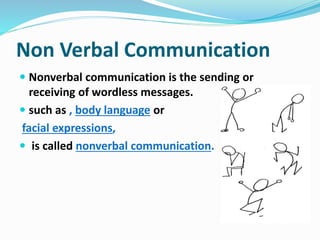
 Nonverbal communication is the sending or
receiving of wordless messages.
 such as , body language or
facial expressions,
 is called nonverbal communication.
Barriers in Communication
Communicating is straightforward. What makes it complex, difficult, and
frustrating are the barriers we put in the way.
Top Barriers :
 The use of jargon. Over-complicated, unfamiliar and/or technical terms.
 Emotional barriers and taboos. Some people may find it difficult to express
their emotions and some topics may be completely 'off-limits' or taboo.
 Lack of attention, interest, distractions, or irrelevance to the receiver
 Differences in perception and viewpoint.
 Physical disabilities such as hearing problems or speech difficulties.
 Cultural differences. The norms of social interaction vary greatly in
different cultures, as do the way in which emotions are expressed. For
example, the concept of personal space varies between cultures and
between different social settings.
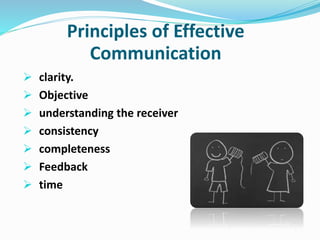
Principles of Effective
Communication
 clarity.
 Objective
 understanding the receiver
 consistency
 completeness
 Feedback
 time
True or False Questions
1. Understanding is not a part of listening. (False)
2. Listening begins with receiving the message a speaker
sends. (True)
3. Eye contact is an example of a nonverbal response to a
message ( False)
4. For listening to take place, it is not important to
remember the message. (False )
5. nonverbal responses to a message are not near as
important as what one says. (False )
Multiple Choice Questions
 Why do we communicate?
A. To create and maintain our sense of identity
B. To help us create communities and to form and
strengthen relationships
C. To develop the ability to influence others
D. To convey and create information
E. For all of the above reasons
 Currect answer: (E)
Multiple Choice Questions
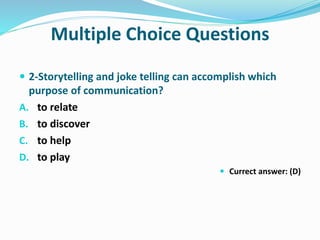
 2-Storytelling and joke telling can accomplish which
purpose of communication?
A. to relate
B. to discover
C. to help
D. to play
 Currect answer: (D)
Multiple Choice Questions
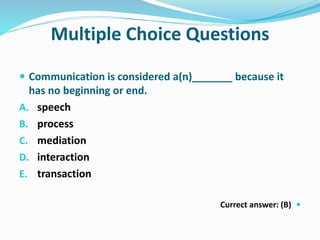
 Communication is considered a(n)_______ because it
has no beginning or end.
A. speech
B. process
C. mediation
D. interaction
E. transaction
Currect answer: (B)
That’s All
Thank you For Your Concentration

Communication Skills

  • 2.
    Definition…  Communication isthe process of exchanging information and ideas.  An active process, it involves encoding, transmitting, and decoding intended messages
  • 3.
    Why Communications SkillsAre So Important ?  The purpose of communication is to get your message across to others. This is a process that involves both the sender of the message and the receiver. This process leaves room for error, with messages often misinterpreted by one or more of the parties involved. This causes unnecessary confusion and counter productivity.  In fact, a message is successful only when both the sender and the receiver perceive it in the same way.
  • 4.
    Communication Is Affected By: • Personal Factors • mood • energy level / fatigue • body language • Environment • noise • temperature • other distractions • Whether we use old technology or new, effective communication includes active listening, choosing our words carefully and matching them with our body language.
  • 5.
    the communication process SenderMessage Receiver Feedback
  • 6.
    Types of Communication •People communicate with each other in a number of ways that depend upon the message and its context in which it is being sent. Choice of communication channel and your style of communicating also affect communication. So, there are a variety of types of communication. • Types of communication based on the communication channels used are: 1. Verbal Communication 2. Nonverbal Communication
  • 7.
    Verbal Communication • VerbalCommunication is further divided into: 1. Oral Communication 2. Written Communication 1. Oral Communication In oral communication, Spoken words are used. It includes face-to-face conversations, speech, radio etc. 2. Written Communication In written communication, written signs or symbols are used to communicate. A written message may be printed or hand written.
  • 8.
    Non Verbal Communication Nonverbal communication is the sending or receiving of wordless messages.  such as , body language or facial expressions,  is called nonverbal communication.
  • 9.
    Barriers in Communication Communicatingis straightforward. What makes it complex, difficult, and frustrating are the barriers we put in the way. Top Barriers :  The use of jargon. Over-complicated, unfamiliar and/or technical terms.  Emotional barriers and taboos. Some people may find it difficult to express their emotions and some topics may be completely 'off-limits' or taboo.  Lack of attention, interest, distractions, or irrelevance to the receiver  Differences in perception and viewpoint.  Physical disabilities such as hearing problems or speech difficulties.  Cultural differences. The norms of social interaction vary greatly in different cultures, as do the way in which emotions are expressed. For example, the concept of personal space varies between cultures and between different social settings.
  • 10.
    Principles of Effective Communication clarity.  Objective  understanding the receiver  consistency  completeness  Feedback  time
  • 11.
    True or FalseQuestions 1. Understanding is not a part of listening. (False) 2. Listening begins with receiving the message a speaker sends. (True) 3. Eye contact is an example of a nonverbal response to a message ( False) 4. For listening to take place, it is not important to remember the message. (False ) 5. nonverbal responses to a message are not near as important as what one says. (False )
  • 12.
    Multiple Choice Questions Why do we communicate? A. To create and maintain our sense of identity B. To help us create communities and to form and strengthen relationships C. To develop the ability to influence others D. To convey and create information E. For all of the above reasons  Currect answer: (E)
  • 13.
    Multiple Choice Questions 2-Storytelling and joke telling can accomplish which purpose of communication? A. to relate B. to discover C. to help D. to play  Currect answer: (D)
  • 14.
    Multiple Choice Questions Communication is considered a(n)_______ because it has no beginning or end. A. speech B. process C. mediation D. interaction E. transaction Currect answer: (B)
  • 15.
    That’s All Thank youFor Your Concentration