It’s All AboutCommunicationRegional IT InstituteSupervised By: Dr. Stephanie JonesBy: Mohamed YehiaMohamed MagdyKarim M. BehieryHaithamSalheen
To be coveredWhat you doWhat a manager doA Shift in Mindset and SkillsInterpersonal CommunicationContemporary OrganizationABCs of Constructive CommunicationDomestic Examples and Analysis References
What you doMeeting’s Effectiveness  LettersPlanned Meetings Unplanned Meetings MemosFaxesPhone CallsAttitude EmailsComplaintsVoice Mails3
What you doWork on tasks or projects _____%Discussions with the boss _____%Conversations with peers _____%Discussions with employees _____%Give employees instructions _____%Give employees feedback _____%Interview _____%Lead or take part in meetings _____%Make presentations _____%Compose memos, letters, e-mail _____%Telephone calls _____%Other activities _____%4
What a manager do1Defining required results2Directing and coaching employee3Monitoring the employee’s Performance4Reporting progress and/or problems5
What a manager doManagementTheprocess of producing resultsthrough other peopleDesired Results 1Defining required results2Directing and coaching employee3Monitoring the employee’s Performance4Reporting progress and/or problems6
A Shift in Mindset and SkillsM a n a g e rW o r k e rManager Oversee other team members performance with good relational and communicator skillsWorkerTask-oriented withtechnical and/or operational skills7
A Shift in Mindset and SkillsRemember Communication is the most important skill in lifeManager Mindset Manager success largely depends on how well he/she and his/her employees work together to accomplish goals, and so manager’s main focus is to do things that will equip and encourage his/her employees to produce the desired results12348
Remember Establish rapportInstill trustFoster cooperationForm alliancesPersuadeMediate conflictCommunicate clearly Communicate constructivelyManager SkillsManager need not to be the best expert with tasks and/or technicalities, but should be the best communicator, his/her most interest should be interpersonal communications - skills that build and maintain relationshipsA Shift in Mindset and Skills9
Interpersonal CommunicationInter means among or between, so,Itis not one-way communicationbutIt is an exchange that occurs through dialogue between two people or through discussion among several, with participation by everyone involved.10
                             E-mail, voice-mail, and other new technologies             should be used to enhance interpersonal communication                                    ASAPInterpersonal CommunicationTechnologyTime Intensity                                              , NOW! No one can afford to waste time through incomplete, inaccurate, or ineffective communicationûDiversity                         Age, ethnic, gender, political preferences, religious beliefs, lifestyle, ….Liability                      Build with employees relationships that encourage                  them to first bring their concerns to you. 11
Contemporary OrganizationInteraction in a Contemporary OrganizationFluidFlattenedFeedback12
Contemporary OrganizationInteraction in a Contemporary OrganizationFluidFlattenedThe multiple levels of a traditional structure have been reduced and replaced with self-managed teams orcross-functional work groups. The “chain of command” is neitheras long nor as rigid.Feedback13
Contemporary OrganizationInteraction in a Contemporary OrganizationFlattenedFluidBecause a contemporary form is more “open” it is encouraged to communicate informally between and among interdependent groups, and so everyone will have more avenues for advancing ideas and the ideas of employees on his/her team. Feedback14
Contemporary OrganizationInteraction in a Contemporary OrganizationFlattenedFeedbackIn a contemporary organization, the manager resides at the center of the team or work group and everyone works within the context of delivering products and services to customers.Fluid15
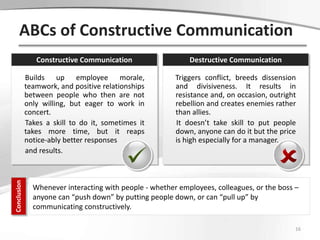
ABCs of Constructive CommunicationûDestructive Communication Constructive Communication Triggers conflict, breeds dissension and divisiveness. It results in resistance and, on occasion, outright rebellion and creates enemies rather than allies.     It doesn’t take skill to put people down, anyone can do it but the price is high especially for a manager.    Builds up employee morale, teamwork, and positive relationships between people who then are not only willing, but eager to work in concert.    Takes a skill to do it, sometimes it takes more time, but it reaps notice-ably better responses     and results.Whenever interacting with people - whether employees, colleagues, or the boss – anyone can “push down” by putting people down, or can “pull up” by communicating constructively.Conclusion16
ABCs of Constructive CommunicationBuild BridgesApproachTrustCommonality17
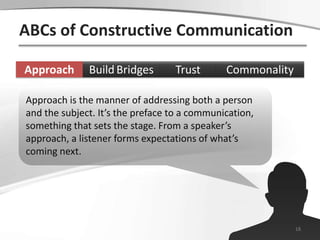
ABCs of Constructive CommunicationBuildBridgesTrustCommonalityApproachApproach is the manner of addressing both a person and the subject. It’s the preface to a communication, something that sets the stage. From a speaker’s approach, a listener forms expectations of what’s coming next.18
ABCs of Constructive CommunicationBuildBridgesTrustCommonalityApproachHow to approach people in the right way?  Be pleasant and gracious
 Be well prepared
 Allude to some benefit the listener
 Approach any person respectfully
 Treat the subject reasonably
 When appropriate, smile sincerely
 If the subject isn’t pleasant, consider the most positive quality   you can project to the person under the circumstances19
ABCs of Constructive CommunicationTrustCommonalityApproachBuild BridgesBuilding a relationship takes time, attention, and skill. It also often entails bridging differences. And sometimes you have to meet people halfwayBuilding bridges leads to productive working relationship20
ABCs of Constructive CommunicationTrustCommonalityApproachBuildBridgesWhen, a manager understands employees’ goals, he/she can cooperate with them to help them attain their goals. And when they understand the manager’s concern about a problem, they can cooperate with him/her to get it solved. Bridges hold up only if they’re constructed on a firm foundation. The same is true of relationships. A cooperative, productive working relationship is based on a twofold foundation of trust and commonality.21
ABCs of Constructive CommunicationBuild BridgesCommonalityApproachTrustIt’s a vital component of constructive communications. The firm belief that someone or something is reliable, that you can depend on them or it. 22
ABCs of Constructive CommunicationTrustCommonalityApproachBuild BridgesHow to gain trust?It’s important that you interact in trustworthy ways. You convey the unspoken message, “You’re safe with me.”Don’t punish people with the past. 23
ABCs of Constructive CommunicationBuildBridgesTrustApproachCommonalityWe prefer dealing with people who are “like” us. It’s easier to understand one another when we share some things in common: a common language, similar backgrounds, common interests. We’ll cooperate more readily with those with whom we have things in common.24
ABCs of Constructive CommunicationBuildBridgesTrustApproachCommonalityWhat we should do?One of your challenges is to discover and develop commonalities. 25
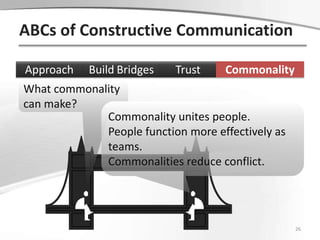
ABCs of Constructive CommunicationBuildBridgesTrustApproachCommonalityWhat commonality can make?Commonality unites people. People function more effectively as teams. Commonalities reduce conflict.26

It’s all about communication

  • 1.
    It’s All AboutCommunicationRegionalIT InstituteSupervised By: Dr. Stephanie JonesBy: Mohamed YehiaMohamed MagdyKarim M. BehieryHaithamSalheen
  • 2.
    To be coveredWhatyou doWhat a manager doA Shift in Mindset and SkillsInterpersonal CommunicationContemporary OrganizationABCs of Constructive CommunicationDomestic Examples and Analysis References
  • 3.
    What you doMeeting’sEffectiveness LettersPlanned Meetings Unplanned Meetings MemosFaxesPhone CallsAttitude EmailsComplaintsVoice Mails3
  • 4.
    What you doWorkon tasks or projects _____%Discussions with the boss _____%Conversations with peers _____%Discussions with employees _____%Give employees instructions _____%Give employees feedback _____%Interview _____%Lead or take part in meetings _____%Make presentations _____%Compose memos, letters, e-mail _____%Telephone calls _____%Other activities _____%4
  • 5.
    What a managerdo1Defining required results2Directing and coaching employee3Monitoring the employee’s Performance4Reporting progress and/or problems5
  • 6.
    What a managerdoManagementTheprocess of producing resultsthrough other peopleDesired Results 1Defining required results2Directing and coaching employee3Monitoring the employee’s Performance4Reporting progress and/or problems6
  • 7.
    A Shift inMindset and SkillsM a n a g e rW o r k e rManager Oversee other team members performance with good relational and communicator skillsWorkerTask-oriented withtechnical and/or operational skills7
  • 8.
    A Shift inMindset and SkillsRemember Communication is the most important skill in lifeManager Mindset Manager success largely depends on how well he/she and his/her employees work together to accomplish goals, and so manager’s main focus is to do things that will equip and encourage his/her employees to produce the desired results12348
  • 9.
    Remember Establish rapportInstilltrustFoster cooperationForm alliancesPersuadeMediate conflictCommunicate clearly Communicate constructivelyManager SkillsManager need not to be the best expert with tasks and/or technicalities, but should be the best communicator, his/her most interest should be interpersonal communications - skills that build and maintain relationshipsA Shift in Mindset and Skills9
  • 10.
    Interpersonal CommunicationInter meansamong or between, so,Itis not one-way communicationbutIt is an exchange that occurs through dialogue between two people or through discussion among several, with participation by everyone involved.10
  • 11.
    E-mail, voice-mail, and other new technologies should be used to enhance interpersonal communication ASAPInterpersonal CommunicationTechnologyTime Intensity , NOW! No one can afford to waste time through incomplete, inaccurate, or ineffective communicationûDiversity Age, ethnic, gender, political preferences, religious beliefs, lifestyle, ….Liability Build with employees relationships that encourage them to first bring their concerns to you. 11
  • 12.
    Contemporary OrganizationInteraction ina Contemporary OrganizationFluidFlattenedFeedback12
  • 13.
    Contemporary OrganizationInteraction ina Contemporary OrganizationFluidFlattenedThe multiple levels of a traditional structure have been reduced and replaced with self-managed teams orcross-functional work groups. The “chain of command” is neitheras long nor as rigid.Feedback13
  • 14.
    Contemporary OrganizationInteraction ina Contemporary OrganizationFlattenedFluidBecause a contemporary form is more “open” it is encouraged to communicate informally between and among interdependent groups, and so everyone will have more avenues for advancing ideas and the ideas of employees on his/her team. Feedback14
  • 15.
    Contemporary OrganizationInteraction ina Contemporary OrganizationFlattenedFeedbackIn a contemporary organization, the manager resides at the center of the team or work group and everyone works within the context of delivering products and services to customers.Fluid15
  • 16.
    ABCs of ConstructiveCommunicationûDestructive Communication Constructive Communication Triggers conflict, breeds dissension and divisiveness. It results in resistance and, on occasion, outright rebellion and creates enemies rather than allies. It doesn’t take skill to put people down, anyone can do it but the price is high especially for a manager. Builds up employee morale, teamwork, and positive relationships between people who then are not only willing, but eager to work in concert. Takes a skill to do it, sometimes it takes more time, but it reaps notice-ably better responses and results.Whenever interacting with people - whether employees, colleagues, or the boss – anyone can “push down” by putting people down, or can “pull up” by communicating constructively.Conclusion16
  • 17.
    ABCs of ConstructiveCommunicationBuild BridgesApproachTrustCommonality17
  • 18.
    ABCs of ConstructiveCommunicationBuildBridgesTrustCommonalityApproachApproach is the manner of addressing both a person and the subject. It’s the preface to a communication, something that sets the stage. From a speaker’s approach, a listener forms expectations of what’s coming next.18
  • 19.
    ABCs of ConstructiveCommunicationBuildBridgesTrustCommonalityApproachHow to approach people in the right way?  Be pleasant and gracious
  • 20.
    Be wellprepared
  • 21.
    Allude tosome benefit the listener
  • 22.
    Approach anyperson respectfully
  • 23.
    Treat thesubject reasonably
  • 24.
    When appropriate,smile sincerely
  • 25.
    If thesubject isn’t pleasant, consider the most positive quality you can project to the person under the circumstances19
  • 26.
    ABCs of ConstructiveCommunicationTrustCommonalityApproachBuild BridgesBuilding a relationship takes time, attention, and skill. It also often entails bridging differences. And sometimes you have to meet people halfwayBuilding bridges leads to productive working relationship20
  • 27.
    ABCs of ConstructiveCommunicationTrustCommonalityApproachBuildBridgesWhen, a manager understands employees’ goals, he/she can cooperate with them to help them attain their goals. And when they understand the manager’s concern about a problem, they can cooperate with him/her to get it solved. Bridges hold up only if they’re constructed on a firm foundation. The same is true of relationships. A cooperative, productive working relationship is based on a twofold foundation of trust and commonality.21
  • 28.
    ABCs of ConstructiveCommunicationBuild BridgesCommonalityApproachTrustIt’s a vital component of constructive communications. The firm belief that someone or something is reliable, that you can depend on them or it. 22
  • 29.
    ABCs of ConstructiveCommunicationTrustCommonalityApproachBuild BridgesHow to gain trust?It’s important that you interact in trustworthy ways. You convey the unspoken message, “You’re safe with me.”Don’t punish people with the past. 23
  • 30.
    ABCs of ConstructiveCommunicationBuildBridgesTrustApproachCommonalityWe prefer dealing with people who are “like” us. It’s easier to understand one another when we share some things in common: a common language, similar backgrounds, common interests. We’ll cooperate more readily with those with whom we have things in common.24
  • 31.
    ABCs of ConstructiveCommunicationBuildBridgesTrustApproachCommonalityWhat we should do?One of your challenges is to discover and develop commonalities. 25
  • 32.
    ABCs of ConstructiveCommunicationBuildBridgesTrustApproachCommonalityWhat commonality can make?Commonality unites people. People function more effectively as teams. Commonalities reduce conflict.26