PRESENTS
subscribe
BUSINESS COMMUNICATION
UNIT 1
BCA ( DR.R.M.L.AWADH
UNIVERSITY )
PDREM EDUCATIONAL &
DEVELOPMENT
FOUNDATION
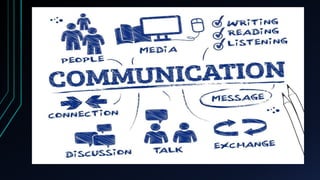
DEFINATION OF COMMUNICATION
• Two-way process of reaching mutual understanding, in which
participants not only exchange (encode-decode) information, news,
ideas and feelings but also create and share meaning. In general,
communication is a means of connecting people or places.
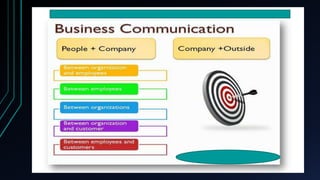
• In business, it is a key function of management--an organization
cannot operate without communication between levels,
departments and employees.
PROCESS OF COMMUNICATION
• Communication Process
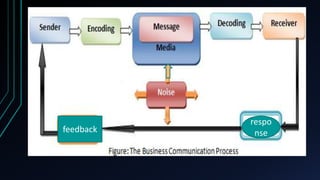
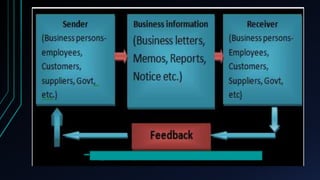
• The communication is a dynamic process that begins with the
conceptualizing of ideas by the sender who then transmits the
message through a channel to the receiver, who in turn gives the
feedback in the form of some message or signal within the given
time frame. Thus, there are Seven major elements of
communication process:
feedback
respo
nse
.
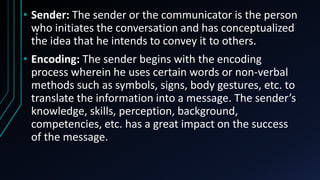
• Sender: The sender or the communicator is the person
who initiates the conversation and has conceptualized
the idea that he intends to convey it to others.
• Encoding: The sender begins with the encoding
process wherein he uses certain words or non-verbal
methods such as symbols, signs, body gestures, etc. to
translate the information into a message. The sender’s
knowledge, skills, perception, background,
competencies, etc. has a great impact on the success
of the message.
.
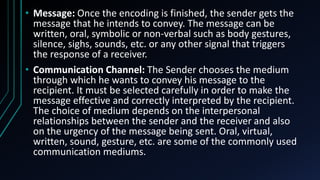
• Message: Once the encoding is finished, the sender gets the
message that he intends to convey. The message can be
written, oral, symbolic or non-verbal such as body gestures,
silence, sighs, sounds, etc. or any other signal that triggers
the response of a receiver.
• Communication Channel: The Sender chooses the medium
through which he wants to convey his message to the
recipient. It must be selected carefully in order to make the
message effective and correctly interpreted by the recipient.
The choice of medium depends on the interpersonal
relationships between the sender and the receiver and also
on the urgency of the message being sent. Oral, virtual,
written, sound, gesture, etc. are some of the commonly used
communication mediums.
,
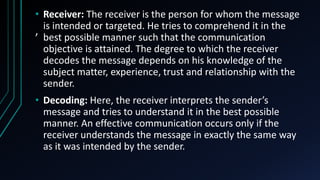
• Receiver: The receiver is the person for whom the message
is intended or targeted. He tries to comprehend it in the
best possible manner such that the communication
objective is attained. The degree to which the receiver
decodes the message depends on his knowledge of the
subject matter, experience, trust and relationship with the
sender.
• Decoding: Here, the receiver interprets the sender’s
message and tries to understand it in the best possible
manner. An effective communication occurs only if the
receiver understands the message in exactly the same way
as it was intended by the sender.
,
• Feedback: The Feedback is the final step of the
process that ensures the receiver has received the
message and interpreted it correctly as it was
intended by the sender. It increases the
effectiveness of the communication as it permits the
sender to know the efficacy of his message. The
response of the receiver can be verbal or non-verbal.
FUNCTIONS OF COMMUNICATION:
• Communication is really a different field that has some various
objectives. To gain individual objectives, communication performs
quite a few functions. Some of its major functions are as follows:
• Informing: The principal function of communication is informing
messages to others. It really is done verbally or non-verbally. Verbal
messages might be either oral or written. On the other hand, non-
verbal messages can be sent via human body language, gestures,
posture etc.
.
• Persuading: One more essential functionality of communication is
persuading a single party by another. In business, management
persuades the employees to make certain that employees persuade
management so that management accepts their ideas, opinions,
and suggestions. The business also communicates with external
stakeholders to persuade them.
• Integrating various divisions and departments: Attainment of
organizational goals requires integration and coordination of
activities performed by various individuals, groups and
departments. Management can put together and coordinate those
people divisions and departments by building a communication
network for the whole organization.
• Creating relationships through external parties: Communication
creates relationships not just with internal parties but also with the
external parties like customers, suppliers, investors, general
community, and government. Communication through these
external parties could be the for the survival of an organization.
• Improving labor-management association: There’s no option to
excellent labor-management relationship for achieving
organizational goals. Therefore, a significant purpose of
communication is to increase labor-management relationship.
Communication helps each party to express themselves and
produce an atmosphere of cooperation.
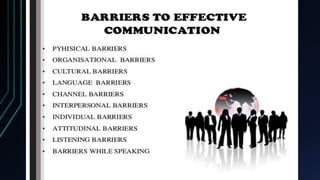
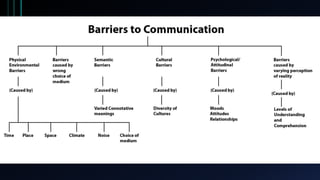
BARRIERS OF COMMUNICATION
Barriers to effective communication
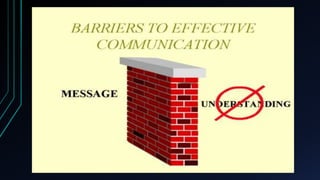
• A communication barrier is anything that prevents you from receiving
and understanding the messages others use to convey their information,
ideas and thoughts. These barriers may be related to the message,
internal barriers related to thoughts and feelings, or external barriers.
• Barriers related to the message include:
• lengthy or disorganized messages
• complex or ambiguous language
• inconsistent body language
• disregard for specific needs.
Case example
• Aaron is a young man with a mild intellectual disability. His new caseworker
jumps quickly from topic to topic, using academic expressions and service
jargon. Aaron becomes upset and has trouble expressing his thoughts. The
worker then tells him to take his time, she is here to help. She keeps looking at
the clock and checking her diary. Aaron feels that he must be stupid and slow,
and his self-esteem plummets.
• Internal barriers include:
• fatigue
• disinterest
• poor listening skills
• past experiences with the client
• home or work problems
• poor listening skills.
Case example
• Today you are just not interested in what this young woman has to
say. You normally listen to her problems and do what you can to
help her, but you are more worried about your son's illness. When
you ask her to repeat something, she accuses you of ignoring her.
You would love to point out that she never takes your advice
anyway.
• External barriers include:
• noise and other distractions
• unpleasant environment
• problems with technology or equipment.
Some of the important barriers to communication
have been discussed below:
• Physical Barriers:
• A communication is a two-way process, distance between the
sender and the receiver of the message is an important barrier to
communication. Noise and environmental factors also block
communication.
• Personal Barriers:
• Personal factors like difference in judgment, social values, inferiority
complex, bias, attitude, pressure of time, inability to communicate,
etc. widen the psychological distance between the communicator
and the communicate.
Language Barriers
• Semantic is the science of meaning. The same words and symbols
carry different meanings to different people. Difficulties in
communication arise when the sender and the receiver of the
message use words or symbols in different senses. The meaning
intended by the sender may be quite different from the meaning
followed by the receiver. People interpret the message in terms of
their own behaviour and experience. Sometimes, the language used
by the sender may not at all be followed by the receiver.
Organizational Structure Barriers:
• Effective communication largely depends upon sound
organizational structure. If the structure is complex involving
several layers of management, the breakdown or distortion in
communication wall arise. It is an established fact that every layer
cuts off a bit of information. In the words of W.C. Bennis,
“Communication gets distorted particularly as it goes up the
hierarchy.”
Barriers Due to Inadequate Attention:
• inadequate attention to the message makes communication less
effective and the message is likely to be misunderstood. Inattention
may arise because of over business of the communicate or because
of the message being contrary to his expectations and beliefs. The
simple failure to read notices, minutes and reports is also a
common feature.
Emotional Attitude:
• Barriers may also arise due to emotional attitude because when
emotions are strong, it is difficult to know the frame of mind of
other person or group. Emotional attitudes of both, the
communicator as well as the communicate, obstruct free flow of
transmission and understanding of messages.
Other Barriers:
• There may be many other barriers, such as un-clarified
assumptions, lack of ability to communicate, mirage of too much
knowledge of closed minds, communication overload, shortage of
time, etc., which cause distortion or obstruction in the free flow of
communication and thus make it ineffective. Failure to retain or
store information for future use becomes a barrier to
communication when the information is needed in future.
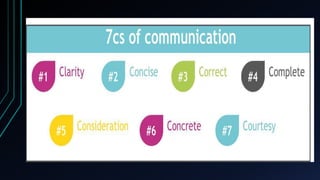
Seven C’s of Effective Communication
• There are 7 C’s of effective communication which are applicable to
both written as well as oral communication. These are as follows:
• Completeness - The communication must be complete. It should
convey all facts required by the audience. The sender of the
message must take into consideration the receiver’s mind set and
convey the message accordingly. A complete communication has
following features:
.
• Complete communication develops and enhances reputation of an
organization.
• Moreover, they are cost saving as no crucial information is missing and
no additional cost is incurred in conveying extra message if the
communication is complete.
• A complete communication always gives additional information
wherever required. It leaves no questions in the mind of receiver.
• Complete communication helps in better decision-making by the
audience/readers/receivers of message as they get all desired and crucial
information.
• It persuades the audience.
• Conciseness - Conciseness means wordiness, i.e, communicating what
you want to convey in least possible words without forgoing the other
C’s of communication. Conciseness is a necessity for effective
communication. Concise communication has following features:
• It is both time-saving as well as cost-saving.
• It underlines and highlights the main message as it avoids using excessive
and needless words.
• Concise communication provides short and essential message in limited
words to the audience.
• Concise message is more appealing and comprehensible to the audience.
• Concise message is non-repetitive in nature.
• Consideration - Consideration implies “stepping into the shoes of others”.
Effective communication must take the audience into consideration, i.e, the
audience’s view points, background, mind-set, education level, etc. Make an
attempt to envisage your audience, their requirements, emotions as well as
problems. Ensure that the self-respect of the audience is maintained and their
emotions are not at harm. Modify your words in message to suit the audience’s
needs while making your message complete. Features of considerate
communication are as follows:
• Emphasize on “you” approach.
• Empathize with the audience and exhibit interest in the audience. This will
stimulate a positive reaction from the audience.
• Show optimism towards your audience. Emphasize on “what is possible” rather
than “what is impossible”. Lay stress on positive words such as jovial,
committed, thanks, warm, healthy, help, etc.
• Clarity - Clarity implies emphasizing on a specific message or goal at
a time, rather than trying to achieve too much at once. Clarity in
communication has following features:
• It makes understanding easier.
• Complete clarity of thoughts and ideas enhances the meaning of
message.
• Clear message makes use of exact, appropriate and concrete words.
• Concreteness - Concrete communication implies being particular
and clear rather than fuzzy and general. Concreteness strengthens
the confidence. Concrete message has following features:
• It is supported with specific facts and figures.
• It makes use of words that are clear and that build the reputation.
• Concrete messages are not misinterpreted.
• Courtesy - Courtesy in message implies the message should show
the sender’s expression as well as should respect the receiver. The
sender of the message should be sincerely polite, judicious,
reflective and enthusiastic. Courteous message has following
features:
• Courtesy implies taking into consideration both viewpoints as well
as feelings of the receiver of the message.
• Courteous message is positive and focused at the audience.
• It makes use of terms showing respect for the receiver of message.
• It is not at all biased.
• Correctness - Correctness in communication implies that there are
no grammatical errors in communication. Correct communication
has following features:
• The message is exact, correct and well-timed.
• If the communication is correct, it boosts up the confidence level.
• Correct message has greater impact on the audience/readers.
• It checks for the precision and accurateness of facts and figures
used in the message.
• It makes use of appropriate and correct language in the message.
BUSINESS COMMUNICATION

BUSINESS COMMUNICATION

  • 1.
  • 2.
    BUSINESS COMMUNICATION UNIT 1 BCA( DR.R.M.L.AWADH UNIVERSITY ) PDREM EDUCATIONAL & DEVELOPMENT FOUNDATION
  • 4.
    DEFINATION OF COMMUNICATION •Two-way process of reaching mutual understanding, in which participants not only exchange (encode-decode) information, news, ideas and feelings but also create and share meaning. In general, communication is a means of connecting people or places. • In business, it is a key function of management--an organization cannot operate without communication between levels, departments and employees.
  • 6.
    PROCESS OF COMMUNICATION •Communication Process • The communication is a dynamic process that begins with the conceptualizing of ideas by the sender who then transmits the message through a channel to the receiver, who in turn gives the feedback in the form of some message or signal within the given time frame. Thus, there are Seven major elements of communication process:
  • 7.
  • 8.
    . • Sender: Thesender or the communicator is the person who initiates the conversation and has conceptualized the idea that he intends to convey it to others. • Encoding: The sender begins with the encoding process wherein he uses certain words or non-verbal methods such as symbols, signs, body gestures, etc. to translate the information into a message. The sender’s knowledge, skills, perception, background, competencies, etc. has a great impact on the success of the message.
  • 9.
    . • Message: Oncethe encoding is finished, the sender gets the message that he intends to convey. The message can be written, oral, symbolic or non-verbal such as body gestures, silence, sighs, sounds, etc. or any other signal that triggers the response of a receiver. • Communication Channel: The Sender chooses the medium through which he wants to convey his message to the recipient. It must be selected carefully in order to make the message effective and correctly interpreted by the recipient. The choice of medium depends on the interpersonal relationships between the sender and the receiver and also on the urgency of the message being sent. Oral, virtual, written, sound, gesture, etc. are some of the commonly used communication mediums.
  • 10.
    , • Receiver: Thereceiver is the person for whom the message is intended or targeted. He tries to comprehend it in the best possible manner such that the communication objective is attained. The degree to which the receiver decodes the message depends on his knowledge of the subject matter, experience, trust and relationship with the sender. • Decoding: Here, the receiver interprets the sender’s message and tries to understand it in the best possible manner. An effective communication occurs only if the receiver understands the message in exactly the same way as it was intended by the sender.
  • 11.
    , • Feedback: TheFeedback is the final step of the process that ensures the receiver has received the message and interpreted it correctly as it was intended by the sender. It increases the effectiveness of the communication as it permits the sender to know the efficacy of his message. The response of the receiver can be verbal or non-verbal.
  • 13.
    FUNCTIONS OF COMMUNICATION: •Communication is really a different field that has some various objectives. To gain individual objectives, communication performs quite a few functions. Some of its major functions are as follows: • Informing: The principal function of communication is informing messages to others. It really is done verbally or non-verbally. Verbal messages might be either oral or written. On the other hand, non- verbal messages can be sent via human body language, gestures, posture etc.
  • 14.
    . • Persuading: Onemore essential functionality of communication is persuading a single party by another. In business, management persuades the employees to make certain that employees persuade management so that management accepts their ideas, opinions, and suggestions. The business also communicates with external stakeholders to persuade them. • Integrating various divisions and departments: Attainment of organizational goals requires integration and coordination of activities performed by various individuals, groups and departments. Management can put together and coordinate those people divisions and departments by building a communication network for the whole organization.
  • 15.
    • Creating relationshipsthrough external parties: Communication creates relationships not just with internal parties but also with the external parties like customers, suppliers, investors, general community, and government. Communication through these external parties could be the for the survival of an organization. • Improving labor-management association: There’s no option to excellent labor-management relationship for achieving organizational goals. Therefore, a significant purpose of communication is to increase labor-management relationship. Communication helps each party to express themselves and produce an atmosphere of cooperation.
  • 20.
  • 21.
    Barriers to effectivecommunication • A communication barrier is anything that prevents you from receiving and understanding the messages others use to convey their information, ideas and thoughts. These barriers may be related to the message, internal barriers related to thoughts and feelings, or external barriers. • Barriers related to the message include: • lengthy or disorganized messages • complex or ambiguous language • inconsistent body language • disregard for specific needs.
  • 22.
    Case example • Aaronis a young man with a mild intellectual disability. His new caseworker jumps quickly from topic to topic, using academic expressions and service jargon. Aaron becomes upset and has trouble expressing his thoughts. The worker then tells him to take his time, she is here to help. She keeps looking at the clock and checking her diary. Aaron feels that he must be stupid and slow, and his self-esteem plummets. • Internal barriers include: • fatigue • disinterest • poor listening skills • past experiences with the client • home or work problems • poor listening skills.
  • 23.
    Case example • Todayyou are just not interested in what this young woman has to say. You normally listen to her problems and do what you can to help her, but you are more worried about your son's illness. When you ask her to repeat something, she accuses you of ignoring her. You would love to point out that she never takes your advice anyway. • External barriers include: • noise and other distractions • unpleasant environment • problems with technology or equipment.
  • 26.
    Some of theimportant barriers to communication have been discussed below: • Physical Barriers: • A communication is a two-way process, distance between the sender and the receiver of the message is an important barrier to communication. Noise and environmental factors also block communication. • Personal Barriers: • Personal factors like difference in judgment, social values, inferiority complex, bias, attitude, pressure of time, inability to communicate, etc. widen the psychological distance between the communicator and the communicate.
  • 27.
    Language Barriers • Semanticis the science of meaning. The same words and symbols carry different meanings to different people. Difficulties in communication arise when the sender and the receiver of the message use words or symbols in different senses. The meaning intended by the sender may be quite different from the meaning followed by the receiver. People interpret the message in terms of their own behaviour and experience. Sometimes, the language used by the sender may not at all be followed by the receiver.
  • 28.
    Organizational Structure Barriers: •Effective communication largely depends upon sound organizational structure. If the structure is complex involving several layers of management, the breakdown or distortion in communication wall arise. It is an established fact that every layer cuts off a bit of information. In the words of W.C. Bennis, “Communication gets distorted particularly as it goes up the hierarchy.”
  • 29.
    Barriers Due toInadequate Attention: • inadequate attention to the message makes communication less effective and the message is likely to be misunderstood. Inattention may arise because of over business of the communicate or because of the message being contrary to his expectations and beliefs. The simple failure to read notices, minutes and reports is also a common feature.
  • 30.
    Emotional Attitude: • Barriersmay also arise due to emotional attitude because when emotions are strong, it is difficult to know the frame of mind of other person or group. Emotional attitudes of both, the communicator as well as the communicate, obstruct free flow of transmission and understanding of messages.
  • 31.
    Other Barriers: • Theremay be many other barriers, such as un-clarified assumptions, lack of ability to communicate, mirage of too much knowledge of closed minds, communication overload, shortage of time, etc., which cause distortion or obstruction in the free flow of communication and thus make it ineffective. Failure to retain or store information for future use becomes a barrier to communication when the information is needed in future.
  • 33.
    Seven C’s ofEffective Communication • There are 7 C’s of effective communication which are applicable to both written as well as oral communication. These are as follows: • Completeness - The communication must be complete. It should convey all facts required by the audience. The sender of the message must take into consideration the receiver’s mind set and convey the message accordingly. A complete communication has following features:
  • 34.
    . • Complete communicationdevelops and enhances reputation of an organization. • Moreover, they are cost saving as no crucial information is missing and no additional cost is incurred in conveying extra message if the communication is complete. • A complete communication always gives additional information wherever required. It leaves no questions in the mind of receiver. • Complete communication helps in better decision-making by the audience/readers/receivers of message as they get all desired and crucial information. • It persuades the audience.
  • 35.
    • Conciseness -Conciseness means wordiness, i.e, communicating what you want to convey in least possible words without forgoing the other C’s of communication. Conciseness is a necessity for effective communication. Concise communication has following features: • It is both time-saving as well as cost-saving. • It underlines and highlights the main message as it avoids using excessive and needless words. • Concise communication provides short and essential message in limited words to the audience. • Concise message is more appealing and comprehensible to the audience. • Concise message is non-repetitive in nature.
  • 36.
    • Consideration -Consideration implies “stepping into the shoes of others”. Effective communication must take the audience into consideration, i.e, the audience’s view points, background, mind-set, education level, etc. Make an attempt to envisage your audience, their requirements, emotions as well as problems. Ensure that the self-respect of the audience is maintained and their emotions are not at harm. Modify your words in message to suit the audience’s needs while making your message complete. Features of considerate communication are as follows: • Emphasize on “you” approach. • Empathize with the audience and exhibit interest in the audience. This will stimulate a positive reaction from the audience. • Show optimism towards your audience. Emphasize on “what is possible” rather than “what is impossible”. Lay stress on positive words such as jovial, committed, thanks, warm, healthy, help, etc.
  • 37.
    • Clarity -Clarity implies emphasizing on a specific message or goal at a time, rather than trying to achieve too much at once. Clarity in communication has following features: • It makes understanding easier. • Complete clarity of thoughts and ideas enhances the meaning of message. • Clear message makes use of exact, appropriate and concrete words.
  • 38.
    • Concreteness -Concrete communication implies being particular and clear rather than fuzzy and general. Concreteness strengthens the confidence. Concrete message has following features: • It is supported with specific facts and figures. • It makes use of words that are clear and that build the reputation. • Concrete messages are not misinterpreted.
  • 39.
    • Courtesy -Courtesy in message implies the message should show the sender’s expression as well as should respect the receiver. The sender of the message should be sincerely polite, judicious, reflective and enthusiastic. Courteous message has following features: • Courtesy implies taking into consideration both viewpoints as well as feelings of the receiver of the message. • Courteous message is positive and focused at the audience. • It makes use of terms showing respect for the receiver of message. • It is not at all biased.
  • 40.
    • Correctness -Correctness in communication implies that there are no grammatical errors in communication. Correct communication has following features: • The message is exact, correct and well-timed. • If the communication is correct, it boosts up the confidence level. • Correct message has greater impact on the audience/readers. • It checks for the precision and accurateness of facts and figures used in the message. • It makes use of appropriate and correct language in the message.