Role Of Communication In Developing
An Effective Organization
  Intra personal, Interpersonal, Intra
group, Intergroup communication
Role Of
Communication In
Developing An
Communication in Organization:


Effective Communication is significant for managers in the organizations so as
to perform the basic functions of management, i.e., Planning, Organizing,
Leading and Controlling. Communication helps managers to perform their
jobs and responsibilities. Communication serves as a foundation for planning.
All the essential information must be communicated to the managers who in-
turn must communicate the plans so as to implement them. Organizing also
requires effective communication with others about their job task. Similarly
leaders as managers must communicate effectively with their subordinates
so as to achieve the team goals. Controlling is not possible without written
and oral communication.


Thus, we can say that “effective communication is a building block of
successful organizations”. In other words, communication acts as
organizational blood.
The importance of communication in an
organization:

  For manager – employee relations:
 Effective communication of information and decision is an essential
 component for management-employee relations. The manager cannot
 get the work done from employees unless they are communicated
 effectively. Most of management problems arise because of lack of
 effective communication. Chances of misunderstanding and
 misrepresentation can be minimized with proper communication system.

  For motivation and employee morale:
 Communication is also a basic tool for motivation, which can improve
 morale of the employees in an organization. Manager should clarify to
 employees about what is to be done, how well are they doing and what
 can be done for better performance to improve their motivation.
For increase productivity:
With effective communication, you can maintain a good human
relation in the organization and by encouraging ideas or suggestions
from employees or workers and implementing them whenever
possible, you can also increase production at low cost.

For employees:
It is through the communication that employees submit their work
reports, comments, grievances and suggestions to their seniors or
management. Organization should have effective and speedy
communication policy and procedures to avoid delays,
misunderstandings, confusion or distortions of facts and to establish
harmony among all the concerned people and departments.

Importance of written communication:
In written communication, text matter in the message is a reflection
of your thinking. So, written communication or message should be
clear and concise with correct words, to avoid any misinterpretation.
Written communications provides a permanent record for future use
and it gives an opportunity to employees to put up their comments
or suggestions in writing.
Intrapersonal communication
Intrapersonal Communication:
Intrapersonal communication means Communication with ourselves. We may find
ourselves daydreaming or engaging in internal dialogues even in the presence of another
person. Intrapersonal communication includes imagining, perceiving, or solving problems in
your head. It takes place within a single person, often for the purpose of clarifying ideas or
analyzing a situation.

Three aspects of intrapersonal communication are : Self-concept, Perception, Expectation

Self-concept:
The self concept is (also called self-awareness) how we think about and evaluate ourselves.
To be aware of oneself is to have a concept of oneself.

Self-concept involves three factors:
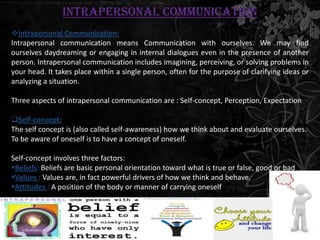
Beliefs: Beliefs are basic personal orientation toward what is true or false, good or bad
Values : Values are, in fact powerful drivers of how we think and behave.
Attitudes : A position of the body or manner of carrying oneself
Perception:
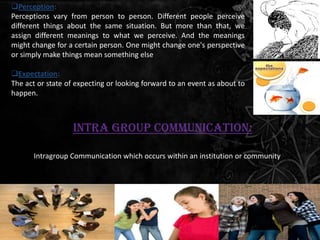
Perceptions vary from person to person. Different people perceive
different things about the same situation. But more than that, we
assign different meanings to what we perceive. And the meanings
might change for a certain person. One might change one's perspective
or simply make things mean something else

Expectation:
The act or state of expecting or looking forward to an event as about to
happen.


                   Intra Group Communication:

      Intragroup Communication which occurs within an institution or community
Interpersonal Communication:

Interpersonal communication is the process of
sending and receiving information between two
or more people. Interpersonal communication
there is face-to-face interaction between two
persons, that is, both are sending and receiving
messages. This is an ideal and effective
communication situation because you can get
immediate feedback. You can clarify and
emphasize many points through your
expressions,     gestures    and    voices.   In
interpersonal communication, therefore, it is
possible to influence the other person and
persuade him or her to accept your point of
view. It can motivate, encourage, and
coordinate work more effectively then any
other form of communication.
Types of Interpersonal Communication
Interpersonal communication is subdivided into :
1.Dyadic communication
2.Public speaking
3.Small-group communication


1.Dyadic communication :

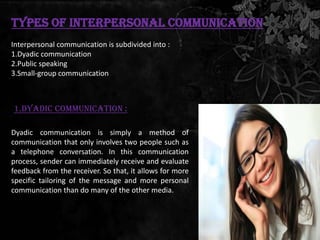
Dyadic communication is simply a method of
communication that only involves two people such as
a telephone conversation. In this communication
process, sender can immediately receive and evaluate
feedback from the receiver. So that, it allows for more
specific tailoring of the message and more personal
communication than do many of the other media.
2.Public speaking:

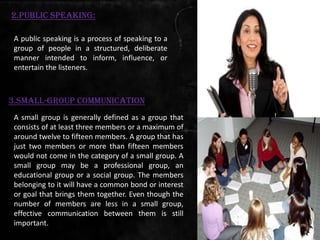
 A public speaking is a process of speaking to a
 group of people in a structured, deliberate
 manner intended to inform, influence, or
 entertain the listeners.


3.Small-group communication
 A small group is generally defined as a group that
 consists of at least three members or a maximum of
 around twelve to fifteen members. A group that has
 just two members or more than fifteen members
 would not come in the category of a small group. A
 small group may be a professional group, an
 educational group or a social group. The members
 belonging to it will have a common bond or interest
 or goal that brings them together. Even though the
 number of members are less in a small group,
 effective communication between them is still
 important..
Inter Group Communication:
The study of intergroup communication
concerns     the    ways     in     which
communication within and between
groups     affects    social    relations.
Intergroup encounters occur when
social, rather than personal, identity
forms the basis for communication.
Intergroup communication is often
characterized by power inequality, bias,
competition or conflict. These troubling
aspects of intergroup communication
have been realized in scholarship on
prejudice and discrimination (e.g.,
ageism, racism, sexism), aggression,
violence.      However,       intergroup
communication can be equally
characterized         by          positive
communication found in identity
expansion,     cooperation,      altruism,
negotiation, and collaboration.
Rakshitha V Nayak

Communication ppt

  • 2.
    Role Of CommunicationIn Developing An Effective Organization Intra personal, Interpersonal, Intra group, Intergroup communication
  • 3.
  • 4.
    Communication in Organization: EffectiveCommunication is significant for managers in the organizations so as to perform the basic functions of management, i.e., Planning, Organizing, Leading and Controlling. Communication helps managers to perform their jobs and responsibilities. Communication serves as a foundation for planning. All the essential information must be communicated to the managers who in- turn must communicate the plans so as to implement them. Organizing also requires effective communication with others about their job task. Similarly leaders as managers must communicate effectively with their subordinates so as to achieve the team goals. Controlling is not possible without written and oral communication. Thus, we can say that “effective communication is a building block of successful organizations”. In other words, communication acts as organizational blood.
  • 5.
    The importance ofcommunication in an organization:  For manager – employee relations: Effective communication of information and decision is an essential component for management-employee relations. The manager cannot get the work done from employees unless they are communicated effectively. Most of management problems arise because of lack of effective communication. Chances of misunderstanding and misrepresentation can be minimized with proper communication system.  For motivation and employee morale: Communication is also a basic tool for motivation, which can improve morale of the employees in an organization. Manager should clarify to employees about what is to be done, how well are they doing and what can be done for better performance to improve their motivation.
  • 6.
    For increase productivity: Witheffective communication, you can maintain a good human relation in the organization and by encouraging ideas or suggestions from employees or workers and implementing them whenever possible, you can also increase production at low cost. For employees: It is through the communication that employees submit their work reports, comments, grievances and suggestions to their seniors or management. Organization should have effective and speedy communication policy and procedures to avoid delays, misunderstandings, confusion or distortions of facts and to establish harmony among all the concerned people and departments. Importance of written communication: In written communication, text matter in the message is a reflection of your thinking. So, written communication or message should be clear and concise with correct words, to avoid any misinterpretation. Written communications provides a permanent record for future use and it gives an opportunity to employees to put up their comments or suggestions in writing.
  • 7.
    Intrapersonal communication Intrapersonal Communication: Intrapersonalcommunication means Communication with ourselves. We may find ourselves daydreaming or engaging in internal dialogues even in the presence of another person. Intrapersonal communication includes imagining, perceiving, or solving problems in your head. It takes place within a single person, often for the purpose of clarifying ideas or analyzing a situation. Three aspects of intrapersonal communication are : Self-concept, Perception, Expectation Self-concept: The self concept is (also called self-awareness) how we think about and evaluate ourselves. To be aware of oneself is to have a concept of oneself. Self-concept involves three factors: Beliefs: Beliefs are basic personal orientation toward what is true or false, good or bad Values : Values are, in fact powerful drivers of how we think and behave. Attitudes : A position of the body or manner of carrying oneself
  • 8.
    Perception: Perceptions vary fromperson to person. Different people perceive different things about the same situation. But more than that, we assign different meanings to what we perceive. And the meanings might change for a certain person. One might change one's perspective or simply make things mean something else Expectation: The act or state of expecting or looking forward to an event as about to happen. Intra Group Communication: Intragroup Communication which occurs within an institution or community
  • 9.
    Interpersonal Communication: Interpersonal communicationis the process of sending and receiving information between two or more people. Interpersonal communication there is face-to-face interaction between two persons, that is, both are sending and receiving messages. This is an ideal and effective communication situation because you can get immediate feedback. You can clarify and emphasize many points through your expressions, gestures and voices. In interpersonal communication, therefore, it is possible to influence the other person and persuade him or her to accept your point of view. It can motivate, encourage, and coordinate work more effectively then any other form of communication.
  • 10.
    Types of InterpersonalCommunication Interpersonal communication is subdivided into : 1.Dyadic communication 2.Public speaking 3.Small-group communication 1.Dyadic communication : Dyadic communication is simply a method of communication that only involves two people such as a telephone conversation. In this communication process, sender can immediately receive and evaluate feedback from the receiver. So that, it allows for more specific tailoring of the message and more personal communication than do many of the other media.
  • 11.
    2.Public speaking: Apublic speaking is a process of speaking to a group of people in a structured, deliberate manner intended to inform, influence, or entertain the listeners. 3.Small-group communication A small group is generally defined as a group that consists of at least three members or a maximum of around twelve to fifteen members. A group that has just two members or more than fifteen members would not come in the category of a small group. A small group may be a professional group, an educational group or a social group. The members belonging to it will have a common bond or interest or goal that brings them together. Even though the number of members are less in a small group, effective communication between them is still important..
  • 12.
    Inter Group Communication: Thestudy of intergroup communication concerns the ways in which communication within and between groups affects social relations. Intergroup encounters occur when social, rather than personal, identity forms the basis for communication. Intergroup communication is often characterized by power inequality, bias, competition or conflict. These troubling aspects of intergroup communication have been realized in scholarship on prejudice and discrimination (e.g., ageism, racism, sexism), aggression, violence. However, intergroup communication can be equally characterized by positive communication found in identity expansion, cooperation, altruism, negotiation, and collaboration.
  • 13.