Meaning of communication The word communication has been derived from the latin word  “communes”  which means  “common”.   Communication & Motivation Skills
Newstorm and Davis, ” Communication is transfer of information from one person to another person. It is a way of reaching others by transmitting, ideas,facts, thoughts, feeling and values.’’ Three Aspects in Communication   -Message, -Ideas,  -Information. Definition of Communication
 
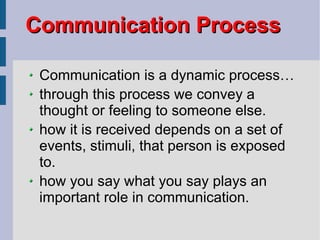
Communication is a dynamic process… through this process we convey a thought or feeling to someone else. how it is received depends on a set of events, stimuli, that person is exposed to. how you say what you say plays an important role in communication. Communication Process
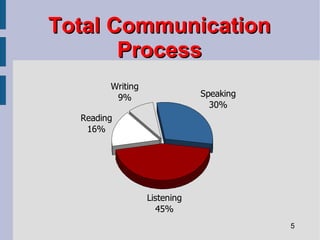
Total Communication Process
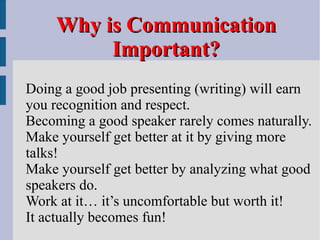
Why is Communication Important? Doing a good job presenting (writing) will earn  you recognition and respect. Becoming a good speaker rarely comes naturally. Make yourself get better at it by giving more  talks! Make yourself get better by analyzing what good  speakers do. Work at it… it’s uncomfortable but worth it! It actually becomes fun!
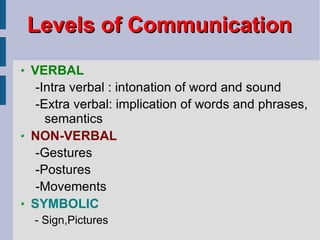
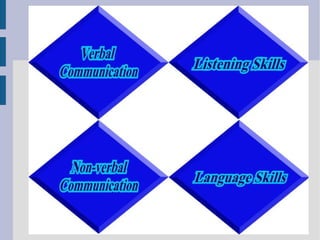
Levels of Communication VERBAL -Intra verbal : intonation of word and sound -Extra verbal: implication of words and phrases, semantics NON-VERBAL -Gestures -Postures -Movements SYMBOLIC - Sign,Pictures
 
Barriers in Communication Disagreement between verbal and non-verbal messages Negative Self Image Lack of Feedback Lack of Motivation and Training Language and Vocabulary Level Lack of Self Awareness cont....
Unwillingness to say things differently Unwillingness to relate to others differently Unwillingness to learn new approaches Lack of Self-Confidence Lack of Enthusiasm Voice quality Prejudice cont....
External Barriers in Communication Environment   The venue The effect of noise Other People –  Status, Education Time
Basic Reasons Why We Do Not Listen? Listening is Hard Work Competition The Rush for Action Speed differences (120 wpm v/s 360 wpm) Lack of Training
Levels of Listening The Non-Listener The Marginal Listener The Evaluative Listener The Active Listener
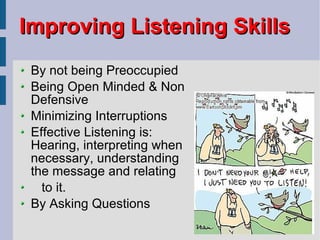
Improving Listening Skills By not being Preoccupied Being Open Minded & Non Defensive Minimizing Interruptions Effective Listening is: Hearing, interpreting when necessary, understanding the message and relating  to it. By Asking Questions
Effective Communication It is free of  stress. It is  clear. It is  two way. It involves  active listening. It reflects the  accountability  of speaker and listener. It utilizes   feedback.
Motivation M otivation is a kind of internal energy which drives a person to do something in order to achieve something.
Do all the  good  you can,
By all the  means  you can,
In all the  ways  you can,
In all the  places  you can,
At all the  times  you can,
To all the  people  you can,
As long as  ever  you can.
 
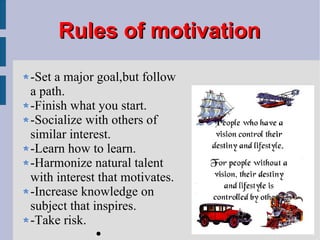
Rules of motivation -Set a major goal,but follow a path. -Finish what you start. -Socialize with others of similar interest. -Learn how to learn. -Harmonize natural talent with interest that motivates. -Increase knowledge on subject that inspires. -Take risk.
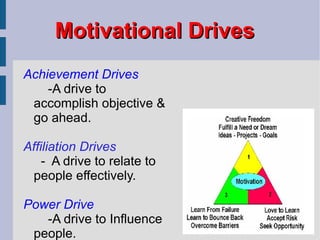
Motivational Drives Achievement Drives  -A drive to accomplish objective & go ahead. Affiliation Drives   -  A drive to relate to people effectively.  Power Drive  -A drive to Influence people.
 
Presented by -Ravi Patel -Ashutosh Pareek -Kapil Dev

Communication & Motivation Skills Rims

  • 1.
    Meaning of communicationThe word communication has been derived from the latin word “communes” which means “common”. Communication & Motivation Skills
  • 2.
    Newstorm and Davis,” Communication is transfer of information from one person to another person. It is a way of reaching others by transmitting, ideas,facts, thoughts, feeling and values.’’ Three Aspects in Communication -Message, -Ideas, -Information. Definition of Communication
  • 3.
  • 4.
    Communication is adynamic process… through this process we convey a thought or feeling to someone else. how it is received depends on a set of events, stimuli, that person is exposed to. how you say what you say plays an important role in communication. Communication Process
  • 5.
  • 6.
    Why is CommunicationImportant? Doing a good job presenting (writing) will earn you recognition and respect. Becoming a good speaker rarely comes naturally. Make yourself get better at it by giving more talks! Make yourself get better by analyzing what good speakers do. Work at it… it’s uncomfortable but worth it! It actually becomes fun!
  • 7.
    Levels of CommunicationVERBAL -Intra verbal : intonation of word and sound -Extra verbal: implication of words and phrases, semantics NON-VERBAL -Gestures -Postures -Movements SYMBOLIC - Sign,Pictures
  • 8.
  • 9.
    Barriers in CommunicationDisagreement between verbal and non-verbal messages Negative Self Image Lack of Feedback Lack of Motivation and Training Language and Vocabulary Level Lack of Self Awareness cont....
  • 10.
    Unwillingness to saythings differently Unwillingness to relate to others differently Unwillingness to learn new approaches Lack of Self-Confidence Lack of Enthusiasm Voice quality Prejudice cont....
  • 11.
    External Barriers inCommunication Environment The venue The effect of noise Other People – Status, Education Time
  • 12.
    Basic Reasons WhyWe Do Not Listen? Listening is Hard Work Competition The Rush for Action Speed differences (120 wpm v/s 360 wpm) Lack of Training
  • 13.
    Levels of ListeningThe Non-Listener The Marginal Listener The Evaluative Listener The Active Listener
  • 14.
    Improving Listening SkillsBy not being Preoccupied Being Open Minded & Non Defensive Minimizing Interruptions Effective Listening is: Hearing, interpreting when necessary, understanding the message and relating to it. By Asking Questions
  • 15.
    Effective Communication Itis free of stress. It is clear. It is two way. It involves active listening. It reflects the accountability of speaker and listener. It utilizes feedback.
  • 16.
    Motivation M otivationis a kind of internal energy which drives a person to do something in order to achieve something.
  • 17.
    Do all the good you can,
By all the means you can,
In all the ways you can,
In all the places you can,
At all the times you can,
To all the people you can,
As long as ever you can.
  • 18.
  • 19.
    Rules of motivation-Set a major goal,but follow a path. -Finish what you start. -Socialize with others of similar interest. -Learn how to learn. -Harmonize natural talent with interest that motivates. -Increase knowledge on subject that inspires. -Take risk.
  • 20.
    Motivational Drives AchievementDrives -A drive to accomplish objective & go ahead. Affiliation Drives - A drive to relate to people effectively. Power Drive -A drive to Influence people.
  • 21.
  • 22.
    Presented by -RaviPatel -Ashutosh Pareek -Kapil Dev