Presented By- 
Brijesh Chaudhari :140210107006 
Urmit Chauhan :140210107007 
Bhavika Chavda :140210107008 
Dhruvi Unadkat :140210107009 
Himalay Diyora :140210107010
What Is 
Communication? 
The word communication is derived from 
Latin word communis or communico or 
communicare which means common. 
It means to share, to impart. 
Communication means speaking or 
writing for sending message to other 
person or person. 
Communication is one of the essential 
condition of social interaction, without 
communication social interaction may not 
be possible because human interaction is 
essentially communicative interaction.
Extra Personal 
Communication 
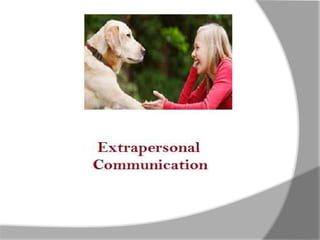
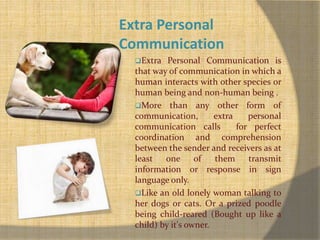
Extra Personal Communication is 
that way of communication in which a 
human interacts with other species or 
human being and non-human being . 
More than any other form of 
communication, extra personal 
communication calls for perfect 
coordination and comprehension 
between the sender and receivers as at 
least one of them transmit 
information or response in sign 
language only. 
Like an old lonely woman talking to 
her dogs or cats. Or a prized poodle 
being child-reared (Bought up like a 
child) by it's owner.
 Interpersonal communication is defined by communication 
scholars in numerous ways, though most definitions involve 
participants who are interdependent on one another, have a 
shared history. Communication channels are the medium 
chosen to convey the message from sender to receiver. 
Communication channels can be categorized into two main 
categories… 
Direct Channels 
Indirect Channels
Direct channels 
 Direct channels are those that are obvious and can be easily 
recognized by the receiver. They are also under direct control of 
the sender. 
 In this category are the verbal and non-verbal channels of 
communication. 
 Verbal communication channels are those that use words in some 
manner, such as written communication or spoken 
communication. 
 Non-verbal communication channels are those that do not require 
silly words, such as certain overt facial expressions, controllable 
body movements (such as that made by a traffic police to control 
traffic at an intersection), color (red for danger, green means go 
etc), sound (sirens, alarms etc.).
Indirect channels 
 Indirect channels are those channels that are usually 
recognized subliminally or subconsciously by the receiver, 
and not under direct control of the sender. This includes 
kinesics or body language, that reflects the inner emotions 
and motivations rather than the actual delivered message. 
It also includes such vague terms as "gut feeling", "hunches" 
or "premonitions". 
 Channels means mode of communicating the messages. 
 Participants is the communicators who are both senders 
and receivers. 
 Context refers to the interrelated condition of 
communication. It consists of such factors as: 
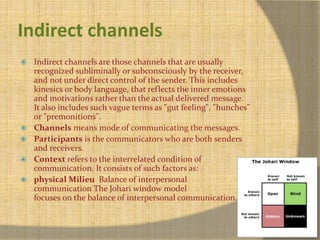
 physical Milieu Balance of interpersonal 
communication The Johari window model 
focuses on the balance of interpersonal communication.
Interpersonal communication encompasses: 
 Speech communication 
 Nonverbal communication 
 Unconscious communication 
 summarizing 
 paraphrasing 
 listening 
 questioning 
 Initiating: Declaring one's conversational intent and inviting 
consent from one's prospective conversation partner 
 Turn-taking: Managing the flow of information back and forth 
between partners in a conversation by alternating roles of 
speaker and listener
 Having good interpersonal communication skills support such 
processes as: 
 parenting 
 intimate relationship 
 management 
 selling 
 counseling 
 coaching 
 mentoring and co-mentoring, which is mentoring in groups 
 conflict management 
 Interpersonal communication is the subject of a number of 
disciplines in the field of psychology, notably Transactional 
analysis.
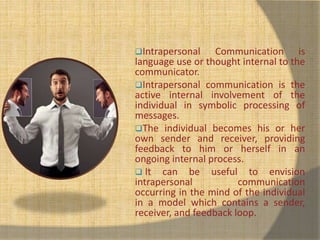
Intrapersonal Communication is 
language use or thought internal to the 
communicator. 
Intrapersonal communication is the 
active internal involvement of the 
individual in symbolic processing of 
messages. 
The individual becomes his or her 
own sender and receiver, providing 
feedback to him or herself in an 
ongoing internal process. 
 It can be useful to envision 
intrapersonal communication 
occurring in the mind of the individual 
in a model which contains a sender, 
receiver, and feedback loop.
 In Communication: The Social Matrix of Psychiatry, Jurgen Ruesch 
and Gregory Bateson argue that intrapersonal communication is 
indeed a special case of interpersonal communication, as 
"dialogue is the foundation for all discourse." 
Intrapersonal communication can encompass: 
 Day-dreaming 
 Nocturnal dreaming, including and especially lucid dreaming 
 Speaking aloud (talking to oneself), reading aloud, repeating what 
one hears; the additional activities of speaking and hearing (in the 
third case of hearing again) what one thinks, reads or hears may 
increase concentration and retention. This is considered normal, 
and the extent to which it occurs varies from person to person. 
The time when there should be concern is when talking to oneself 
occurs outside of socially acceptable situations.
 Writing (by hand, or with a word processor, etc.) one's 
thoughts or observations: the additional activities, on top of 
thinking, of writing and reading back may again increase self-understanding 
("How do I know what I mean until I see what I 
say?") and concentration. It aids ordering one's thoughts; in 
addition it produces a record that can be used later again. 
Copying text to aid memorizing also falls in this category. 
 Making gestures while thinking: the additional activity, on top 
of thinking, of body motions, may again increase 
concentration, assist in problem solving, and assist memory. 
 Sense-making (see Karl Weick) e.g. interpreting maps, texts, 
signs, and symbols
 Interpreting non-verbal communication (see Albert 
Mehrabian) e.g. gestures, eye contact 
 Communication between body parts; e.g. "My stomach is 
telling me it's time for lunch."
 The importance of communication is business becomes even 
more apparent when we consider the communication 
activities of an organisation from overall viewpoints. this kind 
of communication can be further divided into 4 parts.. 
Inter –operational communication 
External operational communication 
Personal communication 
Mass communication
INTER OPERATIONAL 
COMMUNICATION 
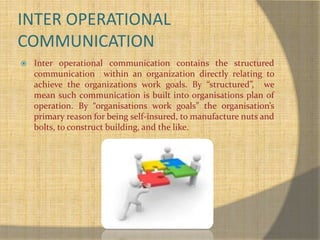
 Inter operational communication contains the structured 
communication within an organization directly relating to 
achieve the organizations work goals. By “structured”, we 
mean such communication is built into organisations plan of 
operation. By “organisations work goals” the organisation’s 
primary reason for being self-insured, to manufacture nuts and 
bolts, to construct building, and the like.
External operational 
communication 
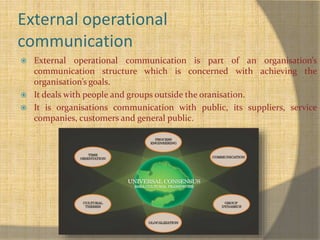
 External operational communication is part of an organisation’s 
communication structure which is concerned with achieving the 
organisation’s goals. 
 It deals with people and groups outside the oranisation. 
 It is organisations communication with public, its suppliers, service 
companies, customers and general public.
Personal Communication 
 Personal communication is that 
incidental exchange of 
information an feeling which 
human being engage in, 
whenever they come together. 
 human beings are social 
animals. They have needed to 
communicate and they will 
communicate even when they 
have nothing to express. 
 Communication that occurs 
without purpose as far as 
business is concerned is called 
personal communication
Mass communication is a process in which a person, 
group of people, or an organization sends a message 
through a channel of communication to a large group 
of anonymous and heterogeneous people and 
organizations. 
Mass communication is controlled by many gate 
keepers, whereas communication is mostly face to face 
and gate keeping do not involve in it. 
This type of communication is more persuasive in 
nature than other forms of communication. 
Channels of communication include broadcast 
television, radio, social media, and print. The sender of 
the message is usually a professional communicator 
that often represents an organization. 
Mass communication is an expensive process. Unlike 
interpersonal communication, feedback for mass 
communication is usually slow and indirect.
 Examples: 
 The following are some types of mass 
communication: 
 Advertising, which consists of 
communications attempting to induce 
purchasing behavior 
 Journalism, such as news 
 Public relations, which is communication 
intended to influence public opinion on a 
product or organization 
 Politics (for example, campaigning)
Thank you.

Levels of communication

  • 2.
    Presented By- BrijeshChaudhari :140210107006 Urmit Chauhan :140210107007 Bhavika Chavda :140210107008 Dhruvi Unadkat :140210107009 Himalay Diyora :140210107010
  • 3.
    What Is Communication? The word communication is derived from Latin word communis or communico or communicare which means common. It means to share, to impart. Communication means speaking or writing for sending message to other person or person. Communication is one of the essential condition of social interaction, without communication social interaction may not be possible because human interaction is essentially communicative interaction.
  • 5.
    Extra Personal Communication Extra Personal Communication is that way of communication in which a human interacts with other species or human being and non-human being . More than any other form of communication, extra personal communication calls for perfect coordination and comprehension between the sender and receivers as at least one of them transmit information or response in sign language only. Like an old lonely woman talking to her dogs or cats. Or a prized poodle being child-reared (Bought up like a child) by it's owner.
  • 7.
     Interpersonal communicationis defined by communication scholars in numerous ways, though most definitions involve participants who are interdependent on one another, have a shared history. Communication channels are the medium chosen to convey the message from sender to receiver. Communication channels can be categorized into two main categories… Direct Channels Indirect Channels
  • 8.
    Direct channels Direct channels are those that are obvious and can be easily recognized by the receiver. They are also under direct control of the sender.  In this category are the verbal and non-verbal channels of communication.  Verbal communication channels are those that use words in some manner, such as written communication or spoken communication.  Non-verbal communication channels are those that do not require silly words, such as certain overt facial expressions, controllable body movements (such as that made by a traffic police to control traffic at an intersection), color (red for danger, green means go etc), sound (sirens, alarms etc.).
  • 9.
    Indirect channels Indirect channels are those channels that are usually recognized subliminally or subconsciously by the receiver, and not under direct control of the sender. This includes kinesics or body language, that reflects the inner emotions and motivations rather than the actual delivered message. It also includes such vague terms as "gut feeling", "hunches" or "premonitions".  Channels means mode of communicating the messages.  Participants is the communicators who are both senders and receivers.  Context refers to the interrelated condition of communication. It consists of such factors as:  physical Milieu Balance of interpersonal communication The Johari window model focuses on the balance of interpersonal communication.
  • 10.
    Interpersonal communication encompasses:  Speech communication  Nonverbal communication  Unconscious communication  summarizing  paraphrasing  listening  questioning  Initiating: Declaring one's conversational intent and inviting consent from one's prospective conversation partner  Turn-taking: Managing the flow of information back and forth between partners in a conversation by alternating roles of speaker and listener
  • 11.
     Having goodinterpersonal communication skills support such processes as:  parenting  intimate relationship  management  selling  counseling  coaching  mentoring and co-mentoring, which is mentoring in groups  conflict management  Interpersonal communication is the subject of a number of disciplines in the field of psychology, notably Transactional analysis.
  • 13.
    Intrapersonal Communication is language use or thought internal to the communicator. Intrapersonal communication is the active internal involvement of the individual in symbolic processing of messages. The individual becomes his or her own sender and receiver, providing feedback to him or herself in an ongoing internal process.  It can be useful to envision intrapersonal communication occurring in the mind of the individual in a model which contains a sender, receiver, and feedback loop.
  • 14.
     In Communication:The Social Matrix of Psychiatry, Jurgen Ruesch and Gregory Bateson argue that intrapersonal communication is indeed a special case of interpersonal communication, as "dialogue is the foundation for all discourse." Intrapersonal communication can encompass:  Day-dreaming  Nocturnal dreaming, including and especially lucid dreaming  Speaking aloud (talking to oneself), reading aloud, repeating what one hears; the additional activities of speaking and hearing (in the third case of hearing again) what one thinks, reads or hears may increase concentration and retention. This is considered normal, and the extent to which it occurs varies from person to person. The time when there should be concern is when talking to oneself occurs outside of socially acceptable situations.
  • 15.
     Writing (byhand, or with a word processor, etc.) one's thoughts or observations: the additional activities, on top of thinking, of writing and reading back may again increase self-understanding ("How do I know what I mean until I see what I say?") and concentration. It aids ordering one's thoughts; in addition it produces a record that can be used later again. Copying text to aid memorizing also falls in this category.  Making gestures while thinking: the additional activity, on top of thinking, of body motions, may again increase concentration, assist in problem solving, and assist memory.  Sense-making (see Karl Weick) e.g. interpreting maps, texts, signs, and symbols
  • 16.
     Interpreting non-verbalcommunication (see Albert Mehrabian) e.g. gestures, eye contact  Communication between body parts; e.g. "My stomach is telling me it's time for lunch."
  • 18.
     The importanceof communication is business becomes even more apparent when we consider the communication activities of an organisation from overall viewpoints. this kind of communication can be further divided into 4 parts.. Inter –operational communication External operational communication Personal communication Mass communication
  • 19.
    INTER OPERATIONAL COMMUNICATION  Inter operational communication contains the structured communication within an organization directly relating to achieve the organizations work goals. By “structured”, we mean such communication is built into organisations plan of operation. By “organisations work goals” the organisation’s primary reason for being self-insured, to manufacture nuts and bolts, to construct building, and the like.
  • 20.
    External operational communication  External operational communication is part of an organisation’s communication structure which is concerned with achieving the organisation’s goals.  It deals with people and groups outside the oranisation.  It is organisations communication with public, its suppliers, service companies, customers and general public.
  • 21.
    Personal Communication Personal communication is that incidental exchange of information an feeling which human being engage in, whenever they come together.  human beings are social animals. They have needed to communicate and they will communicate even when they have nothing to express.  Communication that occurs without purpose as far as business is concerned is called personal communication
  • 23.
    Mass communication isa process in which a person, group of people, or an organization sends a message through a channel of communication to a large group of anonymous and heterogeneous people and organizations. Mass communication is controlled by many gate keepers, whereas communication is mostly face to face and gate keeping do not involve in it. This type of communication is more persuasive in nature than other forms of communication. Channels of communication include broadcast television, radio, social media, and print. The sender of the message is usually a professional communicator that often represents an organization. Mass communication is an expensive process. Unlike interpersonal communication, feedback for mass communication is usually slow and indirect.
  • 24.
     Examples: The following are some types of mass communication:  Advertising, which consists of communications attempting to induce purchasing behavior  Journalism, such as news  Public relations, which is communication intended to influence public opinion on a product or organization  Politics (for example, campaigning)
  • 25.