Reflections on   Organisational Communication Tigere Chagutah BSc, DMCS, MCMS Presented at CPUT 20/08/2010
In this session I keep six honest serving-men (They taught me all I knew); Their names are  What  and  Why  and When And  How  and Where and Who Rudyard Kipling, 1902.
Defining organisational communication The exchange of information & instructions  which enable a company to function efficiently and employees to be properly informed about developments It covers information of all kinds, the channels along which it passes and the means of passing it (Hannigan 1996).
WHY communicate within the organisation?   Organisational communication is “The central binding force that permits coordination among people and thus allows for organised behaviour” – Myers and Myers, Managing by Communication, 1982 Specific reasons: Gaining compliance Leading, motivating and influencing Problem solving and decision-making Conflict management, negotiating, bargaining
Features of organisational communication Key distinctions Formal Vs Informal Vertical / Lateral / Diagonal Internal Vs Externally directed communication
Formal communication Classification derives from the rank of the participants in the communicative act The three categories in a formal communication structure are Downward Communication, Upward Communication, and Lateral Communication. A formal communication structure utilises specific authorised channels for information to flow between organisation positions   Prevalent in large bureaucratic, instruction-led organisations and is mediated through non-personal channels
Informal communication Structure uses relaxed communication channels that are not specifically used for organisational information  This includes employee communication “through the grapevine” that comes from social and personal interests rather than formal organisation requirements.  Some large organisations make use of informal communication if managed well; the challenge is for the formal and informal flows not to conflict but complement each other
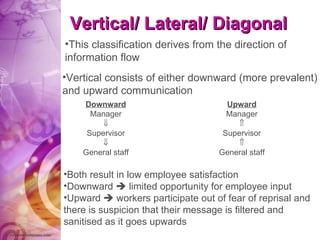
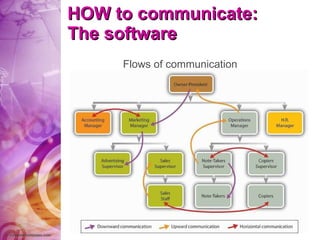
Vertical/ Lateral/ Diagonal This classification derives from the direction of information flow   Vertical consists of either downward (more prevalent) and upward communication   Downward Manager  Supervisor  General staff Upward Manager  Supervisor  General staff Both result in low employee satisfaction Downward    limited opportunity for employee input  Upward    workers participate out of fear of reprisal and there is suspicion that their message is filtered and sanitised as it goes upwards
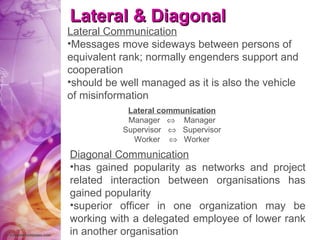
Lateral & Diagonal Lateral Communication Messages move sideways between persons of equivalent rank; normally engenders support and cooperation  should be well managed as it is also the vehicle of misinformation   Lateral communication Manager     Manager Supervisor     Supervisor Worker     Worker Diagonal Communication has gained popularity as networks and project related interaction between organisations has gained popularity superior officer in one organization may be working with a delegated employee of lower rank in another organisation
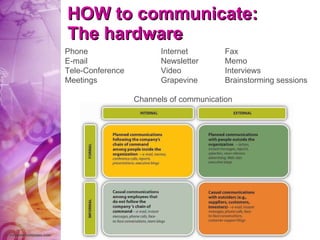
HOW to communicate: The hardware Channels of communication Phone Internet Fax E-mail Newsletter Memo Tele-Conference Video Interviews Meetings Grapevine Brainstorming sessions
HOW to communicate: The software Flows of communication
Dealing with informal communication The bane of many a communication manager! 1. learn to live with it! 2. Tune into it 3. Don’t participate in rumours 4. Check out what you hear 5. Take advantage of the grapevine 6. From the outset, improve formal communication 7. Open door policy 8. Management by walking around I heard it through the grapevine!! The most contentious of the informal channels Flexible Personal Spreads information fast Cathartic
Barriers to communication Cultural  Mistrust Intimidation  Attitudes of Workers Attitudes of the Superior Highly formal structures and procedures ICT literacy/ connectivity Distracting environment  Use of wrong medium  Information overload  Physical distance Mixed messages  Wrong targeting
THANK YOU...

Reflections on Organisational Communication

  • 1.
    Reflections on Organisational Communication Tigere Chagutah BSc, DMCS, MCMS Presented at CPUT 20/08/2010
  • 2.
    In this sessionI keep six honest serving-men (They taught me all I knew); Their names are What and Why and When And How and Where and Who Rudyard Kipling, 1902.
  • 3.
    Defining organisational communicationThe exchange of information & instructions which enable a company to function efficiently and employees to be properly informed about developments It covers information of all kinds, the channels along which it passes and the means of passing it (Hannigan 1996).
  • 4.
    WHY communicate withinthe organisation? Organisational communication is “The central binding force that permits coordination among people and thus allows for organised behaviour” – Myers and Myers, Managing by Communication, 1982 Specific reasons: Gaining compliance Leading, motivating and influencing Problem solving and decision-making Conflict management, negotiating, bargaining
  • 5.
    Features of organisationalcommunication Key distinctions Formal Vs Informal Vertical / Lateral / Diagonal Internal Vs Externally directed communication
  • 6.
    Formal communication Classificationderives from the rank of the participants in the communicative act The three categories in a formal communication structure are Downward Communication, Upward Communication, and Lateral Communication. A formal communication structure utilises specific authorised channels for information to flow between organisation positions Prevalent in large bureaucratic, instruction-led organisations and is mediated through non-personal channels
  • 7.
    Informal communication Structureuses relaxed communication channels that are not specifically used for organisational information This includes employee communication “through the grapevine” that comes from social and personal interests rather than formal organisation requirements. Some large organisations make use of informal communication if managed well; the challenge is for the formal and informal flows not to conflict but complement each other
  • 8.
    Vertical/ Lateral/ DiagonalThis classification derives from the direction of information flow Vertical consists of either downward (more prevalent) and upward communication Downward Manager  Supervisor  General staff Upward Manager  Supervisor  General staff Both result in low employee satisfaction Downward  limited opportunity for employee input Upward  workers participate out of fear of reprisal and there is suspicion that their message is filtered and sanitised as it goes upwards
  • 9.
    Lateral & DiagonalLateral Communication Messages move sideways between persons of equivalent rank; normally engenders support and cooperation should be well managed as it is also the vehicle of misinformation Lateral communication Manager  Manager Supervisor  Supervisor Worker  Worker Diagonal Communication has gained popularity as networks and project related interaction between organisations has gained popularity superior officer in one organization may be working with a delegated employee of lower rank in another organisation
  • 10.
    HOW to communicate:The hardware Channels of communication Phone Internet Fax E-mail Newsletter Memo Tele-Conference Video Interviews Meetings Grapevine Brainstorming sessions
  • 11.
    HOW to communicate:The software Flows of communication
  • 12.
    Dealing with informalcommunication The bane of many a communication manager! 1. learn to live with it! 2. Tune into it 3. Don’t participate in rumours 4. Check out what you hear 5. Take advantage of the grapevine 6. From the outset, improve formal communication 7. Open door policy 8. Management by walking around I heard it through the grapevine!! The most contentious of the informal channels Flexible Personal Spreads information fast Cathartic
  • 13.
    Barriers to communicationCultural Mistrust Intimidation Attitudes of Workers Attitudes of the Superior Highly formal structures and procedures ICT literacy/ connectivity Distracting environment Use of wrong medium Information overload Physical distance Mixed messages Wrong targeting
  • 14.

Editor's Notes

  • #3 The "Five Ws" (and one H): A time honoured concept in news style, research, and in police investigations Who, Where and When is the reason why we are here: To be communication managers; In an organisation; communicating all the time
  • #4 What is it? Why? How?
  • #5 Various scholars and practitioners swear by communication. Success of the organisation is determined by success of communication
  • #6 Distinctions derived from and related to the direction of information flow, structures of reporting and communication in organisations For purposes of time will confine discussion to the first two as the distinction between the third is obvious
  • #7 Downward is top to bottom communication such as CEO to VP of Operations. Upward is bottom to top communication such as Department Supervisor to Regional Manager. Lateral Communication crosses employees horizontally such as two people of same rank from different divisions.
  • #8 The formal/informal dichotomy is becoming less salient as new platforms and channels exist that are neither formal nor informal in character eg Company facegroup groups, innovative use of the intranet
  • #9 Downward: Generally instructs; Assign goals; Informs of policies & procedures; and Feedback on performance Upward: Generally informs; issues progress reports; Relays problems; Suggests improvements
  • #10 Lateral : People of similar rank as they share their suspicions, and often unfounded allegations with peers and never with people of different rank
  • #12 As discussed earlier each of these how to- flows of communication has its advantages and disadvantages