Skill
Development
Advisors
S. No. Section Slide Nos
I The Company Profile 3 - 5
IV Previous Work Profile 6 - 8
V Skill Development - CSR 10 - 12
VI Skill Consultancy 13 - 32
Table of Contents
About Us
• Not for the income; we
work for outcome
• International Quality
Standards
• Research based Analysis
• Best in Class services
• Ethical and transparent
business policies
‘Skill Development Advisors’ is a
certified and accredited company
providing outstanding B2B
contact centre services to the
leading corporate firms,
government and not-for-profit
organizations.
We serve individuals who want
to start for-profit and not-for-
profit businesses and those
who already lead an
organization and need free,
unbiased answers to their
business-related questions.
We study markets, trends, and
emerging best practices, in Skill
industry and region, locally and
globally. All consultants contribute
time and expertise to developing
these insights, because they are
integral to our ability to help clients
achieve their goals.
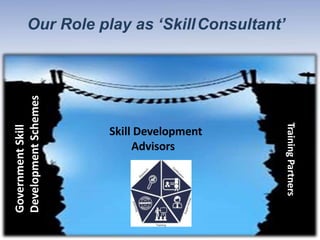
Our Role play as ‘SkillConsultant’GovernmentSkill
DevelopmentSchemes
TrainingPartners
Skill Development
Advisors
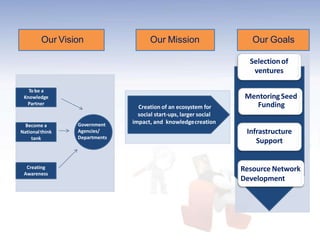
Our Vision Our Mission Our Goals
To be a
Knowledge
Partner
Become a
Nationalthink
tank
Creating
Awareness
Government
Agencies/
Departments
Creation of an ecosystem for
social start-ups, larger social
impact, and knowledgecreation
Selectionof
ventures
MentoringSeed
Funding
Infrastructure
Support
Resource Network
Development
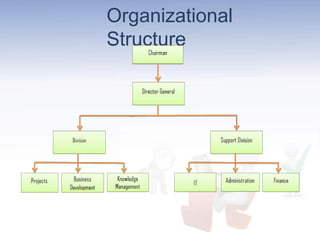
Organizational
Structure
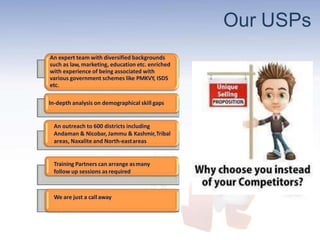
Our USPs
An expert team with diversified backgrounds
such as law, marketing, education etc. enriched
with experience of being associated with
various government schemes like PMKVY, ISDS
etc.
In-depth analysis on demographical skill gaps
An outreach to 600 districts including
Andaman & Nicobar, Jammu & Kashmir,Tribal
areas, Naxalite and North-eastareas
Training Partners can arrange asmany
follow up sessions as required
We are just a callaway
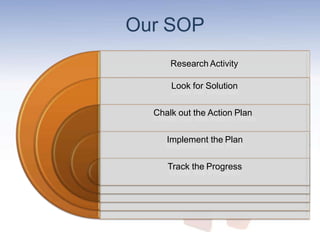
Our SOP
Research Activity
Look for Solution
Chalk out the Action Plan
Implement the Plan
Track the Progress
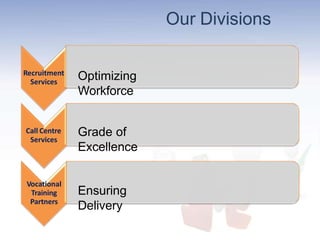
Our Divisions
Recruitment
Services
Call Centre
Services
Vocational
Training
Partners
Optimizing
Workforce
Grade of
Excellence
Ensuring
Delivery
Our Divisions
Recruitment Optimizing
Workforce
Services
Call Centre Grade of
Excellence
Services
Vocational
Training Ensuring
Delivery
Partners
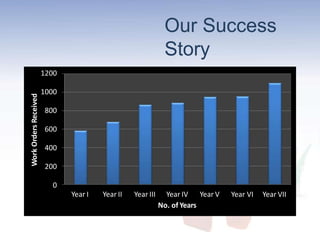
Our Success
Story
1200
1000
800
600
400
200
0
Year I Year II Year III Year V Year VI Year VII
WorkOrdersReceived
Year IV
No. of Years
Corporate Social
Responsibility
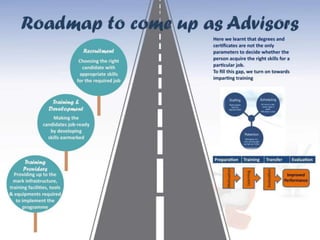
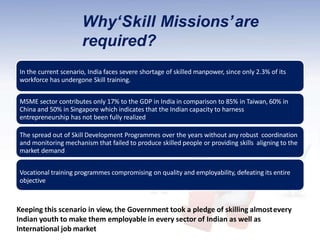
Why‘Skill Missions’are
required?
In the current scenario, India faces severe shortage of skilled manpower, since only 2.3% of its
workforce has undergone Skill training.
MSME sector contributes only 17% to the GDP in India in comparison to 85% in Taiwan, 60% in
China and 50% in Singapore which indicates that the Indian capacity to harness
entrepreneurship has not been fully realized
The spread out of Skill Development Programmes over the years without any robust coordination
and monitoring mechanism that failed to produce skilled people or providing skills aligning to the
market demand
Vocational training programmes compromising on quality and employability, defeating its entire
objective
Keeping this scenario in view, the Government took a pledge of skilling almostevery
Indian youth to make them employable in every sector of Indian as well as
International job market
To incorporate this change
in Skill ecosystem, we got
associated with the
Training Providers
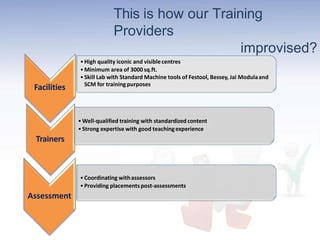
This is how our Training
Providers
improvised?
Facilities
•High quality iconic and visiblecentres
•Minimum area of 3000sq.ft.
•Skill Lab with Standard Machine tools of Festool, Bessey, Jai Modulaand
SCM for trainingpurposes
•Well-qualified training with standardized content
•Strong expertise with good teachingexperience
Trainers
•Coordinating withassessors
•Providing placements post-assessments
Assessment
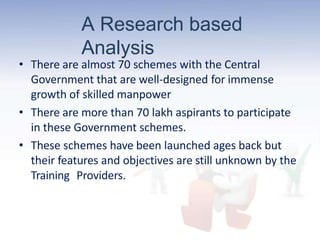
A Research based
Analysis
• There are almost 70 schemes with the Central
Government that are well-designed for immense
growth of skilled manpower
• There are more than 70 lakh aspirants to participate
in these Government schemes.
• These schemes have been launched ages back but
their features and objectives are still unknown by the
Training Providers.
Huge gap of information
between
the Training Partners and
the Skill Development Mission
Observation
Why this Gap?
There can be lot many reasons:
• Research work is missing
• Lack of clearance in the objectives of the scheme
• Only centering the financial benefits of the scheme
• Absence of standardized training
• Shortage of Trainers with TOT
As a result the schemes remained deficit of their
goal achievements
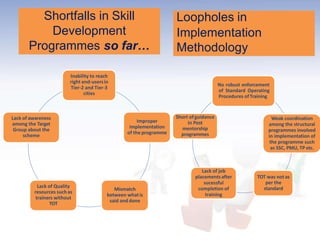
Loopholes in
Implementation
Methodology
Shortfalls in Skill
Development
Programmes so far…
Inability to reach
right end-usersin
Tier-2 and Tier-3
cities
Improper
implementation
of the programme
Mismatch
between whatis
said and done
Lack of Quality
resources suchas
trainers without
TOT
Lack of awareness
among the Target
Group about the
scheme
No robust enforcement
of Standard Operating
Procedures ofTraining
Weak coordination
among the structural
programmes involved
in implementation of
the programme such
as SSC, PMU, TP etc.
TOT was notas
per the
standard
Lack of job
placementsafter
sucessful
completion of
training
Short ofguidance
in Post
mentorship
programmes
Realizing this gap of information in
Skill Training and the shortcomings
in
the implementation, we thought to
become the first ever ‘Skill
Consultants’of India.
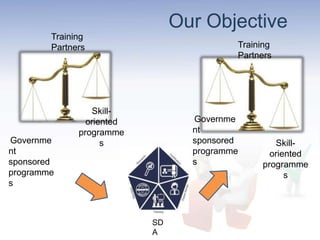
Our Objective
Governme
nt
sponsored
programme
s
Skill-
oriented
programme
s
Governme
nt
sponsored
programme
s
Skill-
oriented
programme
s
SD
A
Training
Partners Training
Partners
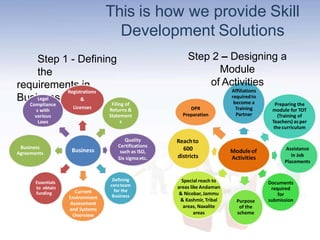
This is how we provide Skill
Development Solutions
Step 1 - Defining
the
requirements in
Business
Business
Registrations
&
Licenses
Filing of
Returns &
Statement
s
Quality
Certifications
such as ISO,
Six sigmaetc.
Defining
coreteam
for the
Business
Current
Environment
Assessment
and Systems
Overview
Essentials
to obtain
funding
Business
Agreements
Legal
Compliance
s with
various
Laws
Moduleof
Activities
Affiliations
requiredto
become a
Training
Partner
Preparing the
module for TOT
(Training of
Teachers) as per
thecurriculum
Documents
required
for
submissionPurpose
of the
scheme
DPR
Preparation
Assistance
in Job
Placements
Special reach to
areas like Andaman
& Nicobar, Jammu
& Kashmir, Tribal
areas, Naxalite
areas
Reachto
600
districts
Step 2 – Designing a
Module
of Activities
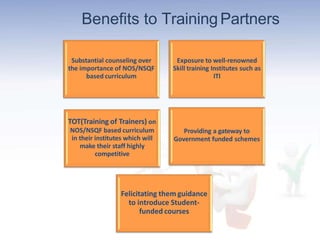
Substantial counseling over
the importance of NOS/NSQF
based curriculum
Exposure to well-renowned
Skill training Institutes such as
ITI
TOT(Training of Trainers) on
NOS/NSQF based curriculum
in their institutes which will
make their staff highly
competitive
Providing a gateway to
Government funded schemes
Felicitating them guidance
to introduce Student-
funded courses
Benefits to TrainingPartners
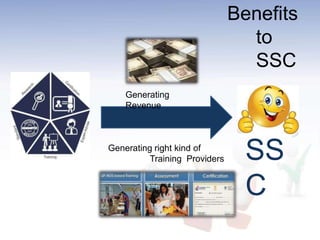
SS
C
Generating right kind of
Training Providers
Generating
Revenue
Benefits
to
SSC
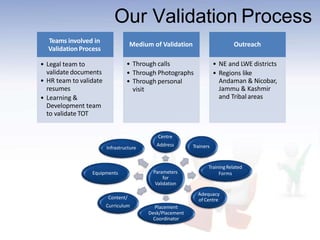
Our Validation Process
Teams involved in
Validation Process
• Legal team to
validate documents
• HR team to validate
resumes
• Learning &
Development team
to validate TOT
Medium of Validation
• Through calls
• Through Photographs
• Through personal
visit
Outreach
• NE and LWE districts
• Regions like
Andaman & Nicobar,
Jammu & Kashmir
and Tribal areas
Parameters
for
Validation
Centre
Address Trainers
TrainingRelated
Forms
Adequacy
of Centre
Placement
Desk/Placement
Coordinator
Content/
Curriculum
Equipments
Infrastructure
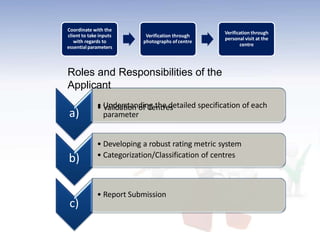
Coordinate with the
client to take inputs
with regards to
essential parameters
Verification through
photographs ofcentre
Verification through
personal visit at the
centre
a)
Roles and Responsibilities of the
Applicant
• Validation of Centres• Understanding the detailed specification of each
parameter
b)
• Developing a robust rating metric system
• Categorization/Classification of centres
c)
• Report Submission
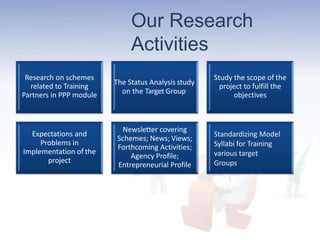
Our Research
Activities
Research on schemes
related to Training
Partners in PPP module
The Status Analysis study
on the Target Group
Study the scope of the
project to fulfill the
objectives
Expectations and
Problems in
Implementation of the
project
Newsletter covering
Schemes; News; Views;
Forthcoming Activities;
Agency Profile;
Entrepreneurial Profile
Standardizing Model
Syllabi for Training
various target
Groups
Upcoming Projects
for Budding
Entrepreneurs
Start-up India – To build a strong ecosystem,
nourishing innovation and establishment of start-
ups in the country for sustainable economic
growth and large scale employment
opportunities
Stand-up India – To facilitate bank loans
between 10
lakh and 1 crore to at least 1 Scheduled Caste
or Scheduled Tribe borrower and at least one
woman borrower per bank branch for setting
up a greenfield enterprise.
Our Forthcoming Schemes
•Ministry of Skill Development and Entrepreneurship – PMKVY, Advanced Training Scheme,
Tradesman Training Scheme, Tradesmen Trainers’ Training Scheme, Skill Development Initiative Scheme
• Urban Development Ministry – DDU-GKY, RSETIS
• Ministry of Housing & Urban Poverty Alleviation - NULM
• Ministry of Textiles - ISDS
• Ministry of Agriculture and Farmer’s Welfare – NFSM, Agri Clinic and Farmers’ Trade Centre
Scheme, Extension Reforms, KVK
•Ministry of Micro, Small & Medium Enterprises – EDPS, MDPS, Support to Training Institutes,
MCWI
• Ministry of Tourism & Culture – Skill to Employment Programme
• Ministry of Human Resource & Development – Commercializing School Education, ACI, People’s
TrainingInstitute
• Ministry of Information & Broadcasting – ESDM, Digital India
• Ministry of Tribal Affairs – Skill Training to Tribals
• Ministry of Women & Child Development - STEP
• Ministry of Commerce & Industry – National Leather Development Programme
• Ministry of Development of North-east Region – Capability Development and Training Support
• Home Ministry -UDAAN
• Ministry of Minority Affairs – Seekho aur Kamao, Nayi Roshni
•Ministry of Social Justice and Empowerment – Skill Development of PwD, SCA, SCACP, NSFDC,
NSKFDC,NBCFDC
• Ministry of Food Processing – NIFTEM, IICPT
• Ministry of Chemical & Fertilisers – Plastic Engineering and Industrial Institutes
Soft Interventions
in
‘Cluster
s’
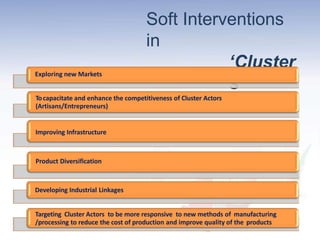
Exploring new Markets
Tocapacitate and enhance the competitiveness of Cluster Actors
(Artisans/Entrepreneurs)
Improving Infrastructure
Product Diversification
Developing Industrial Linkages
Targeting Cluster Actors to be more responsive to new methods of manufacturing
/processing to reduce the cost of production and improve quality of the products
Our Affiliates
Skill Development Advisors Ppt

Skill Development Advisors Ppt

  • 1.
  • 2.
    S. No. SectionSlide Nos I The Company Profile 3 - 5 IV Previous Work Profile 6 - 8 V Skill Development - CSR 10 - 12 VI Skill Consultancy 13 - 32 Table of Contents
  • 3.
    About Us • Notfor the income; we work for outcome • International Quality Standards • Research based Analysis • Best in Class services • Ethical and transparent business policies ‘Skill Development Advisors’ is a certified and accredited company providing outstanding B2B contact centre services to the leading corporate firms, government and not-for-profit organizations. We serve individuals who want to start for-profit and not-for- profit businesses and those who already lead an organization and need free, unbiased answers to their business-related questions. We study markets, trends, and emerging best practices, in Skill industry and region, locally and globally. All consultants contribute time and expertise to developing these insights, because they are integral to our ability to help clients achieve their goals.
  • 4.
    Our Role playas ‘SkillConsultant’GovernmentSkill DevelopmentSchemes TrainingPartners Skill Development Advisors
  • 5.
    Our Vision OurMission Our Goals To be a Knowledge Partner Become a Nationalthink tank Creating Awareness Government Agencies/ Departments Creation of an ecosystem for social start-ups, larger social impact, and knowledgecreation Selectionof ventures MentoringSeed Funding Infrastructure Support Resource Network Development
  • 6.
  • 7.
    Our USPs An expertteam with diversified backgrounds such as law, marketing, education etc. enriched with experience of being associated with various government schemes like PMKVY, ISDS etc. In-depth analysis on demographical skill gaps An outreach to 600 districts including Andaman & Nicobar, Jammu & Kashmir,Tribal areas, Naxalite and North-eastareas Training Partners can arrange asmany follow up sessions as required We are just a callaway
  • 8.
    Our SOP Research Activity Lookfor Solution Chalk out the Action Plan Implement the Plan Track the Progress
  • 9.
  • 10.
    Our Divisions Recruitment Optimizing Workforce Services CallCentre Grade of Excellence Services Vocational Training Ensuring Delivery Partners
  • 11.
    Our Success Story 1200 1000 800 600 400 200 0 Year IYear II Year III Year V Year VI Year VII WorkOrdersReceived Year IV No. of Years
  • 12.
  • 13.
    Why‘Skill Missions’are required? In thecurrent scenario, India faces severe shortage of skilled manpower, since only 2.3% of its workforce has undergone Skill training. MSME sector contributes only 17% to the GDP in India in comparison to 85% in Taiwan, 60% in China and 50% in Singapore which indicates that the Indian capacity to harness entrepreneurship has not been fully realized The spread out of Skill Development Programmes over the years without any robust coordination and monitoring mechanism that failed to produce skilled people or providing skills aligning to the market demand Vocational training programmes compromising on quality and employability, defeating its entire objective Keeping this scenario in view, the Government took a pledge of skilling almostevery Indian youth to make them employable in every sector of Indian as well as International job market
  • 14.
    To incorporate thischange in Skill ecosystem, we got associated with the Training Providers
  • 15.
    This is howour Training Providers improvised? Facilities •High quality iconic and visiblecentres •Minimum area of 3000sq.ft. •Skill Lab with Standard Machine tools of Festool, Bessey, Jai Modulaand SCM for trainingpurposes •Well-qualified training with standardized content •Strong expertise with good teachingexperience Trainers •Coordinating withassessors •Providing placements post-assessments Assessment
  • 16.
    A Research based Analysis •There are almost 70 schemes with the Central Government that are well-designed for immense growth of skilled manpower • There are more than 70 lakh aspirants to participate in these Government schemes. • These schemes have been launched ages back but their features and objectives are still unknown by the Training Providers.
  • 17.
    Huge gap ofinformation between the Training Partners and the Skill Development Mission Observation
  • 18.
    Why this Gap? Therecan be lot many reasons: • Research work is missing • Lack of clearance in the objectives of the scheme • Only centering the financial benefits of the scheme • Absence of standardized training • Shortage of Trainers with TOT As a result the schemes remained deficit of their goal achievements
  • 19.
    Loopholes in Implementation Methodology Shortfalls inSkill Development Programmes so far… Inability to reach right end-usersin Tier-2 and Tier-3 cities Improper implementation of the programme Mismatch between whatis said and done Lack of Quality resources suchas trainers without TOT Lack of awareness among the Target Group about the scheme No robust enforcement of Standard Operating Procedures ofTraining Weak coordination among the structural programmes involved in implementation of the programme such as SSC, PMU, TP etc. TOT was notas per the standard Lack of job placementsafter sucessful completion of training Short ofguidance in Post mentorship programmes
  • 20.
    Realizing this gapof information in Skill Training and the shortcomings in the implementation, we thought to become the first ever ‘Skill Consultants’of India.
  • 21.
  • 22.
    This is howwe provide Skill Development Solutions Step 1 - Defining the requirements in Business Business Registrations & Licenses Filing of Returns & Statement s Quality Certifications such as ISO, Six sigmaetc. Defining coreteam for the Business Current Environment Assessment and Systems Overview Essentials to obtain funding Business Agreements Legal Compliance s with various Laws Moduleof Activities Affiliations requiredto become a Training Partner Preparing the module for TOT (Training of Teachers) as per thecurriculum Documents required for submissionPurpose of the scheme DPR Preparation Assistance in Job Placements Special reach to areas like Andaman & Nicobar, Jammu & Kashmir, Tribal areas, Naxalite areas Reachto 600 districts Step 2 – Designing a Module of Activities
  • 23.
    Substantial counseling over theimportance of NOS/NSQF based curriculum Exposure to well-renowned Skill training Institutes such as ITI TOT(Training of Trainers) on NOS/NSQF based curriculum in their institutes which will make their staff highly competitive Providing a gateway to Government funded schemes Felicitating them guidance to introduce Student- funded courses Benefits to TrainingPartners
  • 25.
    SS C Generating right kindof Training Providers Generating Revenue Benefits to SSC
  • 26.
    Our Validation Process Teamsinvolved in Validation Process • Legal team to validate documents • HR team to validate resumes • Learning & Development team to validate TOT Medium of Validation • Through calls • Through Photographs • Through personal visit Outreach • NE and LWE districts • Regions like Andaman & Nicobar, Jammu & Kashmir and Tribal areas Parameters for Validation Centre Address Trainers TrainingRelated Forms Adequacy of Centre Placement Desk/Placement Coordinator Content/ Curriculum Equipments Infrastructure
  • 27.
    Coordinate with the clientto take inputs with regards to essential parameters Verification through photographs ofcentre Verification through personal visit at the centre a) Roles and Responsibilities of the Applicant • Validation of Centres• Understanding the detailed specification of each parameter b) • Developing a robust rating metric system • Categorization/Classification of centres c) • Report Submission
  • 28.
    Our Research Activities Research onschemes related to Training Partners in PPP module The Status Analysis study on the Target Group Study the scope of the project to fulfill the objectives Expectations and Problems in Implementation of the project Newsletter covering Schemes; News; Views; Forthcoming Activities; Agency Profile; Entrepreneurial Profile Standardizing Model Syllabi for Training various target Groups
  • 29.
    Upcoming Projects for Budding Entrepreneurs Start-upIndia – To build a strong ecosystem, nourishing innovation and establishment of start- ups in the country for sustainable economic growth and large scale employment opportunities Stand-up India – To facilitate bank loans between 10 lakh and 1 crore to at least 1 Scheduled Caste or Scheduled Tribe borrower and at least one woman borrower per bank branch for setting up a greenfield enterprise.
  • 30.
    Our Forthcoming Schemes •Ministryof Skill Development and Entrepreneurship – PMKVY, Advanced Training Scheme, Tradesman Training Scheme, Tradesmen Trainers’ Training Scheme, Skill Development Initiative Scheme • Urban Development Ministry – DDU-GKY, RSETIS • Ministry of Housing & Urban Poverty Alleviation - NULM • Ministry of Textiles - ISDS • Ministry of Agriculture and Farmer’s Welfare – NFSM, Agri Clinic and Farmers’ Trade Centre Scheme, Extension Reforms, KVK •Ministry of Micro, Small & Medium Enterprises – EDPS, MDPS, Support to Training Institutes, MCWI • Ministry of Tourism & Culture – Skill to Employment Programme • Ministry of Human Resource & Development – Commercializing School Education, ACI, People’s TrainingInstitute • Ministry of Information & Broadcasting – ESDM, Digital India • Ministry of Tribal Affairs – Skill Training to Tribals • Ministry of Women & Child Development - STEP • Ministry of Commerce & Industry – National Leather Development Programme • Ministry of Development of North-east Region – Capability Development and Training Support • Home Ministry -UDAAN • Ministry of Minority Affairs – Seekho aur Kamao, Nayi Roshni •Ministry of Social Justice and Empowerment – Skill Development of PwD, SCA, SCACP, NSFDC, NSKFDC,NBCFDC • Ministry of Food Processing – NIFTEM, IICPT • Ministry of Chemical & Fertilisers – Plastic Engineering and Industrial Institutes
  • 31.
    Soft Interventions in ‘Cluster s’ Exploring newMarkets Tocapacitate and enhance the competitiveness of Cluster Actors (Artisans/Entrepreneurs) Improving Infrastructure Product Diversification Developing Industrial Linkages Targeting Cluster Actors to be more responsive to new methods of manufacturing /processing to reduce the cost of production and improve quality of the products
  • 32.