B. H. Gardi College of
Engineering & Technology


  COMMUNICATION
     SKILLS
Communication

 What is communication? (Definition)
 “Communication is the activity or the process
  of expressing ideas and feelings or of sharing
  information or instruction with people.”
         - Oxford Advanced Learners Dictionary
 An exchange and understanding of meaning is
  central to communication.
 Transmission of meaning is the central
  objective of communication.
Process of Communication

   Stages or steps of the Process of Communication:
    Communication     begins with the sender
     sending out a message: S1.
    The Message travels through a channel: S2.
    The message is received and interpreted by
     the receiver: S3.
    The receiver send back the confirmation of
     the reception of the message to the sender:
     S4.
Encoding and Decoding

The  sender selects the words, symbols
 and/or gestures for his thought and
 concept to convey his message. This
 selection of words, symbol and/or
 gesture is called Encoding.
Decoding is the reverse of encoding. It is
 the process of converting words, symbols
 and/or into an interpreted meaning.
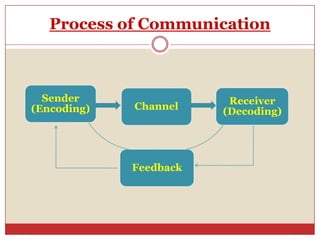
Process of Communication


  Sender                 Receiver
(Encoding)   Channel    (Decoding)


             Feedback
Communication

 Communication can be defined as:

  “…the exchange of
  information, ideas, and
  knowledge between sender
  and receiver through an
  accepted code of symbol.”
Forms of Communication

 There are five main Forms of Communication:
        Face    to face Communication:
   [Examples:- casual conversation, formal interviews, personal meeting etc.]

        Group     Communication:
 [Example:- meetings, conferences, group discussion etc.]

        Written      Communication:
 [Example:- reports, memos, proposals, letters, e-mails etc.]

        Oral   Communication:
   [Example:- telephonic conversation, casual conversation, voice messages, etc.]

        Speaker      – Audience Communication:
   [Speeches, lectures, oral presentation, seminars, etc.]
Levels of Communication

   There are five Levels of human Communication:
     Extra personal Communication:
       Communication between human beings and non-human
        beings.
     Intrapersonal Communication:
       Communication occurring within the mind of a person.

     Interpersonal Communication:
       Communication among two or more person.

     Organizational Communication:
       Communication in an organization for various activities.

     Mass Communication:
       To transmit information, concept, advertisement to the
        mass.
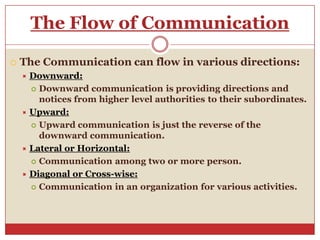
The Flow of Communication

   The Communication can flow in various directions:
     Downward:
       Downward communication is providing directions and
        notices from higher level authorities to their subordinates.
     Upward:
       Upward communication is just the reverse of the
        downward communication.
     Lateral or Horizontal:
       Communication among two or more person.

     Diagonal or Cross-wise:
       Communication in an organization for various activities.
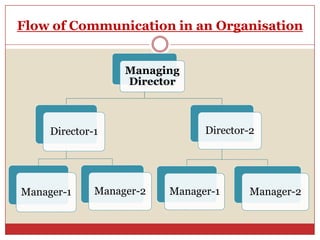
Flow of Communication in an Organisation


                   Managing
                   Director


     Director-1                 Director-2


Manager-1     Manager-2   Manager-1      Manager-2
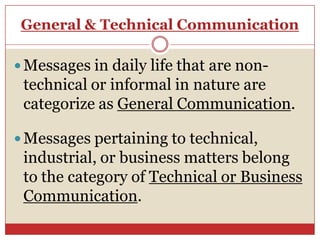
General & Technical Communication

 Messages in daily life that are non-
 technical or informal in nature are
 categorize as General Communication.

 Messages pertaining to technical,
 industrial, or business matters belong
 to the category of Technical or Business
 Communication.
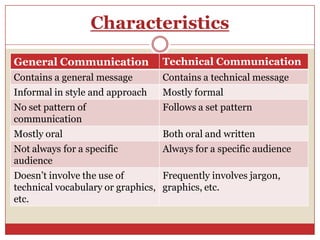
Characteristics

General Communication             Technical Communication
Contains a general message        Contains a technical message
Informal in style and approach    Mostly formal
No set pattern of                 Follows a set pattern
communication
Mostly oral                       Both oral and written
Not always for a specific         Always for a specific audience
audience
Doesn’t involve the use of        Frequently involves jargon,
technical vocabulary or graphics, graphics, etc.
etc.
Network of Communication

 Informal or Grapevine network model:
   Single strand

   Gossip

   Probability

   Cluster

 Formal network model:
   Chain network

   Y – network

   Wheel network

   All-channel network
Thank You

Communication intro

  • 1.
    B. H. GardiCollege of Engineering & Technology COMMUNICATION SKILLS
  • 2.
    Communication  What iscommunication? (Definition) “Communication is the activity or the process of expressing ideas and feelings or of sharing information or instruction with people.” - Oxford Advanced Learners Dictionary An exchange and understanding of meaning is central to communication. Transmission of meaning is the central objective of communication.
  • 3.
    Process of Communication  Stages or steps of the Process of Communication: Communication begins with the sender sending out a message: S1. The Message travels through a channel: S2. The message is received and interpreted by the receiver: S3. The receiver send back the confirmation of the reception of the message to the sender: S4.
  • 4.
    Encoding and Decoding The sender selects the words, symbols and/or gestures for his thought and concept to convey his message. This selection of words, symbol and/or gesture is called Encoding. Decoding is the reverse of encoding. It is the process of converting words, symbols and/or into an interpreted meaning.
  • 5.
    Process of Communication Sender Receiver (Encoding) Channel (Decoding) Feedback
  • 6.
    Communication  Communication canbe defined as: “…the exchange of information, ideas, and knowledge between sender and receiver through an accepted code of symbol.”
  • 7.
    Forms of Communication There are five main Forms of Communication:  Face to face Communication:  [Examples:- casual conversation, formal interviews, personal meeting etc.]  Group Communication:  [Example:- meetings, conferences, group discussion etc.]  Written Communication:  [Example:- reports, memos, proposals, letters, e-mails etc.]  Oral Communication:  [Example:- telephonic conversation, casual conversation, voice messages, etc.]  Speaker – Audience Communication:  [Speeches, lectures, oral presentation, seminars, etc.]
  • 8.
    Levels of Communication  There are five Levels of human Communication:  Extra personal Communication:  Communication between human beings and non-human beings.  Intrapersonal Communication:  Communication occurring within the mind of a person.  Interpersonal Communication:  Communication among two or more person.  Organizational Communication:  Communication in an organization for various activities.  Mass Communication:  To transmit information, concept, advertisement to the mass.
  • 9.
    The Flow ofCommunication  The Communication can flow in various directions:  Downward:  Downward communication is providing directions and notices from higher level authorities to their subordinates.  Upward:  Upward communication is just the reverse of the downward communication.  Lateral or Horizontal:  Communication among two or more person.  Diagonal or Cross-wise:  Communication in an organization for various activities.
  • 10.
    Flow of Communicationin an Organisation Managing Director Director-1 Director-2 Manager-1 Manager-2 Manager-1 Manager-2
  • 11.
    General & TechnicalCommunication  Messages in daily life that are non- technical or informal in nature are categorize as General Communication.  Messages pertaining to technical, industrial, or business matters belong to the category of Technical or Business Communication.
  • 12.
    Characteristics General Communication Technical Communication Contains a general message Contains a technical message Informal in style and approach Mostly formal No set pattern of Follows a set pattern communication Mostly oral Both oral and written Not always for a specific Always for a specific audience audience Doesn’t involve the use of Frequently involves jargon, technical vocabulary or graphics, graphics, etc. etc.
  • 13.
    Network of Communication Informal or Grapevine network model:  Single strand  Gossip  Probability  Cluster  Formal network model:  Chain network  Y – network  Wheel network  All-channel network
  • 14.