Welcome
To the presentation on Linguistics terms
Language:
 Audible, articulate, meaningful sound as produced by the action of the vocal organs
 Audible
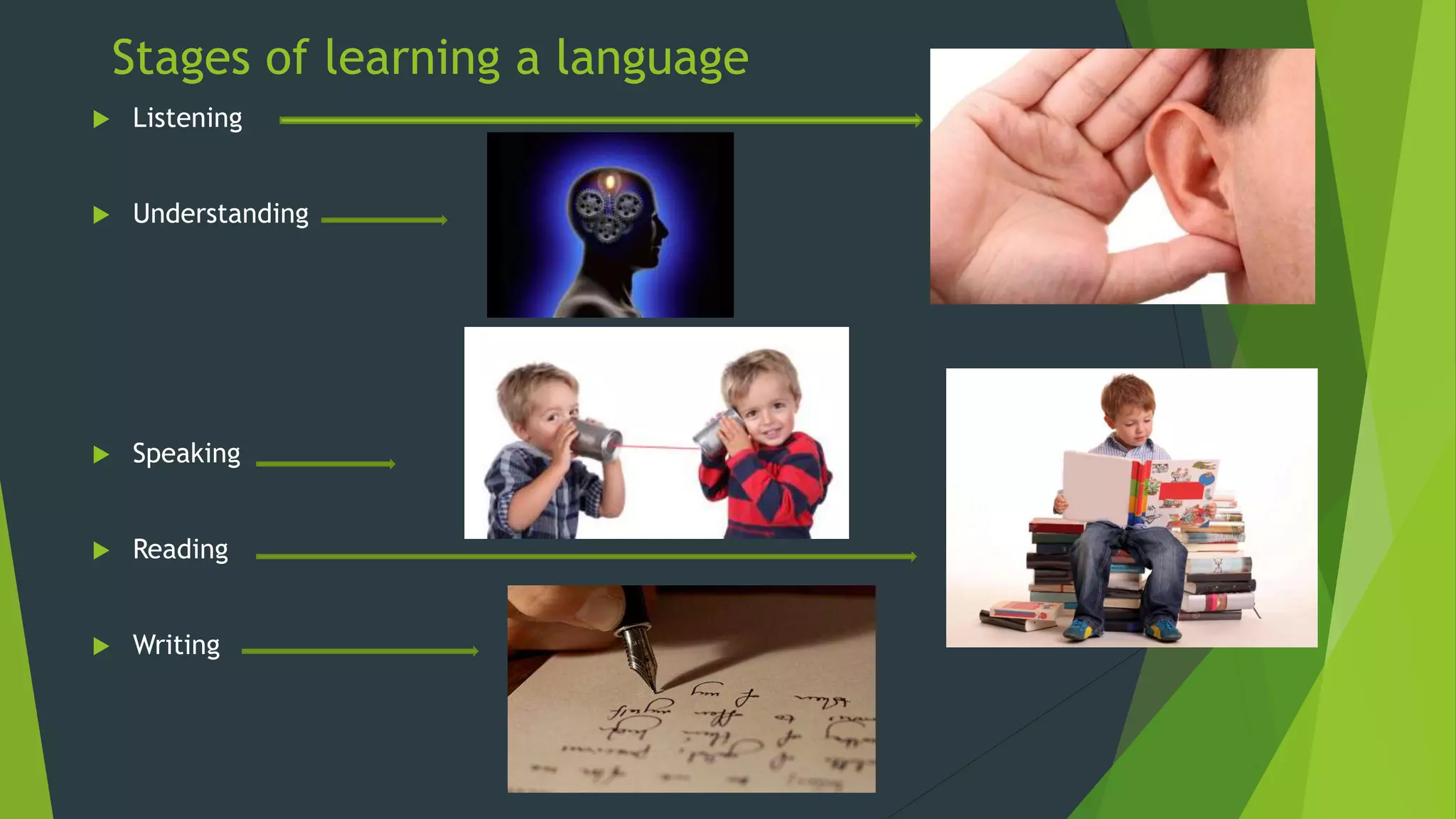
 Articulate
Language
 Meaningful
 the action of the vocal organs
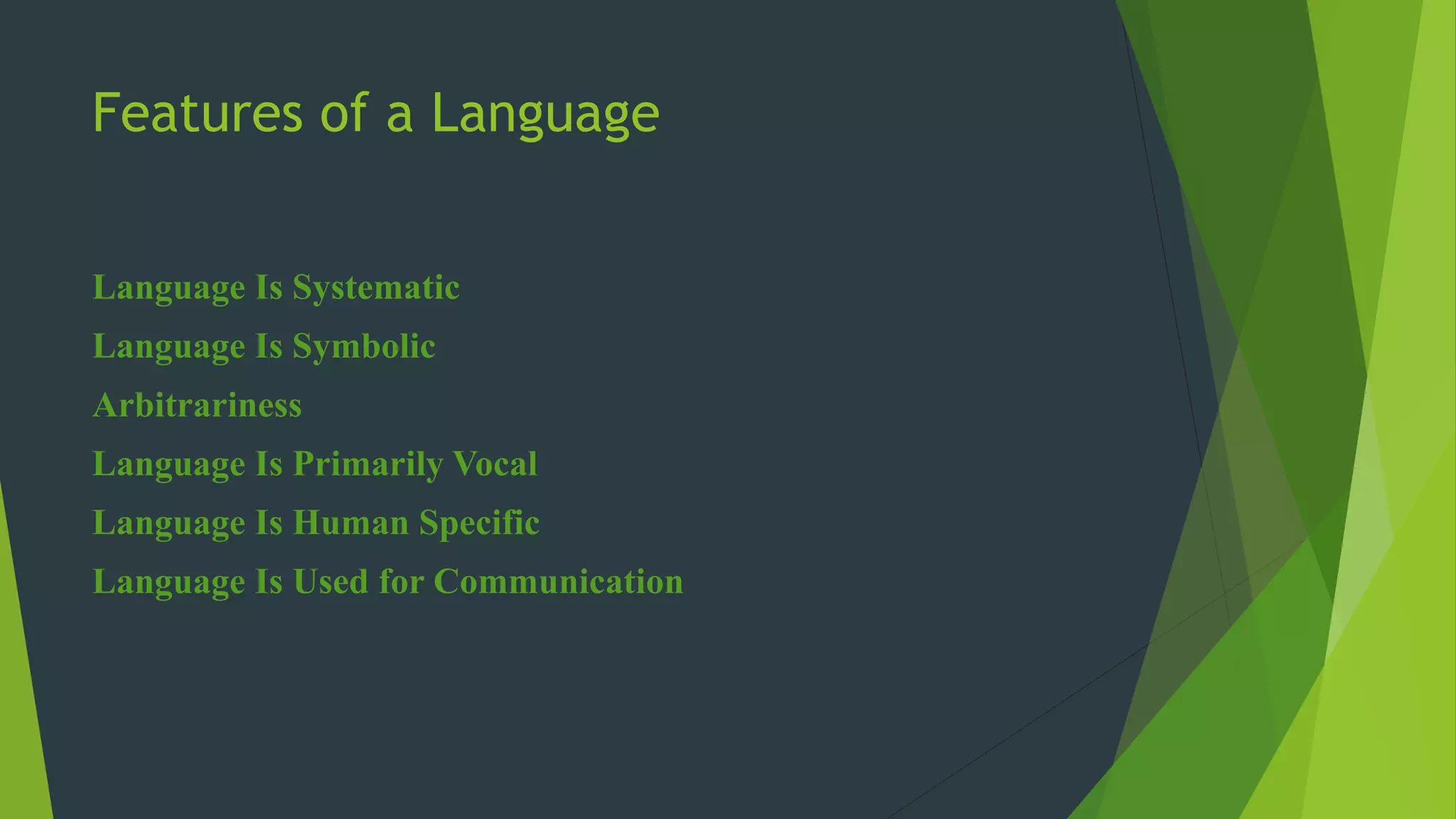
Stages of learning a language
 Listening
 Understanding
 Speaking
 Reading
 Writing
Steps of leaning English as a second language
 Reading
 Memorizing
 Translating
 Writing
Features of a Language
Language Is Systematic
Language Is Symbolic
Arbitrariness
Language Is Primarily Vocal
Language Is Human Specific
Language Is Used for Communication
Functions of Language
 Language enables humans to do many things, thus serving
different functions in the society. Finch (1998) lists seven
general (micro) functions:
 Physiological function
 Phatic function
 Recording function
 Identifying function
 Reasoning function
 Communicating function
 Pleasure function
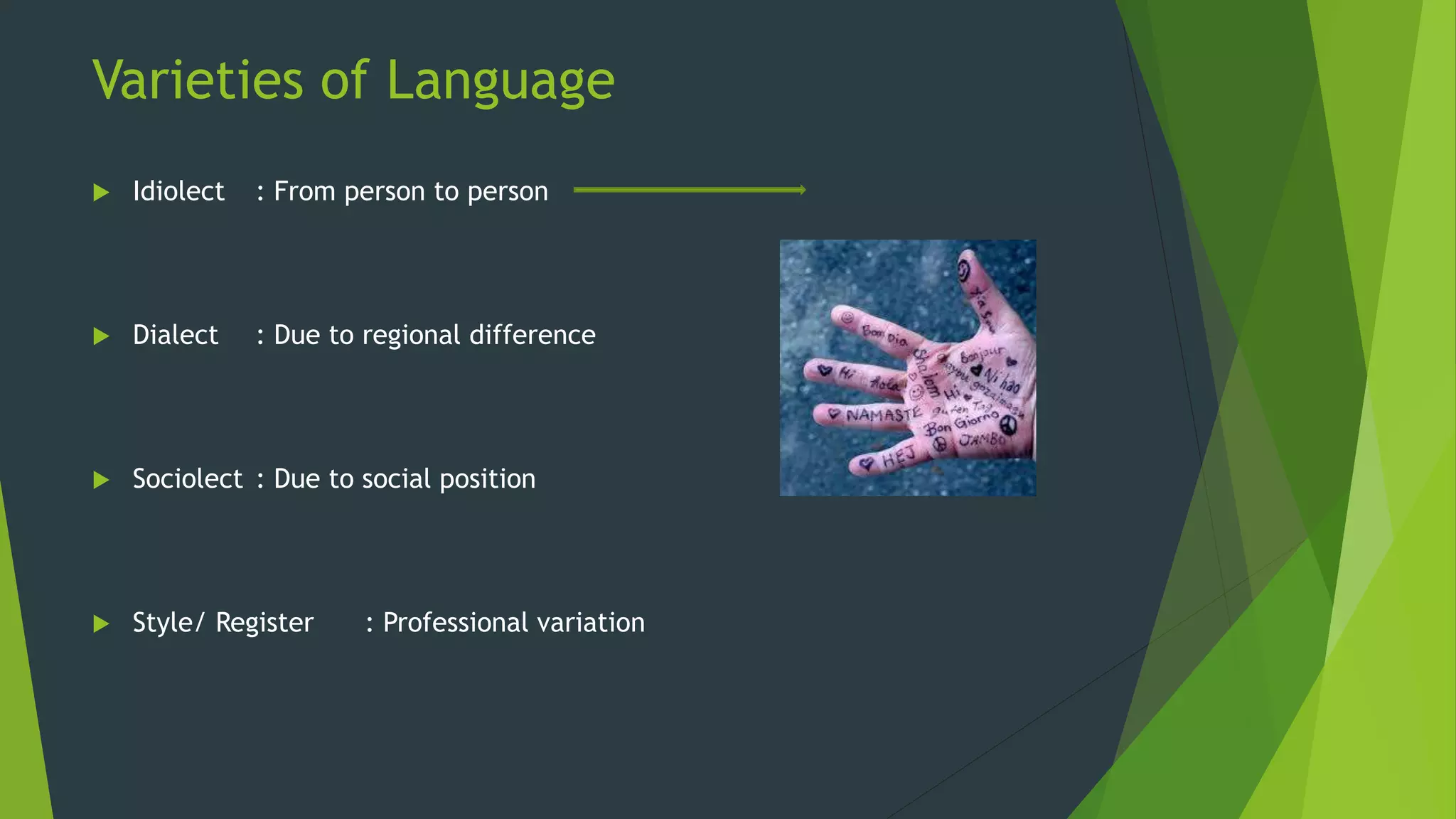
Varieties of Language
 Idiolect : From person to person
 Dialect : Due to regional difference
 Sociolect : Due to social position
 Style/ Register : Professional variation
Other Communication
 Human:
 Direct
 Body language (kinesics), tone of voice, personal space
(proxemics), gesture
 Indirect
 Writing, mathematics, music, painting, signs
 Nonhuman:
 Sounds, odors, body movements
 Call systems, ethologists
 ASL – American Sign Language
Animal v. Human Communication
 Four differences:
 Productivity (infinite expressions)
 Displacement (past, present, future)
 Arbitrariness (no link between word and sound)
 Combining sounds (phonemes)
 English has 45 phonemes
 Nonhuman animals cannot combine sounds
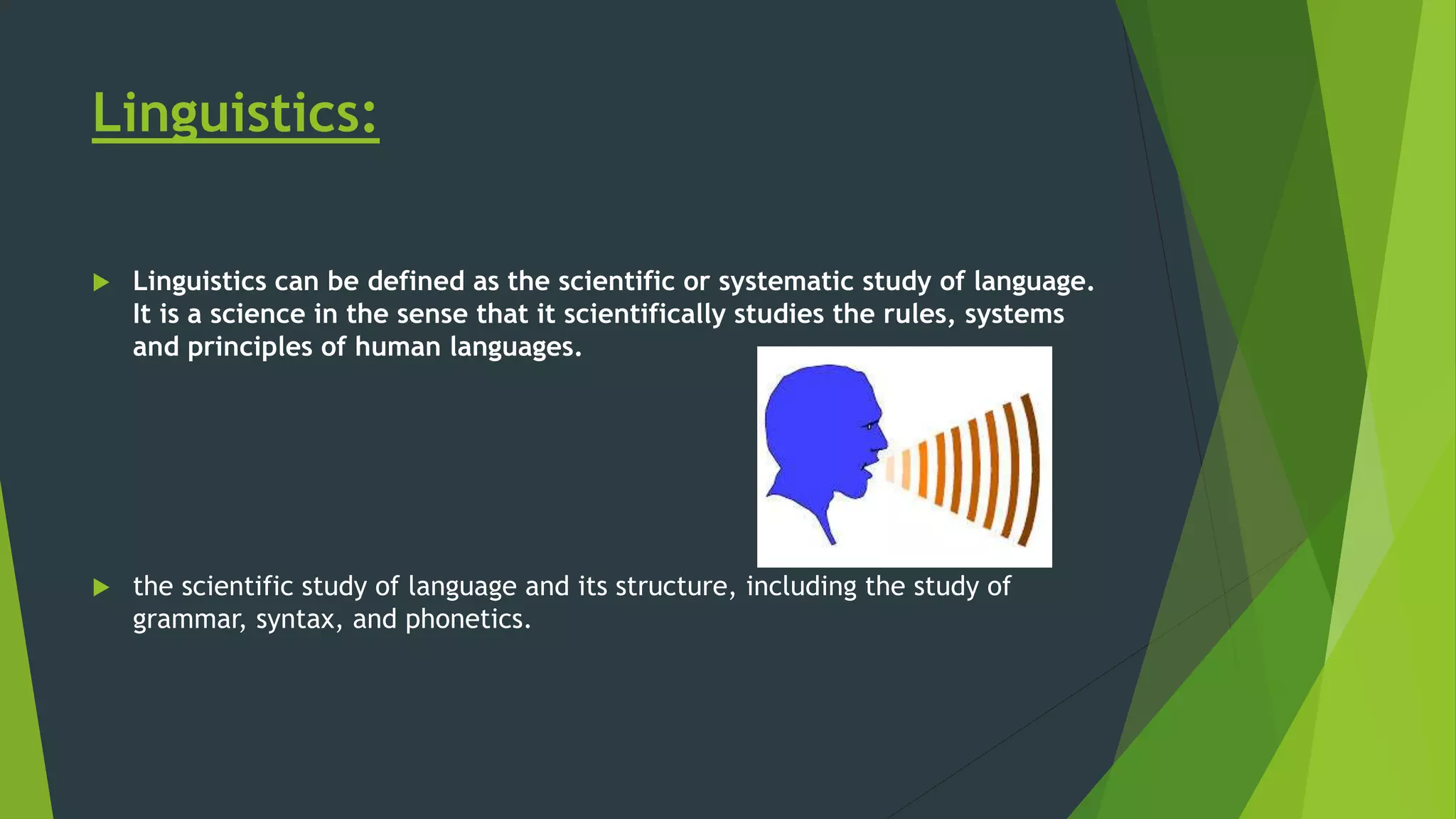
Linguistics:
 Linguistics can be defined as the scientific or systematic study of language.
It is a science in the sense that it scientifically studies the rules, systems
and principles of human languages.
 the scientific study of language and its structure, including the study of
grammar, syntax, and phonetics.
Main branches of linguistics
 Phonetics
 Phonology
 Morphology
 Syntax
 Semantics
Phonetics
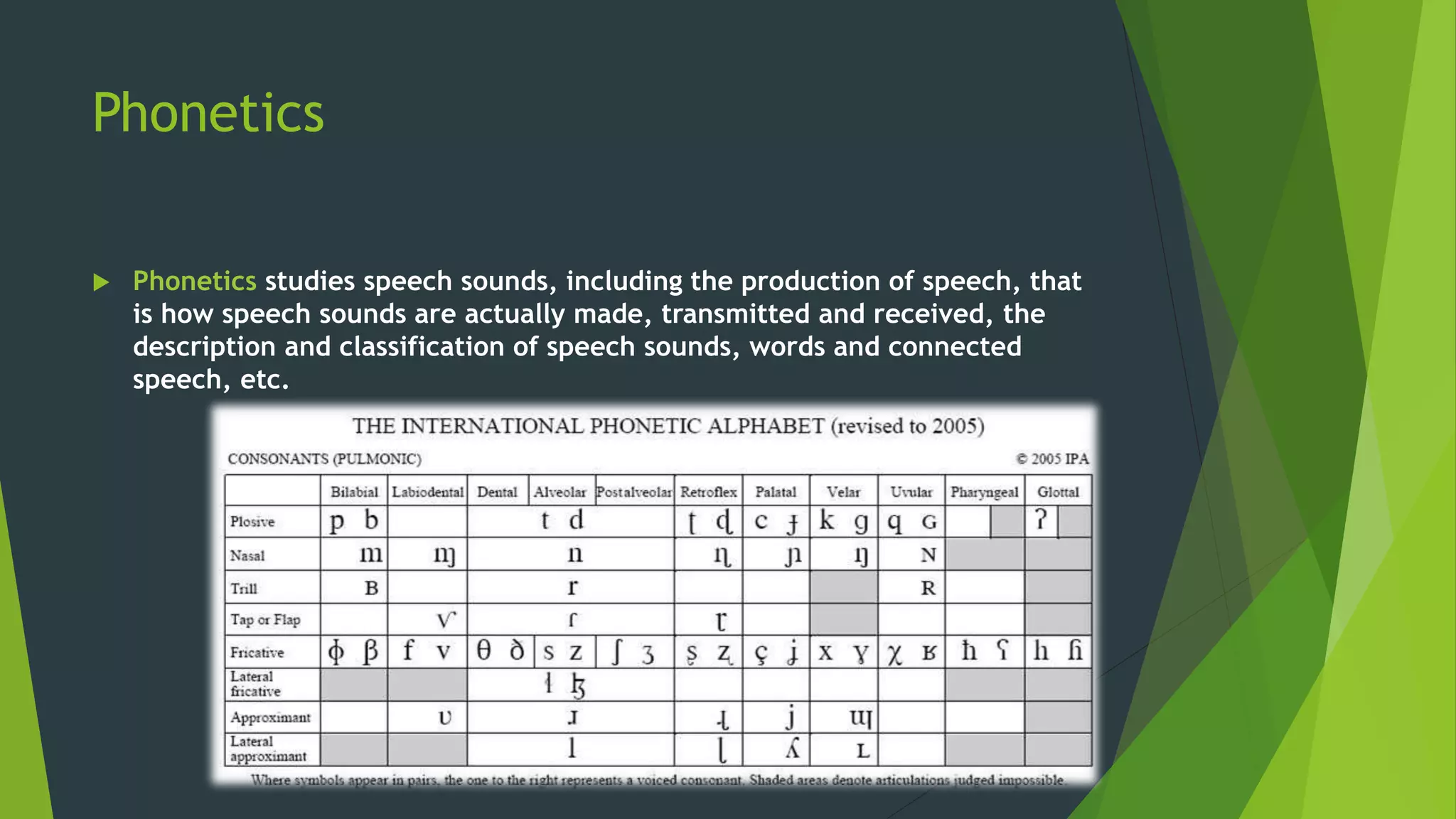
 Phonetics studies speech sounds, including the production of speech, that
is how speech sounds are actually made, transmitted and received, the
description and classification of speech sounds, words and connected
speech, etc.
Phonology
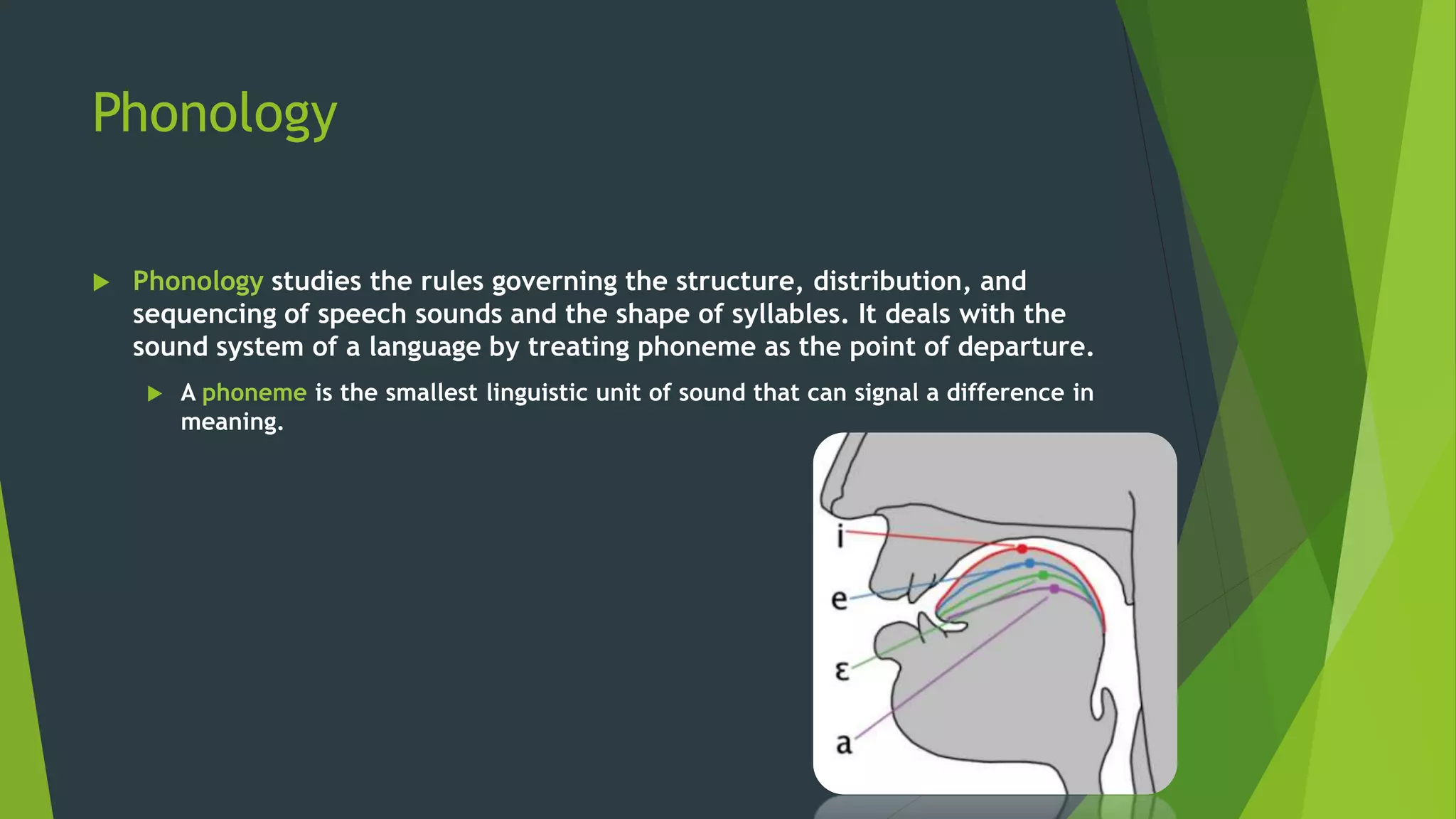
 Phonology studies the rules governing the structure, distribution, and
sequencing of speech sounds and the shape of syllables. It deals with the
sound system of a language by treating phoneme as the point of departure.
 A phoneme is the smallest linguistic unit of sound that can signal a difference in
meaning.
Morphology
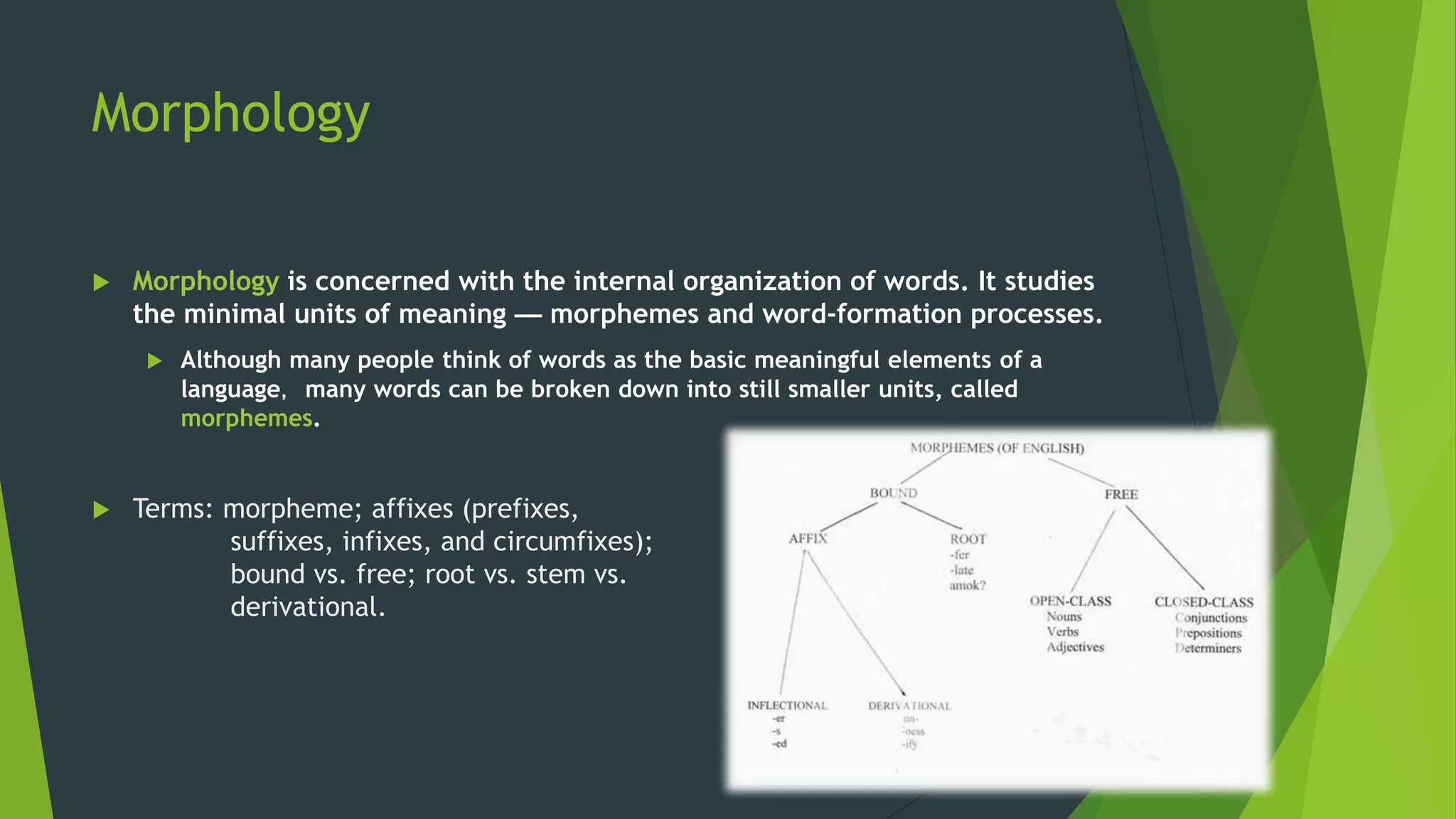
 Morphology is concerned with the internal organization of words. It studies
the minimal units of meaning — morphemes and word-formation processes.
 Although many people think of words as the basic meaningful elements of a
language,many words can be broken down into still smaller units, called
morphemes.
 Terms: morpheme; affixes (prefixes,
suffixes, infixes, and circumfixes);
bound vs. free; root vs. stem vs.
derivational.
Syntax
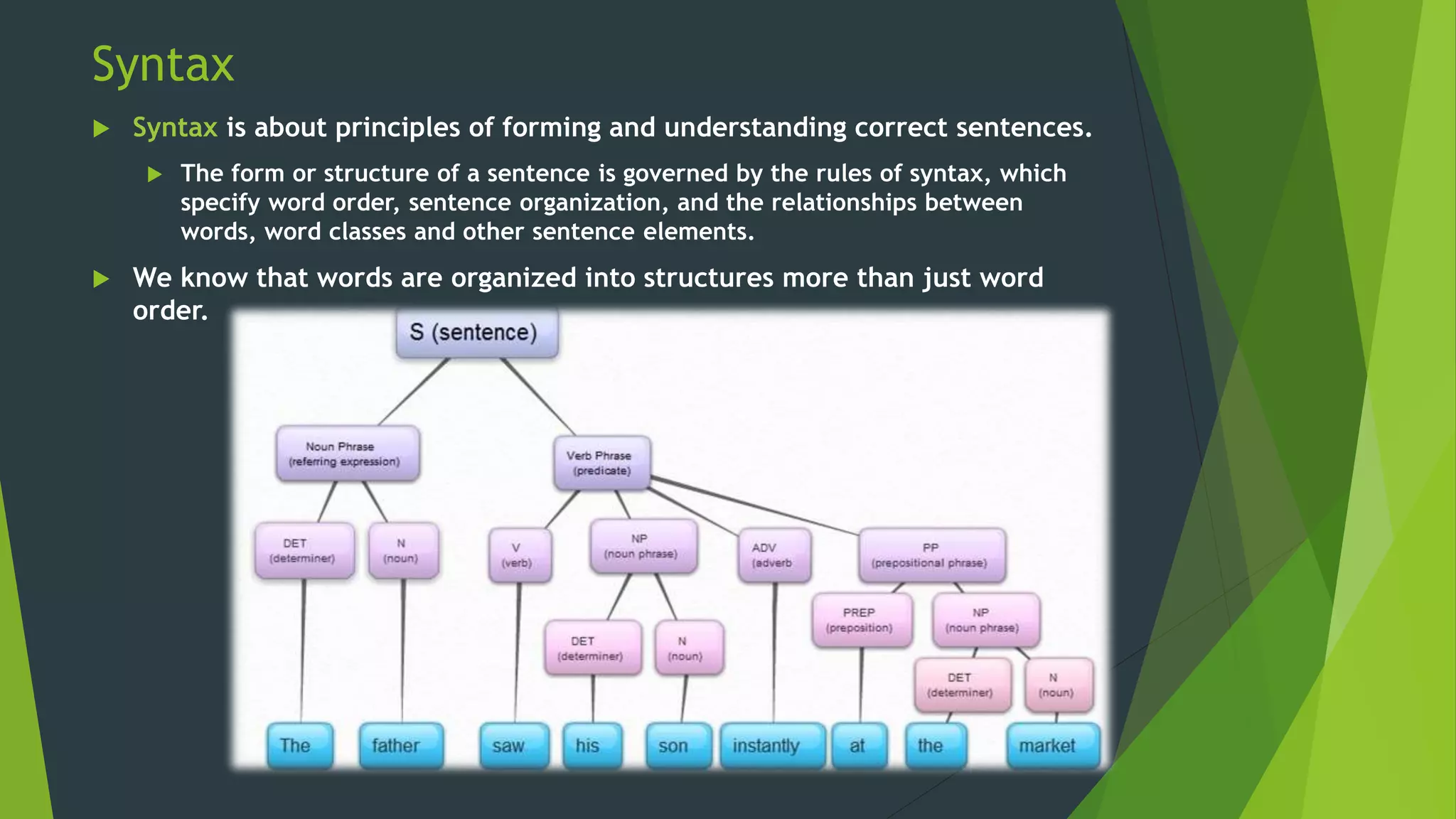
 Syntax is about principles of forming and understanding correct sentences.
 The form or structure of a sentence is governed by the rules of syntax, which
specify word order, sentence organization, and the relationships between
words, word classes and other sentence elements.
 We know that words are organized into structures more than just word
order.
Semantics:
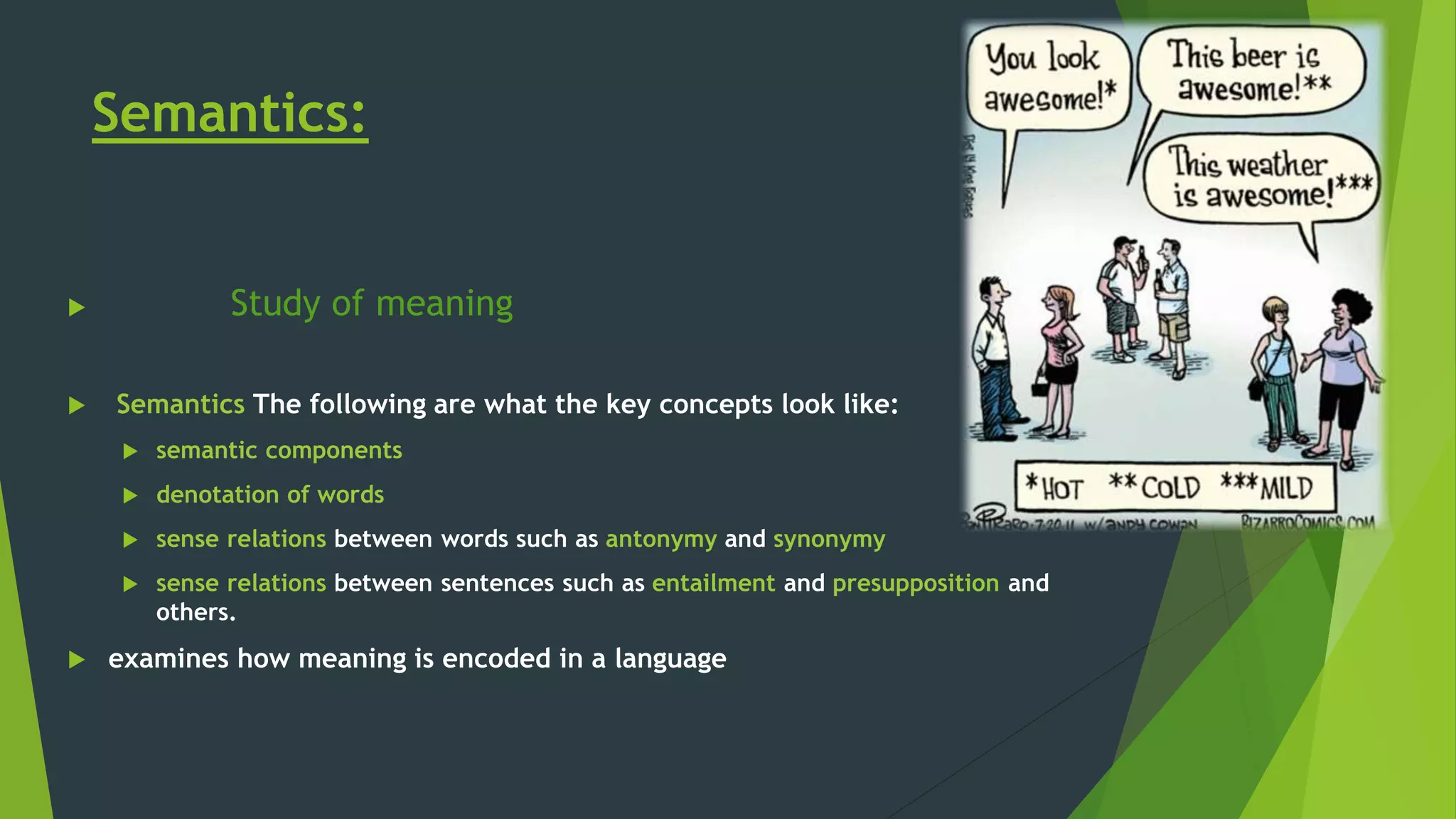
 Study of meaning
 Semantics The following are what the key concepts look like:
 semantic components
 denotation of words
 sense relations between words such as antonymy and synonymy
 sense relations between sentences such as entailment and presupposition and
others.
 examines how meaning is encoded in a language
Saussure’s Theory of the Sign
 Sign = Linguistic form + Meaning
 ‘The word cat’ = [kh æ t] +
C. Grammar:
The sounds and sound patterns, the basic
units of meaning, such as words, and the
rules to combine them to form new
sentences constitute the grammar of a
language. The grammar is an internalized,
unconscious set of rules.
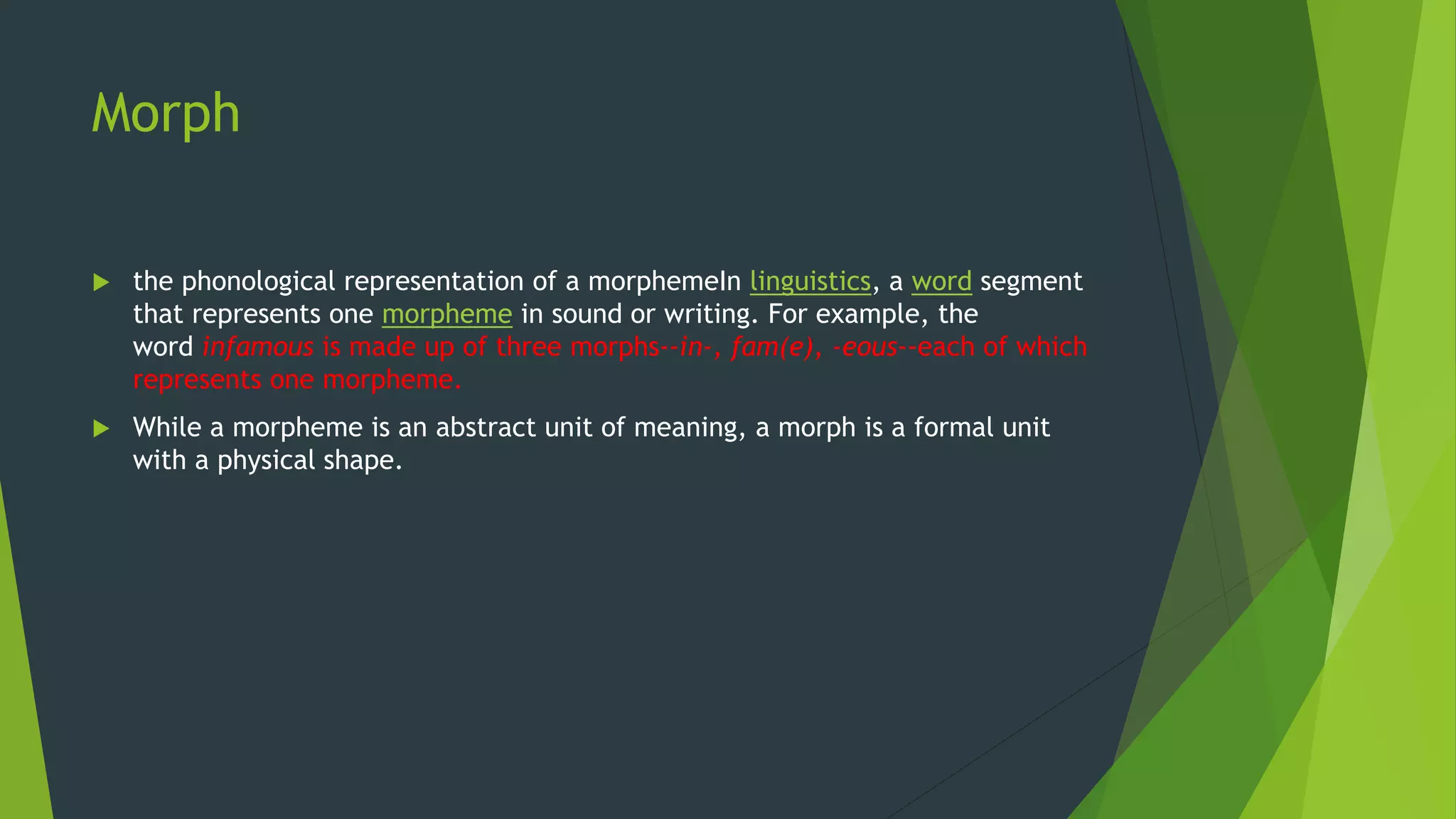
Morph
 the phonological representation of a morphemeIn linguistics, a word segment
that represents one morpheme in sound or writing. For example, the
word infamous is made up of three morphs--in-, fam(e), -eous--each of which
represents one morpheme.
 While a morpheme is an abstract unit of meaning, a morph is a formal unit
with a physical shape.
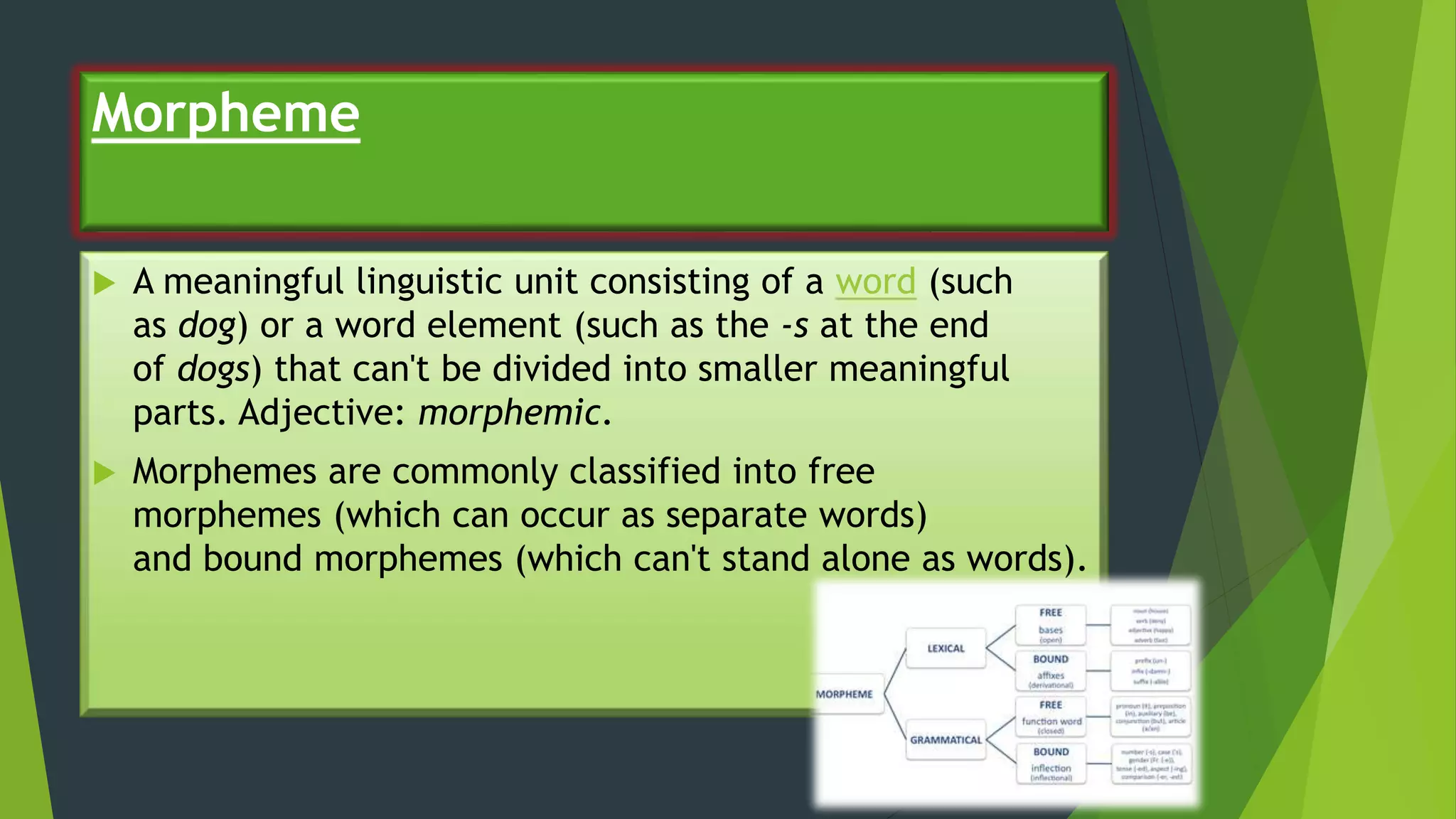
Morpheme
 A meaningful linguistic unit consisting of a word (such
as dog) or a word element (such as the -s at the end
of dogs) that can't be divided into smaller meaningful
parts. Adjective: morphemic.
 Morphemes are commonly classified into free
morphemes (which can occur as separate words)
and bound morphemes (which can't stand alone as words).
Allomorph
 Any of the variant forms of a morpheme. For example, the phonetic (s)
of cats (kăts), (z) of pigs (pĭgz), and (ĭz) horses(hôr′sĭz) are allomorphs of the
English plural morpheme.
Phone
 a speech sound: There are three phonetically different “t” phones in an utter
ance of “titillate,” and two in anutterance of “tattletale.”
 A speech sound considered without reference to its status as a phoneme or an
allophone in a language.
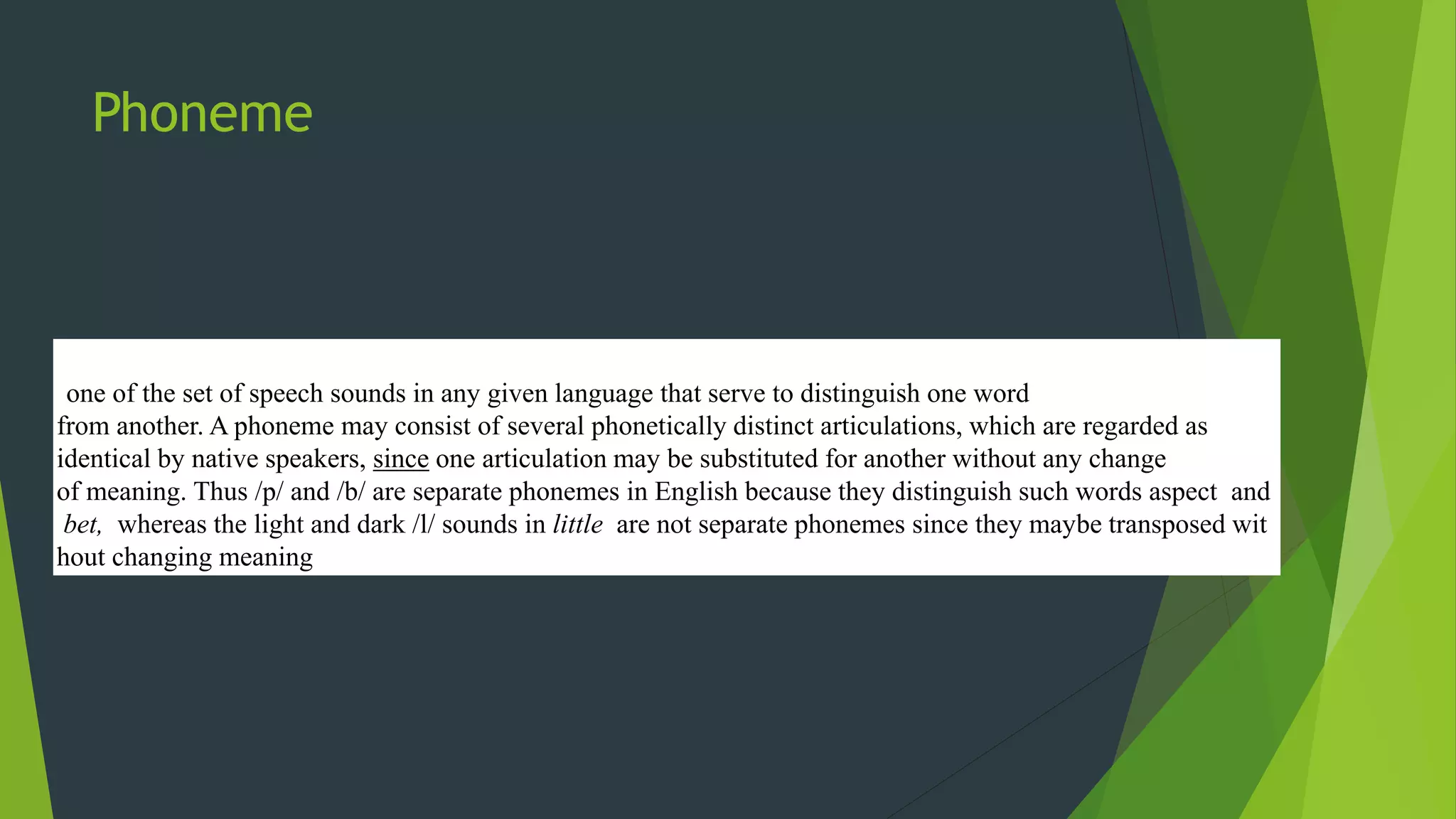
Phoneme
one of the set of speech sounds in any given language that serve to distinguish one word
from another. A phoneme may consist of several phonetically distinct articulations, which are regarded as
identical by native speakers, since one articulation may be substituted for another without any change
of meaning. Thus /p/ and /b/ are separate phonemes in English because they distinguish such words aspect and
bet, whereas the light and dark /l/ sounds in little are not separate phonemes since they maybe transposed wit
hout changing meaning
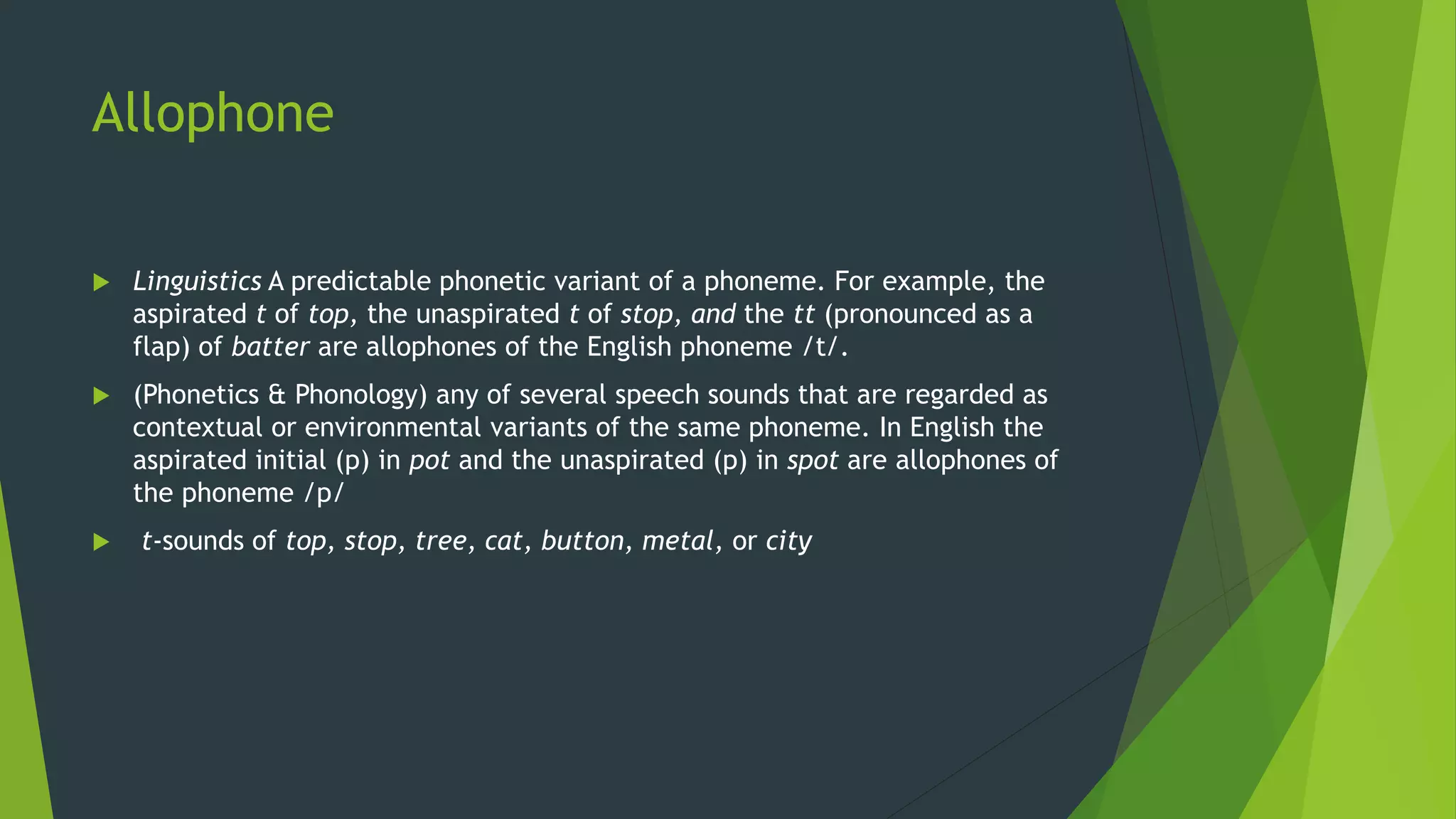
Allophone
 Linguistics A predictable phonetic variant of a phoneme. For example, the
aspirated t of top, the unaspirated t of stop, and the tt (pronounced as a
flap) of batter are allophones of the English phoneme /t/.
 (Phonetics & Phonology) any of several speech sounds that are regarded as
contextual or environmental variants of the same phoneme. In English the
aspirated initial (p) in pot and the unaspirated (p) in spot are allophones of
the phoneme /p/
 t-sounds of top, stop, tree, cat, button, metal, or city
Do you have any query ?

Linguistics Terms

  • 1.
    Welcome To the presentationon Linguistics terms
  • 2.
    Language:  Audible, articulate,meaningful sound as produced by the action of the vocal organs  Audible  Articulate
  • 3.
    Language  Meaningful  theaction of the vocal organs
  • 4.
    Stages of learninga language  Listening  Understanding  Speaking  Reading  Writing
  • 5.
    Steps of leaningEnglish as a second language  Reading  Memorizing  Translating  Writing
  • 6.
    Features of aLanguage Language Is Systematic Language Is Symbolic Arbitrariness Language Is Primarily Vocal Language Is Human Specific Language Is Used for Communication
  • 7.
    Functions of Language Language enables humans to do many things, thus serving different functions in the society. Finch (1998) lists seven general (micro) functions:  Physiological function  Phatic function  Recording function  Identifying function  Reasoning function  Communicating function  Pleasure function
  • 8.
    Varieties of Language Idiolect : From person to person  Dialect : Due to regional difference  Sociolect : Due to social position  Style/ Register : Professional variation
  • 9.
    Other Communication  Human: Direct  Body language (kinesics), tone of voice, personal space (proxemics), gesture  Indirect  Writing, mathematics, music, painting, signs  Nonhuman:  Sounds, odors, body movements  Call systems, ethologists  ASL – American Sign Language
  • 10.
    Animal v. HumanCommunication  Four differences:  Productivity (infinite expressions)  Displacement (past, present, future)  Arbitrariness (no link between word and sound)  Combining sounds (phonemes)  English has 45 phonemes  Nonhuman animals cannot combine sounds
  • 11.
    Linguistics:  Linguistics canbe defined as the scientific or systematic study of language. It is a science in the sense that it scientifically studies the rules, systems and principles of human languages.  the scientific study of language and its structure, including the study of grammar, syntax, and phonetics.
  • 12.
    Main branches oflinguistics  Phonetics  Phonology  Morphology  Syntax  Semantics
  • 13.
    Phonetics  Phonetics studiesspeech sounds, including the production of speech, that is how speech sounds are actually made, transmitted and received, the description and classification of speech sounds, words and connected speech, etc.
  • 14.
    Phonology  Phonology studiesthe rules governing the structure, distribution, and sequencing of speech sounds and the shape of syllables. It deals with the sound system of a language by treating phoneme as the point of departure.  A phoneme is the smallest linguistic unit of sound that can signal a difference in meaning.
  • 15.
    Morphology  Morphology isconcerned with the internal organization of words. It studies the minimal units of meaning — morphemes and word-formation processes.  Although many people think of words as the basic meaningful elements of a language,many words can be broken down into still smaller units, called morphemes.  Terms: morpheme; affixes (prefixes, suffixes, infixes, and circumfixes); bound vs. free; root vs. stem vs. derivational.
  • 16.
    Syntax  Syntax isabout principles of forming and understanding correct sentences.  The form or structure of a sentence is governed by the rules of syntax, which specify word order, sentence organization, and the relationships between words, word classes and other sentence elements.  We know that words are organized into structures more than just word order.
  • 17.
    Semantics:  Study ofmeaning  Semantics The following are what the key concepts look like:  semantic components  denotation of words  sense relations between words such as antonymy and synonymy  sense relations between sentences such as entailment and presupposition and others.  examines how meaning is encoded in a language
  • 19.
    Saussure’s Theory ofthe Sign  Sign = Linguistic form + Meaning  ‘The word cat’ = [kh æ t] +
  • 20.
    C. Grammar: The soundsand sound patterns, the basic units of meaning, such as words, and the rules to combine them to form new sentences constitute the grammar of a language. The grammar is an internalized, unconscious set of rules.
  • 21.
    Morph  the phonologicalrepresentation of a morphemeIn linguistics, a word segment that represents one morpheme in sound or writing. For example, the word infamous is made up of three morphs--in-, fam(e), -eous--each of which represents one morpheme.  While a morpheme is an abstract unit of meaning, a morph is a formal unit with a physical shape.
  • 22.
    Morpheme  A meaningfullinguistic unit consisting of a word (such as dog) or a word element (such as the -s at the end of dogs) that can't be divided into smaller meaningful parts. Adjective: morphemic.  Morphemes are commonly classified into free morphemes (which can occur as separate words) and bound morphemes (which can't stand alone as words).
  • 23.
    Allomorph  Any ofthe variant forms of a morpheme. For example, the phonetic (s) of cats (kăts), (z) of pigs (pĭgz), and (ĭz) horses(hôr′sĭz) are allomorphs of the English plural morpheme.
  • 24.
    Phone  a speechsound: There are three phonetically different “t” phones in an utter ance of “titillate,” and two in anutterance of “tattletale.”  A speech sound considered without reference to its status as a phoneme or an allophone in a language.
  • 25.
    Phoneme one of theset of speech sounds in any given language that serve to distinguish one word from another. A phoneme may consist of several phonetically distinct articulations, which are regarded as identical by native speakers, since one articulation may be substituted for another without any change of meaning. Thus /p/ and /b/ are separate phonemes in English because they distinguish such words aspect and bet, whereas the light and dark /l/ sounds in little are not separate phonemes since they maybe transposed wit hout changing meaning
  • 26.
    Allophone  Linguistics Apredictable phonetic variant of a phoneme. For example, the aspirated t of top, the unaspirated t of stop, and the tt (pronounced as a flap) of batter are allophones of the English phoneme /t/.  (Phonetics & Phonology) any of several speech sounds that are regarded as contextual or environmental variants of the same phoneme. In English the aspirated initial (p) in pot and the unaspirated (p) in spot are allophones of the phoneme /p/  t-sounds of top, stop, tree, cat, button, metal, or city
  • 28.
    Do you haveany query ?