Chapter 5
Communications
Preparatory
Integrates comprehensive knowledge of the
EMS system, safety/well-being of the
paramedic, and medical/legal and ethical
issues, which is intended to improve the
health of EMS personnel, patients, and the
community.
National EMS Education
Standard Competencies
EMS System Communication
Communication needed to
• Call for resources
• Transfer care of the patient
• Interact within the team structure
National EMS Education
Standard Competencies
Communication needed to (cont’d)
• Use the EMS system
• Coordinate care with other health care
professionals
• Improve team dynamics
National EMS Education
Standard Competencies
Therapeutic Communication
Principles of communicating with patients in a
manner that achieves a positive relationship
• Interviewing techniques
• Adjusting communication strategies for age,
stage of development, patients with special
needs, and differing cultures
• Verbal defusing strategies
National EMS Education
Standard Competencies
Principles of communicating with patients in a
manner that achieves a positive relationship
• Family presence issues
• Dealing with difficult patients
• Factors that affect communication
National EMS Education
Standard Competencies
Medical Terminology
Integrates comprehensive anatomic and
medical terminology and abbreviations into
written and oral communication with
colleagues and other health care
professionals.
National EMS Education
Standard Competencies
Introduction
• The ability to communicate clearly is a core
EMS skill.
– You must be able to communicate with
dispatch, other members of the EMS system,
patients, family members, and bystanders.
– Many factors influence how effectively you
communicate.
Introduction
• Communication is both an interactive and a
circular process.
– The sender formulates and encodes the
message.
– The message is transmitted to a receiver.
– The receiver receives and decodes the
message.
– Feedback is confirmation the message was
accurately received.
Introduction
© Jones & Bartlett Learning. Original Illustration Courtesy of Gordon Worley.
Introduction
• Barriers to effective communication:
– Language barriers
– Vision or hearing impairment
– Impaired cognition or confusion
– Psychiatric conditions
– Substance abuse
– Preexisting medical conditions
Introduction
• Barriers to effective communication (cont’d):
– Lack of ability to comprehend
– Stress
– Preconceptions
• Adjust how you communicate to minimize
barriers.
• Your attitude and demeanor can also affect
communication.
Response to the Call for EMS
• EMS calls originate when someone
recognizes a potential emergency and calls
9-1-1.
• The dispatcher elicits information from the
caller.
– Location of patient
– Phone number of caller
– Why EMS was called
– Patient’s condition
Response to the Call for EMS
• Dispatcher will determine which resources
are needed and notify them.
– Computer-assisted dispatch (CAD)
– May provide prearrival medical instructions to the
caller
• Dispatcher must remain aware of what is
occurring in the field and stay in contact with
the responders.
EMS Communications
Systems
• Systems and devices use radio signals to
send and receive information.
– Basic two-way radio
– Computerized radio systems
– Cellular technology
• Backup systems are essential.
Basic Radio Communications
Theory
• A radio transmits by electromagnetic waves.
– Frequency is number of cycles per second
(hertz)
• Frequencies are grouped into bands by the
FCC.
– VHF band extends from 30 to 300 MHz
– UHF band extends from 300 MHz to 3.0 GHz
Basic Radio Communications
Theory
• Radio communications require two types of
devices.
– The transmitter converts data into a radio signal
and transmits it on the designated frequency.
– The receiver collects the radio signal and
translates it back into data or sound.
– Transceivers (two-way radios) contain both a
transmitter and a receiver.
Communications System
Components
• Base stations
– Have a fixed location
– Serve as dispatch
and coordination
areas
• Mobile transceivers
– Two-way radios
mounted on vehicles
• Portable transceivers
– Small battery-
powered units
– Handheld
© Jones & Bartlett Learning. Courtesy of MIEMSS.
Communications System
Components
• Radio systems
– Simplex: All transmissions on the same
frequency
– Duplex: Radio signals transmitted on one
frequency and received on a second frequency
– Multiplex: Carry multiple streams of audio/data
at the same time
– Digital: Transmit digital or digitized signals
Communications System
Components
• Repeaters
– Specialized base station transceiver
– Pick up weak signals and retransmit them at higher
power on another frequency
– Extend system range
©Jones&BartlettLearning.OriginalIllustration
CourtesyofGordonWorley.
Communications System
Components
• Encoded radio signals allow multiple users
to share frequencies and repeaters.
– Continuous Tone-Coded Squelch System
(CTCSS)
• Digital trunked radio systems utilize multiple
repeaters and computers to route radio
traffic within the system.
• Be aware of radio dead spots in your
service area.
Interoperability
• Mutual aid agreements with neighboring
jurisdictions
• SAFECOM
– Program developed by the US Department of
Homeland Security
• Project 25 (P25)
– Digital radio hardware standards established by
the Association of Public Safety
Communications
Cellular Technology
• Cell phones are
commonly used in
EMS.
– Low-power portable
radios
– Connected to the
telephone network
• Know commonly
used phone
numbers.
© Jones & Bartlett Learning.
Cellular Technology
• Smartphones allow users to:
– Take and send photographs or videos
– Use GPS
– Access a huge range of medical applications
• Be aware of privacy implications regarding
photographs or videos.
Automatic Crash Notification
(ACN)
• Use onboard computers to send data to a
monitoring stations.
– Location
– Vehicle type
– Severity of crash
– Whether seat belts or airbags were used
• May allow two-way voice communication
with the occupants of the vehicle.
Satellite Communications
• Satellite phones can be valuable in rural and
remote areas.
• Technology is expensive.
• Global positioning system (GPS) utilizes
handheld or vehicle-mounted receivers to
locate the user’s position and provide
directions.
Backup Communications
Systems
• Necessary for all public safety
communications systems
• Landlines, cell phones
• Amateur radio groups
– Amateur Radio Emergency Service (ARES)
– Radio Amateur Civil Emergency Services
(RACES)
Biotelemetry
• Measures and transmits vital life signs
– Biotelemetry is mostly used with ECGs.
– As paramedics have gained skill, the trend has
been to rely on ECG telemetry less.
• New developments in prehospital ECG
telemetry
– Early diagnosis/treatment of STEMI
– Two-way data transmission
Communicating by Radio
• Effectiveness
depends on:
– Technical
hardware/software
– People who use it
© Jones & Bartlett Learning. Courtesy of MIEMSS.
FCC Regulations
• The FCC:
– Issues radio licenses
– Allocates frequencies
– Develops technical standards
– Establishes/enforces rules/regulations for radio
equipment operation
– Monitors transmissions
FCC Regulations
• The FCC ensures frequencies for
emergency medical use are confined to that
use.
• The FCC forbids:
– Use of obscenities
– Transmission of nonmedical messages
Clarity of Transmission
• Guidelines to improve clarity:
– Know what you want to say before beginning.
– Make sure the channel is clear.
– Start with identifying information.
– Speak clearly and distinctly.
– Keep calm and free of emotion.
– Use plain language.
– Keep transmissions brief.
– Spell out words or numbers to prevent confusion.
Content of Transmissions
• Be accurate and concise.
• Guidelines include:
– Protect the patient’s privacy at all times.
– Be impersonal.
– Use proper medical terminology.
– Act professionally.
– Question orders you did not hear or understand.
Codes
• Most EMS systems have phased out the
10-code system and other radio codes.
• The Medical Priority Dispatch system
(MPDS) uses a specific format to indicate
the nature of the emergency and priority.
• The National Incident Management System
(NIMS) discourages use of radio codes.
– Clear text is the preferred format.
Communications Formats
During Phases of the
Response
• Different formats for each agency’s or
region’s radio communication
• Dispatch communications
– Respond to the dispatcher that you have
received the message.
– Confirm location and call reference.
– Establish your dispatch time.
Response to the Scene
• Contact dispatch when you begin your trip to
the scene.
– Establishes your en route time
• Your next transmission should be at your
arrival on scene.
– Establishes arrival time
– Opportunity to call for additional resources
On-Scene Communications
• You need to stay in contact with other
responders at the scene.
• Contact dispatch when you are ready to
provide transport.
• Your next transmission is to notify dispatch
of your arrival at the medical facility.
• Your last transmission confirms call
completion and establishes status.
Relaying Information to
Medical Control
• The legal basis for
paramedic practice is
supervision by a
physician.
– Off-line medical control
– Online medical control
• Communications
should be concise and
accurate.
© Jones & Bartlett Learning. Courtesy of MIEMSS.
Reporting Medical Information
• Medical information should include:
– Destination facility and ETA
– Patient’s age and sex
– Patient’s chief complaint
– Brief history of present illness or injury
– Medications and allergies
– Other medical history relative to current situation
– Patient’s level of consciousness/distress
Reporting Medical Information
• Medical information should include (cont’d):
– Patient’s mental status
– Patient’s vital signs
– Physical findings in head-to-toe order
– ECG findings
– Treatment given so far and response
Reporting Medical Information
• Transmit information quickly, completely,
and in a well-organized fashion.
• Gather information thoroughly at the scene,
and organize it clearly before reporting.
• Continue to monitor and assess the patient
and report any changes.
Communication With Health
Care Professionals
• In-person report
– Share information not
given on the radio.
– Be mindful of
information relayed in
front of the patient.
• You may want to
step away.
– Answer all questions.
– Provide written
documentation.
© Jones & Bartlett Learning. Courtesy of MIEMSS.
Communication With Health
Care Professionals
• Medical terminology
– Learn established terms and abbreviations.
– Your EMS system may have approved list of
terms.
Therapeutic Communication
• Paramedics often
see people at their
most vulnerable.
– At least half of calls
involve going in
someone’s home.
• See every invitation
into a home as a
personal honor.
© Jones & Bartlett Learning. Courtesy of MIEMSS.
Therapeutic Communication
• When working in a noisy environment:
– Try hard not to shout.
– Reduce noise when possible.
– Move the patient to a quiet area.
– Speak close to the patient’s ear in a calm voice.
Therapeutic Communication
• Use strategies to encourage the patient to
express ideas and feelings.
– Convince the patient you want to hear what he or
she has to say.
– Give patients your undivided attention.
– Pay attention to the patient’s answers the first
time.
– Jot down the patient’s responses.
– Use active listening.
Therapeutic Communication
• Good rapport is essential for obtaining good
medical information.
• If the patient is reluctant, explain why you
need personal information.
– Remind him or her it is protected by law.
• If patients have trouble focusing, move them
safely to the ambulance.
– Talking and listening is easier there.
Therapeutic Communication
• If a patient seems threatened:
– Approach cautiously
– Use open posturing
– Smile
– Be calm
– Reassure the patient
– If possible, take things slowly
Therapeutic Communication
• Introductions are the first step in promoting
open communication.
– Introduce yourself as soon as possible.
– Make and keep eye contact.
– Get on the patient’s level.
– Be aware of body language.
– Use the patient’s name.
– Speak slowly and calmly.
Therapeutic Communication
• Respect and protect
the patient’s
modesty.
– Especially for:
• Elderly
• Adolescents
• Children
• Even if the patient is
not sensitive, family
members will be.
© Glen E. Ellman.
Conducting an Interview
• Two types of questions
– Open-ended, which allow:
• The patient to give you feedback
• You to judge mentation
– Closed-ended
• Used to elicit specific answers
• Also known as direct questions
Conducting an Interview
• Let the patient answer at his or her own
pace.
• Have a standard set of questions for
collecting medical history.
– Avoid talking down to patients.
– Use terms people without medical training can
understand.
Strategies to Elicit Useful
Responses
• Reflection
– Repeat a word or phrase a patient used to
encourage more detail.
• Empathy
– Put yourself in the patient’s position.
• Confrontation
– Make patients aware that you understand
something is inconsistent about their story.
Strategies to Elicit Useful
Responses
• Interpretation
– Repeat what you think the patient said, and have
him or her correct you.
• Facilitation
– Encourage patients to provide more detail.
• Silence
– Be patient and give the patient time to speak.
Strategies to Elicit Useful
Responses
• Clarification
– Ask patients to explain what you do not
understand.
• Redirection
– Redirect patients to something mentioned in
passing to get an answer.
• Simplification and summarization
– Summarize the patient’s comments in simpler
terms.
Common Interviewing Errors
• Providing false assurance or making unlikely
claims.
• Offering a diagnosis or giving medical advice
that is beyond your scope of practice.
• Asking leading questions.
• Interrupting the patient or talking too much.
Nonverbal Skills
• First impressions are
important.
– Maintain a professional
demeanor/appearance.
– Be patient.
– Keep body language
positive.
– Touch may provide
comfort.
• Varies by patient
© Jones & Bartlett Learning. Courtesy of MIEMSS.
Special Interview Situations
• Some situations require special techniques.
– These techniques might be helpful with patients
who are uncommunicative, hostile, very young or
old, or who have special needs.
– Avoid stereotyping any patient group.
People Who Are Hostile or
Violent
• Acknowledge a hostile person’s concerns.
– Remain calm and empathize.
– Use interpretation, clarification, and
summarization.
• Consider asking law enforcement for help.
• You may be insulted on the job.
– Never respond in kind.
People Who Are Hostile or
Violent
• Hostile or angry patients may present a
threat.
– Approach with caution, maintaining eye contact.
– Try not to interview an angry patient alone.
– Identify escape routes from the scene.
– Approach the patient from the front, with hands
visible and open.
– Watch for signs of possible attack such as violent
language or body language.
Sexually Aggressive Patients
• Follow your agency’s policies.
• Make sure someone else is always present.
• Communicate professionally and politely.
– Avoid sexually ambiguous words.
• Document your encounter.
– Get witness names and signatures on notes.
Special Considerations of Age
• Do not assume older patients are harder to
communicate with than anyone else.
– Illnesses may be more complex.
– There may be differences in hearing, mobility,
etc.
• Children tend to protest pain.
– Children may panic when separated from their
parents.
– Practice skills to help improve these interactions.
Special Considerations of Age
• Communicating with children:
– Maintain friendly eye contact.
– Smile.
– Give calm explanations.
– Minimize movements.
– Lower your voice.
– Keep eye level at or below the child’s.
– If possible, involve a parent in the care of a small
child.
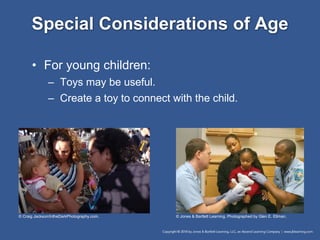
Special Considerations of Age
• For young children:
– Toys may be useful.
– Create a toy to connect with the child.
© Craig Jackson/IntheDarkPhotography.com. © Jones & Bartlett Learning. Photographed by Glen E. Ellman.
Special Considerations of Age
• Adolescents
– Adolescents may not want their parents present.
• Communicate to the physician if a parent insists
over the adolescent’s wishes.
– Offer options; honor their choices.
– Protect the patient’s modesty.
People With Special
Challenges
• Family members and caregivers can
facilitate communication.
• Help patients access any devices to aid
communication or reduce fear.
– Glasses, hearing aids
• Touch and eye contact can convey kindness
or reassurance.
People With Special
Challenges
• Encountering patients with pervasive
developmental disorders is becoming more
common.
– Autism
• A patient may not be able to understand what
you are saying or communicate nonverbally.
• Patients have a wide range of skill
development.
• Communicate through a caregiver if possible.
Cross-Cultural Communication
• Ethnocentrism
– The belief that one’s own culture or ethnic group
is inherently superior to others
– Can lead to incorrect assumptions
• May interfere with your ability to provide
appropriate emergency medical care
Cross-Cultural Communication
• Cultures and religions may have certain
beliefs that conflict with standard medical
procedures.
– Try to understand why the patient is reacting in a
manner you did not anticipate.
Cross-Cultural Communication
• Culture
– System of beliefs, attitudes, and behaviors that
are learned and shared by members of a group
– Learned from others
• Cultural competence
– Ability to recognize cultural differences and
understand how they may affect your interactions
with the diverse population you serve
Cultural Awareness
• Body language may be interpreted differently
by different cultures.
– Eye contact
– Touching with the left hand
– Touching the head
– Showing bottom of feet
– Hands on hips
– Nodding
– Hand gestures
Traditional Folk Medicine and
Understanding of Illness
• Many immigrants to the United States follow
traditional folk medicine practices of their
culture or homeland.
– May believe that health is the result of a balance
of forces
– May believe illness is the result of loss of spirit or
magical influences
– May practice a blend of western and traditional
health practices
Traditional Folk Medicine and
Understanding of Illness
Traditional Folk Medicine and
Understanding of Illness
• Cupping and coining
– May be easily misinterpreted as signs of physical
abuse
• Herbal medicines
– May be a source of symptoms or interact with
prescribed medications
– Collect all medications and bring them to the
hospital
Traditional Folk Medicine and
Understanding of Illness
• The patient may not share the beliefs of his
or her family or cultural background.
– Always remain sensitive to the patient’s
individual religious, cultural, and sociological
beliefs.
Language Interpretation
• The biggest communication challenge with
members of other cultures is a situation in
which no common language exists.
– It may be impossible to perform a good history
and assessment.
– Use a qualified interpreter if possible.
– Assume you are missing something important.

Paramedic Communications

  • 1.
  • 2.
    Preparatory Integrates comprehensive knowledgeof the EMS system, safety/well-being of the paramedic, and medical/legal and ethical issues, which is intended to improve the health of EMS personnel, patients, and the community. National EMS Education Standard Competencies
  • 3.
    EMS System Communication Communicationneeded to • Call for resources • Transfer care of the patient • Interact within the team structure National EMS Education Standard Competencies
  • 4.
    Communication needed to(cont’d) • Use the EMS system • Coordinate care with other health care professionals • Improve team dynamics National EMS Education Standard Competencies
  • 5.
    Therapeutic Communication Principles ofcommunicating with patients in a manner that achieves a positive relationship • Interviewing techniques • Adjusting communication strategies for age, stage of development, patients with special needs, and differing cultures • Verbal defusing strategies National EMS Education Standard Competencies
  • 6.
    Principles of communicatingwith patients in a manner that achieves a positive relationship • Family presence issues • Dealing with difficult patients • Factors that affect communication National EMS Education Standard Competencies
  • 7.
    Medical Terminology Integrates comprehensiveanatomic and medical terminology and abbreviations into written and oral communication with colleagues and other health care professionals. National EMS Education Standard Competencies
  • 8.
    Introduction • The abilityto communicate clearly is a core EMS skill. – You must be able to communicate with dispatch, other members of the EMS system, patients, family members, and bystanders. – Many factors influence how effectively you communicate.
  • 9.
    Introduction • Communication isboth an interactive and a circular process. – The sender formulates and encodes the message. – The message is transmitted to a receiver. – The receiver receives and decodes the message. – Feedback is confirmation the message was accurately received.
  • 10.
    Introduction © Jones &Bartlett Learning. Original Illustration Courtesy of Gordon Worley.
  • 11.
    Introduction • Barriers toeffective communication: – Language barriers – Vision or hearing impairment – Impaired cognition or confusion – Psychiatric conditions – Substance abuse – Preexisting medical conditions
  • 12.
    Introduction • Barriers toeffective communication (cont’d): – Lack of ability to comprehend – Stress – Preconceptions • Adjust how you communicate to minimize barriers. • Your attitude and demeanor can also affect communication.
  • 13.
    Response to theCall for EMS • EMS calls originate when someone recognizes a potential emergency and calls 9-1-1. • The dispatcher elicits information from the caller. – Location of patient – Phone number of caller – Why EMS was called – Patient’s condition
  • 14.
    Response to theCall for EMS • Dispatcher will determine which resources are needed and notify them. – Computer-assisted dispatch (CAD) – May provide prearrival medical instructions to the caller • Dispatcher must remain aware of what is occurring in the field and stay in contact with the responders.
  • 15.
    EMS Communications Systems • Systemsand devices use radio signals to send and receive information. – Basic two-way radio – Computerized radio systems – Cellular technology • Backup systems are essential.
  • 16.
    Basic Radio Communications Theory •A radio transmits by electromagnetic waves. – Frequency is number of cycles per second (hertz) • Frequencies are grouped into bands by the FCC. – VHF band extends from 30 to 300 MHz – UHF band extends from 300 MHz to 3.0 GHz
  • 17.
    Basic Radio Communications Theory •Radio communications require two types of devices. – The transmitter converts data into a radio signal and transmits it on the designated frequency. – The receiver collects the radio signal and translates it back into data or sound. – Transceivers (two-way radios) contain both a transmitter and a receiver.
  • 18.
    Communications System Components • Basestations – Have a fixed location – Serve as dispatch and coordination areas • Mobile transceivers – Two-way radios mounted on vehicles • Portable transceivers – Small battery- powered units – Handheld © Jones & Bartlett Learning. Courtesy of MIEMSS.
  • 19.
    Communications System Components • Radiosystems – Simplex: All transmissions on the same frequency – Duplex: Radio signals transmitted on one frequency and received on a second frequency – Multiplex: Carry multiple streams of audio/data at the same time – Digital: Transmit digital or digitized signals
  • 20.
    Communications System Components • Repeaters –Specialized base station transceiver – Pick up weak signals and retransmit them at higher power on another frequency – Extend system range ©Jones&BartlettLearning.OriginalIllustration CourtesyofGordonWorley.
  • 21.
    Communications System Components • Encodedradio signals allow multiple users to share frequencies and repeaters. – Continuous Tone-Coded Squelch System (CTCSS) • Digital trunked radio systems utilize multiple repeaters and computers to route radio traffic within the system. • Be aware of radio dead spots in your service area.
  • 22.
    Interoperability • Mutual aidagreements with neighboring jurisdictions • SAFECOM – Program developed by the US Department of Homeland Security • Project 25 (P25) – Digital radio hardware standards established by the Association of Public Safety Communications
  • 23.
    Cellular Technology • Cellphones are commonly used in EMS. – Low-power portable radios – Connected to the telephone network • Know commonly used phone numbers. © Jones & Bartlett Learning.
  • 24.
    Cellular Technology • Smartphonesallow users to: – Take and send photographs or videos – Use GPS – Access a huge range of medical applications • Be aware of privacy implications regarding photographs or videos.
  • 25.
    Automatic Crash Notification (ACN) •Use onboard computers to send data to a monitoring stations. – Location – Vehicle type – Severity of crash – Whether seat belts or airbags were used • May allow two-way voice communication with the occupants of the vehicle.
  • 26.
    Satellite Communications • Satellitephones can be valuable in rural and remote areas. • Technology is expensive. • Global positioning system (GPS) utilizes handheld or vehicle-mounted receivers to locate the user’s position and provide directions.
  • 27.
    Backup Communications Systems • Necessaryfor all public safety communications systems • Landlines, cell phones • Amateur radio groups – Amateur Radio Emergency Service (ARES) – Radio Amateur Civil Emergency Services (RACES)
  • 28.
    Biotelemetry • Measures andtransmits vital life signs – Biotelemetry is mostly used with ECGs. – As paramedics have gained skill, the trend has been to rely on ECG telemetry less. • New developments in prehospital ECG telemetry – Early diagnosis/treatment of STEMI – Two-way data transmission
  • 29.
    Communicating by Radio •Effectiveness depends on: – Technical hardware/software – People who use it © Jones & Bartlett Learning. Courtesy of MIEMSS.
  • 30.
    FCC Regulations • TheFCC: – Issues radio licenses – Allocates frequencies – Develops technical standards – Establishes/enforces rules/regulations for radio equipment operation – Monitors transmissions
  • 31.
    FCC Regulations • TheFCC ensures frequencies for emergency medical use are confined to that use. • The FCC forbids: – Use of obscenities – Transmission of nonmedical messages
  • 32.
    Clarity of Transmission •Guidelines to improve clarity: – Know what you want to say before beginning. – Make sure the channel is clear. – Start with identifying information. – Speak clearly and distinctly. – Keep calm and free of emotion. – Use plain language. – Keep transmissions brief. – Spell out words or numbers to prevent confusion.
  • 33.
    Content of Transmissions •Be accurate and concise. • Guidelines include: – Protect the patient’s privacy at all times. – Be impersonal. – Use proper medical terminology. – Act professionally. – Question orders you did not hear or understand.
  • 34.
    Codes • Most EMSsystems have phased out the 10-code system and other radio codes. • The Medical Priority Dispatch system (MPDS) uses a specific format to indicate the nature of the emergency and priority. • The National Incident Management System (NIMS) discourages use of radio codes. – Clear text is the preferred format.
  • 35.
    Communications Formats During Phasesof the Response • Different formats for each agency’s or region’s radio communication • Dispatch communications – Respond to the dispatcher that you have received the message. – Confirm location and call reference. – Establish your dispatch time.
  • 36.
    Response to theScene • Contact dispatch when you begin your trip to the scene. – Establishes your en route time • Your next transmission should be at your arrival on scene. – Establishes arrival time – Opportunity to call for additional resources
  • 37.
    On-Scene Communications • Youneed to stay in contact with other responders at the scene. • Contact dispatch when you are ready to provide transport. • Your next transmission is to notify dispatch of your arrival at the medical facility. • Your last transmission confirms call completion and establishes status.
  • 38.
    Relaying Information to MedicalControl • The legal basis for paramedic practice is supervision by a physician. – Off-line medical control – Online medical control • Communications should be concise and accurate. © Jones & Bartlett Learning. Courtesy of MIEMSS.
  • 39.
    Reporting Medical Information •Medical information should include: – Destination facility and ETA – Patient’s age and sex – Patient’s chief complaint – Brief history of present illness or injury – Medications and allergies – Other medical history relative to current situation – Patient’s level of consciousness/distress
  • 40.
    Reporting Medical Information •Medical information should include (cont’d): – Patient’s mental status – Patient’s vital signs – Physical findings in head-to-toe order – ECG findings – Treatment given so far and response
  • 41.
    Reporting Medical Information •Transmit information quickly, completely, and in a well-organized fashion. • Gather information thoroughly at the scene, and organize it clearly before reporting. • Continue to monitor and assess the patient and report any changes.
  • 42.
    Communication With Health CareProfessionals • In-person report – Share information not given on the radio. – Be mindful of information relayed in front of the patient. • You may want to step away. – Answer all questions. – Provide written documentation. © Jones & Bartlett Learning. Courtesy of MIEMSS.
  • 43.
    Communication With Health CareProfessionals • Medical terminology – Learn established terms and abbreviations. – Your EMS system may have approved list of terms.
  • 44.
    Therapeutic Communication • Paramedicsoften see people at their most vulnerable. – At least half of calls involve going in someone’s home. • See every invitation into a home as a personal honor. © Jones & Bartlett Learning. Courtesy of MIEMSS.
  • 45.
    Therapeutic Communication • Whenworking in a noisy environment: – Try hard not to shout. – Reduce noise when possible. – Move the patient to a quiet area. – Speak close to the patient’s ear in a calm voice.
  • 46.
    Therapeutic Communication • Usestrategies to encourage the patient to express ideas and feelings. – Convince the patient you want to hear what he or she has to say. – Give patients your undivided attention. – Pay attention to the patient’s answers the first time. – Jot down the patient’s responses. – Use active listening.
  • 47.
    Therapeutic Communication • Goodrapport is essential for obtaining good medical information. • If the patient is reluctant, explain why you need personal information. – Remind him or her it is protected by law. • If patients have trouble focusing, move them safely to the ambulance. – Talking and listening is easier there.
  • 48.
    Therapeutic Communication • Ifa patient seems threatened: – Approach cautiously – Use open posturing – Smile – Be calm – Reassure the patient – If possible, take things slowly
  • 49.
    Therapeutic Communication • Introductionsare the first step in promoting open communication. – Introduce yourself as soon as possible. – Make and keep eye contact. – Get on the patient’s level. – Be aware of body language. – Use the patient’s name. – Speak slowly and calmly.
  • 50.
    Therapeutic Communication • Respectand protect the patient’s modesty. – Especially for: • Elderly • Adolescents • Children • Even if the patient is not sensitive, family members will be. © Glen E. Ellman.
  • 51.
    Conducting an Interview •Two types of questions – Open-ended, which allow: • The patient to give you feedback • You to judge mentation – Closed-ended • Used to elicit specific answers • Also known as direct questions
  • 52.
    Conducting an Interview •Let the patient answer at his or her own pace. • Have a standard set of questions for collecting medical history. – Avoid talking down to patients. – Use terms people without medical training can understand.
  • 53.
    Strategies to ElicitUseful Responses • Reflection – Repeat a word or phrase a patient used to encourage more detail. • Empathy – Put yourself in the patient’s position. • Confrontation – Make patients aware that you understand something is inconsistent about their story.
  • 54.
    Strategies to ElicitUseful Responses • Interpretation – Repeat what you think the patient said, and have him or her correct you. • Facilitation – Encourage patients to provide more detail. • Silence – Be patient and give the patient time to speak.
  • 55.
    Strategies to ElicitUseful Responses • Clarification – Ask patients to explain what you do not understand. • Redirection – Redirect patients to something mentioned in passing to get an answer. • Simplification and summarization – Summarize the patient’s comments in simpler terms.
  • 56.
    Common Interviewing Errors •Providing false assurance or making unlikely claims. • Offering a diagnosis or giving medical advice that is beyond your scope of practice. • Asking leading questions. • Interrupting the patient or talking too much.
  • 57.
    Nonverbal Skills • Firstimpressions are important. – Maintain a professional demeanor/appearance. – Be patient. – Keep body language positive. – Touch may provide comfort. • Varies by patient © Jones & Bartlett Learning. Courtesy of MIEMSS.
  • 58.
    Special Interview Situations •Some situations require special techniques. – These techniques might be helpful with patients who are uncommunicative, hostile, very young or old, or who have special needs. – Avoid stereotyping any patient group.
  • 59.
    People Who AreHostile or Violent • Acknowledge a hostile person’s concerns. – Remain calm and empathize. – Use interpretation, clarification, and summarization. • Consider asking law enforcement for help. • You may be insulted on the job. – Never respond in kind.
  • 60.
    People Who AreHostile or Violent • Hostile or angry patients may present a threat. – Approach with caution, maintaining eye contact. – Try not to interview an angry patient alone. – Identify escape routes from the scene. – Approach the patient from the front, with hands visible and open. – Watch for signs of possible attack such as violent language or body language.
  • 61.
    Sexually Aggressive Patients •Follow your agency’s policies. • Make sure someone else is always present. • Communicate professionally and politely. – Avoid sexually ambiguous words. • Document your encounter. – Get witness names and signatures on notes.
  • 62.
    Special Considerations ofAge • Do not assume older patients are harder to communicate with than anyone else. – Illnesses may be more complex. – There may be differences in hearing, mobility, etc. • Children tend to protest pain. – Children may panic when separated from their parents. – Practice skills to help improve these interactions.
  • 63.
    Special Considerations ofAge • Communicating with children: – Maintain friendly eye contact. – Smile. – Give calm explanations. – Minimize movements. – Lower your voice. – Keep eye level at or below the child’s. – If possible, involve a parent in the care of a small child.
  • 64.
    Special Considerations ofAge • For young children: – Toys may be useful. – Create a toy to connect with the child. © Craig Jackson/IntheDarkPhotography.com. © Jones & Bartlett Learning. Photographed by Glen E. Ellman.
  • 65.
    Special Considerations ofAge • Adolescents – Adolescents may not want their parents present. • Communicate to the physician if a parent insists over the adolescent’s wishes. – Offer options; honor their choices. – Protect the patient’s modesty.
  • 66.
    People With Special Challenges •Family members and caregivers can facilitate communication. • Help patients access any devices to aid communication or reduce fear. – Glasses, hearing aids • Touch and eye contact can convey kindness or reassurance.
  • 67.
    People With Special Challenges •Encountering patients with pervasive developmental disorders is becoming more common. – Autism • A patient may not be able to understand what you are saying or communicate nonverbally. • Patients have a wide range of skill development. • Communicate through a caregiver if possible.
  • 68.
    Cross-Cultural Communication • Ethnocentrism –The belief that one’s own culture or ethnic group is inherently superior to others – Can lead to incorrect assumptions • May interfere with your ability to provide appropriate emergency medical care
  • 69.
    Cross-Cultural Communication • Culturesand religions may have certain beliefs that conflict with standard medical procedures. – Try to understand why the patient is reacting in a manner you did not anticipate.
  • 70.
    Cross-Cultural Communication • Culture –System of beliefs, attitudes, and behaviors that are learned and shared by members of a group – Learned from others • Cultural competence – Ability to recognize cultural differences and understand how they may affect your interactions with the diverse population you serve
  • 71.
    Cultural Awareness • Bodylanguage may be interpreted differently by different cultures. – Eye contact – Touching with the left hand – Touching the head – Showing bottom of feet – Hands on hips – Nodding – Hand gestures
  • 72.
    Traditional Folk Medicineand Understanding of Illness • Many immigrants to the United States follow traditional folk medicine practices of their culture or homeland. – May believe that health is the result of a balance of forces – May believe illness is the result of loss of spirit or magical influences – May practice a blend of western and traditional health practices
  • 73.
    Traditional Folk Medicineand Understanding of Illness
  • 74.
    Traditional Folk Medicineand Understanding of Illness • Cupping and coining – May be easily misinterpreted as signs of physical abuse • Herbal medicines – May be a source of symptoms or interact with prescribed medications – Collect all medications and bring them to the hospital
  • 75.
    Traditional Folk Medicineand Understanding of Illness • The patient may not share the beliefs of his or her family or cultural background. – Always remain sensitive to the patient’s individual religious, cultural, and sociological beliefs.
  • 76.
    Language Interpretation • Thebiggest communication challenge with members of other cultures is a situation in which no common language exists. – It may be impossible to perform a good history and assessment. – Use a qualified interpreter if possible. – Assume you are missing something important.