TODAY’S TOPIC
OBJECTIVES
 Introduction to patient education.
 Definition of patient education.
 Types of patient education.
 Goals of patient education
 Objectives of patient education.
 Steps of patient education.
 Model of patient education outcomes.
 Role of nurse in patient education.
 Guidelines for patient education.
INTRODUCTION
Patient education is a significant component of
modern health care.
The process of influencing patient behaviour
producing changes in knowledge, attitudes and
skills required to maintain and improve health.
The process may begin with the imparting of
information but also includes interpretation and
interaction of the information in such a manner
as it brings out attitudinal or behaviour changes.
DEFINITION OF PATIENT EDUCATION
Patient Education refers to only one component
of the patient education processes the actual
imparting of information to the patient.
The transfer of knowledge that takes place with
patient technique does not ensure behaviour
changes
Patient education can be divided into two large
categories -----
A) Clinical patient education( clinical teaching,
learning)
B) Health education
A) Clinical Patient education
It is a planned systematic . Sequential and
logical process of teaching and learning
provided to patients and clients in all clinical
setting.
It is also a continuous teaching and learning
process involving the health care provider and
the patient or client (or the patient’s family).
The goal of clinical teaching and learning are
based on the patient’s assessment ,evolution,
diagnosis,prognosis and individual needs and
requirements related to interventions.
B) Health Education
It is also a teaching and learning process is
similar to patient education
However, it concentrates, mostly on wellness,
prevention and health promotion.
Additionally, health education can be provided
to individual groups and communities
Basic focus of health education is to change and
improve society health behaviour
GOALS OF PATIENT EDUCATION
 Adapt to illness disabilities: patient education
helps chronic people to develop ways of
coping with their impairment , live life to
maximum potential
 Cooperate with précised therapy: patient
education will assist patient who needs
dialysis to learn ways to be cooperative, and
still maintain their sense of self.
GOALS OF PATIENT EDUCATION
 Learn to solve problem when confronted with new situation:
patient education teaches patient the skill of problem-solving
so that they can figure out solutions when they are alone and
at home. Example take sweet if they feel symptoms of
hyperglycemia.
 Prevent Hospitalization or Rehospitalization: The ultimate
goal of patient education is to help the patient to be as fully
functional a person as possible in his her home and
community and it is reduced. Re Hospitalization
OBJECTIVES OF PATIENT EDUCATION
 Changing health behaviour
 Improving health
 Improving patient compliance others
are :-
SKILL BUILDING RESPONSIBILTY
 Patient need to know when how and why they need to
make a lifestyle change
GROUP EFFORT
 Each member of patience, healthcare team needs to be
involved
PATIENT OUTCOME
 Patient more likely to response well to their treatment
plan, which results in a further complications
INFORMED CONSENT
 Patience feel you have provided the information they
need to make the right decision.
UTILISATION
 More effective use of medical service, fewer
unnecessary phone calls and visit
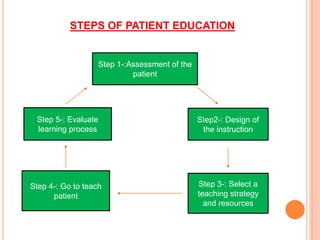
Step 1-:Assessment of the
patient
Step 5-: Evaluate
learning process
Step2-: Design of
the instruction
Step 3-: Select a
teaching strategy
and resources
Step 4-: Go to teach
patient
STEPS OF PATIENT EDUCATION
STEP ONE:- ASSESSMENT OF THE PATIENT
 Define patient and family needs concerns observe
readiness to learn.
 Motivation: patient were motivated when they learn
how their lives could improve focus on the benefit of
education
 Attitude: denial, fear, anger anxiety all could be
barriers to education. Patient must know that he or
she will make gains by learning new skills.
 Outlook: a patience belief about their situation could
affect education. Let them know that learning new
skills can help them feel better or slow disease
progression.
STEP TWO:- DESIGN OF THE INSTRUCTION
PLANNING
 Set objectives with your patient. Select materials.
 Goals should focus on what is necessary critical to
patient survival first
 Pay attention to patient, Concerns, they could stand
in the way of progress
 Respect stated limits. If a patient has refused to do
something try to work around the problems and
incorporate something new as best you can
 Helping a patient understands the need for
changing behaviour
STEP THREE:- SELECT A TECHNIQUE, STRATEGY
AND RESOURCES
 Put the plan in motion help patients along the way to
reach the objective is you have set together
 Providing a good learning environment
 Tone of voice. Ay contact &touch very for all cultural
backgrounds.
 Use of knowledge you gain during assessment
 Mixing education, media
 Choosing the right patient education materials
STEP FOUR:- GO TEACH THE PATIENT
 understand and adapt the barriers of learning
 Let your patient KNOW
 What they should do and why
 When they should expect result
 Possible danger signs to watch for
 What they should do if problems arise
 Whom they should contact for reference
 Ask the patient if they have any questions or
concerns?
STEP FIVE:- EVALUATION
 Evolution is critical and should be continuous
through all four steps
 Getting patient Feedback
 Feedback from the patient and family provides
valuable perspectives on effectiveness of patient
education
 Consider surveys ,documents for patient to sign,
questionnaries
MODEL OF PATIENT EDUCATION OUTCOMES
Knowledge and attitude changes
 Increased understanding
 Increased confidence
 Increase satisfaction
 Improved emotional state
Health status
 Physical health
 Well-being
 Symptoms
 Complications
Behaviour changes
 Health service utilization
 Complains
 Lifestyle
 Self care
Patient education
 Print
 Verbal
 Multimedia
 Combination
Costs
 Length of stay
 Utilisation
 Provider image
 Regulatory complaints
 Role of nurse in
ROLE OF NURSE IN PATIENT TEACHING AND
EDUCATION
 In patient education, the nurse work as a educators so,
the nurse needs to be knowledgeable and confident
 The nurse should keep in mind the patient age,
education status, socioeconomic status, learning needs
of the patient before providing teaching
 The important role of nurse is to help the client
personally work through the problem and identify needs.
It is observed that sometimes client need help in
identification of information relevant to their situation
before they can see any need.
 The nurse should observe clients emotional, physical
needs because in anxiety pain. The client cannot be
attentive
The Nurse needs to encourage and motivate the
nurse to learn at specific time.
The nurse need to provide conductive environment
while delivering information to client. She he should
observe lightning system, ventilation and
temperature. Enna is free atmosphere
The nurse should make the patient to actively
involved inpatient teaching, Active participation.,
active learning , promotes critical thinking and
enable declined to solve problems more effectively.
The nurse should follow the principles, teaching,
such as simple to complex the nurse should
organize the content of critical teaching.
GUIDELINES FOR EFFECTIVE PATIENT
TEACHING
A. Development and maintenance of reports between
nurse. Clients is important.
B. Knowledge of clients. Previous learning enables
nurse to encourage client, faculty , learning skills.
C. Time for delivering teaching should be opted as per
client convenience.
D. Nurse should have all communication skills such as
confidence, good voice and tone,Eye contact, speak
clearly and concisely .
E. Language, local language should be prepared as it
will be easily understood by client
F. Use of audio, visual aids, Foster, learning and
grapes the client.
CONCLUSION
 Nursing is an interaction between a nurse and, nurse and
other health professions, nurse and the community
 The process of human interactions hawkers through,
verbal and non-verbal, and written unwritten, planned and
unplanned.
 Community between people conveys thoughts, ideas,
feelings & information, for nurse to be effective and their
interaction with patience
 The nurse client relationship should be safe and effective
through patient education
 The nurse is also responsible for terminating the
relationship in an appropriate manner so that the safety
and well-being of the client in protector
BIBLIOGRAPHY
 Vij Jo shri , Vij Ankit shri,Text book of nursing
foundation 2nd edition, Jaypee brothers medical
 publishers Ltd , New Delhi India (pg 100-102).
 www.google.com
 Ppt/pdf
ANY DOUBTS ?
Patient Education.pptx

Patient Education.pptx

  • 2.
  • 3.
    OBJECTIVES  Introduction topatient education.  Definition of patient education.  Types of patient education.  Goals of patient education  Objectives of patient education.  Steps of patient education.  Model of patient education outcomes.  Role of nurse in patient education.  Guidelines for patient education.
  • 4.
    INTRODUCTION Patient education isa significant component of modern health care. The process of influencing patient behaviour producing changes in knowledge, attitudes and skills required to maintain and improve health. The process may begin with the imparting of information but also includes interpretation and interaction of the information in such a manner as it brings out attitudinal or behaviour changes.
  • 5.
    DEFINITION OF PATIENTEDUCATION Patient Education refers to only one component of the patient education processes the actual imparting of information to the patient. The transfer of knowledge that takes place with patient technique does not ensure behaviour changes Patient education can be divided into two large categories ----- A) Clinical patient education( clinical teaching, learning) B) Health education
  • 6.
    A) Clinical Patienteducation It is a planned systematic . Sequential and logical process of teaching and learning provided to patients and clients in all clinical setting. It is also a continuous teaching and learning process involving the health care provider and the patient or client (or the patient’s family). The goal of clinical teaching and learning are based on the patient’s assessment ,evolution, diagnosis,prognosis and individual needs and requirements related to interventions.
  • 7.
    B) Health Education Itis also a teaching and learning process is similar to patient education However, it concentrates, mostly on wellness, prevention and health promotion. Additionally, health education can be provided to individual groups and communities Basic focus of health education is to change and improve society health behaviour
  • 8.
    GOALS OF PATIENTEDUCATION  Adapt to illness disabilities: patient education helps chronic people to develop ways of coping with their impairment , live life to maximum potential  Cooperate with précised therapy: patient education will assist patient who needs dialysis to learn ways to be cooperative, and still maintain their sense of self.
  • 9.
    GOALS OF PATIENTEDUCATION  Learn to solve problem when confronted with new situation: patient education teaches patient the skill of problem-solving so that they can figure out solutions when they are alone and at home. Example take sweet if they feel symptoms of hyperglycemia.  Prevent Hospitalization or Rehospitalization: The ultimate goal of patient education is to help the patient to be as fully functional a person as possible in his her home and community and it is reduced. Re Hospitalization
  • 10.
    OBJECTIVES OF PATIENTEDUCATION  Changing health behaviour  Improving health  Improving patient compliance others are :-
  • 11.
    SKILL BUILDING RESPONSIBILTY Patient need to know when how and why they need to make a lifestyle change GROUP EFFORT  Each member of patience, healthcare team needs to be involved PATIENT OUTCOME  Patient more likely to response well to their treatment plan, which results in a further complications INFORMED CONSENT  Patience feel you have provided the information they need to make the right decision. UTILISATION  More effective use of medical service, fewer unnecessary phone calls and visit
  • 12.
    Step 1-:Assessment ofthe patient Step 5-: Evaluate learning process Step2-: Design of the instruction Step 3-: Select a teaching strategy and resources Step 4-: Go to teach patient STEPS OF PATIENT EDUCATION
  • 13.
    STEP ONE:- ASSESSMENTOF THE PATIENT  Define patient and family needs concerns observe readiness to learn.  Motivation: patient were motivated when they learn how their lives could improve focus on the benefit of education  Attitude: denial, fear, anger anxiety all could be barriers to education. Patient must know that he or she will make gains by learning new skills.  Outlook: a patience belief about their situation could affect education. Let them know that learning new skills can help them feel better or slow disease progression.
  • 14.
    STEP TWO:- DESIGNOF THE INSTRUCTION PLANNING  Set objectives with your patient. Select materials.  Goals should focus on what is necessary critical to patient survival first  Pay attention to patient, Concerns, they could stand in the way of progress  Respect stated limits. If a patient has refused to do something try to work around the problems and incorporate something new as best you can  Helping a patient understands the need for changing behaviour
  • 15.
    STEP THREE:- SELECTA TECHNIQUE, STRATEGY AND RESOURCES  Put the plan in motion help patients along the way to reach the objective is you have set together  Providing a good learning environment  Tone of voice. Ay contact &touch very for all cultural backgrounds.  Use of knowledge you gain during assessment  Mixing education, media  Choosing the right patient education materials
  • 16.
    STEP FOUR:- GOTEACH THE PATIENT  understand and adapt the barriers of learning  Let your patient KNOW  What they should do and why  When they should expect result  Possible danger signs to watch for  What they should do if problems arise  Whom they should contact for reference  Ask the patient if they have any questions or concerns?
  • 17.
    STEP FIVE:- EVALUATION Evolution is critical and should be continuous through all four steps  Getting patient Feedback  Feedback from the patient and family provides valuable perspectives on effectiveness of patient education  Consider surveys ,documents for patient to sign, questionnaries
  • 18.
    MODEL OF PATIENTEDUCATION OUTCOMES Knowledge and attitude changes  Increased understanding  Increased confidence  Increase satisfaction  Improved emotional state Health status  Physical health  Well-being  Symptoms  Complications
  • 19.
    Behaviour changes  Healthservice utilization  Complains  Lifestyle  Self care Patient education  Print  Verbal  Multimedia  Combination Costs  Length of stay  Utilisation  Provider image  Regulatory complaints  Role of nurse in
  • 20.
    ROLE OF NURSEIN PATIENT TEACHING AND EDUCATION  In patient education, the nurse work as a educators so, the nurse needs to be knowledgeable and confident  The nurse should keep in mind the patient age, education status, socioeconomic status, learning needs of the patient before providing teaching  The important role of nurse is to help the client personally work through the problem and identify needs. It is observed that sometimes client need help in identification of information relevant to their situation before they can see any need.  The nurse should observe clients emotional, physical needs because in anxiety pain. The client cannot be attentive
  • 21.
    The Nurse needsto encourage and motivate the nurse to learn at specific time. The nurse need to provide conductive environment while delivering information to client. She he should observe lightning system, ventilation and temperature. Enna is free atmosphere The nurse should make the patient to actively involved inpatient teaching, Active participation., active learning , promotes critical thinking and enable declined to solve problems more effectively. The nurse should follow the principles, teaching, such as simple to complex the nurse should organize the content of critical teaching.
  • 22.
    GUIDELINES FOR EFFECTIVEPATIENT TEACHING A. Development and maintenance of reports between nurse. Clients is important. B. Knowledge of clients. Previous learning enables nurse to encourage client, faculty , learning skills. C. Time for delivering teaching should be opted as per client convenience. D. Nurse should have all communication skills such as confidence, good voice and tone,Eye contact, speak clearly and concisely . E. Language, local language should be prepared as it will be easily understood by client F. Use of audio, visual aids, Foster, learning and grapes the client.
  • 23.
    CONCLUSION  Nursing isan interaction between a nurse and, nurse and other health professions, nurse and the community  The process of human interactions hawkers through, verbal and non-verbal, and written unwritten, planned and unplanned.  Community between people conveys thoughts, ideas, feelings & information, for nurse to be effective and their interaction with patience  The nurse client relationship should be safe and effective through patient education  The nurse is also responsible for terminating the relationship in an appropriate manner so that the safety and well-being of the client in protector
  • 24.
    BIBLIOGRAPHY  Vij Joshri , Vij Ankit shri,Text book of nursing foundation 2nd edition, Jaypee brothers medical  publishers Ltd , New Delhi India (pg 100-102).  www.google.com  Ppt/pdf
  • 25.