COMMUNICATING
FOR SUCCESS
IN MANAGEMENT


          Virginia B. Bautista
                 08.16.2010
COMMUNICATION:
      The Manager Style


Meet Manager 1:
His name is Mr. Taylor
He manages the Information
Technology in a division
A communication satisfaction survey
result was communicated to him.
             Communicating for SUCCESS in   22
                    management
The findings:
THE STAFF WAS LESS THAN
SATISFIED.
Mr. Taylor’s reaction:
Defensive, combative


              Communicating for     33
            SUCCESS in management
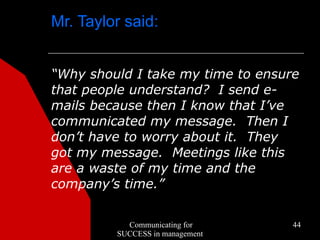
Mr. Taylor said:


“Why should I take my time to ensure
that people understand? I send e-
mails because then I know that I’ve
communicated my message. Then I
don’t have to worry about it. They
got my message. Meetings like this
are a waste of my time and the
company’s time.”


           Communicating for       44
         SUCCESS in management
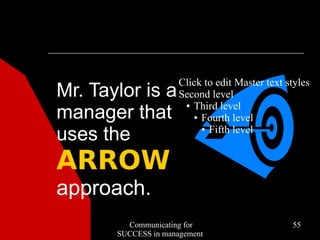
Click to edit Master text styles
Mr. Taylor is a       Second level
                       ● Third level

manager that             ● Fourth level


uses the                   ● Fifth level


ARROW
approach.
         Communicating for                       55
       SUCCESS in management
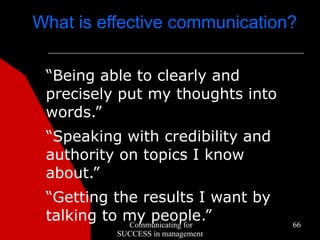
What is effective communication?

 “Being able to clearly and
 precisely put my thoughts into
 words.”
 “Speaking with credibility and
 authority on topics I know
 about.”
 “Getting the results I want by
 talking to my people.”
            Communicating for     66
          SUCCESS in management
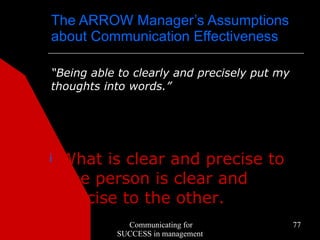
The ARROW Manager’s Assumptions
about Communication Effectiveness

“Being able to clearly and precisely put my
thoughts into words.”


¡   What is clear and precise to
    one person is clear and
    precise to the other.
             Communicating for                77
           SUCCESS in management
The ARROW Manager’s Assumptions about
                   Communication Effectiveness


    “Speaking with credibility and
    authority on topics I know
    about.”
¡   Credibility is something the
    speaker possesses and not
    something given to the
    speaker by the audience.
               Communicating for             88
             SUCCESS in management
The ARROW Manager’s Assumptions about
                 Communication Effectiveness


“Getting the results I want by
talking to my people.”


¡   Communication is primarily a
    one-way activity.

             Communicating for             99
           SUCCESS in management
You are an ARROW manager if:


You focus on accurately encoding your
thoughts into language – much like
selecting, aiming, and firing arrows at
a target.
You see communication as a one-way
activity based primarily on the skills
of the sender.

            Communicating for       1010
          SUCCESS in management
You are an ARROW manager if:


You view receivers as passive
processors of information who react
appropriately if the words are “on the
mark.”
You think feedback is not only
improbable, but also unnecessary.


             Communicating for         1111
           SUCCESS in management
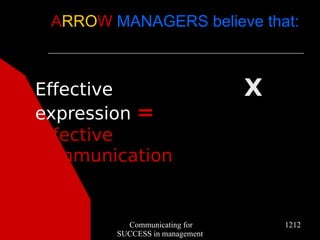
ARROW MANAGERS believe that:


Effective                       X
expression =
Effective
communication


          Communicating for         1212
        SUCCESS in management
Why do managers adopt this style?


The technical training of many
managers reinforces a
stimulus/response orientation.
They think their “Speech teacher”
style works.
Certain people may have personality
predispositions to communicate in
this way.

            Communicating for       1313
          SUCCESS in management
Meet Manager 2:


Mark is district sales manager for a national
life insurance company.
His office visits to “touch base” with the
sales agents in his district were met with
eager anticipation.
Why?
Mark conducted his “meetings” in off-site
locations, e.g. golf course or ski village.


                Communicating for               1414
              SUCCESS in management
For Mark, the meeting agenda was
equally stimulating because the team
rarely talked about business,
production goals, or skill
development.
Mark was a master of rapport ,
camaraderie, and a team
environment.

           Communicating for      1515
         SUCCESS in management
He assumed that because the agents
“felt good” about working for him, and
hence the company, they would then
be more motivated to produce.
The result?
A happy, cohesive team that improved
on their golf scores more than their
selling skills or sales record.


            Communicating for        1616
          SUCCESS in management
Everybody loved Mark but few
respected his managerial abilities.

   CIRCUIT
Mark is a

manager.

              Communicating for       1717
            SUCCESS in management
What is effective communication?


“Effective communication is actively
listening to my coworkers, so I know what
makes them happy.”
“I’m effective as a manager when I am
sensitive to employees’ needs and concerns.
 Then I try to commmunicate that sensitivity
by adapting my message to each individual.”


                Communicating for        1818
              SUCCESS in management
What is effective communication?


“My communication is effective when
my employees feel included and
understood.”


           Communicating for          1919
         SUCCESS in management
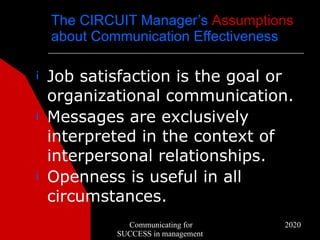
The CIRCUIT Manager’s Assumptions
    about Communication Effectiveness

¡   Job satisfaction is the goal or
    organizational communication.
¡   Messages are exclusively
    interpreted in the context of
    interpersonal relationships.
¡   Openness is useful in all
    circumstances.
              Communicating for     2020
            SUCCESS in management
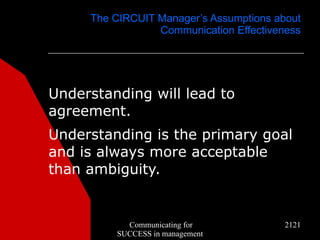
The CIRCUIT Manager’s Assumptions about
                 Communication Effectiveness


Understanding will lead to
agreement.
Understanding is the primary goal
and is always more acceptable
than ambiguity.


           Communicating for             2121
         SUCCESS in management
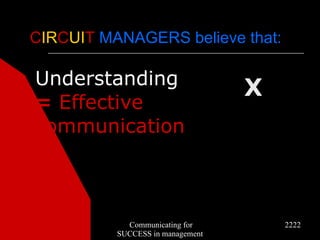
CIRCUIT MANAGERS believe that:

Understanding
                                  X
= Effective
communication


            Communicating for         2222
          SUCCESS in management
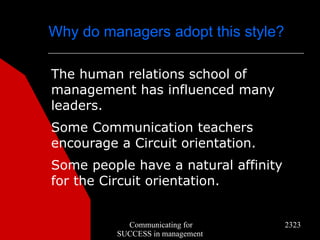
Why do managers adopt this style?

The human relations school of
management has influenced many
leaders.
Some Communication teachers
encourage a Circuit orientation.
Some people have a natural affinity
for the Circuit orientation.


            Communicating for         2323
          SUCCESS in management
Causes of Communication Breakdown
   in both approaches

        Arrow                          Circuit

Arrow managers treat        People just “don’t
communication as an         connect.”
event, and not as a
                            Circuit managers spend
process.
                            vast amount of time in
                            “reaching an
                            understanding” and
                            “building relationships.”


                 Communicating for                      2424
               SUCCESS in management
Arrow                         Circuit

The words “Just read      People are poor
my e-mail,” or “Read      listeners.
my lips” create an
                          The Circuit manager
illusion that meaning
                          believes that
resides in words.
                          communication
                          relationships, like
                          electrical circuits,
                          can operate only
                          under certain
                          conditions.


             Communicating for               2525
           SUCCESS in management
Communication as a Dance


Dance involves patterns, movements, and
creativity.
There are as many styles of dance as
there are people.
Tastes in dance vary, styles change, and
trends come and go.
It is unrepeatable and irreversible.


              Communicating for            2626
            SUCCESS in management
The same are true with
COMMUNICATION.


             Communicating for     2727
           SUCCESS in management
BASIC PRINCIPLES
OF COMMUNICATION

Communication is used for
multiple purposes.
The scientist, politician, salesperson,
philosopher, and preacher may be
using the same language, but with
different objectives or intentions.


            Communicating for         2828
          SUCCESS in management
BASIC PRINCIPLES OF COMMUNICATION


Communication involves coordination
of meanings.
“Communication is the process by which
persons co-create, maintain and alter
patterns of social order, but… the
coordination of talk through which patterns
of order emerge is not necessarily based on
mutual understanding or a shared social
reality.”– COORDINATED MGMT. OF
MEANING


             Communicating for            2929
           SUCCESS in management
BASIC PRINCIPLES OF COMMUNICATION


Communication involves co-
orientation.
Effective communicators can forecast
with some accuracy the actions of
others, their responses, and
interpretations.


           Communicating for            3030
         SUCCESS in management
BASIC PRINCIPLES OF COMMUNICATION


Communication is rule-governed.
A wide range of implicit rules govern
conversations, e. g. who has the right
to initiate or terminate a
conversation, and what topic are
appropriate to talk about.


            Communicating for            3131
          SUCCESS in management
2 Types of Rules in communication


Regulative rules – guide or regulate
action of the communication event.
Example: If a person’s comments are
unclear, then ask for clarification.
Interpretation rules – communicators’
rules for abstracting the meaning out
of a message.


            Communicating for          3232
          SUCCESS in management
Example of interpretation rules


When a manager says, “Tell me more,” what does he mean?


                     Communicating for                    3333
                   SUCCESS in management
Remember this:


Understanding is not the goal, but the
means to attain the goals of an
organization.


            Communicating for      3434
          SUCCESS in management
How can managers use their
knowledge on effective
communication in their jobs?
Explore the Employees’ context.


The more managers know about the
context in which employees interpret
actions and messages, the greater
the likelihood that they can actually
predict the probable interpretations.


            Communicating for      3636
          SUCCESS in management
MBWA


Management by wandering around
helps managers learn about employee
attitudes, environment, needs and
desires.
This can help managers design their
communication taking into
consideration the bg of the
employees.

           Communicating for      3737
         SUCCESS in management
Carefully manage employee
expectations

Example: If the employees expect wage
increase, and then the manager
announced that no salary increase will
happen, employees would feel bad
about the announcement.
However, if the employees expect job
losses or retrenchment, then the no-
salary-increase announcement would
still be “good news” for them.

            Communicating for        3838
          SUCCESS in management
Think about the possible interpretation
and misinterpretation of messages,
events, and symbols.


If communication can fail, it will!
Managers can’t be 100% certain that
their messages will be understood as
intended.

            Communicating for         3939
          SUCCESS in management
Pay attention to secondary messages.

Listen to what the people are not
saying.
Pay attention to non-verbal cues.
Examine the way people dress, put on
make-up, purchase items, or even the
way they spend their break time or
“idle” hours at work.


            Communicating for       4040
          SUCCESS in management
Carefully frame messages.


To frame means to hold a particular
meaning over another.
Sharing our own frame with others is
managing meaning with them.


            Communicating for         4141
          SUCCESS in management
Sculpt the proper context.

Build enough frames and a context emerges.
Skilled managers and companies carefully
craft contexts by artfully accentuating certain
interpretations while chiseling away others.
Example: Put your company mantra all over
the workplace.
Consistently use the company mantra as
bases for the employee development program.


              Communicating for              4242
            SUCCESS in management
COMMUNICATING
  THE CORPORATE CULTURE

CULTURE includes the entire symbolic
environment;
CULTURE defines reality;
CULTURE defines what is, what should be, and
what can be.
CORPORATE CULTURE


The underlying belief and value
structure of an organization
collectively shared by the employees
and symbolically expressed in a
variety of overt and subtle ways.


           Communicating for       4444
         SUCCESS in management
Does culture matter?


Culture influences how an
organization analyzes and solves
problems.
Culture influences how the company
will respond to changes.
Culture impacts employee motivation
and customer satisfaction.


           Communicating for       4545
         SUCCESS in management
How can leaders effectively
communicate the culture?

The effective leader teaches employees what
the corporation values, why it is valued, and
how to transform values into action.
Employees, thru the assistance of the
manager, must be able to transform corporate
mantra into personal commitments and
experiences.
Every manager creates a kind of subculture
within the company culture.


              Communicating for              4646
            SUCCESS in management
Strategies for communicating values:


Craft actionable cultural statements.
The company’s VMG must be
specifically worded, and not too
ambiguous.


            Communicating for          4747
          SUCCESS in management
Strategies for communicating values:


Appropriately socialize employees.
When an employee is newly hired, be
sure to let him mingle with the “right”
employees who have the “right” values
consistent with the company’s.
The way employees talk to one another,
the office design, and even the hiring
process are all indicators of the
corporate culture.

             Communicating for               4848
           SUCCESS in management
Strategies for communicating values:


Research indicates that the initial weeks
of employment are a critical period for
the manager to exert influence.
Supervisors, to some extent, lose their
power to shape the values, beliefs, and
behaviours of employees after the first
month or so.– THIS IS THE REASON
TRAINING IS IMPORTANT!


             Communicating for               4949
           SUCCESS in management
Strategies for communicating values:


Develop symbolic reminders of the
core values.
Symbols reinforce critical values,
acting as continual reminders of what
the organization stands for.
Example: The IQUAME and ISO
certifications are posted in offices.


             Communicating for               5050
           SUCCESS in management
Strategies for communicating values:


Link values with specific behaviours
Values are abstract concepts. These values
must be translated to tangible items.
Example: Wal-Mart: 10-foot rule to better
serve the customers. Employees who come
as close as 10 feet with a customer shall
“look him in the eye, greet him, and ask
him if he can help him.”


             Communicating for               5151
           SUCCESS in management
Other examples:

Imperial Inc. has a “Two rings are plenty”
rule. This means that when a phone
rings, someone has to answer within two
rings. This translates customer service
into tangible behavior.
AUF-IS values strong belief in God, so as
its form of greeting, students say, “Pax et
venia a Deo.”


                Communicating for             5252
              SUCCESS in management
Strategies for communicating values:


Filter information through the
values.
Managers use the company values to
structure information.
With all the information available, the
manager should be able to find a
“focus” by highlighting significant
information related to the values of
the organization.
            Communicating for               5353
          SUCCESS in management
Strategies for communicating values:


Tell the right stories and create
opportunities to originate stories.
George Gerbner: “The control of any
culture is dependent on those who
control the stories that are told.”
A manager must be able to tell a
story that translates company values
into something easy to relate to.


           Communicating for               5454
         SUCCESS in management
Strategies for communicating values:


The book Managing by Storying
Around by David Armstrong
describes how a company use stories:
“Storytelling is a much simpler and
more effective way to manage. I don’t
have to make thousands of individual
decisions. The story gives people
guidelines, and then it is up to them.”


            Communicating for               5555
          SUCCESS in management
Strategies for communicating values:


Storytelling promotes
self-management.


         Communicating for               5656
       SUCCESS in management
Strategies for communicating values:


Use rewards as powerful reminders.
If you want to know what an
organization values, watch how it
invests its resources.
Rewards may be used to reinforce
values.


             Communicating for               5757
           SUCCESS in management
Strategies for communicating values:


Example:
Link pay to key indicators on
company values.
Provide special rewards (monetary
and non-monetary) to employees who
practice values-in-action.
“If you want something to grow, pour
champagne on it.” – Carol Bernick, President of
Alberto-Culver, North America.

                 Communicating for                5858
               SUCCESS in management
Strategies for communicating values:


Manage conflict through values, not
through hierarchy.
Example: An hourly worker argued
with the manager on how to pack a
semi-trailer with paper product. The
worker argues, “This is how the
customer wants it done…”
A manager uses company values as a
“compass” in making decision, instead
of insisting on his position or authority.
             Communicating for               5959
           SUCCESS in management
Strategies for communicating values:


Routinely evaluate progress on
the core values.
Of course, evaluation tools must be
based on the core values of the
company.


           Communicating for               6060
         SUCCESS in management
Strategies for communicating values:


Assist in the evolution of the
meaning of values.
A wise manager tries to bridge the
gap between what the company
says, and what the employees
practice.


            Communicating for               6161
          SUCCESS in management
Strategies for communicating values:


¡   Example: Johnson & Johnson
    practices “Live for life,” by
    encouraging employees to eat
    right, stop smoking, and exercise
    in the gym. However, it turned
    out that the company
    environment was not smoke-free
    until the company values reached
    15 years.
Thank
 you!
  Have a
communic
ation-filled
weekend!
         Communicating for     6363
       SUCCESS in management

38874461 communicating-for-success-in-management

  • 1.
    COMMUNICATING FOR SUCCESS IN MANAGEMENT Virginia B. Bautista 08.16.2010
  • 2.
    COMMUNICATION: The Manager Style Meet Manager 1: His name is Mr. Taylor He manages the Information Technology in a division A communication satisfaction survey result was communicated to him. Communicating for SUCCESS in 22 management
  • 3.
    The findings: THE STAFFWAS LESS THAN SATISFIED. Mr. Taylor’s reaction: Defensive, combative Communicating for 33 SUCCESS in management
  • 4.
    Mr. Taylor said: “Whyshould I take my time to ensure that people understand? I send e- mails because then I know that I’ve communicated my message. Then I don’t have to worry about it. They got my message. Meetings like this are a waste of my time and the company’s time.” Communicating for 44 SUCCESS in management
  • 5.
    Click to editMaster text styles Mr. Taylor is a Second level ● Third level manager that ● Fourth level uses the ● Fifth level ARROW approach. Communicating for 55 SUCCESS in management
  • 6.
    What is effectivecommunication? “Being able to clearly and precisely put my thoughts into words.” “Speaking with credibility and authority on topics I know about.” “Getting the results I want by talking to my people.” Communicating for 66 SUCCESS in management
  • 7.
    The ARROW Manager’sAssumptions about Communication Effectiveness “Being able to clearly and precisely put my thoughts into words.” ¡ What is clear and precise to one person is clear and precise to the other. Communicating for 77 SUCCESS in management
  • 8.
    The ARROW Manager’sAssumptions about Communication Effectiveness “Speaking with credibility and authority on topics I know about.” ¡ Credibility is something the speaker possesses and not something given to the speaker by the audience. Communicating for 88 SUCCESS in management
  • 9.
    The ARROW Manager’sAssumptions about Communication Effectiveness “Getting the results I want by talking to my people.” ¡ Communication is primarily a one-way activity. Communicating for 99 SUCCESS in management
  • 10.
    You are anARROW manager if: You focus on accurately encoding your thoughts into language – much like selecting, aiming, and firing arrows at a target. You see communication as a one-way activity based primarily on the skills of the sender. Communicating for 1010 SUCCESS in management
  • 11.
    You are anARROW manager if: You view receivers as passive processors of information who react appropriately if the words are “on the mark.” You think feedback is not only improbable, but also unnecessary. Communicating for 1111 SUCCESS in management
  • 12.
    ARROW MANAGERS believethat: Effective X expression = Effective communication Communicating for 1212 SUCCESS in management
  • 13.
    Why do managersadopt this style? The technical training of many managers reinforces a stimulus/response orientation. They think their “Speech teacher” style works. Certain people may have personality predispositions to communicate in this way. Communicating for 1313 SUCCESS in management
  • 14.
    Meet Manager 2: Markis district sales manager for a national life insurance company. His office visits to “touch base” with the sales agents in his district were met with eager anticipation. Why? Mark conducted his “meetings” in off-site locations, e.g. golf course or ski village. Communicating for 1414 SUCCESS in management
  • 15.
    For Mark, themeeting agenda was equally stimulating because the team rarely talked about business, production goals, or skill development. Mark was a master of rapport , camaraderie, and a team environment. Communicating for 1515 SUCCESS in management
  • 16.
    He assumed thatbecause the agents “felt good” about working for him, and hence the company, they would then be more motivated to produce. The result? A happy, cohesive team that improved on their golf scores more than their selling skills or sales record. Communicating for 1616 SUCCESS in management
  • 17.
    Everybody loved Markbut few respected his managerial abilities. CIRCUIT Mark is a manager. Communicating for 1717 SUCCESS in management
  • 18.
    What is effectivecommunication? “Effective communication is actively listening to my coworkers, so I know what makes them happy.” “I’m effective as a manager when I am sensitive to employees’ needs and concerns. Then I try to commmunicate that sensitivity by adapting my message to each individual.” Communicating for 1818 SUCCESS in management
  • 19.
    What is effectivecommunication? “My communication is effective when my employees feel included and understood.” Communicating for 1919 SUCCESS in management
  • 20.
    The CIRCUIT Manager’sAssumptions about Communication Effectiveness ¡ Job satisfaction is the goal or organizational communication. ¡ Messages are exclusively interpreted in the context of interpersonal relationships. ¡ Openness is useful in all circumstances. Communicating for 2020 SUCCESS in management
  • 21.
    The CIRCUIT Manager’sAssumptions about Communication Effectiveness Understanding will lead to agreement. Understanding is the primary goal and is always more acceptable than ambiguity. Communicating for 2121 SUCCESS in management
  • 22.
    CIRCUIT MANAGERS believethat: Understanding X = Effective communication Communicating for 2222 SUCCESS in management
  • 23.
    Why do managersadopt this style? The human relations school of management has influenced many leaders. Some Communication teachers encourage a Circuit orientation. Some people have a natural affinity for the Circuit orientation. Communicating for 2323 SUCCESS in management
  • 24.
    Causes of CommunicationBreakdown in both approaches Arrow Circuit Arrow managers treat People just “don’t communication as an connect.” event, and not as a Circuit managers spend process. vast amount of time in “reaching an understanding” and “building relationships.” Communicating for 2424 SUCCESS in management
  • 25.
    Arrow Circuit The words “Just read People are poor my e-mail,” or “Read listeners. my lips” create an The Circuit manager illusion that meaning believes that resides in words. communication relationships, like electrical circuits, can operate only under certain conditions. Communicating for 2525 SUCCESS in management
  • 26.
    Communication as aDance Dance involves patterns, movements, and creativity. There are as many styles of dance as there are people. Tastes in dance vary, styles change, and trends come and go. It is unrepeatable and irreversible. Communicating for 2626 SUCCESS in management
  • 27.
    The same aretrue with COMMUNICATION. Communicating for 2727 SUCCESS in management
  • 28.
    BASIC PRINCIPLES OF COMMUNICATION Communicationis used for multiple purposes. The scientist, politician, salesperson, philosopher, and preacher may be using the same language, but with different objectives or intentions. Communicating for 2828 SUCCESS in management
  • 29.
    BASIC PRINCIPLES OFCOMMUNICATION Communication involves coordination of meanings. “Communication is the process by which persons co-create, maintain and alter patterns of social order, but… the coordination of talk through which patterns of order emerge is not necessarily based on mutual understanding or a shared social reality.”– COORDINATED MGMT. OF MEANING Communicating for 2929 SUCCESS in management
  • 30.
    BASIC PRINCIPLES OFCOMMUNICATION Communication involves co- orientation. Effective communicators can forecast with some accuracy the actions of others, their responses, and interpretations. Communicating for 3030 SUCCESS in management
  • 31.
    BASIC PRINCIPLES OFCOMMUNICATION Communication is rule-governed. A wide range of implicit rules govern conversations, e. g. who has the right to initiate or terminate a conversation, and what topic are appropriate to talk about. Communicating for 3131 SUCCESS in management
  • 32.
    2 Types ofRules in communication Regulative rules – guide or regulate action of the communication event. Example: If a person’s comments are unclear, then ask for clarification. Interpretation rules – communicators’ rules for abstracting the meaning out of a message. Communicating for 3232 SUCCESS in management
  • 33.
    Example of interpretationrules When a manager says, “Tell me more,” what does he mean? Communicating for 3333 SUCCESS in management
  • 34.
    Remember this: Understanding isnot the goal, but the means to attain the goals of an organization. Communicating for 3434 SUCCESS in management
  • 35.
    How can managersuse their knowledge on effective communication in their jobs?
  • 36.
    Explore the Employees’context. The more managers know about the context in which employees interpret actions and messages, the greater the likelihood that they can actually predict the probable interpretations. Communicating for 3636 SUCCESS in management
  • 37.
    MBWA Management by wanderingaround helps managers learn about employee attitudes, environment, needs and desires. This can help managers design their communication taking into consideration the bg of the employees. Communicating for 3737 SUCCESS in management
  • 38.
    Carefully manage employee expectations Example:If the employees expect wage increase, and then the manager announced that no salary increase will happen, employees would feel bad about the announcement. However, if the employees expect job losses or retrenchment, then the no- salary-increase announcement would still be “good news” for them. Communicating for 3838 SUCCESS in management
  • 39.
    Think about thepossible interpretation and misinterpretation of messages, events, and symbols. If communication can fail, it will! Managers can’t be 100% certain that their messages will be understood as intended. Communicating for 3939 SUCCESS in management
  • 40.
    Pay attention tosecondary messages. Listen to what the people are not saying. Pay attention to non-verbal cues. Examine the way people dress, put on make-up, purchase items, or even the way they spend their break time or “idle” hours at work. Communicating for 4040 SUCCESS in management
  • 41.
    Carefully frame messages. Toframe means to hold a particular meaning over another. Sharing our own frame with others is managing meaning with them. Communicating for 4141 SUCCESS in management
  • 42.
    Sculpt the propercontext. Build enough frames and a context emerges. Skilled managers and companies carefully craft contexts by artfully accentuating certain interpretations while chiseling away others. Example: Put your company mantra all over the workplace. Consistently use the company mantra as bases for the employee development program. Communicating for 4242 SUCCESS in management
  • 43.
    COMMUNICATING THECORPORATE CULTURE CULTURE includes the entire symbolic environment; CULTURE defines reality; CULTURE defines what is, what should be, and what can be.
  • 44.
    CORPORATE CULTURE The underlyingbelief and value structure of an organization collectively shared by the employees and symbolically expressed in a variety of overt and subtle ways. Communicating for 4444 SUCCESS in management
  • 45.
    Does culture matter? Cultureinfluences how an organization analyzes and solves problems. Culture influences how the company will respond to changes. Culture impacts employee motivation and customer satisfaction. Communicating for 4545 SUCCESS in management
  • 46.
    How can leaderseffectively communicate the culture? The effective leader teaches employees what the corporation values, why it is valued, and how to transform values into action. Employees, thru the assistance of the manager, must be able to transform corporate mantra into personal commitments and experiences. Every manager creates a kind of subculture within the company culture. Communicating for 4646 SUCCESS in management
  • 47.
    Strategies for communicatingvalues: Craft actionable cultural statements. The company’s VMG must be specifically worded, and not too ambiguous. Communicating for 4747 SUCCESS in management
  • 48.
    Strategies for communicatingvalues: Appropriately socialize employees. When an employee is newly hired, be sure to let him mingle with the “right” employees who have the “right” values consistent with the company’s. The way employees talk to one another, the office design, and even the hiring process are all indicators of the corporate culture. Communicating for 4848 SUCCESS in management
  • 49.
    Strategies for communicatingvalues: Research indicates that the initial weeks of employment are a critical period for the manager to exert influence. Supervisors, to some extent, lose their power to shape the values, beliefs, and behaviours of employees after the first month or so.– THIS IS THE REASON TRAINING IS IMPORTANT! Communicating for 4949 SUCCESS in management
  • 50.
    Strategies for communicatingvalues: Develop symbolic reminders of the core values. Symbols reinforce critical values, acting as continual reminders of what the organization stands for. Example: The IQUAME and ISO certifications are posted in offices. Communicating for 5050 SUCCESS in management
  • 51.
    Strategies for communicatingvalues: Link values with specific behaviours Values are abstract concepts. These values must be translated to tangible items. Example: Wal-Mart: 10-foot rule to better serve the customers. Employees who come as close as 10 feet with a customer shall “look him in the eye, greet him, and ask him if he can help him.” Communicating for 5151 SUCCESS in management
  • 52.
    Other examples: Imperial Inc.has a “Two rings are plenty” rule. This means that when a phone rings, someone has to answer within two rings. This translates customer service into tangible behavior. AUF-IS values strong belief in God, so as its form of greeting, students say, “Pax et venia a Deo.” Communicating for 5252 SUCCESS in management
  • 53.
    Strategies for communicatingvalues: Filter information through the values. Managers use the company values to structure information. With all the information available, the manager should be able to find a “focus” by highlighting significant information related to the values of the organization. Communicating for 5353 SUCCESS in management
  • 54.
    Strategies for communicatingvalues: Tell the right stories and create opportunities to originate stories. George Gerbner: “The control of any culture is dependent on those who control the stories that are told.” A manager must be able to tell a story that translates company values into something easy to relate to. Communicating for 5454 SUCCESS in management
  • 55.
    Strategies for communicatingvalues: The book Managing by Storying Around by David Armstrong describes how a company use stories: “Storytelling is a much simpler and more effective way to manage. I don’t have to make thousands of individual decisions. The story gives people guidelines, and then it is up to them.” Communicating for 5555 SUCCESS in management
  • 56.
    Strategies for communicatingvalues: Storytelling promotes self-management. Communicating for 5656 SUCCESS in management
  • 57.
    Strategies for communicatingvalues: Use rewards as powerful reminders. If you want to know what an organization values, watch how it invests its resources. Rewards may be used to reinforce values. Communicating for 5757 SUCCESS in management
  • 58.
    Strategies for communicatingvalues: Example: Link pay to key indicators on company values. Provide special rewards (monetary and non-monetary) to employees who practice values-in-action. “If you want something to grow, pour champagne on it.” – Carol Bernick, President of Alberto-Culver, North America. Communicating for 5858 SUCCESS in management
  • 59.
    Strategies for communicatingvalues: Manage conflict through values, not through hierarchy. Example: An hourly worker argued with the manager on how to pack a semi-trailer with paper product. The worker argues, “This is how the customer wants it done…” A manager uses company values as a “compass” in making decision, instead of insisting on his position or authority. Communicating for 5959 SUCCESS in management
  • 60.
    Strategies for communicatingvalues: Routinely evaluate progress on the core values. Of course, evaluation tools must be based on the core values of the company. Communicating for 6060 SUCCESS in management
  • 61.
    Strategies for communicatingvalues: Assist in the evolution of the meaning of values. A wise manager tries to bridge the gap between what the company says, and what the employees practice. Communicating for 6161 SUCCESS in management
  • 62.
    Strategies for communicatingvalues: ¡ Example: Johnson & Johnson practices “Live for life,” by encouraging employees to eat right, stop smoking, and exercise in the gym. However, it turned out that the company environment was not smoke-free until the company values reached 15 years.
  • 63.
    Thank you! Have a communic ation-filled weekend! Communicating for 6363 SUCCESS in management