July 3, 2015 2
THE QUALITY OF YOUR LIFE
IS THE QUALITY OF YOUR COMMUNICATION
~
BOTH WITH YOURSELF & OTHERS
Rebuild Your Life
Through
Effective Communication
UNIQUENESS
OF
HUMAN
COMMUNICATION SKILLS
“ YOUR SPEECH REVEALS YOUR
CHARACTER”
SPEECHISAMIRROROFTHESOUL
What is
communication ?
 Derived from the Greek word
“communicare” or “communico” which
means “to share”.
Community implies a group of people
living in one place.
Languages are the codes of
communications.
COMMUNICATION
is the process of sending andis the process of sending and
receiving messages betweenreceiving messages between
parties.parties.
Challenge
EFFECTIVE COMMUNICATIONEFFECTIVE COMMUNICATIONEFFECTIVE COMMUNICATIONEFFECTIVE COMMUNICATION
Need for Communication
• Very strong in Human beings
• Considered as a basic need,
as in the case of eating, sleeping, etc.
• Established as both a social &
individual need
Who Is Responsible?
 The Communicator.
How Much Is The
Communicator Responsible?
 60 Percent!
July 3, 2015 10
Why is
communication
important ?
• Inspires confidence
• Builds respect
• Helps make friends
• Reveals your ability to others
• Develops a distinct personality
• Inspires confidence
• Builds respect
• Helps make friends
• Reveals your ability to others
• Develops a distinct personality
TEST OF LISTENING
“ If you don’t agree with me it
means you haven’t been
listening”
 (Sam Markewich)
BASIC MODEL OFBASIC MODEL OF
COMMUNICATIONCOMMUNICATION
This means that if you want to get your message
across accurately, you need to consider these
three things.
1. The message
2. The audience or receiver; and
3. How the message is likely to be
received
The meaning of communication lies in the way that
it is received.
Do you agree with the above statement?
OFOF
COMMUNICATICOMMUNICATI
ONON
OFOF
COMMUNICATICOMMUNICATI
ONON
 Senders and
Receivers
Transmitters and
Receptor
Messages and
Channels
Decoding, Meaning,
and Encoding
Feedback
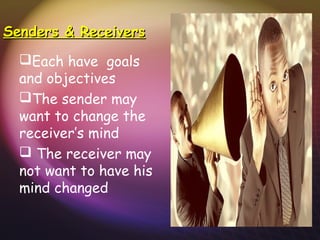
Senders & ReceiversSenders & Receivers
Each have goals
and objectives
The sender may
want to change the
receiver’s mind
 The receiver may
not want to have his
mind changed
is the equipment byis the equipment by
which information is sentwhich information is sent
Information can beInformation can be
sent verbally andsent verbally and
nonverballynonverbally
Transmitters and Receptors
Messages and Channels
are the vehicles by
which information is
communicated
direct expressions
symbolic representations
 Decoding is the process of
translating messages from their
symbolic form into interpretations that
can be understood.
 Meanings are the facts, ideas,
feelings, reactions, or thoughts that
exist whitin individuals, and act as a set
of “filters” through which the decoded
messages are interpreted.
 Encoding is the process by which
messages are put into symbolic form
Decoding, Meaning, and Encoding
is the process by which
the receiver “reacts”
to the sender’s
message
It is necessary to let
the sender know that
the message was
(a) actually received,
(b) encoded,
(c) ascribed with the
same meaning that the
sender intended
Feedback
Through feedback,
communication becomes
dynamic, two-way Process
rather than just event.
Meant To avoid
communication failure as it
provides preliminary info to
sender.
Noise
Internal or external interference with
or distraction form intended
message.
Can cause distortion in sending &
receiving of messages. In addition to
physical conditions- make
communication more difficult-
Emotional states can also create
noise.
 Some Basic Truths about
Communication
 Meanings sent are not always
received.
Meaning is in the mind.
Symbols of communication -
imperfect.
TYPES OF
COMMUNICATION
Doing is Believing
“ I hear and I forget, I see
and I remember.
I do and I understand.”
(Confucius 551-479 BC)
COMMUNICATION
PLAYS VITAL ROLE IN
DISCOVERING OURSELVES &
THE WORLD AROUND US
Our attitudes and beliefs, perceptions
and prejudices, the quality of our
thinking & our values get conveyed in
our communication
“Great speakers are not born,
they’re
Trained.”
-Dale Carnegie
“ Perhaps you will forget tomorrow
the kind words you say today,
but the recipient may cherish
them over a lifetime”
-Dale Carneigie
Process Barriers
Every step in the communication process is necessary
for effective and good communication.. Blocked steps
become barriers. Consider the following situations :
Sender barrier- A management trainee with unusual
new idea fails to speak up at meeting for fear of
criticism.
Encoding barrier- A Spanish-speaking staff member
cannot get an English-speaking administrator to
understand a grievance about working conditions.
Medium Barrier- After getting no answer three
times & busy signal twice, customer concludes
that a store’s consumer hot line is waste of time.
Decoding barrier- An older principal is not sure
what a young department head means when he
refers to a teacher as "spaced out."
Receiver Barrier- A mgr who is preoccupied with
preparation of budget ask clerk to repeat earlier
statement.
Feedback Barrier – During on the job training,
failure of trainee ask any question causes mgr to
wonder if any real understanding what is being
taken place.
Medium Barrier- After getting no answer three
times & busy signal twice, customer concludes
that a store’s consumer hot line is waste of time.
Decoding barrier- An older principal is not sure
what a young department head means when he
refers to a teacher as "spaced out."
Receiver Barrier- A mgr who is preoccupied with
preparation of budget ask clerk to repeat earlier
statement.
Feedback Barrier – During on the job training,
failure of trainee ask any question causes mgr to
wonder if any real understanding what is being
taken place.
re!” Distance is
another physical
barrier
For example, a Factory worker, who wears
ear protectors probably could not hear
someone yelling : “Fire!” Distance is
another physical barrier.
Thousand of miles between New York &
Islamabad & time-zone difference can
complicate communication in a global org.
Physical Barriers
Sometimes physical object blocks
effective communication.
Distrust, Threat & Fear
Undermine communication.
In climate with forces, any message will be viewed
with skepticism.
Distrust can be result of inconsistent behavior by
superior, or it can be due to past experiences
-subordinate punished for honestly reporting
unfavorable, but true, information to boss.
In light of threats – whether real or imagined – people
tend to tighten up, become defensive, & distort
information.
SEMANTICS BARRIERS
Is the study of meaning of words.
The words we choose, how we use them, and the
meaning we attach to them cause many communication
barriers. The problem is semantic, or the meaning of the
words we use. The same word may mean different
things to different people. Words and phrases such as
efficiency, increased productivity, management
prerogatives, and just cause may mean one thing to a
school administrator, and something entirely different to
a staff member.
 Unexpected reaction or behavior by others may signal
a semantic barrier.
Psychosocial
Barriers and social
Barriers
fields of experience,
 filtering, and
psychological distance
FIELDS OF EXPERIENCE
 Fields of experience include people's
backgrounds, perceptions, values,
biases, needs, and expectations.
Senders can encode and receivers
decode messages only in the context
of their fields of experience. When
the sender's field of experience
overlaps very little the receiver's,
communication becomes difficult.
filter
Filtering means that more often
than not we see and hear what we
are emotionally tuned in to see
and hear. Filtering is caused by
our own needs and interests,
which guide our listening.
PSYCHOLOGICAL DISTANCE
 psychological distance between people
that is similar to actual physical
distance. For example, the school
administrator talks down to a staff
member, who resents this attitude,
and this resentment separates them,
thereby blocking opportunity for
effective communication.
The following are the major areas where
communicate breakdowns most frequently occur
in schools:
The following are the major areas where
communicate breakdowns most frequently occur
in schools:
 Sincerity
 Empathy
 Self-perception
 Role perception
 Efforts to distort the
meaning
 Images
 Vehicle for message
 Sincerity
 Empathy
 Self-perception
 Role perception
 Efforts to distort the
meaning
 Images
 Vehicle for message
 Ability to communicate
 Listening ability
 Culture
 Tradition
 Condition
 Noise
 Feedback
 Ability to communicate
 Listening ability
 Culture
 Tradition
 Condition
 Noise
 Feedback
 Sincerity. Nearly all communication
theorists assert that sincerity is the
foundation on which all true
communication rests. Without
sincerity—honesty,
straightforwardness, and authenticity
—all attempts at communication are
destined to fail
 Sincerity. Nearly all communication
theorists assert that sincerity is the
foundation on which all true
communication rests. Without
sincerity—honesty,
straightforwardness, and authenticity
—all attempts at communication are
destined to fail
 Empathy. Research shows that lack of
empathy is one of the major obstacles
to effective communication. Empathy
is the ability to put one's self into
another's shoes. The empathetic
person is able to see the world
through the eyes of the other person
 Empathy. Research shows that lack of
empathy is one of the major obstacles
to effective communication. Empathy
is the ability to put one's self into
another's shoes. The empathetic
person is able to see the world
through the eyes of the other person
 Self-perception. How we see ourselves
affects our ability to communicate
effectively. A healthy but realistic
self-perception is a necessary
ingredient in communicating with
others
 Self-perception. How we see ourselves
affects our ability to communicate
effectively. A healthy but realistic
self-perception is a necessary
ingredient in communicating with
others
 Role perception. Unless people know
what their role is, the importance of
their role, and what is expected of
them, they will not know what to
communicate, when to communicate,
or to whom to communicate
 Role perception. Unless people know
what their role is, the importance of
their role, and what is expected of
them, they will not know what to
communicate, when to communicate,
or to whom to communicate
 Efforts to distort the message.
Pitfalls in communication often occur
in our efforts—both consciously and
unconsciously—to distort messages
 Efforts to distort the message.
Pitfalls in communication often occur
in our efforts—both consciously and
unconsciously—to distort messages
 Images. Another obstacle to successful
communication is the sender's image of the
receiver and vice versa. For example, on the
one hand, school administrators are sometimes
viewed as not too well informed about
teaching, seen as out of touch with the
classroom, and looked on as paper shufflers. On
the other hand, some school administrators
view teachers as lazy, inconsiderate of
administrative problems, and unrealistic about
the strengths and weaknesses of their students.
Such views to a "we-they" attitude.
 Images. Another obstacle to successful
communication is the sender's image of the
receiver and vice versa. For example, on the
one hand, school administrators are sometimes
viewed as not too well informed about
teaching, seen as out of touch with the
classroom, and looked on as paper shufflers. On
the other hand, some school administrators
view teachers as lazy, inconsiderate of
administrative problems, and unrealistic about
the strengths and weaknesses of their students.
Such views to a "we-they" attitude.
 • Vehicle for message. The vehicle
by which we choose to send
messages is important in successful
communication. In most cases, the
vehicle to be used is defined by the
situation.
 • Ability to communicate. Some of
the ways we communicate raise
barriers by inhibiting discussion or
causing others to feel inferior,
angry, hostile, dependent,
compliant, or subservient.
 • Vehicle for message. The vehicle
by which we choose to send
messages is important in successful
communication. In most cases, the
vehicle to be used is defined by the
situation.
 • Ability to communicate. Some of
the ways we communicate raise
barriers by inhibiting discussion or
causing others to feel inferior,
angry, hostile, dependent,
compliant, or subservient.
 • Listening ability. Frequently, people fail to
appreciate the importance of listening, do not
care enough to become actively involved with
what others are saying, and are not sufficiently
motivated to develop the skills necessary to
acquire the art of listening.
 • Culture. Our cultural heritage, biases, and
prejudices often serve as barriers to
communication. The fact that we are African-
American or white, young or old, male or
female have all proved to be obstacles in
communicating effectively
 • Listening ability. Frequently, people fail to
appreciate the importance of listening, do not
care enough to become actively involved with
what others are saying, and are not sufficiently
motivated to develop the skills necessary to
acquire the art of listening.
 • Culture. Our cultural heritage, biases, and
prejudices often serve as barriers to
communication. The fact that we are African-
American or white, young or old, male or
female have all proved to be obstacles in
communicating effectively
 • Tradition. Past practice in a school
helps determine how, when, and what
we send and receive. For example, a
school administrator who has an
authoritative style may find that his
staff will not share information
readily. If a new administrator with a
collaborative style replaces the
authoritarian one, the new
administrator may find that it takes
a while for his colleagues to speak
out on important issues
 • Tradition. Past practice in a school
helps determine how, when, and what
we send and receive. For example, a
school administrator who has an
authoritative style may find that his
staff will not share information
readily. If a new administrator with a
collaborative style replaces the
authoritarian one, the new
administrator may find that it takes
a while for his colleagues to speak
out on important issues
 Conditioning. The manner in which
communication is conditioned by the
environment influences the accuracy
of messages sent and received. If we
work for administrators who set a
climate in which we are encouraged
to share information, we soon
become conditioned to communicate
accordingly.
 Conditioning. The manner in which
communication is conditioned by the
environment influences the accuracy
of messages sent and received. If we
work for administrators who set a
climate in which we are encouraged
to share information, we soon
become conditioned to communicate
accordingly.
 Noise. A major barrier to communication
is what communication experts call noise.
Noise consists of the external factors in
the channels and the internal perceptions
and experiences within the source and the
receiver that affect communication.
 • Feedback. Faculty and staff tell their
leaders that they want feedback.
However, feedback improperly given can
impede communication rather than
improve it. Administrators and followers
both need more training in how to use
feedback more productively.
 Noise. A major barrier to communication
is what communication experts call noise.
Noise consists of the external factors in
the channels and the internal perceptions
and experiences within the source and the
receiver that affect communication.
 • Feedback. Faculty and staff tell their
leaders that they want feedback.
However, feedback improperly given can
impede communication rather than
improve it. Administrators and followers
both need more training in how to use
feedback more productively.
 Our first responsibility as
effective listeners is to
understand ourselves as
communicators.
“Just as the source of the
communication message should be
trained in self-intra personal
communication, so, too, should
listeners know themselves.”
~~Carolyn Coakley.
“Communication skills are the
lifeblood of a successful life…if
you plan on spending any time
there..”
(Doug Firebaugh)
“Communication is really all
anyone ever gets paid for
ultimately..and if you cannot
effectively communicate..you will
PAY.. Not get paid..”
~Doug Firebaugh~
Effective communication

Effective communication

  • 2.
    July 3, 20152 THE QUALITY OF YOUR LIFE IS THE QUALITY OF YOUR COMMUNICATION ~ BOTH WITH YOURSELF & OTHERS
  • 3.
  • 4.
    UNIQUENESS OF HUMAN COMMUNICATION SKILLS “ YOURSPEECH REVEALS YOUR CHARACTER” SPEECHISAMIRROROFTHESOUL
  • 5.
    What is communication ? Derived from the Greek word “communicare” or “communico” which means “to share”. Community implies a group of people living in one place. Languages are the codes of communications.
  • 6.
    COMMUNICATION is the processof sending andis the process of sending and receiving messages betweenreceiving messages between parties.parties.
  • 7.
  • 8.
    Need for Communication •Very strong in Human beings • Considered as a basic need, as in the case of eating, sleeping, etc. • Established as both a social & individual need
  • 9.
    Who Is Responsible? The Communicator. How Much Is The Communicator Responsible?  60 Percent!
  • 10.
    July 3, 201510 Why is communication important ? • Inspires confidence • Builds respect • Helps make friends • Reveals your ability to others • Develops a distinct personality • Inspires confidence • Builds respect • Helps make friends • Reveals your ability to others • Develops a distinct personality
  • 13.
    TEST OF LISTENING “If you don’t agree with me it means you haven’t been listening”  (Sam Markewich)
  • 14.
    BASIC MODEL OFBASICMODEL OF COMMUNICATIONCOMMUNICATION
  • 15.
    This means thatif you want to get your message across accurately, you need to consider these three things. 1. The message 2. The audience or receiver; and 3. How the message is likely to be received The meaning of communication lies in the way that it is received. Do you agree with the above statement?
  • 16.
    OFOF COMMUNICATICOMMUNICATI ONON OFOF COMMUNICATICOMMUNICATI ONON  Senders and Receivers Transmittersand Receptor Messages and Channels Decoding, Meaning, and Encoding Feedback
  • 17.
    Senders & ReceiversSenders& Receivers Each have goals and objectives The sender may want to change the receiver’s mind  The receiver may not want to have his mind changed
  • 18.
    is the equipmentbyis the equipment by which information is sentwhich information is sent Information can beInformation can be sent verbally andsent verbally and nonverballynonverbally Transmitters and Receptors
  • 19.
    Messages and Channels arethe vehicles by which information is communicated direct expressions symbolic representations
  • 20.
     Decoding isthe process of translating messages from their symbolic form into interpretations that can be understood.  Meanings are the facts, ideas, feelings, reactions, or thoughts that exist whitin individuals, and act as a set of “filters” through which the decoded messages are interpreted.  Encoding is the process by which messages are put into symbolic form Decoding, Meaning, and Encoding
  • 21.
    is the processby which the receiver “reacts” to the sender’s message It is necessary to let the sender know that the message was (a) actually received, (b) encoded, (c) ascribed with the same meaning that the sender intended Feedback
  • 22.
    Through feedback, communication becomes dynamic,two-way Process rather than just event. Meant To avoid communication failure as it provides preliminary info to sender.
  • 23.
    Noise Internal or externalinterference with or distraction form intended message. Can cause distortion in sending & receiving of messages. In addition to physical conditions- make communication more difficult- Emotional states can also create noise.
  • 24.
     Some BasicTruths about Communication  Meanings sent are not always received. Meaning is in the mind. Symbols of communication - imperfect.
  • 25.
  • 26.
    Doing is Believing “I hear and I forget, I see and I remember. I do and I understand.” (Confucius 551-479 BC)
  • 27.
    COMMUNICATION PLAYS VITAL ROLEIN DISCOVERING OURSELVES & THE WORLD AROUND US Our attitudes and beliefs, perceptions and prejudices, the quality of our thinking & our values get conveyed in our communication
  • 42.
    “Great speakers arenot born, they’re Trained.” -Dale Carnegie “ Perhaps you will forget tomorrow the kind words you say today, but the recipient may cherish them over a lifetime” -Dale Carneigie
  • 43.
    Process Barriers Every stepin the communication process is necessary for effective and good communication.. Blocked steps become barriers. Consider the following situations : Sender barrier- A management trainee with unusual new idea fails to speak up at meeting for fear of criticism. Encoding barrier- A Spanish-speaking staff member cannot get an English-speaking administrator to understand a grievance about working conditions.
  • 44.
    Medium Barrier- Aftergetting no answer three times & busy signal twice, customer concludes that a store’s consumer hot line is waste of time. Decoding barrier- An older principal is not sure what a young department head means when he refers to a teacher as "spaced out." Receiver Barrier- A mgr who is preoccupied with preparation of budget ask clerk to repeat earlier statement. Feedback Barrier – During on the job training, failure of trainee ask any question causes mgr to wonder if any real understanding what is being taken place. Medium Barrier- After getting no answer three times & busy signal twice, customer concludes that a store’s consumer hot line is waste of time. Decoding barrier- An older principal is not sure what a young department head means when he refers to a teacher as "spaced out." Receiver Barrier- A mgr who is preoccupied with preparation of budget ask clerk to repeat earlier statement. Feedback Barrier – During on the job training, failure of trainee ask any question causes mgr to wonder if any real understanding what is being taken place.
  • 45.
    re!” Distance is anotherphysical barrier For example, a Factory worker, who wears ear protectors probably could not hear someone yelling : “Fire!” Distance is another physical barrier. Thousand of miles between New York & Islamabad & time-zone difference can complicate communication in a global org. Physical Barriers Sometimes physical object blocks effective communication.
  • 46.
    Distrust, Threat &Fear Undermine communication. In climate with forces, any message will be viewed with skepticism. Distrust can be result of inconsistent behavior by superior, or it can be due to past experiences -subordinate punished for honestly reporting unfavorable, but true, information to boss. In light of threats – whether real or imagined – people tend to tighten up, become defensive, & distort information.
  • 47.
    SEMANTICS BARRIERS Is thestudy of meaning of words. The words we choose, how we use them, and the meaning we attach to them cause many communication barriers. The problem is semantic, or the meaning of the words we use. The same word may mean different things to different people. Words and phrases such as efficiency, increased productivity, management prerogatives, and just cause may mean one thing to a school administrator, and something entirely different to a staff member.  Unexpected reaction or behavior by others may signal a semantic barrier.
  • 48.
    Psychosocial Barriers and social Barriers fieldsof experience,  filtering, and psychological distance
  • 49.
    FIELDS OF EXPERIENCE Fields of experience include people's backgrounds, perceptions, values, biases, needs, and expectations. Senders can encode and receivers decode messages only in the context of their fields of experience. When the sender's field of experience overlaps very little the receiver's, communication becomes difficult.
  • 50.
    filter Filtering means thatmore often than not we see and hear what we are emotionally tuned in to see and hear. Filtering is caused by our own needs and interests, which guide our listening.
  • 51.
    PSYCHOLOGICAL DISTANCE  psychologicaldistance between people that is similar to actual physical distance. For example, the school administrator talks down to a staff member, who resents this attitude, and this resentment separates them, thereby blocking opportunity for effective communication.
  • 52.
    The following arethe major areas where communicate breakdowns most frequently occur in schools: The following are the major areas where communicate breakdowns most frequently occur in schools:  Sincerity  Empathy  Self-perception  Role perception  Efforts to distort the meaning  Images  Vehicle for message  Sincerity  Empathy  Self-perception  Role perception  Efforts to distort the meaning  Images  Vehicle for message  Ability to communicate  Listening ability  Culture  Tradition  Condition  Noise  Feedback  Ability to communicate  Listening ability  Culture  Tradition  Condition  Noise  Feedback
  • 53.
     Sincerity. Nearlyall communication theorists assert that sincerity is the foundation on which all true communication rests. Without sincerity—honesty, straightforwardness, and authenticity —all attempts at communication are destined to fail  Sincerity. Nearly all communication theorists assert that sincerity is the foundation on which all true communication rests. Without sincerity—honesty, straightforwardness, and authenticity —all attempts at communication are destined to fail
  • 54.
     Empathy. Researchshows that lack of empathy is one of the major obstacles to effective communication. Empathy is the ability to put one's self into another's shoes. The empathetic person is able to see the world through the eyes of the other person  Empathy. Research shows that lack of empathy is one of the major obstacles to effective communication. Empathy is the ability to put one's self into another's shoes. The empathetic person is able to see the world through the eyes of the other person
  • 55.
     Self-perception. Howwe see ourselves affects our ability to communicate effectively. A healthy but realistic self-perception is a necessary ingredient in communicating with others  Self-perception. How we see ourselves affects our ability to communicate effectively. A healthy but realistic self-perception is a necessary ingredient in communicating with others
  • 56.
     Role perception.Unless people know what their role is, the importance of their role, and what is expected of them, they will not know what to communicate, when to communicate, or to whom to communicate  Role perception. Unless people know what their role is, the importance of their role, and what is expected of them, they will not know what to communicate, when to communicate, or to whom to communicate
  • 57.
     Efforts todistort the message. Pitfalls in communication often occur in our efforts—both consciously and unconsciously—to distort messages  Efforts to distort the message. Pitfalls in communication often occur in our efforts—both consciously and unconsciously—to distort messages
  • 58.
     Images. Anotherobstacle to successful communication is the sender's image of the receiver and vice versa. For example, on the one hand, school administrators are sometimes viewed as not too well informed about teaching, seen as out of touch with the classroom, and looked on as paper shufflers. On the other hand, some school administrators view teachers as lazy, inconsiderate of administrative problems, and unrealistic about the strengths and weaknesses of their students. Such views to a "we-they" attitude.  Images. Another obstacle to successful communication is the sender's image of the receiver and vice versa. For example, on the one hand, school administrators are sometimes viewed as not too well informed about teaching, seen as out of touch with the classroom, and looked on as paper shufflers. On the other hand, some school administrators view teachers as lazy, inconsiderate of administrative problems, and unrealistic about the strengths and weaknesses of their students. Such views to a "we-they" attitude.
  • 59.
     • Vehiclefor message. The vehicle by which we choose to send messages is important in successful communication. In most cases, the vehicle to be used is defined by the situation.  • Ability to communicate. Some of the ways we communicate raise barriers by inhibiting discussion or causing others to feel inferior, angry, hostile, dependent, compliant, or subservient.  • Vehicle for message. The vehicle by which we choose to send messages is important in successful communication. In most cases, the vehicle to be used is defined by the situation.  • Ability to communicate. Some of the ways we communicate raise barriers by inhibiting discussion or causing others to feel inferior, angry, hostile, dependent, compliant, or subservient.
  • 60.
     • Listeningability. Frequently, people fail to appreciate the importance of listening, do not care enough to become actively involved with what others are saying, and are not sufficiently motivated to develop the skills necessary to acquire the art of listening.  • Culture. Our cultural heritage, biases, and prejudices often serve as barriers to communication. The fact that we are African- American or white, young or old, male or female have all proved to be obstacles in communicating effectively  • Listening ability. Frequently, people fail to appreciate the importance of listening, do not care enough to become actively involved with what others are saying, and are not sufficiently motivated to develop the skills necessary to acquire the art of listening.  • Culture. Our cultural heritage, biases, and prejudices often serve as barriers to communication. The fact that we are African- American or white, young or old, male or female have all proved to be obstacles in communicating effectively
  • 61.
     • Tradition.Past practice in a school helps determine how, when, and what we send and receive. For example, a school administrator who has an authoritative style may find that his staff will not share information readily. If a new administrator with a collaborative style replaces the authoritarian one, the new administrator may find that it takes a while for his colleagues to speak out on important issues  • Tradition. Past practice in a school helps determine how, when, and what we send and receive. For example, a school administrator who has an authoritative style may find that his staff will not share information readily. If a new administrator with a collaborative style replaces the authoritarian one, the new administrator may find that it takes a while for his colleagues to speak out on important issues
  • 62.
     Conditioning. Themanner in which communication is conditioned by the environment influences the accuracy of messages sent and received. If we work for administrators who set a climate in which we are encouraged to share information, we soon become conditioned to communicate accordingly.  Conditioning. The manner in which communication is conditioned by the environment influences the accuracy of messages sent and received. If we work for administrators who set a climate in which we are encouraged to share information, we soon become conditioned to communicate accordingly.
  • 63.
     Noise. Amajor barrier to communication is what communication experts call noise. Noise consists of the external factors in the channels and the internal perceptions and experiences within the source and the receiver that affect communication.  • Feedback. Faculty and staff tell their leaders that they want feedback. However, feedback improperly given can impede communication rather than improve it. Administrators and followers both need more training in how to use feedback more productively.  Noise. A major barrier to communication is what communication experts call noise. Noise consists of the external factors in the channels and the internal perceptions and experiences within the source and the receiver that affect communication.  • Feedback. Faculty and staff tell their leaders that they want feedback. However, feedback improperly given can impede communication rather than improve it. Administrators and followers both need more training in how to use feedback more productively.
  • 64.
     Our firstresponsibility as effective listeners is to understand ourselves as communicators. “Just as the source of the communication message should be trained in self-intra personal communication, so, too, should listeners know themselves.” ~~Carolyn Coakley.
  • 65.
    “Communication skills arethe lifeblood of a successful life…if you plan on spending any time there..” (Doug Firebaugh) “Communication is really all anyone ever gets paid for ultimately..and if you cannot effectively communicate..you will PAY.. Not get paid..” ~Doug Firebaugh~