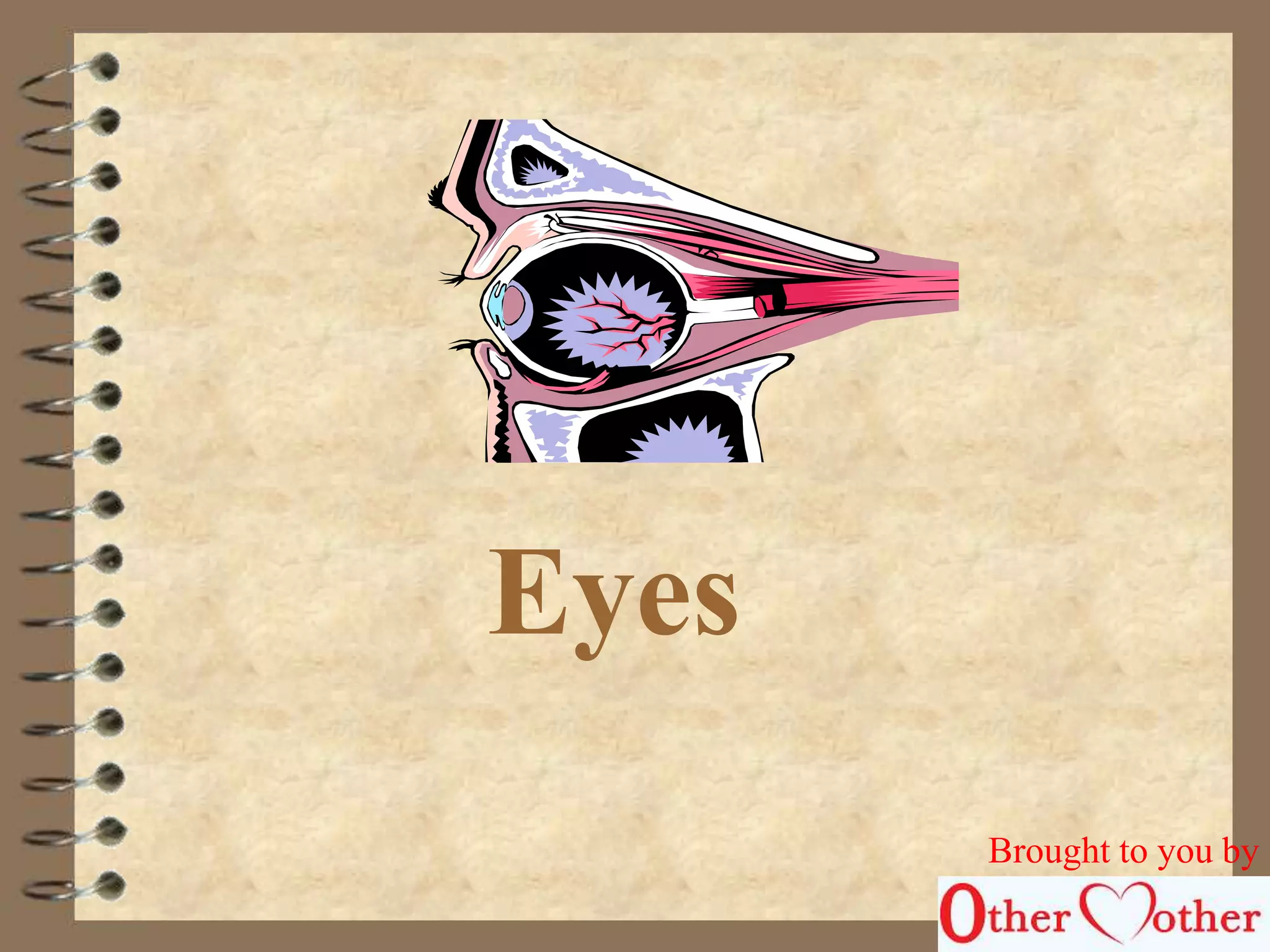
Eyes 
Brought to you by
You are not alone! 
A very popular topic 
How much time at medical school? 
What do the acuity numbers mean! 
Brought to you by
Special history 
One or both? 
What disturbance of vision? 
Rate of onset? 
Any blind spots? 
Any associated symptoms e.g. 
floaters? flashing lights? 
Exactly what is worrying the patient. 
Brought to you by
Contact lens use? 
Myopia? (increases risk of retinal 
detachment 10 fold) 
Any family history? (FH of 
glaucoma in a 1st degree relative 
gives you a 1/10 lifetime risk, or 
squint) 
Any history of diabetes, 
hypertension or connective tissue 
disease? Brought to you by
Examination 
Snellan chart, 3m or 6m, simple text for near 
vision, 
Pinholes 
Fields, remember red and the quality of the red, 
simple 4 quadrant testing. 
Pupils: a bright torch and magnifying glass 
Squint 
Movements 
Opthalmoscopy: Start at 10, red reflex?, green 
filter enhances blood vessels, dilate prn, risk of 
acute closed angle glaucoma remote. Brought to you by
Clinical classification 
Red eye 
Lids and tears 
Slow visual loss in the quiet eye 
Trauma 
Squints, new and congenital, rare 
movement disorders 
 …..(then a rare specialist rag bag) 
Brought to you by
Red eye 
Conjunctivitis 
Commonest, an uncomfortable red eye. 
Bacterial 
 Discomfort. Purulent discharge. Spreads 
from one eye to the other. Vision normal. 
Uniform engorgement Chloramphenicol 
first choice (?) 
Brought to you by
Conjunctivitis 
Viral 
Often with an URTI. Gritty. 
Discomfort. Watery discharge. May 
last many weeks. 
Photophobia. Small corneal opacities 
may develop. Prolonged (often 
adenoviral) may need specialist 
therapy with steroids. 
Chloramphenicol to prevent 2nd 
infection. 
Brought to you by
Conjunctivitis 
Chlamydia 
 Mucopurulent, cornea inflamed, visual loss. Often 
with STD. Permanent damage possible, topical 
and? systemic tetracyclines. Refer. 
Infants 
 Less than one month is notifiable disease - any 
cause. May lead to scarring and permanent 
damage. Refer most. 
Allergic 
 Itching and discomfort. Chemosis and visual 
acuity loss possible. Papillae and if big 
cobblestones. Cromoglycate may take days to 
start to work if bad. Brought to you by
Episcleritis / scleritis 
Red sore eye. No discharge. Localised 
(viz. conjunctivitis=generalised) 
inflammation. 
Episcleritis usually self limiting and 
idiopathic, no treatment needed. 
Scleritis often with CT diseases, 
dangerous (perforation possible) 
Refer. 
Brought to you by
Corneal ulcers 
 Any infection, Abrasion, topical steroids, contact 
lens use. 
 PAIN. - Except zoster 
 May be general or localised inflammation. 
 Must stain. Should evert upper lid to exclude a 
sub tarsal FB 
 ?Hypopyon - pus in anterior chamber. 
 Refer most (except small abrasions - but refer if 
big or longer than 36 hours) 
 Remember recurrent abrasion syndrome. 
Brought to you by
Anterior uveitis 
 The uveal tract. So iritis, iridocyclitis and 
anterior uveitis are synonyms. 
 At risk: HLA-B27, CT diseases, past attacks, 
juvenile arthritis, sarcoid. 
 PAIN, then photophobia then visual loss. 
 Ciliary flush. As it gets worse the pupil gets 
small and reactions get sluggish, hypopyon, 
keratitis (back of cornea). These markers of 
it getting worse are bad news. 
 Refer all. Brought to you by
Acute closed angle glaucoma 
Often starts in the evening. 
Especially in those over 50 years. 
Severe pain first. Impaired vision and 
haloes around lights. May have 
history of past episodes relieved by 
going to sleep (the pupil constricts 
during sleep). 
Refer even if attack spontaneously 
resolves. Brought to you by
Lids and tears 
Chalazion 
= meibomnian cyst. In the lid. Warm 
compresses and chloramphenicol. 
Persistent - incise. 
Recurrent: ? DM, ? blepharitis, ? 
roseacea. 
Can cause astigmatism from 
pressure. 
Brought to you by
Stye 
An infection of lash follicle. May 
be head of pus - nick with needle. 
Or warm compresses and 
chloramphenicol. 
Brought to you by
Marginal cysts 
Non infected cysts from sweat or 
sebaceous lid glands, if a problem 
can often be simply treated with a 
nick with a needle - small. 
Brought to you by
Blepharitis 
Common, underdiagnosed. Persistently 
sore eyes. Gritty. Often with chalazions or 
styes. Inflamed lid margins, crusts, may 
have inflamed lids. 
 Associated with psoriasis, eczema and 
roseacea. 
 Keep clean, antibiotic 
ointment[tetracycline], artificial tears ? 
oral tetracyclines 
Brought to you by
Acute dacrocystitis 
Medial inflammation over lacrimal 
sac. Refer, systemic therapy and 
topical urgently. 
Brought to you by
Orbital cellulitis 
 Life threatening and blinding. Usually 
from sinuses. Especially important in 
children who may become blind in hours. 
Unilateral swollen lids which may not be 
red. 
 The patient is ill, there is tenderness over 
the sinuses, restricted eye movements. 
ADMIT 
Brought to you by
Ectropion 
Watery eye.. Laxity from age or nerve 
palsy. Ointment and refer for LA operation 
to correct. 
Entropion 
Common especially in the elderly. 
Scarring from the lashes. 
 Often results from blepharitis or chronic 
conjunctivitis 
 Refer Brought to you by
Ingrowing lashes 
Damage to lids. May be 
removed but will often need 
electrolysis or cryocautery to 
prevent recurrence. 
Brought to you by
Watering eyes 
Differential diagnosis.- 
your homework! 
Dry eyes 
Common, 
Remember to treat associated 
blepharitis 
Brought to you by
Sudden visual loss 
An easy list really as 
they all need 
specialist 
assessment! 
Brought to you by
Retinal detachment 
 Floaters, photopsias, the shadow or curtain 
across the sight. 
Optic neuritis 
 More women, pain on moving the eye, 
central scotoma 
Posterior vitreous detachment 
 Aged 50+, flashing lights, floaters 
Vitreous haemorrhage 
 Floaters, red haze may be present. Red 
reflex absent.0 
Brought to you by
Disciform macular degeneration 
•Sudden disturbance of central vision. 
Vascular occlusions 
•Field loss. Diabetes, hypertension 
Migraine 
•Youth, headache, zigzag lines, 
multicoloured lights. 
Cerebrovascular disease 
•Elderly, bilateral loss. 
Brought to you by
Slow visual loss 
Refer to optician then ? refer. 
Cataracts 
Corneal opacities 
Macular problems 
Retinal problems 
Brought to you by
Trauma 
Refer ! 
Unless really trivial 
Brought to you by
Squints 
Refer 
Remember the orthoptist 
Can you do a cover test? 
Brought to you by
This platform has been started by 
Parveen Kumar Chadha with the vision 
that nobody should suffer the way he has 
suffered because of lack and improper 
healthcare facilities in India. We need 
lots of funds manpower etc. to make this 
vision a reality please contact us. Join us 
as a member for a noble cause. 
Brought to you by
Our views have increased the 
mark of the 25,000 
 Thank you viewers 
 Looking forward for franchise, collaboration, 
partners. 
Brought to you by
Contact Us:- 
011-25464531, 011-41425180, 011- 
+91-9818308353,+69612-17387 
Brought to you by 
othermotherindia@g9m8a1i8l.5c6o9m476 
www.other-mother.in 
Saxbee Consultants Details :-www.parveenchadha.com 
https://cparveen.wix.com/other-mother 
https://twitter.com/othermotherindi 
http://www.linkedin.com/profile/view?id=326103341&trk=nav_responsive_tab_profile 
https://www.facebook.com/pages/Other-Mother-Nursing-Crusade/224235031114989?ref=hl 
A WORLDWIDE MISSITION 
JOIN US

Eyes

  • 1.
  • 2.
    You are notalone! A very popular topic How much time at medical school? What do the acuity numbers mean! Brought to you by
  • 3.
    Special history Oneor both? What disturbance of vision? Rate of onset? Any blind spots? Any associated symptoms e.g. floaters? flashing lights? Exactly what is worrying the patient. Brought to you by
  • 4.
    Contact lens use? Myopia? (increases risk of retinal detachment 10 fold) Any family history? (FH of glaucoma in a 1st degree relative gives you a 1/10 lifetime risk, or squint) Any history of diabetes, hypertension or connective tissue disease? Brought to you by
  • 5.
    Examination Snellan chart,3m or 6m, simple text for near vision, Pinholes Fields, remember red and the quality of the red, simple 4 quadrant testing. Pupils: a bright torch and magnifying glass Squint Movements Opthalmoscopy: Start at 10, red reflex?, green filter enhances blood vessels, dilate prn, risk of acute closed angle glaucoma remote. Brought to you by
  • 6.
    Clinical classification Redeye Lids and tears Slow visual loss in the quiet eye Trauma Squints, new and congenital, rare movement disorders  …..(then a rare specialist rag bag) Brought to you by
  • 7.
    Red eye Conjunctivitis Commonest, an uncomfortable red eye. Bacterial  Discomfort. Purulent discharge. Spreads from one eye to the other. Vision normal. Uniform engorgement Chloramphenicol first choice (?) Brought to you by
  • 8.
    Conjunctivitis Viral Oftenwith an URTI. Gritty. Discomfort. Watery discharge. May last many weeks. Photophobia. Small corneal opacities may develop. Prolonged (often adenoviral) may need specialist therapy with steroids. Chloramphenicol to prevent 2nd infection. Brought to you by
  • 9.
    Conjunctivitis Chlamydia Mucopurulent, cornea inflamed, visual loss. Often with STD. Permanent damage possible, topical and? systemic tetracyclines. Refer. Infants  Less than one month is notifiable disease - any cause. May lead to scarring and permanent damage. Refer most. Allergic  Itching and discomfort. Chemosis and visual acuity loss possible. Papillae and if big cobblestones. Cromoglycate may take days to start to work if bad. Brought to you by
  • 10.
    Episcleritis / scleritis Red sore eye. No discharge. Localised (viz. conjunctivitis=generalised) inflammation. Episcleritis usually self limiting and idiopathic, no treatment needed. Scleritis often with CT diseases, dangerous (perforation possible) Refer. Brought to you by
  • 11.
    Corneal ulcers Any infection, Abrasion, topical steroids, contact lens use.  PAIN. - Except zoster  May be general or localised inflammation.  Must stain. Should evert upper lid to exclude a sub tarsal FB  ?Hypopyon - pus in anterior chamber.  Refer most (except small abrasions - but refer if big or longer than 36 hours)  Remember recurrent abrasion syndrome. Brought to you by
  • 12.
    Anterior uveitis The uveal tract. So iritis, iridocyclitis and anterior uveitis are synonyms.  At risk: HLA-B27, CT diseases, past attacks, juvenile arthritis, sarcoid.  PAIN, then photophobia then visual loss.  Ciliary flush. As it gets worse the pupil gets small and reactions get sluggish, hypopyon, keratitis (back of cornea). These markers of it getting worse are bad news.  Refer all. Brought to you by
  • 13.
    Acute closed angleglaucoma Often starts in the evening. Especially in those over 50 years. Severe pain first. Impaired vision and haloes around lights. May have history of past episodes relieved by going to sleep (the pupil constricts during sleep). Refer even if attack spontaneously resolves. Brought to you by
  • 14.
    Lids and tears Chalazion = meibomnian cyst. In the lid. Warm compresses and chloramphenicol. Persistent - incise. Recurrent: ? DM, ? blepharitis, ? roseacea. Can cause astigmatism from pressure. Brought to you by
  • 15.
    Stye An infectionof lash follicle. May be head of pus - nick with needle. Or warm compresses and chloramphenicol. Brought to you by
  • 16.
    Marginal cysts Noninfected cysts from sweat or sebaceous lid glands, if a problem can often be simply treated with a nick with a needle - small. Brought to you by
  • 17.
    Blepharitis Common, underdiagnosed.Persistently sore eyes. Gritty. Often with chalazions or styes. Inflamed lid margins, crusts, may have inflamed lids.  Associated with psoriasis, eczema and roseacea.  Keep clean, antibiotic ointment[tetracycline], artificial tears ? oral tetracyclines Brought to you by
  • 18.
    Acute dacrocystitis Medialinflammation over lacrimal sac. Refer, systemic therapy and topical urgently. Brought to you by
  • 19.
    Orbital cellulitis Life threatening and blinding. Usually from sinuses. Especially important in children who may become blind in hours. Unilateral swollen lids which may not be red.  The patient is ill, there is tenderness over the sinuses, restricted eye movements. ADMIT Brought to you by
  • 20.
    Ectropion Watery eye..Laxity from age or nerve palsy. Ointment and refer for LA operation to correct. Entropion Common especially in the elderly. Scarring from the lashes.  Often results from blepharitis or chronic conjunctivitis  Refer Brought to you by
  • 21.
    Ingrowing lashes Damageto lids. May be removed but will often need electrolysis or cryocautery to prevent recurrence. Brought to you by
  • 22.
    Watering eyes Differentialdiagnosis.- your homework! Dry eyes Common, Remember to treat associated blepharitis Brought to you by
  • 23.
    Sudden visual loss An easy list really as they all need specialist assessment! Brought to you by
  • 24.
    Retinal detachment Floaters, photopsias, the shadow or curtain across the sight. Optic neuritis  More women, pain on moving the eye, central scotoma Posterior vitreous detachment  Aged 50+, flashing lights, floaters Vitreous haemorrhage  Floaters, red haze may be present. Red reflex absent.0 Brought to you by
  • 25.
    Disciform macular degeneration •Sudden disturbance of central vision. Vascular occlusions •Field loss. Diabetes, hypertension Migraine •Youth, headache, zigzag lines, multicoloured lights. Cerebrovascular disease •Elderly, bilateral loss. Brought to you by
  • 26.
    Slow visual loss Refer to optician then ? refer. Cataracts Corneal opacities Macular problems Retinal problems Brought to you by
  • 27.
    Trauma Refer ! Unless really trivial Brought to you by
  • 28.
    Squints Refer Rememberthe orthoptist Can you do a cover test? Brought to you by
  • 29.
    This platform hasbeen started by Parveen Kumar Chadha with the vision that nobody should suffer the way he has suffered because of lack and improper healthcare facilities in India. We need lots of funds manpower etc. to make this vision a reality please contact us. Join us as a member for a noble cause. Brought to you by
  • 30.
    Our views haveincreased the mark of the 25,000  Thank you viewers  Looking forward for franchise, collaboration, partners. Brought to you by
  • 31.
    Contact Us:- 011-25464531,011-41425180, 011- +91-9818308353,+69612-17387 Brought to you by othermotherindia@g9m8a1i8l.5c6o9m476 www.other-mother.in Saxbee Consultants Details :-www.parveenchadha.com https://cparveen.wix.com/other-mother https://twitter.com/othermotherindi http://www.linkedin.com/profile/view?id=326103341&trk=nav_responsive_tab_profile https://www.facebook.com/pages/Other-Mother-Nursing-Crusade/224235031114989?ref=hl A WORLDWIDE MISSITION JOIN US