Factors Affecting Commodity Prices
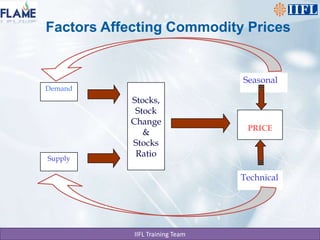
Factors Affecting Commodity PricesSeasonalDemandStocks,StockChange&StocksRatioPRICESupplyTechnical
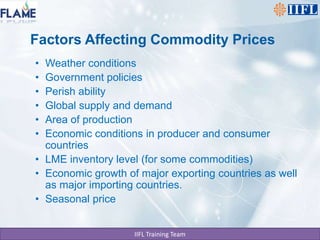
Factors Affecting Commodity PricesWeather conditions
Government policies
Perish ability
Global supply and demand
Area of production
Economic conditions in producer and consumer countries
LME inventory level (for some commodities)
Economic growth of major exporting countries as well as major importing countries.
Seasonal priceEconomic IndicatorsLet us look at the Economic Indicators which are used in the USA. Such macro indicators are being followed by the vast majority of traders worldwide. These indicator are highly valuable if one may use it to better forecast future trends. ( for commodity market).
Economic Indicators: CCI - Consumer Confidence IndexThe CCI is a survey based on a sample of 5,000 U.S. households and is considered one of the most accurate indicators of confidence. The idea behind consumer confidence is that when the economy warrants more jobs, increased wages, and lower interest rates, it increases our confidence and spending power. The respondents answer questions about their income, the market condition as they see it, and the chances to see increase in their income. Confidence is looked at closely by the Federal Reserve when determining interest rates. It is considered to be a big market mover as private consumption is two thirds of the American economy.
Economic Indicators: CPI - Consumer Price Index; Core-CPIThe CPI is considered the most widely used measure of inflation and is regarded as an indicator of the effectiveness of government policy. The CPI is a basket of consumer goods (and services) tracked from month to month (excluding taxes). The CPI is one of the most followed economic indicators and considered to be a very big market mover. A rising CPI indicates inflation. The Core-CPI (CPI, excluding food and energy, expense items which are subject to seasonal fluctuations) gives a more stringent measure of general prices.
Economic Indicators: Employment Situation ReportThe Employment Situation Report is a monthly indicator which contains two major parts. One part is the unemployment and new jobs created, the report tells the unemployment rate and the change in unemployment rate. The second part of the report indicates things like average weekly hours worked and average hourly earningsThis data is important for determining the tightness of the labor market, which is a major determinant of inflation. The Bureau of Labor surveys over 250 regions across the United States and covers almost every major industry. This indicator is definitely one of the most watched indicators by the financial markets, the report almost always moves markets. Investors value the fact that information in the Employment report is very timely, less than a week old. The report provides one of the best snapshots of the health of the economy.
Economic Indicators: FOMC Meeting (Federal Open Market Committee): Rate announcementThe meeting of the US Federal Bank representatives, held 8 times a year. The decision about the prime interest rate is published during each meeting The FED (the Federal Reserve of USA) is responsible for managing the US monetary policy, controlling the banks, providing services to governmental organizations and citizens, and maintaining the countrys financial stability.There are 12 Fed regions in the USA (each comprising several states), represented in the Fed committee by regional commissioners.The rate of interest on a currency is in practice the price of the money.The higher the rate of interest on a currency, the more people will tend to hold that currency, to purchase it and in that way to strengthen the value of the currency. This is very important indicator affecting the rate of inflation and the very big market mover.There is great importance to the FOMC announcement, however  the content of the deliberation held in the meeting (and published 2 weeks afterwards) is almost as important for the market players.
Economic Indicators: GDP - Gross Domestic ProductBEA (Bureau of Economic Analysis); Last day of the quarter, covers previous quarter data.The US Commerce department publishes the GDP in 3 modes: advance; preliminary; final.GDP is a gross measure of market activity. It represents the monetary value of all the goods and services produced by an economy over a specified period. This includes consumption, government purchases, investments, and the trade balance.
Economic Indicators: GDP - Gross Domestic ProductThe GDP is perhaps the greatest indicator of the economic health of a country. It is usually measured on a yearly basis, but quarterly stats are also released.The Commerce Department releases an "advance report" on the last day of each quarter. Within a month it follows up with the "preliminary report" and then the "final report" is released another month later. The most recent GDP figures have a relatively high importance to the markets.GDP indicates the pace at which a country's economy is growing (or shrinking)
Economic Indicators: NFP - Changes in non-farm payrollsDepartment of Labor; The first Friday of each month, 8:30am EST, covers previous month dataThe data intended to represent changes in the total number of paid U.S. workers of any business, excluding the followingGeneral government employeesPrivate household employeesEmployees of nonprofit organizations that provide assistance to individualsFarm employeesThe total non-farm payroll accounts for approximately 80% of the workers who produce the entire gross domestic product of the United States It is used to assist government policy makers and economists determine the current state of the economy and predict future levels of economic activity. It is a very big market mover mainly due to the high deviations in the forecasting.
Economic Indicators: Retail Sales Data; Retail Sales less AutomotivesBureau of Census; Around the 12th of each monthRetail sales are a key driving force in US economyThis indicator tracks the merchandise sold by companies within the retail trade. This indicator measures the total consumer spending on retails sales (not including service costs). The retail revenues are a major part (two thirds) of the US economy. The Census Bureau surveys hundreds of various sized firms and business offering some type of retail trade. Every month the data is released showing the percent change from the previous month data. A negative number indicates that sales decreased from the previous months sales. This indicator is a very big market mover because it is used as a gauge of consumer activity and confidence as higher sales figures would indicate increased economic activity. The data is very timely because retail sales data is released within 2 weeks of the previous month.
Economic Indicators: Trade BalanceDepartment of Commerce; The second week of each month, covers month before previous dataThe largest component of a country's balance of payments. The balance of trade measures difference between the value of goods and services that a nation exports and the value of goods and services that it imports. A country has a trade deficit if it imports more than it exports, and the opposite scenario is a trade surplus. It is considered as a very big market mover.
Economic Indicators: Current AccountBEA (Bureau of Economic Analysis); Quarterly, around six weeks after quarter endThe difference between a nation's total exports of goods, services, and transfers, and its total imports of them. Current account balance calculations exclude transactions in financial assets and liabilities. The level of the current account is followed as an indicator of trends in foreign trade so it is considered as a big market mover.

Commodity factors affecting commodity prices 14012011

  • 1.
  • 2.
    Factors Affecting CommodityPricesSeasonalDemandStocks,StockChange&StocksRatioPRICESupplyTechnical
  • 3.
    Factors Affecting CommodityPricesWeather conditions
  • 4.
  • 5.
  • 6.
  • 7.
  • 8.
    Economic conditions inproducer and consumer countries
  • 9.
    LME inventory level(for some commodities)
  • 10.
    Economic growth ofmajor exporting countries as well as major importing countries.
  • 11.
    Seasonal priceEconomic IndicatorsLetus look at the Economic Indicators which are used in the USA. Such macro indicators are being followed by the vast majority of traders worldwide. These indicator are highly valuable if one may use it to better forecast future trends. ( for commodity market).
  • 12.
    Economic Indicators: CCI- Consumer Confidence IndexThe CCI is a survey based on a sample of 5,000 U.S. households and is considered one of the most accurate indicators of confidence. The idea behind consumer confidence is that when the economy warrants more jobs, increased wages, and lower interest rates, it increases our confidence and spending power. The respondents answer questions about their income, the market condition as they see it, and the chances to see increase in their income. Confidence is looked at closely by the Federal Reserve when determining interest rates. It is considered to be a big market mover as private consumption is two thirds of the American economy.
  • 13.
    Economic Indicators: CPI- Consumer Price Index; Core-CPIThe CPI is considered the most widely used measure of inflation and is regarded as an indicator of the effectiveness of government policy. The CPI is a basket of consumer goods (and services) tracked from month to month (excluding taxes). The CPI is one of the most followed economic indicators and considered to be a very big market mover. A rising CPI indicates inflation. The Core-CPI (CPI, excluding food and energy, expense items which are subject to seasonal fluctuations) gives a more stringent measure of general prices.
  • 14.
    Economic Indicators: EmploymentSituation ReportThe Employment Situation Report is a monthly indicator which contains two major parts. One part is the unemployment and new jobs created, the report tells the unemployment rate and the change in unemployment rate. The second part of the report indicates things like average weekly hours worked and average hourly earningsThis data is important for determining the tightness of the labor market, which is a major determinant of inflation. The Bureau of Labor surveys over 250 regions across the United States and covers almost every major industry. This indicator is definitely one of the most watched indicators by the financial markets, the report almost always moves markets. Investors value the fact that information in the Employment report is very timely, less than a week old. The report provides one of the best snapshots of the health of the economy.
  • 15.
    Economic Indicators: FOMCMeeting (Federal Open Market Committee): Rate announcementThe meeting of the US Federal Bank representatives, held 8 times a year. The decision about the prime interest rate is published during each meeting The FED (the Federal Reserve of USA) is responsible for managing the US monetary policy, controlling the banks, providing services to governmental organizations and citizens, and maintaining the countrys financial stability.There are 12 Fed regions in the USA (each comprising several states), represented in the Fed committee by regional commissioners.The rate of interest on a currency is in practice the price of the money.The higher the rate of interest on a currency, the more people will tend to hold that currency, to purchase it and in that way to strengthen the value of the currency. This is very important indicator affecting the rate of inflation and the very big market mover.There is great importance to the FOMC announcement, however the content of the deliberation held in the meeting (and published 2 weeks afterwards) is almost as important for the market players.
  • 16.
    Economic Indicators: GDP- Gross Domestic ProductBEA (Bureau of Economic Analysis); Last day of the quarter, covers previous quarter data.The US Commerce department publishes the GDP in 3 modes: advance; preliminary; final.GDP is a gross measure of market activity. It represents the monetary value of all the goods and services produced by an economy over a specified period. This includes consumption, government purchases, investments, and the trade balance.
  • 17.
    Economic Indicators: GDP- Gross Domestic ProductThe GDP is perhaps the greatest indicator of the economic health of a country. It is usually measured on a yearly basis, but quarterly stats are also released.The Commerce Department releases an "advance report" on the last day of each quarter. Within a month it follows up with the "preliminary report" and then the "final report" is released another month later. The most recent GDP figures have a relatively high importance to the markets.GDP indicates the pace at which a country's economy is growing (or shrinking)
  • 18.
    Economic Indicators: NFP- Changes in non-farm payrollsDepartment of Labor; The first Friday of each month, 8:30am EST, covers previous month dataThe data intended to represent changes in the total number of paid U.S. workers of any business, excluding the followingGeneral government employeesPrivate household employeesEmployees of nonprofit organizations that provide assistance to individualsFarm employeesThe total non-farm payroll accounts for approximately 80% of the workers who produce the entire gross domestic product of the United States It is used to assist government policy makers and economists determine the current state of the economy and predict future levels of economic activity. It is a very big market mover mainly due to the high deviations in the forecasting.
  • 19.
    Economic Indicators: RetailSales Data; Retail Sales less AutomotivesBureau of Census; Around the 12th of each monthRetail sales are a key driving force in US economyThis indicator tracks the merchandise sold by companies within the retail trade. This indicator measures the total consumer spending on retails sales (not including service costs). The retail revenues are a major part (two thirds) of the US economy. The Census Bureau surveys hundreds of various sized firms and business offering some type of retail trade. Every month the data is released showing the percent change from the previous month data. A negative number indicates that sales decreased from the previous months sales. This indicator is a very big market mover because it is used as a gauge of consumer activity and confidence as higher sales figures would indicate increased economic activity. The data is very timely because retail sales data is released within 2 weeks of the previous month.
  • 20.
    Economic Indicators: TradeBalanceDepartment of Commerce; The second week of each month, covers month before previous dataThe largest component of a country's balance of payments. The balance of trade measures difference between the value of goods and services that a nation exports and the value of goods and services that it imports. A country has a trade deficit if it imports more than it exports, and the opposite scenario is a trade surplus. It is considered as a very big market mover.
  • 21.
    Economic Indicators: CurrentAccountBEA (Bureau of Economic Analysis); Quarterly, around six weeks after quarter endThe difference between a nation's total exports of goods, services, and transfers, and its total imports of them. Current account balance calculations exclude transactions in financial assets and liabilities. The level of the current account is followed as an indicator of trends in foreign trade so it is considered as a big market mover.