Equity BasicsDepository
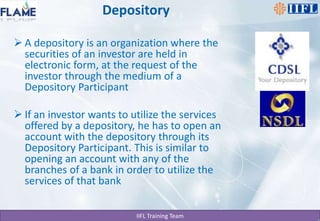
Depository A depository is an organization where the securities of an investor are held in electronic form, at the request of the investor through the medium of a Depository ParticipantIf an investor wants to utilize the services offered by a depository, he has to open an account with the depository through its Depository Participant. This is similar to opening an account with any of the branches of a bank in order to utilize the services of that bank
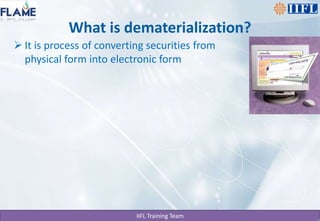
What is dematerialization?It is process of converting securities from physical form into electronic form
Who is a Depository Participant?A Depository Participant (DP) is an agent of the depository and is authorized to offer depository services to investorsAccording to SEBI guidelines, financial institutions, banks, custodians, stockbrokers, etc. can become DP with a depository
Who is a Depository Participant?A DP is an interface between customers and the depositoryA customer opens an account with a DP and commences operations Balances  are maintained with the depository and are available through the DPDP intimates customers’ status of holdings or transactions from time to time
Depositories in India Central Depository Services (India) Limited - Promoted by BSE, BoI, BoB, SBI and  HDFC BankNational Securities Depository Limited (NSDL)- Promoted by UTI, IDBI and NSE Securities and Exchange Board of India (SEBI) is the regulating authority
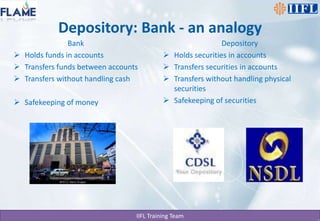
Depository: Bank - an analogyBank		Holds funds in accountsTransfers funds between accountsTransfers without handling cashSafekeeping of moneyDepositoryHolds securities in accountsTransfers securities in accountsTransfers without handling physical securitiesSafekeeping of securities
Services offered by a DPAccount Opening & MaintenanceDematerialization of SecuritiesRematerialization of SecuritiesTransfer of SecuritiesPledging of Securities
Types of accountsBeneficiary AccountThese are ownership accounts, for use of Individuals, Corporates, HUFs etcPool Account These are commercial accounts , for use of broker, for transfer of securities to and fro, from Exchange or Clearing CorporationAll the securities received in the pool account should be transferred to the respective beneficial accounts within 24 hrs
How are securities dematerialized?Physical securities are to be submitted to DP, along with DRFEach security certificate should be defaced by the client. Defacing of certificate to be done by putting a stamp ‘Surrendered for Dematerialization’
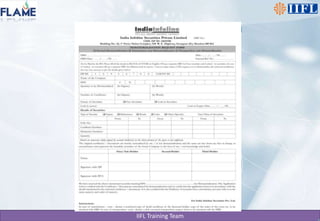
Demat Requisition Form
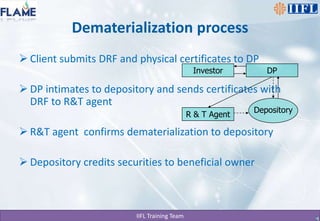
Dematerialization processClient submits DRF and physical certificates to DPDP intimates to depository and sends certificates with DRF to R&T agentR&T agent  confirms dematerialization to depositoryDepository credits securities to beneficial ownerDepositoryInvestorDPR & T Agent
Dematerialization ProcessHow many copies of DRF are made and who all get them?3 CopiesClient / Account HolderDepository participantR & T agent
Trading and settlementMarket TradeTrade done through a broker on the exchange. Has to be settled through the exchangeOff Market Trade Trade done between two parties without the involvement of a broker. Has to be settled mutually between the two parties, shares moves from one account to another
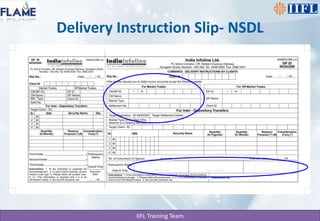
Delivery Instruction Slip- NSDL
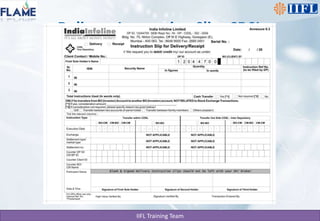
Delivery Instruction Slip- CDSL
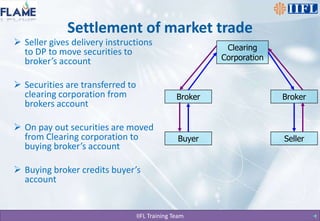
Settlement of market tradeSeller gives delivery instructions to DP to move securities to broker’s accountSecurities are transferred to clearing corporation from brokers accountOn pay out securities are moved from Clearing corporation to buying broker’s accountBuying broker credits buyer’s accountClearing CorporationBrokerBrokerBuyerSeller
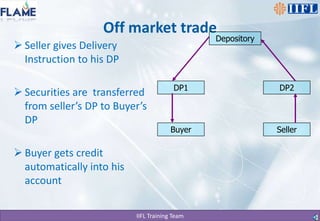
Off market tradeDepositorySeller gives Delivery Instruction to his DPSecurities are  transferred from seller’s DP to Buyer’s DPBuyer gets credit automatically into his accountDP1DP2BuyerSeller
Who can open a demat account?Individuals, NRIs, Minors, HUFs, Trusts (Regd), Corporates can open demat accountProprietary firms, partnership firms and unregistered trusts cannot open a demat account as the Companies Act,1956 prohibits these entities from becoming shareholders of companies
Basic documents for account openingRegistration formPhotograph/s with signatures across itPAN CardProof of residence-Passport, Voter’s ID card, Driving license, Ration cardProof of identity-Passport, Voter’s ID card, Driving license, PAN cardBank Account Proof-Bank statement, cancelled cheque
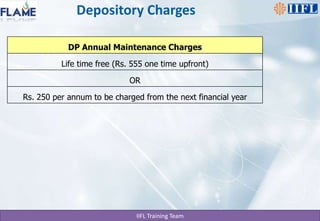
Depository Charges
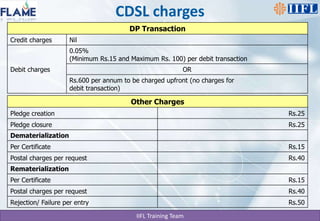
CDSL charges
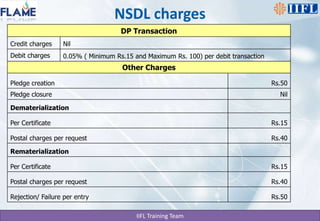
NSDL charges
Thank You

Equity Basics DP

  • 1.
  • 2.
    Depository A depositoryis an organization where the securities of an investor are held in electronic form, at the request of the investor through the medium of a Depository ParticipantIf an investor wants to utilize the services offered by a depository, he has to open an account with the depository through its Depository Participant. This is similar to opening an account with any of the branches of a bank in order to utilize the services of that bank
  • 3.
    What is dematerialization?Itis process of converting securities from physical form into electronic form
  • 4.
    Who is aDepository Participant?A Depository Participant (DP) is an agent of the depository and is authorized to offer depository services to investorsAccording to SEBI guidelines, financial institutions, banks, custodians, stockbrokers, etc. can become DP with a depository
  • 5.
    Who is aDepository Participant?A DP is an interface between customers and the depositoryA customer opens an account with a DP and commences operations Balances are maintained with the depository and are available through the DPDP intimates customers’ status of holdings or transactions from time to time
  • 6.
    Depositories in IndiaCentral Depository Services (India) Limited - Promoted by BSE, BoI, BoB, SBI and HDFC BankNational Securities Depository Limited (NSDL)- Promoted by UTI, IDBI and NSE Securities and Exchange Board of India (SEBI) is the regulating authority
  • 7.
    Depository: Bank -an analogyBank Holds funds in accountsTransfers funds between accountsTransfers without handling cashSafekeeping of moneyDepositoryHolds securities in accountsTransfers securities in accountsTransfers without handling physical securitiesSafekeeping of securities
  • 8.
    Services offered bya DPAccount Opening & MaintenanceDematerialization of SecuritiesRematerialization of SecuritiesTransfer of SecuritiesPledging of Securities
  • 9.
    Types of accountsBeneficiaryAccountThese are ownership accounts, for use of Individuals, Corporates, HUFs etcPool Account These are commercial accounts , for use of broker, for transfer of securities to and fro, from Exchange or Clearing CorporationAll the securities received in the pool account should be transferred to the respective beneficial accounts within 24 hrs
  • 10.
    How are securitiesdematerialized?Physical securities are to be submitted to DP, along with DRFEach security certificate should be defaced by the client. Defacing of certificate to be done by putting a stamp ‘Surrendered for Dematerialization’
  • 11.
  • 12.
    Dematerialization processClient submitsDRF and physical certificates to DPDP intimates to depository and sends certificates with DRF to R&T agentR&T agent confirms dematerialization to depositoryDepository credits securities to beneficial ownerDepositoryInvestorDPR & T Agent
  • 13.
    Dematerialization ProcessHow manycopies of DRF are made and who all get them?3 CopiesClient / Account HolderDepository participantR & T agent
  • 14.
    Trading and settlementMarketTradeTrade done through a broker on the exchange. Has to be settled through the exchangeOff Market Trade Trade done between two parties without the involvement of a broker. Has to be settled mutually between the two parties, shares moves from one account to another
  • 15.
  • 16.
  • 17.
    Settlement of markettradeSeller gives delivery instructions to DP to move securities to broker’s accountSecurities are transferred to clearing corporation from brokers accountOn pay out securities are moved from Clearing corporation to buying broker’s accountBuying broker credits buyer’s accountClearing CorporationBrokerBrokerBuyerSeller
  • 18.
    Off market tradeDepositorySellergives Delivery Instruction to his DPSecurities are transferred from seller’s DP to Buyer’s DPBuyer gets credit automatically into his accountDP1DP2BuyerSeller
  • 19.
    Who can opena demat account?Individuals, NRIs, Minors, HUFs, Trusts (Regd), Corporates can open demat accountProprietary firms, partnership firms and unregistered trusts cannot open a demat account as the Companies Act,1956 prohibits these entities from becoming shareholders of companies
  • 20.
    Basic documents foraccount openingRegistration formPhotograph/s with signatures across itPAN CardProof of residence-Passport, Voter’s ID card, Driving license, Ration cardProof of identity-Passport, Voter’s ID card, Driving license, PAN cardBank Account Proof-Bank statement, cancelled cheque
  • 21.
  • 22.
  • 23.
  • 24.