Types of mutual funds
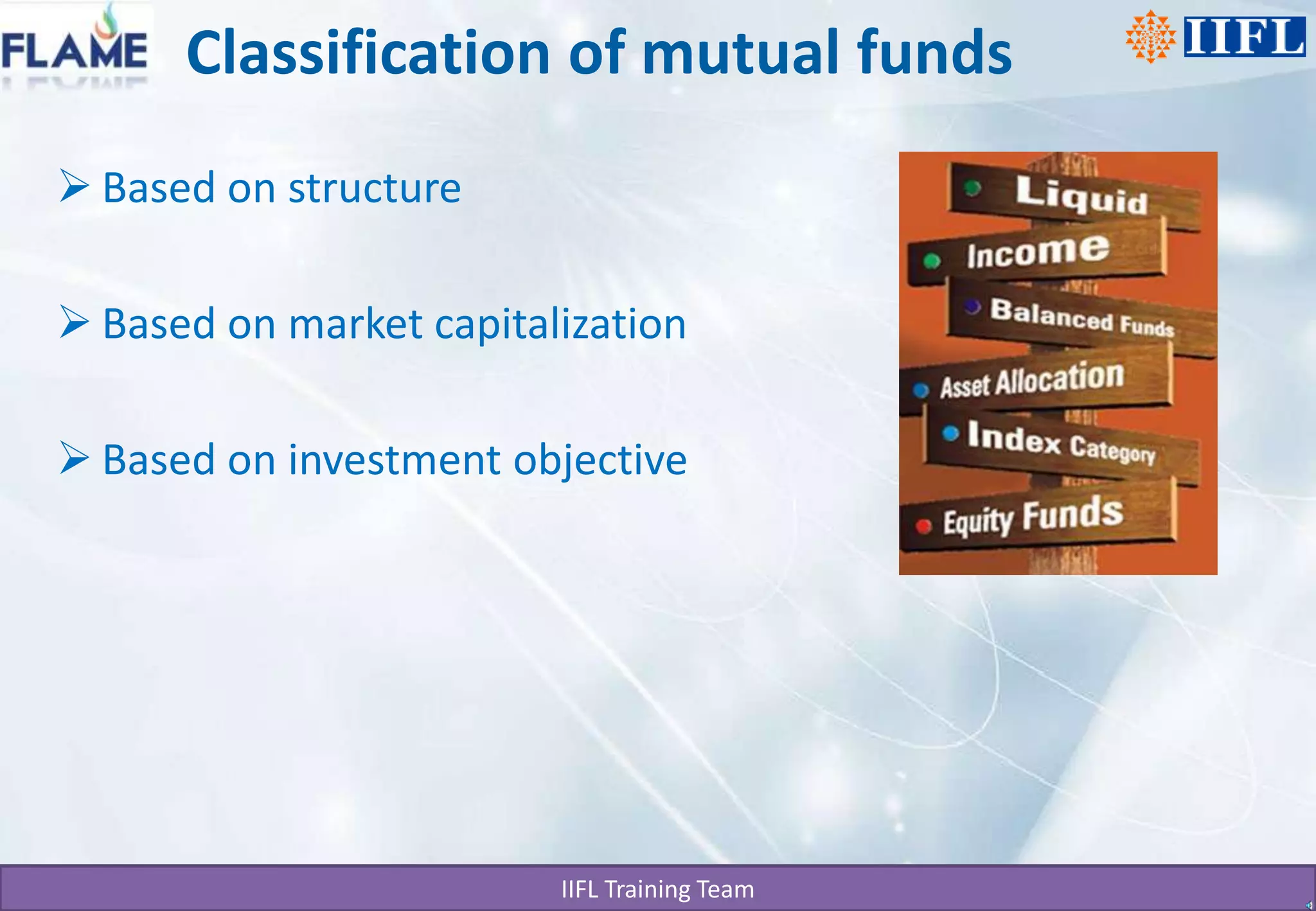
Classification of mutual fundsBased on structureBased on market capitalizationBased on investment objective
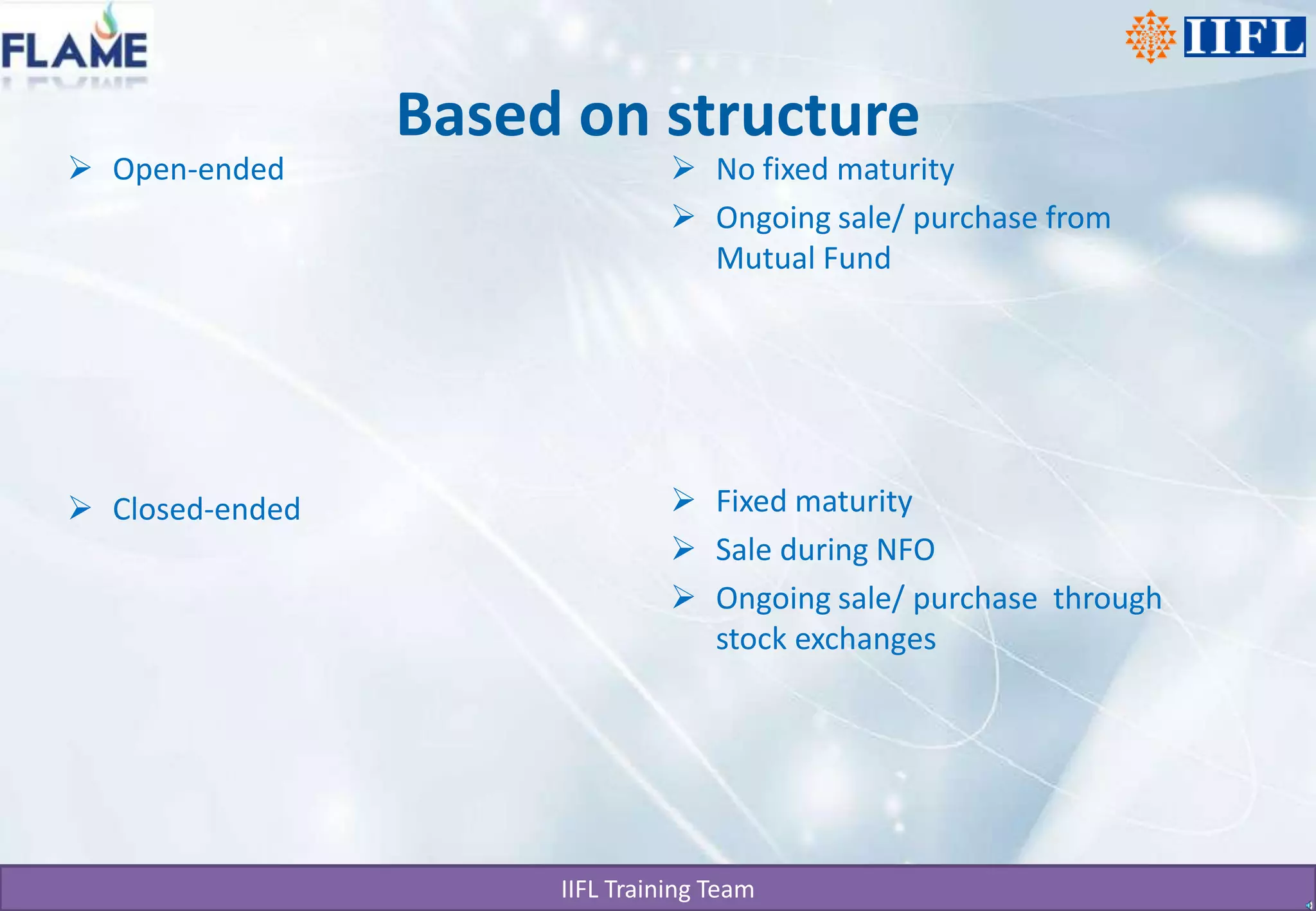
Based on structureNo fixed maturityOngoing sale/ purchase from Mutual FundFixed maturitySale during NFOOngoing sale/ purchase  through stock exchangesOpen-endedClosed-ended
Based on market capitalizationProfessional Management Mutual Funds provide the services of experienced and skilled professionals, backed by a dedicated investment research team that analyses the performance and prospects of companies and selects suitable investments to achieve the objectives of the scheme.DiversificationMutual Funds invest in a number of companies across a broad cross-section of industries and sectors. This diversification reduces the risk because seldom do all stocks decline at the same time and in the same proportion. You achieve this diversification through a Mutual Fund with far less money than you can do on your own.Convenient AdministrationInvesting in a Mutual Fund reduces paperwork and helps you avoid many problems such as bad deliveries, delayed payments and follow up with brokers and companies. Mutual Funds save your time and make investing easy and convenient.Return PotentialOver a medium to long-term, Mutual Funds have the potential to provide a higher return as they invest in a diversified basket of selected securities.Low CostsMutual Funds are a relatively less expensive way to invest compared to directly investing in the capital markets because the benefits of scale in brokerage, custodial and other fees translate into lower costs for investors.LiquidityIn open-end schemes, the investor gets the money back promptly at net asset value related prices from the Mutual Fund. In closed-end schemes, the units can be sold on a stock exchange at the prevailing market price or the investor can avail of the facility of direct repurchase at NAV related prices by the Mutual Fund.TransparencyYou get regular information on the value of your investment in addition to disclosure on the specific investments made by your scheme, the proportion invested in each class of assets and the fund manager's investment strategy and outlook.FlexibilityThrough features such as regular investment plans, regular withdrawal plans and dividend reinvestment plans, you can systematically invest or withdraw funds according to your needs and convenience.AffordabilityInvestors individually may lack sufficient funds to invest in high-grade stocks. A mutual fund because of its large corpus allows even a small investor to take the benefit of its investment strategy.Choice of SchemesMutual Funds offer a family of schemes to suit your varying needs over a lifetime.Well RegulatedAll Mutual Funds are registered with SEBI and they function within the provisions of strict regulations designed to protect the interests of investors. The operations of Mutual Funds are regularly monitored by SEBI.                              Open-end FundsAn open-end fund is one that is available for subscription all through the year. These do not have a fixed maturity. Investors can conveniently buy and sell units at Net Asset Value ("NAV") related prices. The key feature of open-end schemes is liquidity.Closed-end FundsA closed-end fund has a stipulated maturity period which generally ranging from 3 to 15 years. The fund is open for subscription only during a specified period. Investors can invest in the scheme at the time of the initial public issue and thereafter they can buy or sell the units of the scheme on the stock exchanges where they are listed. In order to provide an exit route to the investors, some close-ended funds give an option of selling back the units to the Mutual Fund through periodic repurchase at NAV related prices. SEBI Regulations stipulate that at least one of the two exit routes is provided to the investor.Interval FundsInterval funds combine the features of open-ended and close-ended schemes. They are open for sale or redemption during pre-determined intervals at NAV related prices.Large cap fundsMid cap fundsSmall cap funds
Based on investment objectiveGrowth/ Equity fundsHybrid fundsDebt funds
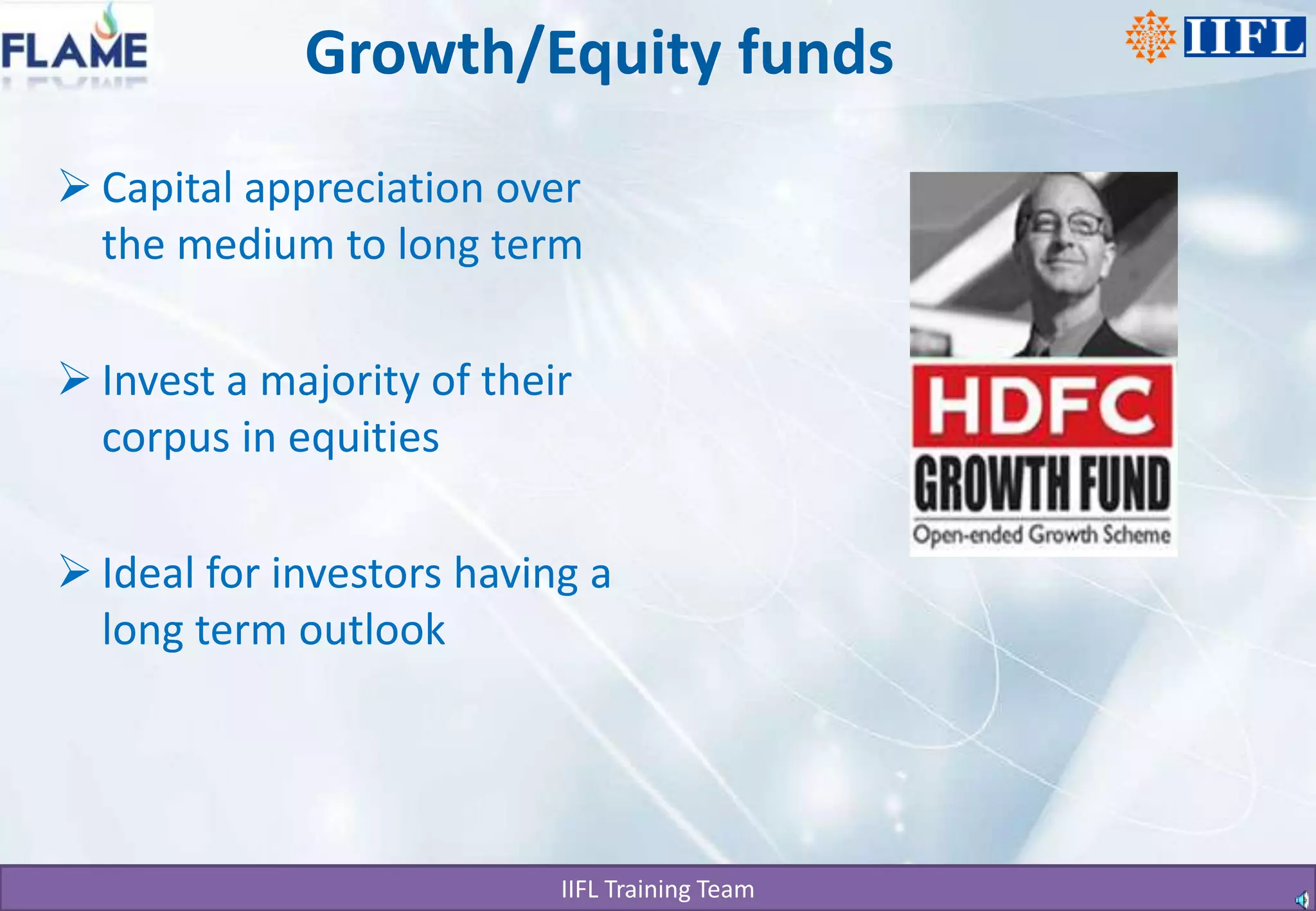
Growth/Equity fundsCapital appreciation over the medium to long termInvest a majority of their corpus in equities Ideal for investors having a long term outlook
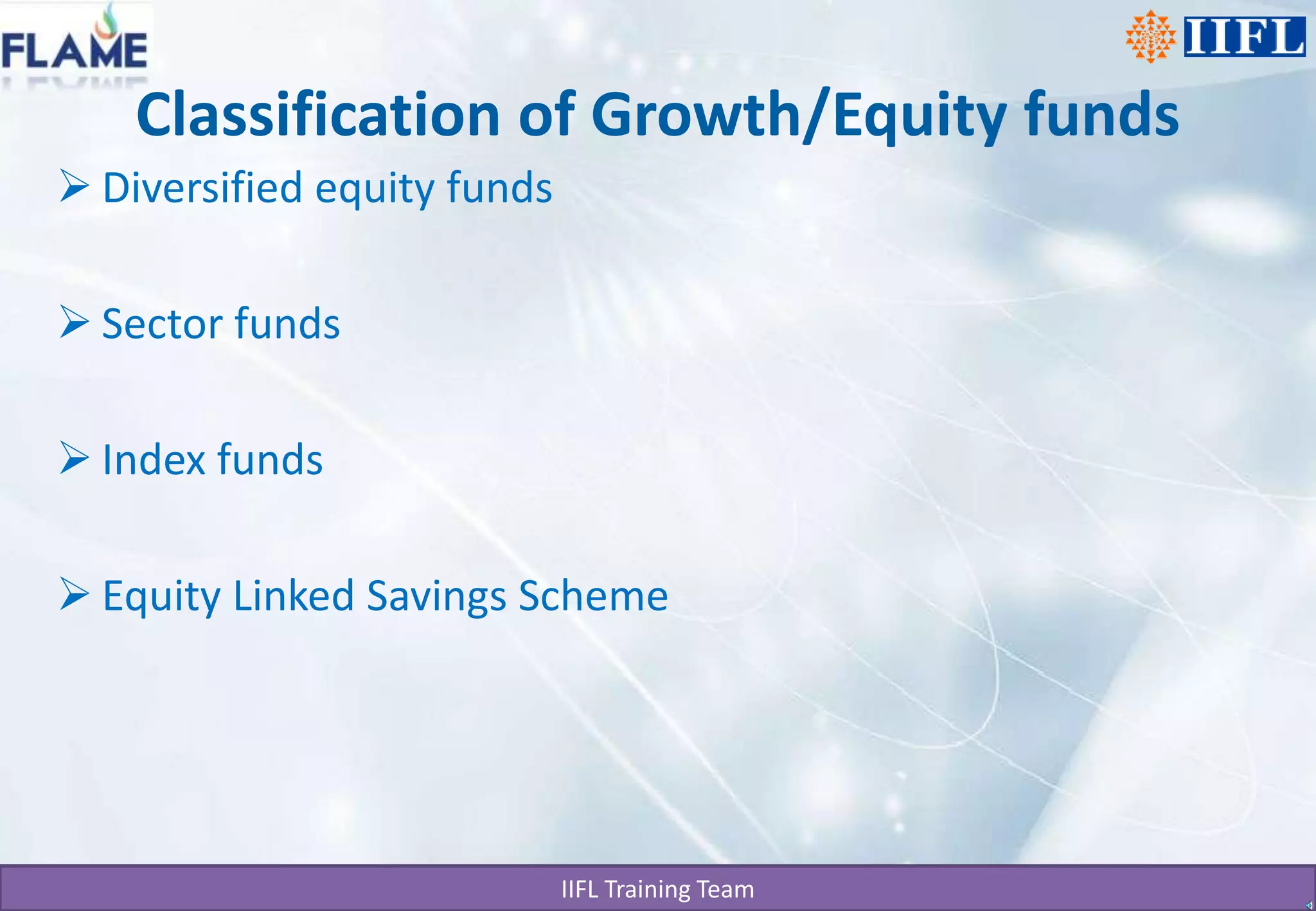
Classification of Growth/Equity fundsDiversified equity funds  Sector fundsIndex fundsEquity Linked Savings Scheme
Hybrid fundsMix of debt and equity component in varying proportion Suitable for investors who want capital appreciation with stability of income. They are classified as:Balanced FundsMonthly Income Plans (MIP):
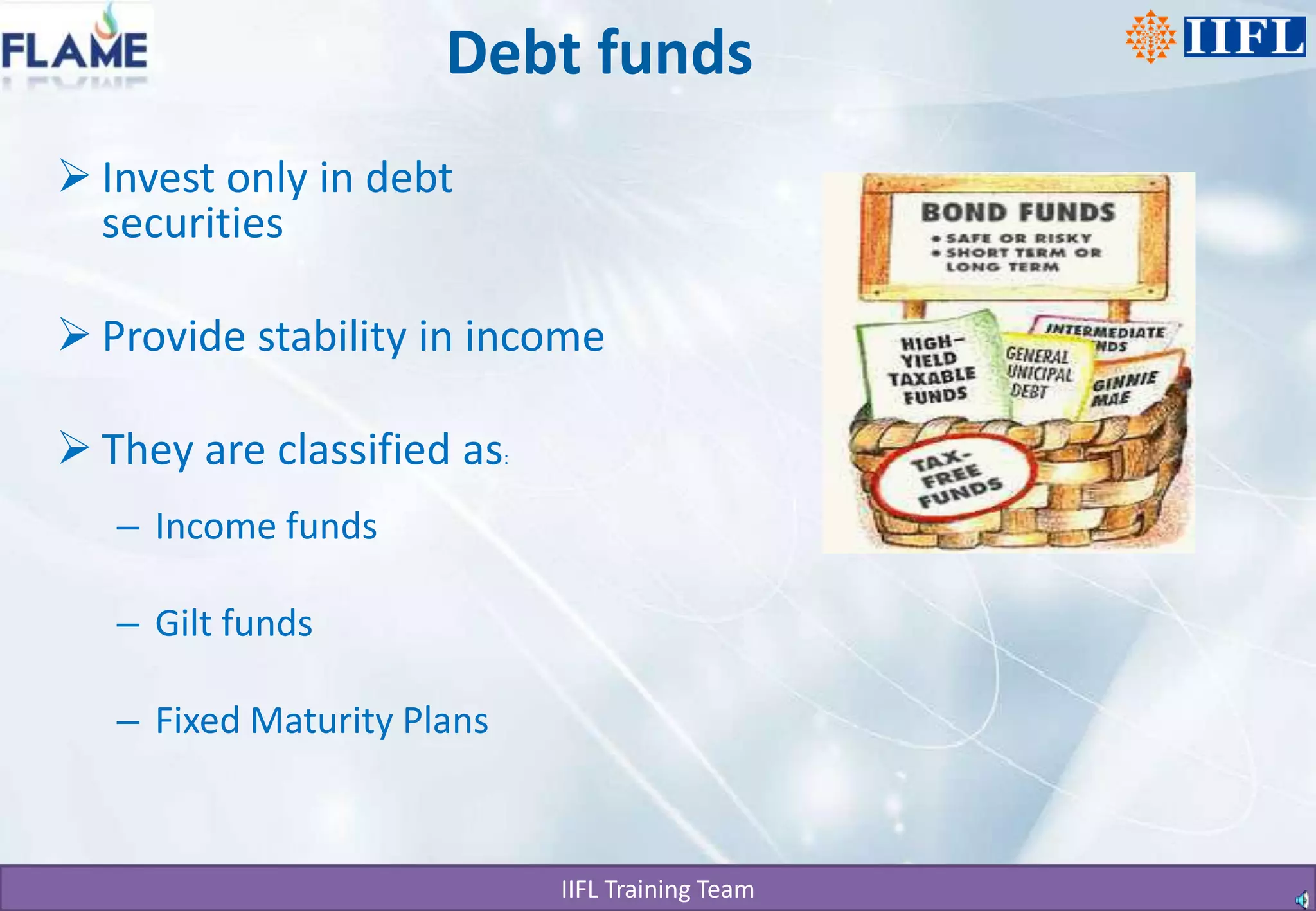
Debt fundsInvest only in debt securities Provide stability in income They are classified as:Income fundsGilt fundsFixed Maturity Plans
Lets reviseOpen/close ended schemeLarge/mid/small cap fundsDiversified equity schemesSector fundsIndex fundsELSS schemesFMPMIP
Various options available GrowthDividend payoutDividend reinvest
Exercise 1Mr. Bachhan invested Rs 10,000/- in a mutual fund (growth option) @ NAV of Rs 10(including the load). Current NAV is Rs 15 and a dividend of Rs 2 is declared.	Calculate the amount Mr. Bachhan will get as:	1) Dividend	2) Redeemed amount
Solution:Having opted for the Growth scheme, Mr. Bachhan will not receive any dividendNumber of units held= 10000/10 = 1000	Current NAV = Rs 15 	Therefore,	Redeemed amount = 15 x 1000                                = Rs 15000/-
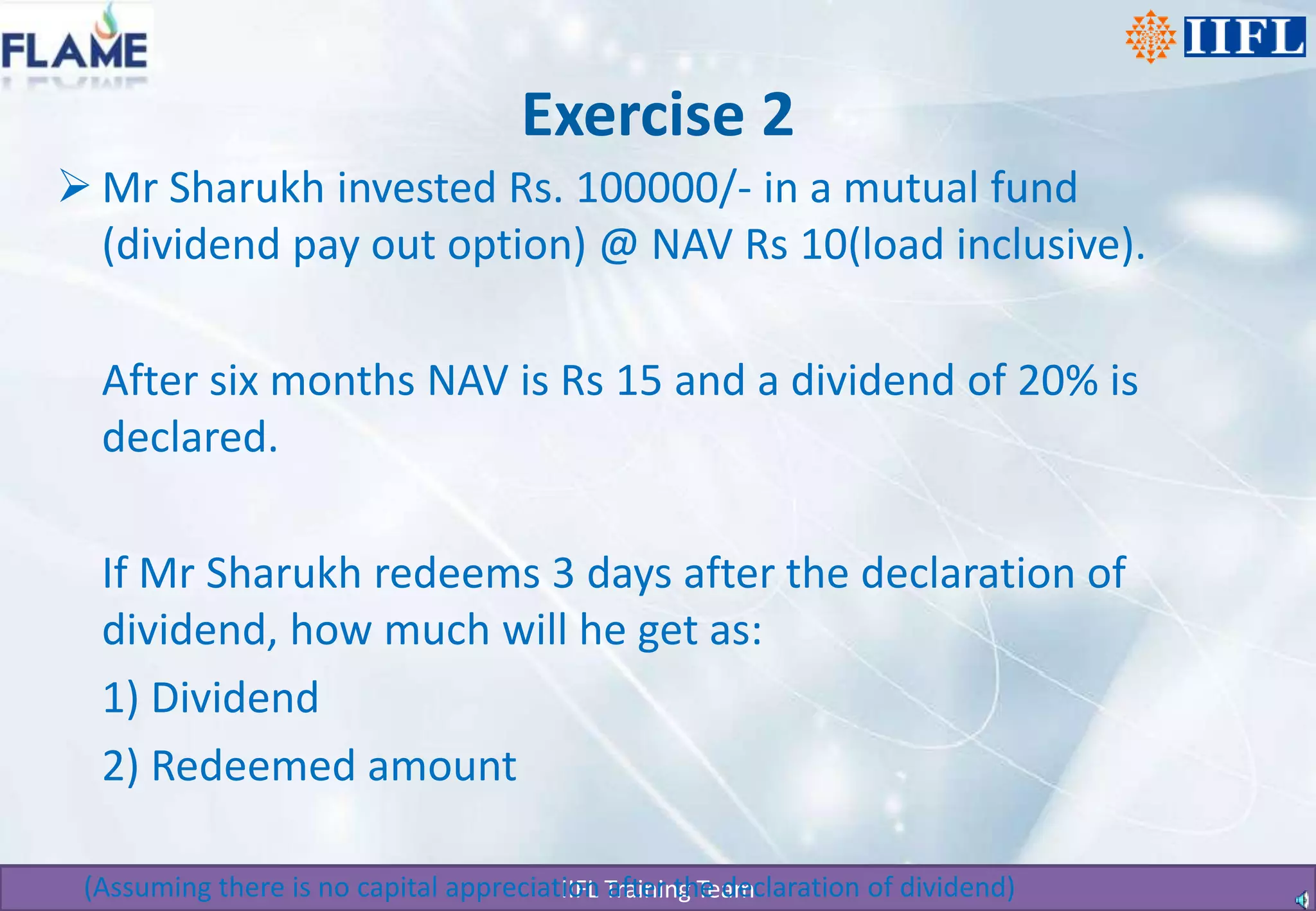
Exercise 2Mr Sharukh invested Rs. 100000/- in a mutual fund (dividend pay out option) @ NAV Rs 10(load inclusive).   	After six months NAV is Rs 15 and a dividend of 20% is declared.   	If Mr Sharukh redeems 3 days after the declaration of dividend, how much will he get as:	1) Dividend	2) Redeemed amount    (Assuming there is no capital appreciation after the declaration of dividend)
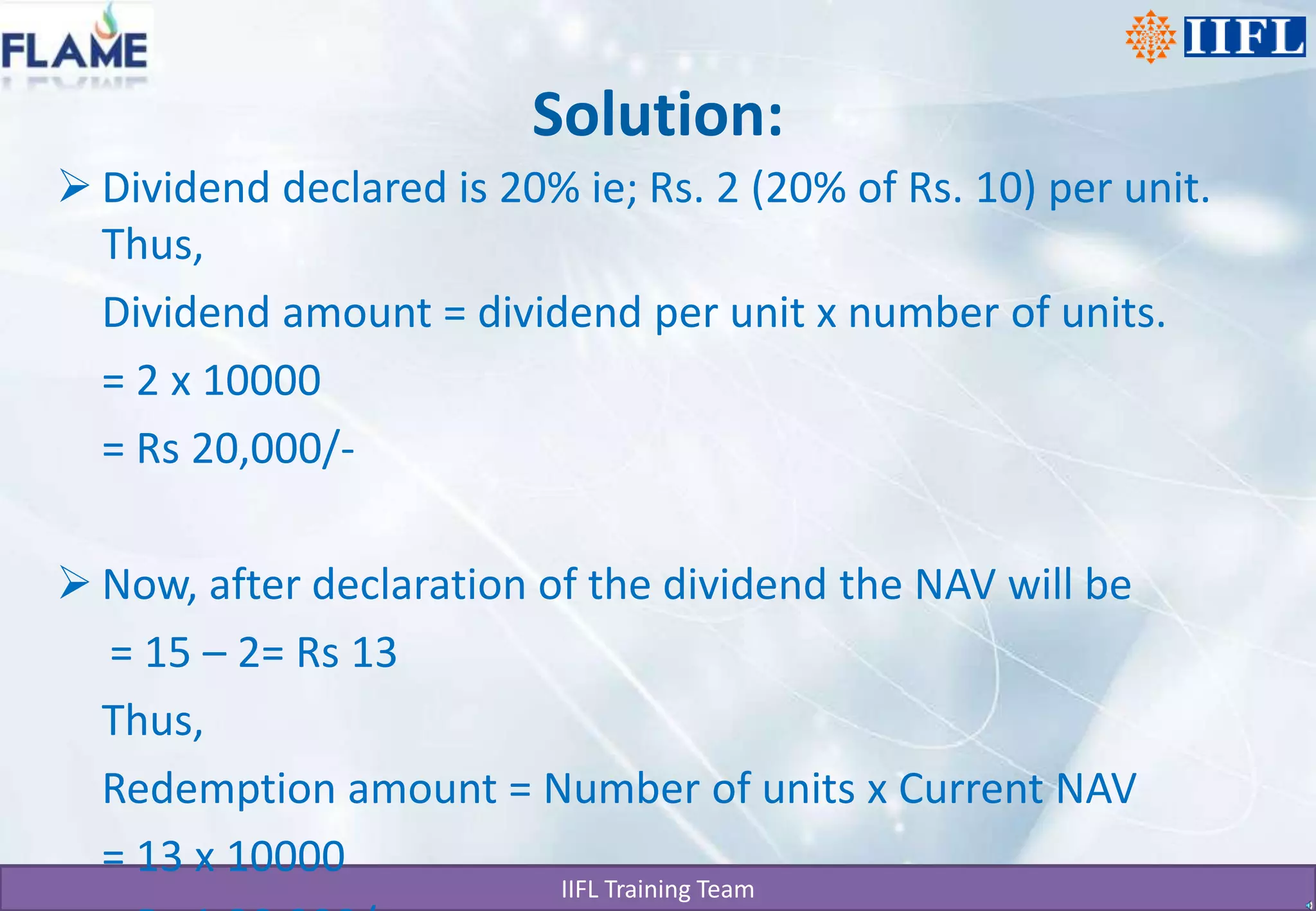
Solution:Dividend declared is 20% ie; Rs. 2 (20% of Rs. 10) per unit. Thus,	Dividend amount = dividend per unit x number of units.	= 2 x 10000	= Rs 20,000/-Now, after declaration of the dividend the NAV will be     = 15 – 2= Rs 13	Thus,	Redemption amount = Number of units x Current NAV	= 13 x 10000	= Rs 1,30,000/-
SIP (Systmatic Investment Plan)Has a capability of creating wealth for everybodyIt is simplest and smartest way to start investing
What is SIP?Your Financial Goal At 50- Wealth Creation.You are here today at 30.SIP, which helps you reach your goal. A method of investing money systematically at regular intervals of time, to create wealth over a long-term.
Why should one systematically invest?When chasing a financial goal, the simplest form of planning is to invest regularlyMost of us calculate our earnings, expenses and savings monthlyThe easiest way to plan our investments, therefore, is on a monthly basis
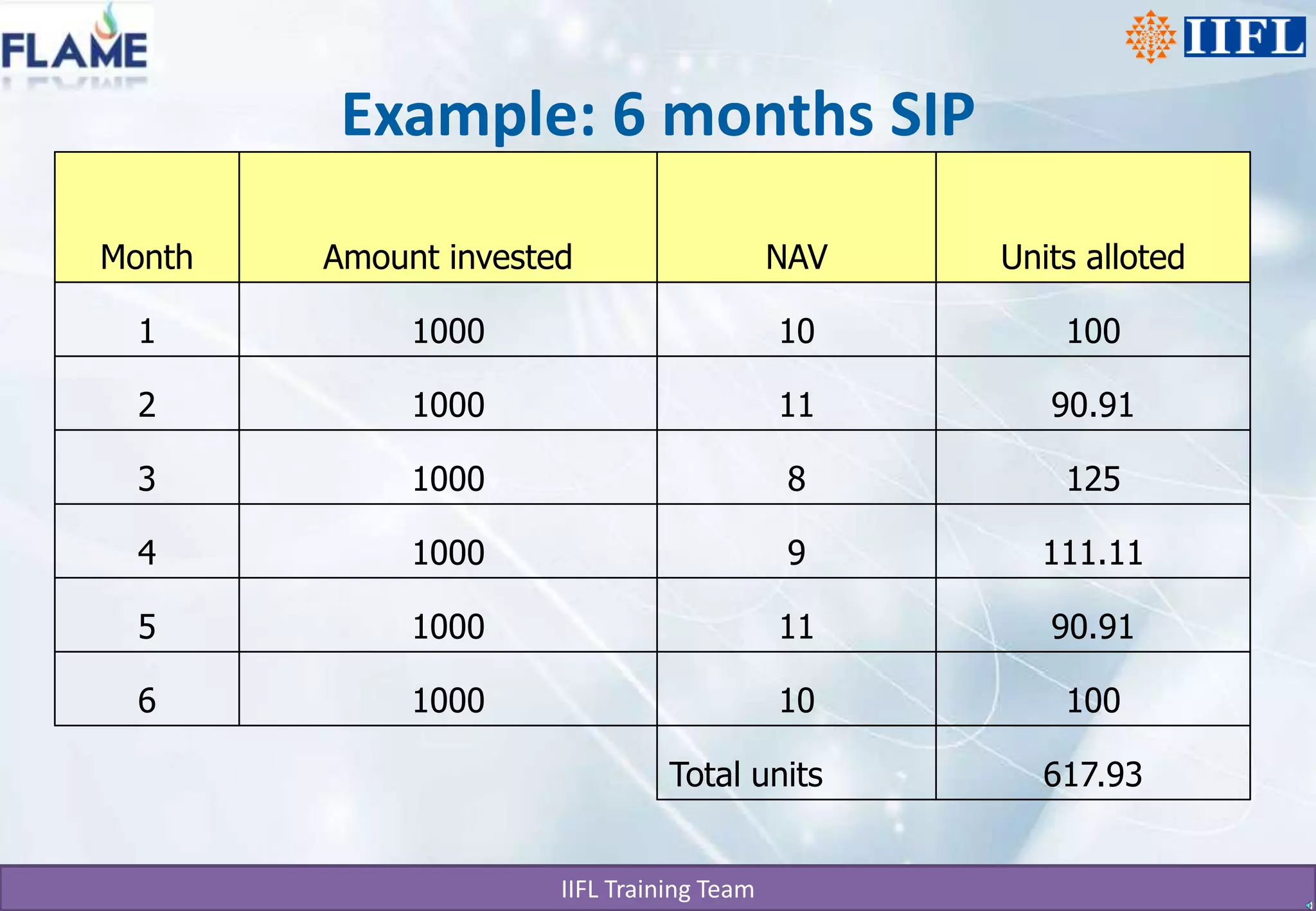
Example: 6 months SIPUnits allotedNAVAmount investedMonth 100101000190.911110002125810003111.1191000490.9111100051001010006617.93Total units
Mode of payments for SIPPost dated chequesECS (Electronic clearing system)
STP (Systematic Transfer Plan)A Systematic Transfer Plan is a facility wherein investors can transfer an amount regularly from an income scheme / liquid scheme to an equity or hybrid scheme
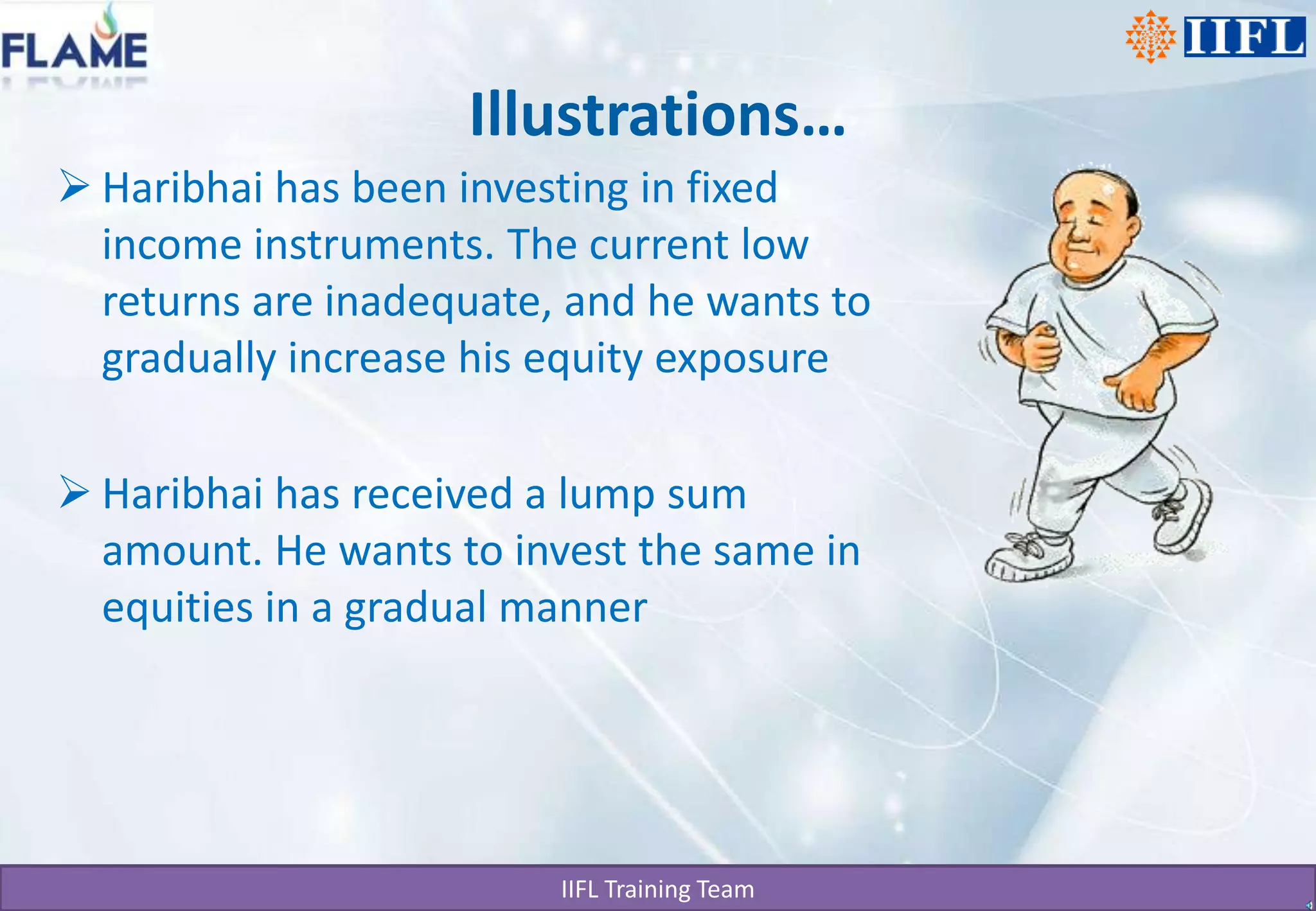
Illustrations…Haribhai has been investing in fixed income instruments. The current low returns are inadequate, and he wants to gradually increase his equity exposureHaribhai has received a lump sum amount. He wants to invest the same in equities in a gradual manner
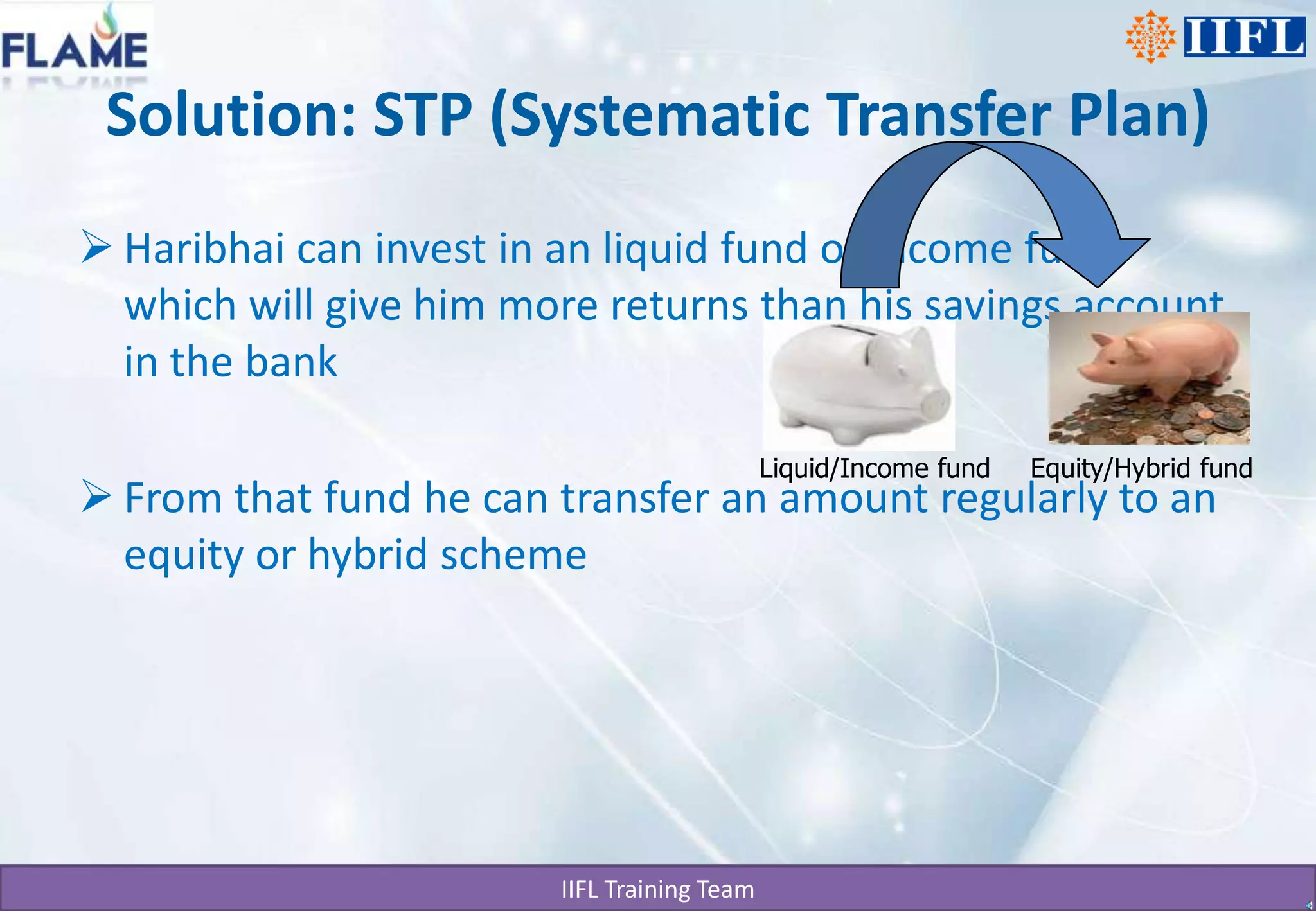
Solution: STP (Systematic Transfer Plan)Haribhai can invest in an liquid fund or income fund which will give him more returns than his savings account in the bankFrom that fund he can transfer an amount regularly to an equity or hybrid schemeLiquid/Income fundEquity/Hybrid fund
Benefits of SIP and STPRupee cost averagingPower of compoundingConvenienceBuilds wealth for long term
Thank You

Mutual funds types

  • 1.
  • 2.
    Classification of mutualfundsBased on structureBased on market capitalizationBased on investment objective
  • 3.
    Based on structureNofixed maturityOngoing sale/ purchase from Mutual FundFixed maturitySale during NFOOngoing sale/ purchase through stock exchangesOpen-endedClosed-ended
  • 4.
    Based on marketcapitalizationProfessional Management Mutual Funds provide the services of experienced and skilled professionals, backed by a dedicated investment research team that analyses the performance and prospects of companies and selects suitable investments to achieve the objectives of the scheme.DiversificationMutual Funds invest in a number of companies across a broad cross-section of industries and sectors. This diversification reduces the risk because seldom do all stocks decline at the same time and in the same proportion. You achieve this diversification through a Mutual Fund with far less money than you can do on your own.Convenient AdministrationInvesting in a Mutual Fund reduces paperwork and helps you avoid many problems such as bad deliveries, delayed payments and follow up with brokers and companies. Mutual Funds save your time and make investing easy and convenient.Return PotentialOver a medium to long-term, Mutual Funds have the potential to provide a higher return as they invest in a diversified basket of selected securities.Low CostsMutual Funds are a relatively less expensive way to invest compared to directly investing in the capital markets because the benefits of scale in brokerage, custodial and other fees translate into lower costs for investors.LiquidityIn open-end schemes, the investor gets the money back promptly at net asset value related prices from the Mutual Fund. In closed-end schemes, the units can be sold on a stock exchange at the prevailing market price or the investor can avail of the facility of direct repurchase at NAV related prices by the Mutual Fund.TransparencyYou get regular information on the value of your investment in addition to disclosure on the specific investments made by your scheme, the proportion invested in each class of assets and the fund manager's investment strategy and outlook.FlexibilityThrough features such as regular investment plans, regular withdrawal plans and dividend reinvestment plans, you can systematically invest or withdraw funds according to your needs and convenience.AffordabilityInvestors individually may lack sufficient funds to invest in high-grade stocks. A mutual fund because of its large corpus allows even a small investor to take the benefit of its investment strategy.Choice of SchemesMutual Funds offer a family of schemes to suit your varying needs over a lifetime.Well RegulatedAll Mutual Funds are registered with SEBI and they function within the provisions of strict regulations designed to protect the interests of investors. The operations of Mutual Funds are regularly monitored by SEBI.                              Open-end FundsAn open-end fund is one that is available for subscription all through the year. These do not have a fixed maturity. Investors can conveniently buy and sell units at Net Asset Value ("NAV") related prices. The key feature of open-end schemes is liquidity.Closed-end FundsA closed-end fund has a stipulated maturity period which generally ranging from 3 to 15 years. The fund is open for subscription only during a specified period. Investors can invest in the scheme at the time of the initial public issue and thereafter they can buy or sell the units of the scheme on the stock exchanges where they are listed. In order to provide an exit route to the investors, some close-ended funds give an option of selling back the units to the Mutual Fund through periodic repurchase at NAV related prices. SEBI Regulations stipulate that at least one of the two exit routes is provided to the investor.Interval FundsInterval funds combine the features of open-ended and close-ended schemes. They are open for sale or redemption during pre-determined intervals at NAV related prices.Large cap fundsMid cap fundsSmall cap funds
  • 5.
    Based on investmentobjectiveGrowth/ Equity fundsHybrid fundsDebt funds
  • 6.
    Growth/Equity fundsCapital appreciationover the medium to long termInvest a majority of their corpus in equities Ideal for investors having a long term outlook
  • 7.
    Classification of Growth/EquityfundsDiversified equity funds Sector fundsIndex fundsEquity Linked Savings Scheme
  • 8.
    Hybrid fundsMix ofdebt and equity component in varying proportion Suitable for investors who want capital appreciation with stability of income. They are classified as:Balanced FundsMonthly Income Plans (MIP):
  • 9.
    Debt fundsInvest onlyin debt securities Provide stability in income They are classified as:Income fundsGilt fundsFixed Maturity Plans
  • 10.
    Lets reviseOpen/close endedschemeLarge/mid/small cap fundsDiversified equity schemesSector fundsIndex fundsELSS schemesFMPMIP
  • 11.
    Various options availableGrowthDividend payoutDividend reinvest
  • 12.
    Exercise 1Mr. Bachhaninvested Rs 10,000/- in a mutual fund (growth option) @ NAV of Rs 10(including the load). Current NAV is Rs 15 and a dividend of Rs 2 is declared. Calculate the amount Mr. Bachhan will get as: 1) Dividend 2) Redeemed amount
  • 13.
    Solution:Having opted forthe Growth scheme, Mr. Bachhan will not receive any dividendNumber of units held= 10000/10 = 1000 Current NAV = Rs 15 Therefore, Redeemed amount = 15 x 1000 = Rs 15000/-
  • 14.
    Exercise 2Mr Sharukhinvested Rs. 100000/- in a mutual fund (dividend pay out option) @ NAV Rs 10(load inclusive). After six months NAV is Rs 15 and a dividend of 20% is declared. If Mr Sharukh redeems 3 days after the declaration of dividend, how much will he get as: 1) Dividend 2) Redeemed amount (Assuming there is no capital appreciation after the declaration of dividend)
  • 15.
    Solution:Dividend declared is20% ie; Rs. 2 (20% of Rs. 10) per unit. Thus, Dividend amount = dividend per unit x number of units. = 2 x 10000 = Rs 20,000/-Now, after declaration of the dividend the NAV will be = 15 – 2= Rs 13 Thus, Redemption amount = Number of units x Current NAV = 13 x 10000 = Rs 1,30,000/-
  • 16.
    SIP (Systmatic InvestmentPlan)Has a capability of creating wealth for everybodyIt is simplest and smartest way to start investing
  • 17.
    What is SIP?YourFinancial Goal At 50- Wealth Creation.You are here today at 30.SIP, which helps you reach your goal. A method of investing money systematically at regular intervals of time, to create wealth over a long-term.
  • 18.
    Why should onesystematically invest?When chasing a financial goal, the simplest form of planning is to invest regularlyMost of us calculate our earnings, expenses and savings monthlyThe easiest way to plan our investments, therefore, is on a monthly basis
  • 19.
    Example: 6 monthsSIPUnits allotedNAVAmount investedMonth 100101000190.911110002125810003111.1191000490.9111100051001010006617.93Total units
  • 20.
    Mode of paymentsfor SIPPost dated chequesECS (Electronic clearing system)
  • 21.
    STP (Systematic TransferPlan)A Systematic Transfer Plan is a facility wherein investors can transfer an amount regularly from an income scheme / liquid scheme to an equity or hybrid scheme
  • 22.
    Illustrations…Haribhai has beeninvesting in fixed income instruments. The current low returns are inadequate, and he wants to gradually increase his equity exposureHaribhai has received a lump sum amount. He wants to invest the same in equities in a gradual manner
  • 23.
    Solution: STP (SystematicTransfer Plan)Haribhai can invest in an liquid fund or income fund which will give him more returns than his savings account in the bankFrom that fund he can transfer an amount regularly to an equity or hybrid schemeLiquid/Income fundEquity/Hybrid fund
  • 24.
    Benefits of SIPand STPRupee cost averagingPower of compoundingConvenienceBuilds wealth for long term
  • 25.