Supply
Supply
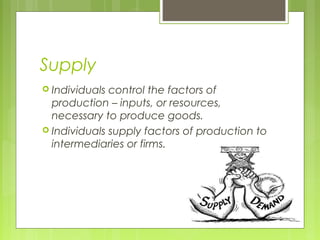
 Individuals control the factors of
production – inputs, or resources,
necessary to produce goods.
 Individuals supply factors of production to
intermediaries or firms.
Supply
 The analysis of the supply of produced
goods has two parts:
– An analysis of the supply of the factors of
production to households and firms.
– An analysis of why firms transform those
factors of production into usable goods and
services.
The Law of Supply
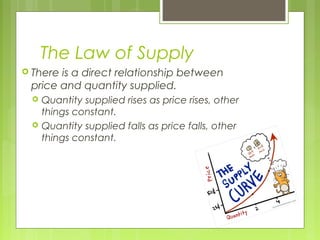
 There is a direct relationship between
price and quantity supplied.
 Quantity supplied rises as price rises, other
things constant.
 Quantity supplied falls as price falls, other
things constant.
Law of Supply
Law of Supply
 As the price of a product rises, producers will be
willing to supply more.
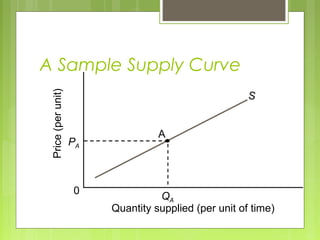
 The height of the supply curve at any quantity
shows the minimum price necessary to induce
producers to supply that next unit to market.
 The height of the supply curve at any quantity
also shows the opportunity cost of producing the
next unit of the good.
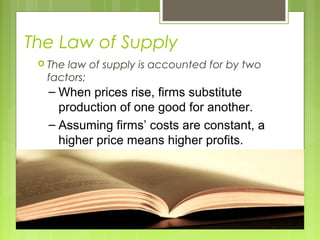
The Law of Supply
 The law of supply is accounted for by two
factors:
– When prices rise, firms substitute
production of one good for another.
– Assuming firms’ costs are constant, a
higher price means higher profits.
S
A
Quantity supplied (per unit of time)
0
Price(perunit)
PA
QA
A Sample Supply Curve
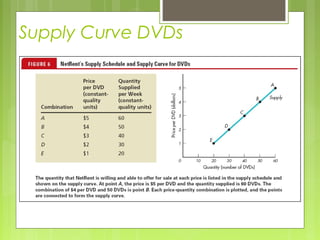
Supply Curve DVDs
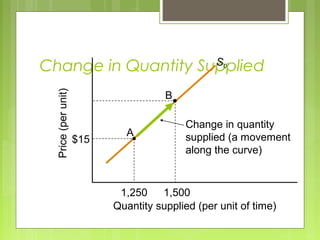
Change in quantity
supplied (a movement
along the curve)
Change in Quantity SuppliedPrice(perunit)
Quantity supplied (per unit of time)
S0
$15
A
1,250 1,500
B
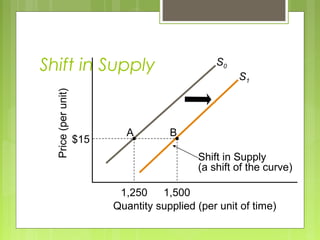
Shift in SupplyPrice(perunit)
Quantity supplied (per unit of time)
S0
Shift in Supply
(a shift of the curve)
S1
$15
A B
1,250 1,500
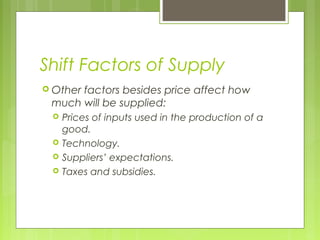
Shift Factors of Supply
 Other factors besides price affect how
much will be supplied:
 Prices of inputs used in the production of a
good.
 Technology.
 Suppliers’ expectations.
 Taxes and subsidies.
economics supply

economics supply

  • 1.
  • 2.
    Supply  Individuals controlthe factors of production – inputs, or resources, necessary to produce goods.  Individuals supply factors of production to intermediaries or firms.
  • 3.
    Supply  The analysisof the supply of produced goods has two parts: – An analysis of the supply of the factors of production to households and firms. – An analysis of why firms transform those factors of production into usable goods and services.
  • 4.
    The Law ofSupply  There is a direct relationship between price and quantity supplied.  Quantity supplied rises as price rises, other things constant.  Quantity supplied falls as price falls, other things constant.
  • 5.
    Law of Supply Lawof Supply  As the price of a product rises, producers will be willing to supply more.  The height of the supply curve at any quantity shows the minimum price necessary to induce producers to supply that next unit to market.  The height of the supply curve at any quantity also shows the opportunity cost of producing the next unit of the good.
  • 6.
    The Law ofSupply  The law of supply is accounted for by two factors: – When prices rise, firms substitute production of one good for another. – Assuming firms’ costs are constant, a higher price means higher profits.
  • 8.
    S A Quantity supplied (perunit of time) 0 Price(perunit) PA QA A Sample Supply Curve
  • 9.
  • 10.
    Change in quantity supplied(a movement along the curve) Change in Quantity SuppliedPrice(perunit) Quantity supplied (per unit of time) S0 $15 A 1,250 1,500 B
  • 11.
    Shift in SupplyPrice(perunit) Quantitysupplied (per unit of time) S0 Shift in Supply (a shift of the curve) S1 $15 A B 1,250 1,500
  • 12.
    Shift Factors ofSupply  Other factors besides price affect how much will be supplied:  Prices of inputs used in the production of a good.  Technology.  Suppliers’ expectations.  Taxes and subsidies.