Introduction:-
The major portion of the coal available in India is of
low quality, high ash content and low calorific value. The
traditional grate fuel firing systems have got limitations and are
techno-economically unviable to meet the challenges of future.
Fluidized bed combustion has emerged as a viable alternative
and has significant advantages over conventional firing system
and offers multiple benefits – compact boiler design, fuel
flexibility, higher combustion efficiency and reduced emission
of noxious pollutants such as Sox and NOx. The fuels burnt in
these boilers Include coal, washery rejects, rice husk, bagasse
and other agricultural wastes. The fluidized bed boilers have a
wide capacity range- 0.5 T/hr to over 100 T/hr.
Development of CFB
• 1921, Fritz Winkler, Germany, Coal Gasification
• 1938, Waren Lewis and Edwin Gilliland, USA, Fluid Catalytic
Cracking, Fast Fluidized Bed
• 1960, Douglas Elliott, England, Coal Combustion, BFB
• 1960s, Ahlstrom Group, Finland, First commercial CFB
boiler, 15 MWth, Peat
Types of Fluidized Bed Combustion Boilers:-
1. Atmospheric classic Fluidized Bed Combustion System (AFBC)
2. Atmospheric circulating (fast) Fluidized Bed Combustion system
(CFBC)
3. Pressurized Fluidized Bed Combustion System (PFBC).
1
Mechanism of fluidized bed coumbstion
When an evenly distributed air or gas is passed upward
through a finely divided bed of solid particles such as sand
supported on a fine mesh, the particles are undisturbed at low
velocity.
As air velocity is gradually increased, a stage is reached when the
individual particles are suspended in the air stream – the bed is
called “fluidised”.
With further increase in air velocity, there is bubble formation,
vigorous turbulence, rapid mixing and formation of dense defined
bed surface. The bed of solid particles exhibits the properties of a
boiling liquid and assumes the appearance of a fluid – “bubbling
fluidized bed”.
At higher velocities, bubbles disappear, and particles are blown
out of the bed. Therefore, some amounts of particles have to be
recirculated to maintain a stable system - "circulating fluidised
bed".
Combustion process requires the three “T”s that is Time,
Temperature and Turbulence.
In FBC, turbulence is promoted by fluidisation. Improved mixing
generates evenly distributed heat at lower temperature. Residence
time is many times greater than conventional grate firing. Thus an
FBC system releases heat more efficiently at lower temperatures.
Since limestone is used as particle bed, control of sulfur dioxide
and nitrogen oxide emissions in the combustion chamber is
achieved without any additional control equipment.
2
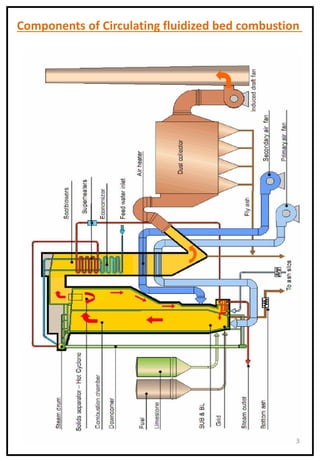
Components of Circulating fluidized bed combustion
3
Wind box and grid nozzle
primary air is fed into wind box. Air is equally
distributed on furnace cross section by passing
through the grid nozzle. This will help mixing of
air and fuel for completed combustion
Bottom ash drain
coarse size of ash that is not take away from
furnace by fluidizing air will be drain at bottom
ash drain port locating on grid nozzle floor by
gravity. bottom ash will be cooled and conveyed
to silo by cooling conveyor.
HP Blower
supply high pressure air to fluidize bed material
in loop seal so that it can overflow to furnace
Cyclone separator
located after furnace exit and before
convective part. Fluidized boiler without this
would be BFB not CFB
Evaporative or Superheat Wing
Wall located on upper zone of furnace it can be
both of evaporative or SH panel lower portion
covered by erosion resistant materials
Fuel Feeding system
solid fuel is fed into the lower zone of furnace
through the screw conveyor cooling with
combustion air. Number of feeding port depend
on the size of boiler
Components of CFBC
4
Refractory
refractory is used to protect the pressure part
from serious erosion zone such as lower bed,
cyclone separator
Solid recycle system
dip leg of separator and furnace. Its design physical is
similar to furnace which have air box and nozzle to
distribute air. Distributed air from HP blower initiate
fluidization. Solid behave like a fluid then over flow
back to the furnace.
Kick out
kick out is referred to interface zone between the end
of lower zone refractory and water tube. It is design
to protect the erosion by by-passing the interface
from falling down bed materials
Lime stone and sand system
lime stone is pneumatically feed or gravitational
feed into the furnace slightly above fuel feed
port. the objective is to reduce SOx emission.
Sand is normally fed by gravitation from silo in
order to maintain bed pressure. Its flow control
by speed of rotary screw.
5
1. High Efficiency
FBC boilers can burn fuel with a combustion efficiency of over
95% irrespective of ash content.
FBC boilers can operate with overall efficiency of 84% (plus or
minus 2%).
2. Reduction in Boiler Size
High heat transfer rate over a small heat transfer area immersed in
the bed result in overall
size reduction of the boiler.
3. Fuel Flexibility
FBC boilers can be operated efficiently with a variety of fuels.
Even fuels like flotation
slimes, washer rejects, agro waste can be burnt efficiently. These
can be fed either independently
or in combination with coal into the same furnace.
4. Ability to Burn Low Grade Fuel
FBC boilers would give the rated output even with inferior quality
fuel. The boilers can fire coals with ash content as high as 62%
and having calorific value as low as 2,500 kCal/kg.
Even carbon content of only 1% by weight can sustain the
fluidised bed combustion.
5. Ability to Burn Fines
Coal containing fines below 6 mm can be burnt efficiently in FBC
boiler, which is very
difficult to achieve in conventional firing system.
Advantages of CFBC
6
6. Pollution Control
SO2 formation can be greatly minimized by addition of limestone
or dolomite for high sulphur
coals. 3% limestone is required for every 1% sulphur in the coal
feed. Low combustion temperature eliminates NOx formation.
7. Low Corrosion and Erosion
The corrosion and erosion effects are less due to lower
combustion temperature, softness of ash and low particle velocity
(of the order of 1 m/sec).
8. Easier Ash Removal – No Clinker Formation
Since the temperature of the furnace is in the range of 750 – 900
°C in FBC boilers, even
coal of low ash fusion temperature can be burnt without clinker
formation. Ash removal is easier as the ash flows like liquid from
the combustion chamber. Hence less manpower is
required for ash handling.
9. Less Excess Air – Higher CO2 in Flue Gas
The CO2 in the flue gases will be of the order of 14 – 15% at full
load. Hence, the FBC -
boiler can operate at low excess air - only 20 - 25%.
10. Fast Response to Load Fluctuations
Inherent high thermal storage characteristics can easily absorb
fluctuation in fuel feed rates.
Response to changing load is comparable to that of oil fired
boilers.
7
Inspection& Maintance
Before maintenance work
Make sure that all staff are understand about
safety instruction for doing CFB boiler
maintenance work
Make sure that all maintenance and safety equipments
shall be a first class
Windbox Inspection
● Inspect sand inside windbox after shutdown
● Drain pipe
● Crack
● Air gun pipe
● Refractory
● Crack,wear and fall down inspectby
hammer(knocking) if burner is under bed design 8
Furnace Inspection
● Nozzle :
● Wear
● Fall-off
● Refractory
● Crack, wear and fall down inspect by hammer
knocking if burner is under bed design
● Feed fuel port
● Wear
● Crack
● Burner
● Limestone port
● Crack
● Deform
● Refractory damage at connection between port and
refractory
● Secondary & Recirculation Air port
● Crack
● Deform
● Refractory damage at connection between port and
refractory
● Bed Temperature
● Check thermo well deformation
● Check wear
9
Kick-Out Inspection
● Refractory
● Wear
● Crack and fall down by hammer(knocking)
● Water tube
● Wear
● Thickness measuring
● Erosion at corner
● Defect from weld build up
● Water tube sampling for internal check every 3 years
Superheater
● Water Tube:
● Thickness measuring
● Erosion at tube connection
● Refractory
● Crack and fall down by hammer(knocking)
● Guard
● Crack
● fall down
● Offset Water Tube:
● Thickness measuring
● Erosion at offset tube
● SH tube
● Thickness measuring
● Omega Guard
● Crack
● fall down
10
Roof &Inlet Separator
● Water Tube:
● Thickness measuring
● Erosion
● Refractory
● Crack, wear and fall down by hammer(knocking)
Steam Drum
● Surface :
● Surface were black by magnetite
● Deposits
● Deposits at bottom drum need to check chemical
analysis
● Cyclone Separator
● Demister
● Blowdown hole
● U-Clamp
Economizer
● Water Tube
● Thickness measuring
● High erosion between economizer tube and wall
● Steam erosion due to improper soot blower
● Guard
● Fall down & Crack
Air Heater
● Tube
● Cold end corrosion due to high concentrate
SO3 in flue gas
● Steam erosion due to improper soot blower 11

Power plant engineering micro project

  • 1.
    Introduction:- The major portionof the coal available in India is of low quality, high ash content and low calorific value. The traditional grate fuel firing systems have got limitations and are techno-economically unviable to meet the challenges of future. Fluidized bed combustion has emerged as a viable alternative and has significant advantages over conventional firing system and offers multiple benefits – compact boiler design, fuel flexibility, higher combustion efficiency and reduced emission of noxious pollutants such as Sox and NOx. The fuels burnt in these boilers Include coal, washery rejects, rice husk, bagasse and other agricultural wastes. The fluidized bed boilers have a wide capacity range- 0.5 T/hr to over 100 T/hr. Development of CFB • 1921, Fritz Winkler, Germany, Coal Gasification • 1938, Waren Lewis and Edwin Gilliland, USA, Fluid Catalytic Cracking, Fast Fluidized Bed • 1960, Douglas Elliott, England, Coal Combustion, BFB • 1960s, Ahlstrom Group, Finland, First commercial CFB boiler, 15 MWth, Peat Types of Fluidized Bed Combustion Boilers:- 1. Atmospheric classic Fluidized Bed Combustion System (AFBC) 2. Atmospheric circulating (fast) Fluidized Bed Combustion system (CFBC) 3. Pressurized Fluidized Bed Combustion System (PFBC). 1
  • 2.
    Mechanism of fluidizedbed coumbstion When an evenly distributed air or gas is passed upward through a finely divided bed of solid particles such as sand supported on a fine mesh, the particles are undisturbed at low velocity. As air velocity is gradually increased, a stage is reached when the individual particles are suspended in the air stream – the bed is called “fluidised”. With further increase in air velocity, there is bubble formation, vigorous turbulence, rapid mixing and formation of dense defined bed surface. The bed of solid particles exhibits the properties of a boiling liquid and assumes the appearance of a fluid – “bubbling fluidized bed”. At higher velocities, bubbles disappear, and particles are blown out of the bed. Therefore, some amounts of particles have to be recirculated to maintain a stable system - "circulating fluidised bed". Combustion process requires the three “T”s that is Time, Temperature and Turbulence. In FBC, turbulence is promoted by fluidisation. Improved mixing generates evenly distributed heat at lower temperature. Residence time is many times greater than conventional grate firing. Thus an FBC system releases heat more efficiently at lower temperatures. Since limestone is used as particle bed, control of sulfur dioxide and nitrogen oxide emissions in the combustion chamber is achieved without any additional control equipment. 2
  • 3.
    Components of Circulatingfluidized bed combustion 3
  • 4.
    Wind box andgrid nozzle primary air is fed into wind box. Air is equally distributed on furnace cross section by passing through the grid nozzle. This will help mixing of air and fuel for completed combustion Bottom ash drain coarse size of ash that is not take away from furnace by fluidizing air will be drain at bottom ash drain port locating on grid nozzle floor by gravity. bottom ash will be cooled and conveyed to silo by cooling conveyor. HP Blower supply high pressure air to fluidize bed material in loop seal so that it can overflow to furnace Cyclone separator located after furnace exit and before convective part. Fluidized boiler without this would be BFB not CFB Evaporative or Superheat Wing Wall located on upper zone of furnace it can be both of evaporative or SH panel lower portion covered by erosion resistant materials Fuel Feeding system solid fuel is fed into the lower zone of furnace through the screw conveyor cooling with combustion air. Number of feeding port depend on the size of boiler Components of CFBC 4
  • 5.
    Refractory refractory is usedto protect the pressure part from serious erosion zone such as lower bed, cyclone separator Solid recycle system dip leg of separator and furnace. Its design physical is similar to furnace which have air box and nozzle to distribute air. Distributed air from HP blower initiate fluidization. Solid behave like a fluid then over flow back to the furnace. Kick out kick out is referred to interface zone between the end of lower zone refractory and water tube. It is design to protect the erosion by by-passing the interface from falling down bed materials Lime stone and sand system lime stone is pneumatically feed or gravitational feed into the furnace slightly above fuel feed port. the objective is to reduce SOx emission. Sand is normally fed by gravitation from silo in order to maintain bed pressure. Its flow control by speed of rotary screw. 5
  • 6.
    1. High Efficiency FBCboilers can burn fuel with a combustion efficiency of over 95% irrespective of ash content. FBC boilers can operate with overall efficiency of 84% (plus or minus 2%). 2. Reduction in Boiler Size High heat transfer rate over a small heat transfer area immersed in the bed result in overall size reduction of the boiler. 3. Fuel Flexibility FBC boilers can be operated efficiently with a variety of fuels. Even fuels like flotation slimes, washer rejects, agro waste can be burnt efficiently. These can be fed either independently or in combination with coal into the same furnace. 4. Ability to Burn Low Grade Fuel FBC boilers would give the rated output even with inferior quality fuel. The boilers can fire coals with ash content as high as 62% and having calorific value as low as 2,500 kCal/kg. Even carbon content of only 1% by weight can sustain the fluidised bed combustion. 5. Ability to Burn Fines Coal containing fines below 6 mm can be burnt efficiently in FBC boiler, which is very difficult to achieve in conventional firing system. Advantages of CFBC 6
  • 7.
    6. Pollution Control SO2formation can be greatly minimized by addition of limestone or dolomite for high sulphur coals. 3% limestone is required for every 1% sulphur in the coal feed. Low combustion temperature eliminates NOx formation. 7. Low Corrosion and Erosion The corrosion and erosion effects are less due to lower combustion temperature, softness of ash and low particle velocity (of the order of 1 m/sec). 8. Easier Ash Removal – No Clinker Formation Since the temperature of the furnace is in the range of 750 – 900 °C in FBC boilers, even coal of low ash fusion temperature can be burnt without clinker formation. Ash removal is easier as the ash flows like liquid from the combustion chamber. Hence less manpower is required for ash handling. 9. Less Excess Air – Higher CO2 in Flue Gas The CO2 in the flue gases will be of the order of 14 – 15% at full load. Hence, the FBC - boiler can operate at low excess air - only 20 - 25%. 10. Fast Response to Load Fluctuations Inherent high thermal storage characteristics can easily absorb fluctuation in fuel feed rates. Response to changing load is comparable to that of oil fired boilers. 7
  • 8.
    Inspection& Maintance Before maintenancework Make sure that all staff are understand about safety instruction for doing CFB boiler maintenance work Make sure that all maintenance and safety equipments shall be a first class Windbox Inspection ● Inspect sand inside windbox after shutdown ● Drain pipe ● Crack ● Air gun pipe ● Refractory ● Crack,wear and fall down inspectby hammer(knocking) if burner is under bed design 8
  • 9.
    Furnace Inspection ● Nozzle: ● Wear ● Fall-off ● Refractory ● Crack, wear and fall down inspect by hammer knocking if burner is under bed design ● Feed fuel port ● Wear ● Crack ● Burner ● Limestone port ● Crack ● Deform ● Refractory damage at connection between port and refractory ● Secondary & Recirculation Air port ● Crack ● Deform ● Refractory damage at connection between port and refractory ● Bed Temperature ● Check thermo well deformation ● Check wear 9
  • 10.
    Kick-Out Inspection ● Refractory ●Wear ● Crack and fall down by hammer(knocking) ● Water tube ● Wear ● Thickness measuring ● Erosion at corner ● Defect from weld build up ● Water tube sampling for internal check every 3 years Superheater ● Water Tube: ● Thickness measuring ● Erosion at tube connection ● Refractory ● Crack and fall down by hammer(knocking) ● Guard ● Crack ● fall down ● Offset Water Tube: ● Thickness measuring ● Erosion at offset tube ● SH tube ● Thickness measuring ● Omega Guard ● Crack ● fall down 10
  • 11.
    Roof &Inlet Separator ●Water Tube: ● Thickness measuring ● Erosion ● Refractory ● Crack, wear and fall down by hammer(knocking) Steam Drum ● Surface : ● Surface were black by magnetite ● Deposits ● Deposits at bottom drum need to check chemical analysis ● Cyclone Separator ● Demister ● Blowdown hole ● U-Clamp Economizer ● Water Tube ● Thickness measuring ● High erosion between economizer tube and wall ● Steam erosion due to improper soot blower ● Guard ● Fall down & Crack Air Heater ● Tube ● Cold end corrosion due to high concentrate SO3 in flue gas ● Steam erosion due to improper soot blower 11