B O I L E R E F F I C I E N C Y C A L C U L A T I O N
M E A S U R E M E N T O F E X C E S S A I R
B E S T P R A C T I S E S F O R B O I L E R O P E R A T I O N
Boiler
BOILER EFFICIENCY
 Boiler efficiency is the percentage of heat input
that is effectively utilized to generate steam.
Why performance evaluation is important?
 The performance parameter of boiler reduces with
time due to poor combustion, heat transfer surface
fouling and poor operation and maintenance. Even
for new boilers, reasons such as fuel quality, water
quality can result in poor boiler performance.
 Boiler efficiency tests help us to find out the
deviations from the best efficiency and target
problem area for corrective actions.
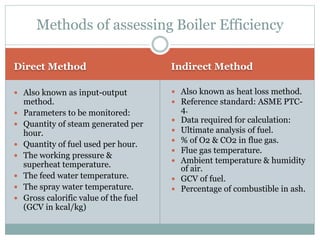
Direct Method Indirect Method
 Also known as input-output
method.
 Parameters to be monitored:
 Quantity of steam generated per
hour.
 Quantity of fuel used per hour.
 The working pressure &
superheat temperature.
 The feed water temperature.
 The spray water temperature.
 Gross calorific value of the fuel
(GCV in kcal/kg)
 Also known as heat loss method.
 Reference standard: ASME PTC-
4.
 Data required for calculation:
 Ultimate analysis of fuel.
 % of O2 & CO2 in flue gas.
 Flue gas temperature.
 Ambient temperature & humidity
of air.
 GCV of fuel.
 Percentage of combustible in ash.
Methods of assessing Boiler Efficiency
Direct Method
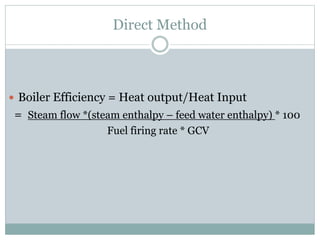
 Boiler Efficiency = Heat output/Heat Input
= Steam flow *(steam enthalpy – feed water enthalpy) * 100
Fuel firing rate * GCV
Advantages Disadvantages
 Plant people can
evaluate quickly the
efficiency of boiler.
 Requires few
parameters for
computation.
 New few instruments
for monitoring.
 Does not give clues to
operator the reason for
deviation w.r.t. design
efficiency, if any
 Does not calculate
various losses
accountable for various
efficiency levels.
Direct Method
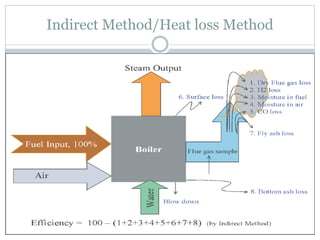
Indirect Method/Heat loss Method
Dry Gas Loss (Controllable)
 This is the heat carried away by flue gas at AH outlet.
 It’s a function of flue gas quantity and the temperature difference
between air heater exit flue gas temperature and FD fan inlet air
temperature
Sensible heat of flue gas (Sh)= Mass of dry flue gas* Sp. Heat*
(Tfg-Tair)
Mass of dry flue gas = ( C+S/2.67-U)/12 Co2
Dry flue gas loss % = (Sh /GCV of fuel) * 100
Reduction in Dry Gas Loss
 Factors affecting furnace Heat transfer include
 Furnace wall condition
 Combustion Heat release rate,
 Emissivity,
 Absorptivity and thermal conductivity of deposits
 ash dust loading,
 Pulverised fuel fineness
 Mill combination (Top, Middle, Bottom),
 Air regime for combustion etc.
Reduction in Dry Gas Loss
 Operation at optimum excess air – Hi O2 ~ Hi DFG
 Cleanliness of boiler surfaces – Dirty tubes ~ Hi EGT
 Cleaning of air heater surfaces and proper heating elements.
 Reduction of tempering air to mill.
 Reduction in air ingress.
 Representative measurements.
Typically 20~22°C increase in exit gas temperature ~ 1% reduction in
boiler efficiency.
Unburnt Carbon loss
 The amount of unburnt is a measure of combustion process in
general and mills/burners in particular.
 Loss due to Unburnt Carbon:
= U*Cvc*100/GCV of Coal
CVc – CV of carbon 8077.8 kcal/kg
U = Carbon in ash/kg of coal = Ash/100* (C/(100-C)
Influencing factors- Unburnt Carbon Loss
 Type of mills and firing system
 Furnace size
 Coal FC/VM ratio, coal reactivity
 Burners design/ condition
 PF fineness ( Pulverizer problems)
 Insufficient excess air in combustion zone
 Burner balance / worn orifices
 Primary air flow / pressures
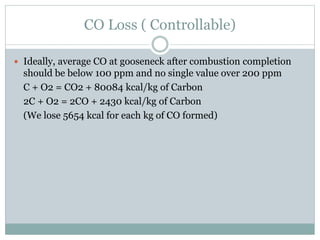
CO Loss ( Controllable)
 Ideally, average CO at gooseneck after combustion completion
should be below 100 ppm and no single value over 200 ppm
C + O2 = CO2 + 80084 kcal/kg of Carbon
2C + O2 = 2CO + 2430 kcal/kg of Carbon
(We lose 5654 kcal for each kg of CO formed)
Loss due to moisture
 Includes loss due to inherent & surface moisture in fuel,
moisture loss due to combustion of H2 in fuel & loss due
to moisture in combustion air.
 Fuel H2 loss: On combustion H2 in fuel reacts with O2 to
form water. This water evaporates & gets superheated
and is a loss.
 Fuel & air moisture loss: This loss is due to evaporation
and heating of inherent and surface moisture present in
fuel and air.
 Total moisture loss = (9H + M) * Sw / GCV
Sw – Sensible heat of water vapour
= 1.88*( Tgo- 25)+ 2442 + 4.2*( 25- Trai)
Other losses
 Sensible heat loss of ash
 Bottom ash hopper Eco hopper
 AH hopper ESP hopper
 Radiation loss through Bottom Ash Hopper
 Coal mill reject loss
 Radiation Loss
 Actual radiation and convection losses are difficult to assess
because of particular emissivity of various surfaces.
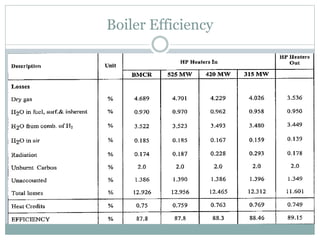
Boiler Efficiency
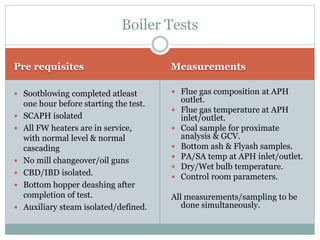
Pre requisites Measurements
 Sootblowing completed atleast
one hour before starting the test.
 SCAPH isolated
 All FW heaters are in service,
with normal level & normal
cascading
 No mill changeover/oil guns
 CBD/IBD isolated.
 Bottom hopper deashing after
completion of test.
 Auxiliary steam isolated/defined.
 Flue gas composition at APH
outlet.
 Flue gas temperature at APH
inlet/outlet.
 Coal sample for proximate
analysis & GCV.
 Bottom ash & Flyash samples.
 PA/SA temp at APH inlet/outlet.
 Dry/Wet bulb temperature.
 Control room parameters.
All measurements/sampling to be
done simultaneously.
Boiler Tests
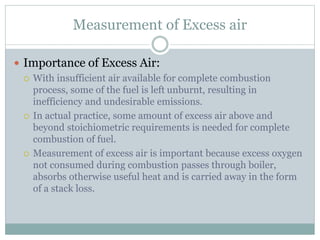
Measurement of Excess air
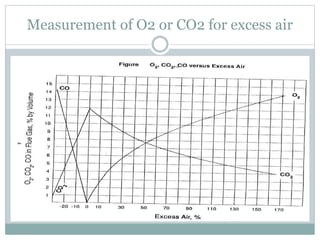
 Importance of Excess Air:
 With insufficient air available for complete combustion
process, some of the fuel is left unburnt, resulting in
inefficiency and undesirable emissions.
 In actual practice, some amount of excess air above and
beyond stoichiometric requirements is needed for complete
combustion of fuel.
 Measurement of excess air is important because excess oxygen
not consumed during combustion passes through boiler,
absorbs otherwise useful heat and is carried away in the form
of a stack loss.
Measurement of O2 or CO2 for excess air
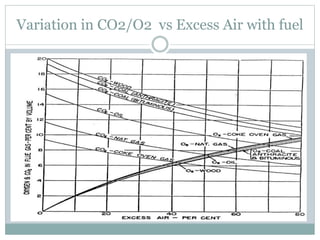
Variation in CO2/O2 vs Excess Air with fuel
Excess air recommendations
 Recommended excess air levels at full boiler load:
 For natural gas ……………….. 10-20%
 For fuel oil ……………….. 10-20%
 For pulverized coal ………….. 20-25%
 For stocker coal ……………….. 35-40%
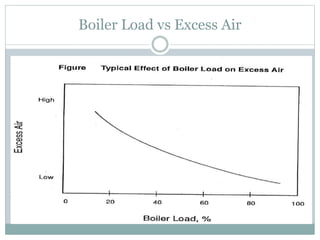
Boiler Load vs Excess Air
Constituent Measured Advantages Disadvantages
Carbon dioxide only One instrument Can not determine on
which side of
stoichiometric
combustion is occurring
Oxygen only One instrument If sub-stoichiometric,
extent of incomplete
combustion is measured.
Oxygen and Carbon
Dioxide
Defines entire
combustion range ( if O2
& CO2 measured
separately)
CO2 not usually used to
measure incomplete
combustion.
Oxygen and Carbon
monoxide
Defines entire
combustion
CO is preferred method
of sensing incomplete
combustion.
Factors affecting Boiler Performance
 Periodic cleaning of boiler
 Periodical sootblowing
 Proper water treatment program and blowdown control
 Draft control
 Excess air control
 Percentage loading of boiler
 Steam generation pressure and temperature
 Boiler insulation
 Quality of fuel
 Primary airflow
 Mill fineness
 Mill outlet temperature
 Air ingress

Boiler Efficiency.pptx

  • 1.
    B O IL E R E F F I C I E N C Y C A L C U L A T I O N M E A S U R E M E N T O F E X C E S S A I R B E S T P R A C T I S E S F O R B O I L E R O P E R A T I O N Boiler
  • 2.
    BOILER EFFICIENCY  Boilerefficiency is the percentage of heat input that is effectively utilized to generate steam.
  • 3.
    Why performance evaluationis important?  The performance parameter of boiler reduces with time due to poor combustion, heat transfer surface fouling and poor operation and maintenance. Even for new boilers, reasons such as fuel quality, water quality can result in poor boiler performance.  Boiler efficiency tests help us to find out the deviations from the best efficiency and target problem area for corrective actions.
  • 4.
    Direct Method IndirectMethod  Also known as input-output method.  Parameters to be monitored:  Quantity of steam generated per hour.  Quantity of fuel used per hour.  The working pressure & superheat temperature.  The feed water temperature.  The spray water temperature.  Gross calorific value of the fuel (GCV in kcal/kg)  Also known as heat loss method.  Reference standard: ASME PTC- 4.  Data required for calculation:  Ultimate analysis of fuel.  % of O2 & CO2 in flue gas.  Flue gas temperature.  Ambient temperature & humidity of air.  GCV of fuel.  Percentage of combustible in ash. Methods of assessing Boiler Efficiency
  • 5.
    Direct Method  BoilerEfficiency = Heat output/Heat Input = Steam flow *(steam enthalpy – feed water enthalpy) * 100 Fuel firing rate * GCV
  • 6.
    Advantages Disadvantages  Plantpeople can evaluate quickly the efficiency of boiler.  Requires few parameters for computation.  New few instruments for monitoring.  Does not give clues to operator the reason for deviation w.r.t. design efficiency, if any  Does not calculate various losses accountable for various efficiency levels. Direct Method
  • 7.
  • 8.
    Dry Gas Loss(Controllable)  This is the heat carried away by flue gas at AH outlet.  It’s a function of flue gas quantity and the temperature difference between air heater exit flue gas temperature and FD fan inlet air temperature Sensible heat of flue gas (Sh)= Mass of dry flue gas* Sp. Heat* (Tfg-Tair) Mass of dry flue gas = ( C+S/2.67-U)/12 Co2 Dry flue gas loss % = (Sh /GCV of fuel) * 100
  • 9.
    Reduction in DryGas Loss  Factors affecting furnace Heat transfer include  Furnace wall condition  Combustion Heat release rate,  Emissivity,  Absorptivity and thermal conductivity of deposits  ash dust loading,  Pulverised fuel fineness  Mill combination (Top, Middle, Bottom),  Air regime for combustion etc.
  • 10.
    Reduction in DryGas Loss  Operation at optimum excess air – Hi O2 ~ Hi DFG  Cleanliness of boiler surfaces – Dirty tubes ~ Hi EGT  Cleaning of air heater surfaces and proper heating elements.  Reduction of tempering air to mill.  Reduction in air ingress.  Representative measurements. Typically 20~22°C increase in exit gas temperature ~ 1% reduction in boiler efficiency.
  • 11.
    Unburnt Carbon loss The amount of unburnt is a measure of combustion process in general and mills/burners in particular.  Loss due to Unburnt Carbon: = U*Cvc*100/GCV of Coal CVc – CV of carbon 8077.8 kcal/kg U = Carbon in ash/kg of coal = Ash/100* (C/(100-C)
  • 12.
    Influencing factors- UnburntCarbon Loss  Type of mills and firing system  Furnace size  Coal FC/VM ratio, coal reactivity  Burners design/ condition  PF fineness ( Pulverizer problems)  Insufficient excess air in combustion zone  Burner balance / worn orifices  Primary air flow / pressures
  • 13.
    CO Loss (Controllable)  Ideally, average CO at gooseneck after combustion completion should be below 100 ppm and no single value over 200 ppm C + O2 = CO2 + 80084 kcal/kg of Carbon 2C + O2 = 2CO + 2430 kcal/kg of Carbon (We lose 5654 kcal for each kg of CO formed)
  • 14.
    Loss due tomoisture  Includes loss due to inherent & surface moisture in fuel, moisture loss due to combustion of H2 in fuel & loss due to moisture in combustion air.  Fuel H2 loss: On combustion H2 in fuel reacts with O2 to form water. This water evaporates & gets superheated and is a loss.  Fuel & air moisture loss: This loss is due to evaporation and heating of inherent and surface moisture present in fuel and air.  Total moisture loss = (9H + M) * Sw / GCV Sw – Sensible heat of water vapour = 1.88*( Tgo- 25)+ 2442 + 4.2*( 25- Trai)
  • 15.
    Other losses  Sensibleheat loss of ash  Bottom ash hopper Eco hopper  AH hopper ESP hopper  Radiation loss through Bottom Ash Hopper  Coal mill reject loss  Radiation Loss  Actual radiation and convection losses are difficult to assess because of particular emissivity of various surfaces.
  • 16.
  • 17.
    Pre requisites Measurements Sootblowing completed atleast one hour before starting the test.  SCAPH isolated  All FW heaters are in service, with normal level & normal cascading  No mill changeover/oil guns  CBD/IBD isolated.  Bottom hopper deashing after completion of test.  Auxiliary steam isolated/defined.  Flue gas composition at APH outlet.  Flue gas temperature at APH inlet/outlet.  Coal sample for proximate analysis & GCV.  Bottom ash & Flyash samples.  PA/SA temp at APH inlet/outlet.  Dry/Wet bulb temperature.  Control room parameters. All measurements/sampling to be done simultaneously. Boiler Tests
  • 18.
    Measurement of Excessair  Importance of Excess Air:  With insufficient air available for complete combustion process, some of the fuel is left unburnt, resulting in inefficiency and undesirable emissions.  In actual practice, some amount of excess air above and beyond stoichiometric requirements is needed for complete combustion of fuel.  Measurement of excess air is important because excess oxygen not consumed during combustion passes through boiler, absorbs otherwise useful heat and is carried away in the form of a stack loss.
  • 19.
    Measurement of O2or CO2 for excess air
  • 20.
    Variation in CO2/O2vs Excess Air with fuel
  • 21.
    Excess air recommendations Recommended excess air levels at full boiler load:  For natural gas ……………….. 10-20%  For fuel oil ……………….. 10-20%  For pulverized coal ………….. 20-25%  For stocker coal ……………….. 35-40%
  • 22.
    Boiler Load vsExcess Air
  • 23.
    Constituent Measured AdvantagesDisadvantages Carbon dioxide only One instrument Can not determine on which side of stoichiometric combustion is occurring Oxygen only One instrument If sub-stoichiometric, extent of incomplete combustion is measured. Oxygen and Carbon Dioxide Defines entire combustion range ( if O2 & CO2 measured separately) CO2 not usually used to measure incomplete combustion. Oxygen and Carbon monoxide Defines entire combustion CO is preferred method of sensing incomplete combustion.
  • 24.
    Factors affecting BoilerPerformance  Periodic cleaning of boiler  Periodical sootblowing  Proper water treatment program and blowdown control  Draft control  Excess air control  Percentage loading of boiler  Steam generation pressure and temperature  Boiler insulation  Quality of fuel  Primary airflow  Mill fineness  Mill outlet temperature  Air ingress