Combining Sentences
Sentence Combining
•Sentence combining is the process of joining two or more
short sentences to make one longer sentence. A theory-based
approach to sentence combining, influenced by Noam
Chomsky's transformational grammar, emerged in the U.S. in
the 1970s.
bsf1704470@ue.edu.pk 2
When Would Someone Combine Sentences?
• To connect ideas/thoughts
• To expand upon idea/thought
• To eliminate repetition
• To create sentence variety
• To write more academically
• Remember: The key here is to connect ideas. If two sentences do not make
sense or do not go together, than do not combine them. It is more important to
have ideas that match then to have a specific sentence count.
bsf1704470@ue.edu.pk 3
Terms to know
• Clause: It as a group of words which containing a subject and a verb. For
Example Sentence “I know you and you know me” contains two clauses rather
than saying it contains two sentences.
• Independent Clause: Is an idea/thought/concept that can be understood by
itself. The clause is independent from the other sentences.
• Dependent Clause: It cannot be understood by itself. Dependent clauses are
missing a main idea/thought/concept. Dependent clauses depend on the rest of
the sentence to make sense.
• Sentence: A sentence is the combination of an independent and dependent
clauses used in a variety of ways to create four basic sentences: simple,
compound, complex, and compound-complex.
bsf1704470@ue.edu.pk 4
Types of Sentences
• Simple Sentence: A simple sentence has one independent clause. One main
thought, idea, or concept. Example: Either my mother or my sister bought this
DVD player.
• Compound Sentence: A compound sentence has two or more independent
clauses. Example: Saleem went to the movies, but Usman stayed home with
the children.
bsf1704470@ue.edu.pk 5
Types of Sentences
• Complex Sentence: A complex sentence has one independent clause and one or
more subordinate clauses. The independent clause contains the main
idea/concept of the sentence while the subordinate clause is not considered
vital information. Example: Before Zikria drove home from work, he realized
that his car was out of gas.
• Compound-Complex Sentence: Compound-Complex- A compound-complex
sentence has at least two independent clauses and at least one dependent
clause.
• Example: Since Usman stayed home with the kids; Saleem was able to go to the
movies; he was very pleased with the film.
bsf1704470@ue.edu.pk 6
Ways of Combining Sentences
•Punctuation
•Coordination
•Subordination
•Reduction
•Apposition
bsf1704470@ue.edu.pk 7
Punctuation
• Sentences can be combined by using special punctuation marks. We know that
a period [ . ] question mark [ ? ] and exclamation point [ ! ] are used at the end
of a sentence, so they cannot be used for combining sentences. We also know
that a comma [ , ] is not strong enough to connect 2 sentences. (If you use a
comma to try to connect 2 sentences you will have a type of run-on sentence
called a comma splice, which is not acceptable.)
• There are 3 punctuation marks that are stronger than a comma but weaker than
a period, question mark, or exclamation point. These are the dash [ -- ] colon [ :
] and semi-colon [ ; ].
bsf1704470@ue.edu.pk 8
Punctuation
• A dash is used to add more information about some part of your sentence. It is
rather informal and although you may see it when you read, it is better to avoid
this punctuation in your writing.
• For Example
• My mother went to Aunt Nasreen's house – the bright blue house on the
corner – to prepare for the birthday party.
• Explanation
• If you removed the words between the dashes (the bright blue house on the
corner), you would still understand all of the important components of the
sentence. You know the noun, “my mother”, and you also know what the noun
has done, “went to Aunt Nasreen's house”, and, you even know what the noun
did, “prepared for the birthday party”. You still understand exactly what
happened. bsf1704470@ue.edu.pk 9
Punctuation
• A colon is also used to add more information and especially to give examples of
something in the sentence. What follows a colon may be a clause or a group of
words that cannot stand by themselves.
• For Example
• Fraz is a great athlete: he plays soccer, baseball and basketball.
• Mohsin plays many sports: soccer, baseball and basketball.
• A semi-colon is used to connect clauses and is the most important punctuation
mark for combining sentences. It can be used alone to connect clauses.
• For Example
• Awais is my brother. He is not heavy
• “Awais is my brother; he is not Heavy”
• Sleem went to the movies. Usman stayed home with the children
• “Saleem went to the movies; Usman stayed home with the children.”
bsf1704470@ue.edu.pk 10
Coordination
• Coordination is a way of adding sentences together. In this type of sentence
(compound sentence) the 2 or more sentences (clauses) which are combined
are equal partners. One clause is not more important than the other
grammatically. Words that connect clauses in this way are called coordinating
conjunctions.
• Conjunctions are “FANBOYS” (For, And, Nor, But, Or, Yet, So) and the most
important conjunctions are “And, But, Or, So”
• And is used to join clauses that contain additional information.
• Example
• “Muneeb bought a ticket and got on the bus.”
• Or is used to join clauses that contain choices or alternatives.
• Example
• “Write me a letter or send an e-mail message.”
bsf1704470@ue.edu.pk 11
Coordination
• But is used to join clauses that contain opposing ideas.
• Example
• “Haseeb arrived early but no one was there.”
• So is used to join clauses that contain ideas of cause and effect.
• Example
• “The jacket didn't fit so Shahzaib took it back to the store.”
bsf1704470@ue.edu.pk 12
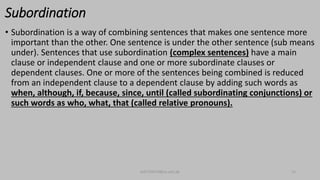
Subordination
• Subordination is a way of combining sentences that makes one sentence more
important than the other. One sentence is under the other sentence (sub means
under). Sentences that use subordination (complex sentences) have a main
clause or independent clause and one or more subordinate clauses or
dependent clauses. One or more of the sentences being combined is reduced
from an independent clause to a dependent clause by adding such words as
when, although, if, because, since, until (called subordinating conjunctions) or
such words as who, what, that (called relative pronouns).
bsf1704470@ue.edu.pk 13
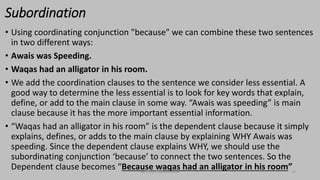
Subordination
• Using coordinating conjunction "because" we can combine these two sentences
in two different ways:
• Awais was Speeding.
• Waqas had an alligator in his room.
• We add the coordination clauses to the sentence we consider less essential. A
good way to determine the less essential is to look for key words that explain,
define, or add to the main clause in some way. “Awais was speeding” is main
clause because it has the more important essential information.
• “Waqas had an alligator in his room” is the dependent clause because it simply
explains, defines, or adds to the main clause by explaining WHY Awais was
speeding. Since the dependent clause explains WHY, we should use the
subordinating conjunction ‘because’ to connect the two sentences. So the
Dependent clause becomes “Because waqas had an alligator in his room”
bsf1704470@ue.edu.pk 14
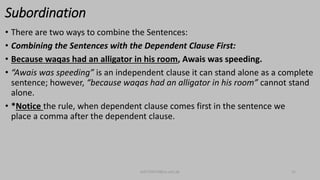
Subordination
• There are two ways to combine the Sentences:
• Combining the Sentences with the Dependent Clause First:
• Because waqas had an alligator in his room, Awais was speeding.
• “Awais was speeding” is an independent clause it can stand alone as a complete
sentence; however, “because waqas had an alligator in his room” cannot stand
alone.
• *Notice the rule, when dependent clause comes first in the sentence we
place a comma after the dependent clause.
bsf1704470@ue.edu.pk 15
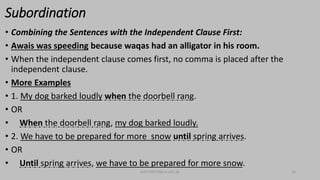
Subordination
• Combining the Sentences with the Independent Clause First:
• Awais was speeding because waqas had an alligator in his room.
• When the independent clause comes first, no comma is placed after the
independent clause.
• More Examples
• 1. My dog barked loudly when the doorbell rang.
• OR
• When the doorbell rang, my dog barked loudly.
• 2. We have to be prepared for more snow until spring arrives.
• OR
• Until spring arrives, we have to be prepared for more snow.
bsf1704470@ue.edu.pk 16
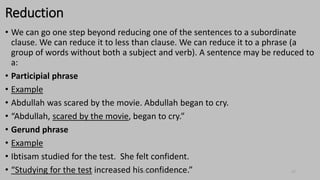
Reduction
• We can go one step beyond reducing one of the sentences to a subordinate
clause. We can reduce it to less than clause. We can reduce it to a phrase (a
group of words without both a subject and verb). A sentence may be reduced to
a:
• Participial phrase
• Example
• Abdullah was scared by the movie. Abdullah began to cry.
• “Abdullah, scared by the movie, began to cry.”
• Gerund phrase
• Example
• Ibtisam studied for the test. She felt confident.
• “Studying for the test increased his confidence.”
bsf1704470@ue.edu.pk 17
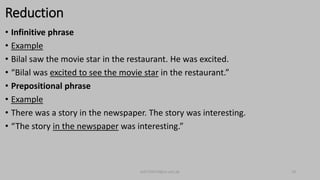
Reduction
• Infinitive phrase
• Example
• Bilal saw the movie star in the restaurant. He was excited.
• “Bilal was excited to see the movie star in the restaurant.”
• Prepositional phrase
• Example
• There was a story in the newspaper. The story was interesting.
• “The story in the newspaper was interesting.”
bsf1704470@ue.edu.pk 18
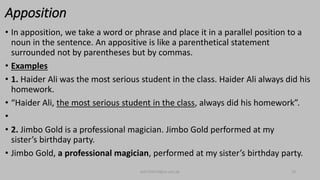
Apposition
• In apposition, we take a word or phrase and place it in a parallel position to a
noun in the sentence. An appositive is like a parenthetical statement
surrounded not by parentheses but by commas.
• Examples
• 1. Haider Ali was the most serious student in the class. Haider Ali always did his
homework.
• “Haider Ali, the most serious student in the class, always did his homework”.
•
• 2. Jimbo Gold is a professional magician. Jimbo Gold performed at my
sister’s birthday party.
• Jimbo Gold, a professional magician, performed at my sister’s birthday party.
bsf1704470@ue.edu.pk 19

Combining sentences

  • 1.
  • 2.
    Sentence Combining •Sentence combiningis the process of joining two or more short sentences to make one longer sentence. A theory-based approach to sentence combining, influenced by Noam Chomsky's transformational grammar, emerged in the U.S. in the 1970s. bsf1704470@ue.edu.pk 2
  • 3.
    When Would SomeoneCombine Sentences? • To connect ideas/thoughts • To expand upon idea/thought • To eliminate repetition • To create sentence variety • To write more academically • Remember: The key here is to connect ideas. If two sentences do not make sense or do not go together, than do not combine them. It is more important to have ideas that match then to have a specific sentence count. bsf1704470@ue.edu.pk 3
  • 4.
    Terms to know •Clause: It as a group of words which containing a subject and a verb. For Example Sentence “I know you and you know me” contains two clauses rather than saying it contains two sentences. • Independent Clause: Is an idea/thought/concept that can be understood by itself. The clause is independent from the other sentences. • Dependent Clause: It cannot be understood by itself. Dependent clauses are missing a main idea/thought/concept. Dependent clauses depend on the rest of the sentence to make sense. • Sentence: A sentence is the combination of an independent and dependent clauses used in a variety of ways to create four basic sentences: simple, compound, complex, and compound-complex. bsf1704470@ue.edu.pk 4
  • 5.
    Types of Sentences •Simple Sentence: A simple sentence has one independent clause. One main thought, idea, or concept. Example: Either my mother or my sister bought this DVD player. • Compound Sentence: A compound sentence has two or more independent clauses. Example: Saleem went to the movies, but Usman stayed home with the children. bsf1704470@ue.edu.pk 5
  • 6.
    Types of Sentences •Complex Sentence: A complex sentence has one independent clause and one or more subordinate clauses. The independent clause contains the main idea/concept of the sentence while the subordinate clause is not considered vital information. Example: Before Zikria drove home from work, he realized that his car was out of gas. • Compound-Complex Sentence: Compound-Complex- A compound-complex sentence has at least two independent clauses and at least one dependent clause. • Example: Since Usman stayed home with the kids; Saleem was able to go to the movies; he was very pleased with the film. bsf1704470@ue.edu.pk 6
  • 7.
    Ways of CombiningSentences •Punctuation •Coordination •Subordination •Reduction •Apposition bsf1704470@ue.edu.pk 7
  • 8.
    Punctuation • Sentences canbe combined by using special punctuation marks. We know that a period [ . ] question mark [ ? ] and exclamation point [ ! ] are used at the end of a sentence, so they cannot be used for combining sentences. We also know that a comma [ , ] is not strong enough to connect 2 sentences. (If you use a comma to try to connect 2 sentences you will have a type of run-on sentence called a comma splice, which is not acceptable.) • There are 3 punctuation marks that are stronger than a comma but weaker than a period, question mark, or exclamation point. These are the dash [ -- ] colon [ : ] and semi-colon [ ; ]. bsf1704470@ue.edu.pk 8
  • 9.
    Punctuation • A dashis used to add more information about some part of your sentence. It is rather informal and although you may see it when you read, it is better to avoid this punctuation in your writing. • For Example • My mother went to Aunt Nasreen's house – the bright blue house on the corner – to prepare for the birthday party. • Explanation • If you removed the words between the dashes (the bright blue house on the corner), you would still understand all of the important components of the sentence. You know the noun, “my mother”, and you also know what the noun has done, “went to Aunt Nasreen's house”, and, you even know what the noun did, “prepared for the birthday party”. You still understand exactly what happened. bsf1704470@ue.edu.pk 9
  • 10.
    Punctuation • A colonis also used to add more information and especially to give examples of something in the sentence. What follows a colon may be a clause or a group of words that cannot stand by themselves. • For Example • Fraz is a great athlete: he plays soccer, baseball and basketball. • Mohsin plays many sports: soccer, baseball and basketball. • A semi-colon is used to connect clauses and is the most important punctuation mark for combining sentences. It can be used alone to connect clauses. • For Example • Awais is my brother. He is not heavy • “Awais is my brother; he is not Heavy” • Sleem went to the movies. Usman stayed home with the children • “Saleem went to the movies; Usman stayed home with the children.” bsf1704470@ue.edu.pk 10
  • 11.
    Coordination • Coordination isa way of adding sentences together. In this type of sentence (compound sentence) the 2 or more sentences (clauses) which are combined are equal partners. One clause is not more important than the other grammatically. Words that connect clauses in this way are called coordinating conjunctions. • Conjunctions are “FANBOYS” (For, And, Nor, But, Or, Yet, So) and the most important conjunctions are “And, But, Or, So” • And is used to join clauses that contain additional information. • Example • “Muneeb bought a ticket and got on the bus.” • Or is used to join clauses that contain choices or alternatives. • Example • “Write me a letter or send an e-mail message.” bsf1704470@ue.edu.pk 11
  • 12.
    Coordination • But isused to join clauses that contain opposing ideas. • Example • “Haseeb arrived early but no one was there.” • So is used to join clauses that contain ideas of cause and effect. • Example • “The jacket didn't fit so Shahzaib took it back to the store.” bsf1704470@ue.edu.pk 12
  • 13.
    Subordination • Subordination isa way of combining sentences that makes one sentence more important than the other. One sentence is under the other sentence (sub means under). Sentences that use subordination (complex sentences) have a main clause or independent clause and one or more subordinate clauses or dependent clauses. One or more of the sentences being combined is reduced from an independent clause to a dependent clause by adding such words as when, although, if, because, since, until (called subordinating conjunctions) or such words as who, what, that (called relative pronouns). bsf1704470@ue.edu.pk 13
  • 14.
    Subordination • Using coordinatingconjunction "because" we can combine these two sentences in two different ways: • Awais was Speeding. • Waqas had an alligator in his room. • We add the coordination clauses to the sentence we consider less essential. A good way to determine the less essential is to look for key words that explain, define, or add to the main clause in some way. “Awais was speeding” is main clause because it has the more important essential information. • “Waqas had an alligator in his room” is the dependent clause because it simply explains, defines, or adds to the main clause by explaining WHY Awais was speeding. Since the dependent clause explains WHY, we should use the subordinating conjunction ‘because’ to connect the two sentences. So the Dependent clause becomes “Because waqas had an alligator in his room” bsf1704470@ue.edu.pk 14
  • 15.
    Subordination • There aretwo ways to combine the Sentences: • Combining the Sentences with the Dependent Clause First: • Because waqas had an alligator in his room, Awais was speeding. • “Awais was speeding” is an independent clause it can stand alone as a complete sentence; however, “because waqas had an alligator in his room” cannot stand alone. • *Notice the rule, when dependent clause comes first in the sentence we place a comma after the dependent clause. bsf1704470@ue.edu.pk 15
  • 16.
    Subordination • Combining theSentences with the Independent Clause First: • Awais was speeding because waqas had an alligator in his room. • When the independent clause comes first, no comma is placed after the independent clause. • More Examples • 1. My dog barked loudly when the doorbell rang. • OR • When the doorbell rang, my dog barked loudly. • 2. We have to be prepared for more snow until spring arrives. • OR • Until spring arrives, we have to be prepared for more snow. bsf1704470@ue.edu.pk 16
  • 17.
    Reduction • We cango one step beyond reducing one of the sentences to a subordinate clause. We can reduce it to less than clause. We can reduce it to a phrase (a group of words without both a subject and verb). A sentence may be reduced to a: • Participial phrase • Example • Abdullah was scared by the movie. Abdullah began to cry. • “Abdullah, scared by the movie, began to cry.” • Gerund phrase • Example • Ibtisam studied for the test. She felt confident. • “Studying for the test increased his confidence.” bsf1704470@ue.edu.pk 17
  • 18.
    Reduction • Infinitive phrase •Example • Bilal saw the movie star in the restaurant. He was excited. • “Bilal was excited to see the movie star in the restaurant.” • Prepositional phrase • Example • There was a story in the newspaper. The story was interesting. • “The story in the newspaper was interesting.” bsf1704470@ue.edu.pk 18
  • 19.
    Apposition • In apposition,we take a word or phrase and place it in a parallel position to a noun in the sentence. An appositive is like a parenthetical statement surrounded not by parentheses but by commas. • Examples • 1. Haider Ali was the most serious student in the class. Haider Ali always did his homework. • “Haider Ali, the most serious student in the class, always did his homework”. • • 2. Jimbo Gold is a professional magician. Jimbo Gold performed at my sister’s birthday party. • Jimbo Gold, a professional magician, performed at my sister’s birthday party. bsf1704470@ue.edu.pk 19