Independent and Dependent
Clauses
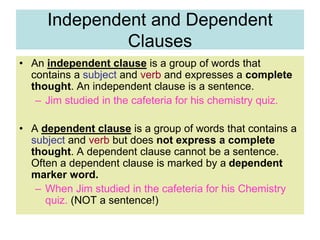
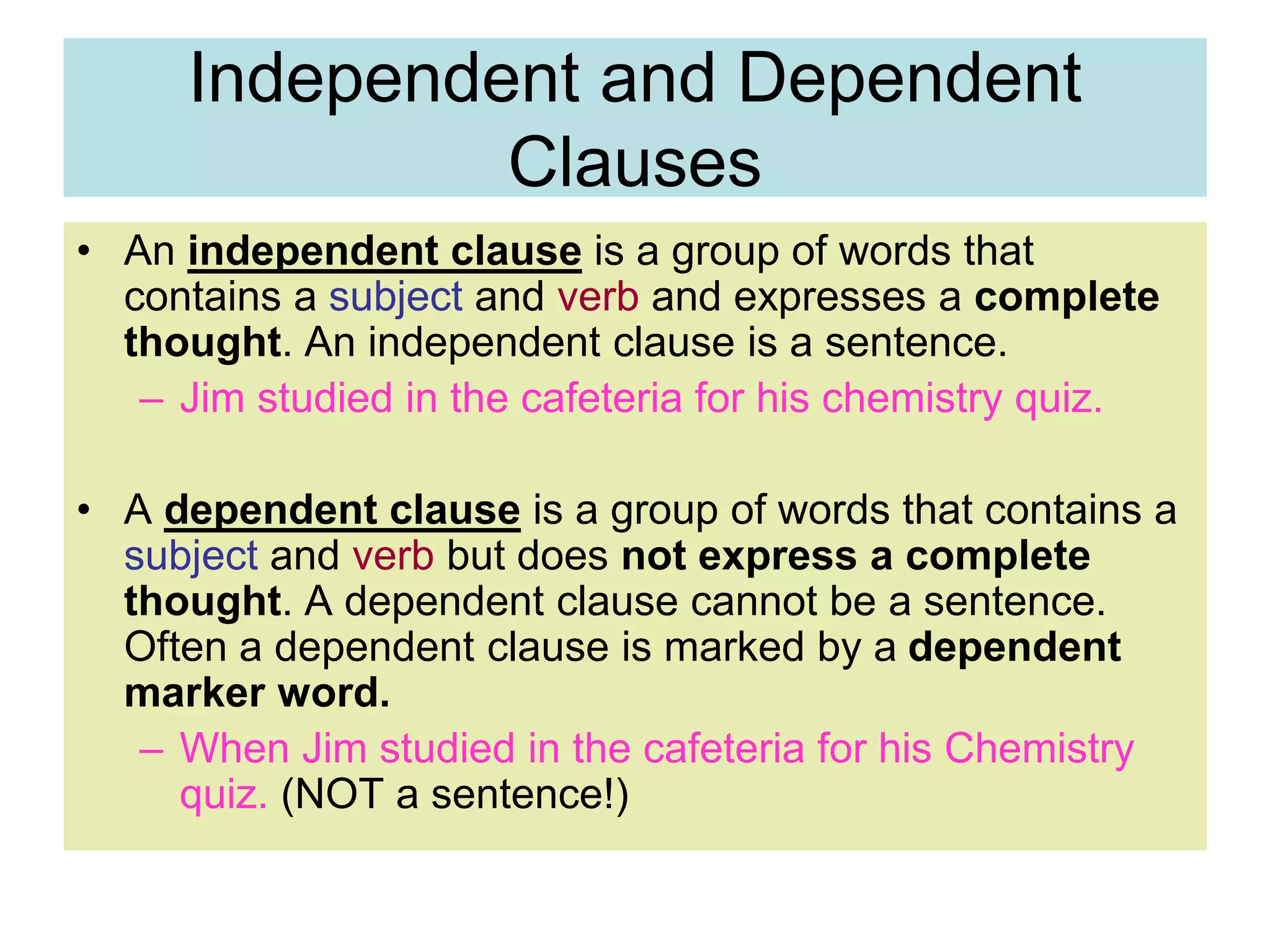
• An independent clause is a group of words that
contains a subject and verb and expresses a complete
thought. An independent clause is a sentence.
– Jim studied in the cafeteria for his chemistry quiz.
• A dependent clause is a group of words that contains a
subject and verb but does not express a complete
thought. A dependent clause cannot be a sentence.
Often a dependent clause is marked by a dependent
marker word.
– When Jim studied in the cafeteria for his Chemistry
quiz. (NOT a sentence!)
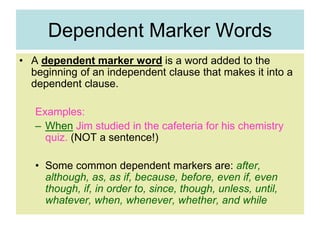
Dependent Marker Words
• A dependent marker word is a word added to the
beginning of an independent clause that makes it into a
dependent clause.
Examples:
– When Jim studied in the cafeteria for his chemistry
quiz. (NOT a sentence!)
• Some common dependent markers are: after,
although, as, as if, because, before, even if, even
though, if, in order to, since, though, unless, until,
whatever, when, whenever, whether, and while
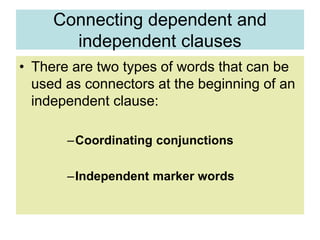
Connecting dependent and
independent clauses
• There are two types of words that can be
used as connectors at the beginning of an
independent clause:
–Coordinating conjunctions
–Independent marker words
Coordinating Conjunctions
• Coordinating conjunctions are used as connecting words
at the beginning of an independent clause.
• They are: for, and, nor, but, or, yet, & so. (FANBOYS)
• When the second independent clause in a sentence
begins with a coordinating conjunction, a comma is
needed before the coordinating conjunction:
– Example:
Jim studied in the cafeteria for his chemistry quiz, but it was hard
to concentrate because of the noise.
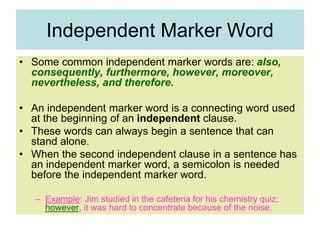
Independent Marker Word
• Some common independent marker words are: also,
consequently, furthermore, however, moreover,
nevertheless, and therefore.
• An independent marker word is a connecting word used
at the beginning of an independent clause.
• These words can always begin a sentence that can
stand alone.
• When the second independent clause in a sentence has
an independent marker word, a semicolon is needed
before the independent marker word.
– Example: Jim studied in the cafeteria for his chemistry quiz;
however, it was hard to concentrate because of the noise.
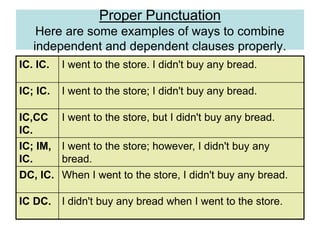
Proper Punctuation
Here are some examples of ways to combine
independent and dependent clauses properly.
IC. IC. I went to the store. I didn't buy any bread.
IC; IC. I went to the store; I didn't buy any bread.
IC,CC
IC.
I went to the store, but I didn't buy any bread.
IC; IM,
IC.
I went to the store; however, I didn't buy any
bread.
DC, IC. When I went to the store, I didn't buy any bread.
IC DC. I didn't buy any bread when I went to the store.

Independent-and-Dependent-Clauses (1).ppt

  • 1.
    Independent and Dependent Clauses •An independent clause is a group of words that contains a subject and verb and expresses a complete thought. An independent clause is a sentence. – Jim studied in the cafeteria for his chemistry quiz. • A dependent clause is a group of words that contains a subject and verb but does not express a complete thought. A dependent clause cannot be a sentence. Often a dependent clause is marked by a dependent marker word. – When Jim studied in the cafeteria for his Chemistry quiz. (NOT a sentence!)
  • 2.
    Dependent Marker Words •A dependent marker word is a word added to the beginning of an independent clause that makes it into a dependent clause. Examples: – When Jim studied in the cafeteria for his chemistry quiz. (NOT a sentence!) • Some common dependent markers are: after, although, as, as if, because, before, even if, even though, if, in order to, since, though, unless, until, whatever, when, whenever, whether, and while
  • 3.
    Connecting dependent and independentclauses • There are two types of words that can be used as connectors at the beginning of an independent clause: –Coordinating conjunctions –Independent marker words
  • 4.
    Coordinating Conjunctions • Coordinatingconjunctions are used as connecting words at the beginning of an independent clause. • They are: for, and, nor, but, or, yet, & so. (FANBOYS) • When the second independent clause in a sentence begins with a coordinating conjunction, a comma is needed before the coordinating conjunction: – Example: Jim studied in the cafeteria for his chemistry quiz, but it was hard to concentrate because of the noise.
  • 5.
    Independent Marker Word •Some common independent marker words are: also, consequently, furthermore, however, moreover, nevertheless, and therefore. • An independent marker word is a connecting word used at the beginning of an independent clause. • These words can always begin a sentence that can stand alone. • When the second independent clause in a sentence has an independent marker word, a semicolon is needed before the independent marker word. – Example: Jim studied in the cafeteria for his chemistry quiz; however, it was hard to concentrate because of the noise.
  • 6.
    Proper Punctuation Here aresome examples of ways to combine independent and dependent clauses properly. IC. IC. I went to the store. I didn't buy any bread. IC; IC. I went to the store; I didn't buy any bread. IC,CC IC. I went to the store, but I didn't buy any bread. IC; IM, IC. I went to the store; however, I didn't buy any bread. DC, IC. When I went to the store, I didn't buy any bread. IC DC. I didn't buy any bread when I went to the store.