SUBORDINATING
CONJUNCTIONS
Angel Laudenorio
Discussant
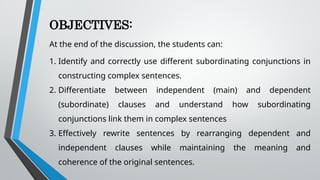
OBJECTIVES:
At the end of the discussion, the students can:
1. Identify and correctly use different subordinating conjunctions in
constructing complex sentences.
2. Differentiate between independent (main) and dependent
(subordinate) clauses and understand how subordinating
conjunctions link them in complex sentences
3. Effectively rewrite sentences by rearranging dependent and
independent clauses while maintaining the meaning and
coherence of the original sentences.
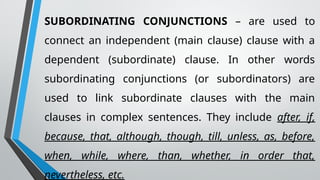
SUBORDINATING CONJUNCTIONS – are used to
connect an independent (main clause) clause with a
dependent (subordinate) clause. In other words
subordinating conjunctions (or subordinators) are
used to link subordinate clauses with the main
clauses in complex sentences. They include after, if,
because, that, although, though, till, unless, as, before,
when, while, where, than, whether, in order that,
nevertheless, etc.
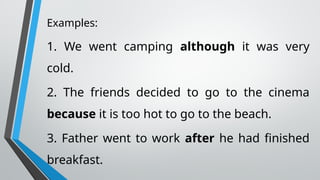
Examples:
1. We went camping although it was very
cold.
2. The friends decided to go to the cinema
because it is too hot to go to the beach.
3. Father went to work after he had finished
breakfast.
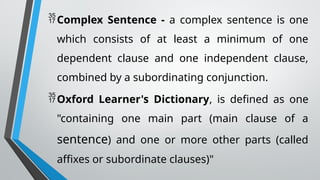
Complex Sentence - a complex sentence is one
which consists of at least a minimum of one
dependent clause and one independent clause,
combined by a subordinating conjunction.
Oxford Learner's Dictionary, is defined as one
"containing one main part (main clause of a
sentence) and one or more other parts (called
affixes or subordinate clauses)"
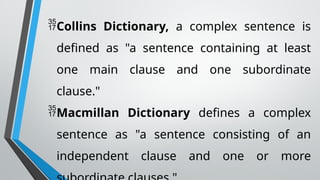
Collins Dictionary, a complex sentence is
defined as "a sentence containing at least
one main clause and one subordinate
clause."
Macmillan Dictionary defines a complex
sentence as "a sentence consisting of an
independent clause and one or more
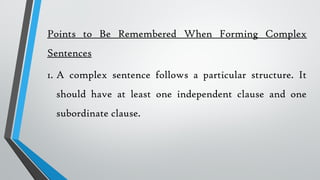
Points to Be Remembered When Forming Complex
Sentences
1. A complex sentence follows a particular structure. It
should have at least one independent clause and one
subordinate clause.
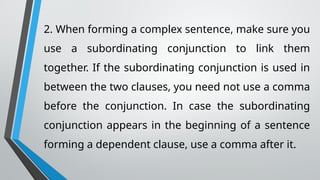
2. When forming a complex sentence, make sure you
use a subordinating conjunction to link them
together. If the subordinating conjunction is used in
between the two clauses, you need not use a comma
before the conjunction. In case the subordinating
conjunction appears in the beginning of a sentence
forming a dependent clause, use a comma after it.
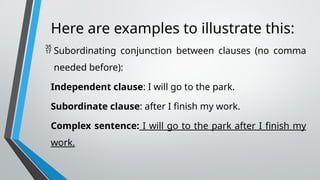
Here are examples to illustrate this:
 Subordinating conjunction between clauses (no comma
needed before):
Independent clause: I will go to the park.
Subordinate clause: after I finish my work.
Complex sentence: I will go to the park after I finish my
work.
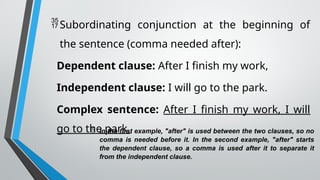
Subordinating conjunction at the beginning of
the sentence (comma needed after):
Dependent clause: After I finish my work,
Independent clause: I will go to the park.
Complex sentence: After I finish my work, I will
go to the park.
 In the first example, "after" is used between the two clauses, so no
comma is needed before it. In the second example, "after" starts
the dependent clause, so a comma is used after it to separate it
from the independent clause.
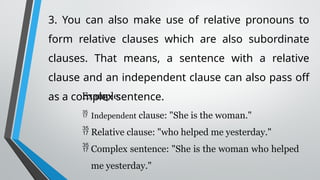
3. You can also make use of relative pronouns to
form relative clauses which are also subordinate
clauses. That means, a sentence with a relative
clause and an independent clause can also pass off
as a complex sentence.
Example:
 Independent clause: "She is the woman."
 Relative clause: "who helped me yesterday."
 Complex sentence: "She is the woman who helped
me yesterday."
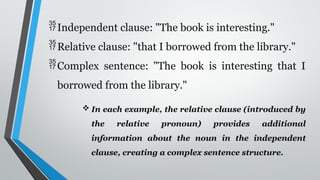
Independent clause: "The book is interesting."
Relative clause: "that I borrowed from the library."
Complex sentence: "The book is interesting that I
borrowed from the library."
 In each example, the relative clause (introduced by
the relative pronoun) provides additional
information about the noun in the independent
clause, creating a complex sentence structure.
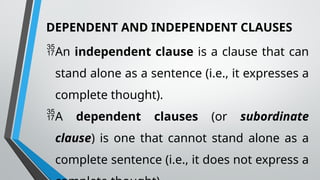
DEPENDENT AND INDEPENDENT CLAUSES
An independent clause is a clause that can
stand alone as a sentence (i.e., it expresses a
complete thought).
A dependent clauses (or subordinate
clause) is one that cannot stand alone as a
complete sentence (i.e., it does not express a
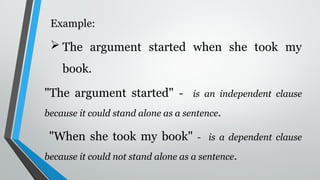
Example:
 The argument started when she took my
book.
"The argument started" - is an independent clause
because it could stand alone as a sentence.
"When she took my book" - is a dependent clause
because it could not stand alone as a sentence.
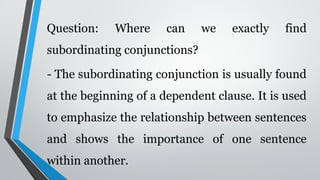
Question: Where can we exactly find
subordinating conjunctions?
- The subordinating conjunction is usually found
at the beginning of a dependent clause. It is used
to emphasize the relationship between sentences
and shows the importance of one sentence
within another.
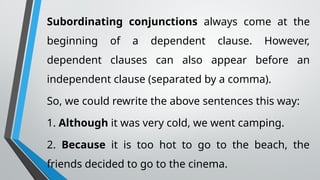
Subordinating conjunctions always come at the
beginning of a dependent clause. However,
dependent clauses can also appear before an
independent clause (separated by a comma).
So, we could rewrite the above sentences this way:
1. Although it was very cold, we went camping.
2. Because it is too hot to go to the beach, the
friends decided to go to the cinema.
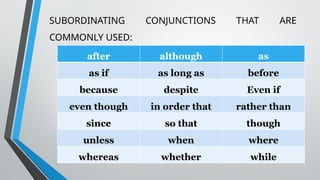
SUBORDINATING CONJUNCTIONS THAT ARE
COMMONLY USED:
after although as
as if as long as before
because despite Even if
even though in order that rather than
since so that though
unless when where
whereas whether while
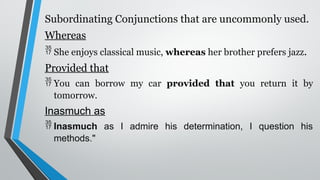
Subordinating Conjunctions that are uncommonly used.
Whereas
 She enjoys classical music, whereas her brother prefers jazz.
Provided that
 You can borrow my car provided that you return it by
tomorrow.
Inasmuch as
 Inasmuch as I admire his determination, I question his
methods."
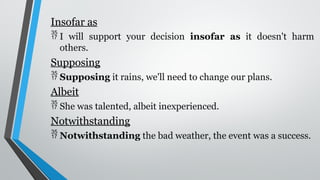
Insofar as
 I will support your decision insofar as it doesn't harm
others.
Supposing
 Supposing it rains, we'll need to change our plans.
Albeit
 She was talented, albeit inexperienced.
Notwithstanding
 Notwithstanding the bad weather, the event was a success.
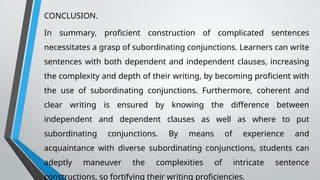
CONCLUSION.
In summary, proficient construction of complicated sentences
necessitates a grasp of subordinating conjunctions. Learners can write
sentences with both dependent and independent clauses, increasing
the complexity and depth of their writing, by becoming proficient with
the use of subordinating conjunctions. Furthermore, coherent and
clear writing is ensured by knowing the difference between
independent and dependent clauses as well as where to put
subordinating conjunctions. By means of experience and
acquaintance with diverse subordinating conjunctions, students can
adeptly maneuver the complexities of intricate sentence
constructions, so fortifying their writing proficiencies.
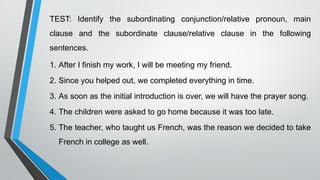
TEST: Identify the subordinating conjunction/relative pronoun, main
clause and the subordinate clause/relative clause in the following
sentences.
1. After I finish my work, I will be meeting my friend.
2. Since you helped out, we completed everything in time.
3. As soon as the initial introduction is over, we will have the prayer song.
4. The children were asked to go home because it was too late.
5. The teacher, who taught us French, was the reason we decided to take
French in college as well.
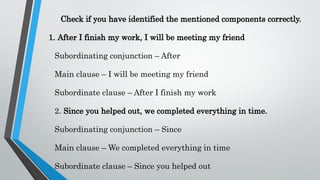
Check if you have identified the mentioned components correctly.
1. After I finish my work, I will be meeting my friend
Subordinating conjunction – After
Main clause – I will be meeting my friend
Subordinate clause – After I finish my work
2. Since you helped out, we completed everything in time.
Subordinating conjunction – Since
Main clause – We completed everything in time
Subordinate clause – Since you helped out
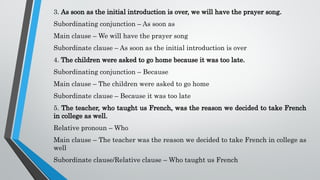
3. As soon as the initial introduction is over, we will have the prayer song.
Subordinating conjunction – As soon as
Main clause – We will have the prayer song
Subordinate clause – As soon as the initial introduction is over
4. The children were asked to go home because it was too late.
Subordinating conjunction – Because
Main clause – The children were asked to go home
Subordinate clause – Because it was too late
5. The teacher, who taught us French, was the reason we decided to take French
in college as well.
Relative pronoun – Who
Main clause – The teacher was the reason we decided to take French in college as
well
Subordinate clause/Relative clause – Who taught us French
REFERENCES:
Independent clause : explanation and examples. Retrieved from https://www.grammar-
monster.com/glossary/independent_clause.htm
Complex oxford dictionary, Retrieved from
https://www.oxfordlearnersdictionaries.com/us/definition/american_english/
complex_1#:~:text=(grammar)%20(of%20a%20word,and%20%E2%80%9Cif%20it's
%20warm%20enough%E2%80%9D
Byju's. (n.d.). Complex Sentences. Byju's. Retrieved from
https://byjus.com/english/complex-sentences/#:~:text=A%20complex%20sentence%20is
%20one,combined%20by%20a%20subordinating%20conjunction.

SUBORDINATING CONJUNCTIONS laudenorio.pptx

  • 1.
  • 2.
    OBJECTIVES: At the endof the discussion, the students can: 1. Identify and correctly use different subordinating conjunctions in constructing complex sentences. 2. Differentiate between independent (main) and dependent (subordinate) clauses and understand how subordinating conjunctions link them in complex sentences 3. Effectively rewrite sentences by rearranging dependent and independent clauses while maintaining the meaning and coherence of the original sentences.
  • 3.
    SUBORDINATING CONJUNCTIONS –are used to connect an independent (main clause) clause with a dependent (subordinate) clause. In other words subordinating conjunctions (or subordinators) are used to link subordinate clauses with the main clauses in complex sentences. They include after, if, because, that, although, though, till, unless, as, before, when, while, where, than, whether, in order that, nevertheless, etc.
  • 4.
    Examples: 1. We wentcamping although it was very cold. 2. The friends decided to go to the cinema because it is too hot to go to the beach. 3. Father went to work after he had finished breakfast.
  • 5.
    Complex Sentence -a complex sentence is one which consists of at least a minimum of one dependent clause and one independent clause, combined by a subordinating conjunction. Oxford Learner's Dictionary, is defined as one "containing one main part (main clause of a sentence) and one or more other parts (called affixes or subordinate clauses)"
  • 6.
    Collins Dictionary, acomplex sentence is defined as "a sentence containing at least one main clause and one subordinate clause." Macmillan Dictionary defines a complex sentence as "a sentence consisting of an independent clause and one or more
  • 7.
    Points to BeRemembered When Forming Complex Sentences 1. A complex sentence follows a particular structure. It should have at least one independent clause and one subordinate clause.
  • 8.
    2. When forminga complex sentence, make sure you use a subordinating conjunction to link them together. If the subordinating conjunction is used in between the two clauses, you need not use a comma before the conjunction. In case the subordinating conjunction appears in the beginning of a sentence forming a dependent clause, use a comma after it.
  • 9.
    Here are examplesto illustrate this:  Subordinating conjunction between clauses (no comma needed before): Independent clause: I will go to the park. Subordinate clause: after I finish my work. Complex sentence: I will go to the park after I finish my work.
  • 10.
    Subordinating conjunction atthe beginning of the sentence (comma needed after): Dependent clause: After I finish my work, Independent clause: I will go to the park. Complex sentence: After I finish my work, I will go to the park.  In the first example, "after" is used between the two clauses, so no comma is needed before it. In the second example, "after" starts the dependent clause, so a comma is used after it to separate it from the independent clause.
  • 11.
    3. You canalso make use of relative pronouns to form relative clauses which are also subordinate clauses. That means, a sentence with a relative clause and an independent clause can also pass off as a complex sentence. Example:  Independent clause: "She is the woman."  Relative clause: "who helped me yesterday."  Complex sentence: "She is the woman who helped me yesterday."
  • 12.
    Independent clause: "Thebook is interesting." Relative clause: "that I borrowed from the library." Complex sentence: "The book is interesting that I borrowed from the library."  In each example, the relative clause (introduced by the relative pronoun) provides additional information about the noun in the independent clause, creating a complex sentence structure.
  • 13.
    DEPENDENT AND INDEPENDENTCLAUSES An independent clause is a clause that can stand alone as a sentence (i.e., it expresses a complete thought). A dependent clauses (or subordinate clause) is one that cannot stand alone as a complete sentence (i.e., it does not express a
  • 14.
    Example:  The argumentstarted when she took my book. "The argument started" - is an independent clause because it could stand alone as a sentence. "When she took my book" - is a dependent clause because it could not stand alone as a sentence.
  • 15.
    Question: Where canwe exactly find subordinating conjunctions? - The subordinating conjunction is usually found at the beginning of a dependent clause. It is used to emphasize the relationship between sentences and shows the importance of one sentence within another.
  • 16.
    Subordinating conjunctions alwayscome at the beginning of a dependent clause. However, dependent clauses can also appear before an independent clause (separated by a comma). So, we could rewrite the above sentences this way: 1. Although it was very cold, we went camping. 2. Because it is too hot to go to the beach, the friends decided to go to the cinema.
  • 17.
    SUBORDINATING CONJUNCTIONS THATARE COMMONLY USED: after although as as if as long as before because despite Even if even though in order that rather than since so that though unless when where whereas whether while
  • 18.
    Subordinating Conjunctions thatare uncommonly used. Whereas  She enjoys classical music, whereas her brother prefers jazz. Provided that  You can borrow my car provided that you return it by tomorrow. Inasmuch as  Inasmuch as I admire his determination, I question his methods."
  • 19.
    Insofar as  Iwill support your decision insofar as it doesn't harm others. Supposing  Supposing it rains, we'll need to change our plans. Albeit  She was talented, albeit inexperienced. Notwithstanding  Notwithstanding the bad weather, the event was a success.
  • 20.
    CONCLUSION. In summary, proficientconstruction of complicated sentences necessitates a grasp of subordinating conjunctions. Learners can write sentences with both dependent and independent clauses, increasing the complexity and depth of their writing, by becoming proficient with the use of subordinating conjunctions. Furthermore, coherent and clear writing is ensured by knowing the difference between independent and dependent clauses as well as where to put subordinating conjunctions. By means of experience and acquaintance with diverse subordinating conjunctions, students can adeptly maneuver the complexities of intricate sentence constructions, so fortifying their writing proficiencies.
  • 21.
    TEST: Identify thesubordinating conjunction/relative pronoun, main clause and the subordinate clause/relative clause in the following sentences. 1. After I finish my work, I will be meeting my friend. 2. Since you helped out, we completed everything in time. 3. As soon as the initial introduction is over, we will have the prayer song. 4. The children were asked to go home because it was too late. 5. The teacher, who taught us French, was the reason we decided to take French in college as well.
  • 22.
    Check if youhave identified the mentioned components correctly. 1. After I finish my work, I will be meeting my friend Subordinating conjunction – After Main clause – I will be meeting my friend Subordinate clause – After I finish my work 2. Since you helped out, we completed everything in time. Subordinating conjunction – Since Main clause – We completed everything in time Subordinate clause – Since you helped out
  • 23.
    3. As soonas the initial introduction is over, we will have the prayer song. Subordinating conjunction – As soon as Main clause – We will have the prayer song Subordinate clause – As soon as the initial introduction is over 4. The children were asked to go home because it was too late. Subordinating conjunction – Because Main clause – The children were asked to go home Subordinate clause – Because it was too late 5. The teacher, who taught us French, was the reason we decided to take French in college as well. Relative pronoun – Who Main clause – The teacher was the reason we decided to take French in college as well Subordinate clause/Relative clause – Who taught us French
  • 24.
    REFERENCES: Independent clause :explanation and examples. Retrieved from https://www.grammar- monster.com/glossary/independent_clause.htm Complex oxford dictionary, Retrieved from https://www.oxfordlearnersdictionaries.com/us/definition/american_english/ complex_1#:~:text=(grammar)%20(of%20a%20word,and%20%E2%80%9Cif%20it's %20warm%20enough%E2%80%9D Byju's. (n.d.). Complex Sentences. Byju's. Retrieved from https://byjus.com/english/complex-sentences/#:~:text=A%20complex%20sentence%20is %20one,combined%20by%20a%20subordinating%20conjunction.