Phrase, Clause and Sentence
Structure Chapter 3 Part 1
Phrase
• A group of words, which makes sense, but not complete sense, is called a
phrase. It has not subject and verb.
• Examples
• The sun rises in the east.
• We cannot start while it is raining.
• Show me how to do it.
bsf1704470@ue.edu.pk 2
Kinds of Phrases
• Noun Phrase
• A group of words that does the work of a noun in a sentence. It consist of a noun and
other related words (usually modifiers and determiners) which modify the noun.
• Examples
• He demanded something to eat.
• His sudden resignation is a mystery.
• To win a prize is a hard task.
• Adjective Phrase
• A group of words that does the work of an adjective is called adjective phrase.
• Examples
• My neighbour is a man with strange habits.
• A crown made of gold.
• A boy of short stature stood there. bsf1704470@ue.edu.pk 3
Kinds of Phrases
• Adverb Phrase
• A group of words that does the function of an adverb in a sentence is called adverb
phrase.
• Examples
• He lived in Saudi-Arabia once upon a time.
• Ali ran with great speed.
• He answered me in a rude manner.
• Position of Adverb Phrase
• The normal order is Adverb of Manner, Place, Time.
• Example
• They sang sweetly at the concert yesterday.
• “Sweetly” is an Adverb of manner, “At the concert” is an Adverb of place and
“yesterday” is an Adverb of time.
bsf1704470@ue.edu.pk 4
Kinds of Phrases
• Prepositional Phrase
• A group of words that does the work of a preposition and usually ends in a simple
preposition.
• Example s
• 1. He worked hard for the sake of a prize.
• 2. He is at home in English.
• 3. He acted according to the instructions.
•
• It consists of a preposition followed by a prepositional complement which is characteristically
a noun phrase or a WH-Clause or V-ing Clause.
• Examples
• 1. At the railway station.
• “At” is Preposition and “the railway station” is prepositional complement.
bsf1704470@ue.edu.pk 5
Kinds of Phrases
• 2. From what he said.
• “From” is preposition and “what he said” is prepositional complement.
• 3. By singing a song.
• “By” is preposition and “singing a song” is prepositional complement.
•
• A few prepositional phrases are:
• According to, along with, away from, because of, in favor of, in spite of, instead
of, in order to, in place of, an account of, with a view to, with regard to, at the
bottom of, in case of, etc.
bsf1704470@ue.edu.pk 6
Kinds of Phrases
• . Verbal Phrase
• A verbal phrase can be a finite verb phrase or non-finite verb phrase.
• A) Finite Verb Phrase is one that can be the main phrase of a sentence.
• Example
• “You leave” ; “you are leaving”
• In a finite verb phrase there a number of choices.
• Tense ( Past or Present)
• Examples
• It showed
• It shows
• From (Perfect or Continuous)
• Examples
• It has gone
• It was happening
• Voice (Passive or Active)
• Examples
• They were informed
• He informed them bsf1704470@ue.edu.pk 7
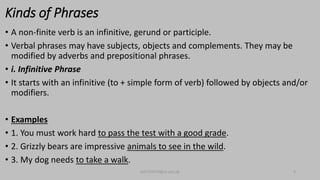
Kinds of Phrases
• A non-finite verb is an infinitive, gerund or participle.
• Verbal phrases may have subjects, objects and complements. They may be
modified by adverbs and prepositional phrases.
• i. Infinitive Phrase
• It starts with an infinitive (to + simple form of verb) followed by objects and/or
modifiers.
• Examples
• 1. You must work hard to pass the test with a good grade.
• 2. Grizzly bears are impressive animals to see in the wild.
• 3. My dog needs to take a walk.
bsf1704470@ue.edu.pk 8
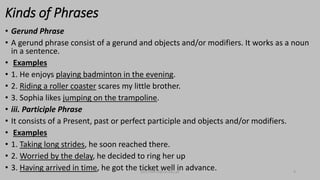
Kinds of Phrases
• Gerund Phrase
• A gerund phrase consist of a gerund and objects and/or modifiers. It works as a noun
in a sentence.
• Examples
• 1. He enjoys playing badminton in the evening.
• 2. Riding a roller coaster scares my little brother.
• 3. Sophia likes jumping on the trampoline.
• iii. Participle Phrase
• It consists of a Present, past or perfect participle and objects and/or modifiers.
• Examples
• 1. Taking long strides, he soon reached there.
• 2. Worried by the delay, he decided to ring her up
• 3. Having arrived in time, he got the ticket well in advance.
bsf1704470@ue.edu.pk 9
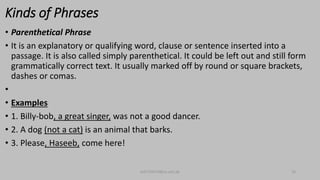
Kinds of Phrases
• Parenthetical Phrase
• It is an explanatory or qualifying word, clause or sentence inserted into a
passage. It is also called simply parenthetical. It could be left out and still form
grammatically correct text. It usually marked off by round or square brackets,
dashes or comas.
•
• Examples
• 1. Billy-bob, a great singer, was not a good dancer.
• 2. A dog (not a cat) is an animal that barks.
• 3. Please, Haseeb, come here!
bsf1704470@ue.edu.pk 10
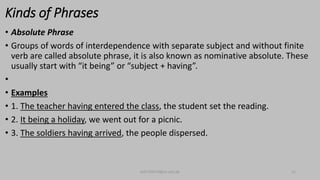
Kinds of Phrases
• Absolute Phrase
• Groups of words of interdependence with separate subject and without finite
verb are called absolute phrase, it is also known as nominative absolute. These
usually start with “it being” or “subject + having”.
•
• Examples
• 1. The teacher having entered the class, the student set the reading.
• 2. It being a holiday, we went out for a picnic.
• 3. The soldiers having arrived, the people dispersed.
bsf1704470@ue.edu.pk 11
Kinds of Phrases
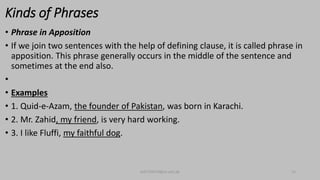
• Phrase in Apposition
• If we join two sentences with the help of defining clause, it is called phrase in
apposition. This phrase generally occurs in the middle of the sentence and
sometimes at the end also.
•
• Examples
• 1. Quid-e-Azam, the founder of Pakistan, was born in Karachi.
• 2. Mr. Zahid, my friend, is very hard working.
• 3. I like Fluffi, my faithful dog.
bsf1704470@ue.edu.pk 12
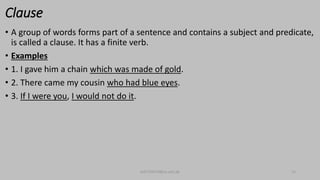
Clause
• A group of words forms part of a sentence and contains a subject and predicate,
is called a clause. It has a finite verb.
• Examples
• 1. I gave him a chain which was made of gold.
• 2. There came my cousin who had blue eyes.
• 3. If I were you, I would not do it.
bsf1704470@ue.edu.pk 13
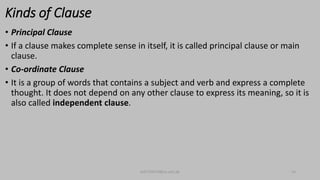
Kinds of Clause
• Principal Clause
• If a clause makes complete sense in itself, it is called principal clause or main
clause.
• Co-ordinate Clause
• It is a group of words that contains a subject and verb and express a complete
thought. It does not depend on any other clause to express its meaning, so it is
also called independent clause.
bsf1704470@ue.edu.pk 14
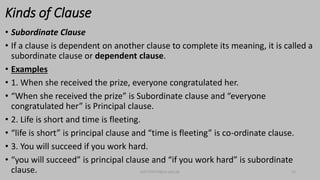
Kinds of Clause
• Subordinate Clause
• If a clause is dependent on another clause to complete its meaning, it is called a
subordinate clause or dependent clause.
• Examples
• 1. When she received the prize, everyone congratulated her.
• “When she received the prize” is Subordinate clause and “everyone
congratulated her” is Principal clause.
• 2. Life is short and time is fleeting.
• “life is short” is principal clause and “time is fleeting” is co-ordinate clause.
• 3. You will succeed if you work hard.
• “you will succeed” is principal clause and “if you work hard” is subordinate
clause. bsf1704470@ue.edu.pk 15
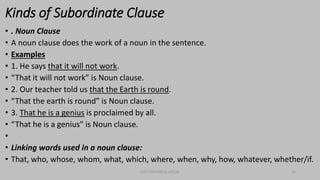
Kinds of Subordinate Clause
• . Noun Clause
• A noun clause does the work of a noun in the sentence.
• Examples
• 1. He says that it will not work.
• “That it will not work” is Noun clause.
• 2. Our teacher told us that the Earth is round.
• “That the earth is round” is Noun clause.
• 3. That he is a genius is proclaimed by all.
• “That he is a genius” is Noun clause.
•
• Linking words used in a noun clause:
• That, who, whose, whom, what, which, where, when, why, how, whatever, whether/if.
bsf1704470@ue.edu.pk 16
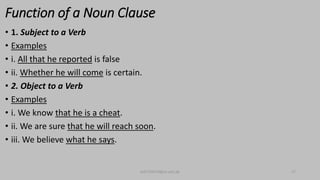
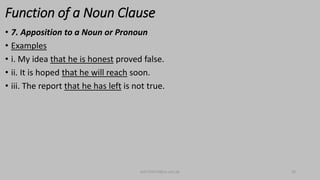
Function of a Noun Clause
• 1. Subject to a Verb
• Examples
• i. All that he reported is false
• ii. Whether he will come is certain.
• 2. Object to a Verb
• Examples
• i. We know that he is a cheat.
• ii. We are sure that he will reach soon.
• iii. We believe what he says.
bsf1704470@ue.edu.pk 17
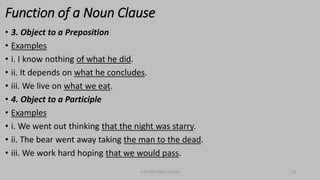
Function of a Noun Clause
• 3. Object to a Preposition
• Examples
• i. I know nothing of what he did.
• ii. It depends on what he concludes.
• iii. We live on what we eat.
• 4. Object to a Participle
• Examples
• i. We went out thinking that the night was starry.
• ii. The bear went away taking the man to the dead.
• iii. We work hard hoping that we would pass.
bsf1704470@ue.edu.pk 18
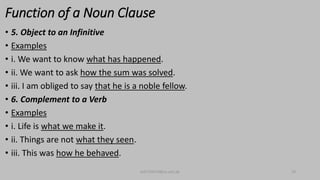
Function of a Noun Clause
• 5. Object to an Infinitive
• Examples
• i. We want to know what has happened.
• ii. We want to ask how the sum was solved.
• iii. I am obliged to say that he is a noble fellow.
• 6. Complement to a Verb
• Examples
• i. Life is what we make it.
• ii. Things are not what they seen.
• iii. This was how he behaved.
bsf1704470@ue.edu.pk 19
Function of a Noun Clause
• 7. Apposition to a Noun or Pronoun
• Examples
• i. My idea that he is honest proved false.
• ii. It is hoped that he will reach soon.
• iii. The report that he has left is not true.
bsf1704470@ue.edu.pk 20
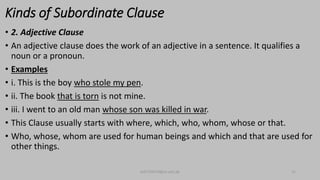
Kinds of Subordinate Clause
• 2. Adjective Clause
• An adjective clause does the work of an adjective in a sentence. It qualifies a
noun or a pronoun.
• Examples
• i. This is the boy who stole my pen.
• ii. The book that is torn is not mine.
• iii. I went to an old man whose son was killed in war.
• This Clause usually starts with where, which, who, whom, whose or that.
• Who, whose, whom are used for human beings and which and that are used for
other things.
bsf1704470@ue.edu.pk 21
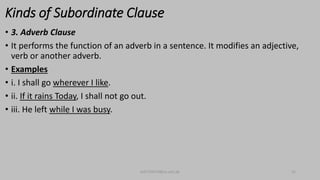
Kinds of Subordinate Clause
• 3. Adverb Clause
• It performs the function of an adverb in a sentence. It modifies an adjective,
verb or another adverb.
• Examples
• i. I shall go wherever I like.
• ii. If it rains Today, I shall not go out.
• iii. He left while I was busy.
bsf1704470@ue.edu.pk 22
Continued
bsf1704470@ue.edu.pk 23

Chapter 3 part 1 phrase, clause and sentence structure

  • 1.
    Phrase, Clause andSentence Structure Chapter 3 Part 1
  • 2.
    Phrase • A groupof words, which makes sense, but not complete sense, is called a phrase. It has not subject and verb. • Examples • The sun rises in the east. • We cannot start while it is raining. • Show me how to do it. bsf1704470@ue.edu.pk 2
  • 3.
    Kinds of Phrases •Noun Phrase • A group of words that does the work of a noun in a sentence. It consist of a noun and other related words (usually modifiers and determiners) which modify the noun. • Examples • He demanded something to eat. • His sudden resignation is a mystery. • To win a prize is a hard task. • Adjective Phrase • A group of words that does the work of an adjective is called adjective phrase. • Examples • My neighbour is a man with strange habits. • A crown made of gold. • A boy of short stature stood there. bsf1704470@ue.edu.pk 3
  • 4.
    Kinds of Phrases •Adverb Phrase • A group of words that does the function of an adverb in a sentence is called adverb phrase. • Examples • He lived in Saudi-Arabia once upon a time. • Ali ran with great speed. • He answered me in a rude manner. • Position of Adverb Phrase • The normal order is Adverb of Manner, Place, Time. • Example • They sang sweetly at the concert yesterday. • “Sweetly” is an Adverb of manner, “At the concert” is an Adverb of place and “yesterday” is an Adverb of time. bsf1704470@ue.edu.pk 4
  • 5.
    Kinds of Phrases •Prepositional Phrase • A group of words that does the work of a preposition and usually ends in a simple preposition. • Example s • 1. He worked hard for the sake of a prize. • 2. He is at home in English. • 3. He acted according to the instructions. • • It consists of a preposition followed by a prepositional complement which is characteristically a noun phrase or a WH-Clause or V-ing Clause. • Examples • 1. At the railway station. • “At” is Preposition and “the railway station” is prepositional complement. bsf1704470@ue.edu.pk 5
  • 6.
    Kinds of Phrases •2. From what he said. • “From” is preposition and “what he said” is prepositional complement. • 3. By singing a song. • “By” is preposition and “singing a song” is prepositional complement. • • A few prepositional phrases are: • According to, along with, away from, because of, in favor of, in spite of, instead of, in order to, in place of, an account of, with a view to, with regard to, at the bottom of, in case of, etc. bsf1704470@ue.edu.pk 6
  • 7.
    Kinds of Phrases •. Verbal Phrase • A verbal phrase can be a finite verb phrase or non-finite verb phrase. • A) Finite Verb Phrase is one that can be the main phrase of a sentence. • Example • “You leave” ; “you are leaving” • In a finite verb phrase there a number of choices. • Tense ( Past or Present) • Examples • It showed • It shows • From (Perfect or Continuous) • Examples • It has gone • It was happening • Voice (Passive or Active) • Examples • They were informed • He informed them bsf1704470@ue.edu.pk 7
  • 8.
    Kinds of Phrases •A non-finite verb is an infinitive, gerund or participle. • Verbal phrases may have subjects, objects and complements. They may be modified by adverbs and prepositional phrases. • i. Infinitive Phrase • It starts with an infinitive (to + simple form of verb) followed by objects and/or modifiers. • Examples • 1. You must work hard to pass the test with a good grade. • 2. Grizzly bears are impressive animals to see in the wild. • 3. My dog needs to take a walk. bsf1704470@ue.edu.pk 8
  • 9.
    Kinds of Phrases •Gerund Phrase • A gerund phrase consist of a gerund and objects and/or modifiers. It works as a noun in a sentence. • Examples • 1. He enjoys playing badminton in the evening. • 2. Riding a roller coaster scares my little brother. • 3. Sophia likes jumping on the trampoline. • iii. Participle Phrase • It consists of a Present, past or perfect participle and objects and/or modifiers. • Examples • 1. Taking long strides, he soon reached there. • 2. Worried by the delay, he decided to ring her up • 3. Having arrived in time, he got the ticket well in advance. bsf1704470@ue.edu.pk 9
  • 10.
    Kinds of Phrases •Parenthetical Phrase • It is an explanatory or qualifying word, clause or sentence inserted into a passage. It is also called simply parenthetical. It could be left out and still form grammatically correct text. It usually marked off by round or square brackets, dashes or comas. • • Examples • 1. Billy-bob, a great singer, was not a good dancer. • 2. A dog (not a cat) is an animal that barks. • 3. Please, Haseeb, come here! bsf1704470@ue.edu.pk 10
  • 11.
    Kinds of Phrases •Absolute Phrase • Groups of words of interdependence with separate subject and without finite verb are called absolute phrase, it is also known as nominative absolute. These usually start with “it being” or “subject + having”. • • Examples • 1. The teacher having entered the class, the student set the reading. • 2. It being a holiday, we went out for a picnic. • 3. The soldiers having arrived, the people dispersed. bsf1704470@ue.edu.pk 11
  • 12.
    Kinds of Phrases •Phrase in Apposition • If we join two sentences with the help of defining clause, it is called phrase in apposition. This phrase generally occurs in the middle of the sentence and sometimes at the end also. • • Examples • 1. Quid-e-Azam, the founder of Pakistan, was born in Karachi. • 2. Mr. Zahid, my friend, is very hard working. • 3. I like Fluffi, my faithful dog. bsf1704470@ue.edu.pk 12
  • 13.
    Clause • A groupof words forms part of a sentence and contains a subject and predicate, is called a clause. It has a finite verb. • Examples • 1. I gave him a chain which was made of gold. • 2. There came my cousin who had blue eyes. • 3. If I were you, I would not do it. bsf1704470@ue.edu.pk 13
  • 14.
    Kinds of Clause •Principal Clause • If a clause makes complete sense in itself, it is called principal clause or main clause. • Co-ordinate Clause • It is a group of words that contains a subject and verb and express a complete thought. It does not depend on any other clause to express its meaning, so it is also called independent clause. bsf1704470@ue.edu.pk 14
  • 15.
    Kinds of Clause •Subordinate Clause • If a clause is dependent on another clause to complete its meaning, it is called a subordinate clause or dependent clause. • Examples • 1. When she received the prize, everyone congratulated her. • “When she received the prize” is Subordinate clause and “everyone congratulated her” is Principal clause. • 2. Life is short and time is fleeting. • “life is short” is principal clause and “time is fleeting” is co-ordinate clause. • 3. You will succeed if you work hard. • “you will succeed” is principal clause and “if you work hard” is subordinate clause. bsf1704470@ue.edu.pk 15
  • 16.
    Kinds of SubordinateClause • . Noun Clause • A noun clause does the work of a noun in the sentence. • Examples • 1. He says that it will not work. • “That it will not work” is Noun clause. • 2. Our teacher told us that the Earth is round. • “That the earth is round” is Noun clause. • 3. That he is a genius is proclaimed by all. • “That he is a genius” is Noun clause. • • Linking words used in a noun clause: • That, who, whose, whom, what, which, where, when, why, how, whatever, whether/if. bsf1704470@ue.edu.pk 16
  • 17.
    Function of aNoun Clause • 1. Subject to a Verb • Examples • i. All that he reported is false • ii. Whether he will come is certain. • 2. Object to a Verb • Examples • i. We know that he is a cheat. • ii. We are sure that he will reach soon. • iii. We believe what he says. bsf1704470@ue.edu.pk 17
  • 18.
    Function of aNoun Clause • 3. Object to a Preposition • Examples • i. I know nothing of what he did. • ii. It depends on what he concludes. • iii. We live on what we eat. • 4. Object to a Participle • Examples • i. We went out thinking that the night was starry. • ii. The bear went away taking the man to the dead. • iii. We work hard hoping that we would pass. bsf1704470@ue.edu.pk 18
  • 19.
    Function of aNoun Clause • 5. Object to an Infinitive • Examples • i. We want to know what has happened. • ii. We want to ask how the sum was solved. • iii. I am obliged to say that he is a noble fellow. • 6. Complement to a Verb • Examples • i. Life is what we make it. • ii. Things are not what they seen. • iii. This was how he behaved. bsf1704470@ue.edu.pk 19
  • 20.
    Function of aNoun Clause • 7. Apposition to a Noun or Pronoun • Examples • i. My idea that he is honest proved false. • ii. It is hoped that he will reach soon. • iii. The report that he has left is not true. bsf1704470@ue.edu.pk 20
  • 21.
    Kinds of SubordinateClause • 2. Adjective Clause • An adjective clause does the work of an adjective in a sentence. It qualifies a noun or a pronoun. • Examples • i. This is the boy who stole my pen. • ii. The book that is torn is not mine. • iii. I went to an old man whose son was killed in war. • This Clause usually starts with where, which, who, whom, whose or that. • Who, whose, whom are used for human beings and which and that are used for other things. bsf1704470@ue.edu.pk 21
  • 22.
    Kinds of SubordinateClause • 3. Adverb Clause • It performs the function of an adverb in a sentence. It modifies an adjective, verb or another adverb. • Examples • i. I shall go wherever I like. • ii. If it rains Today, I shall not go out. • iii. He left while I was busy. bsf1704470@ue.edu.pk 22
  • 23.