Combining Sentences
Why combine sentences?

Too many short sentences make a paragraph
sound choppy.
Why combine sentences?

Combining sentences helps us
to showcase the relationships
between ideas.
Compound sentences

One way to combine two sentences
is to make a compound sentence
with the conjunctions
and, or, but, yet, or so.
Combine the sentences
Wetlands can improve water quality.

People build new wetlands in cities.
Combine the sentences
Wetlands can improve water quality.
What conjunction can
connect these ideas?

People build new wetlands in cities.

and

but

so

or

yet
Combine the sentences
Wetlands can improve water quality.

so
People build new wetlands in cities.
Combine the sentences
Wetlands can improve water
quality, so people build wetlands in
cities.
Combine the sentences
This body of water looks like a lake.

It is a reservoir to hold drinking water.

and

but

so

or

yet
Combine the sentences
This body of water looks like a lake.

but
It is a reservoir to hold drinking water.

and

but

so

or

yet
Combine the sentences
This body of water looks like a
lake, but it is a reservoir to hold
drinking water.
Combine the sentences
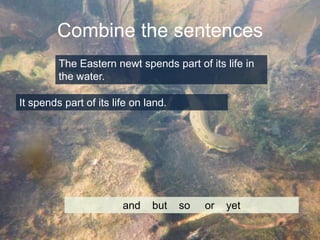
The Eastern newt spends part of its life in
the water.
It spends part of its life on land.

and

but

so

or

yet
Combine the sentences
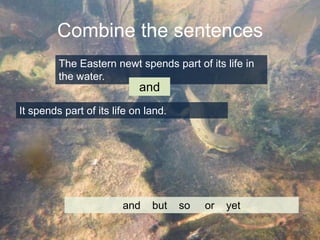
The Eastern newt spends part of its life in
the water.

and
It spends part of its life on land.

and

but

so

or

yet
Combine the sentences

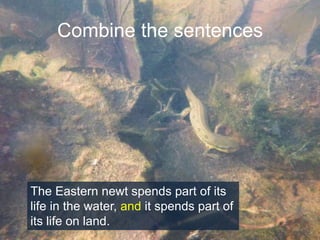
The Eastern newt spends part of its
life in the water, and it spends part of
its life on land.
Other ways to combine sentences

We can also move ideas around
to make longer, smoother
sentences.
Combine the sentences
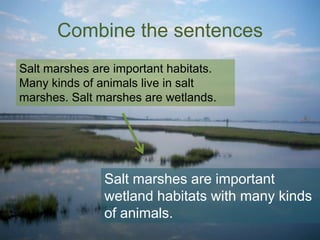
Salt marshes are important habitats.
Many kinds of animals live in salt
marshes. Salt marshes are wetlands.

Salt marshes are important
wetland habitats with many kinds
of animals.
Combine the sentences
Salt marshes are important habitats.
Many kinds of animals live in salt
marshes. Salt marshes are wetlands.

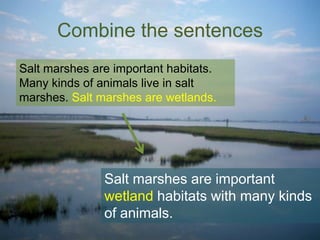
Salt marshes are important
wetland habitats with many kinds
of animals.
Combine the sentences
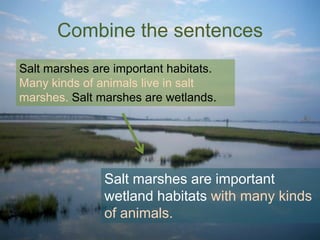
Salt marshes are important habitats.
Many kinds of animals live in salt
marshes. Salt marshes are wetlands.

Salt marshes are important
wetland habitats with many kinds
of animals.
Lots of choices!
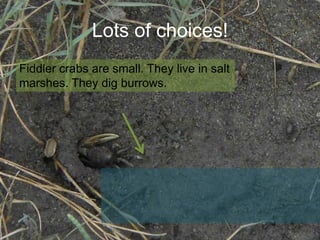
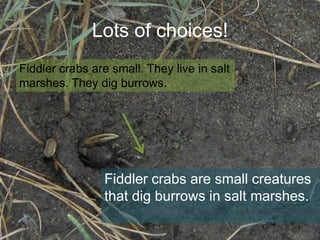
Fiddler crabs are small. They live in salt
marshes. They dig burrows.
Lots of choices!
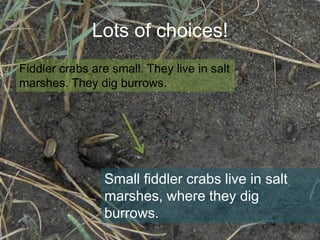
Fiddler crabs are small. They live in salt
marshes. They dig burrows.

Fiddler crabs are small creatures
that dig burrows in salt marshes.
Lots of choices!
Fiddler crabs are small. They live in salt
marshes. They dig burrows.

Small fiddler crabs live in salt
marshes, where they dig
burrows.
Can you combine these?
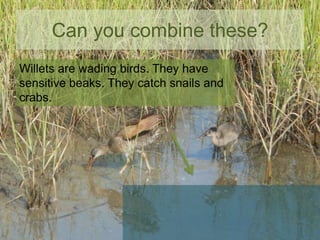
Willets are wading birds. They have
sensitive beaks. They catch snails and
crabs.
Is this a good combination?
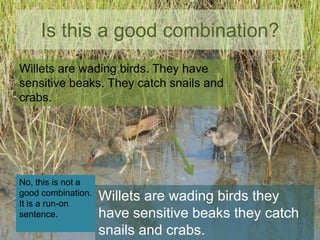
Willets are wading birds. They have
sensitive beaks. They catch snails and
crabs.

No, this is not a
good combination.
It is a run-on
sentence.

Willets are wading birds they
have sensitive beaks they catch
snails and crabs.
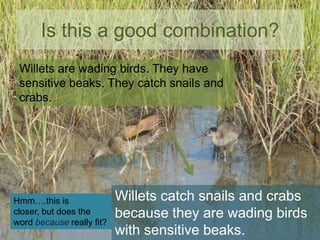
Is this a good combination?
Willets are wading birds. They have
sensitive beaks. They catch snails and
crabs.

Hmm….this is
closer, but does the
word because really fit?

Willets catch snails and crabs
because they are wading birds
with sensitive beaks.
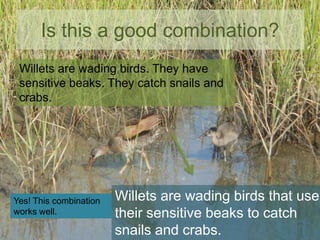
Is this a good combination?
Willets are wading birds. They have
sensitive beaks. They catch snails and
crabs.

Yes! This combination
works well.

Willets are wading birds that use
their sensitive beaks to catch
snails and crabs.
More Practice
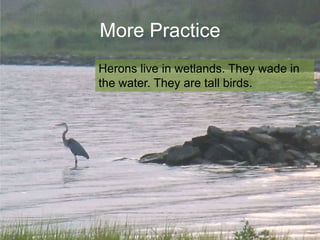
Herons live in wetlands. They wade in
the water. They are tall birds.
More Practice

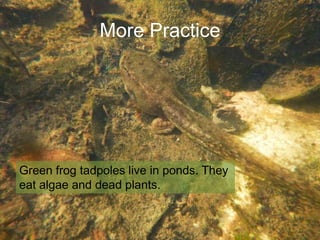
Green frog tadpoles live in ponds. They
eat algae and dead plants.
More Practice

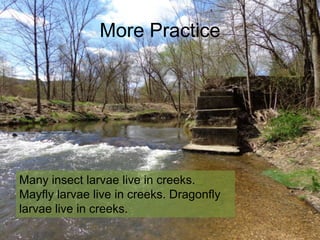
Many insect larvae live in creeks.
Mayfly larvae live in creeks. Dragonfly
larvae live in creeks.
What have you learned?

What strategies do you use to
combine sentences?
What are you still wondering
about?
by Emily Kissner
All photos by Emily Kissner

Sentence Combining

  • 1.
  • 2.
    Why combine sentences? Toomany short sentences make a paragraph sound choppy.
  • 3.
    Why combine sentences? Combiningsentences helps us to showcase the relationships between ideas.
  • 4.
    Compound sentences One wayto combine two sentences is to make a compound sentence with the conjunctions and, or, but, yet, or so.
  • 5.
    Combine the sentences Wetlandscan improve water quality. People build new wetlands in cities.
  • 6.
    Combine the sentences Wetlandscan improve water quality. What conjunction can connect these ideas? People build new wetlands in cities. and but so or yet
  • 7.
    Combine the sentences Wetlandscan improve water quality. so People build new wetlands in cities.
  • 8.
    Combine the sentences Wetlandscan improve water quality, so people build wetlands in cities.
  • 9.
    Combine the sentences Thisbody of water looks like a lake. It is a reservoir to hold drinking water. and but so or yet
  • 10.
    Combine the sentences Thisbody of water looks like a lake. but It is a reservoir to hold drinking water. and but so or yet
  • 11.
    Combine the sentences Thisbody of water looks like a lake, but it is a reservoir to hold drinking water.
  • 12.
    Combine the sentences TheEastern newt spends part of its life in the water. It spends part of its life on land. and but so or yet
  • 13.
    Combine the sentences TheEastern newt spends part of its life in the water. and It spends part of its life on land. and but so or yet
  • 14.
    Combine the sentences TheEastern newt spends part of its life in the water, and it spends part of its life on land.
  • 15.
    Other ways tocombine sentences We can also move ideas around to make longer, smoother sentences.
  • 16.
    Combine the sentences Saltmarshes are important habitats. Many kinds of animals live in salt marshes. Salt marshes are wetlands. Salt marshes are important wetland habitats with many kinds of animals.
  • 17.
    Combine the sentences Saltmarshes are important habitats. Many kinds of animals live in salt marshes. Salt marshes are wetlands. Salt marshes are important wetland habitats with many kinds of animals.
  • 18.
    Combine the sentences Saltmarshes are important habitats. Many kinds of animals live in salt marshes. Salt marshes are wetlands. Salt marshes are important wetland habitats with many kinds of animals.
  • 19.
    Lots of choices! Fiddlercrabs are small. They live in salt marshes. They dig burrows.
  • 20.
    Lots of choices! Fiddlercrabs are small. They live in salt marshes. They dig burrows. Fiddler crabs are small creatures that dig burrows in salt marshes.
  • 21.
    Lots of choices! Fiddlercrabs are small. They live in salt marshes. They dig burrows. Small fiddler crabs live in salt marshes, where they dig burrows.
  • 22.
    Can you combinethese? Willets are wading birds. They have sensitive beaks. They catch snails and crabs.
  • 23.
    Is this agood combination? Willets are wading birds. They have sensitive beaks. They catch snails and crabs. No, this is not a good combination. It is a run-on sentence. Willets are wading birds they have sensitive beaks they catch snails and crabs.
  • 24.
    Is this agood combination? Willets are wading birds. They have sensitive beaks. They catch snails and crabs. Hmm….this is closer, but does the word because really fit? Willets catch snails and crabs because they are wading birds with sensitive beaks.
  • 25.
    Is this agood combination? Willets are wading birds. They have sensitive beaks. They catch snails and crabs. Yes! This combination works well. Willets are wading birds that use their sensitive beaks to catch snails and crabs.
  • 26.
    More Practice Herons livein wetlands. They wade in the water. They are tall birds.
  • 27.
    More Practice Green frogtadpoles live in ponds. They eat algae and dead plants.
  • 28.
    More Practice Many insectlarvae live in creeks. Mayfly larvae live in creeks. Dragonfly larvae live in creeks.
  • 29.
    What have youlearned? What strategies do you use to combine sentences? What are you still wondering about?
  • 30.
    by Emily Kissner Allphotos by Emily Kissner

Editor's Notes

  • #2 An egret near Ocean City, MD
  • #3 View of Ocean City MD near Fenwick Island, DE
  • #5 Young writers usually resist using “for” as a conjunction, so I chose not to introduce it here.
  • #6 Some students may try to use a complex sentence to combine the sentences. This is perfectly acceptable, but encourage them to try for the compound sentence as well. The goal is for young writers to gain control over their sentence structure and writing.
  • #7 Watch to see the conjunctions that students choose. Emphasize that these ideas are related in a way that makes “and” not the best choice.
  • #9 Have students copy the sentence. Emphasize the comma before the conjunction.
  • #10 Photo: Long Pine Run, near Caledonia State Park, PA
  • #13 Photo: Taken at Kings Gap State Park, PA
  • #15 Once again, have students write the sentence correctly with the conjunction. This would be a good stopping point.
  • #17 Ask students, “How were the ideas from these sentences combined?”
  • #20 Have students attempt to combine these sentences. Photo: Isle of Wight near Ocean City, MD
  • #21 This is one option…
  • #22 …and this is another. Students will probably have come up with some different ways entirely. Expect that they will not know exactly how to punctuate their longer sentences at this point.
  • #23 Photo: Isle of Wight near Ocean City, MD. Yes, this is an adult and a juvenile! I was so excited to be able to watch them for 20 minutes.
  • #24 You may be seeing some sentences like this, so discuss why it is not the best.
  • #25 As students start to combine sentences, they sometimes try to make relationships where none exist, as in this sentence. Expect this as a natural part of the process and encourage students to think carefully about their sentences.
  • #27 One possible combination: Herons are tall wetland birds that wade in the water.Photo: Isle of Wight near Ocean City, MD. This is a great blue heron.
  • #28 One combination: Green frog tadpoles live in ponds, where they eat algae and dead plants.Photo: Kings Gap State Park, PA
  • #29 One option: Many insect larvae, including mayfly and dragonfly, live in creeks.Mill race(?) ruins near Mt. Holly Springs, PA