Writing Sentences
in English
Presented by Ingrid Johanna Rodríguez Granados
Professor at Universidad El Bosque
Subject: English 2
Bogota, Colombia
I - 2016
Table of Contents
1. Introduction
2. Types of sentences
2.1. simple sentences
2.2. Compound sentences
2.3. Complex sentences
3. Extra explanations, examples and
exercises
4. References
Introduction
Writing in English is different from writing in Spanish.
English texts follow different formats according to the
intention of the writer. Prose works are divided into
paragraphs, which are also divided into sentences.
In this class, you will focus on the types of sentences
you can include in your English texts.
Types of Sentences
There are three main types of sentences when
writing in English:
1. Simple
2. Compound
3. Complex
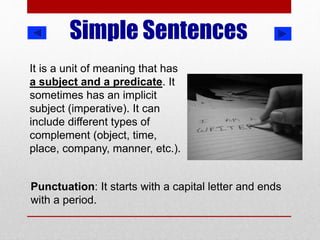
Simple Sentences
It is a unit of meaning that has
a subject and a predicate. It
sometimes has an implicit
subject (imperative). It can
include different types of
complement (object, time,
place, company, manner, etc.).
Punctuation: It starts with a capital letter and ends
with a period.
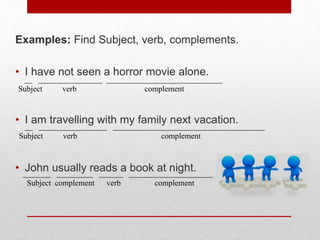
Examples: Find Subject, verb, complements.
• I have not seen a horror movie alone.
• I am travelling with my family next vacation.
• John usually reads a book at night.
__ ________________ _____________________________
Subject verb complement
__ _________________ ______________________________________
Subject verb complement
_______ _________ ______ _____________________
Subject complement verb complement
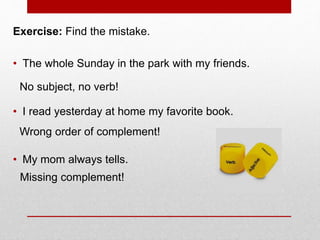
Exercise: Find the mistake.
• The whole Sunday in the park with my friends.
• I read yesterday at home my favorite book.
• My mom always tells.
No subject, no verb!
Wrong order of complement!
Missing complement!
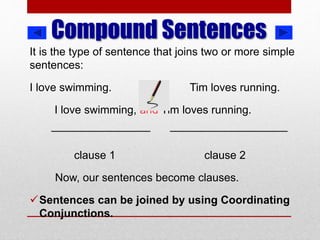
Compound Sentences
It is the type of sentence that joins two or more simple
sentences:
I love swimming. Tim loves running.
I love swimming, and Tim loves running.
________________ ___________________
clause 1 clause 2
Now, our sentences become clauses.
Sentences can be joined by using Coordinating
Conjunctions.
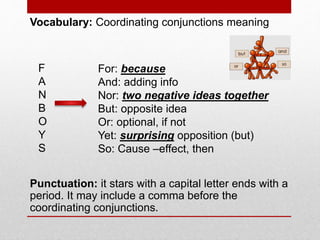
Vocabulary: Coordinating conjunctions meaning
Punctuation: it stars with a capital letter ends with a
period. It may include a comma before the
coordinating conjunctions.
F
A
N
B
O
Y
S
For: because
And: adding info
Nor: two negative ideas together
But: opposite idea
Or: optional, if not
Yet: surprising opposition (but)
So: Cause –effect, then
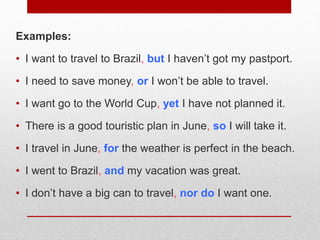
Examples:
• I want to travel to Brazil, but I haven’t got my pastport.
• I need to save money, or I won’t be able to travel.
• I want go to the World Cup, yet I have not planned it.
• There is a good touristic plan in June, so I will take it.
• I travel in June, for the weather is perfect in the beach.
• I went to Brazil, and my vacation was great.
• I don’t have a big can to travel, nor do I want one.
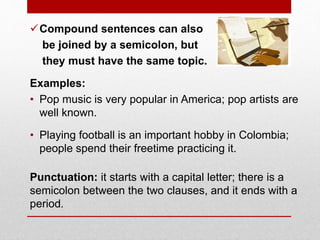
Compound sentences can also
be joined by a semicolon, but
they must have the same topic.
Examples:
• Pop music is very popular in America; pop artists are
well known.
• Playing football is an important hobby in Colombia;
people spend their freetime practicing it.
Punctuation: it starts with a capital letter; there is a
semicolon between the two clauses, and it ends with a
period.
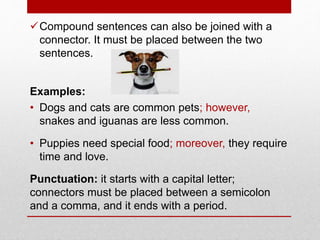
Compound sentences can also be joined with a
connector. It must be placed between the two
sentences.
Examples:
• Dogs and cats are common pets; however,
snakes and iguanas are less common.
• Puppies need special food; moreover, they require
time and love.
Punctuation: it starts with a capital letter;
connectors must be placed between a semicolon
and a comma, and it ends with a period.
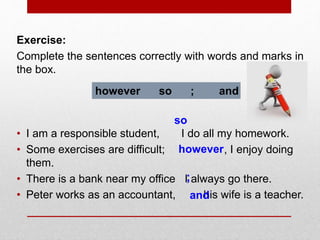
Exercise:
Complete the sentences correctly with words and marks in
the box.
• I am a responsible student, I do all my homework.
• Some exercises are difficult; , I enjoy doing
them.
• There is a bank near my office I always go there.
• Peter works as an accountant, his wife is a teacher.
however so ; and
however
so
;
and
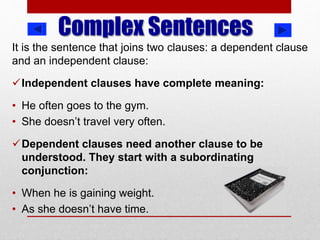
Complex Sentences
It is the sentence that joins two clauses: a dependent clause
and an independent clause:
Independent clauses have complete meaning:
• He often goes to the gym.
• She doesn’t travel very often.
Dependent clauses need another clause to be
understood. They start with a subordinating
conjunction:
• When he is gaining weight.
• As she doesn’t have time.
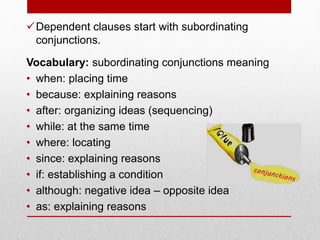
Dependent clauses start with subordinating
conjunctions.
Vocabulary: subordinating conjunctions meaning
• when: placing time
• because: explaining reasons
• after: organizing ideas (sequencing)
• while: at the same time
• where: locating
• since: explaining reasons
• if: establishing a condition
• although: negative idea – opposite idea
• as: explaining reasons
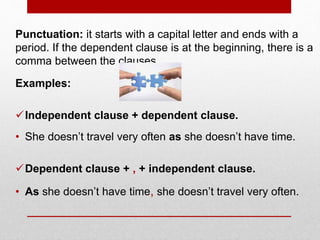
Punctuation: it starts with a capital letter and ends with a
period. If the dependent clause is at the beginning, there is a
comma between the clauses.
Examples:
Independent clause + dependent clause.
• She doesn’t travel very often as she doesn’t have time.
Dependent clause + , + independent clause.
• As she doesn’t have time, she doesn’t travel very often.
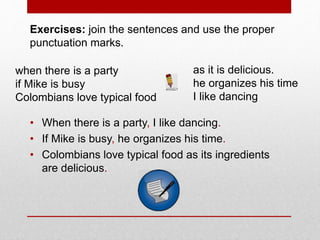
Exercises: join the sentences and use the proper
punctuation marks.
• When there is a party, I like dancing.
• If Mike is busy, he organizes his time.
• Colombians love typical food as its ingredients
are delicious.
as it is delicious.
he organizes his time
I like dancing
when there is a party
if Mike is busy
Colombians love typical food
More Explanations,
Examples and Exercises
Simple sentences
• http://www.testden.com/toefl/english-grammar-for-students/The-Simple-Sentence-
exercises.html
• https://www.dlsweb.rmit.edu.au/lsu/content/4_WritingSkills/writing_tuts/sentences_L
L/simple.html
Compound sentences
• https://www.dlsweb.rmit.edu.au/lsu/content/4_WritingSkills/writing_tuts/sentences_L
L/compound.html
• http://study.com/academy/lesson/what-is-a-compound-sentence-examples-
definition-quiz.html
Complex sentences
• http://study.com/academy/lesson/what-is-a-complex-sentence-examples-lesson-
quiz.html
• http://www.learnamericanenglishonline.com/Orange%20Level/O4%20Complex%20
Sentences.html
References
• Bailey, S. (2003). Academic Writing. A handbook
for international students. NY: MPG Bolls Ltd.
• Gower, R. (2008). Real Writing. UK: Cambridge
University Press.
• Oshima, A. and Hogue, A. (2007). Introduction to
Academic Writing. NY: Pearson Education.

Writing Sentences in English

  • 1.
    Writing Sentences in English Presentedby Ingrid Johanna Rodríguez Granados Professor at Universidad El Bosque Subject: English 2 Bogota, Colombia I - 2016
  • 2.
    Table of Contents 1.Introduction 2. Types of sentences 2.1. simple sentences 2.2. Compound sentences 2.3. Complex sentences 3. Extra explanations, examples and exercises 4. References
  • 3.
    Introduction Writing in Englishis different from writing in Spanish. English texts follow different formats according to the intention of the writer. Prose works are divided into paragraphs, which are also divided into sentences. In this class, you will focus on the types of sentences you can include in your English texts.
  • 4.
    Types of Sentences Thereare three main types of sentences when writing in English: 1. Simple 2. Compound 3. Complex
  • 5.
    Simple Sentences It isa unit of meaning that has a subject and a predicate. It sometimes has an implicit subject (imperative). It can include different types of complement (object, time, place, company, manner, etc.). Punctuation: It starts with a capital letter and ends with a period.
  • 6.
    Examples: Find Subject,verb, complements. • I have not seen a horror movie alone. • I am travelling with my family next vacation. • John usually reads a book at night. __ ________________ _____________________________ Subject verb complement __ _________________ ______________________________________ Subject verb complement _______ _________ ______ _____________________ Subject complement verb complement
  • 7.
    Exercise: Find themistake. • The whole Sunday in the park with my friends. • I read yesterday at home my favorite book. • My mom always tells. No subject, no verb! Wrong order of complement! Missing complement!
  • 8.
    Compound Sentences It isthe type of sentence that joins two or more simple sentences: I love swimming. Tim loves running. I love swimming, and Tim loves running. ________________ ___________________ clause 1 clause 2 Now, our sentences become clauses. Sentences can be joined by using Coordinating Conjunctions.
  • 9.
    Vocabulary: Coordinating conjunctionsmeaning Punctuation: it stars with a capital letter ends with a period. It may include a comma before the coordinating conjunctions. F A N B O Y S For: because And: adding info Nor: two negative ideas together But: opposite idea Or: optional, if not Yet: surprising opposition (but) So: Cause –effect, then
  • 10.
    Examples: • I wantto travel to Brazil, but I haven’t got my pastport. • I need to save money, or I won’t be able to travel. • I want go to the World Cup, yet I have not planned it. • There is a good touristic plan in June, so I will take it. • I travel in June, for the weather is perfect in the beach. • I went to Brazil, and my vacation was great. • I don’t have a big can to travel, nor do I want one.
  • 11.
    Compound sentences canalso be joined by a semicolon, but they must have the same topic. Examples: • Pop music is very popular in America; pop artists are well known. • Playing football is an important hobby in Colombia; people spend their freetime practicing it. Punctuation: it starts with a capital letter; there is a semicolon between the two clauses, and it ends with a period.
  • 12.
    Compound sentences canalso be joined with a connector. It must be placed between the two sentences. Examples: • Dogs and cats are common pets; however, snakes and iguanas are less common. • Puppies need special food; moreover, they require time and love. Punctuation: it starts with a capital letter; connectors must be placed between a semicolon and a comma, and it ends with a period.
  • 13.
    Exercise: Complete the sentencescorrectly with words and marks in the box. • I am a responsible student, I do all my homework. • Some exercises are difficult; , I enjoy doing them. • There is a bank near my office I always go there. • Peter works as an accountant, his wife is a teacher. however so ; and however so ; and
  • 14.
    Complex Sentences It isthe sentence that joins two clauses: a dependent clause and an independent clause: Independent clauses have complete meaning: • He often goes to the gym. • She doesn’t travel very often. Dependent clauses need another clause to be understood. They start with a subordinating conjunction: • When he is gaining weight. • As she doesn’t have time.
  • 15.
    Dependent clauses startwith subordinating conjunctions. Vocabulary: subordinating conjunctions meaning • when: placing time • because: explaining reasons • after: organizing ideas (sequencing) • while: at the same time • where: locating • since: explaining reasons • if: establishing a condition • although: negative idea – opposite idea • as: explaining reasons
  • 16.
    Punctuation: it startswith a capital letter and ends with a period. If the dependent clause is at the beginning, there is a comma between the clauses. Examples: Independent clause + dependent clause. • She doesn’t travel very often as she doesn’t have time. Dependent clause + , + independent clause. • As she doesn’t have time, she doesn’t travel very often.
  • 17.
    Exercises: join thesentences and use the proper punctuation marks. • When there is a party, I like dancing. • If Mike is busy, he organizes his time. • Colombians love typical food as its ingredients are delicious. as it is delicious. he organizes his time I like dancing when there is a party if Mike is busy Colombians love typical food
  • 18.
    More Explanations, Examples andExercises Simple sentences • http://www.testden.com/toefl/english-grammar-for-students/The-Simple-Sentence- exercises.html • https://www.dlsweb.rmit.edu.au/lsu/content/4_WritingSkills/writing_tuts/sentences_L L/simple.html Compound sentences • https://www.dlsweb.rmit.edu.au/lsu/content/4_WritingSkills/writing_tuts/sentences_L L/compound.html • http://study.com/academy/lesson/what-is-a-compound-sentence-examples- definition-quiz.html Complex sentences • http://study.com/academy/lesson/what-is-a-complex-sentence-examples-lesson- quiz.html • http://www.learnamericanenglishonline.com/Orange%20Level/O4%20Complex%20 Sentences.html
  • 19.
    References • Bailey, S.(2003). Academic Writing. A handbook for international students. NY: MPG Bolls Ltd. • Gower, R. (2008). Real Writing. UK: Cambridge University Press. • Oshima, A. and Hogue, A. (2007). Introduction to Academic Writing. NY: Pearson Education.