Downloaded 17 times


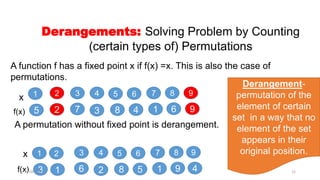
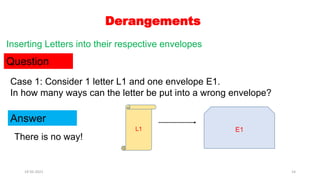
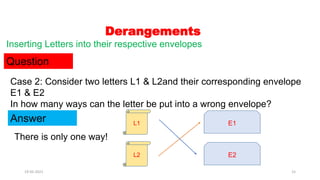
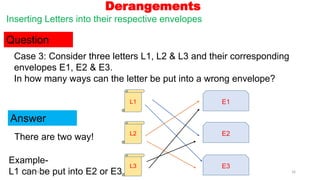
![Derangements- Notation and Formula
The number of derangement of n element set is called the nth
derangement number or recontres number, or the subfactorial of n and is
sometimes denoted !n or Dn:
And is given by the formula
𝐷𝑛 = 𝑛!
𝑖=0
𝑛
(−1)𝑖
𝑖!
Dn= n! [1-(1/1!)+ (1/2!)-(1/3!)…(1/n!)]
Simply:
19-05-2021 17](https://image.slidesharecdn.com/combinatorics-210519044516/85/Combinatorics-17-320.jpg)
![Illustrations on Derangements
Question
In how many ways can you form a dancing couple from 3 boys and 3 girls
so that no boy dances with his respective girlfriend?
Answer
It is derangement of 3 boys and 3 girls.
Dn= n! [1-(1/1!)+ (1/2!)-(1/3!)…(1/n!)]
=3! [1-(1/1!)+ (1/2!)-(1/3!)]
=2 ways
19-05-2021 18](https://image.slidesharecdn.com/combinatorics-210519044516/85/Combinatorics-18-320.jpg)
![Illustration on Derangements
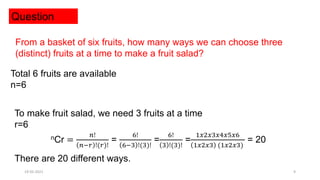
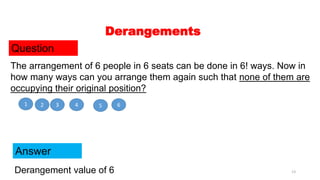
The arrangement of 6 people in 6 seats can be done in 6! ways. Now in
how many ways can you arrange them again such that none of them are
occupying their original position?
Question
Answer
Derangement value of 6
1 2 3 4 5 6 Dn= n! [1-(1/1!)+ (1/2!)-(1/3!)…(1/n!)]
=6! [1-(1/1!)+ (1/2!)-(1/3!)+(1/4!)-(1/5!)+ (1/6!)]
= 265 ways
D0 D1 D2 D3 D4 D5 D6 D7 D8 D9
1 0 1 2 9 44 265 1854 14833 133496
19-05-2021 19](https://image.slidesharecdn.com/combinatorics-210519044516/85/Combinatorics-19-320.jpg)
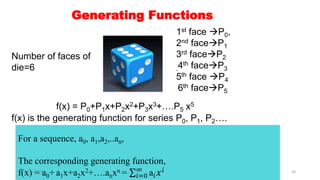
![Scaling Rule
Multiplying a generating function by a constant scales every term in the
associated sequence by the same constant.
[f0,f1,f2,f3..]↔ F(x)
c[f0,f1,f2,f3..]↔ cF(x)
Example:
[1,0,1,0,1,0..] ↔1+x2+x4+...=
1
1−𝑥2
Note: To indicate correspondence between a sequence and its
generating function with a double sided-arrow.
19-05-2021 24
Multiplying with 2:
2+2x2+2x4+...=
2
1−𝑥2](https://image.slidesharecdn.com/combinatorics-210519044516/85/Combinatorics-24-320.jpg)

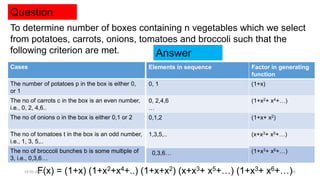

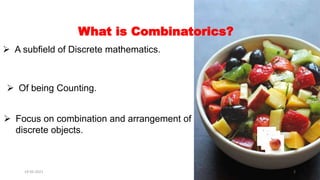
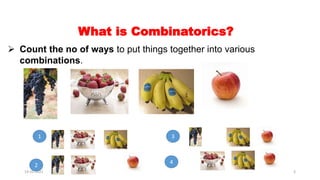
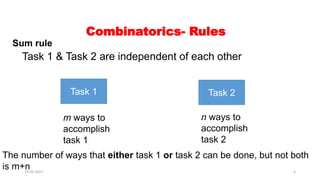
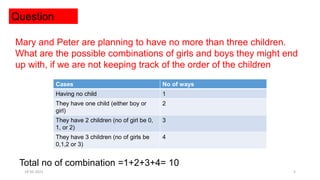
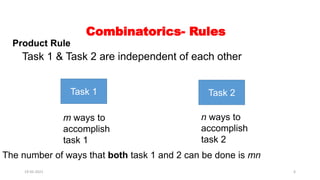
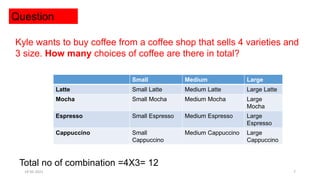
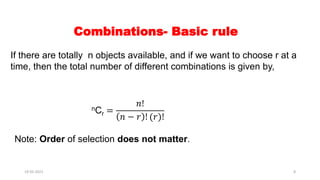
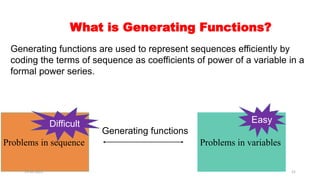
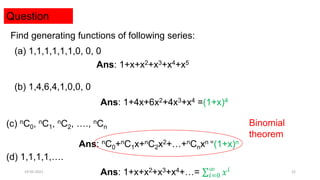
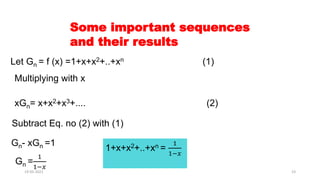
Combinatorics is a subfield of discrete mathematics that focuses on counting combinations and arrangements of discrete objects. It involves counting the number of ways to put things together into various combinations. Some key rules in combinatorics include the sum rule, which states that the number of ways to accomplish either of two independent tasks is the sum of the number of ways to accomplish each task individually. The product rule states that the number of ways to accomplish two independent tasks is the product of the number of ways to accomplish each task. Generating functions can be used to efficiently represent counting sequences by coding terms as coefficients of a variable in a formal power series. They allow problems involving counting and arrangements to be solved using operations with formal power series.


