Phase Diagrams
Dr. Anjali Devi J S
Assistant Professor (Contract Faculty), IIRBS, Mahatma Gandhi University, Kerala.
Phase
• A phase of a substance is a form of matter that is uniform throughout
in chemical composition and physical state.
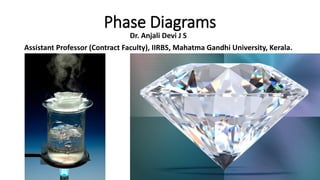
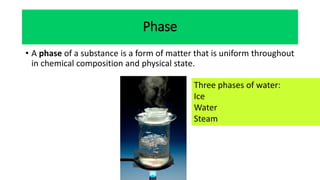
Three phases of water:
Ice
Water
Steam
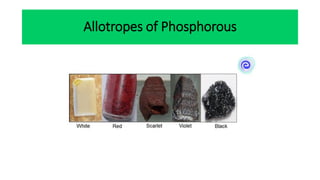
Allotropes of Phosphorous
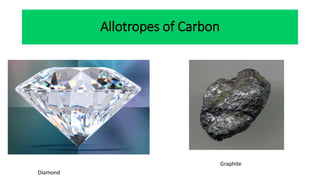
Allotropes of Carbon
Diamond
Graphite
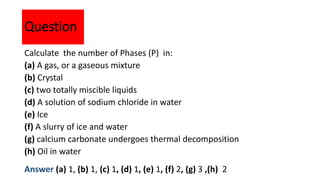
Calculate the number of Phases (P) in:
(a) A gas, or a gaseous mixture
(b) Crystal
(c) two totally miscible liquids
(d) A solution of sodium chloride in water
(e) Ice
(f) A slurry of ice and water
(g) calcium carbonate undergoes thermal decomposition
(h) Oil in water
Question
Answer (a) 1, (b) 1, (c) 1, (d) 1, (e) 1, (f) 2, (g) 3 ,(h) 2
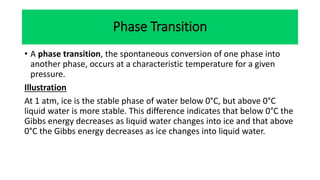
Phase Transition
• A phase transition, the spontaneous conversion of one phase into
another phase, occurs at a characteristic temperature for a given
pressure.
Illustration
At 1 atm, ice is the stable phase of water below 0°C, but above 0°C
liquid water is more stable. This difference indicates that below 0°C the
Gibbs energy decreases as liquid water changes into ice and that above
0°C the Gibbs energy decreases as ice changes into liquid water.
Transition temperature
• The transition temperature, Ttrs, is the temperature at which the
two phases are in equilibrium and the Gibbs energy is minimized at the
prevailing pressure.
What about Carbon?
• At normal temperatures and pressures the molar Gibbs energy of
graphite is lower than that of diamond, so there is a thermodynamic
tendency for diamond to change into graphite.
But No…!
Why?
• For this transition to take place, the C atoms must change their
locations, which is an immeasurably slow process in a solid except at
high temperatures.
• The discussion of the rate of attainment of equilibrium is a kinetic
problem and is outside the range of thermodynamics. In gases and
liquids the mobilities of the molecules allow phase transitions to
occur rapidly, but in solids thermodynamic instability may be frozen
in.
Metastable Phase
• Thermodynamically unstable phases that persist because the
transition is kinetically hindered are called metastable phases.
Example:
Diamond is a metastable phase of carbon under normal conditions.
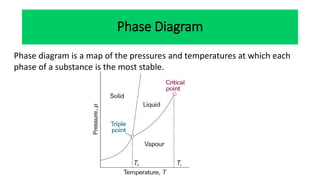
Phase Diagram
• The phase diagram of a substance shows the regions of pressure and
temperature at which its various phases are thermodynamically
stable.
Phase Diagram
Phase diagram is a map of the pressures and temperatures at which each
phase of a substance is the most stable.
Phase Boundaries
• The lines separating the regions, which are called phase boundaries,
show the values of p and T at which two phases coexist in
equilibrium.
Vapor Pressure
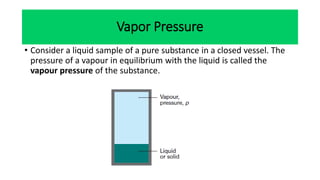
• Consider a liquid sample of a pure substance in a closed vessel. The
pressure of a vapour in equilibrium with the liquid is called the
vapour pressure of the substance.
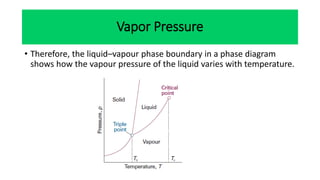
• Therefore, the liquid–vapour phase boundary in a phase diagram
shows how the vapour pressure of the liquid varies with temperature.
Vapor Pressure
• The solid– vapour phase boundary shows the temperature variation
of the sublimation vapour pressure, the vapour pressure of the solid
phase.
• The vapour pressure of a substance increases with temperature
because at higher temperatures more molecules have sufficient
energy to escape from their neighbours.
Vapor Pressure
Boiling Temperature
• The temperature at which the vapour pressure of a liquid is equal to
the external pressure is called the boiling temperature at that
pressure.
Normal Boiling point
Vs
Standard Boiling point
• For an external pressure of 1 atm, the boiling temperature is called
the normal boiling point, Tb
• standard boiling point is the temperature at which the vapour
pressure reaches 1 bar.
• Hint: 1.00 bar = 0.987 atm. Choose normal boiling point standard
boiling point of water.
(a) 99.6°C (b) 100°C
Critical Points
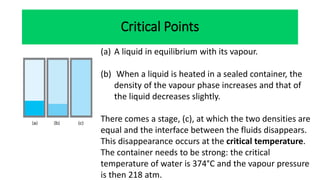
(a) A liquid in equilibrium with its vapour.
(b) When a liquid is heated in a sealed container, the
density of the vapour phase increases and that of
the liquid decreases slightly.
There comes a stage, (c), at which the two densities are
equal and the interface between the fluids disappears.
This disappearance occurs at the critical temperature.
The container needs to be strong: the critical
temperature of water is 374°C and the vapour pressure
is then 218 atm.
Melting Temperature
• The temperature at which, under a specified pressure, the liquid and
solid phases of a substance coexist in equilibrium is called the melting
temperature.
• The freezing temperature when the pressure is 1 atm is called the
normal freezing point, Tf,
• Freezing point when the pressure is 1 bar is called the standard
freezing point.
Normal Freezing point
Vs
Standard Freezing point
Triple Point
• There is a set of conditions under which three different phases of a
substance (typically solid, liquid, and vapour) all simultaneously
coexist in equilibrium.
• These conditions are represented by the triple point, a point at
which the three phase boundaries meet.
• The temperature at the triple point is denoted T3
Triple Point
• The triple point of a pure substance is outside our control: it occurs at
a single definite pressure and temperature characteristic of the
substance.
• The triple point of water lies at 273.16 K and 611 Pa (6.11 mbar, 4.58
Torr), and the three phases of water (ice, liquid water, and water
vapour) coexist in equilibrium at no other combination of pressure
and temperature.
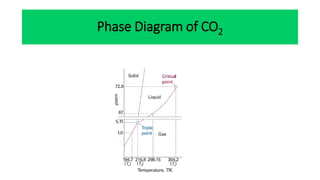
Phase Diagram of CO2
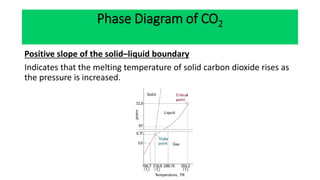
Positive slope of the solid–liquid boundary
Indicates that the melting temperature of solid carbon dioxide rises as
the pressure is increased.
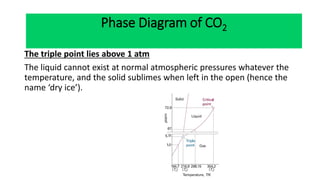
The triple point lies above 1 atm
The liquid cannot exist at normal atmospheric pressures whatever the
temperature, and the solid sublimes when left in the open (hence the
name ‘dry ice’).
Phase Diagram of CO2
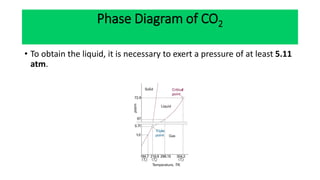
• To obtain the liquid, it is necessary to exert a pressure of at least 5.11
atm.
Phase Diagram of CO2
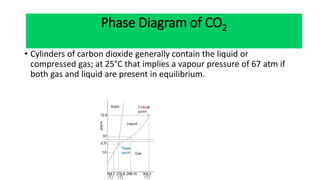
• Cylinders of carbon dioxide generally contain the liquid or
compressed gas; at 25°C that implies a vapour pressure of 67 atm if
both gas and liquid are present in equilibrium.
Phase Diagram of CO2
Question
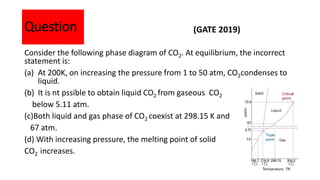
Consider the following phase diagram of CO2. At equilibrium, the incorrect
statement is:
(a) At 200K, on increasing the pressure from 1 to 50 atm, CO2condenses to
liquid.
(b) It is nt pssible to obtain liquid CO2 from gaseous CO2
below 5.11 atm.
(c)Both liquid and gas phase of CO2 coexist at 298.15 K and
67 atm.
(d) With increasing pressure, the melting point of solid
CO2 increases.
(GATE 2019)
Answer
• Option (a) is incorrect.
Gaseous CO2 converted into liquid at -78°C.
Thank You

Phase diagram

  • 1.
    Phase Diagrams Dr. AnjaliDevi J S Assistant Professor (Contract Faculty), IIRBS, Mahatma Gandhi University, Kerala.
  • 2.
    Phase • A phaseof a substance is a form of matter that is uniform throughout in chemical composition and physical state. Three phases of water: Ice Water Steam
  • 3.
  • 4.
  • 5.
    Calculate the numberof Phases (P) in: (a) A gas, or a gaseous mixture (b) Crystal (c) two totally miscible liquids (d) A solution of sodium chloride in water (e) Ice (f) A slurry of ice and water (g) calcium carbonate undergoes thermal decomposition (h) Oil in water Question Answer (a) 1, (b) 1, (c) 1, (d) 1, (e) 1, (f) 2, (g) 3 ,(h) 2
  • 6.
    Phase Transition • Aphase transition, the spontaneous conversion of one phase into another phase, occurs at a characteristic temperature for a given pressure. Illustration At 1 atm, ice is the stable phase of water below 0°C, but above 0°C liquid water is more stable. This difference indicates that below 0°C the Gibbs energy decreases as liquid water changes into ice and that above 0°C the Gibbs energy decreases as ice changes into liquid water.
  • 7.
    Transition temperature • Thetransition temperature, Ttrs, is the temperature at which the two phases are in equilibrium and the Gibbs energy is minimized at the prevailing pressure.
  • 8.
    What about Carbon? •At normal temperatures and pressures the molar Gibbs energy of graphite is lower than that of diamond, so there is a thermodynamic tendency for diamond to change into graphite.
  • 9.
    But No…! Why? • Forthis transition to take place, the C atoms must change their locations, which is an immeasurably slow process in a solid except at high temperatures. • The discussion of the rate of attainment of equilibrium is a kinetic problem and is outside the range of thermodynamics. In gases and liquids the mobilities of the molecules allow phase transitions to occur rapidly, but in solids thermodynamic instability may be frozen in.
  • 10.
    Metastable Phase • Thermodynamicallyunstable phases that persist because the transition is kinetically hindered are called metastable phases. Example: Diamond is a metastable phase of carbon under normal conditions.
  • 11.
    Phase Diagram • Thephase diagram of a substance shows the regions of pressure and temperature at which its various phases are thermodynamically stable.
  • 12.
    Phase Diagram Phase diagramis a map of the pressures and temperatures at which each phase of a substance is the most stable.
  • 13.
    Phase Boundaries • Thelines separating the regions, which are called phase boundaries, show the values of p and T at which two phases coexist in equilibrium.
  • 14.
    Vapor Pressure • Considera liquid sample of a pure substance in a closed vessel. The pressure of a vapour in equilibrium with the liquid is called the vapour pressure of the substance.
  • 15.
    • Therefore, theliquid–vapour phase boundary in a phase diagram shows how the vapour pressure of the liquid varies with temperature. Vapor Pressure
  • 16.
    • The solid–vapour phase boundary shows the temperature variation of the sublimation vapour pressure, the vapour pressure of the solid phase. • The vapour pressure of a substance increases with temperature because at higher temperatures more molecules have sufficient energy to escape from their neighbours. Vapor Pressure
  • 17.
    Boiling Temperature • Thetemperature at which the vapour pressure of a liquid is equal to the external pressure is called the boiling temperature at that pressure.
  • 18.
    Normal Boiling point Vs StandardBoiling point • For an external pressure of 1 atm, the boiling temperature is called the normal boiling point, Tb • standard boiling point is the temperature at which the vapour pressure reaches 1 bar. • Hint: 1.00 bar = 0.987 atm. Choose normal boiling point standard boiling point of water. (a) 99.6°C (b) 100°C
  • 19.
    Critical Points (a) Aliquid in equilibrium with its vapour. (b) When a liquid is heated in a sealed container, the density of the vapour phase increases and that of the liquid decreases slightly. There comes a stage, (c), at which the two densities are equal and the interface between the fluids disappears. This disappearance occurs at the critical temperature. The container needs to be strong: the critical temperature of water is 374°C and the vapour pressure is then 218 atm.
  • 20.
    Melting Temperature • Thetemperature at which, under a specified pressure, the liquid and solid phases of a substance coexist in equilibrium is called the melting temperature.
  • 21.
    • The freezingtemperature when the pressure is 1 atm is called the normal freezing point, Tf, • Freezing point when the pressure is 1 bar is called the standard freezing point. Normal Freezing point Vs Standard Freezing point
  • 22.
    Triple Point • Thereis a set of conditions under which three different phases of a substance (typically solid, liquid, and vapour) all simultaneously coexist in equilibrium. • These conditions are represented by the triple point, a point at which the three phase boundaries meet. • The temperature at the triple point is denoted T3
  • 23.
    Triple Point • Thetriple point of a pure substance is outside our control: it occurs at a single definite pressure and temperature characteristic of the substance. • The triple point of water lies at 273.16 K and 611 Pa (6.11 mbar, 4.58 Torr), and the three phases of water (ice, liquid water, and water vapour) coexist in equilibrium at no other combination of pressure and temperature.
  • 24.
  • 25.
    Phase Diagram ofCO2 Positive slope of the solid–liquid boundary Indicates that the melting temperature of solid carbon dioxide rises as the pressure is increased.
  • 26.
    The triple pointlies above 1 atm The liquid cannot exist at normal atmospheric pressures whatever the temperature, and the solid sublimes when left in the open (hence the name ‘dry ice’). Phase Diagram of CO2
  • 27.
    • To obtainthe liquid, it is necessary to exert a pressure of at least 5.11 atm. Phase Diagram of CO2
  • 28.
    • Cylinders ofcarbon dioxide generally contain the liquid or compressed gas; at 25°C that implies a vapour pressure of 67 atm if both gas and liquid are present in equilibrium. Phase Diagram of CO2
  • 29.
    Question Consider the followingphase diagram of CO2. At equilibrium, the incorrect statement is: (a) At 200K, on increasing the pressure from 1 to 50 atm, CO2condenses to liquid. (b) It is nt pssible to obtain liquid CO2 from gaseous CO2 below 5.11 atm. (c)Both liquid and gas phase of CO2 coexist at 298.15 K and 67 atm. (d) With increasing pressure, the melting point of solid CO2 increases. (GATE 2019)
  • 30.
    Answer • Option (a)is incorrect. Gaseous CO2 converted into liquid at -78°C.
  • 31.