DESIGN AND ANALYSIS OF
ALGORITHMS
UNIT-I
ABHIMANYU MISHRA
ASSISTANT PROF.(CSE)
JETGI
6/10/2017 1Abhimanyu Mishra(CSE) JETGI
 Notion of an Algorithm
 Fundamentals of Algorithmic Problem Solving
 Important Problem Types
 Fundamentals of the Analysis of Algorithm Efficiency
 Analysis Framework
 Asymptotic Notations and its properties
 Mathematical analysis for Recursive algorithms
 Mathematical analysis for Non-recursive algorithms
CONTENTS
6/10/2017 2Abhimanyu Mishra(CSE) JETGI
NOTION OF AN ALGORITHM
• An algorithm is a sequence of unambiguous instructions for solving a problem,
i.e., for obtaining a required output for any legitimate input in a finite amount of
time.
Introduction To Algorithm:
6/10/2017 3Abhimanyu Mishra(CSE) JETGI
Problem to be
solved
Algorithm
Output
Computer
Program
Input
Characteristics of an algorithm:
 Input: Zero / more quantities are externally supplied.
 Output: At least one quantity is produced.
 Definiteness: Each instruction is clear and unambiguous.
 Finiteness: If the instructions of an algorithm is traced then
for all cases the algorithm must terminates after a finite
number of steps.
 Efficiency: Every instruction must be very basic and runs in
short time.
6/10/2017 4Abhimanyu Mishra(CSE) JETGI
An algorithm is a procedure. It has two parts; the first part is head and the second part is
body.
 The Head section consists of keyword Algorithm and Name of the algorithm with
parameter list. E.g. Algorithm name1(p1, p2,…,p3). The head section also has the
following:
//Problem Description
//Input:
//Output:
In the body of an algorithm various programming constructs like if, for, while and some
statements like assignments are used.
The compound statements may be enclosed with { and } brackets. if, for, while can be
closed by endif, endfor, endwhile respectively. Proper indention is must for block.
The identifier should begin by a letter and not by digit. It contains alpha numeric letters
after first letter. No need to mention data types.
Input and Output can be done using read and write.
Steps for writing an algorithm:
6/10/2017 5Abhimanyu Mishra(CSE) JETGI
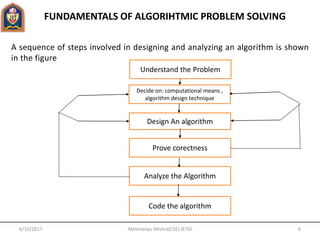
A sequence of steps involved in designing and analyzing an algorithm is shown
in the figure
FUNDAMENTALS OF ALGORIHTMIC PROBLEM SOLVING
6/10/2017 6Abhimanyu Mishra(CSE) JETGI
Understand the Problem
Decide on: computational means ,
algorithm design technique
Design An algorithm
Prove corectness
Analyze the Algorithm
Code the algorithm
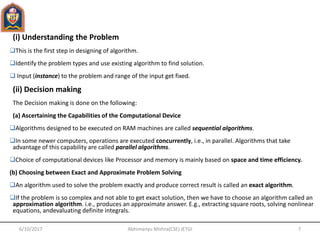
(i) Understanding the Problem
This is the first step in designing of algorithm.
Identify the problem types and use existing algorithm to find solution.
 Input (instance) to the problem and range of the input get fixed.
(ii) Decision making
The Decision making is done on the following:
(a) Ascertaining the Capabilities of the Computational Device
Algorithms designed to be executed on RAM machines are called sequential algorithms.
In some newer computers, operations are executed concurrently, i.e., in parallel. Algorithms that take
advantage of this capability are called parallel algorithms.
Choice of computational devices like Processor and memory is mainly based on space and time efficiency.
(b) Choosing between Exact and Approximate Problem Solving
An algorithm used to solve the problem exactly and produce correct result is called an exact algorithm.
If the problem is so complex and not able to get exact solution, then we have to choose an algorithm called an
approximation algorithm. i.e., produces an approximate answer. E.g., extracting square roots, solving nonlinear
equations, andevaluating definite integrals.
6/10/2017 7Abhimanyu Mishra(CSE) JETGI
(c) Algorithm Design Techniques
 An algorithm design technique (or “strategy” or “paradigm”) is a general approach
to solving problems algorithmically that is applicable to a variety of problems from different areas of
computing.
 Algorithms+ Data Structures = Programs
(iii) Methods of Specifying an Algorithm
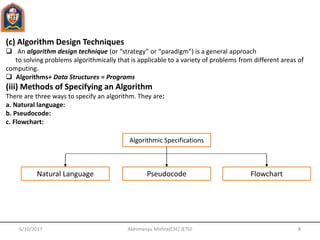
There are three ways to specify an algorithm. They are:
a. Natural language:
b. Pseudocode:
c. Flowchart:
6/10/2017 8Abhimanyu Mishra(CSE) JETGI
Algorithmic Specifications
FlowchartPseudocodeNatural Language
6/10/2017 9Abhimanyu Mishra(CSE) JETGI
a. Natural Language
It is very simple and easy to specify an algorithm using natural language. But many times
specification of algorithm by using natural language is not clear and thereby we get brief
specification.
Example: An algorithm to perform addition of two numbers.
Step 1: Read the first number, say a.
Step 2: Read the first number, say b.
Step 3: Add the above two numbers and store the result in c.
Step 4: Display the result from c.
Such a specification creates difficulty while actually implementing it. Hence many programmers
prefer to have specification of algorithm by means of Pseudocode.
b. Pseudocode
Pseudocode is a mixture of a natural language and programming language constructs. Pseudocode is
usually more precise than natural language.
For Assignment operation left arrow “←”, for comments two slashes “//”,if condition, for,while loops
are used.
ALGORITHM Sum(a,b)
//Problem Description: This algorithm performs addition of two numbers
//Input: Two integers a and b
//Output: Addition of two integers
c←a+b
return c
c. Flowchart
Flowchart is a graphical representation of an algorithm. It is a a method of
expressing an algorithm by a collection of connected geometric shapes
containing descriptions of the algorithm’s step
6/10/2017 10Abhimanyu Mishra(CSE) JETGI
(iv) Proving an Algorithm’s Correctness
 Once an algorithm has been specified then its correctness must be proved.
 An algorithm must yields a required result for every legitimate input in a finite
amount of time.
(v) Analyzing an Algorithm
 For an algorithm the most important is efficiency. In fact, there are two kinds of
algorithm efficiency. They are:
 Time efficiency, indicating how fast the algorithm runs, and
 Space efficiency, indicating how much extra memory it uses.
 The efficiency of an algorithm is determined by measuring both time efficiency
and space efficiency.
So factors to analyze an algorithm are:
 Time efficiency of an algorithm
 Space efficiency of an algorithm
 Simplicity of an algorithm
 Generality of an algorithm
6/10/2017 11Abhimanyu Mishra(CSE) JETGI
6/10/2017 12Abhimanyu Mishra(CSE) JETGI
(vi) Coding an Algorithm
 The coding / implementation of an algorithm is done by a suitable programming
language like C, C++, JAVA.
 It is very essential to write an optimized code (efficient code) to reduce the burden of
compiler.
FUNDAMENTALS OF THE ANALYSIS OF ALGORITHM EFFICIENCY:
The efficiency of an algorithm can be in terms of time and space. The algorithm
efficiency can be analyzed by the following ways:-
a. Analysis Framework.
b. Asymptotic Notations and its properties.
c. Mathematical analysis for Recursive algorithms.
d. Mathematical analysis for Non-recursive algorithms.
 Analysis Framework
There are two kinds of efficiencies to analyze the efficiency of any algorithm. They
are:
• Time efficiency, indicating how fast the algorithm runs, and
• Space efficiency, indicating how much extra memory it uses.
The algorithm analysis framework consists of the following:
• Measuring an Input’s Size
• Units for Measuring Running Time
• Orders of Growth
• Worst-Case, Best-Case, and Average-Case Efficiencies
6/10/2017 13Abhimanyu Mishra(CSE) JETGI
Orders of Growth
 A difference in running times on small inputs is not what really distinguishes efficient
 algorithms from inefficient ones.
 For example, the greatest common divisor of two small numbers, it is not immediately clear
how much more efficient Euclid’s algorithm is compared to the other algorithms, the
difference in algorithm efficiencies becomes clear for larger numbers only.
Worst-Case, Best-Case, and Average-Case Efficiencies
Consider Sequential Search algorithm some search key K
ALGORITHM SequentialSearch(A[0..n - 1], K)
//Searches for a given value in a given array by sequential search
//Input: An array A[0..n - 1] and a search key K
//Output: The index of the first element in A that matches K or -1 if there are no
// matching elements
i ←0
while i < n and A[i] ≠ K do
i ←i + 1
if i < n return i
else return -1
Clearly, the running time of this algorithm can be quite different for the same list size n.
6/10/2017 14Abhimanyu Mishra(CSE) JETGI
Worst-case efficiency:-
• The worst-case efficiency of an algorithm is its efficiency for the worst case
input of size n.
• The algorithm runs the longest among all possible inputs of that size.
• For the input of size n, the running time is Cworst(n) = n.
Best case efficiency
• The best-case efficiency of an algorithm is its efficiency for the best case
input of size n.
• The algorithm runs the fastest among all possible inputs of that size n.
• In sequential search, If we search a first element in list of size n. (i.e. first
element equal to a search key), then the running time is
Cbest(n) = 1.
Average case efficiency
• The Average case efficiency lies between best case and worst case.
• To analyze the algorithm’s average case efficiency, we must make some
assumptions aboutpossible inputs of size n.
6/10/2017 15Abhimanyu Mishra(CSE) JETGI
6/10/2017 16Abhimanyu Mishra(CSE) JETGI
The standard assumptions are that
• The probability of a successful search is equal to p (0 ≤ p ≤ 1) and
• The probability of the first match occurring in the ith position of the list is the
same for every i.
6/10/2017 17Abhimanyu Mishra(CSE) JETGI
ASYMPTOTIC NOTATIONS AND ITS PROPERTIES
Asymptotic notation is a notation, which is used to take meaningful statement about the
efficiency of a program.
The efficiency analysis framework concentrates on the order of growth of an
algorithm’s basic operation count as the principal indicator of the algorithm’s efficiency.
To compare and rank such orders of growth, computer scientists use three notations,
they
are:
 O - Big oh notation
 Ω - Big omega notation
 Θ - Big theta notation
Let t(n) and g(n) can be any nonnegative functions defined on the set of natural
numbers.
The algorithm’s running time t(n) usually indicated by its basic operation count C(n),
and g(n),some simple function to compare with the count.
6/10/2017 Abhimanyu Mishra(CSE) JETGI 18
(i) O - Big oh notation
A function t(n) is said to be in O(g(n)), denoted t (n) ∈ O(g(n)),if t (n) is bounded above
by some constant multiple of g(n) for all large n, i.e., if there exist some positive constant c
and some non-negative integer n0 such that
t(n) ≤ c g(n) for all n ≥ n0
Where t(n) and g(n) are nonnegative functions defined on the set of natural numbers.
O = Asymptotic upper bound = Useful for worst case analysis = Loose bound
Big-oh notation: t(n) ∈O(g(n))
6/10/2017 19Abhimanyu Mishra(CSE) JETGI
(ii) Ω - Big omega notation
A function t(n) is said to be in Ω(g(n)), denoted t(n) ∈ Ω(g(n)), if t(n) is bounded
below by some positive constant multiple of g(n) for all large n, i.e., if there exist
some positive constant c and some nonnegative integer n0 such that
t (n) ≥ cg(n) for all n ≥ n0.
Where t(n) and g(n) are nonnegative functions defined on the set of natural
numbers.
Ω = Asymptotic lower bound = Useful for best case analysis = Loose bound
Big-omega notation: t (n) ∈ Ω (g(n)).
6/10/2017 Abhimanyu Mishra(CSE) JETGI 20
(iii) Θ - Big theta notation
A function t(n) is said to be in Θ(g(n)), denoted t(n) ∈ Θ(g(n)), if t(n) is bounded both
above and below by some positive constant multiples of g(n) for all large n, i.e., if there
exist some positive constants c1 and c2 and some nonnegative integer n0 such that
c2g(n) ≤ t (n) ≤ c1g(n) for all n ≥ n0.
Where t(n) and g(n) are nonnegative functions defined on the set of natural numbers.
Θ = Asymptotic tight bound = Useful for average case analysis
Big-theta notation: t (n) ∈ Θ(g(n))
6/10/2017 21Abhimanyu Mishra(CSE) JETGI
General Plan for Analyzing the Time Efficiency of Recursive Algorithms
1. Decide on a parameter (or parameters) indicating an input’s size.
2. Identify the algorithm’s basic operation.
3. Check whether the number of times the basic operation is executed can vary on
different inputs of the same size; if it can, the worst-case, average-case, and best-
case efficiencies must be investigated separately.
4. Set up a recurrence relation, with an appropriate initial condition, for the number of
times the basic operation is executed.
5. Solve the recurrence or, at least, ascertain the order of growth of its solution.
MATHEMATICAL ANALYSIS FOR RECURSIVE ALGORITHMS
Recurrence relations:
The reccurence equation is an eequation that defines a sequence recursively.It normally belongs
in the form:-
T(n)=T(n-1)+n for all n>0
Methods For Solving Recurrence Relation:
 Substitution method
 Recurrence Tree Method
 Master’s Theorem
6/10/2017 22Abhimanyu Mishra(CSE) JETGI
MATHEMATICAL ANALYSIS FOR NON-RECURSIVE ALGORITHMS
General Plan for Analyzing the Time Efficiency of Nonrecursive Algorithms
1. Decide on a parameter (or parameters) indicating an input’s size.
2. Identify the algorithm’s basic operation (in the innermost loop).
3. Check whether the number of times the basic operation is executed depends only
on the size of an input. If it also depends on some additional property, the worst-case,
average-case,and, if necessary, best-case efficiencies have to be investigated
separately.
4. Set up a sum expressing the number of times the algorithm’s basic operation is
executed.
5. Using standard formulas and rules of sum manipulation either find a closed form
formula for the count or at the least, establish its order of growth.
6/10/2017 Abhimanyu Mishra(CSE) JETGI 23
Example For Substitution Method
We make a guess for the solution and then we use mathematical induction to prove the the
guess is correct or incorrect.
For example:
consider the recurrence T(n) = 2T(n/2) + n
We guess the solution as T(n) = O(nLogn).
Now we use induction to prove our guess.
We need to prove that T(n) <= cnLogn.
We can assume that it is true for values smaller than n.
T(n) = 2T(n/2) + n
<= cn/2Log(n/2) + n
<= cnLogn - cnLog2 + n
= cnLogn - cn + n
<= cnLogn
6/10/2017 Abhimanyu Mishra(CSE) JETGI 24
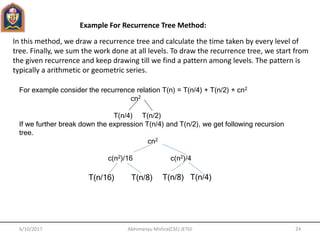
Example For Recurrence Tree Method:
In this method, we draw a recurrence tree and calculate the time taken by every level of
tree. Finally, we sum the work done at all levels. To draw the recurrence tree, we start from
the given recurrence and keep drawing till we find a pattern among levels. The pattern is
typically a arithmetic or geometric series.
For example consider the recurrence relation T(n) = T(n/4) + T(n/2) + cn2
cn2
T(n/4) T(n/2)
If we further break down the expression T(n/4) and T(n/2), we get following recursion
tree.
cn2
c(n2)/16 c(n2)/4
T(n/16) T(n/8) T(n/8) T(n/4)
6/10/2017 Abhimanyu Mishra(CSE) JETGI 25
Breaking down further gives us following
cn2
c(n2)/16 c(n2)/4
c(n2)/256 c(n2)/64 c(n2)/64 c(n2)/16
To know the value of T(n), we need to calculate sum of tree nodes level by level.
If we sum the above tree level by level, we get the following series
T(n) = c(n^2 + 5(n^2)/16 + 25(n^2)/256) + ....
The above series is geometrical progression with ratio 5/16. To get an upper
bound, we can sum the infinite series.
We get the sum as (n2)/(1 - 5/16) which is O(n2)
6/10/2017 Abhimanyu Mishra(CSE) JETGI 26
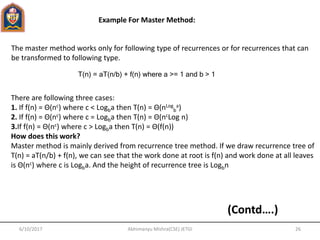
Example For Master Method:
The master method works only for following type of recurrences or for recurrences that can
be transformed to following type.
T(n) = aT(n/b) + f(n) where a >= 1 and b > 1
There are following three cases:
1. If f(n) = Θ(nc) where c < Logba then T(n) = Θ(nLog
b
a)
2. If f(n) = Θ(nc) where c = Logba then T(n) = Θ(ncLog n)
3.If f(n) = Θ(nc) where c > Logba then T(n) = Θ(f(n))
How does this work?
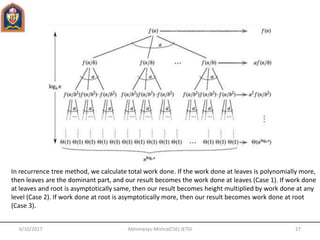
Master method is mainly derived from recurrence tree method. If we draw recurrence tree of
T(n) = aT(n/b) + f(n), we can see that the work done at root is f(n) and work done at all leaves
is Θ(nc) where c is Logba. And the height of recurrence tree is Logbn
(Contd….)
6/10/2017 Abhimanyu Mishra(CSE) JETGI 27
In recurrence tree method, we calculate total work done. If the work done at leaves is polynomially more,
then leaves are the dominant part, and our result becomes the work done at leaves (Case 1). If work done
at leaves and root is asymptotically same, then our result becomes height multiplied by work done at any
level (Case 2). If work done at root is asymptotically more, then our result becomes work done at root
(Case 3).
6/10/2017 Abhimanyu Mishra(CSE) JETGI 28
Notes:
1) It is not necessary that a recurrence of the form T(n) = aT(n/b) + f(n) can be solved
using Master Theorem. The given three cases have some gaps between them. For
example, the recurrence T(n) = 2T(n/2) + n/Logn cannot be solved using master method.
2) Case 2 can be extended for f(n) = Θ(ncLogkn)
If f(n) = Θ(ncLogkn) for some constant k >= 0 and c = Logba, then T(n) = Θ(ncLogk+1n)
Examples of some standard algorithms whose time complexity can be evaluated using
Master Method
Merge Sort: T(n) = 2T(n/2) + Θ(n). It falls in case 2 as c is 1 and Logba] is also 1. So the
solution is Θ(n Logn)
Binary Search: T(n) = T(n/2) + Θ(1). It also falls in case 2 as c is 0 and Logba is also 0. So
the solution is Θ(Logn)
All the best - There is no substitute for hard work

Daa unit 1

  • 1.
    DESIGN AND ANALYSISOF ALGORITHMS UNIT-I ABHIMANYU MISHRA ASSISTANT PROF.(CSE) JETGI 6/10/2017 1Abhimanyu Mishra(CSE) JETGI
  • 2.
     Notion ofan Algorithm  Fundamentals of Algorithmic Problem Solving  Important Problem Types  Fundamentals of the Analysis of Algorithm Efficiency  Analysis Framework  Asymptotic Notations and its properties  Mathematical analysis for Recursive algorithms  Mathematical analysis for Non-recursive algorithms CONTENTS 6/10/2017 2Abhimanyu Mishra(CSE) JETGI
  • 3.
    NOTION OF ANALGORITHM • An algorithm is a sequence of unambiguous instructions for solving a problem, i.e., for obtaining a required output for any legitimate input in a finite amount of time. Introduction To Algorithm: 6/10/2017 3Abhimanyu Mishra(CSE) JETGI Problem to be solved Algorithm Output Computer Program Input
  • 4.
    Characteristics of analgorithm:  Input: Zero / more quantities are externally supplied.  Output: At least one quantity is produced.  Definiteness: Each instruction is clear and unambiguous.  Finiteness: If the instructions of an algorithm is traced then for all cases the algorithm must terminates after a finite number of steps.  Efficiency: Every instruction must be very basic and runs in short time. 6/10/2017 4Abhimanyu Mishra(CSE) JETGI
  • 5.
    An algorithm isa procedure. It has two parts; the first part is head and the second part is body.  The Head section consists of keyword Algorithm and Name of the algorithm with parameter list. E.g. Algorithm name1(p1, p2,…,p3). The head section also has the following: //Problem Description //Input: //Output: In the body of an algorithm various programming constructs like if, for, while and some statements like assignments are used. The compound statements may be enclosed with { and } brackets. if, for, while can be closed by endif, endfor, endwhile respectively. Proper indention is must for block. The identifier should begin by a letter and not by digit. It contains alpha numeric letters after first letter. No need to mention data types. Input and Output can be done using read and write. Steps for writing an algorithm: 6/10/2017 5Abhimanyu Mishra(CSE) JETGI
  • 6.
    A sequence ofsteps involved in designing and analyzing an algorithm is shown in the figure FUNDAMENTALS OF ALGORIHTMIC PROBLEM SOLVING 6/10/2017 6Abhimanyu Mishra(CSE) JETGI Understand the Problem Decide on: computational means , algorithm design technique Design An algorithm Prove corectness Analyze the Algorithm Code the algorithm
  • 7.
    (i) Understanding theProblem This is the first step in designing of algorithm. Identify the problem types and use existing algorithm to find solution.  Input (instance) to the problem and range of the input get fixed. (ii) Decision making The Decision making is done on the following: (a) Ascertaining the Capabilities of the Computational Device Algorithms designed to be executed on RAM machines are called sequential algorithms. In some newer computers, operations are executed concurrently, i.e., in parallel. Algorithms that take advantage of this capability are called parallel algorithms. Choice of computational devices like Processor and memory is mainly based on space and time efficiency. (b) Choosing between Exact and Approximate Problem Solving An algorithm used to solve the problem exactly and produce correct result is called an exact algorithm. If the problem is so complex and not able to get exact solution, then we have to choose an algorithm called an approximation algorithm. i.e., produces an approximate answer. E.g., extracting square roots, solving nonlinear equations, andevaluating definite integrals. 6/10/2017 7Abhimanyu Mishra(CSE) JETGI
  • 8.
    (c) Algorithm DesignTechniques  An algorithm design technique (or “strategy” or “paradigm”) is a general approach to solving problems algorithmically that is applicable to a variety of problems from different areas of computing.  Algorithms+ Data Structures = Programs (iii) Methods of Specifying an Algorithm There are three ways to specify an algorithm. They are: a. Natural language: b. Pseudocode: c. Flowchart: 6/10/2017 8Abhimanyu Mishra(CSE) JETGI Algorithmic Specifications FlowchartPseudocodeNatural Language
  • 9.
    6/10/2017 9Abhimanyu Mishra(CSE)JETGI a. Natural Language It is very simple and easy to specify an algorithm using natural language. But many times specification of algorithm by using natural language is not clear and thereby we get brief specification. Example: An algorithm to perform addition of two numbers. Step 1: Read the first number, say a. Step 2: Read the first number, say b. Step 3: Add the above two numbers and store the result in c. Step 4: Display the result from c. Such a specification creates difficulty while actually implementing it. Hence many programmers prefer to have specification of algorithm by means of Pseudocode. b. Pseudocode Pseudocode is a mixture of a natural language and programming language constructs. Pseudocode is usually more precise than natural language. For Assignment operation left arrow “←”, for comments two slashes “//”,if condition, for,while loops are used. ALGORITHM Sum(a,b) //Problem Description: This algorithm performs addition of two numbers //Input: Two integers a and b //Output: Addition of two integers c←a+b return c
  • 10.
    c. Flowchart Flowchart isa graphical representation of an algorithm. It is a a method of expressing an algorithm by a collection of connected geometric shapes containing descriptions of the algorithm’s step 6/10/2017 10Abhimanyu Mishra(CSE) JETGI
  • 11.
    (iv) Proving anAlgorithm’s Correctness  Once an algorithm has been specified then its correctness must be proved.  An algorithm must yields a required result for every legitimate input in a finite amount of time. (v) Analyzing an Algorithm  For an algorithm the most important is efficiency. In fact, there are two kinds of algorithm efficiency. They are:  Time efficiency, indicating how fast the algorithm runs, and  Space efficiency, indicating how much extra memory it uses.  The efficiency of an algorithm is determined by measuring both time efficiency and space efficiency. So factors to analyze an algorithm are:  Time efficiency of an algorithm  Space efficiency of an algorithm  Simplicity of an algorithm  Generality of an algorithm 6/10/2017 11Abhimanyu Mishra(CSE) JETGI
  • 12.
    6/10/2017 12Abhimanyu Mishra(CSE)JETGI (vi) Coding an Algorithm  The coding / implementation of an algorithm is done by a suitable programming language like C, C++, JAVA.  It is very essential to write an optimized code (efficient code) to reduce the burden of compiler.
  • 13.
    FUNDAMENTALS OF THEANALYSIS OF ALGORITHM EFFICIENCY: The efficiency of an algorithm can be in terms of time and space. The algorithm efficiency can be analyzed by the following ways:- a. Analysis Framework. b. Asymptotic Notations and its properties. c. Mathematical analysis for Recursive algorithms. d. Mathematical analysis for Non-recursive algorithms.  Analysis Framework There are two kinds of efficiencies to analyze the efficiency of any algorithm. They are: • Time efficiency, indicating how fast the algorithm runs, and • Space efficiency, indicating how much extra memory it uses. The algorithm analysis framework consists of the following: • Measuring an Input’s Size • Units for Measuring Running Time • Orders of Growth • Worst-Case, Best-Case, and Average-Case Efficiencies 6/10/2017 13Abhimanyu Mishra(CSE) JETGI
  • 14.
    Orders of Growth A difference in running times on small inputs is not what really distinguishes efficient  algorithms from inefficient ones.  For example, the greatest common divisor of two small numbers, it is not immediately clear how much more efficient Euclid’s algorithm is compared to the other algorithms, the difference in algorithm efficiencies becomes clear for larger numbers only. Worst-Case, Best-Case, and Average-Case Efficiencies Consider Sequential Search algorithm some search key K ALGORITHM SequentialSearch(A[0..n - 1], K) //Searches for a given value in a given array by sequential search //Input: An array A[0..n - 1] and a search key K //Output: The index of the first element in A that matches K or -1 if there are no // matching elements i ←0 while i < n and A[i] ≠ K do i ←i + 1 if i < n return i else return -1 Clearly, the running time of this algorithm can be quite different for the same list size n. 6/10/2017 14Abhimanyu Mishra(CSE) JETGI
  • 15.
    Worst-case efficiency:- • Theworst-case efficiency of an algorithm is its efficiency for the worst case input of size n. • The algorithm runs the longest among all possible inputs of that size. • For the input of size n, the running time is Cworst(n) = n. Best case efficiency • The best-case efficiency of an algorithm is its efficiency for the best case input of size n. • The algorithm runs the fastest among all possible inputs of that size n. • In sequential search, If we search a first element in list of size n. (i.e. first element equal to a search key), then the running time is Cbest(n) = 1. Average case efficiency • The Average case efficiency lies between best case and worst case. • To analyze the algorithm’s average case efficiency, we must make some assumptions aboutpossible inputs of size n. 6/10/2017 15Abhimanyu Mishra(CSE) JETGI
  • 16.
    6/10/2017 16Abhimanyu Mishra(CSE)JETGI The standard assumptions are that • The probability of a successful search is equal to p (0 ≤ p ≤ 1) and • The probability of the first match occurring in the ith position of the list is the same for every i.
  • 17.
    6/10/2017 17Abhimanyu Mishra(CSE)JETGI ASYMPTOTIC NOTATIONS AND ITS PROPERTIES Asymptotic notation is a notation, which is used to take meaningful statement about the efficiency of a program. The efficiency analysis framework concentrates on the order of growth of an algorithm’s basic operation count as the principal indicator of the algorithm’s efficiency. To compare and rank such orders of growth, computer scientists use three notations, they are:  O - Big oh notation  Ω - Big omega notation  Θ - Big theta notation Let t(n) and g(n) can be any nonnegative functions defined on the set of natural numbers. The algorithm’s running time t(n) usually indicated by its basic operation count C(n), and g(n),some simple function to compare with the count.
  • 18.
    6/10/2017 Abhimanyu Mishra(CSE)JETGI 18 (i) O - Big oh notation A function t(n) is said to be in O(g(n)), denoted t (n) ∈ O(g(n)),if t (n) is bounded above by some constant multiple of g(n) for all large n, i.e., if there exist some positive constant c and some non-negative integer n0 such that t(n) ≤ c g(n) for all n ≥ n0 Where t(n) and g(n) are nonnegative functions defined on the set of natural numbers. O = Asymptotic upper bound = Useful for worst case analysis = Loose bound Big-oh notation: t(n) ∈O(g(n))
  • 19.
    6/10/2017 19Abhimanyu Mishra(CSE)JETGI (ii) Ω - Big omega notation A function t(n) is said to be in Ω(g(n)), denoted t(n) ∈ Ω(g(n)), if t(n) is bounded below by some positive constant multiple of g(n) for all large n, i.e., if there exist some positive constant c and some nonnegative integer n0 such that t (n) ≥ cg(n) for all n ≥ n0. Where t(n) and g(n) are nonnegative functions defined on the set of natural numbers. Ω = Asymptotic lower bound = Useful for best case analysis = Loose bound Big-omega notation: t (n) ∈ Ω (g(n)).
  • 20.
    6/10/2017 Abhimanyu Mishra(CSE)JETGI 20 (iii) Θ - Big theta notation A function t(n) is said to be in Θ(g(n)), denoted t(n) ∈ Θ(g(n)), if t(n) is bounded both above and below by some positive constant multiples of g(n) for all large n, i.e., if there exist some positive constants c1 and c2 and some nonnegative integer n0 such that c2g(n) ≤ t (n) ≤ c1g(n) for all n ≥ n0. Where t(n) and g(n) are nonnegative functions defined on the set of natural numbers. Θ = Asymptotic tight bound = Useful for average case analysis Big-theta notation: t (n) ∈ Θ(g(n))
  • 21.
    6/10/2017 21Abhimanyu Mishra(CSE)JETGI General Plan for Analyzing the Time Efficiency of Recursive Algorithms 1. Decide on a parameter (or parameters) indicating an input’s size. 2. Identify the algorithm’s basic operation. 3. Check whether the number of times the basic operation is executed can vary on different inputs of the same size; if it can, the worst-case, average-case, and best- case efficiencies must be investigated separately. 4. Set up a recurrence relation, with an appropriate initial condition, for the number of times the basic operation is executed. 5. Solve the recurrence or, at least, ascertain the order of growth of its solution. MATHEMATICAL ANALYSIS FOR RECURSIVE ALGORITHMS Recurrence relations: The reccurence equation is an eequation that defines a sequence recursively.It normally belongs in the form:- T(n)=T(n-1)+n for all n>0 Methods For Solving Recurrence Relation:  Substitution method  Recurrence Tree Method  Master’s Theorem
  • 22.
    6/10/2017 22Abhimanyu Mishra(CSE)JETGI MATHEMATICAL ANALYSIS FOR NON-RECURSIVE ALGORITHMS General Plan for Analyzing the Time Efficiency of Nonrecursive Algorithms 1. Decide on a parameter (or parameters) indicating an input’s size. 2. Identify the algorithm’s basic operation (in the innermost loop). 3. Check whether the number of times the basic operation is executed depends only on the size of an input. If it also depends on some additional property, the worst-case, average-case,and, if necessary, best-case efficiencies have to be investigated separately. 4. Set up a sum expressing the number of times the algorithm’s basic operation is executed. 5. Using standard formulas and rules of sum manipulation either find a closed form formula for the count or at the least, establish its order of growth.
  • 23.
    6/10/2017 Abhimanyu Mishra(CSE)JETGI 23 Example For Substitution Method We make a guess for the solution and then we use mathematical induction to prove the the guess is correct or incorrect. For example: consider the recurrence T(n) = 2T(n/2) + n We guess the solution as T(n) = O(nLogn). Now we use induction to prove our guess. We need to prove that T(n) <= cnLogn. We can assume that it is true for values smaller than n. T(n) = 2T(n/2) + n <= cn/2Log(n/2) + n <= cnLogn - cnLog2 + n = cnLogn - cn + n <= cnLogn
  • 24.
    6/10/2017 Abhimanyu Mishra(CSE)JETGI 24 Example For Recurrence Tree Method: In this method, we draw a recurrence tree and calculate the time taken by every level of tree. Finally, we sum the work done at all levels. To draw the recurrence tree, we start from the given recurrence and keep drawing till we find a pattern among levels. The pattern is typically a arithmetic or geometric series. For example consider the recurrence relation T(n) = T(n/4) + T(n/2) + cn2 cn2 T(n/4) T(n/2) If we further break down the expression T(n/4) and T(n/2), we get following recursion tree. cn2 c(n2)/16 c(n2)/4 T(n/16) T(n/8) T(n/8) T(n/4)
  • 25.
    6/10/2017 Abhimanyu Mishra(CSE)JETGI 25 Breaking down further gives us following cn2 c(n2)/16 c(n2)/4 c(n2)/256 c(n2)/64 c(n2)/64 c(n2)/16 To know the value of T(n), we need to calculate sum of tree nodes level by level. If we sum the above tree level by level, we get the following series T(n) = c(n^2 + 5(n^2)/16 + 25(n^2)/256) + .... The above series is geometrical progression with ratio 5/16. To get an upper bound, we can sum the infinite series. We get the sum as (n2)/(1 - 5/16) which is O(n2)
  • 26.
    6/10/2017 Abhimanyu Mishra(CSE)JETGI 26 Example For Master Method: The master method works only for following type of recurrences or for recurrences that can be transformed to following type. T(n) = aT(n/b) + f(n) where a >= 1 and b > 1 There are following three cases: 1. If f(n) = Θ(nc) where c < Logba then T(n) = Θ(nLog b a) 2. If f(n) = Θ(nc) where c = Logba then T(n) = Θ(ncLog n) 3.If f(n) = Θ(nc) where c > Logba then T(n) = Θ(f(n)) How does this work? Master method is mainly derived from recurrence tree method. If we draw recurrence tree of T(n) = aT(n/b) + f(n), we can see that the work done at root is f(n) and work done at all leaves is Θ(nc) where c is Logba. And the height of recurrence tree is Logbn (Contd….)
  • 27.
    6/10/2017 Abhimanyu Mishra(CSE)JETGI 27 In recurrence tree method, we calculate total work done. If the work done at leaves is polynomially more, then leaves are the dominant part, and our result becomes the work done at leaves (Case 1). If work done at leaves and root is asymptotically same, then our result becomes height multiplied by work done at any level (Case 2). If work done at root is asymptotically more, then our result becomes work done at root (Case 3).
  • 28.
    6/10/2017 Abhimanyu Mishra(CSE)JETGI 28 Notes: 1) It is not necessary that a recurrence of the form T(n) = aT(n/b) + f(n) can be solved using Master Theorem. The given three cases have some gaps between them. For example, the recurrence T(n) = 2T(n/2) + n/Logn cannot be solved using master method. 2) Case 2 can be extended for f(n) = Θ(ncLogkn) If f(n) = Θ(ncLogkn) for some constant k >= 0 and c = Logba, then T(n) = Θ(ncLogk+1n) Examples of some standard algorithms whose time complexity can be evaluated using Master Method Merge Sort: T(n) = 2T(n/2) + Θ(n). It falls in case 2 as c is 1 and Logba] is also 1. So the solution is Θ(n Logn) Binary Search: T(n) = T(n/2) + Θ(1). It also falls in case 2 as c is 0 and Logba is also 0. So the solution is Θ(Logn) All the best - There is no substitute for hard work