Subject :- Discrete Structure
Submitted To :-Khoubo Patidar
Name of Presenter :-Irfan khan
PATEL COLLEGE OF SCIENCE & TECHNOLOGY
INDORE
COMBINATORICS
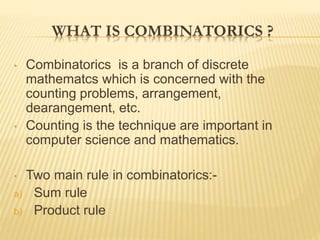
WHAT IS COMBINATORICS ?
• Combinatorics is a branch of discrete
mathematcs which is concerned with the
counting problems, arrangement,
dearangement, etc.
• Counting is the technique are important in
computer science and mathematics.
• Two main rule in combinatorics:-
a) Sum rule
b) Product rule
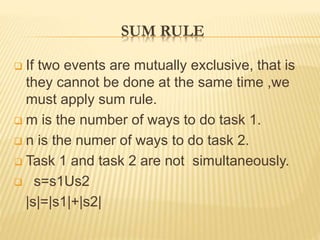
SUM RULE
 If two events are mutually exclusive, that is
they cannot be done at the same time ,we
must apply sum rule.
 m is the number of ways to do task 1.
 n is the numer of ways to do task 2.
 Task 1 and task 2 are not simultaneously.
 s=s1Us2
|s|=|s1|+|s2|
PRODUCT RULE
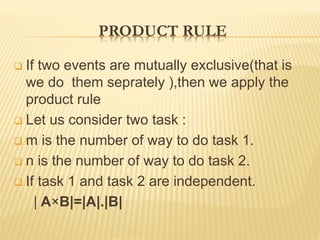
 If two events are mutually exclusive(that is
we do them seprately ),then we apply the
product rule
 Let us consider two task :
 m is the number of way to do task 1.
 n is the number of way to do task 2.
 If task 1 and task 2 are independent.
| A×B|=|A|.|B|
EXAMPLE OF SUM RULE
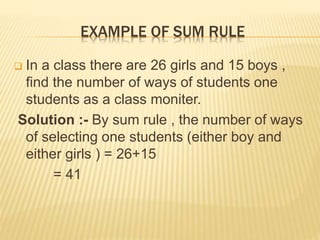
 In a class there are 26 girls and 15 boys ,
find the number of ways of students one
students as a class moniter.
Solution :- By sum rule , the number of ways
of selecting one students (either boy and
either girls ) = 26+15
= 41
EXAMPLE OF PRODUCT RULE
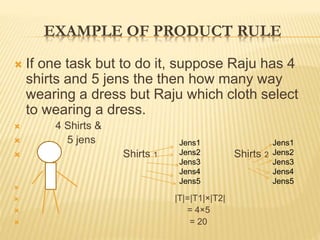
 If one task but to do it, suppose Raju has 4
shirts and 5 jens the then how many way
wearing a dress but Raju which cloth select
to wearing a dress.
 4 Shirts &
 5 jens
 Shirts 1 Shirts 2

 |T|=|T1|×|T2|
 = 4×5
 = 20
Jens1
Jens2
Jens3
Jens4
Jens5
Jens1
Jens2
Jens3
Jens4
Jens5
PERMUTATION
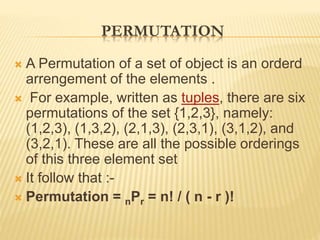
 A Permutation of a set of object is an orderd
arrengement of the elements .
 For example, written as tuples, there are six
permutations of the set {1,2,3}, namely:
(1,2,3), (1,3,2), (2,1,3), (2,3,1), (3,1,2), and
(3,2,1). These are all the possible orderings
of this three element set
 It follow that :-
 Permutation = nPr = n! / ( n - r )!
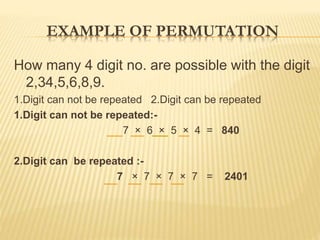
EXAMPLE OF PERMUTATION
How many 4 digit no. are possible with the digit
2,34,5,6,8,9.
1.Digit can not be repeated 2.Digit can be repeated
1.Digit can not be repeated:-
7 × 6 × 5 × 4 = 840
2.Digit can be repeated :-
7 × 7 × 7 × 7 = 2401
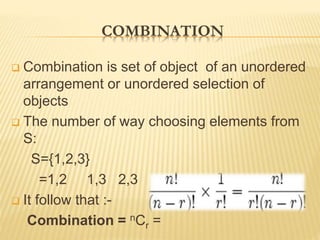
COMBINATION
 Combination is set of object of an unordered
arrangement or unordered selection of
objects
 The number of way choosing elements from
S:
S={1,2,3}
=1,2 1,3 2,3
 It follow that :-
Combination = nCr =
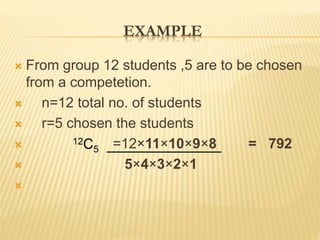
EXAMPLE
 From group 12 students ,5 are to be chosen
from a competetion.
 n=12 total no. of students
 r=5 chosen the students
 =12×11×10×9×8 = 792
 5×4×3×2×1

12C5
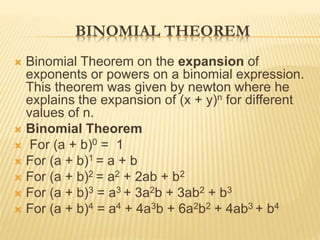
BINOMIAL THEOREM
 Binomial Theorem on the expansion of
exponents or powers on a binomial expression.
This theorem was given by newton where he
explains the expansion of (x + y)n for different
values of n.
 Binomial Theorem
 For (a + b)0 = 1
 For (a + b)1 = a + b
 For (a + b)2 = a2 + 2ab + b2
 For (a + b)3 = a3 + 3a2b + 3ab2 + b3
 For (a + b)4 = a4 + 4a3b + 6a2b2 + 4ab3 + b4
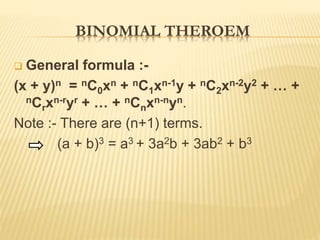
BINOMIAL THEROEM
 General formula :-
(x + y)n = nC0xn + nC1xn-1y + nC2xn-2y2 + … +
nCrxn-ryr + … + nCnxn-nyn.
Note :- There are (n+1) terms.
(a + b)3 = a3 + 3a2b + 3ab2 + b3
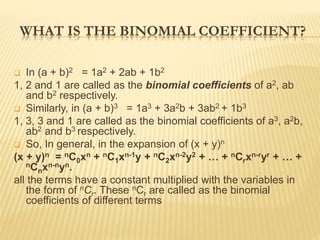
WHAT IS THE BINOMIAL COEFFICIENT?
 In (a + b)2 = 1a2 + 2ab + 1b2
1, 2 and 1 are called as the binomial coefficients of a2, ab
and b2 respectively.
 Similarly, in (a + b)3 = 1a3 + 3a2b + 3ab2 + 1b3
1, 3, 3 and 1 are called as the binomial coefficients of a3, a2b,
ab2 and b3 respectively.
 So, In general, in the expansion of (x + y)n
(x + y)n = nC0xn + nC1xn-1y + nC2xn-2y2 + … + nCrxn-ryr + … +
nCnxn-nyn.
all the terms have a constant multiplied with the variables in
the form of nCr. These nCr are called as the binomial
coefficients of different terms
Ds presentation1

Ds presentation1

  • 1.
    Subject :- DiscreteStructure Submitted To :-Khoubo Patidar Name of Presenter :-Irfan khan PATEL COLLEGE OF SCIENCE & TECHNOLOGY INDORE
  • 2.
  • 3.
    WHAT IS COMBINATORICS? • Combinatorics is a branch of discrete mathematcs which is concerned with the counting problems, arrangement, dearangement, etc. • Counting is the technique are important in computer science and mathematics. • Two main rule in combinatorics:- a) Sum rule b) Product rule
  • 4.
    SUM RULE  Iftwo events are mutually exclusive, that is they cannot be done at the same time ,we must apply sum rule.  m is the number of ways to do task 1.  n is the numer of ways to do task 2.  Task 1 and task 2 are not simultaneously.  s=s1Us2 |s|=|s1|+|s2|
  • 5.
    PRODUCT RULE  Iftwo events are mutually exclusive(that is we do them seprately ),then we apply the product rule  Let us consider two task :  m is the number of way to do task 1.  n is the number of way to do task 2.  If task 1 and task 2 are independent. | A×B|=|A|.|B|
  • 6.
    EXAMPLE OF SUMRULE  In a class there are 26 girls and 15 boys , find the number of ways of students one students as a class moniter. Solution :- By sum rule , the number of ways of selecting one students (either boy and either girls ) = 26+15 = 41
  • 7.
    EXAMPLE OF PRODUCTRULE  If one task but to do it, suppose Raju has 4 shirts and 5 jens the then how many way wearing a dress but Raju which cloth select to wearing a dress.  4 Shirts &  5 jens  Shirts 1 Shirts 2   |T|=|T1|×|T2|  = 4×5  = 20 Jens1 Jens2 Jens3 Jens4 Jens5 Jens1 Jens2 Jens3 Jens4 Jens5
  • 8.
    PERMUTATION  A Permutationof a set of object is an orderd arrengement of the elements .  For example, written as tuples, there are six permutations of the set {1,2,3}, namely: (1,2,3), (1,3,2), (2,1,3), (2,3,1), (3,1,2), and (3,2,1). These are all the possible orderings of this three element set  It follow that :-  Permutation = nPr = n! / ( n - r )!
  • 9.
    EXAMPLE OF PERMUTATION Howmany 4 digit no. are possible with the digit 2,34,5,6,8,9. 1.Digit can not be repeated 2.Digit can be repeated 1.Digit can not be repeated:- 7 × 6 × 5 × 4 = 840 2.Digit can be repeated :- 7 × 7 × 7 × 7 = 2401
  • 10.
    COMBINATION  Combination isset of object of an unordered arrangement or unordered selection of objects  The number of way choosing elements from S: S={1,2,3} =1,2 1,3 2,3  It follow that :- Combination = nCr =
  • 11.
    EXAMPLE  From group12 students ,5 are to be chosen from a competetion.  n=12 total no. of students  r=5 chosen the students  =12×11×10×9×8 = 792  5×4×3×2×1  12C5
  • 12.
    BINOMIAL THEOREM  BinomialTheorem on the expansion of exponents or powers on a binomial expression. This theorem was given by newton where he explains the expansion of (x + y)n for different values of n.  Binomial Theorem  For (a + b)0 = 1  For (a + b)1 = a + b  For (a + b)2 = a2 + 2ab + b2  For (a + b)3 = a3 + 3a2b + 3ab2 + b3  For (a + b)4 = a4 + 4a3b + 6a2b2 + 4ab3 + b4
  • 13.
    BINOMIAL THEROEM  Generalformula :- (x + y)n = nC0xn + nC1xn-1y + nC2xn-2y2 + … + nCrxn-ryr + … + nCnxn-nyn. Note :- There are (n+1) terms. (a + b)3 = a3 + 3a2b + 3ab2 + b3
  • 14.
    WHAT IS THEBINOMIAL COEFFICIENT?  In (a + b)2 = 1a2 + 2ab + 1b2 1, 2 and 1 are called as the binomial coefficients of a2, ab and b2 respectively.  Similarly, in (a + b)3 = 1a3 + 3a2b + 3ab2 + 1b3 1, 3, 3 and 1 are called as the binomial coefficients of a3, a2b, ab2 and b3 respectively.  So, In general, in the expansion of (x + y)n (x + y)n = nC0xn + nC1xn-1y + nC2xn-2y2 + … + nCrxn-ryr + … + nCnxn-nyn. all the terms have a constant multiplied with the variables in the form of nCr. These nCr are called as the binomial coefficients of different terms