Normal Distribution
Dr. Anjali Devi J S
Guest Faculty
School of Chemical Sciences
M G University
What is a Normal Distribution
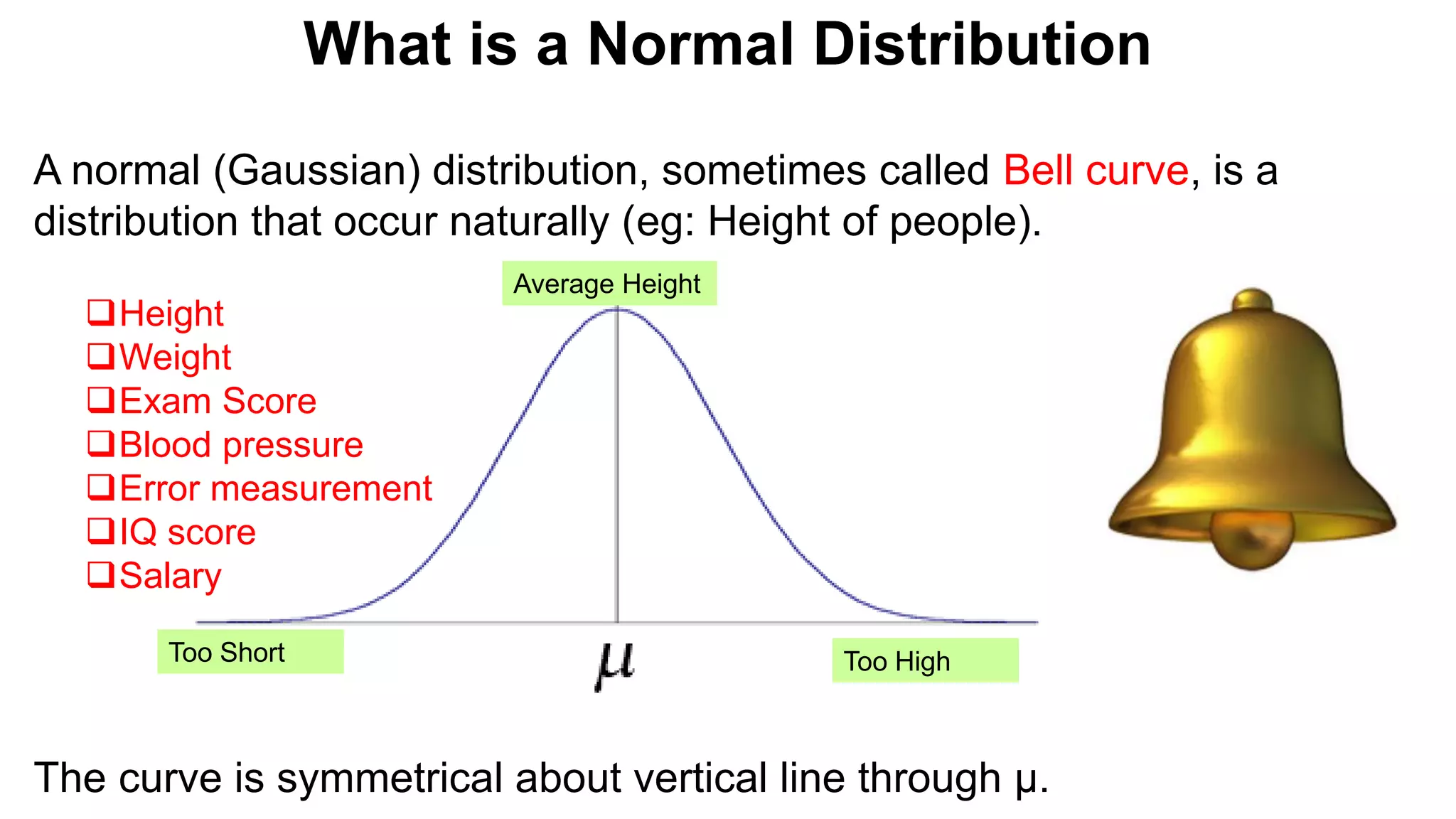
A normal (Gaussian) distribution, sometimes called Bell curve, is a
distribution that occur naturally (eg: Height of people).
The curve is symmetrical about vertical line through µ.
Too Short Too High
Average Height
Height
Weight
Exam Score
Blood pressure
Error measurement
IQ score
Salary
Normal Distribution Function
The function defined by
𝑛 𝑥 =
1
2𝜋
𝑒−
1
2𝑥2
is called normal density function.
Its integral
𝑁 𝑥 =
1
2𝜋 −∞
+∞
𝑒−
1
2
𝑦2
𝑑𝑦
is the normal distribution function.
Notation
If a random variable X is normally distributed (i.e., its probability function
uses a normal distribution), then we write:
𝑋~𝑁(𝜇, 𝜎2)
The random variable X
Is distributed
Using a Normal distribution with mean µ
and variance 𝜎2
Example Suppose X is a normal random variable with 𝜇=32 and 𝜎2=6,
then notation:
𝑋~𝑁(32,6)
Properties
 The mean, mode, and median are all equal.
 The curve is symmetric at the centre (i.e., around the mean µ).
 Exactly half of the values are to the left of center and exactly half the
values are to the right.
 The total area under the curve is 1.
−∞
+∞
𝑁 𝑥 𝑑𝑥 = 1
Standard Normal Model
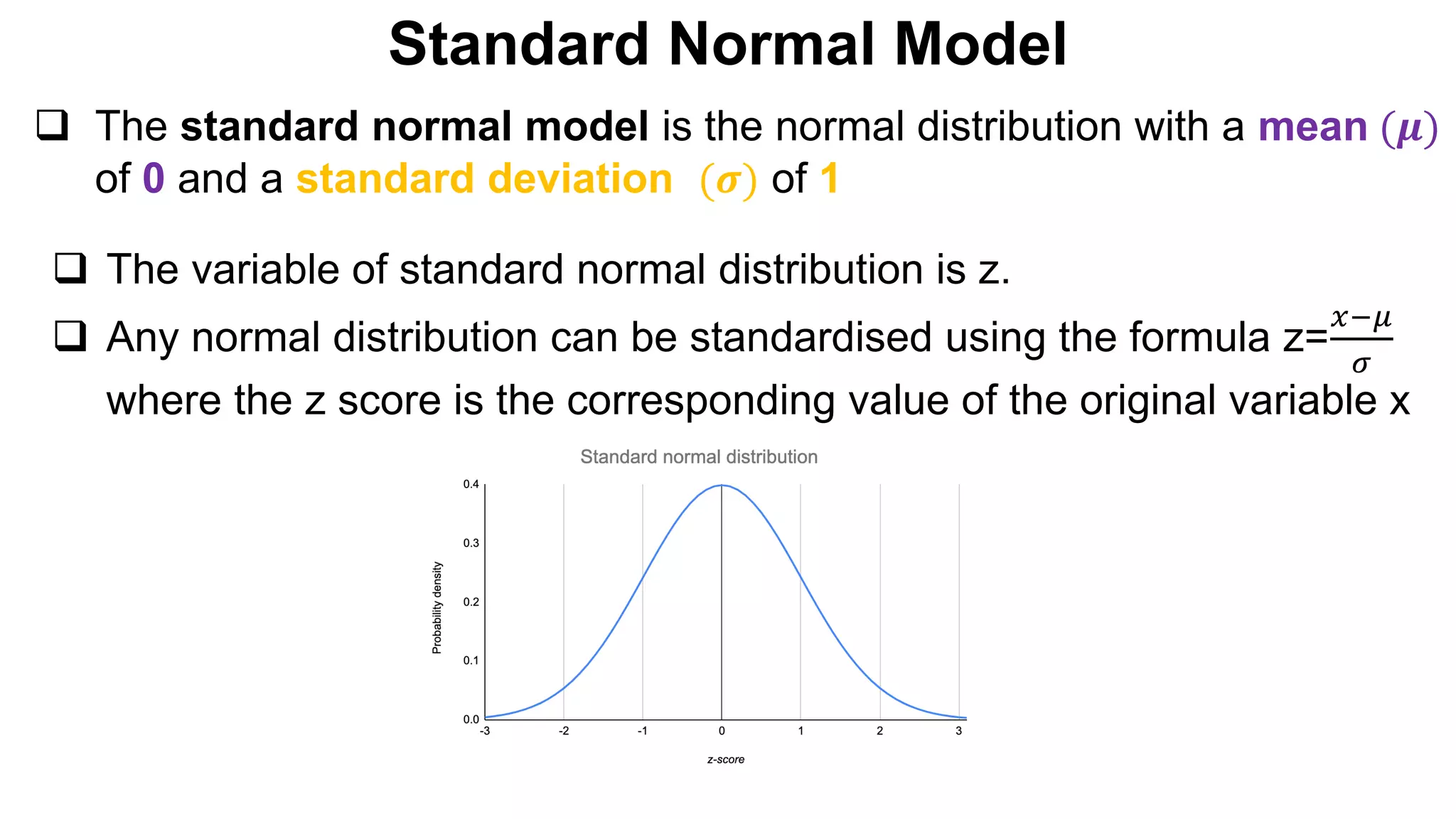
 The standard normal model is the normal distribution with a mean (𝝁)
of 0 and a standard deviation (𝝈) of 1
 The variable of standard normal distribution is z.
 Any normal distribution can be standardised using the formula z=
𝑥−𝜇
𝜎
where the z score is the corresponding value of the original variable x
Standard Normal Model
Distance from mean in
terms of standard
deviation in one direction
0-1 1-2 2-3 Over 3
Proportion of area in the
above range
34% 14% 2% Negligible
Question
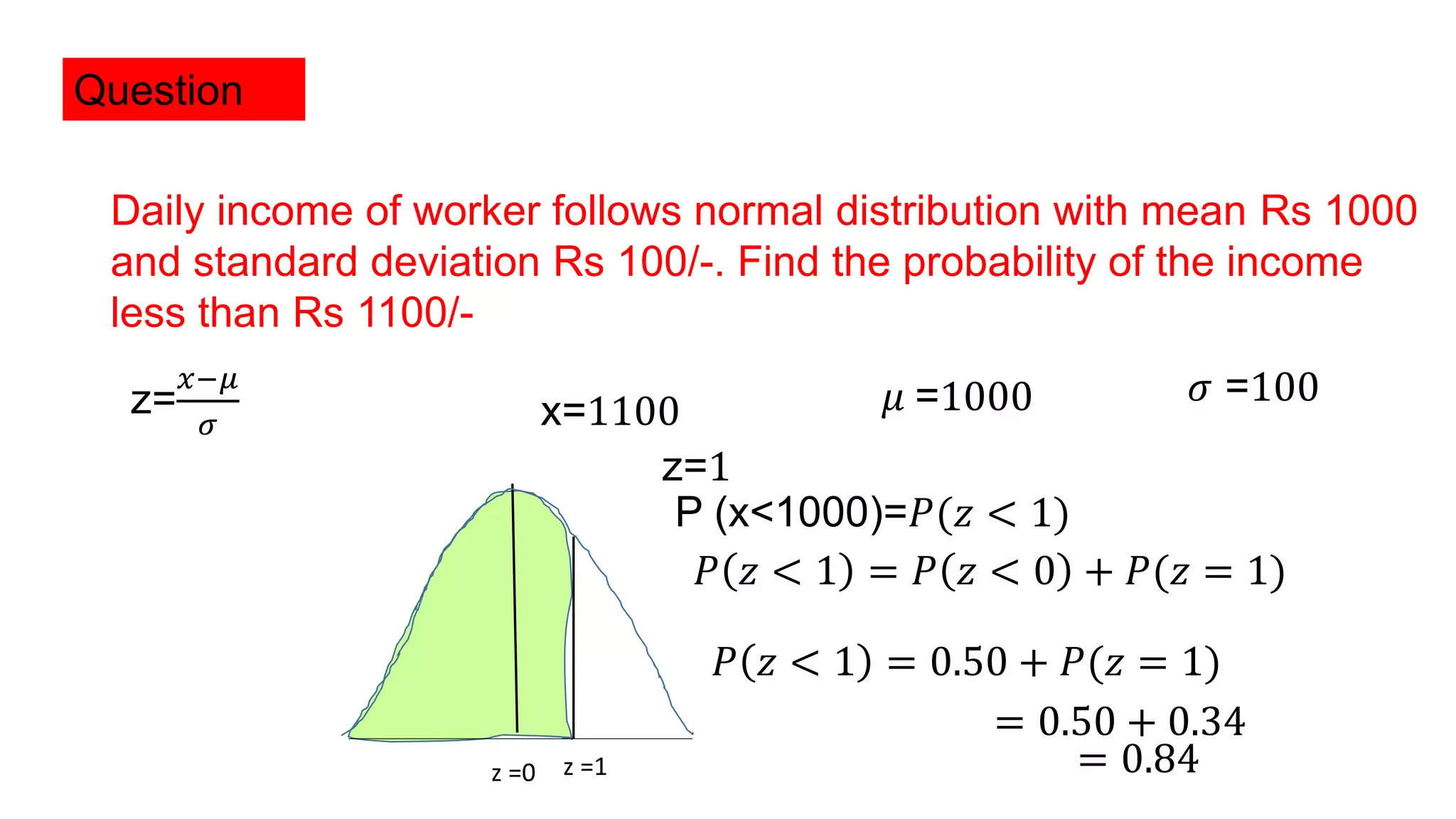
Daily income of worker follows normal distribution with mean Rs 1000
and standard deviation Rs 100/-. Find the probability of the income
less than Rs 1100/-
z=
𝑥−𝜇
𝜎 x=1100 𝜇 =1000 𝜎 =100
z=1
P (x<1000)=𝑃(𝑧 < 1)
z =0 z =1
𝑃 𝑧 < 1 = 𝑃 𝑧 < 0 + 𝑃(𝑧 = 1)
𝑃 𝑧 < 1 = 0.50 + 𝑃(𝑧 = 1)
= 0.50 + 0.34
= 0.84
Question
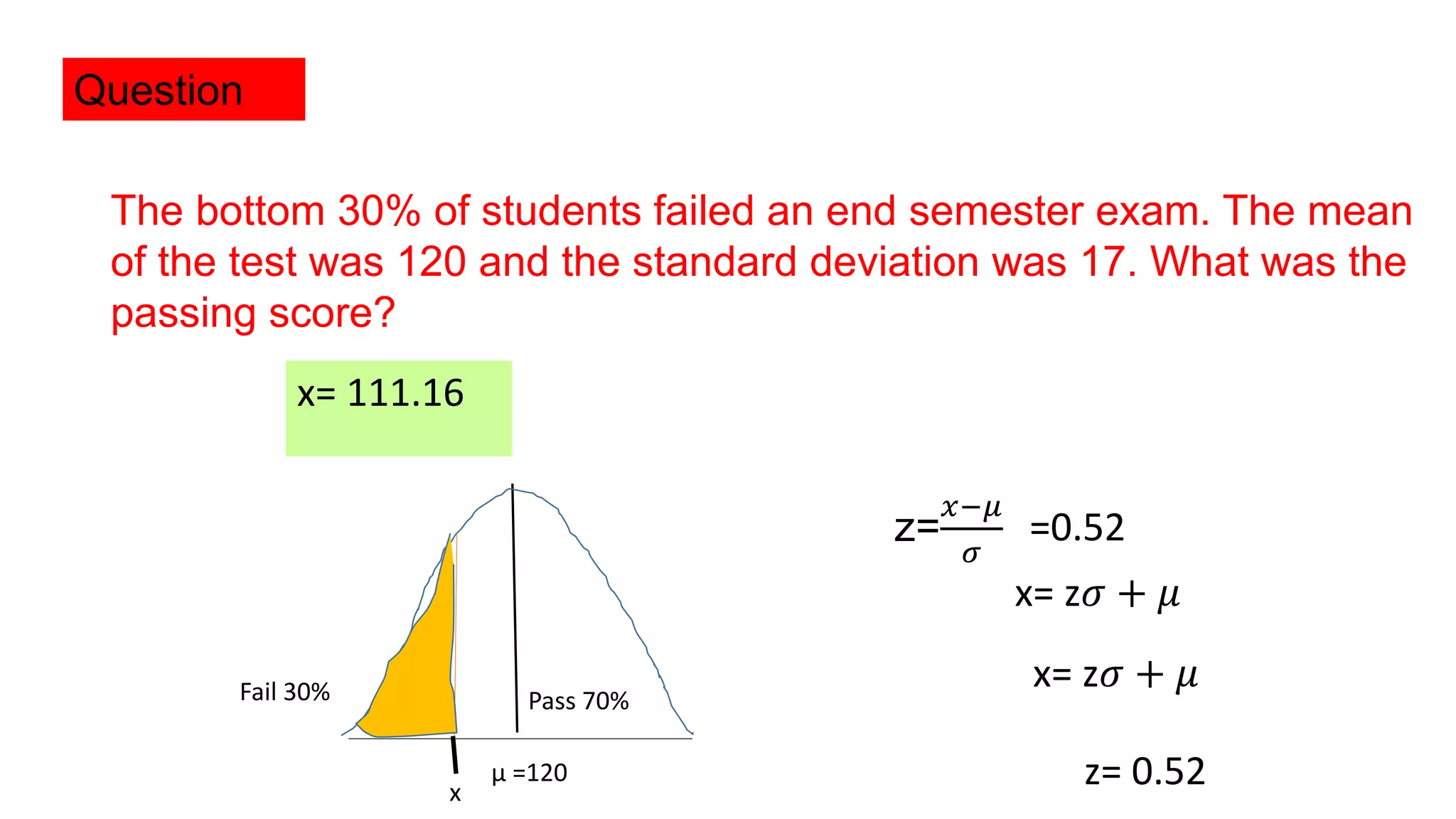
The bottom 30% of students failed an end semester exam. The mean
of the test was 120 and the standard deviation was 17. What was the
passing score?
µ =120
x
z=
𝑥−𝜇
𝜎
x= z𝜎 + 𝜇
=0.52
Fail 30% Pass 70%
x= z𝜎 + 𝜇
z= 0.52
x= 111.16

Normal distribution

  • 1.
    Normal Distribution Dr. AnjaliDevi J S Guest Faculty School of Chemical Sciences M G University
  • 2.
    What is aNormal Distribution A normal (Gaussian) distribution, sometimes called Bell curve, is a distribution that occur naturally (eg: Height of people). The curve is symmetrical about vertical line through µ. Too Short Too High Average Height Height Weight Exam Score Blood pressure Error measurement IQ score Salary
  • 3.
    Normal Distribution Function Thefunction defined by 𝑛 𝑥 = 1 2𝜋 𝑒− 1 2𝑥2 is called normal density function. Its integral 𝑁 𝑥 = 1 2𝜋 −∞ +∞ 𝑒− 1 2 𝑦2 𝑑𝑦 is the normal distribution function.
  • 4.
    Notation If a randomvariable X is normally distributed (i.e., its probability function uses a normal distribution), then we write: 𝑋~𝑁(𝜇, 𝜎2) The random variable X Is distributed Using a Normal distribution with mean µ and variance 𝜎2 Example Suppose X is a normal random variable with 𝜇=32 and 𝜎2=6, then notation: 𝑋~𝑁(32,6)
  • 5.
    Properties  The mean,mode, and median are all equal.  The curve is symmetric at the centre (i.e., around the mean µ).  Exactly half of the values are to the left of center and exactly half the values are to the right.  The total area under the curve is 1. −∞ +∞ 𝑁 𝑥 𝑑𝑥 = 1
  • 6.
    Standard Normal Model The standard normal model is the normal distribution with a mean (𝝁) of 0 and a standard deviation (𝝈) of 1  The variable of standard normal distribution is z.  Any normal distribution can be standardised using the formula z= 𝑥−𝜇 𝜎 where the z score is the corresponding value of the original variable x
  • 7.
    Standard Normal Model Distancefrom mean in terms of standard deviation in one direction 0-1 1-2 2-3 Over 3 Proportion of area in the above range 34% 14% 2% Negligible
  • 8.
    Question Daily income ofworker follows normal distribution with mean Rs 1000 and standard deviation Rs 100/-. Find the probability of the income less than Rs 1100/- z= 𝑥−𝜇 𝜎 x=1100 𝜇 =1000 𝜎 =100 z=1 P (x<1000)=𝑃(𝑧 < 1) z =0 z =1 𝑃 𝑧 < 1 = 𝑃 𝑧 < 0 + 𝑃(𝑧 = 1) 𝑃 𝑧 < 1 = 0.50 + 𝑃(𝑧 = 1) = 0.50 + 0.34 = 0.84
  • 9.
    Question The bottom 30%of students failed an end semester exam. The mean of the test was 120 and the standard deviation was 17. What was the passing score? µ =120 x z= 𝑥−𝜇 𝜎 x= z𝜎 + 𝜇 =0.52 Fail 30% Pass 70% x= z𝜎 + 𝜇 z= 0.52 x= 111.16