Color Schemes
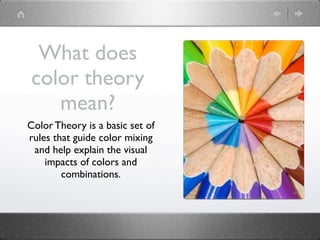
What does
color theory
   mean?
Color Theory is a basic set of
rules that guide color mixing
 and help explain the visual
    impacts of colors and
        combinations.
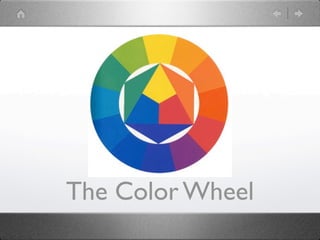
The Color Wheel
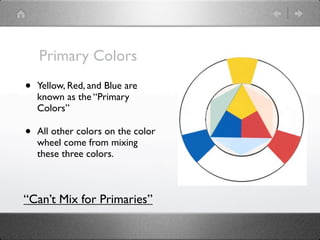
Primary Colors
•   Yellow, Red, and Blue are
    known as the “Primary
    Colors”

•   All other colors on the color
    wheel come from mixing
    these three colors.


“Can’t Mix for Primaries”
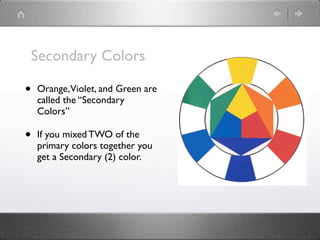
Secondary Colors

•   Orange,Violet, and Green are
    called the “Secondary
    Colors”

•   If you mixed TWO of the
    primary colors together you
    get a Secondary (2) color.
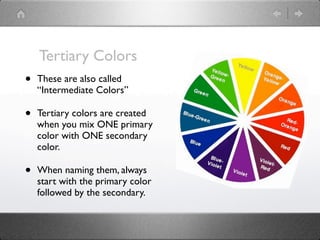
Tertiary Colors
•   These are also called
    “Intermediate Colors”

•   Tertiary colors are created
    when you mix ONE primary
    color with ONE secondary
    color.

•   When naming them, always
    start with the primary color
    followed by the secondary.
Now that we know all of the colors on our
color wheel. . . Color Theory now helps us
organize them into different combinations/
                  schemes.
Complementary Color Scheme
These are colors that are directly across from each other
on the color wheel. The strong contrast between the two
colors makes for a successful combination.
 Blue & Orange        Yellow & Violet      Red & Green


             “Complementary in Every Way”
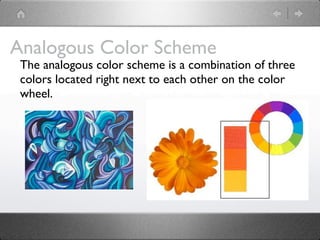
Analogous Color Scheme
 The analogous color scheme is a combination of three
 colors located right next to each other on the color
 wheel.
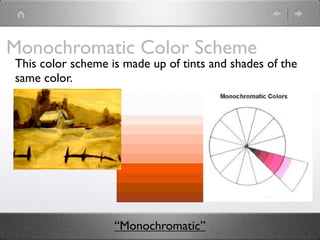
Monochromatic Color Scheme
This color scheme is made up of tints and shades of the
same color.


                   “Monochromatic”

Color schemes ppt

  • 1.
  • 2.
    What does color theory mean? Color Theory is a basic set of rules that guide color mixing and help explain the visual impacts of colors and combinations.
  • 3.
  • 4.
    Primary Colors • Yellow, Red, and Blue are known as the “Primary Colors” • All other colors on the color wheel come from mixing these three colors. “Can’t Mix for Primaries”
  • 5.
    Secondary Colors • Orange,Violet, and Green are called the “Secondary Colors” • If you mixed TWO of the primary colors together you get a Secondary (2) color.
  • 6.
    Tertiary Colors • These are also called “Intermediate Colors” • Tertiary colors are created when you mix ONE primary color with ONE secondary color. • When naming them, always start with the primary color followed by the secondary.
  • 7.
    Now that weknow all of the colors on our color wheel. . . Color Theory now helps us organize them into different combinations/ schemes.
  • 8.
    Complementary Color Scheme Theseare colors that are directly across from each other on the color wheel. The strong contrast between the two colors makes for a successful combination. Blue & Orange Yellow & Violet Red & Green “Complementary in Every Way”
  • 9.
    Analogous Color Scheme The analogous color scheme is a combination of three colors located right next to each other on the color wheel.
  • 10.
    Monochromatic Color Scheme Thiscolor scheme is made up of tints and shades of the same color. “Monochromatic”

Editor's Notes