Seminar on
“Color Model And Color Image
Processing"
Color fundamental
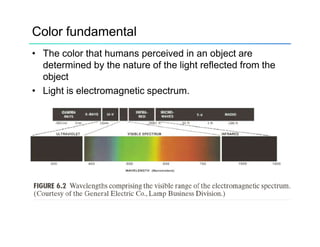
• The color that humans perceived in an object are
determined by the nature of the light reflected from the
object
• Light is electromagnetic spectrum.
Visible light and Color
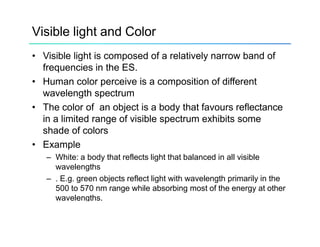
• Visible light is composed of a relatively narrow band of
frequencies in the ES.
• Human color perceive is a composition of different
wavelength spectrum
• The color of an object is a body that favours reflectance
in a limited range of visible spectrum exhibits some
shade of colors
• Example
– White: a body that reflects light that balanced in all visible
wavelengths
– . E.g. green objects reflect light with wavelength primarily in the
500 to 570 nm range while absorbing most of the energy at other
wavelengths.
Characterization of light
• If the light achromatic (void of color), if its only attribute is
intensity. Gray level refers to a scalar measure of
intensity that ranges from black, to grays, and finally to
white
• Chromatic light spans the ES from about 400 to 700 nm
• Three basic quantities are used to describe the quality of
a chromatic light source
• Radiance: total amount of energy flows from the light
source
• Luminance: amount of energy perceive from light source
• Brightness: a subjective descriptor that is practically
impossible to measure
Color sensors of eyes: cones
• Cones can be divided into three principle sensing
categories, roughly red (65%), green (33 %), blue (2%)
• Colors are seen as variable combination of the so-called
primary colors Red (R), Green (G), and blue (B).
Primary colors and secondary colors
• CIE (Commission Internationale de
l’Eclariage) standard for primary
color
– Red: 700 nm
– Green: 546.1 nm
– Blue: 435.8 nm
• Primary color can be added to
produce secondary colors
– Primary colors can not produce all
colors
• Pigments (colorants)
–Define the primary colors to
be the absorbing one and
reflect other two
Characterization
• Brightness, hue, and saturation
• Brightness: achromatic notion of intensity
• Hue: attribute associated with dominating wavelength in a mixture of
light waves, i.e., the dominant color perceived by observer
• Saturation: refers to the relative purity or the amount white light
mixed with a hue.
• Hue and saturation together are called chromaticity, so a color can
be characterized by its brightness and chromaticity
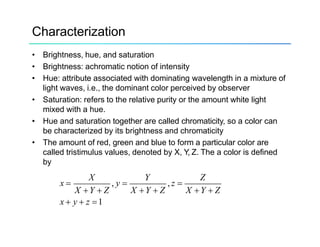
• The amount of red, green and blue to form a particular color are
called tristimulus values, denoted by X, Y, Z. The a color is defined
by
X Y
, y  , z 
Z
x 
X Y  Z X Y  Z X Y  Z
x  y  z 1
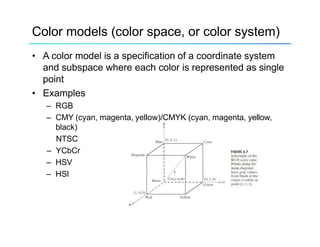
Color models (color space, or color system)
• A color model is a specification of a coordinate system
and subspace where each color is represented as single
point
• Examples
– RGB
– CMY (cyan, magenta, yellow)/CMYK (cyan, magenta, yellow,
black)
NTSC
– YCbCr
– HSV
– HSI
RGB Color models
• (R, G, B): all values of R, G, B are between 0 and 1.
• With digital representation, for a fixed length of bits each
color element. The total number of bits is called color
depth, or pixel depth. For example, 24-bit RGB color (r,
g, b), 8-bits for each color. The 8-bit binary number r
represents the value of r/256 in [0,1]
Displaying Colors in RGB model
CMY and CMYK model
• (C, M, Y)  C  1 R
M   1  G
     

 Y 
 
1
 
B

• CMYK: (C, M, Y
, B), where B is a fixed black color. This
basically for printing purpose, where black is usually the
dominating color. When printing black, using B rather
than using (C, M, B) = (1, 1, 1)
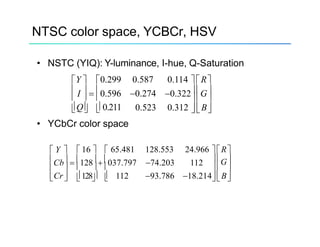
NTSC color space, YCBCr, HSV
• NSTC (YIQ): Y-luminance, I-hue, Q-Saturation
0.299
 I   0.596 0.322 G
Y 
• YCbCr color space
  
Q 0.211
0.587 0.114  R
0.274   
0.523 0.312 
 
B

 16   65.481
 Y 
 G
Cb  128  037.797
128.553 24.966  R
74.203 112
       
93.786

Cr
 128 112
 18.214
 
B

HSI
• HSI color space: H – hue, S-saturation, I-intensity
, B  G
H 


360  B  G
1
[(R G)  (R  B)]
 cos1
{ 2 }
[(R G)2
 (R  B)(G  B)]1/ 2
3
S 1 [min(R,G, B)]
(R  G  B)
I 
1
(R  G  B)
3
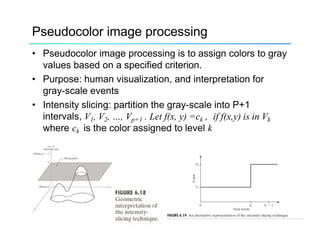
Pseudocolor image processing
• Pseudocolor image processing is to assign colors to gray
values based on a specified criterion.
• Purpose: human visualization, and interpretation for
gray-scale events
• Intensity slicing: partition the gray-scale into P+1
intervals, V1, V2, …, Vp+1 . Let f(x, y) =ck , if f(x,y) is in Vk
where ck is the color assigned to level k
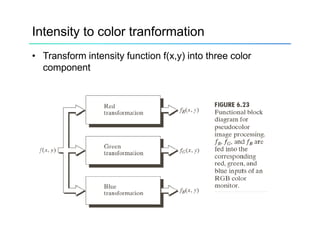
Intensity to color tranformation
• Transform intensity function f(x,y) into three color
component
Thank You

Colour%20Model%20new.pptx

  • 1.
    Seminar on “Color ModelAnd Color Image Processing"
  • 2.
    Color fundamental • Thecolor that humans perceived in an object are determined by the nature of the light reflected from the object • Light is electromagnetic spectrum.
  • 3.
    Visible light andColor • Visible light is composed of a relatively narrow band of frequencies in the ES. • Human color perceive is a composition of different wavelength spectrum • The color of an object is a body that favours reflectance in a limited range of visible spectrum exhibits some shade of colors • Example – White: a body that reflects light that balanced in all visible wavelengths – . E.g. green objects reflect light with wavelength primarily in the 500 to 570 nm range while absorbing most of the energy at other wavelengths.
  • 4.
    Characterization of light •If the light achromatic (void of color), if its only attribute is intensity. Gray level refers to a scalar measure of intensity that ranges from black, to grays, and finally to white • Chromatic light spans the ES from about 400 to 700 nm • Three basic quantities are used to describe the quality of a chromatic light source • Radiance: total amount of energy flows from the light source • Luminance: amount of energy perceive from light source • Brightness: a subjective descriptor that is practically impossible to measure
  • 5.
    Color sensors ofeyes: cones • Cones can be divided into three principle sensing categories, roughly red (65%), green (33 %), blue (2%) • Colors are seen as variable combination of the so-called primary colors Red (R), Green (G), and blue (B).
  • 6.
    Primary colors andsecondary colors • CIE (Commission Internationale de l’Eclariage) standard for primary color – Red: 700 nm – Green: 546.1 nm – Blue: 435.8 nm • Primary color can be added to produce secondary colors – Primary colors can not produce all colors • Pigments (colorants) –Define the primary colors to be the absorbing one and reflect other two
  • 7.
    Characterization • Brightness, hue,and saturation • Brightness: achromatic notion of intensity • Hue: attribute associated with dominating wavelength in a mixture of light waves, i.e., the dominant color perceived by observer • Saturation: refers to the relative purity or the amount white light mixed with a hue. • Hue and saturation together are called chromaticity, so a color can be characterized by its brightness and chromaticity • The amount of red, green and blue to form a particular color are called tristimulus values, denoted by X, Y, Z. The a color is defined by X Y , y  , z  Z x  X Y  Z X Y  Z X Y  Z x  y  z 1
  • 8.
    Color models (colorspace, or color system) • A color model is a specification of a coordinate system and subspace where each color is represented as single point • Examples – RGB – CMY (cyan, magenta, yellow)/CMYK (cyan, magenta, yellow, black) NTSC – YCbCr – HSV – HSI
  • 9.
    RGB Color models •(R, G, B): all values of R, G, B are between 0 and 1. • With digital representation, for a fixed length of bits each color element. The total number of bits is called color depth, or pixel depth. For example, 24-bit RGB color (r, g, b), 8-bits for each color. The 8-bit binary number r represents the value of r/256 in [0,1]
  • 10.
  • 12.
    CMY and CMYKmodel • (C, M, Y)  C  1 R M   1  G         Y    1   B  • CMYK: (C, M, Y , B), where B is a fixed black color. This basically for printing purpose, where black is usually the dominating color. When printing black, using B rather than using (C, M, B) = (1, 1, 1)
  • 13.
    NTSC color space,YCBCr, HSV • NSTC (YIQ): Y-luminance, I-hue, Q-Saturation 0.299  I   0.596 0.322 G Y  • YCbCr color space    Q 0.211 0.587 0.114  R 0.274    0.523 0.312    B   16   65.481  Y   G Cb  128  037.797 128.553 24.966  R 74.203 112         93.786  Cr  128 112  18.214   B 
  • 14.
    HSI • HSI colorspace: H – hue, S-saturation, I-intensity , B  G H    360  B  G 1 [(R G)  (R  B)]  cos1 { 2 } [(R G)2  (R  B)(G  B)]1/ 2 3 S 1 [min(R,G, B)] (R  G  B) I  1 (R  G  B) 3
  • 15.
    Pseudocolor image processing •Pseudocolor image processing is to assign colors to gray values based on a specified criterion. • Purpose: human visualization, and interpretation for gray-scale events • Intensity slicing: partition the gray-scale into P+1 intervals, V1, V2, …, Vp+1 . Let f(x, y) =ck , if f(x,y) is in Vk where ck is the color assigned to level k
  • 16.
    Intensity to colortranformation • Transform intensity function f(x,y) into three color component
  • 18.