COLLOIDAL
SOLUTIONS
SAIM HASAN 9(C)
WHAT ARE COLLOIDAL SOLUTIONS?
◦ A colloid is a kind of solution in which the size of solute
particles is intermediate between those in true solutions and
those in suspensions. The size of solute particles in a colloid
is bigger than that of true solution but smaller than those of
suspension. Though colloids appear to be homogenous to us
but, they are found to be heterogenous when observed
through a high-power microscope. So, a colloid is not a true
solution.
WHY COLLOIDAL SOLUTIONS ARE
HETROGENEOUS?
◦ Colloidal solutions can be considered as a heterogeneous system consisting of the
following three essential components:
(i) A dispersed phase: It is also known as discontinuous or inner phase. It consists of
discrete particles significantly larger than ordinary molecules and in this small particles of
solute is diffused in solvent.
(ii) A dispersion medium: It is the medium in which dispersed phase is present. This
consists of continuously interlinked molecules.
(iii) A stabilising agent: This is a substance which tends to keep the colloidal particles
apart. Some colloids are self stabilizers.
◦ (iv) Colloids are unlike solutions because their dispersed particles are much larger than
those of a solution. The dispersed particles of a colloid cannot be separated by filtration,
but they scatter light, a phenomenon called the Tyndall effect.
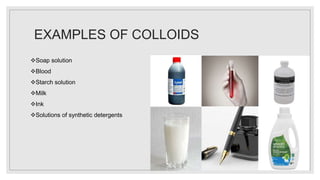
EXAMPLES OF COLLOIDS
Soap solution
Blood
Starch solution
Milk
Ink
Solutions of synthetic detergents
PROPERTIES OF COLLOIDS :
◦ The important characteristic properties of colloids (or colloidal solutions) are as follows:-
1.A colloid or colloidal solution appears to be homogenous but actually it is
heterogenous.
2.The size of particles in a colloid is bigger than those in a true solution but smaller than
those in a suspension. It is between 1 nm and 100 nm in diameter.
3.The particles of most of the colloids cannot be seen even with a microscope.
4.The particles of a colloid can pass through a filter paper. So, a colloid cannot be
separated by filtration.
5.The colloids are quite stable. The particles of a colloid do not separate out on keeping.
6.A colloid scatters a beam of light passing through it because its particles are fairly
large.
CLASSIFICATION OF COLLOIDS
◦ Colloids do not involve only solids and liquids, they may also involve gases. So, colloids
are classified according to the physical state of dispersed phase (solute) and the
dispersion medium (solvent). Most of the colloids can be classified into the following seven
groups.
• Sol
• Solid sol
• Aerosol
• Emulsion
• Foam
• Solid foam
• Gel
Continuation…
• Sol – Sol is a colloid in which tiny solid particles are dispersed in a liquid medium. The examples of sols are –
ink, soap solution, starch solution and most paints
• Solid sol – Solid sol is a colloid in which solid particles are dispersed in a solid medium. The example of a
solid sol is – colored gemstones (like ruby).
• Aerosol –An aerosol is a colloid in which a solid or liquid is dispersed in a gas(including air). The examples of
aerosols in which a solid is dispersed in a gas are – smoke (which soot in air) and automobile exhausts. The
examples of aerosols in which a liquid is dispersed in a gas are – hairspray, fog, mist and clouds.
• Emulsion – An emulsion is a colloid in which minute droplets of one liquid are dispersed in another liquid
which is not miscible with it. Examples of emulsions are – milk, butter and face cream.
• Foam – The foam is a colloid in which a gas is dispersed in a liquid medium. The examples of foam are – fire
extinguisher foam, soap bubbles, shaving cream and beer foam.
• Solid foam – The solid foam is a colloid in which a gas is dispersed in a solid medium. The examples of solid
foam are – insulating foam, foam rubber, sponge and bread.
• Gel – The gel is a semi solid colloid in which there is a continuous network of solid particles dispersed in a
liquid. The examples of gel are – jellies, gelatin and hair gel.
This Photo by Unknown Author is licensed under CC BY

Colloidal solutions

  • 1.
  • 2.
    WHAT ARE COLLOIDALSOLUTIONS? ◦ A colloid is a kind of solution in which the size of solute particles is intermediate between those in true solutions and those in suspensions. The size of solute particles in a colloid is bigger than that of true solution but smaller than those of suspension. Though colloids appear to be homogenous to us but, they are found to be heterogenous when observed through a high-power microscope. So, a colloid is not a true solution.
  • 3.
    WHY COLLOIDAL SOLUTIONSARE HETROGENEOUS? ◦ Colloidal solutions can be considered as a heterogeneous system consisting of the following three essential components: (i) A dispersed phase: It is also known as discontinuous or inner phase. It consists of discrete particles significantly larger than ordinary molecules and in this small particles of solute is diffused in solvent. (ii) A dispersion medium: It is the medium in which dispersed phase is present. This consists of continuously interlinked molecules. (iii) A stabilising agent: This is a substance which tends to keep the colloidal particles apart. Some colloids are self stabilizers. ◦ (iv) Colloids are unlike solutions because their dispersed particles are much larger than those of a solution. The dispersed particles of a colloid cannot be separated by filtration, but they scatter light, a phenomenon called the Tyndall effect.
  • 4.
    EXAMPLES OF COLLOIDS Soapsolution Blood Starch solution Milk Ink Solutions of synthetic detergents
  • 5.
    PROPERTIES OF COLLOIDS: ◦ The important characteristic properties of colloids (or colloidal solutions) are as follows:- 1.A colloid or colloidal solution appears to be homogenous but actually it is heterogenous. 2.The size of particles in a colloid is bigger than those in a true solution but smaller than those in a suspension. It is between 1 nm and 100 nm in diameter. 3.The particles of most of the colloids cannot be seen even with a microscope. 4.The particles of a colloid can pass through a filter paper. So, a colloid cannot be separated by filtration. 5.The colloids are quite stable. The particles of a colloid do not separate out on keeping. 6.A colloid scatters a beam of light passing through it because its particles are fairly large.
  • 6.
    CLASSIFICATION OF COLLOIDS ◦Colloids do not involve only solids and liquids, they may also involve gases. So, colloids are classified according to the physical state of dispersed phase (solute) and the dispersion medium (solvent). Most of the colloids can be classified into the following seven groups. • Sol • Solid sol • Aerosol • Emulsion • Foam • Solid foam • Gel
  • 7.
    Continuation… • Sol –Sol is a colloid in which tiny solid particles are dispersed in a liquid medium. The examples of sols are – ink, soap solution, starch solution and most paints • Solid sol – Solid sol is a colloid in which solid particles are dispersed in a solid medium. The example of a solid sol is – colored gemstones (like ruby). • Aerosol –An aerosol is a colloid in which a solid or liquid is dispersed in a gas(including air). The examples of aerosols in which a solid is dispersed in a gas are – smoke (which soot in air) and automobile exhausts. The examples of aerosols in which a liquid is dispersed in a gas are – hairspray, fog, mist and clouds. • Emulsion – An emulsion is a colloid in which minute droplets of one liquid are dispersed in another liquid which is not miscible with it. Examples of emulsions are – milk, butter and face cream. • Foam – The foam is a colloid in which a gas is dispersed in a liquid medium. The examples of foam are – fire extinguisher foam, soap bubbles, shaving cream and beer foam. • Solid foam – The solid foam is a colloid in which a gas is dispersed in a solid medium. The examples of solid foam are – insulating foam, foam rubber, sponge and bread. • Gel – The gel is a semi solid colloid in which there is a continuous network of solid particles dispersed in a liquid. The examples of gel are – jellies, gelatin and hair gel.
  • 8.
    This Photo byUnknown Author is licensed under CC BY